
Life, 1918-01-31 · page 13 of 40
Life — January 31, 1918 — page 13: what you’re looking at
What you’re looking at
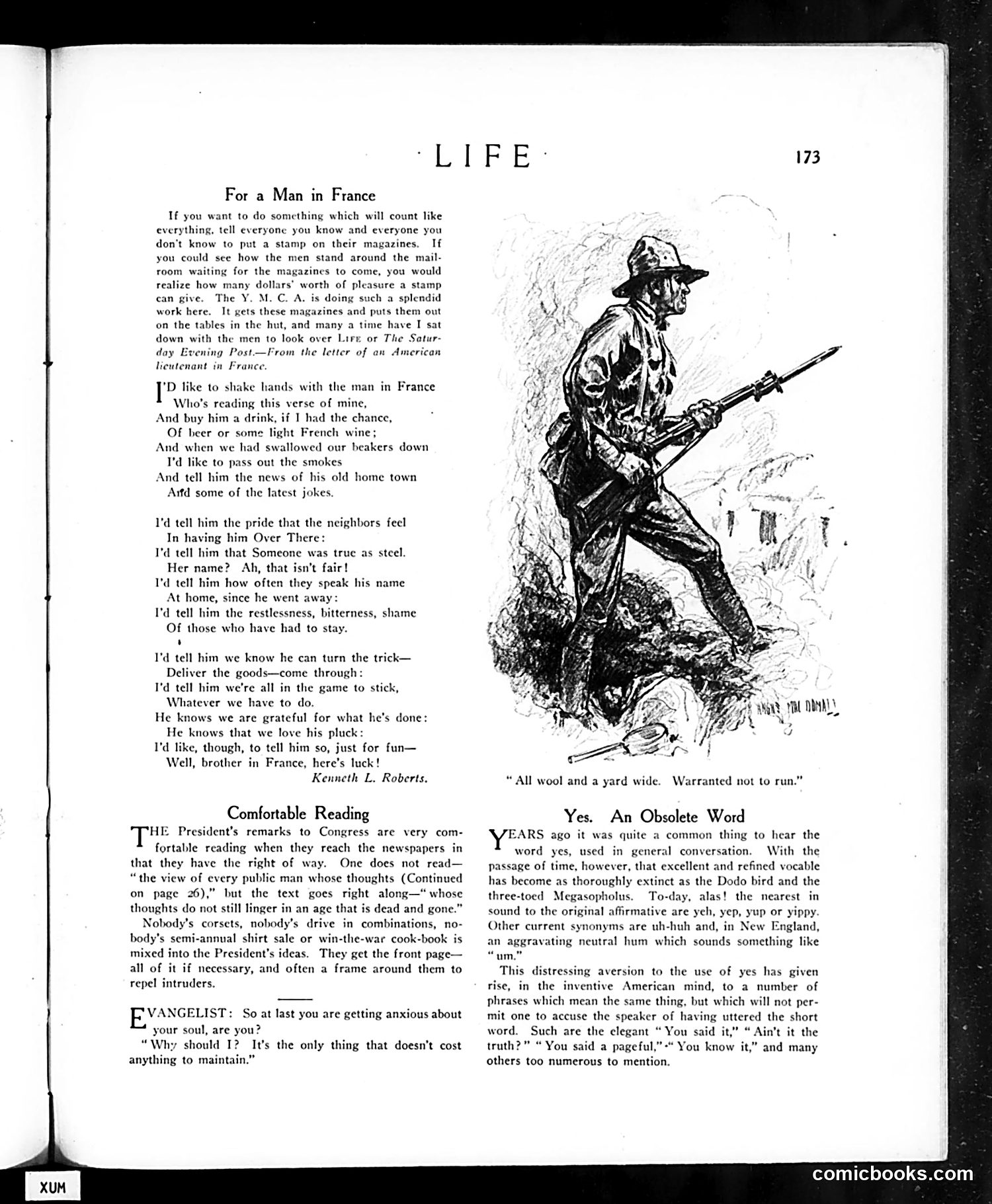
This page contains a poem titled "For a Man in France" by Kenneth L. Roberts, accompanied by an illustration of a WWI soldier in combat gear on rocky terrain with a rifle. The poem expresses the desire to communicate with American soldiers fighting in France during World War I, describing what the speaker would tell such a soldier: news from home, pride in his service, reassurance about a sweetheart's faithfulness, and encouragement about victory. The accompanying illustration depicts a typical WWI American soldier in period-accurate uniform and equipment, reinforcing the patriotic message of the poem. Below are two unrelated short pieces: "Comfortable Reading" (about presidential remarks to Congress) and "Yes. An Obsolete Word" (discussing the declining use of "yes" in American conversation).
📄 Transcribed text from this page (OCR, searchable)
Machine-transcribed from the original scan — historical spelling and the odd misread are preserved.
‘LIFE? For a Man in France If you want to do something which will count like everything, tell everyone you know and everyone you don't know to put a stamp on their magazines. If you could see how the men stand around the mail- room waiting for the magazines to come, you would realize how many dollars’ worth of pleasure a stamp can give. The Y. M. C. A. is doing such a splendid work here. It gets these magazines and puts them out on the tables in the hut, and many a time have I’ sat down with the men to look over Lire or The Satur- day Evening Post—From the letter of an American lieutenant in France. JP Like to shake hands with the man in France Who's reading this verse of mine, And buy him a drink, if I had the chance, Of beer or some light French wine; And when we had swallowed our beakers down I'd like to pass out the smokes And tell him the news of his old home town Aitd some of the latest jol I'd tell him the pride that the neighbors feel In having him Over Ther: I'd tell him that Someone was true as steel. Her name? Ah, that isn’t fair! I'd tell him how often they speak his name At home, since he went away: I'd tell him the restlessness, bitterness, shame Of those who have had to stay. ‘ I'd tell him we know he can turn the trick— Deliver the goods—come through: I'd tell him we're all in the game to stick, Whatever we have to do. He knows we are grateful for what he's done: He knows that we love his pluck: I'd like, though, to tell him so, just for fun— Well, brother in France, here’s luck! Kenneth L. Roberts, Comfortable Reading HE President’s remarks to Congress are very com- fortable reading when they reach the newspapers in that they have the right of way. One does not read— “the view of every public man whose thoughts (Continued on page 26),” but the text goes right along—* whose thoughts do not still linger in an age that is dead and gone.” Nobody's corsets, nobody’s drive in combinations, no- body's semi-annual shirt sale or win-the-war cook-book is mixed into the President's ideas. They get the front page— all of it if necessary, and often a frame around them to repel intruders. EY NGELIST: So at last you are getting anxious about your soul, are you? “Why should I? It’s the only thing that doesn’t cost anything to maintain.” “ All wool and a yard wide. Warranted not to run.” Yes. An Obsolete Word Y® RS ago it was quite a common thing to hear the word yes, used in general conversation. With the passage of time, however, that excellent and refined vocable has become as thoroughly extinct as the Dodo bird and the three-toed Megasopholus. To-day, alas! the nearest in sound to the original affirmative are yeh, yep, yup or yippy. Other current synonyms are uh-huh and, in New England, an aggravating neutral hum which sounds something like "om" This distressing aversion to the use of yes has given rise, in the inventive American mind, to a number of phrases which mean the same thing, but which will not per- mit one to accuse the speaker of having uttered the short word. Such are the elegant “ You said it,” “ Ain't it the truth?” “ You said a pageful,”-“ You know it,” and many others too numerous to mention. comicbooks.com