
Life, 1918-01-31 · page 22 of 40
Life — January 31, 1918 — page 22: what you’re looking at
What you’re looking at
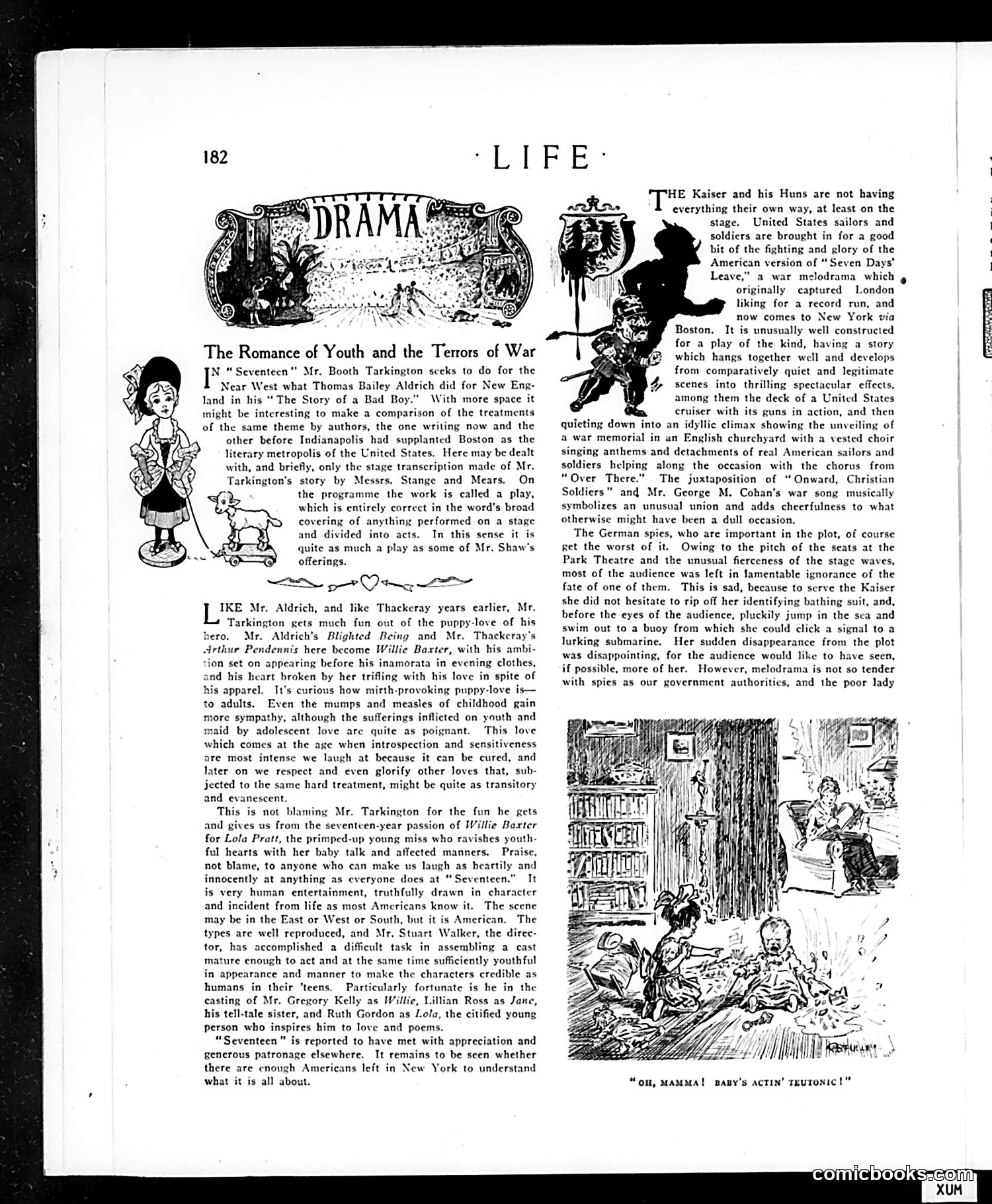
This page reviews two Broadway plays. The main review covers **"Seventeen,"** adapted from Booth Tarkington's novel about teenage romance—specifically the protagonist Willie Baxter's puppy-love infatuation with the affected young woman Lola Pratt. The critic praises how the play humorously captures adolescent sentimentality, comparing it to earlier literary treatments by Thackeray and Aldrich. The review notes the production's success in casting age-appropriate actors and achieving authentic American characterization. A secondary review discusses **"Seven Days' Leave,"** a war melodrama featuring American soldiers and sailors fighting Germans. The critic observes that unlike the Kaiser's forces dominating the stage elsewhere, this play gives American forces prominence, moving from spectacular battle scenes to quieter romantic climaxes. The illustration (captioned "OH, MAMMA! BABY'S ACTIN' JEJUNIC!") depicts a domestic scene, likely referencing the teenage melodrama of "Seventeen."
📄 Transcribed text from this page (OCR, searchable)
Machine-transcribed from the original scan — historical spelling and the odd misread are preserved.
The Romance of Youth and the Terrors of War N “Seventeen” Mr. Booth Tarkington seeks to do for the Near West what Thomas Bailey Aldrich did for New Eng- land in his ‘The Story of a Bad Boy.” With more space it might be interesting to make a comparison of the treatments of the same theme by authors, the one writing now and the other before Indianapolis had supplanted Boston as the iterary metropolis of the United States. Here may be dealt with, and briefly, only the stage transcription made of Mr. Tarkington's story by Messrs, Stange and Mears. On the programme the work is called a play, which is entirely correct in the word’s broad » covering of anything performed on a stage and divided into acts, In this sense it i: quite as much a play as some of Mr. Shaw’s offerings. IKE Mr. Aldrich, and like Thackeray years earlier, Mr. Tarkington gets much fun out of the puppy-love of his hero. Mr. Aldrich’s Blighted Being and Mr. Thackeray's -irthur Pendennis here become Willie Baxter, with his ambi- ion set on appearing before his inamorata in evening clothes, and his heart broken by her trifling with his love in spite of apparel. It’s curious how mirth-provoking puppy-love is— to adults. Even the mumps and measles of childhood gain more sympathy, although the sufferings inflicted on youth and maid by adolescent love are quite as poignant. This love which comes at the age when introspection and sensitiveness are most intense we laugh at because it can be cured, and later on we respect and even glorify other loves that, sub- jected to the same hard treatment, might be quite as transitory and evanescent, This is not blaming Mr. Tarkington for the fun he gets and gives us from the seventeen-year passion of Willie Baxter for Lola Pratt, the primped-up young miss who ravishes youth- ful hearts with her baby talk and affected manners, Praise, not blame, to anyone who can make us laugh as heartily and innocently at anything as everyone does at “Seventeen.” It is very human entertainment, truthfully drawn in character and incident from life as most Americans know it. The scene may be in the East or West or South, but it is American. The types are well reproduced, and Mr. Stuart Walker, the direc- tor, has accomplished a difficult task in assembling a cast mature enough to act and at the same time sufficiently youthful in appearance and manner to make the characters credible as humans in their ‘teens. Particularly fortunate is he in the casting of Mr. Gregory Kelly as Willie, Lillian Ri as Jane, his tell-tale sister, and Ruth Gordon as Lola, the citified young person who inspires him to love and poems. “Seventeen” is reported to have met with appreciation and generous patronage elsewhere. It remains to be seen whether there are cnough Americans left in New York to understand what it is all about. HE Kaiser and his Huns are not having everything their own way, at least on the stage. United States sailors and soldiers are brought in for a good bit of the fighting and glory of the American version of “Seven Days’ Leave,” a war melodrama which » originally captured London liking for a record run, and now comes to New York via R Boston. It is unusually well constructed for a play of the kind, having a story i which hangs together well and develops from comparatively quiet and legitimate scenes into thrilling spectacular effects, among them the deck of a United States E cruiser with its guns in action, and then quieting down into an idyllic climax showing the unveiling of a war memorial in an English churchyard with a vested choir singing anthems and detachments of real American sailors and soldiers helping along the occasion with the chorus from “Over There.” The juxtaposition of “Onward, Christian Soldiers” and Mr, George M. Cohan's war song musically symbolizes an unusual union and adds cheerfulness to what otherwise might have been a dull occasion. The German spies, who are important in the plot, of course get the worst of it. Owing to the pitch of the seats at the Park Theatre and the unusual fierceness of the stage waves, most of the audience was left in famentable ignorance of the fate of one of them. This is sad, because to serve the Kaiser she did not hesitate to rip off her identifying bathing suit, and, before the eyes of the audience, pluckily jump in the sea and swim out to a buoy from which she could click a signal to a lurking submarine, Her sudden disappearance from the plot was disappointing, for the audience would like to have secn, if possible, more of her. However, melodrama is not so tender with spies as our government authorities, and the poor lady “oH, MAMMA! Bapy's ACTIN’ TEUTONIC!”