
Life, 1918-01-31 · page 18 of 40
Life — January 31, 1918 — page 18: what you’re looking at
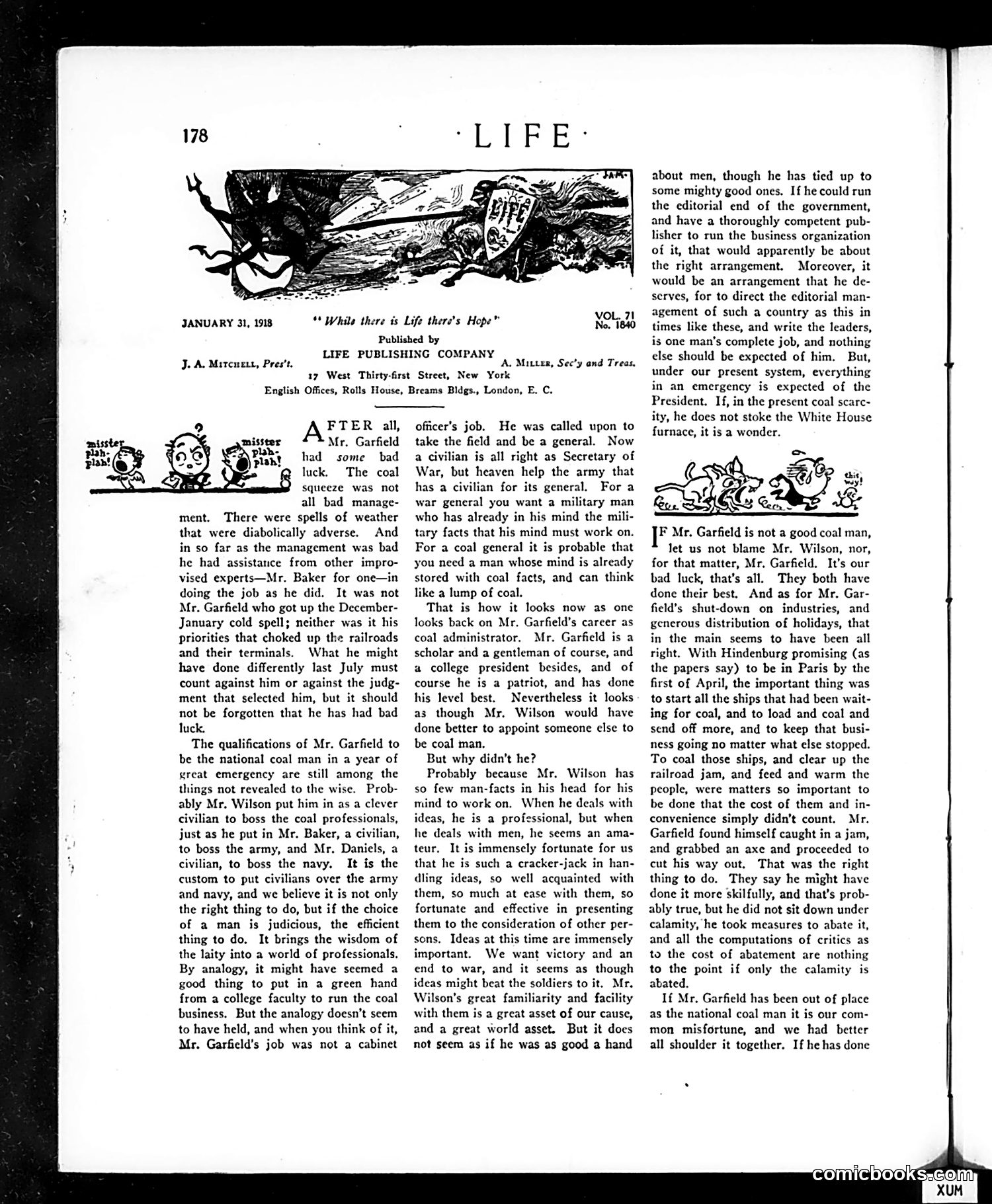
What you’re looking at
This editorial page critiques President Wilson's appointment of **Harry Garfield as Coal Administrator** during WWI's fuel crisis. The small cartoon at top (showing figures labeled "mister") appears to illustrate the coal shortage's domestic impact. The article argues Garfield—a college president and scholar—lacks the specialized "coal facts" needed for this wartime job, despite his patriotism and effort. The satire suggests Wilson excels at abstract ideas and ideology but struggles with practical personnel decisions and managing people. The author proposes Wilson should focus on "editorial" (policy/ideas) while delegating "business organization" (implementation/administration) to competent professionals. This reflects broader WWI-era debates about appointing civilians versus specialists to emergency positions—Wilson appointed similar amateurs to head the War and Navy departments. The piece's tone is sympathetic to both Garfield and Wilson while critiquing the fundamental mismatch between intellectual capability and administrative need.
📄 Transcribed text from this page (OCR, searchable)
Machine-transcribed from the original scan — historical spelling and the odd misread are preserved.
JANUARY 31, 1918 “© While there is Life there's: Hope” Published by LIFE PUBLISHING COMPANY 17 West Thirty-first Street, New York English Offices, Rolls House, Breams Bldgs., London, E. C. J. A. Mitcuent, Pres’t. FTER all, Mr, Garfield had some bad luck. The coal squeeze was not all bad manage- ment. There were spells of weather that were diabolically adverse. And in so far as the management was bad he had assistance from other impro- vised experts—Mr. Baker for one—in doing the job as he did. It was not Mr. Garfield who got up the December- January cold spell; neither was it his priorities that choked up the railroads and their terminals. What he might have done differently last July must count against him or against the judg- ment that selected him, but it should not be forgotten that he has had bad luck. The qualifications of Mr. Garfield to be the national coal man in a year of great emergency are still among the things not revealed to the wise. Prob- ably Mr. Wilson put him in as a clever civilian to boss the coal professionals, just as he put in Mr. Baker, a civilian, to boss the army, and Mr. Daniels, a civilian, to boss the navy. It is the custom to put civilians over the army and navy, and we believe it is not only the right thing to do, but if the choice of a man is judicious, the efficient thing to do. It brings the wisdom of the laity into a world of professionals, By analogy, it might have seemed a good thing to put in a green hand from a college faculty to run the coal business. But the analogy doesn’t seem to have held, and when you think of it, Mr. Garfield’s job was not a cabinet A, Mitta, Sec’y and Treas, officer's job. He was called upon to take the field and be a general. Now a civilian is all right as Secretary of War, but heaven help the army that has a civilian for its general. For a war general you want a military man who has already in his mind the mili- tary facts that his mind must work on. For a coal general it is probable that you need a man whose mind is already stored with coal facts, and can think like a lump of coal. That is how it looks now as one looks back on Mr. Garfield’s career as coal administrator. Mr. Garfield is a scholar and a gentleman of course, and a college president besides, and of course he is a patriot, and has done his level best. Nevertheless it looks as though Mr. Wilson would have done better to appoint someone else to be coal man, But why didn’t he? Probably because Mr. Wilson has so few man-facts in his head for his mind to work on. When he deals with ideas, he is a professional, but when he deals with men, he seems an ama- teur, It is immensely fortunate for us that he is such a cracker-jack in han- dling ideas, so well acquainted with them, so much at ease with them, so fortunate and effective in presenting them to the consideration of other per- sons, Ideas at this time are immensely important. We want victory and an end to war, and it seems as though ideas might beat the soldiers to it. Mr. Wilson’s great familiarity and facility with them is a great asset of our cause, and a great world asset. But it does not seem as if he was as good a hand about men, though he has tied up to some mighty good ones. If he could run the editorial end of the government, and have a thoroughly competent pub- lisher to run the business organization of it, that would apparently be about the right arrangement. Moreover, it would be an arrangement that he de- serves, for to direct the editorial man- agement of such a country as this in times like these, and write the leaders, is one man’s complete job, and nothing else should be expected of him. But, under our present system, everything in an emergency is expected of the President. If, in the present coal scarc- ity, he does not stoke the White House furnace, it is a wonder. oe F Mr. Garfield is not a good coal man, let us not blame Mr. Wilson, nor, for that matter, Mr. Garfield. It’s our bad luck, that’s all. They both have done their best. And as for Mr. Gar- field's shut-down on industries, and generous distribution of holidays, that in the main seems to have been all right. With Hindenburg promising (as the papers say) to be in Paris by the first of April, the important thing was to start all the ships that had been wait- ing for coal, and to load and coal and send off more, and to keep that busi- ness going no matter what else stopped. To coal those ships, and clear up the railroad jam, and feed and warm the people, were matters so important to be done that the cost of them and in- convenience simply didn’t count. Mr. Garfield found himself caught in a jam, and grabbed an axe and proceeded to cut his way out, That was the right thing to do. They say he might have done it more skilfully, and that’s prob- ably true, but he did not sit down under calamity, he took measures to abate it, and all the computations of critics as to the cost of abatement are nothing to the point if only the calamity is abated. If Mr. Garfield has been out of place as the national coal man it is our com- mon misfortune, and we had better all shoulder it together. If he has done