
Life, 1918-01-31 · page 24 of 40
Life — January 31, 1918 — page 24: what you’re looking at
What you’re looking at
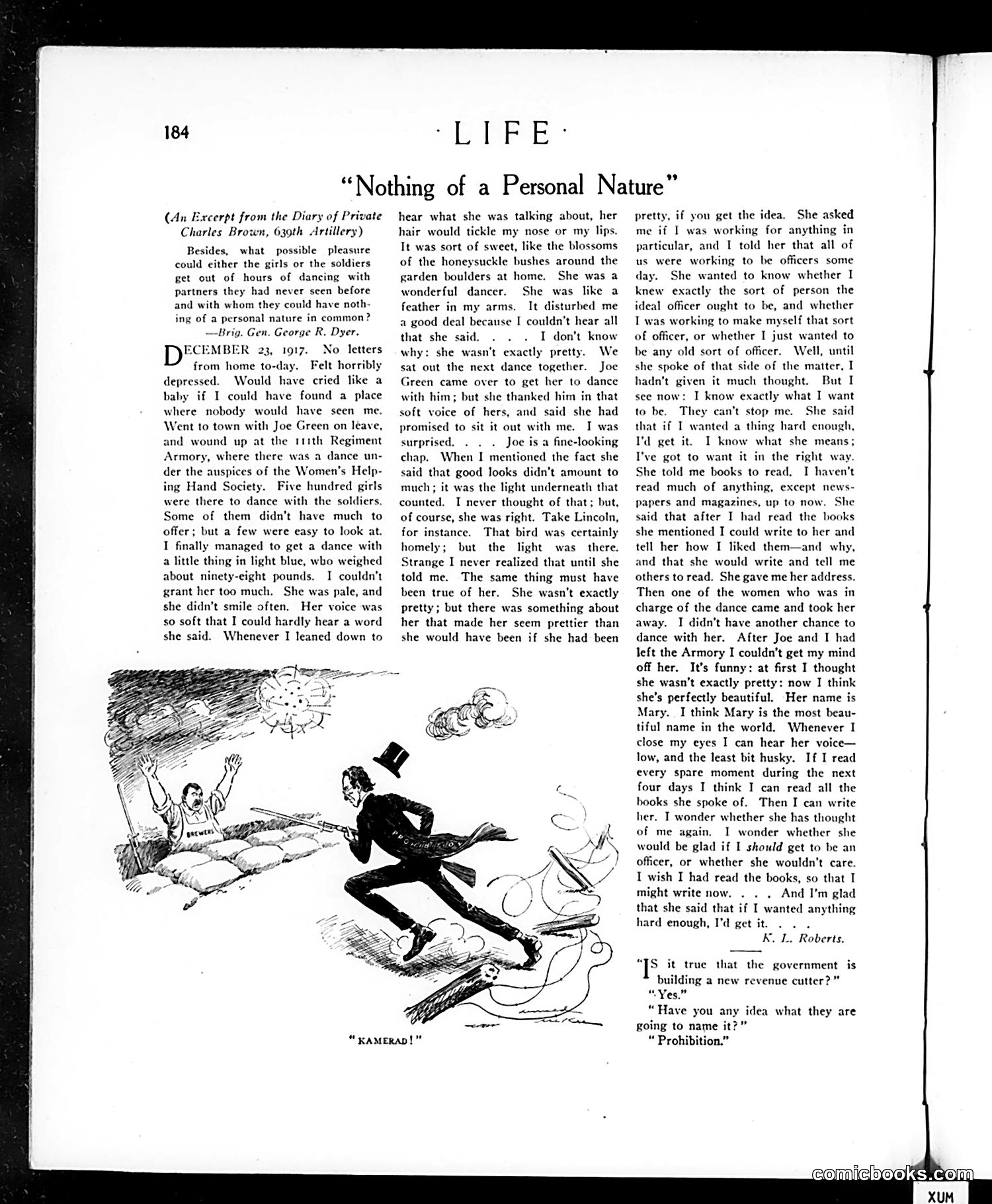
This page satirizes a military authority's claim that soldiers and women shouldn't dance together because they share "nothing of a personal nature in common." The diary entry (from a Private Charles Brown) directly contradicts this by showing a soldier meeting a young woman at a 1917 wartime dance and forming a genuine emotional connection. Despite her plain appearance, he becomes deeply attracted to her through meaningful conversation about character, ambition, and intellectual growth. The cartoon "KAMERAD!" depicts a man in formal dress tumbling comically—likely representing the absurdity of the general's position being upended by reality. **The satire's point:** Military leadership wrongly assumes soldiers and civilian women cannot connect meaningfully. The soldier's account proves the opposite—real human connection transcends superficial attraction and occurs through genuine interaction. The general's restrictive policy contradicts basic human nature and romantic experience.
📄 Transcribed text from this page (OCR, searchable)
Machine-transcribed from the original scan — historical spelling and the odd misread are preserved.
“ETRE * “Nothing of a Personal Nature” (An Excerpt from the Diary of Private Charles Brown, 639th Artillery) Besides, what possible pleasure could either the girls or the soldiers get out of hours of dancing with partners they had never scen before and with whom they could have noth- ing of a personal nature in common? -Brig. Gen. George R. Dyer. . 1917. No letters from home to-day. Felt horribly depressed. Would have cried like a baby if I could have found a place where nobody would have seen me. Went to town with Joe Green on léave, and wound up at the riith Regiment Armory, where there was a dance un- der the auspices of the Women’s Help- ing Hand Society. Five hundred girls were there to dance with the soldiers, Some of them didn’t have much to offer; but a few were easy to look at. I finally managed to get a dance with a little thing in light blue, who weighed about ninety-eight pounds. I couldn't grant her too much, She was pale, and she didn’t smile often. Her voice was so soft that I could hardly hear a word she said. Whenever I leaned down to hear what she was talking about, her hair would tickle my nose or my lips. It was sort of sweet, like the blossoms of the honeysuckle bushes around the garden boulders at home. She was a wonderful dancer. She was like a feather in my arms. It disturbed me a good deal because I couldn’t hear all that she said. I don’t know why: she wasn’t exactly pretty. We sat out the next dance together. Joe Green came over to get her to dance with him; but she thanked him in that soft voice of hers, and said she had promised to sit it out with me. I was surprised. . Joe is a fine-looking chap. When I mentioned the fact she said that good looks didn’t amount to much; it was the light underneath that counted, I never thought of that; but, of course, she was right. Take Lincoln, for instance. That bird was certainly homely; but the light’ was there. Strange I never realized that until she told me. The same thing must have been true of her. She wasn’t exactly pretty; but there was something about her that made her seem prettier than she would have been if she had been “ KaMeRAD!"” pretty, if you get the idea. She asked me if I was working for anything in particular, and I told her that all of us were working to be officers some day. She wanted to know whether I knew exactly the sort of person the ideal officer ought to be, and whether I was working to make myself that sort of officer, or whether I just wanted to be any old sort of officer. Well, until she spoke of that side of the matter, I hadn’t given it much thought. But I see now: I know exactly what I want to be. They can't stop me. She said that if I wanted a thing hard cnough, I'd get it. I know what she means; I've got to want it in the right way. She told me books to read, I haven't read much of anything, except news- papers and magazines, up to now. She said that after I had read the books she mentioned I could write to her and tell her how I liked them—and why, and that she would write and tell me others to read. She gave me her address. Then one of the women who was in charge of the dance came and took her away. I didn’t have another chance to dance with her. After Joe and I had left the Armory I couldn’t get my mind off her. It’s funny: at first I thought she wasn’t exactly pretty: now I think she’s perfectly beautiful. Her name is Mary. I think Mary is the most beau- tiful name in the world. Whenever I close my eyes I can hear her voice— low, and the least bit husky. If I read every spare moment during the next four days I think I can read all the books she spoke of. Then I can write her. I wonder whether she has thought of me again. I wonder whether she would be glad if I should get to be an officer, or whether she wouldn't care. I wish I had read the books, so that I might write now. . . . And I’m glad that she said that if I wanted anything hard enough, I'd get it. 2. K. L. Roberts, I it true that the government is building a new revenue cutter?” “Yes.” “Have you an: going to name it?” “ Prohibition.” idea what they are