
Life, 1918-01-31 · page 14 of 40
Life — January 31, 1918 — page 14: what you’re looking at
What you’re looking at
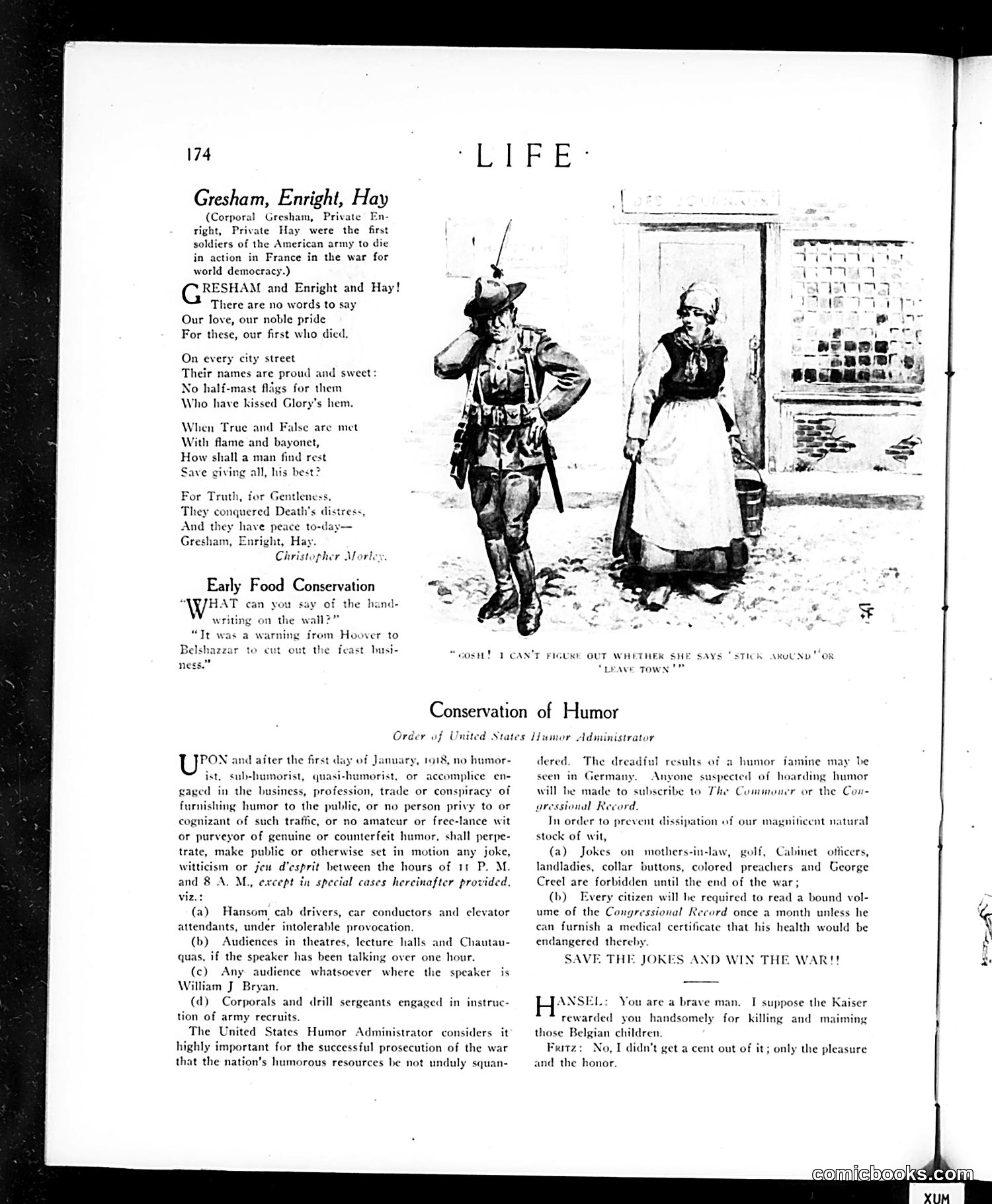
This page contains two distinct sections: **"Gresham, Enright, Hay"** — A patriotic poem by Christopher Morley commemorating three soldiers who died in World War I, establishing a solemn, honoring tone. **"Early Food Conservation"** — A cartoon depicting a soldier and woman, with the caption about whether she says "stick around" or "leave town." This satirizes domestic food rationing during WWI, likely mocking either a woman's conflicting signals or the tension between soldiers and the home front during wartime scarcity. **"Conservation of Humor"** — A formal order from the U.S. Humor Administrator (a fictional position) that satirizes government overreach by proposing to ban certain jokes during wartime. It specifically forbids humor about mothers-in-law, golf, and other topics, sarcastically suggesting patriotism requires suppressing natural humor to "win the war." The page overall satirizes American WWI-era regulations and propaganda.
📄 Transcribed text from this page (OCR, searchable)
Machine-transcribed from the original scan — historical spelling and the odd misread are preserved.
174 Gresham, Enright, Hay (Corporal Gresham, Private En- right, Private Hay were the first soldiers of the American army to die in action in France in the war for world democracy.) GRE and Enright and Hay! There are no words to say Our love, our noble pride For these, our first who died. On every city street Their names are proud and sweet: No half-mast flags for them Who have kissed Glory’s hem. When True and False are met With flame and bayonet, How shall a man find rest Save giving all, his best? For Truth, for Gentleness, They conquered Death's di And they have peace to-day— Gresham, Enright, H: Chris Early Food Conservation NYHAT can y writing on the wall?” “Tr was a warning from Hoover to Belshazzar to cut out the feast busi- pher Morke ay say of the ha Urs and after the first day of January, 1918, no humor- i st. sub-humorist, quasi-humorist, or accomplice en- gaged in the business, profession, trade or conspiracy of furnishing humor to the public, or no person privy to or cognizant of such traffic, or no amateur or free-lance wit or purveyor of genuine or counterfeit humor, shall perpe- trate, make public or otherwise set in motion any joke, witticism or jeu d’esprit between the hours of 11 P. M. and 8 A. M., except in special cases hereinafter pr viz: (a) Hansom cab drivers, car conductors and clevator attendants, under intolerable provocation. (b) Audiences in theatres, lecture halls and Chautau- quas, if the speaker has been talking over one hour. (c) Any audience whatsoever where the speaker is William J Bryan. (d) Corporals and drill sergeants engaged in instruc- tion of army recruits. The United States Humor Administrator considers it highly important for the successful prosecution of the war that the nation’s humorous resources be not unduly squan- “cos! 1 CAN'T FIGUKE OUT WHETHER SHE SAYS ‘STICK Conservation of Humor Order of United States Humor Administrator sKUUND "OR “Leave TOWN humor famine may be cted of hoarding humor The dreadful results of rmany. Anyone susp le to subscribe to The Commouer or the Con- dered. seen in will be m: gressional Record. In order to prevent diss stock of wit, (a) Jokes on mothers-in-law, golf, Cabinet landladies, collar buttons, colored preachers and Creel are forbidden until the end of the war; (b) Every citizen will he required to read a bound vol- ume of the Congressional Record once a month unless he can furnish a medical certificate that his health would be endangered thereby. SAVE. THE JOKES AND WIN THE WAR!! ition of our magnificent natural ANS You are a brave man. r rewarded you handsomely for killing and maiming those Belgian children. Fritz: No, I didn’t get a cent out of it; only the pleasure and the honor. I suppose the Kai