
Life, 1918-01-31 · page 37 of 40
Life — January 31, 1918 — page 37: what you’re looking at
What you’re looking at
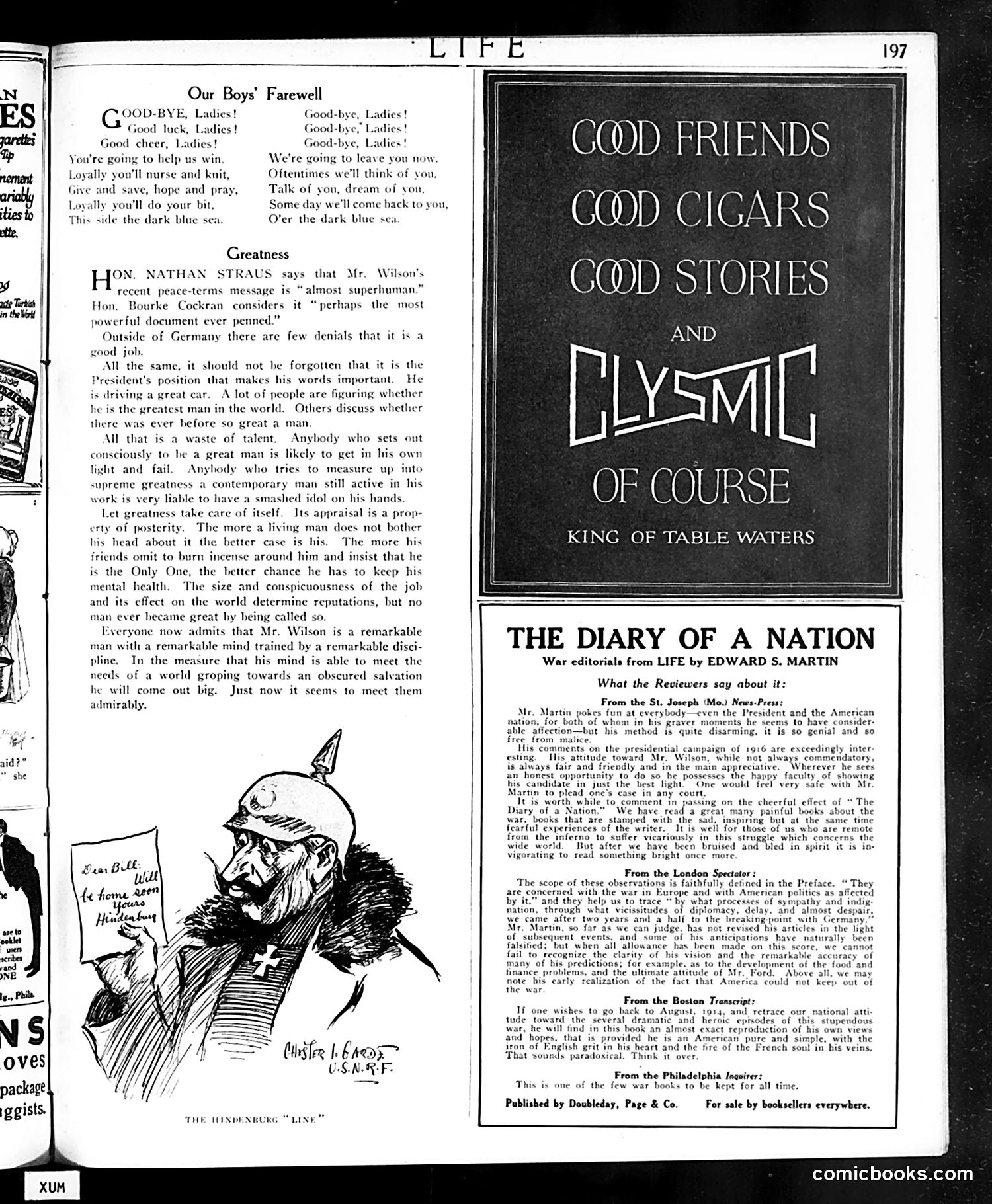
This page contains two distinct elements: **Left side:** A poem titled "Our Boys' Farewell" and an essay on "Greatness" discussing President Wilson's recent peace proposal. The essay praises Wilson's intellect and position while cautioning against excessive hero-worship of living leaders—arguing that greatness should speak for itself rather than be proclaimed. **Right side:** A political cartoon labeled "The Hindenburg 'Live'" depicts a German military officer (appears to be a caricature of a Prussian general, likely meant to represent German militarism broadly) with a Spiked Prussian helmet. Below it is advertising for *The Diary of a Nation*, a book of war editorials by Edward S. Martin from *Life* magazine, with positive reviews praising Martin's balanced commentary on Wilson and the war. The cartoon's placement alongside Wilson content suggests satirical commentary on German versus American leadership during World War I.
📄 Transcribed text from this page (OCR, searchable)
Machine-transcribed from the original scan — historical spelling and the odd misread are preserved.
Our Boys’ Farewell OOD-BYE, Ladies! Good-by : Good luck, Ladies! Good-by ] Good cheer, Ladies! Good-bye, Ladie: “4 | IDS You're going to help us win Y ve you now. Loyally you'll nurse and knit, Oftentimes we'll think of you, Give and save, hope and pray Talk of you, dream of you, Losally you'll do your bit, Some day we'll come back to you, E This side the dark blue se: O'er the dark blue sea. ] Greatness HO NATHAN: STRAUS says that Me, Wilson's | CMD STOR] ES recent peace-terms message is “almost superhuman.” | Hon. Bourke Cockran considers it “perhaps the most powerful document ever penned.” Outside of Germany there are few denials that it is a AND good job. All the same, it should not he forgotten that it is the President's position that makes his words important. He is driving a great car. A lot of people are figuring whether | he is the greatest man in the world. Others discuss whether there was ever hefore so great a man. Alt is a waste of talent. Anybody who sets out consciously to he a great man is likely to get in his own light and fail, Anybody who tries to measure up into 8 supreme greatness a contemporary man still active in his | OF CO RSE work is very liable to have a smashed idol on his hands. Let greatness take care of itself. Its appraisal is a prop- erty of posterity. The more a living man does not bother his head about it the better case is his. The more his iriends omit to burn incense around him and insist that he is the Only One, the better chance he has to keep his mental health. The size and conspicuousness of the job and its effect on the world determine reputations, but no man ever hecame great by being called so. veryone now admits that Mr. Wilson is a remarkable THE DIARY OF A NATION man with a remarkable mind trained by a remarkable disci- pline. In the measure that his mind is able to meet the | War editorials from LIFE by EDWARD S. MARTIN needs of a world groping towards an obscured salvation he will come out big. Just now it seems to meet them admirably, KING OF TABLE WATERS What the Reviewers say about it: From the St. Joseph (Mo.) News-Press: Mr. Martin pokes fun c President and the American nation, for b hi ni eem nsider- able alfection—but his method ts quite disarming, it is $0 genial and so free from malice Ilis comments on the presidential can { 1916 are exceedingly inter attitude toward Mr. Wils not always commendatory, ways fair and friendly and in the main appreciative. Wherever he sees honest opportunity to do so he possesses the happy faculty of showing his candidate in just the best light. One would feel very safe with Mr Martin to plead. one’s case in any court. It is worth while to comment in passing on the cheerful effect of * The Diary of a Nation,” We have read a great many painful books about the war, books that are stamped with the sad. inspiring but at the same time fearful experiences of the writer. It is well for those of us who are remote from the inferno to suffer vicariously in this struggle which concerns the wide world. But after we have been bruised and bled in spirit it is in+ Vigorating to read something bright once more: From the London Spectator: The scope of these observations is faithfully defined in the Preface. “ They are concerned with the war in Europe and with American politics as affected by it.” and they help us to trace * by what proce { sympathy and indig- nation, through what vicissitudes of diplomacy, delay, and almost des we came after two years and a half to the breaking-point with Ge Mr. so far as we can judge. has not revised his articles in the li Of subsequent events, ands his anticipations have naturally been falsified; but when all allowance is been made on fail to recognize the clarity of his vision and the re mai of his predictions; for ¢ It s to the developm fin problems, and the ultimate attitude of Mr, Ford. Above all, note ly realization of the fact that America could not kei the From the Boston Transcript: If one wishes to go back to August, retrace our national tude toward the several dramatic eroic episodes of this ste war, he will find in this book tion of his own views ‘ovided he is a pure and le, with the r n his heart and the fire of the French soul in his veins. That sounds paradoxical. Think it over. From the Philadelphia Inquirer: This i of the few war books to be kept for all time. Published by Doubleday, Page & Co. For sale by booksellers everywhere. comicbooks.com