
A complete issue · 42 pages · 1917
Life — May 3, 1917
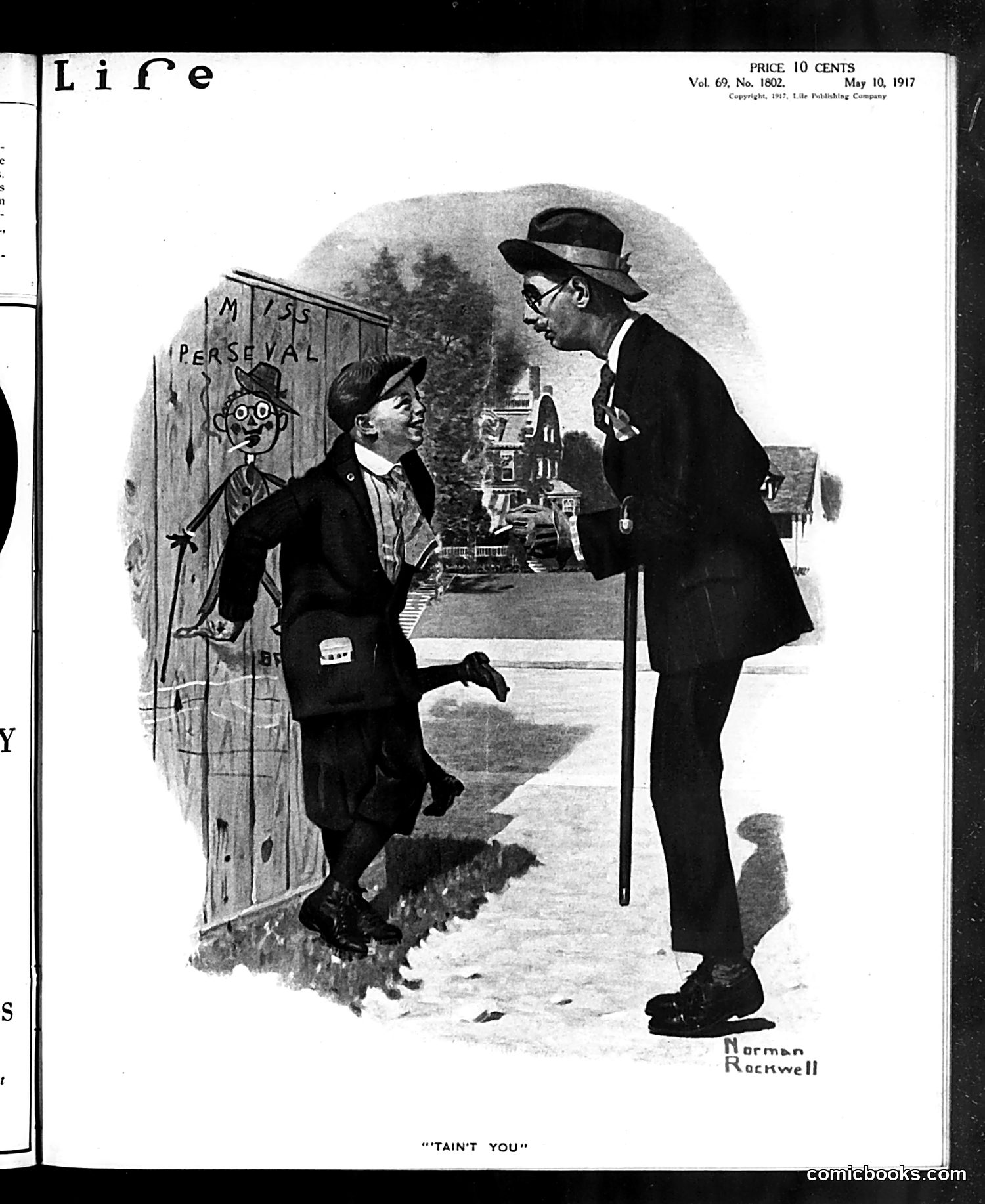
This Norman Rockwell cartoon depicts a tall gentleman confronting a young boy who has drawn a crude caricature on a wall labeled "M/355 PERSEVOL" (likely "Miss Persuasive" or similar). The boy appears caught in the act of mischief—the scribbled face is a crude, exaggerated drawing typical of childhood graffiti. The title "Tain't You" suggests the boy is protesting his innocence or denying responsibility. The cartoon satirizes how children deflect blame when caught doing wrong, offering implausible denials. The well-dressed adult's patient but skeptical demeanor captures the awkward moment of confrontation. Published in May 1917 (during America's WWI entry), this appears to be simple domestic humor rather than political commentary.
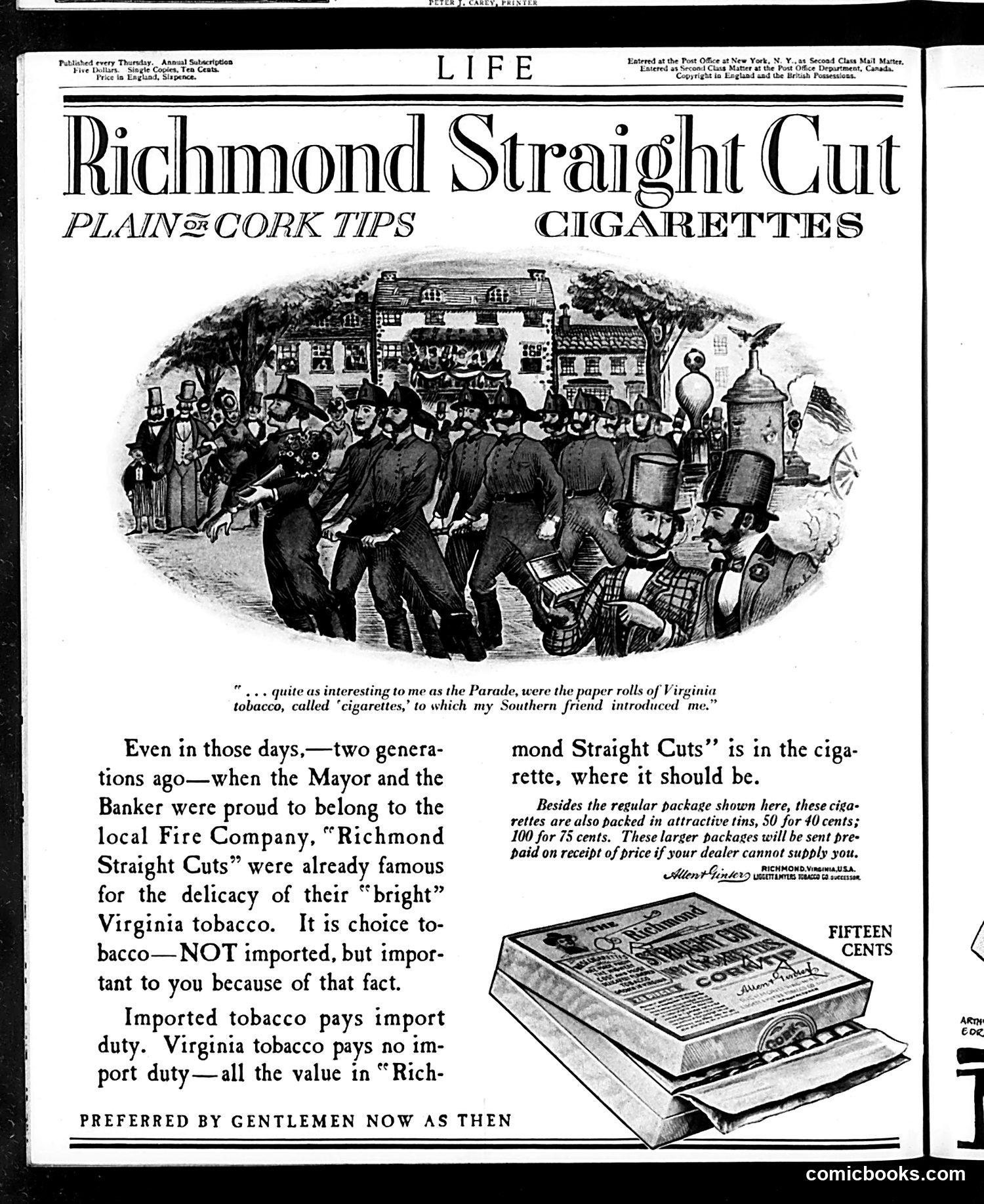
This is primarily a **cigarette advertisement** rather than political satire. The engraving depicts a 19th-century street parade or public gathering, likely referencing a historical event when cigarettes were novelties in America. The ad's narrative claims that even two generations prior, the "Mayor and the Banker" were proud to belong to the local Fire Company and valued Richmond Straight Cuts for their Virginia tobacco quality. The text emphasizes the product uses *domestic* Virginia tobacco (avoiding import duties), positioning this as economically advantageous compared to imported alternatives. The phrase "quite as interesting to me as the Parade" suggests cigarettes were considered sophisticated entertainment worthy of gentlemen's attention. This reflects early-20th-century marketing strategies targeting affluent male consumers.
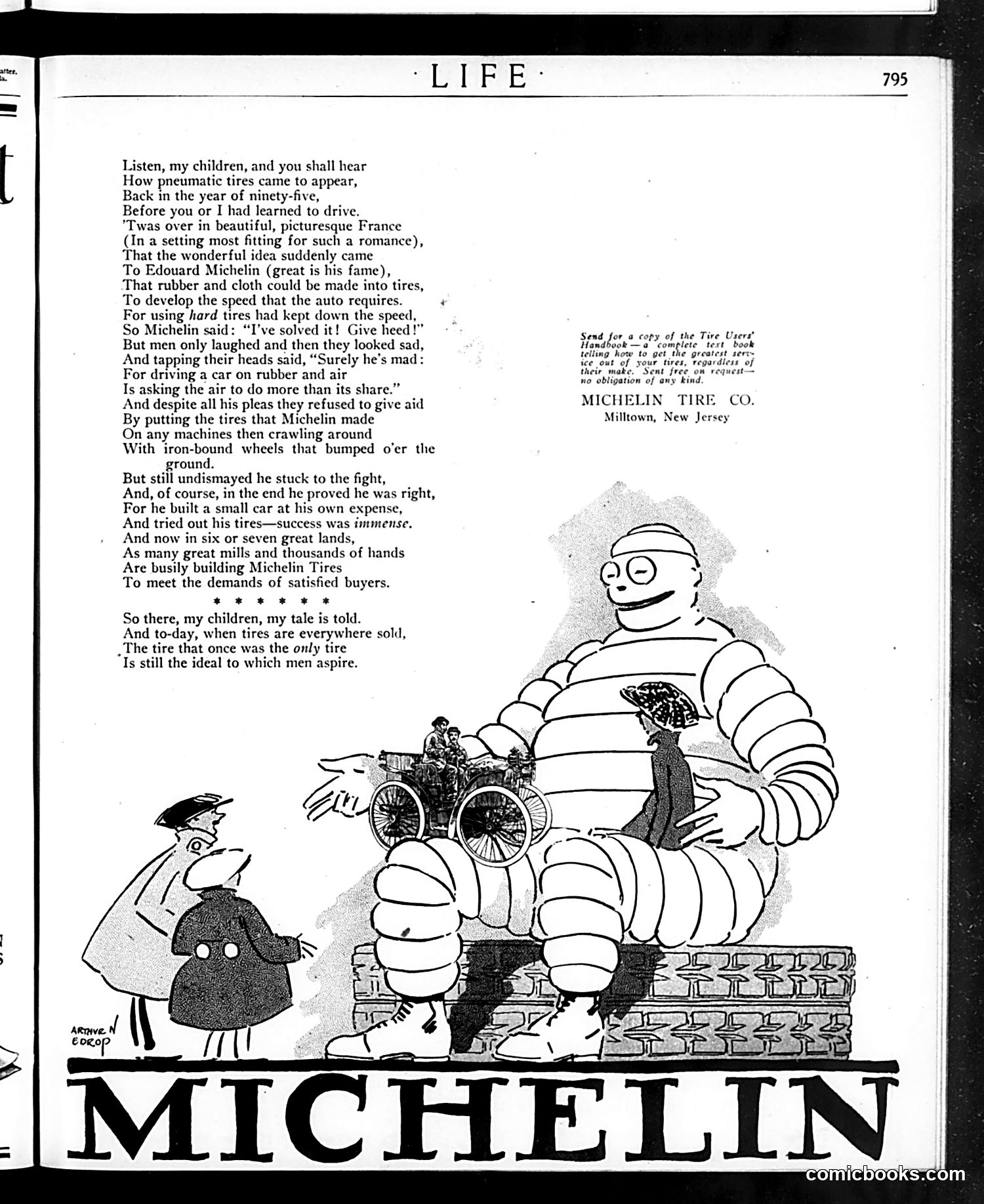
This page presents a poem celebrating Édouard Michelin's invention of pneumatic (air-filled) tires around 1895. The narrative humorously depicts initial skepticism—men laughed at the idea, questioning whether rubber and air could replace hard tires or improve automobile speed. The accompanying cartoon shows the famous **Michelin Man** (Bibendum), the mascot character made of stacked tire rings, presenting a small early automobile to a skeptical onlooker. The giant figure embodies the tire company's growth into "six or seven great lands." The satire mocks conservative resistance to innovation: people doubted Michelin would succeed until he personally proved the concept worked. By publication, Michelin tires dominated the market—the poem's moral being that revolutionary ideas eventually vindicate themselves despite initial mockery.
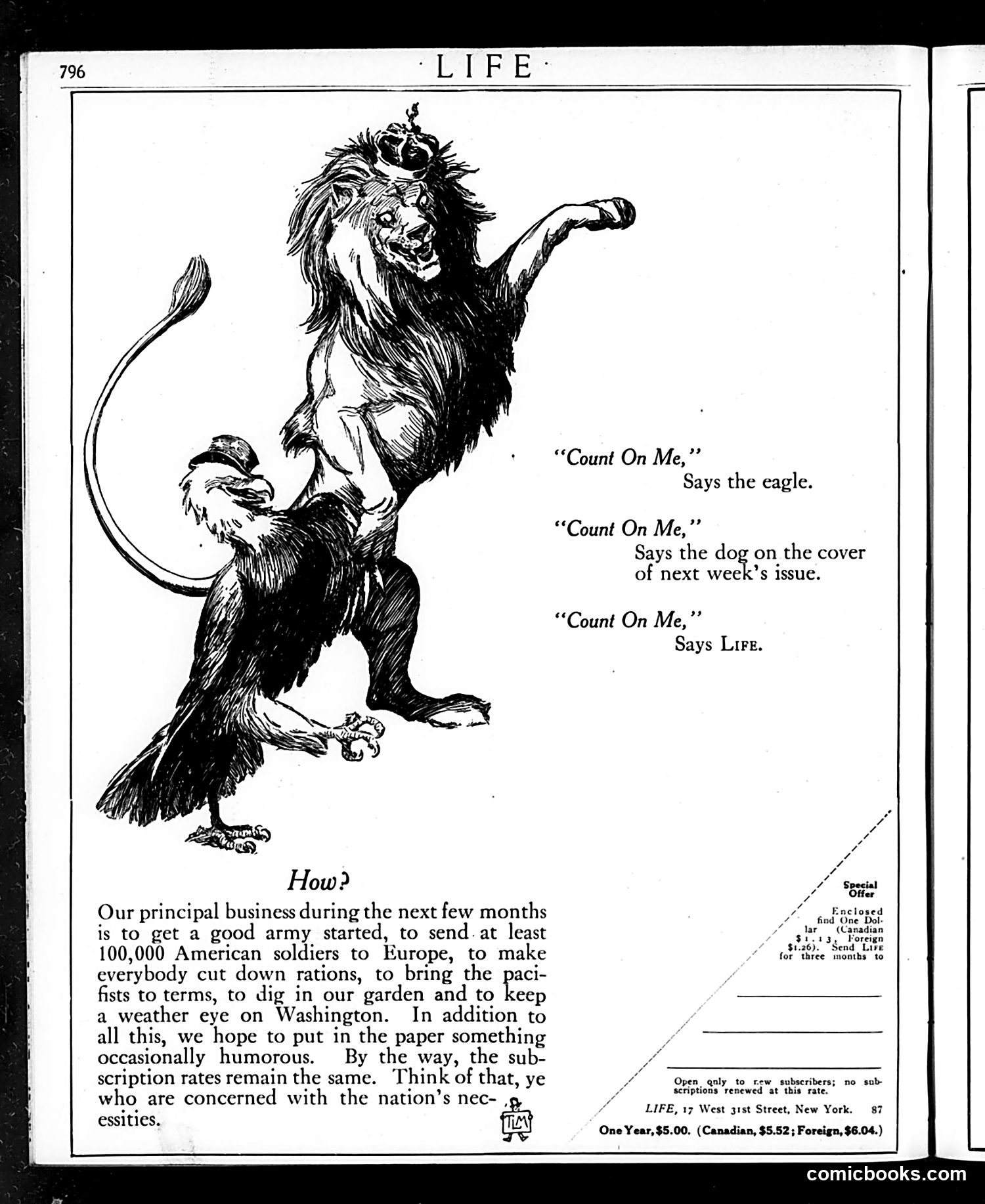
This satirical piece uses animals to critique media competition and patriotic messaging during World War I. An eagle and dog compete to appear on magazine covers, each demanding "Count On Me" — a patriotic rallying cry. LIFE magazine claims it will also feature patriotic content while maintaining subscription rates. The "How?" section outlines America's wartime priorities: raising a 100,000-soldier army for Europe, rationing, suppressing pacifist speech, and monitoring Washington. LIFE acknowledges these serious demands while asserting its own role in providing occasional humor alongside coverage of national necessities. The satire gently mocks competing publications' patriotic posturing while LIFE positions itself as balancing duty with levity—maintaining business as usual during wartime crisis.
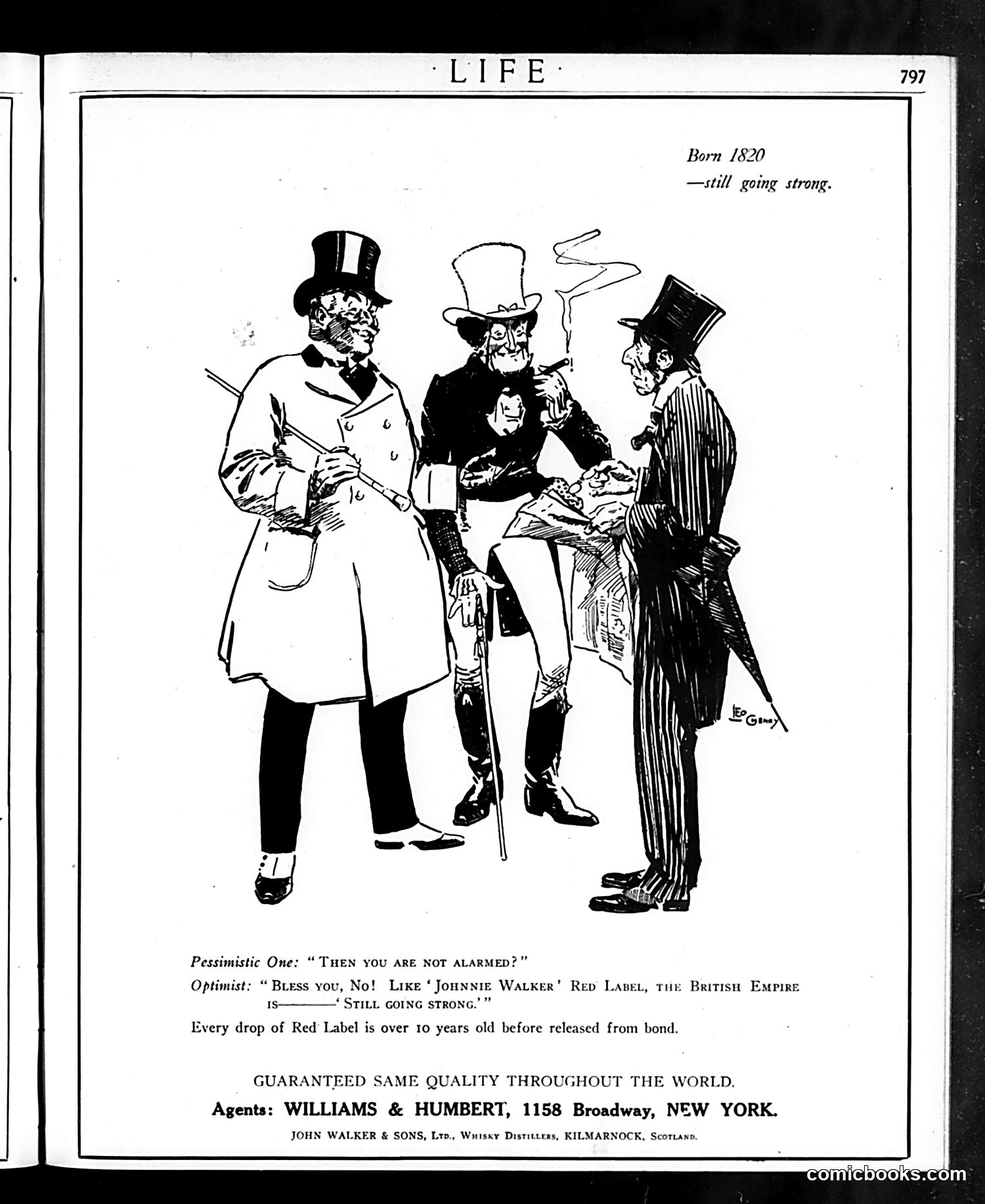
This is primarily a **whisky advertisement** for Red Label by John Walker & Sons, disguised as political satire. The page depicts three caricatured figures in top hats discussing the whisky's longevity—born 1820 and "still going strong." The "Pessimistic One" questions whether the product should still be alarmed (functioning), while the "Optimist" praises it as enduring like the British Empire itself. The satire compares the whisky's age and durability to imperial permanence, reflecting early 20th-century attitudes about British institutional strength. The exaggerated, grotesque facial features were typical of period satirical illustration. The ad emphasizes that Red Label's quality remains consistent globally and that each bottle ages over 10 years before release. This is essentially **advertising wrapped in topical political humor** about British institutions and longevity.
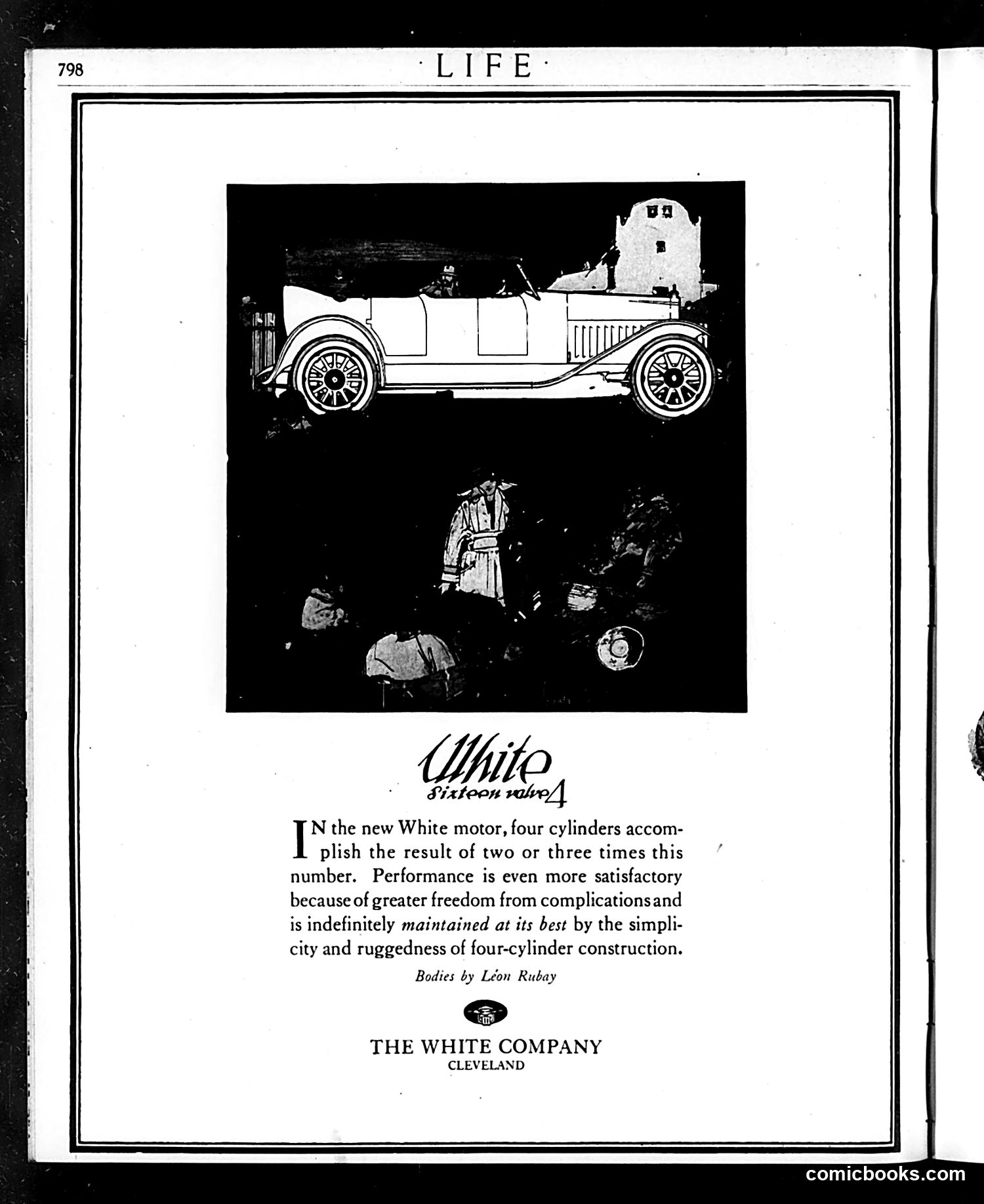
This is primarily **advertising, not political satire**. The page promotes the White motor company's "White" automobile, a four-cylinder vehicle manufactured in Cleveland. The top illustration shows an elegant open-air touring car of the 1910s-1920s era parked near what appears to be a Mediterranean or Middle Eastern building. Below, well-dressed pedestrians observe the vehicle. The ad copy emphasizes the car's performance advantages: four cylinders accomplish what competitors need two or three times as many to achieve. The text praises the design's "simplicity and ruggedness." "Bodies by Léon Rubay" credits the coachwork designer, indicating this was a luxury vehicle. There is no political content or satire present—this is straightforward automotive marketing from Life magazine's advertising section.
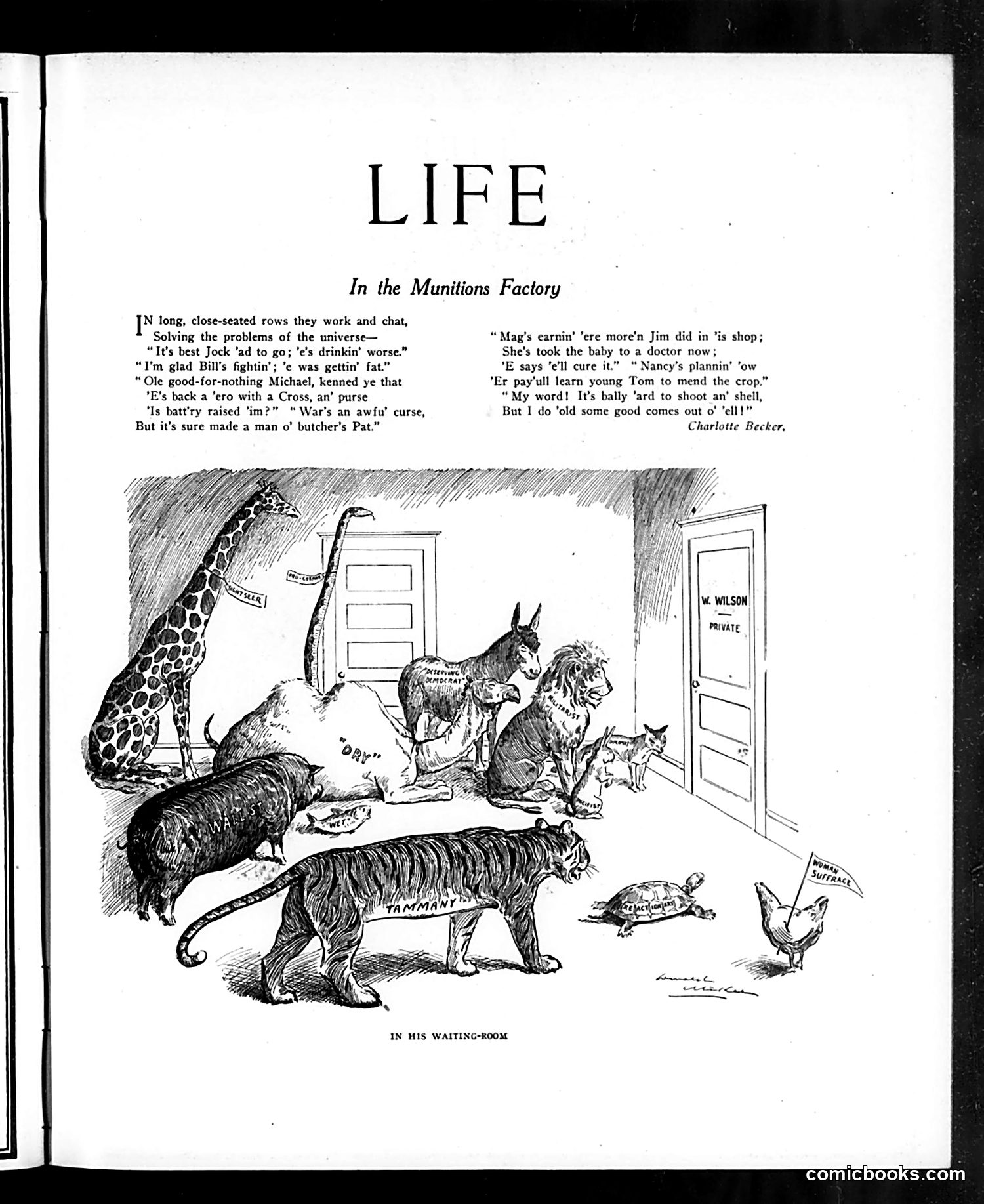
This is a satirical cartoon titled "Life in the Munitions Factory," depicting a waiting room labeled "W. WILSON - PRIVATE" filled with various animals representing different nations or interests during World War I. The animals appear to represent competing parties seeking President Wilson's attention and support regarding munitions production and war involvement. The giraffe, goat, dog, pig, tiger, turtle, and bird likely symbolize different Allied nations or factions lobbying for American military resources and backing. The subtitle "In His Waiting Room" suggests these parties are literally queuing to see Wilson, satirizing the diplomatic pressure on the U.S. regarding WWI involvement. The Charlotte Becker quote humorously depicts factory workers' mundane conversations contrasting with the serious geopolitical stakes being decided above them.
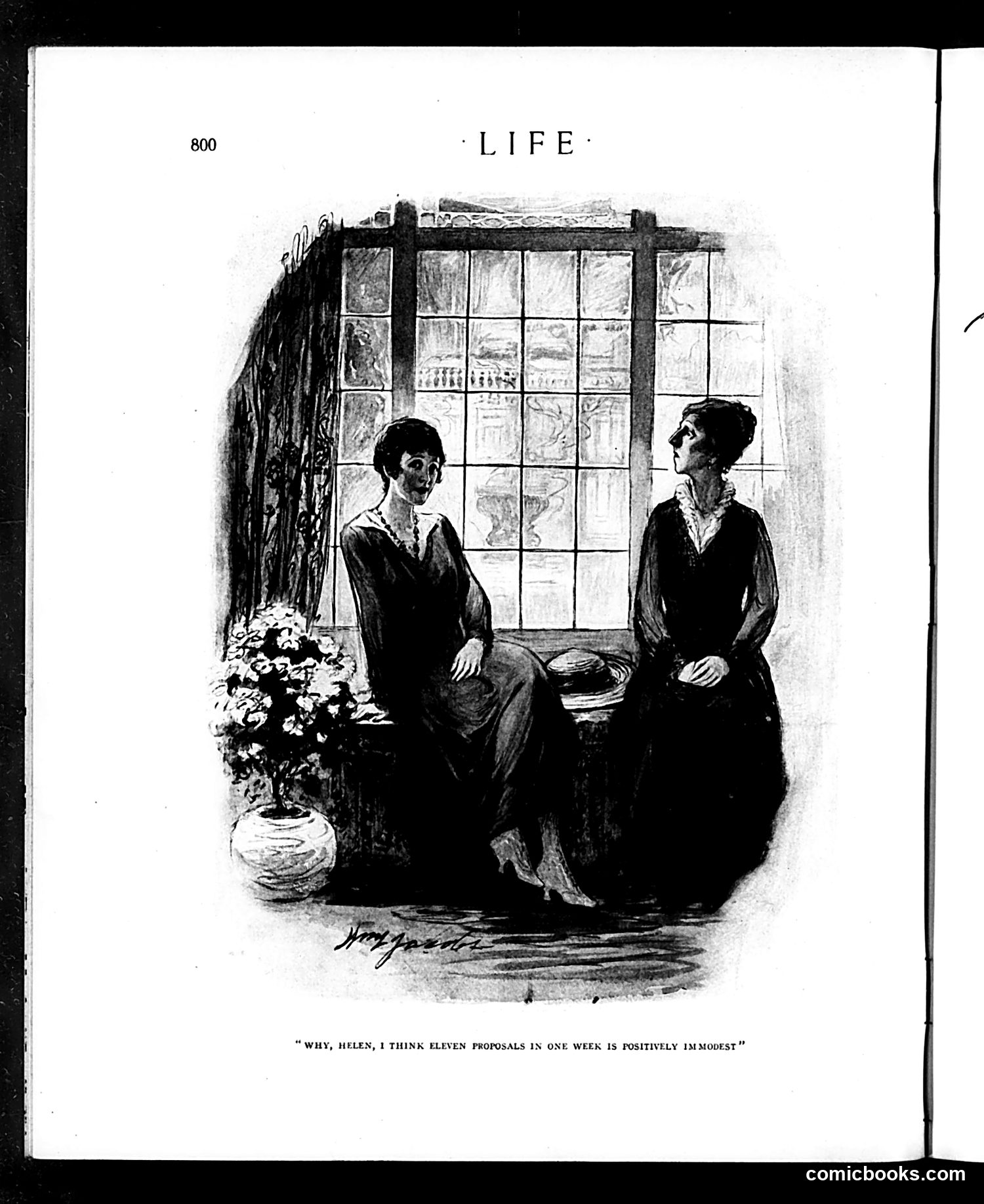
This is a satirical cartoon from *Life* magazine depicting two women in conversation by a window with potted flowers. The caption reads: "Why, Helen, I think eleven proposals in one week is positively immodest." The joke targets early 20th-century courtship rituals and marriage prospects. One woman reports receiving an extraordinary number of marriage proposals—eleven in a single week—which she describes as "immodest," suggesting excessive attention to her marriageability. The satire mocks both the conventions of the era (where proposals were frequent and expected from suitors) and the woman's coy response, which treats an abundance of marriage proposals as a social impropriety rather than a triumph. The cartoon humorously critiques period gender dynamics and courtship expectations.
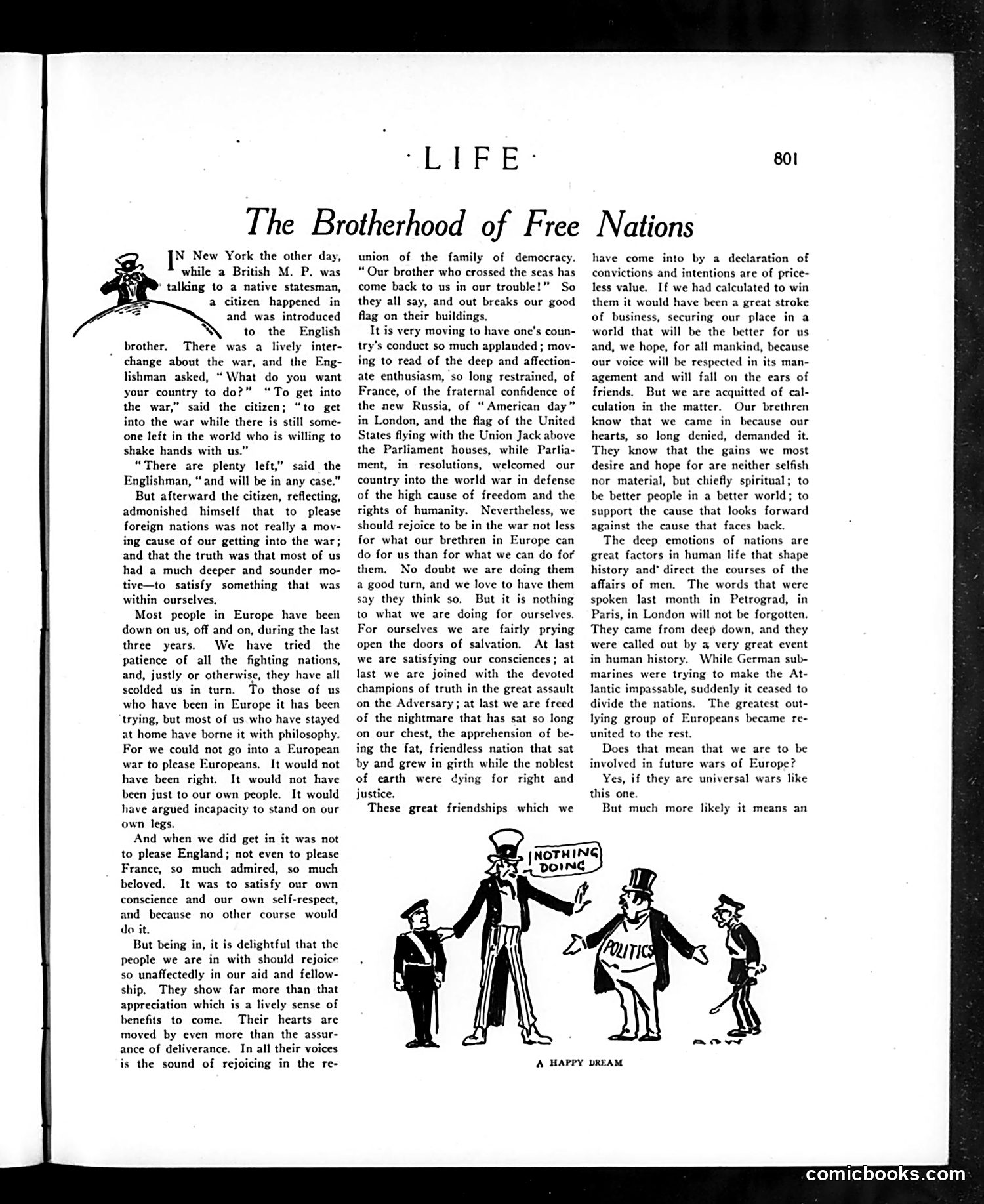
The article discusses Allied unity during WWI, celebrating how Britain, France, Russia, and America joined together for democracy and freedom. The accompanying cartoon, titled "A Happy Dream," satirizes this brotherhood. The central figure appears to be **Uncle Sam** (representing America), gesturing toward three smaller figures labeled with national identities. One figure is labeled "**POLITICS**"—likely representing divisive domestic political interests. Uncle Sam declares "NOTHING DOING," suggesting America will not let partisan politics interfere with the war effort and international unity. The satire suggests that while nations publicly celebrate brotherhood, domestic political factions threaten to undermine this unity. The "happy dream" is precisely that—idealistic but fragile.
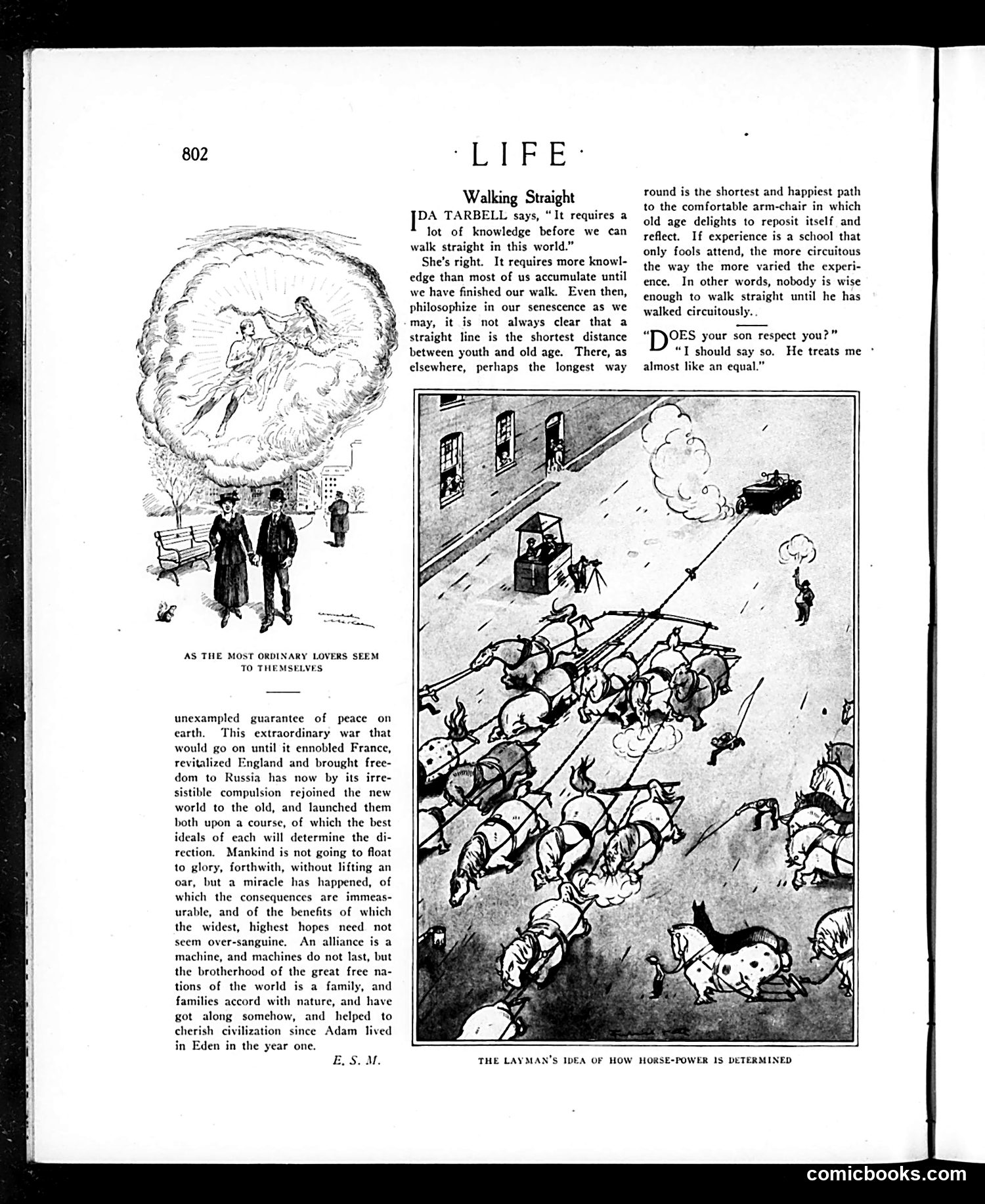
This page contains two distinct elements: **Top section:** An essay by IDA TARBELL arguing that walking a "straight line" through life requires more wisdom than we typically possess. The accompanying sketch shows an ordinary couple under a large tree, illustrating romance. **Bottom cartoon:** Titled "The Layman's Idea of How Horse-Power Is Determined," this is satirical commentary on measuring mechanical power. It depicts horses literally pulling a large load of people/workers, with observers measuring or calculating the effort—a visual pun mocking how laypeople misunderstand the technical term "horsepower" (the unit of mechanical power, not actual horse strength). The page also contains philosophical text about war, peace, and mankind's progress, attributed to E.S.M.
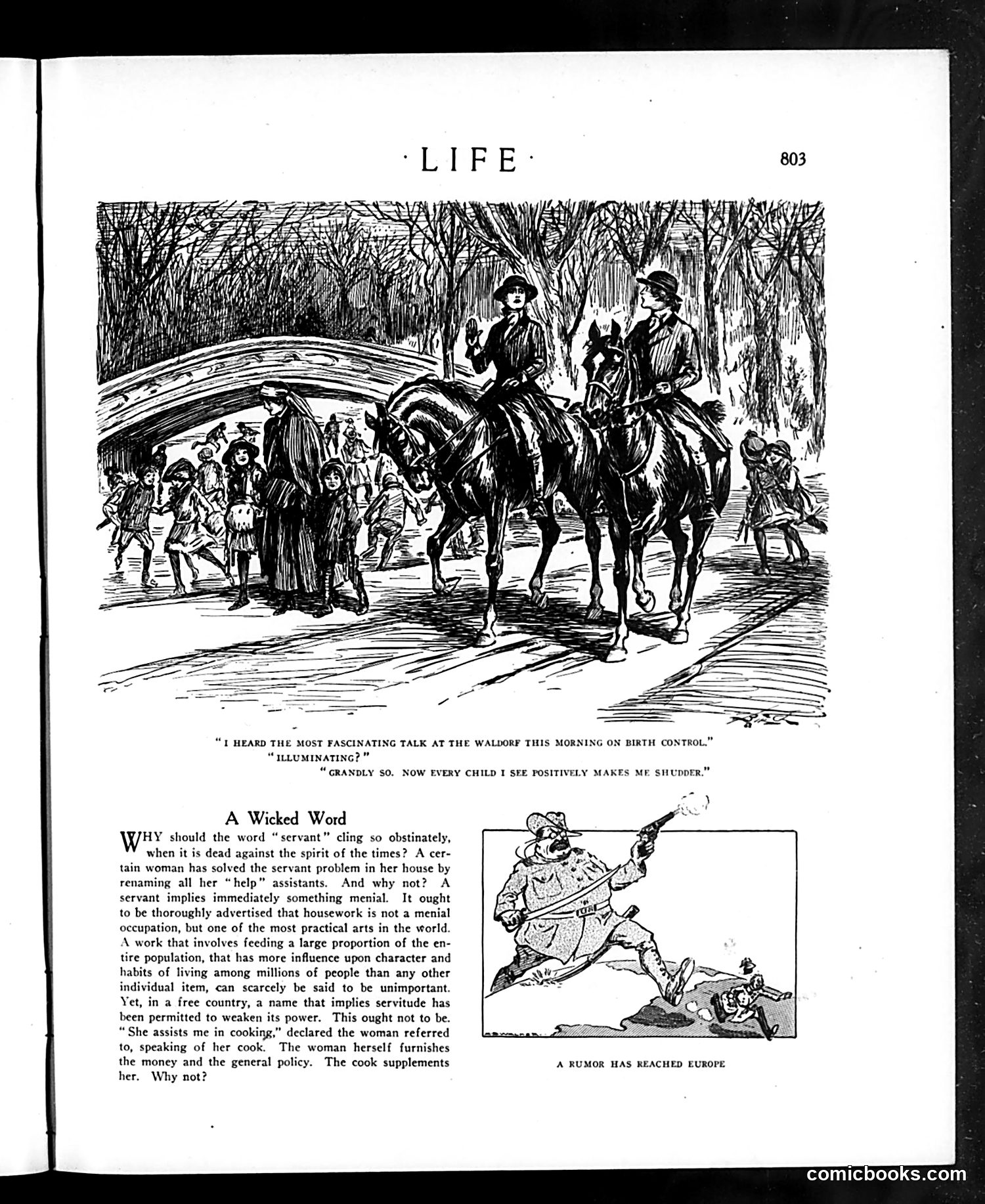
This page contains two satirical pieces: **Top cartoon:** Shows mounted riders (appearing to be wealthy or upper-class women) on horseback passing pedestrians. The caption mocks discussion of "birth control" at a Waldorf (an elite venue), with commentary that such talk makes the speaker "shudder"—satirizing conservative outrage over contraception discussion among the wealthy. **Bottom article "A Wicked Word":** Argues against the term "servant," proposing "help" assistants instead. The piece critiques how the word "servant" carries negative connotations, yet paradoxically argues housework deserves respect as skilled labor. It questions why employers control household spending and policy while servants (or "help") execute work without corresponding authority—a commentary on class hierarchy and labor relations in early 20th-century America. The small cartoon "A Rumor Has Reached Europe" appears unrelated satirical commentary.
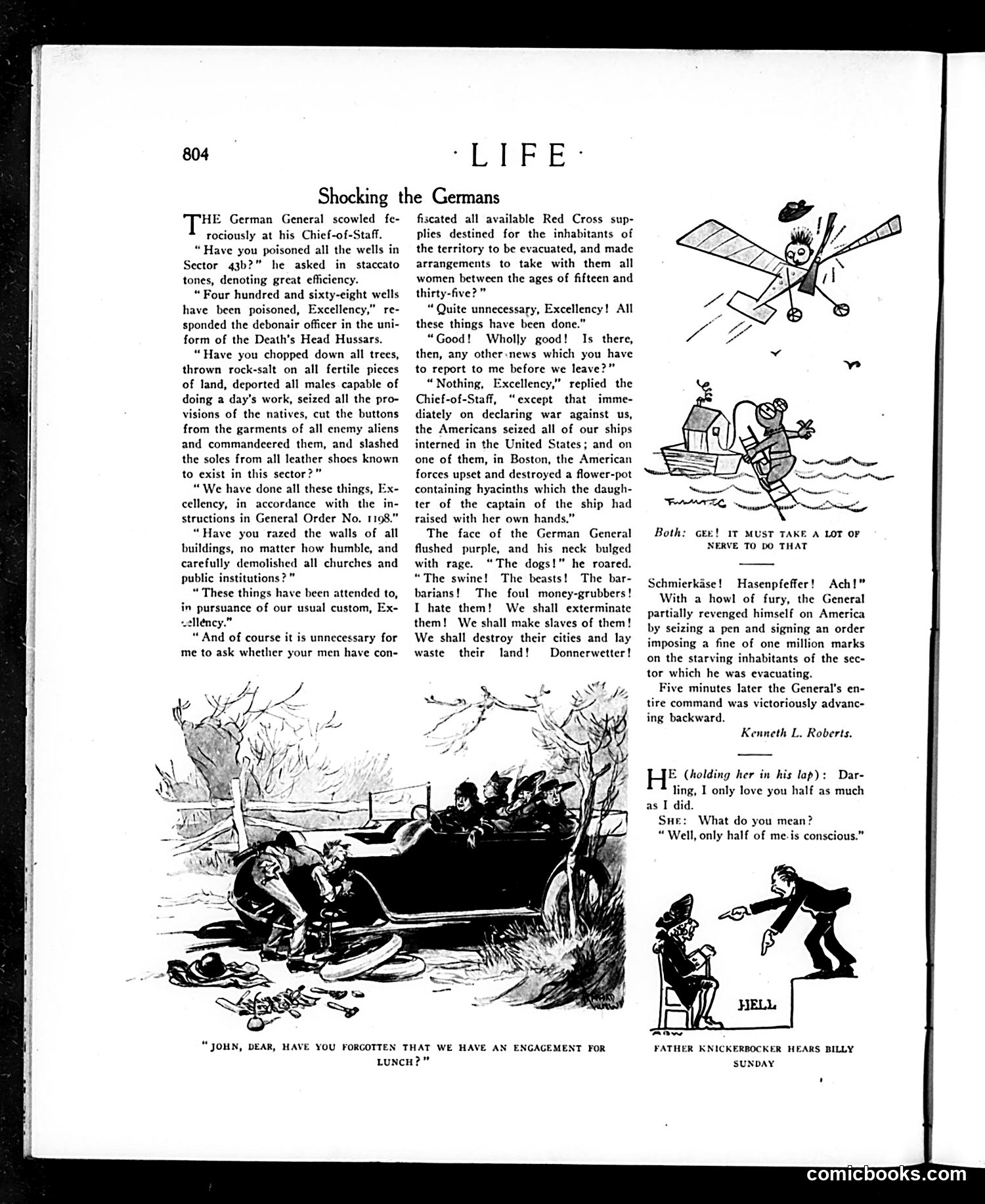
This page satirizes German military brutality during World War I. The main article, "Shocking the Germans," depicts a German General boasting to his Chief-of-Staff about atrocities: poisoning wells, destroying crops, seizing provisions, demolishing churches, and enslaving populations. The General's rage escalates when learning Americans destroyed a German ship and a flower-pot containing his daughter's hyacinth—the absurd juxtaposition mocking his disproportionate fury over personal loss versus mass cruelty. The accompanying illustrations reinforce anti-German sentiment through exaggerated depictions of German militarism. A small domestic comic strip ("Father Knickerbocker Hears Billy Sunday") provides lighter relief. The satire's point: exposing German warfare tactics as inhumane while ridiculing the General's outrage over trivial matters, making propaganda against a wartime enemy.
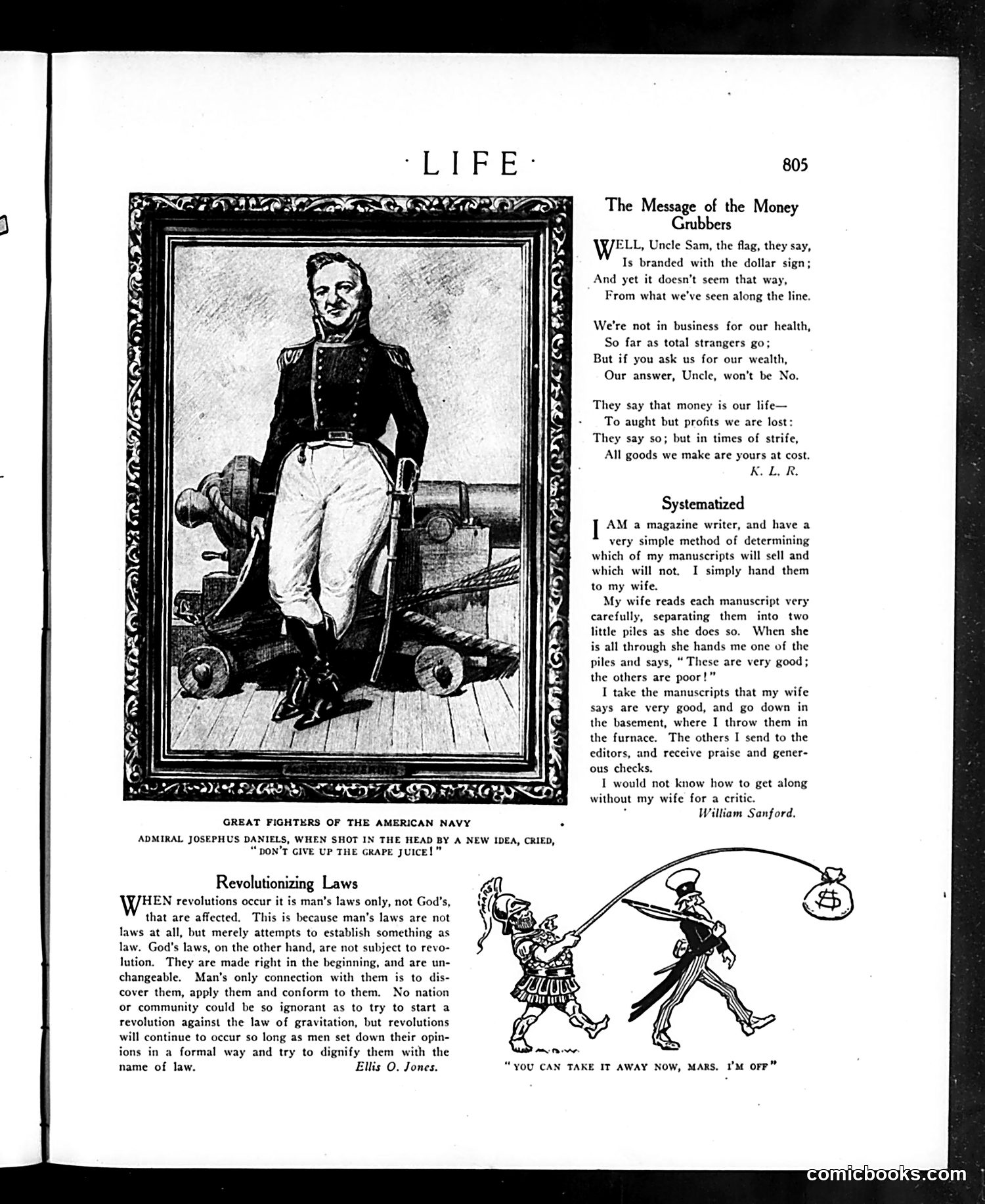
**Main Image:** Portrait of Admiral Josephus Daniels, labeled "Great Fighters of the American Navy." The caption references an incident where Daniels, when shot in the head by "a new idea," cried "Don't give up the grape juice!"—a satirical jab at his famous prohibition stance and perceived resistance to naval modernization. **"Revolutionizing Laws":** Ellis O. Jones argues that God's laws (nature) cannot be revolutionized, only man's laws can. This appears to critique contemporary progressive reform movements. **Bottom Cartoon:** Depicts Mars (god of war) taking money from another figure, captioned "You can take it away now, Mars. I'm off"—likely satirizing post-WWI disarmament or peace efforts. The page overall mocks political and military figures through satire.
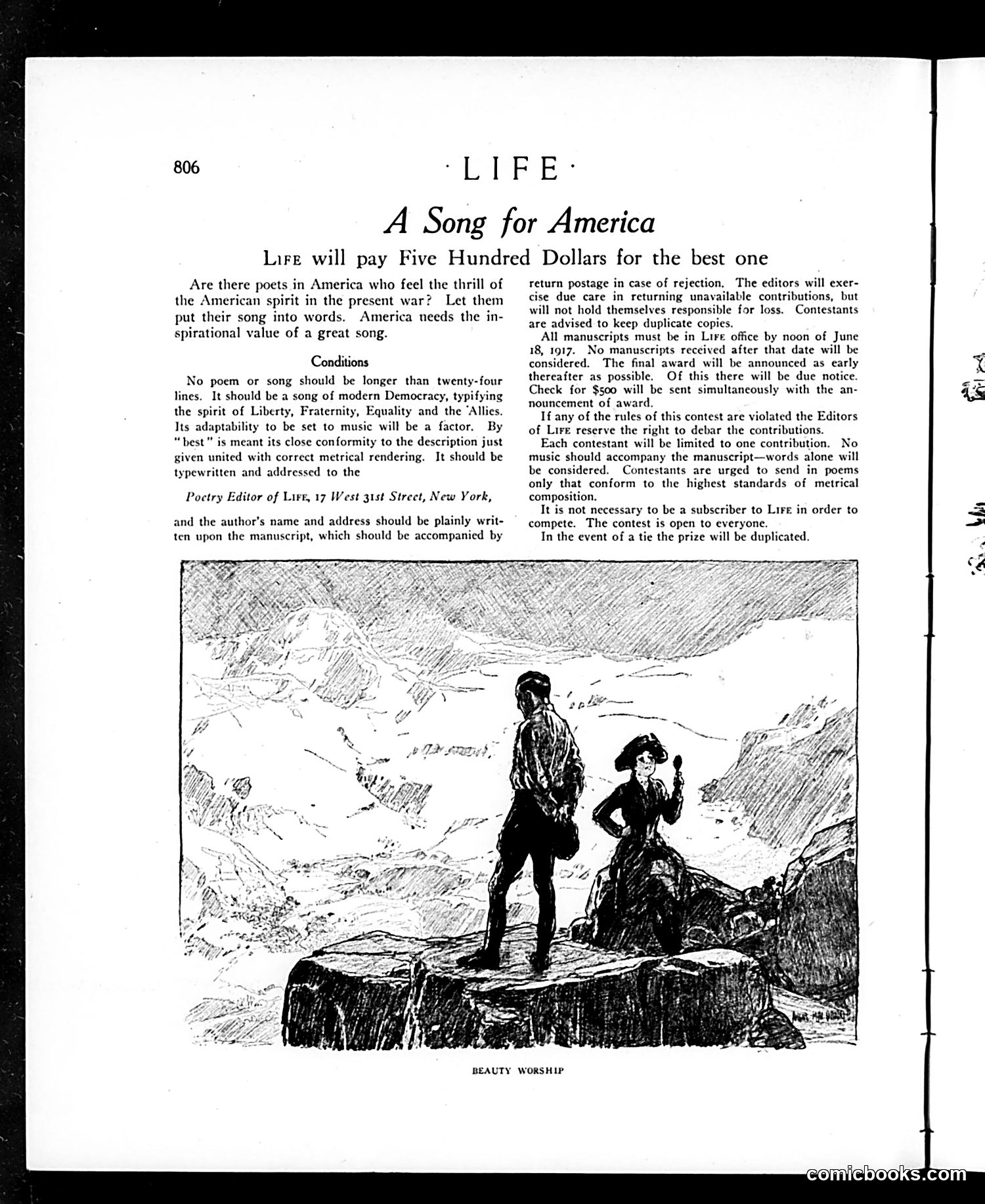
This page announces a *Life* magazine poetry contest offering $500 for the best patriotic song. The contest seeks work celebrating American democracy, liberty, fraternity, equality, and "the Allies"—indicating this was published during World War I era when America had allied with Britain and France. The illustration titled "Beauty Worship" shows two figures on a rocky outcrop gazing at a mountainous landscape. This likely represents idealized American spirit and natural beauty—imagery meant to inspire the patriotic verses *Life* was soliciting. The contest required poems under 24 lines, modern democratic language, and proper metrical composition. Submissions were due by June 18, 1917, addressed to *Life's* New York office.
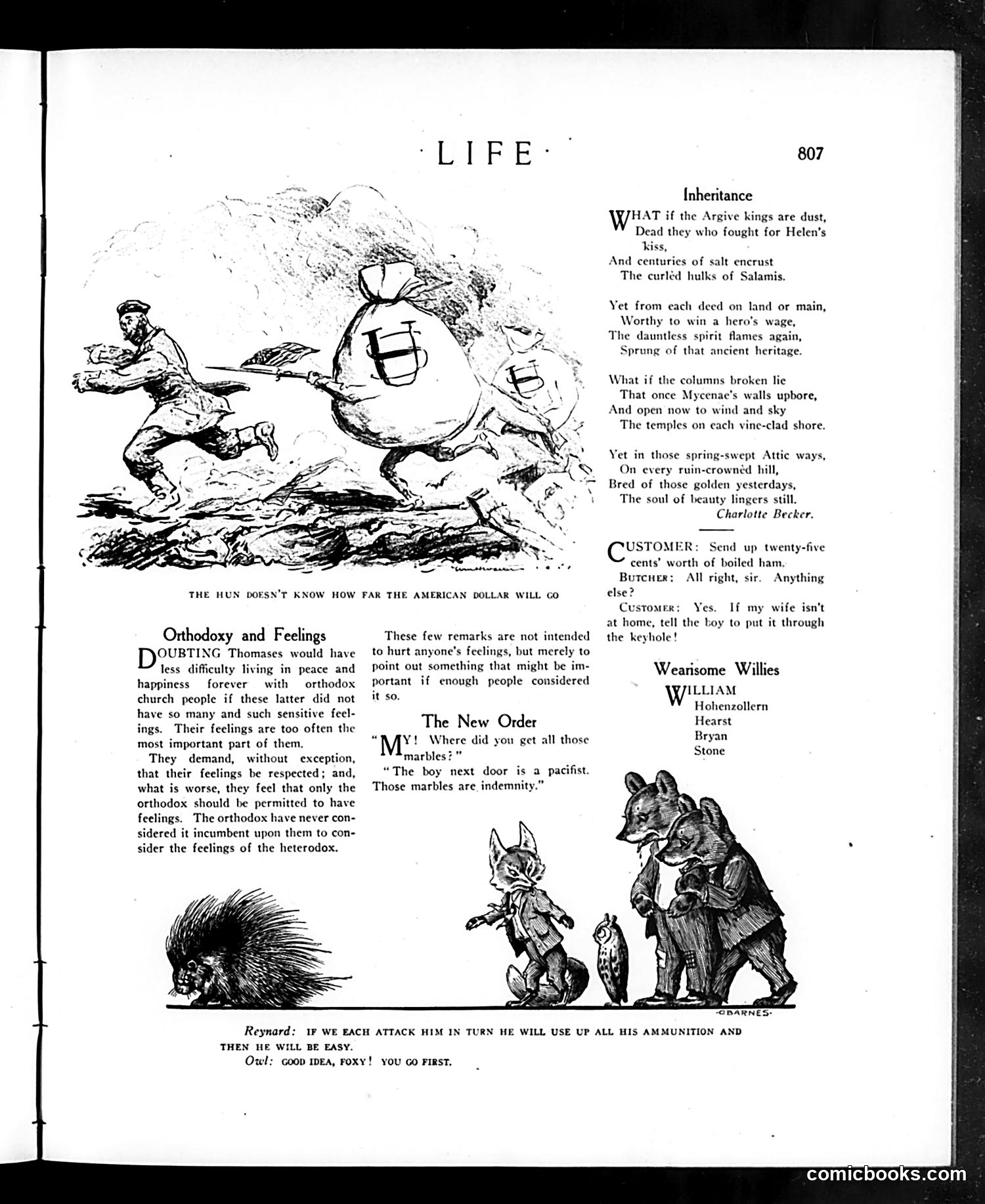
**Top Cartoon:** "The Hen Doesn't Know How Far the American Dollar Will Go" depicts a man chasing two anthropomorphic dollar bills (drawn as round characters with dollar signs). This appears to satirize inflation or currency depreciation—the idea that the dollar's purchasing power is unpredictable or diminishing, so even the "hen" (perhaps representing ordinary citizens or commerce) cannot anticipate its value. **"Orthodoxy and Feelings":** A commentary on religious rigidity. The piece criticizes how orthodox church members prioritize doctrinal conformity over the emotional needs of heterodox (non-conforming) believers, suggesting institutional religion dismisses dissenters' legitimate concerns. **"The New Order":** A fable-like cartoon showing animals discussing pacifism, likely satirizing pre-war peace advocates as naïve.
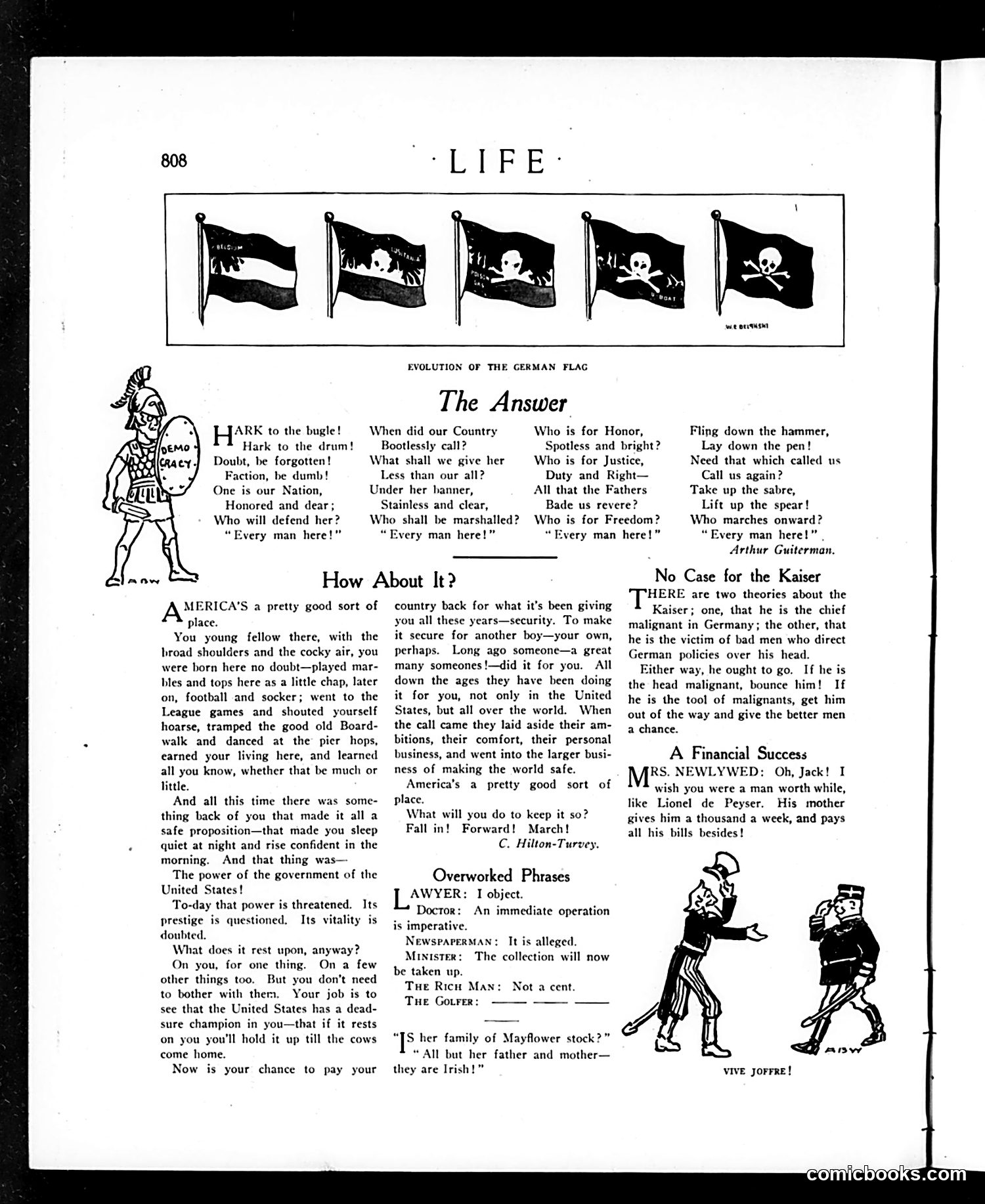
This WWI-era page combines patriotic propaganda with satirical commentary. **Top section:** The "Evolution of the German Flag" cartoon shows five flag designs progressing from a standard flag to increasingly skull-and-crossbones variations, suggesting Germany's moral degradation during the war. **"The Answer":** A patriotic poem by Arthur Guiterman calls Americans to military service, rhetorically asking "Who will defend her?" and receiving the rousing response "Every man here!" **"How About It?":** An appeal to young American men to repay their country's protection by enlisting, framed as a debt owed for the security the U.S. government has provided. **Side content:** "No Case for the Kaiser" argues for removing Kaiser Wilhelm II regardless of whether he's personally evil or merely a puppet. "A Financial Success" mocks a newlywed woman for wishing her husband were wealthier. "Overworked Phrases" satirizes clichéd speech. The bottom joke targets Irish immigrants' status as "outsiders" to old American families. The page overall reflects American pro-intervention sentiment circa 1917.
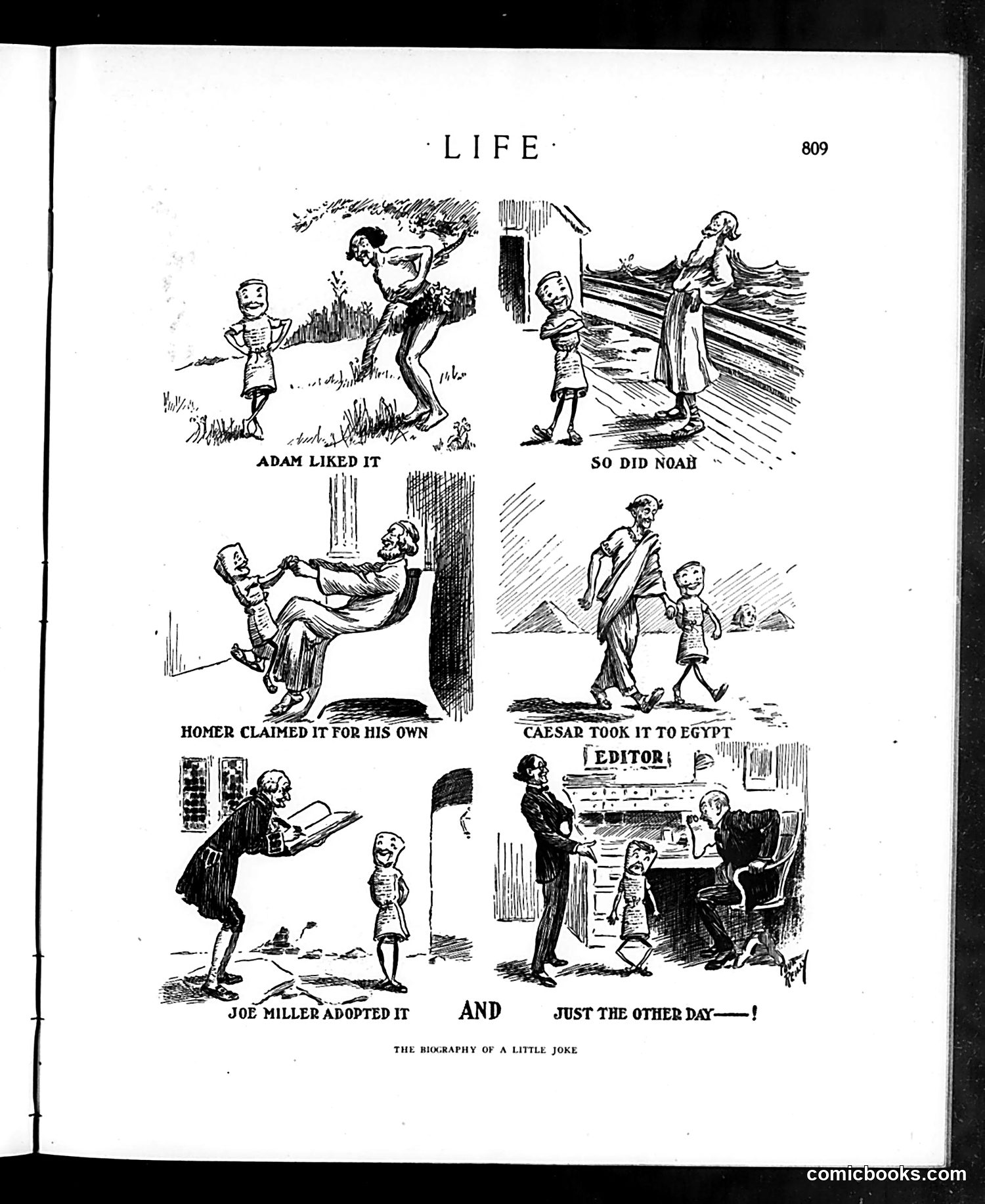
This satirical comic traces how a single joke travels through history and society. The sequence shows: 1. **Adam liked it** - A child discovers the joke in prehistoric times 2. **So did Noah** - The joke survives to biblical times 3. **Homer claimed it for his own** - Ancient writers appropriate it 4. **Caesar took it to Egypt** - Military/political figures spread it 5. **Joe Miller adopted it** - Reference to Joe Miller's Jests, an 18th-century joke collection 6. **Just the other day** - A newspaper editor publishes it as original material The final panel shows the joke reaching a modern newspaper office, where an editor presents it to readers as fresh content, unaware of its ancient origins. The satire mocks how "new" material circulates endlessly through culture—from ancient times through literature, politics, and finally modern journalism—with each person believing they've discovered something original.
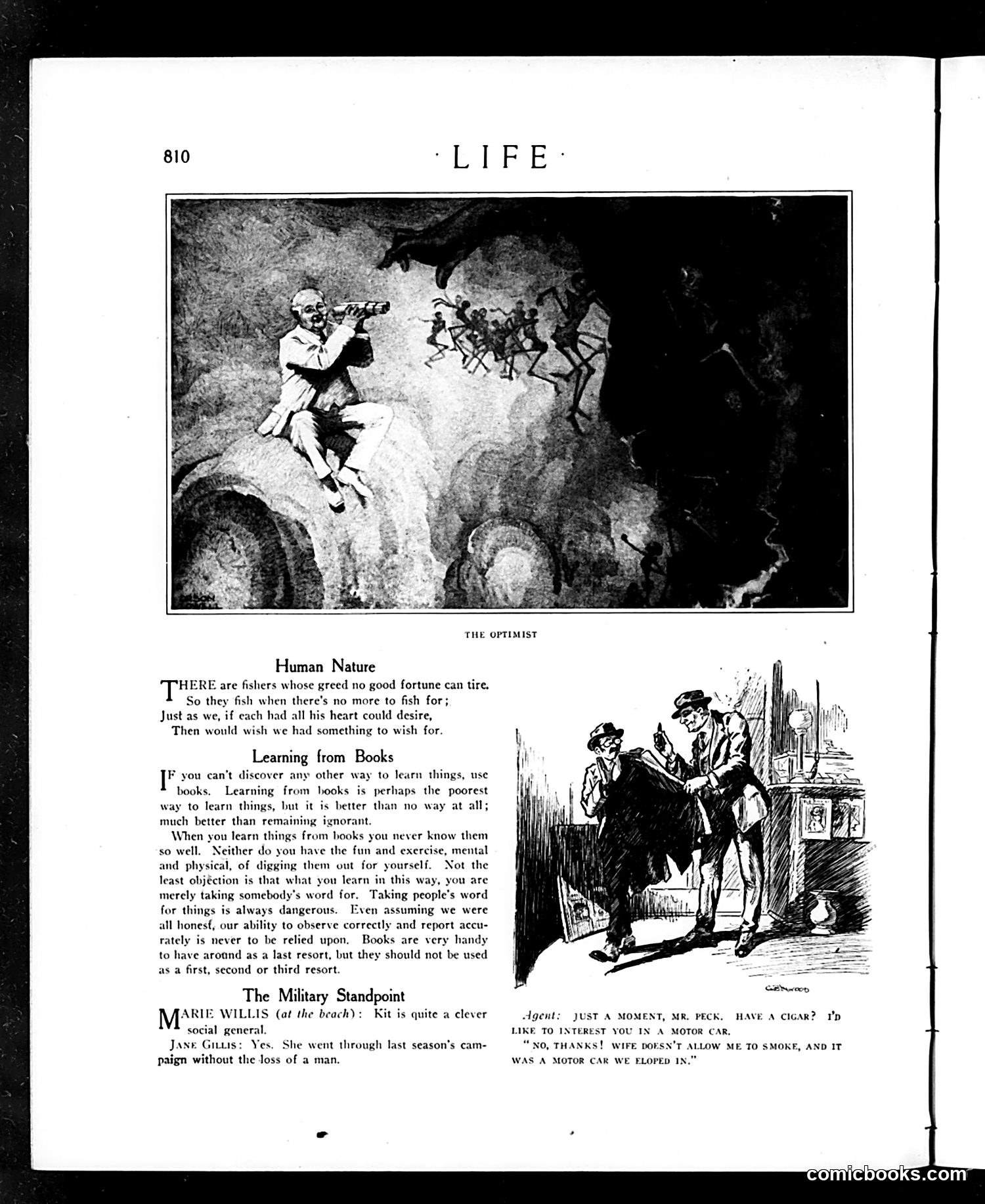
This page contains three satirical pieces mocking human nature and social conventions: **"The Optimist"** (top illustration): Shows a man with a telescope spotting distant figures, satirizing perpetual dissatisfaction—the idea that humans always want what they lack, even when having everything they desire. **"Learning from Books"**: A text essay mocking over-reliance on books as education. It argues learning from books is inferior to direct experience and observation, yet better than ignorance. The satire targets passive acceptance of printed authority without critical thinking or personal investigation. **"The Military Standpoint"**: A dialogue joke where a woman (Kit) is praised for managing a social "campaign" without "loss of a man"—using military terminology to mock women's competitive social maneuvering for marriage prospects. **Bottom cartoon**: An insurance or car salesman attempts to sell Mr. Peck a motor car, but Peck refuses because his wife forbids smoking and a motor car caused their elopement—suggesting cars as both romantic facilitators and marital complications.
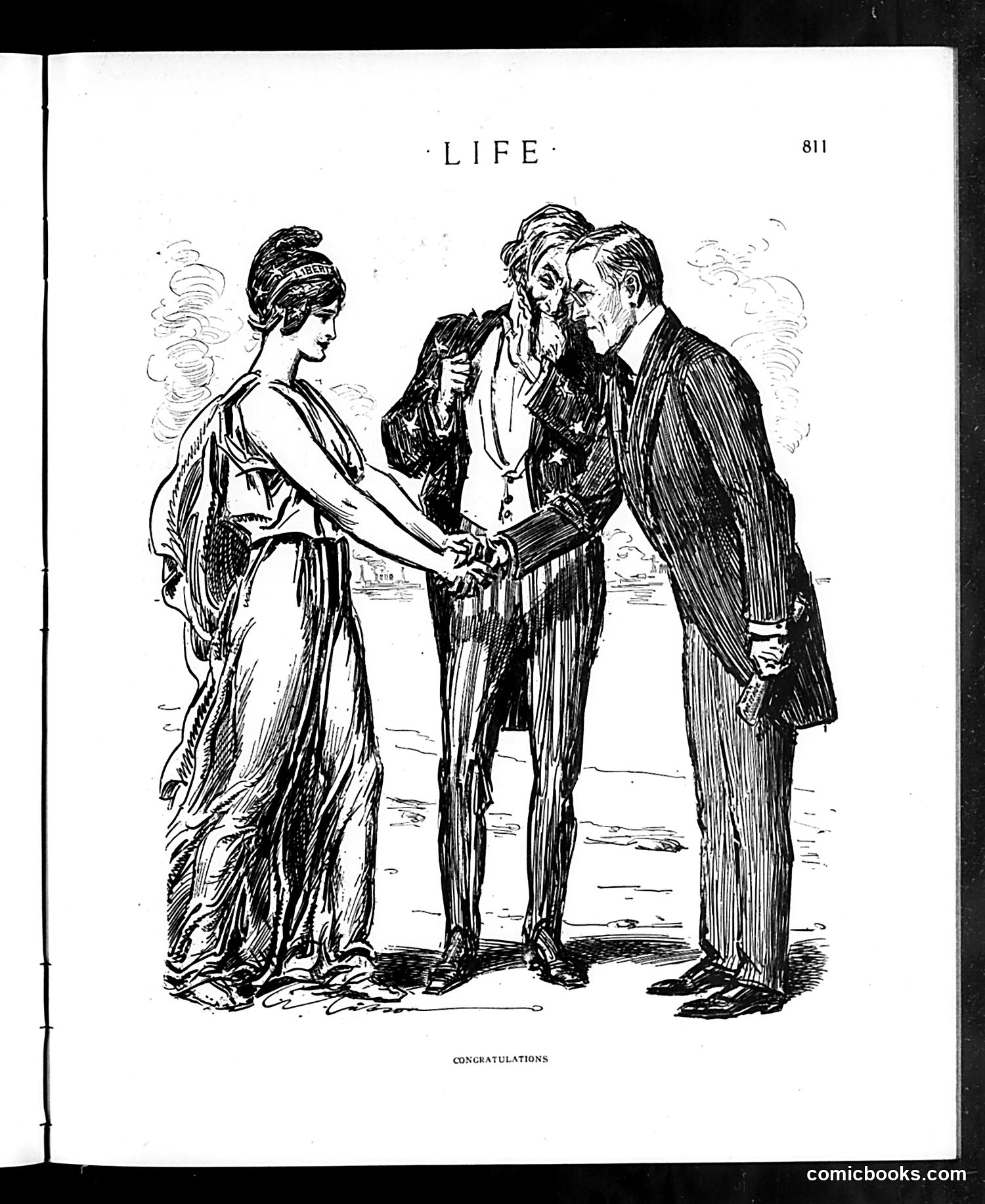
This single-panel cartoon depicts three figures: a woman on the left (dressed classically, possibly representing an allegorical figure or "Lady Liberty") shaking hands with two men in formal Victorian-era dress. The central figure appears elderly with distinctive facial features, while the man on the right wears a dark suit. The caption reads simply "CONGRATULATIONS," suggesting the cartoon comments on some political agreement, merger, or reconciliation between parties. Without additional context about the specific issue date, I cannot definitively identify the historical figures or the exact political event being satirized. The formal handshake suggests a deal or understanding being struck, likely presented ironically given Life magazine's satirical nature.
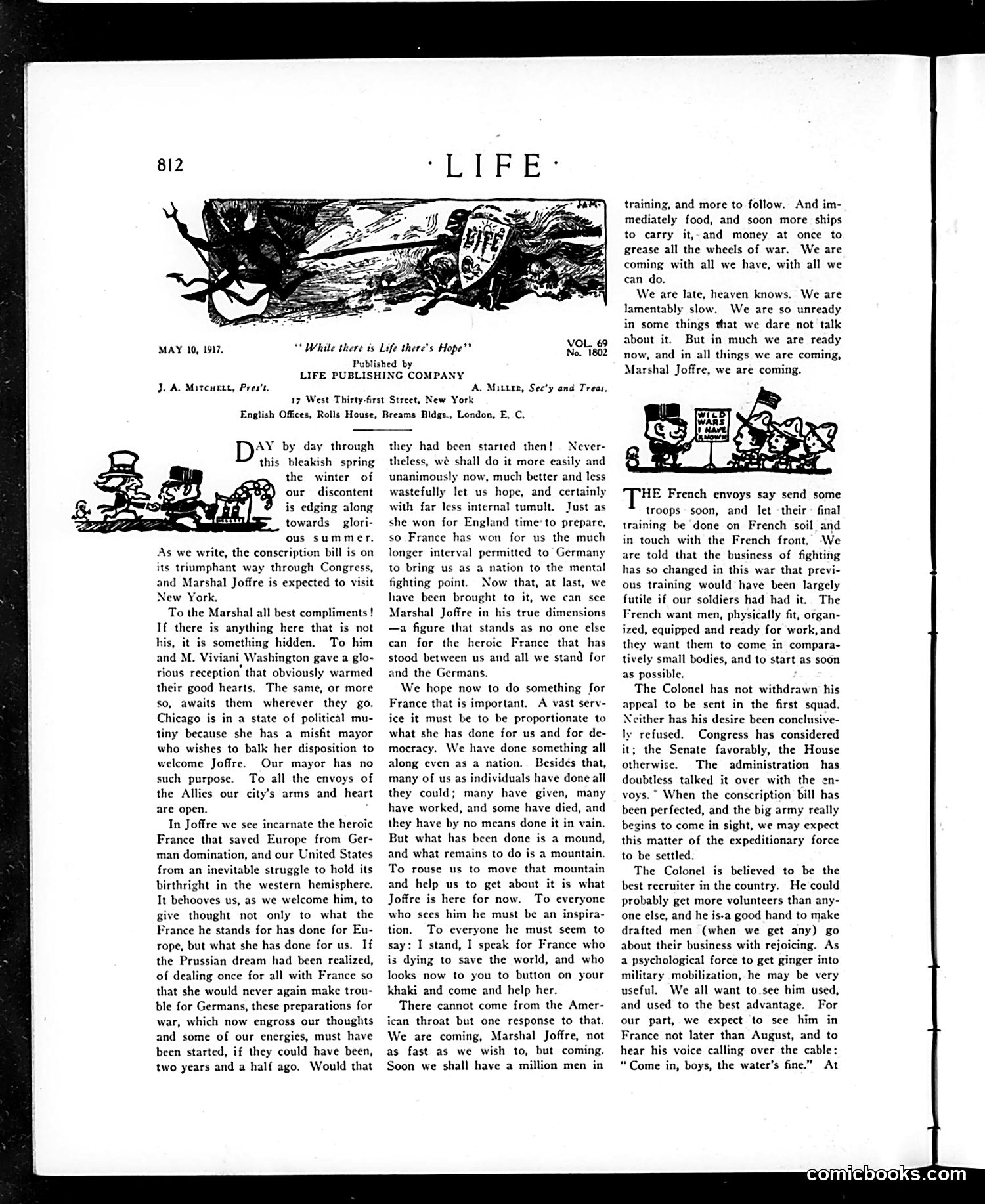
This page celebrates French Marshal Ferdinand Joffre's expected visit to New York during World War I. The cartoon (top left) appears to show figures in a celebratory or triumphant pose, likely depicting American enthusiasm for the French military leader. The text is a patriotic editorial framing Joffre as embodying heroic France—the nation that both saved Europe from German domination and, implicitly, justified America's recent entry into the war (April 1917). The piece criticizes Chicago's mayor for resisting the welcome, while praising New York's open arms to Allied representatives. The editorial uses Joffre's visit as motivation for American mobilization: conscription, troop training, and war production. It acknowledges America's late entry and unpreparedness while pledging commitment—promising "a million men" and supplies soon. This reflects the propaganda and morale-building efforts of early American involvement in WWI.
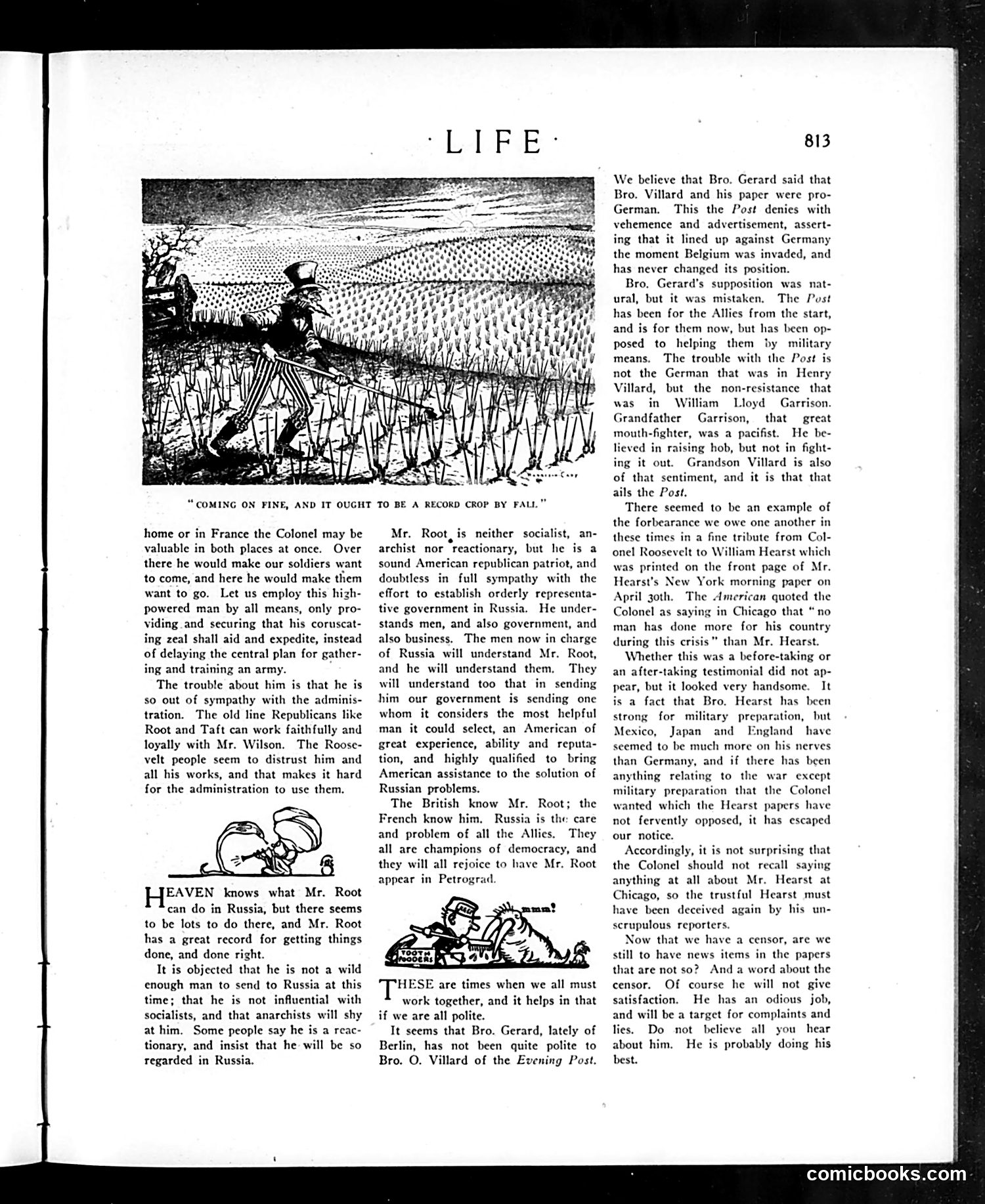
This page contains political editorials rather than cartoons. The main illustration shows a farmer in a field with the caption "Coming on fine, and it ought to be a record crop by fall"—likely a metaphor for American military preparation during World War I. The text discusses sending Elihu Root (a Republican elder statesman) to Russia as a diplomatic envoy, arguing he's qualified despite being viewed as insufficiently radical for dealing with Russian socialists. It also addresses a dispute between Ambassador James Gerard (former Berlin envoy) and Oswald Garrison Villard of the *Evening Post*, accusing the Post of pacifism inherited from abolitionist William Lloyd Garrison. Finally, it praises William Randolph Hearst for supporting military preparedness, citing Roosevelt's public endorsement. The underlying theme: unity and civility are needed during wartime, even among those with political disagreements.
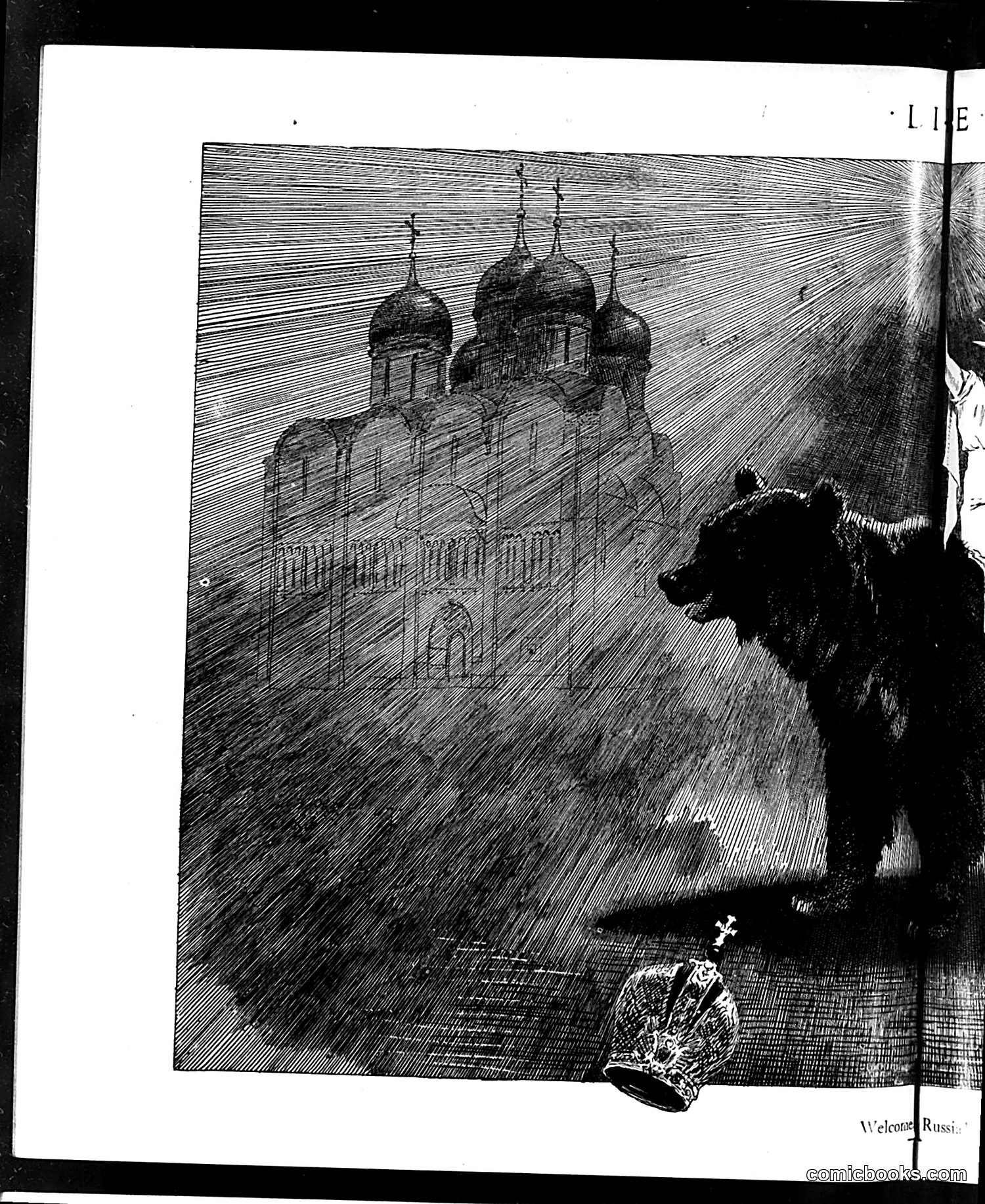
This engraving depicts a silhouetted figure in the foreground (right side) gazing toward an ornate Orthodox church with distinctive onion domes. The caption reads "Welcome Russi." [sic] The work appears to be satirical commentary on U.S.-Russian relations, likely from the early 20th century. The figure's gesture of welcome toward Russian architecture suggests irony—either welcoming Russia into international affairs or, conversely, mocking such overtures. The dramatic lighting and Eastern Orthodox aesthetic emphasize Russia's distinct cultural identity. Without a clear date visible, the specific historical moment remains uncertain, though the style suggests pre-1920s publication. The incomplete caption ("Russi." rather than "Russia") may indicate OCR error or intentional truncation for satirical effect.
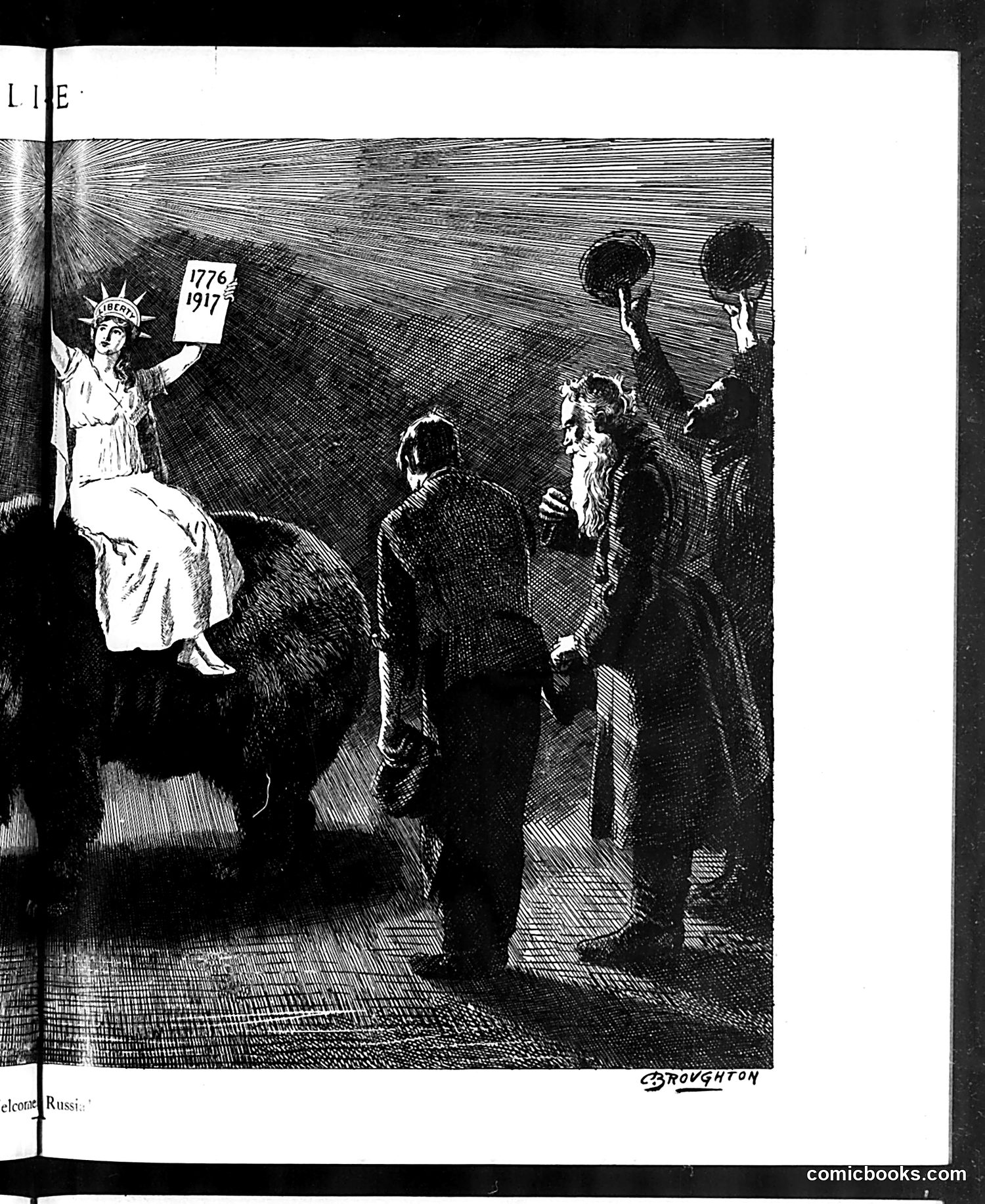
This 1917 cartoon by Broughton depicts Liberty (identified by her crown and torch) presenting a document labeled "1776-1917" to three figures in dark coats—likely representing American political or military leaders. The 141-year span marks America's independence through America's entry into World War I. The cartoon appears to satirize the contrast between American revolutionary ideals and contemporary 1917 realities. Liberty holds the founding document while the men below appear to gaze upward, suggesting they're being reminded of or challenged to honor original principles during wartime. The text fragment mentioning "Russia" likely references the Russian Revolution (occurring simultaneously), adding geopolitical context. The satire likely questions whether America's war involvement aligns with its founding democratic values.
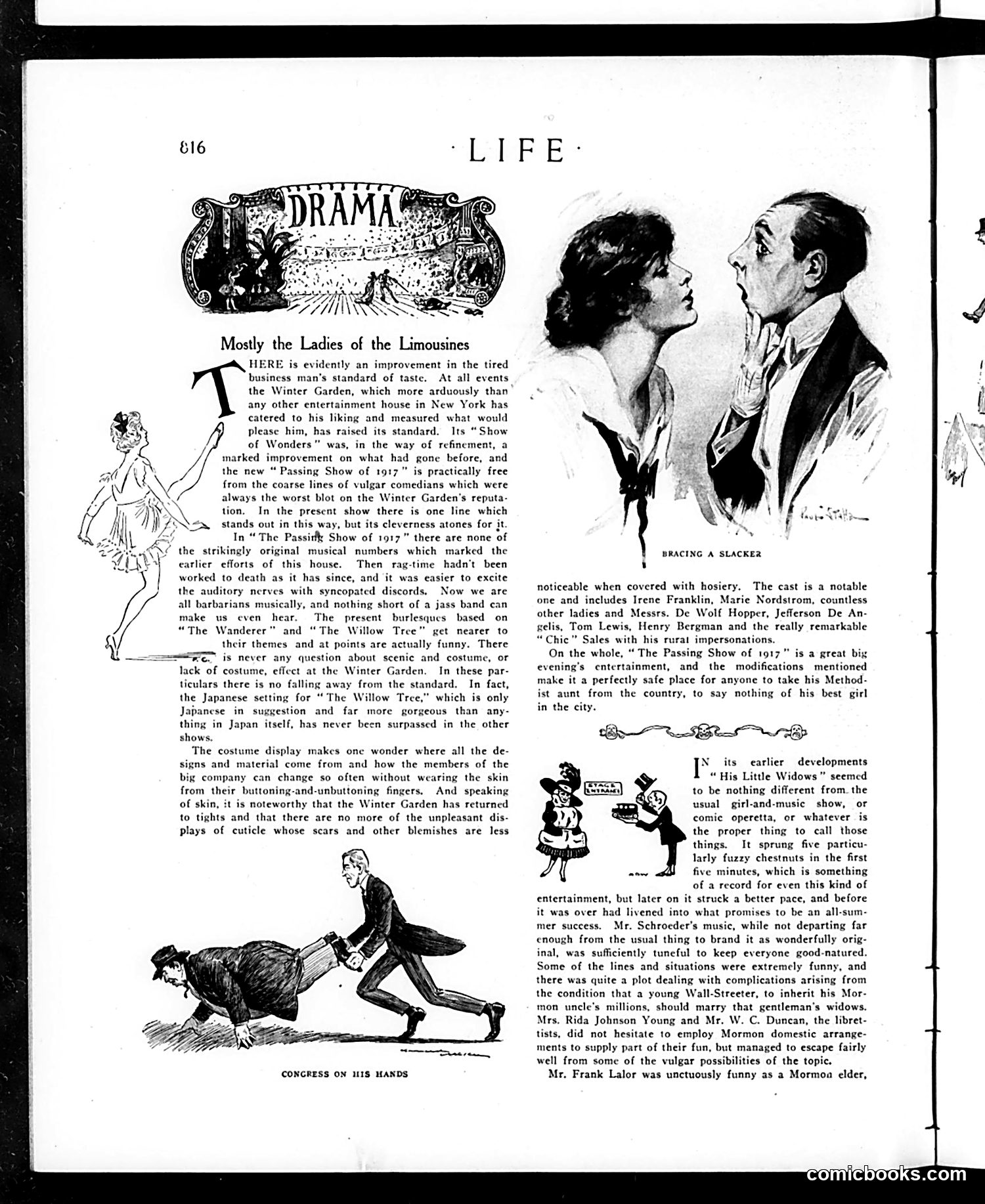
This page reviews two Broadway shows at the Winter Garden theater. The main article praises "The Passing Show of 1917" for raising standards at a venue historically known for catering to "tired business men" with vulgar comedy. The reviewer notes improvements in refinement while acknowledging the shows lack original musical numbers—ragtime having been "worked to death." The cartoons illustrate the shows' appeal: "Bracing a Slacker" depicts a romantic scene (the couple shown in profile), while "Congress on His Hands" (bottom left) shows a man apparently struggling with a woman, likely satirizing the comedic physical business typical of these revues. The secondary review of "His Little Widows" describes a plot involving a Wall Street man marrying multiple widows to inherit a Mormon uncle's fortune—using contemporary concerns about inheritance and unconventional marriage arrangements for comedic effect. The "Ladies of the Limousines" subtitle suggests these shows appealed to wealthy female audiences, not just businessmen.
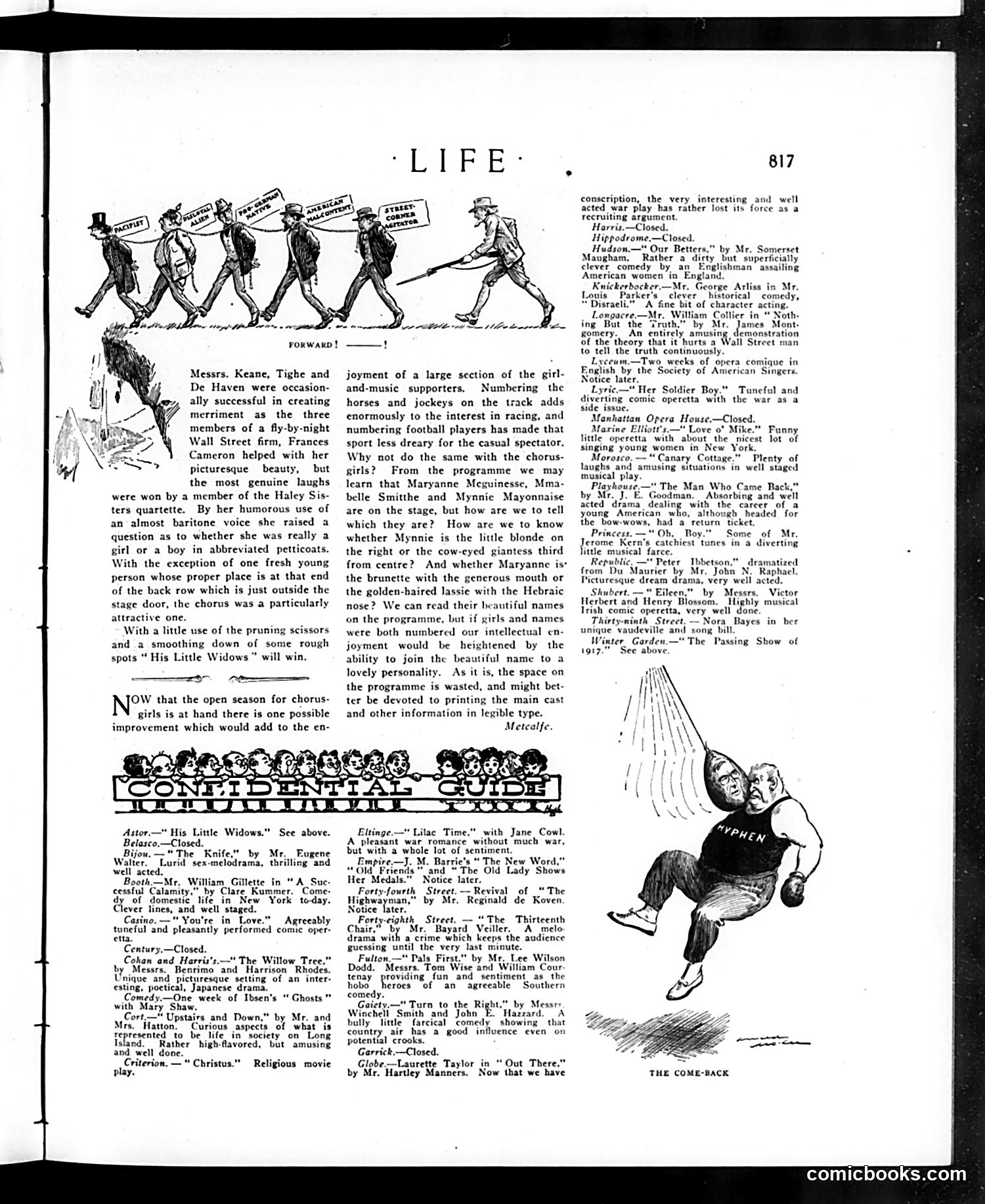
The top cartoon depicts five figures labeled as Wall Street financial firms being pulled forward by a sixth figure—likely representing the government or regulatory authority—using a rope. The caption "FORWARD!" suggests governmental pressure pushing reluctant businessmen toward compliance or reform during the Progressive Era. Below, the text reviews theatrical productions, with particular satire directed at chorus girls. The critic proposes numbering chorus girls like horses at racetracks or football players, arguing this would enhance audience enjoyment by allowing spectators to match names from programs to actual performers on stage. This tongue-in-cheek suggestion satirizes both the objectification of female performers and the contemporary obsession with quantification and organization in entertainment and sport. The review mocks theater management for wasting program space while suggesting the reduction of women to mere numbered objects.
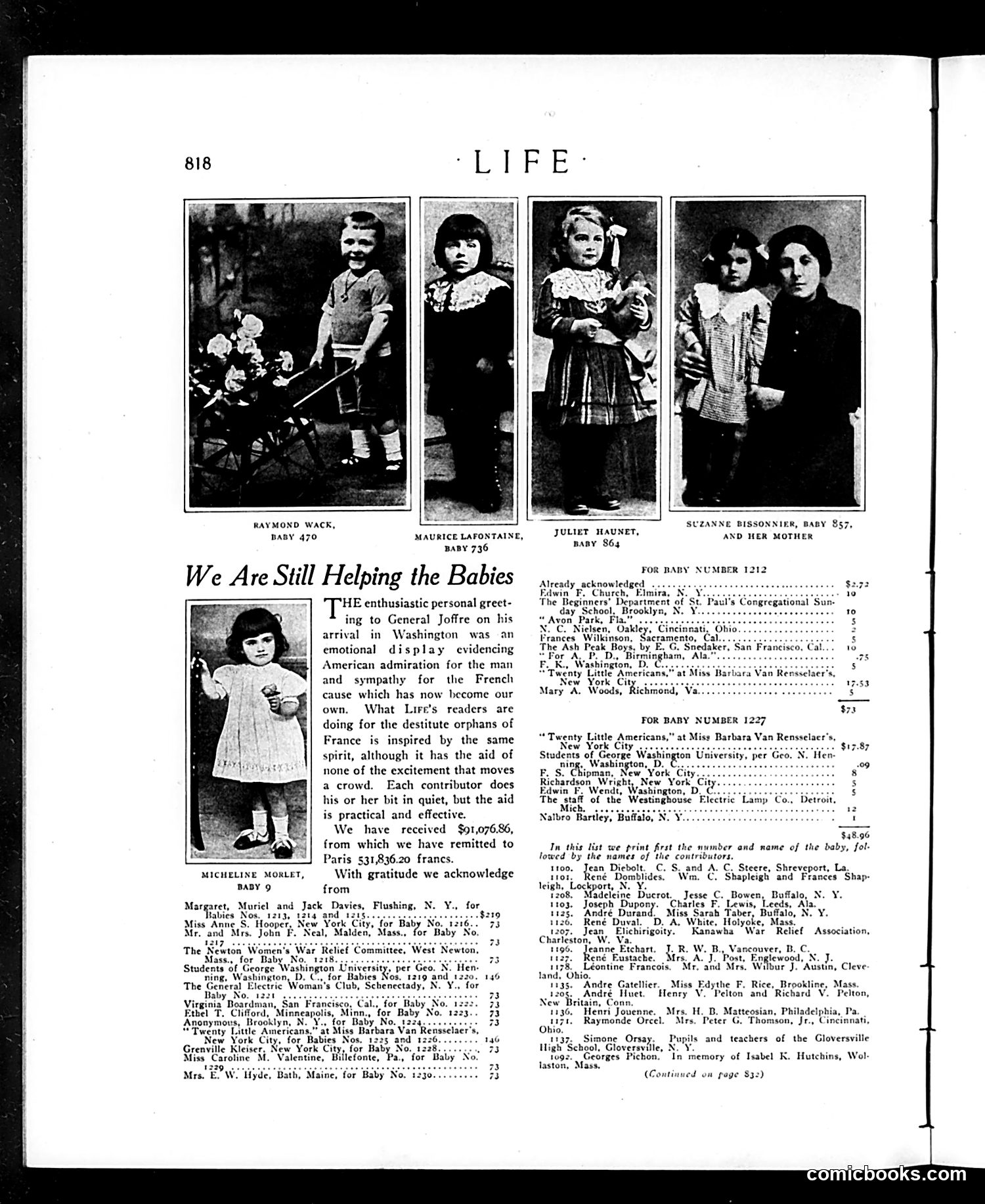
This page documents Life magazine's charitable drive to support French war orphans during World War I. The top features photographs of four French children being sponsored by American donors—Raymond Wack (Baby 470), Maurice Lafontaine (Baby 736), Juliet Haumet (Baby 864), and Suzanne Bissonnier with her mother. The article references General Joffre's recent arrival in Washington, noting that American sympathy for France's WWI suffering has inspired this ongoing relief effort. Rather than sensational fundraising, Life emphasizes "quiet" but "practical and effective" aid. The bulk of the page lists contributors' names and the babies they sponsor, along with donation amounts. This transparency—printing donor names alongside specific babies—was intended to validate the program's legitimacy and encourage further contributions. The campaign had raised $91,076.86 by this point, remitted to Paris as 531,836.20 francs.
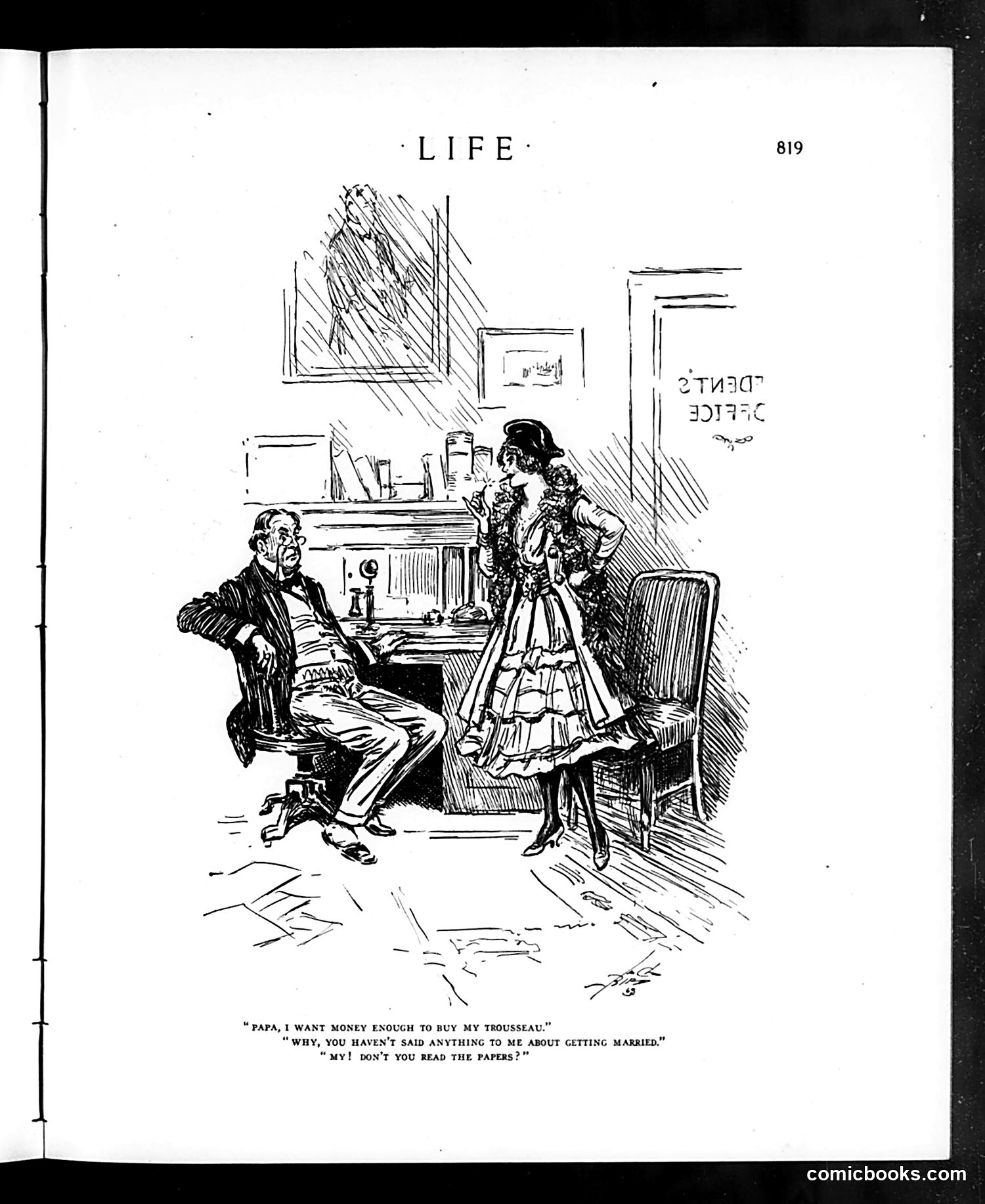
This is a single-panel cartoon from *Life* magazine (page 819) depicting a domestic scene. A young woman in fashionable dress approaches a seated man (presumably her father, based on "PAPA" in the dialogue) at his desk in what appears to be a study or office. The joke turns on a generational clash about marriage and materialism. The daughter asks for money to buy a trousseau (wedding clothing/linens), implying she's getting married. The father, apparently unaware of this development, responds with surprise that she hasn't mentioned marriage. The daughter deflects by asking if he reads the newspapers—suggesting her engagement should have been public knowledge, or humorously implying the father is out of touch. The satire gently mocks both parental obliviousness and young women's focus on acquiring luxury goods for marriage.
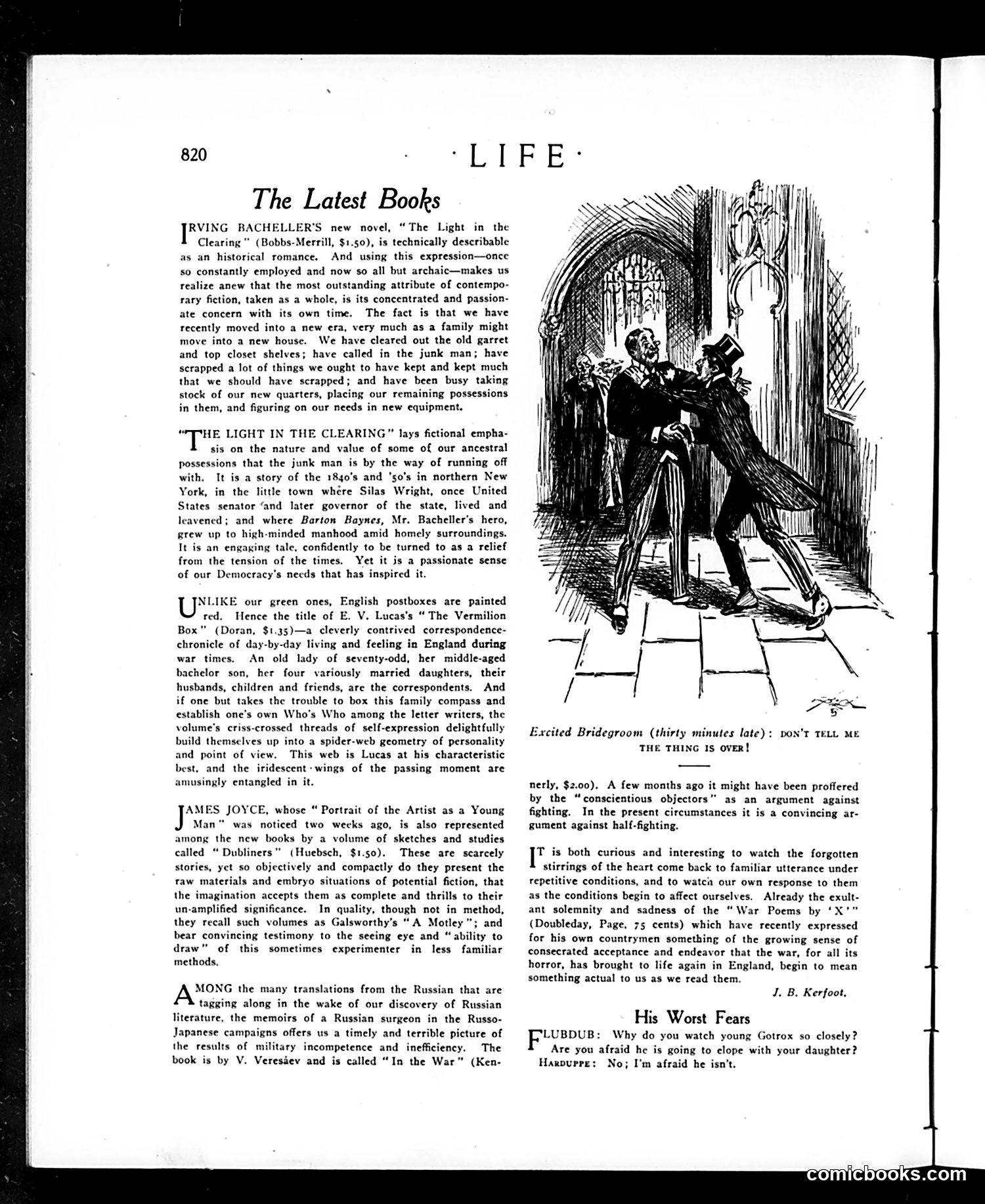
This is a book review page from *Life* magazine featuring literary criticism, not political cartoons. The small illustration shows an "Excited Bridegroom (thirty minutes late)" rushing into what appears to be a wedding ceremony, with the caption "DON'T TELL ME THE THING IS OVER!" This is a humorous domestic scene playing on the anxiety of arriving late to one's own wedding—a timeless source of comedy. The cartoon has no political content; it's simply a light joke about wedding day jitters. The page reviews contemporary novels including Irving Bacheller's "The Light in the Clearing" (historical fiction set in 1840s New York), E.V. Lucas's "The Vermilion Box" (wartime correspondence), James Joyce's "Dubliners," and a Russian memoir about military incompetence. The reviews discuss how modern literature focuses on contemporary concerns rather than historical romance.
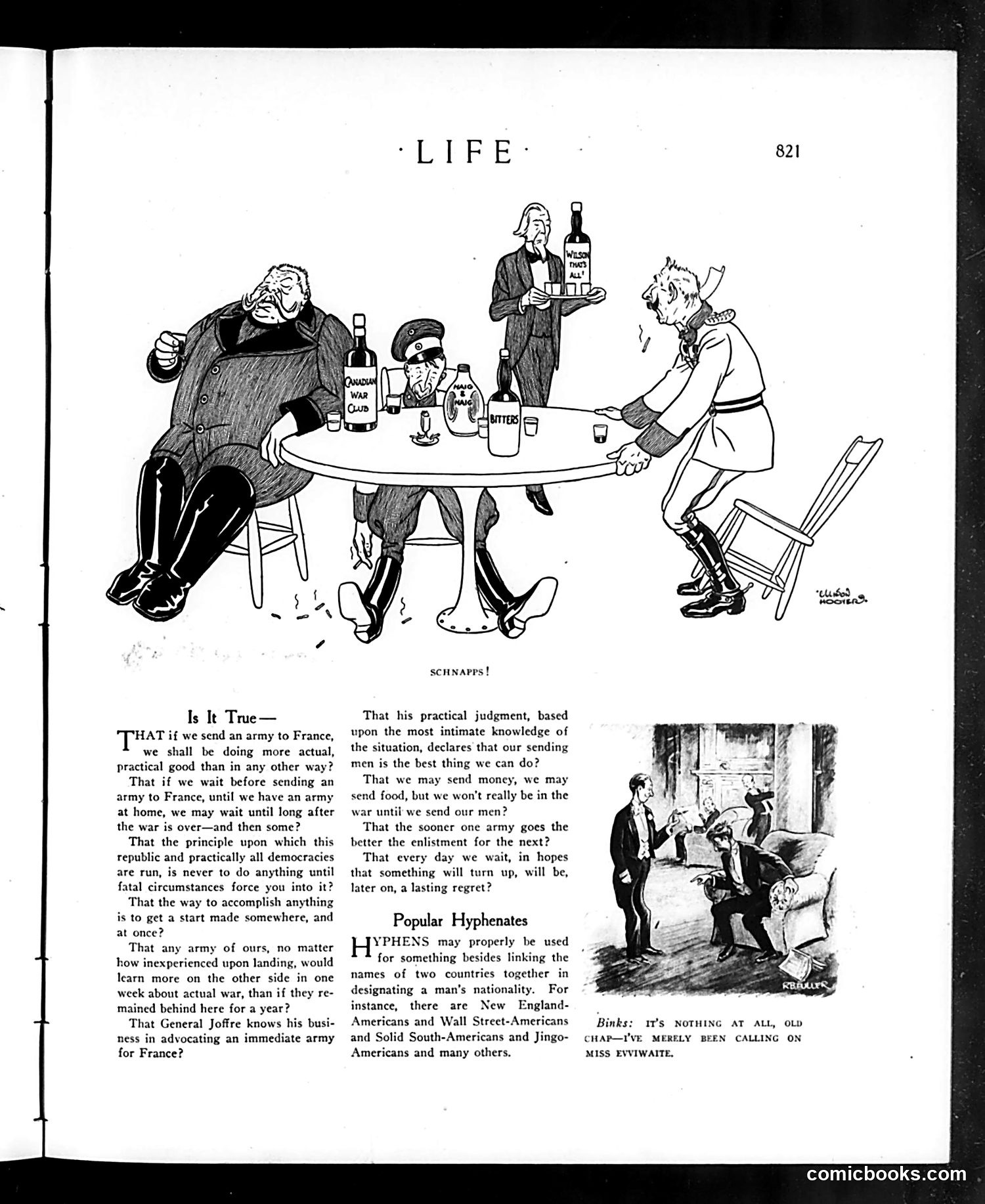
**Top Cartoon ("Schnapps!")**: Depicts four men drinking around a table laden with bottles. The figure on the left appears intoxicated and emotional. This satirizes arguments for immediate American military intervention in World War I. The caption lists rhetorical questions advocating sending troops to France without delay—framed as self-evident "truths." The cartoon mocks this reasoning as drunken logic, suggesting those pushing for immediate intervention are either inebriated or speaking nonsense. **Text Section "Is It True"**: The article sarcastically presents arguments made by General Joffre (French military commander) for immediate American troop deployment, questioning whether waiting for proper military preparation at home is actually prudent democratic policy. **Bottom Cartoon**: Unrelated social humor about a man awkwardly explaining his visit to a woman to another man. **"Popular Hyphenates"**: Critiques Americans divided by regional or class loyalties ("Wall Street-Americans," "Jingo-Americans"), suggesting fragmented national identity during the pre-war period. The page reflects American debate over entering WWI.
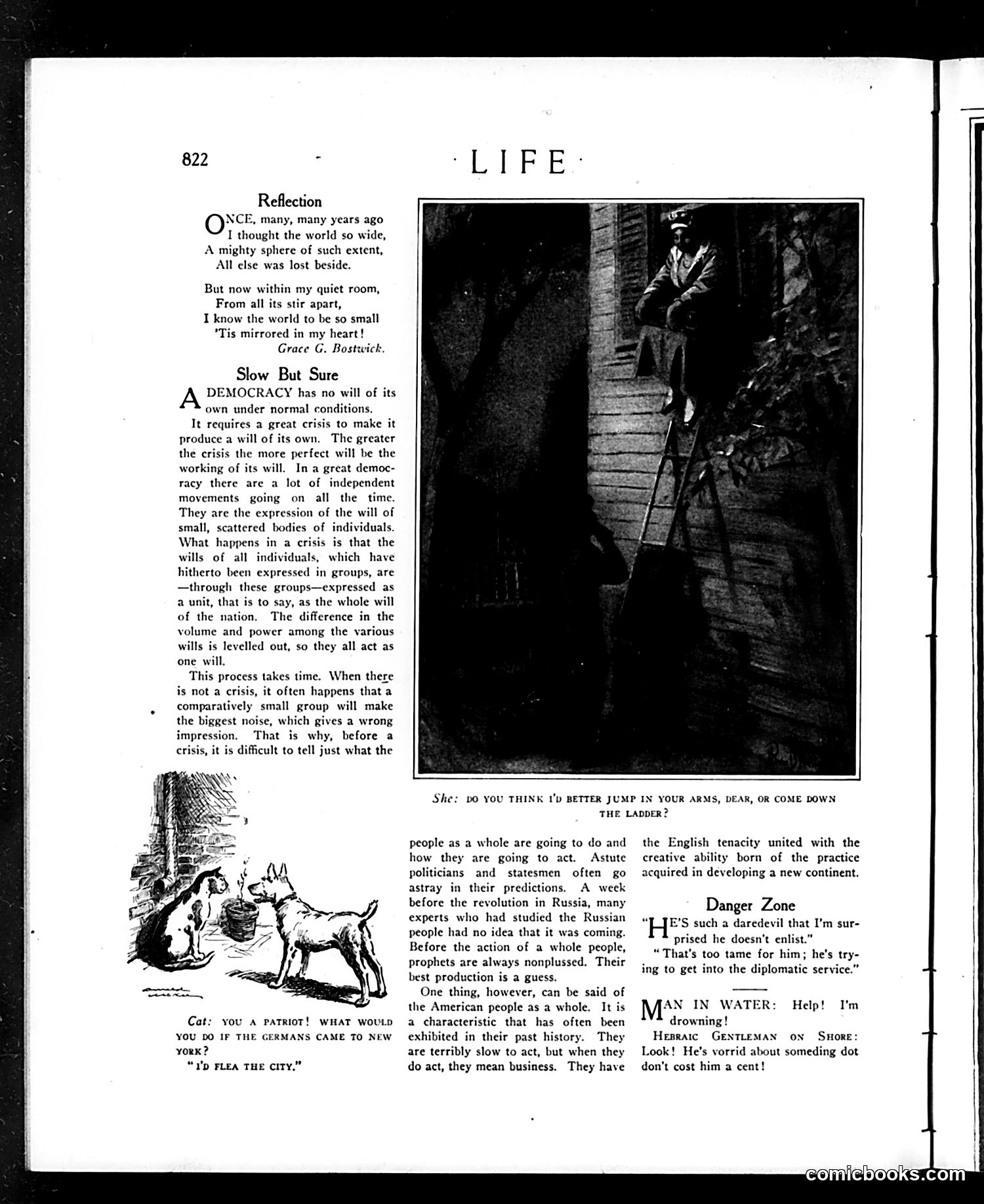
This page contains three satirical elements reflecting American anxieties during World War I: **"Cat" cartoon (lower left):** A cat claims it would "flee the city" if Germans invaded New York—mocking pacifists or cowards who prioritize self-preservation over patriotic duty. **"She/Ladder" cartoon (upper right):** A woman on a ladder asks a man below whether to jump into his arms or climb down—likely satirizing dramatic or foolish behavior during wartime hysteria. **"Man in Water" cartoon (lower right):** Features an immigrant character (indicated by dialect: "vorrid," "someding dot") drowning, while a bystander ironically notes he's worried about "something dot don't cost him a cent"—mocking immigrant concerns about monetary loss during a life-threatening crisis, or satirizing immigrant attitudes toward wealth. The page's essay "Slow But Sure" discusses democracy's need for crisis to unite citizens, contextualizing these cartoons as commentary on American readiness and social divisions during the war period.
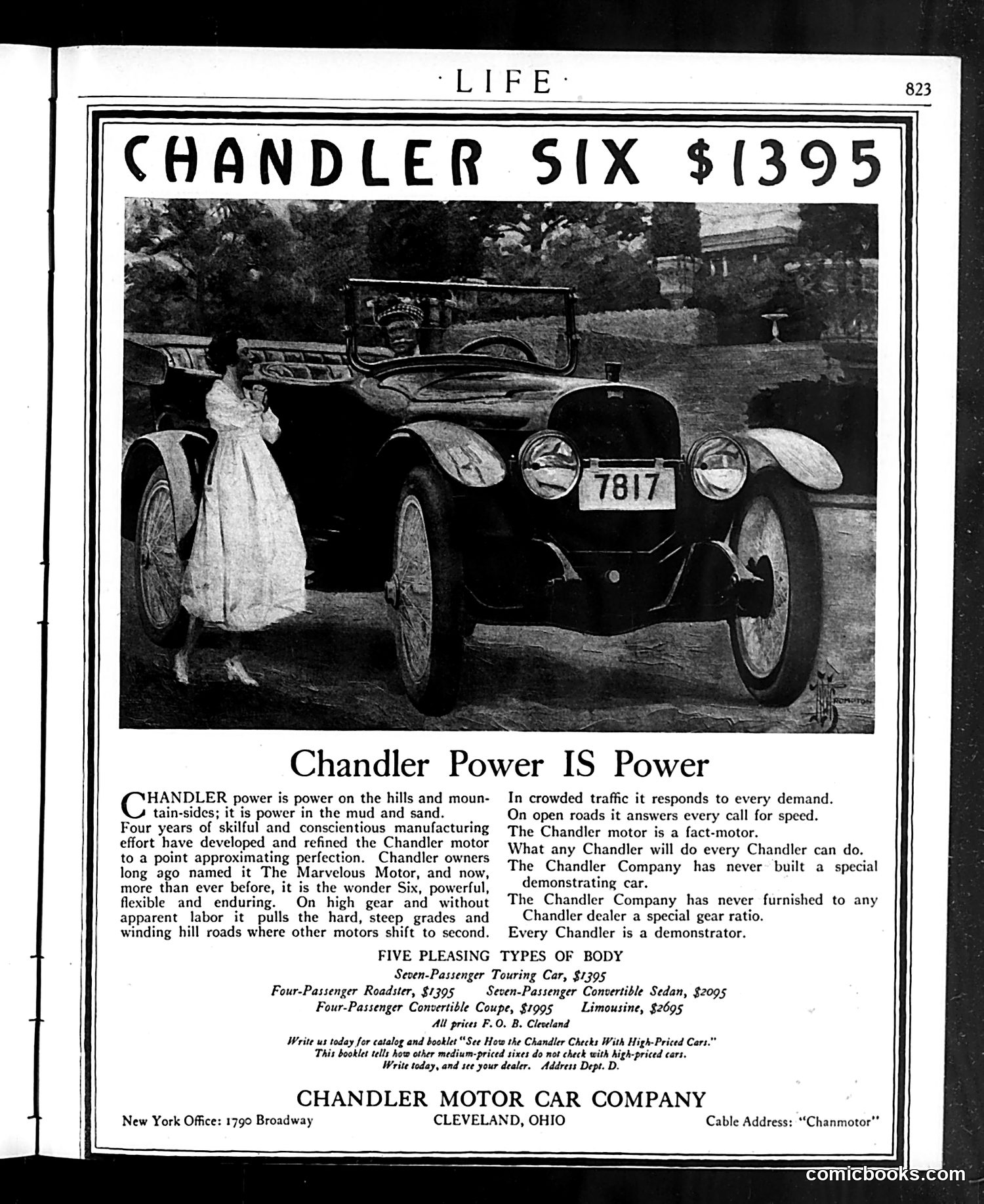
This is not a political cartoon but rather a **full-page automobile advertisement** from Life magazine (page 823). The image shows a **Chandler Six automobile** priced at $1,395, photographed with a woman in period dress standing beside it. The car bears a license plate reading "7817." The advertisement makes no satirical or political points. Instead, it's a straightforward marketing pitch emphasizing the Chandler motor's reliability and power—particularly its performance on hills and rough terrain ("power on the hills and mountain-sides; it is power in the mud and sand"). The text stresses that every Chandler performs identically, with no special demonstrator models or gear ratios favoring dealers. This represents typical early-20th-century automotive advertising, targeting consumers interested in purchasing a mid-range "six-cylinder" vehicle. The presence in Life magazine reflects advertising's integration into satirical publications of that era.
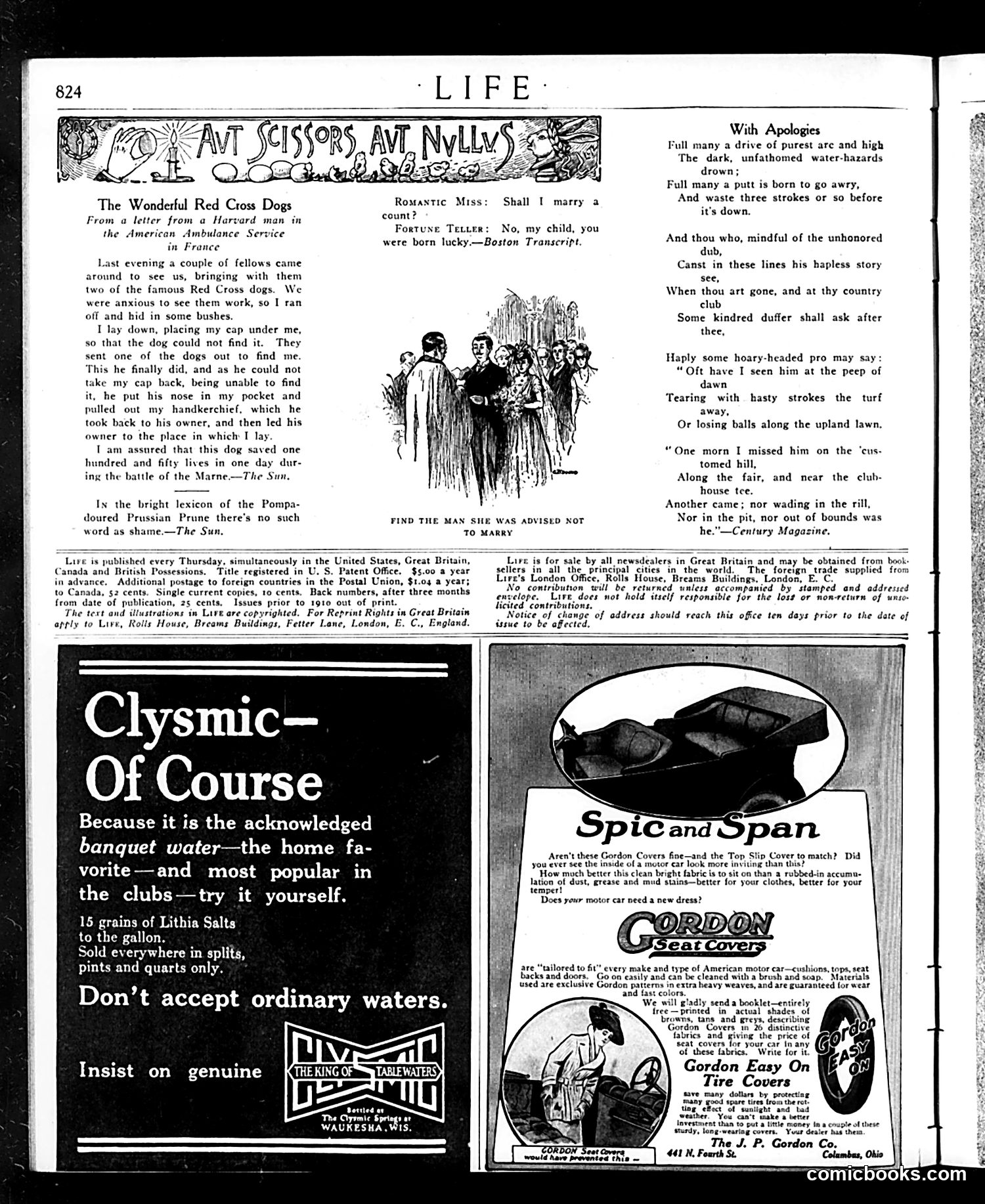
**Main Content: "The Wonderful Red Cross Dogs"** This is a wartime anecdote (appearing to reference World War I, given references to the Battle of the Marne and American Ambulance Service in France). The story describes a Red Cross search-and-rescue dog's remarkable ability: it located a hidden soldier and retrieved his handkerchief, then led its handler to him. The accompanying claim that such dogs saved 150 lives in a single battle celebrates their wartime heroism. **Poetry Section: "With Apologies"** This parodies Shakespeare's Sonnet 29, recontextualizing romantic language to mock a golfer's mediocrity. Instead of tragic love, the poem humorously documents a poor golfer's failures—missed putts, lost balls—and imagines how country-club peers will mockingly remember him after he's gone. **Visual Content:** The cartoon shows two figures in conversation with the caption "FIND THE MAN SHE WAS ADVISED NOT TO MARRY," illustrating the ironic gap between warning and reality. **Remainder:** The page contains advertisements for mineral water and automobile seat covers—typical period advertising.
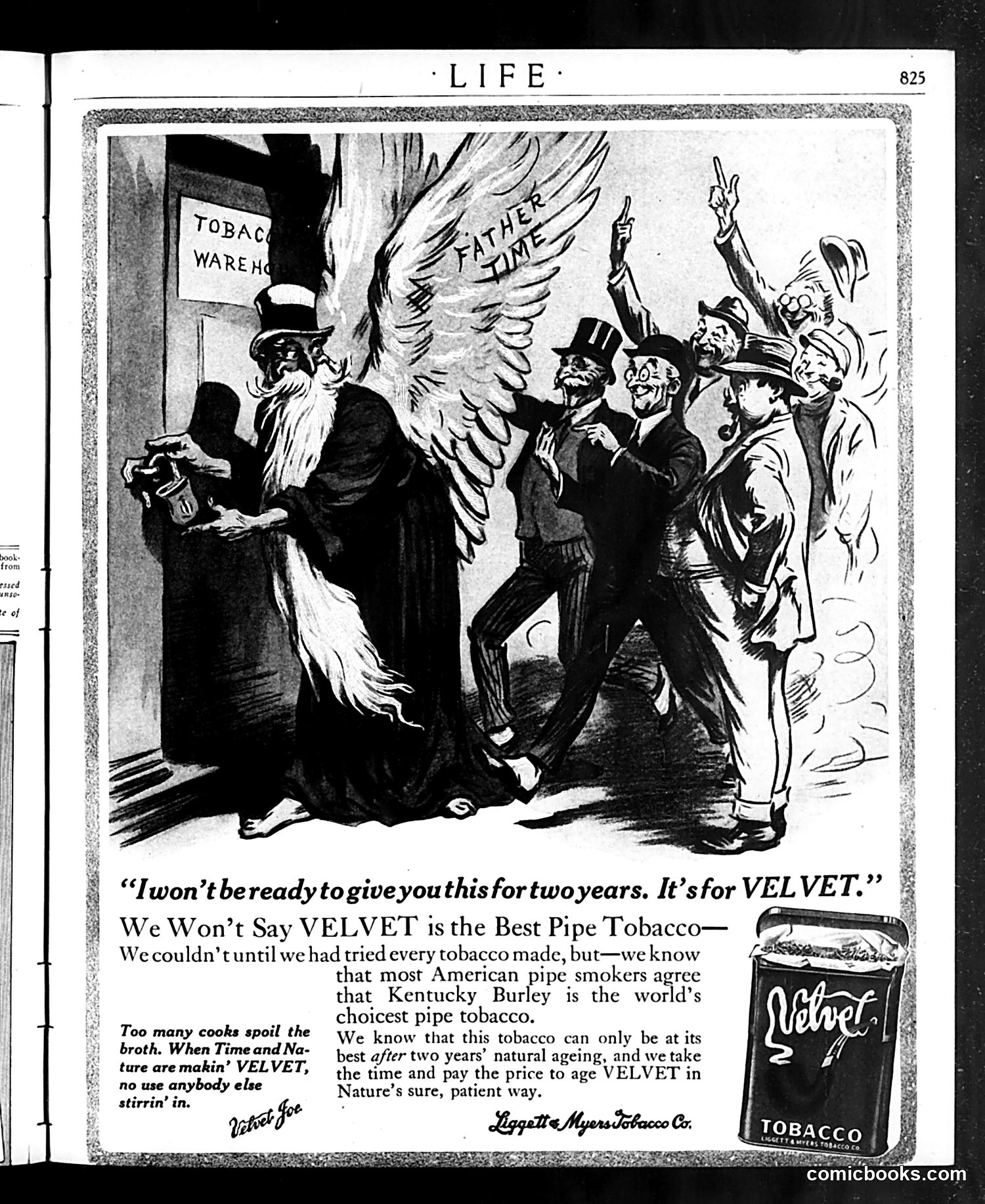
This page is primarily a **tobacco advertisement** for Velvet brand pipe tobacco, not political satire. The cartoon depicts Father Time (the winged figure labeled "Father Time") guarding a tobacco warehouse from a group of impatient men in top hats—likely representing tobacco merchants or competitors. They're clamoring for the product, but Father Time refuses, saying "I won't be ready to give you this for two years. It's for VELVET." The **satire's point**: The ad mocks competitors who rush their product to market. Velvet claims superiority through patience—aging tobacco naturally for two years rather than forcing quick production. The "too many cooks spoil the broth" proverb reinforces this message. The caricatured men appear to represent impatient businessmen or rival tobacco makers, not specific political figures. This is **commercial satire**, using humor to sell a product by contrasting Velvet's careful methods against industry shortcuts.
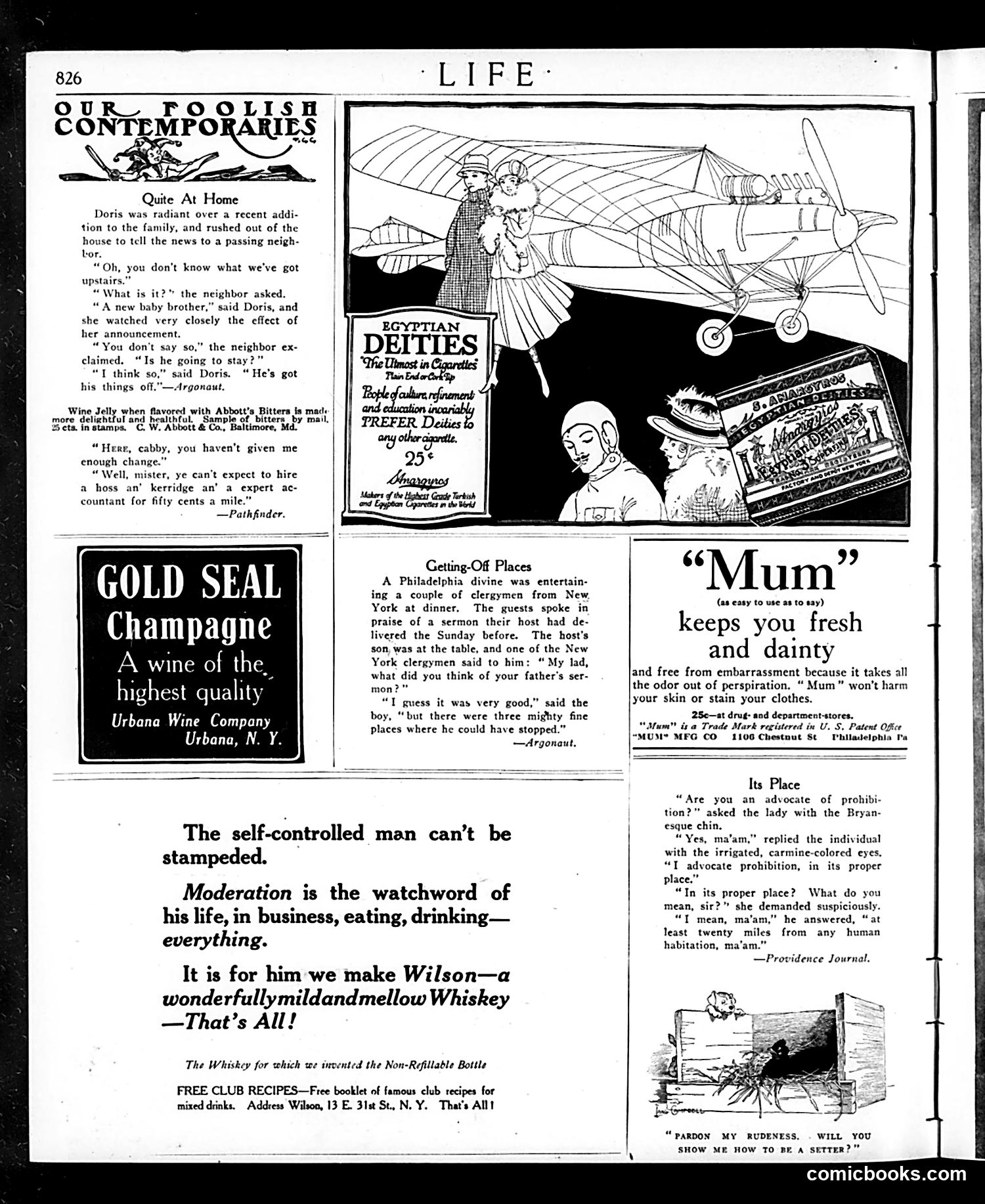
This page contains several short humorous anecdotes and advertisements typical of early 20th-century satirical journalism. **"Quite At Home"** jokes about a child's innocent misunderstanding—when told her new baby brother "has his things off," she means he's unpacked, but the neighbor's question "Is he going to stay?" implies concern about whether the parents will keep him. **"Getting-Off Places"** satirizes false piety: a minister's son, asked about his father's sermon, diplomatically praises it while revealing there were "three mighty fine places where he could have stopped"—suggesting the sermon was tediously long. **"Its Place"** mocks prohibition advocates through a drunk man who claims to support prohibition "in its proper place"—twenty miles from human habitation, meaning he wants to drink without interference. The advertisements (Gold Seal Champagne, Egyptian Deities cigarettes, Mum deodorant, Wilson Whiskey) are period-typical. The Wilson ad ironically emphasizes "moderation" while promoting whiskey—reflecting Prohibition-era tensions about alcohol consumption.
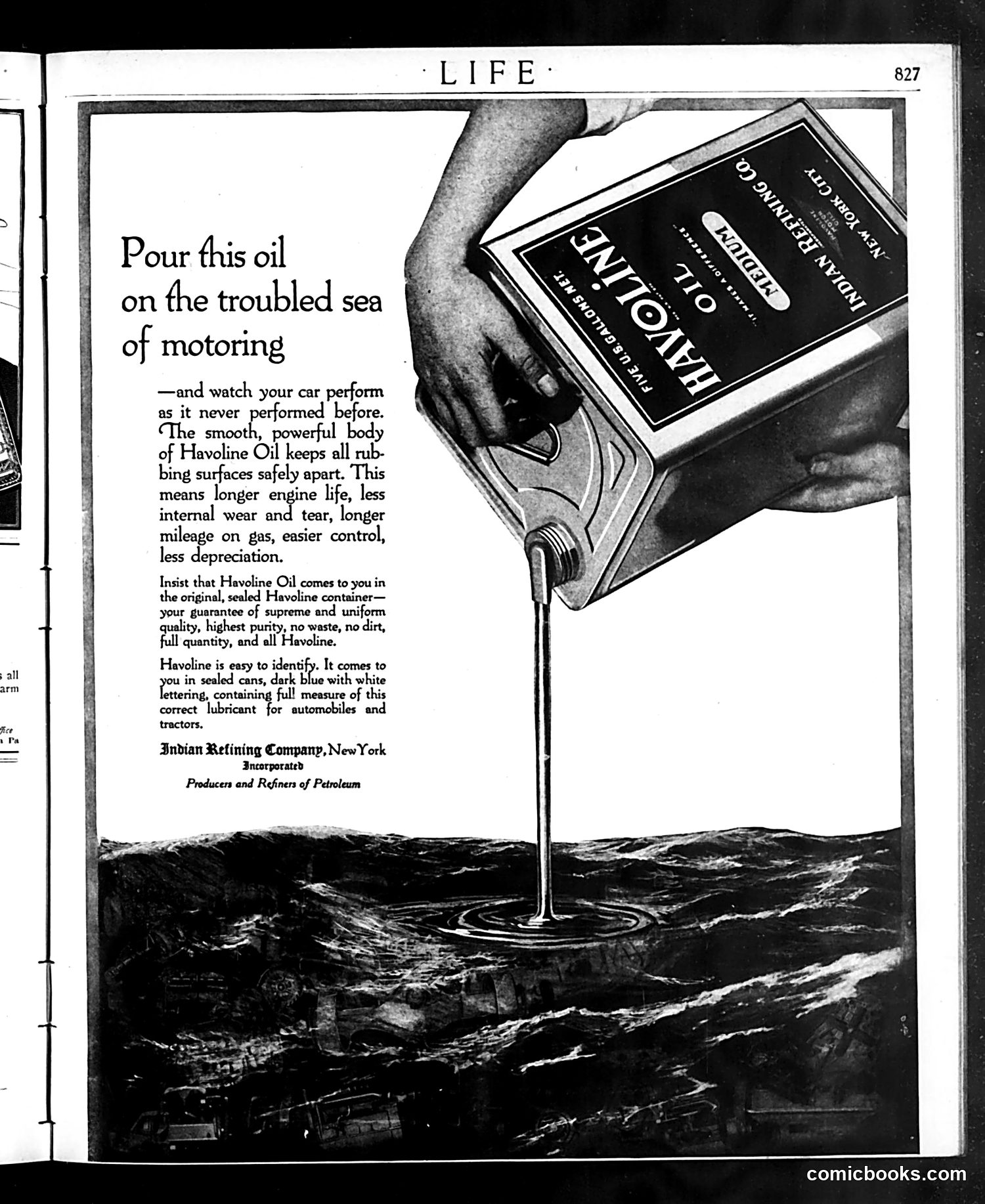
This is a **motor oil advertisement**, not a political cartoon. The page is from Life magazine (page 827) and promotes Havoline Oil by the Indian Refining Company. The ad uses metaphorical language—"Pour this oil on the troubled sea of motoring"—playing on the biblical phrase "pour oil on troubled waters" to suggest the product will smooth out car troubles. The visual shows oil being poured onto actual water, literalizing the metaphor. The pitch emphasizes product reliability: sealed containers guarantee purity and prevent adulteration, which was a genuine consumer concern in early automotive days. The claims about longer engine life, better gas mileage, and easier control reflect period anxieties about vehicle performance and maintenance. This is straightforward commercial messaging, not satire or social commentary.
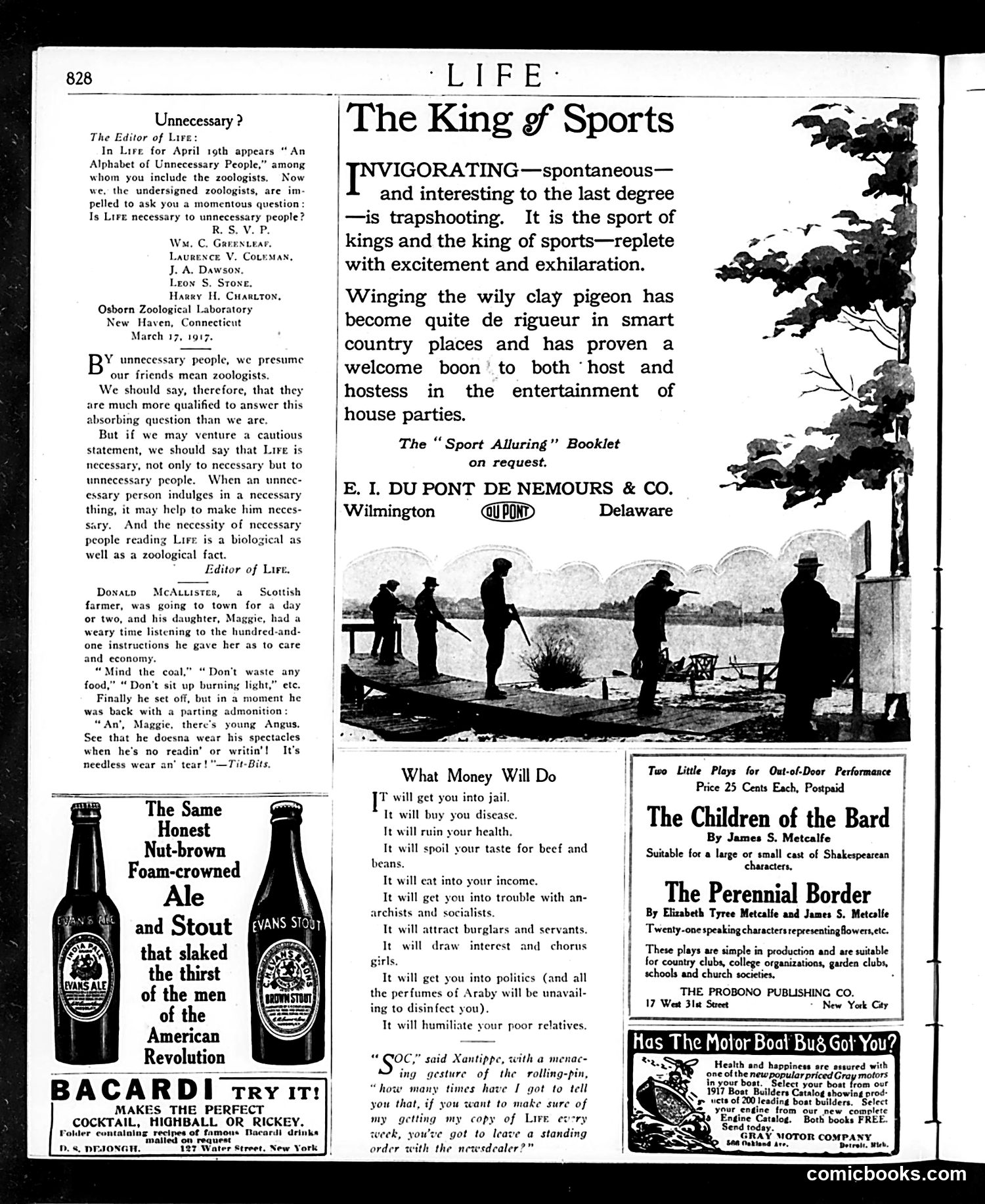
This page is primarily **advertising and reader correspondence**, not political cartoons. The main content includes: **Letters to the Editor**: Zoologists humorously protest being labeled "unnecessary people" in a previous Life article; the editor responds wittily that Life itself is necessary. **Humorous Anecdote**: A Scottish farmer obsessively instructs his daughter on economy, culminating in the absurd worry that his son shouldn't wear spectacles unnecessarily—treating eyewear as wasteful. **Advertisements**: - Du Pont promotes trapshooting as elite sport entertainment - Bacardi rum advertisement references American Revolution - Plays for performance and motor boat catalogs **"What Money Will Do"**: A satirical list of money's harms (jail, disease, political corruption, attracting burglars), reflecting wartime anxieties and Progressive-era skepticism of wealth. The page reflects 1917 American culture: class consciousness, satirical humor about consumption, and marketing leisure activities to the affluent.
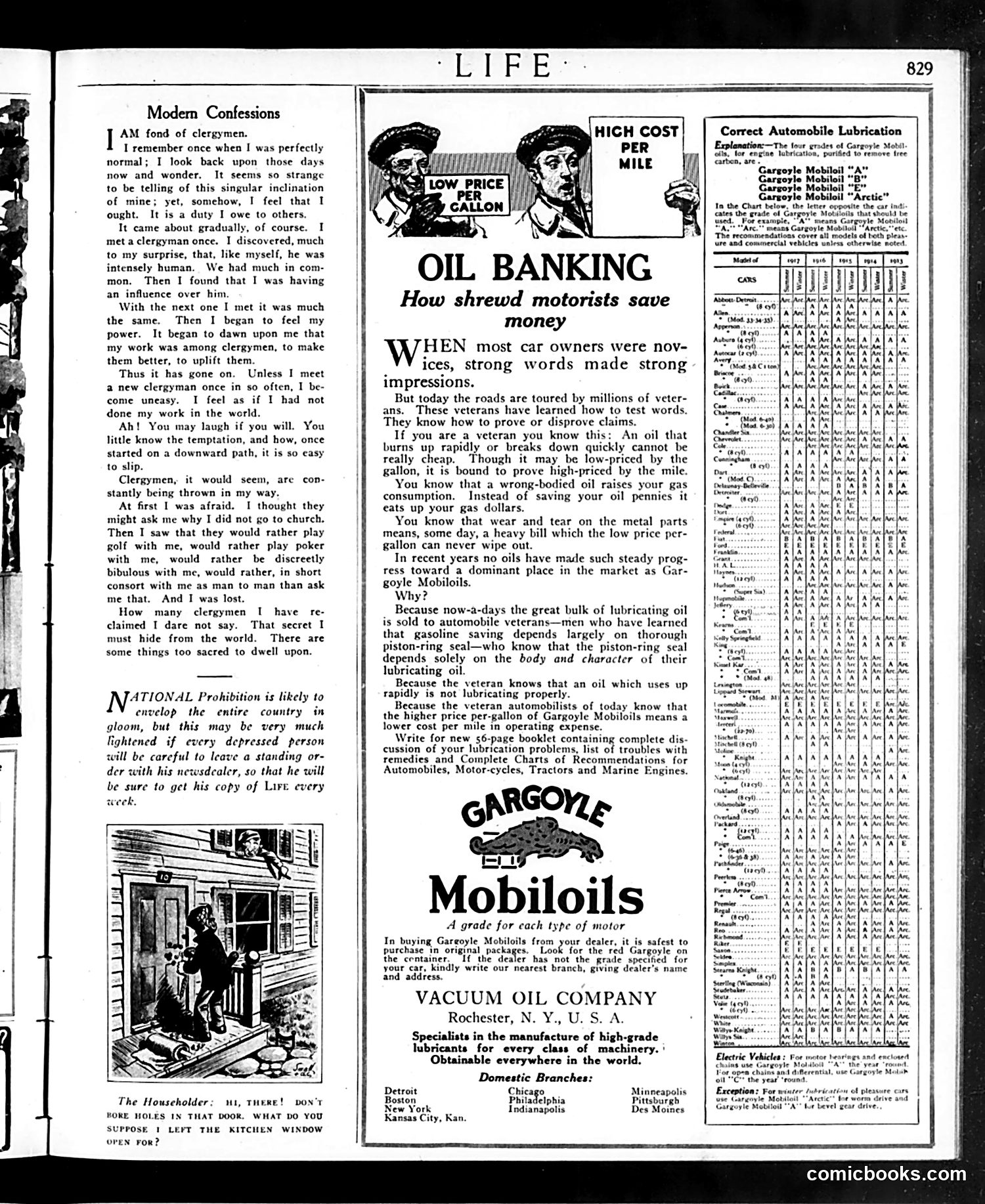
This page combines two distinct pieces: a satirical column and automobile advertising. **"Modern Confessions"** is a humorous first-person narrative where the narrator admits to having an "influence" over clergymen—implying seduction or moral corruption. The joke plays on 1920s anxieties about clergy's humanity and hypocrisy: these supposedly virtuous men happily engage in golf, poker, and drinking with the narrator rather than upholding religious standards. The confession's breathless tone parodies sincere confessional literature while suggesting the narrator has "reclaimed" multiple clergymen through moral compromise. The sidebar cartoon shows a householder scolding someone about moles burrowing through a door, sarcastically asking why they left a kitchen window open—a non-sequitur joke about poor logic. **"Oil Banking"** is a Gargoyle Mobiloils advertisement targeting experienced motorists ("veterans"), arguing that cheap oil costs more per mile through rapid breakdown and increased fuel consumption. It appeals to practical economic reasoning rather than price alone. The page reflects early 1920s concerns: clergy morality, Prohibition's gloom, and automobile maintenance culture.
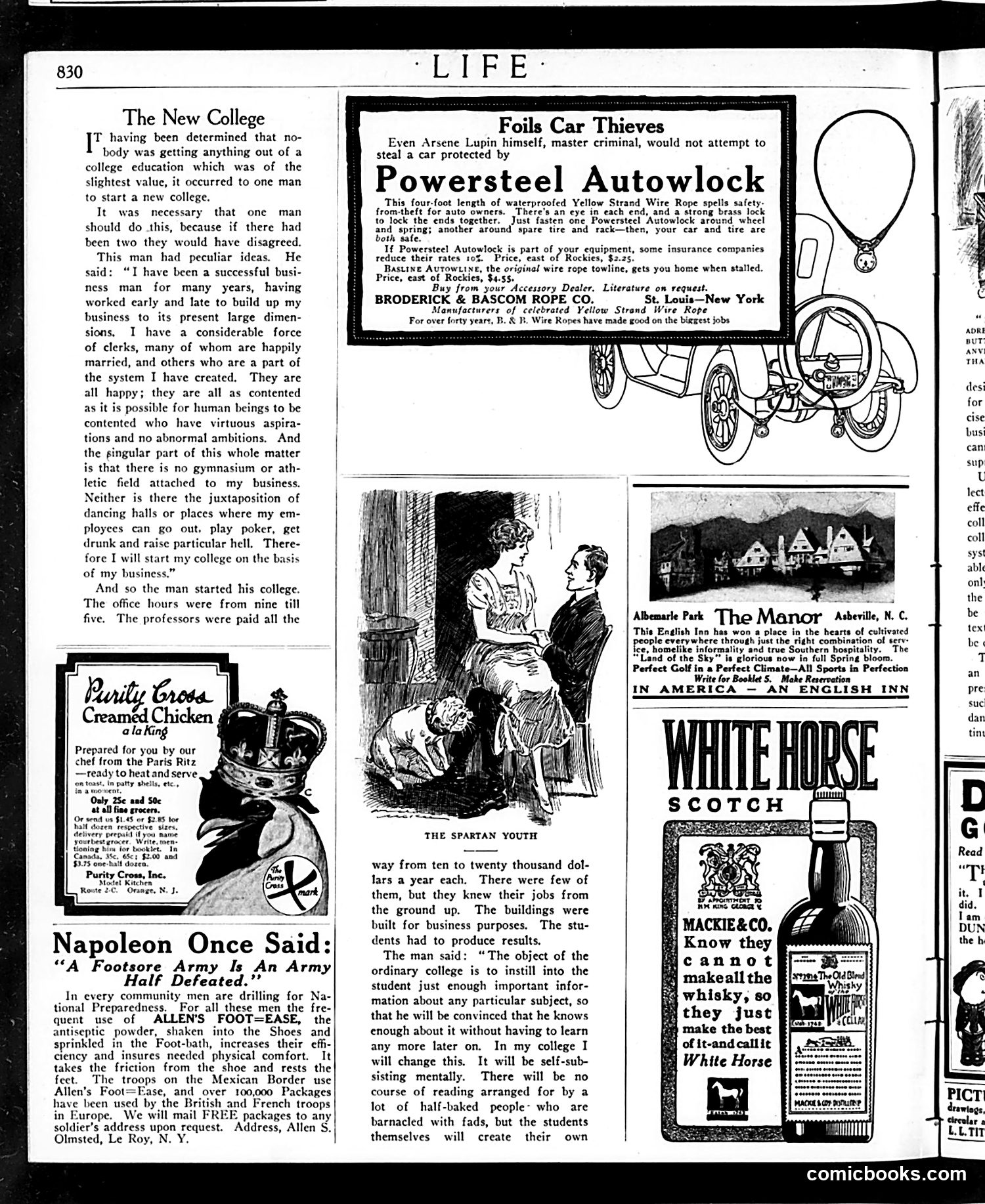
This satirical piece mocks a businessman's attempt to create a college based purely on business principles. The unnamed founder argues that traditional colleges waste resources on gymnasiums, athletic fields, and social spaces where employees "get drunk and raise particular hell." Instead, he establishes his college with 9-to-5 office hours, paying professors like salaried clerks, and demanding students "produce results"—treating education as a profit-driven enterprise rather than intellectual development. The satire targets the early 20th-century tension between practical, vocational education and liberal arts. Life magazine ridicules this utilitarian approach, suggesting that reducing college to mere job training ignores the broader purpose of education: developing well-rounded citizens rather than mere cogs in a business machine. The joke is that this "successful" businessman fundamentally misunderstands what education should be.
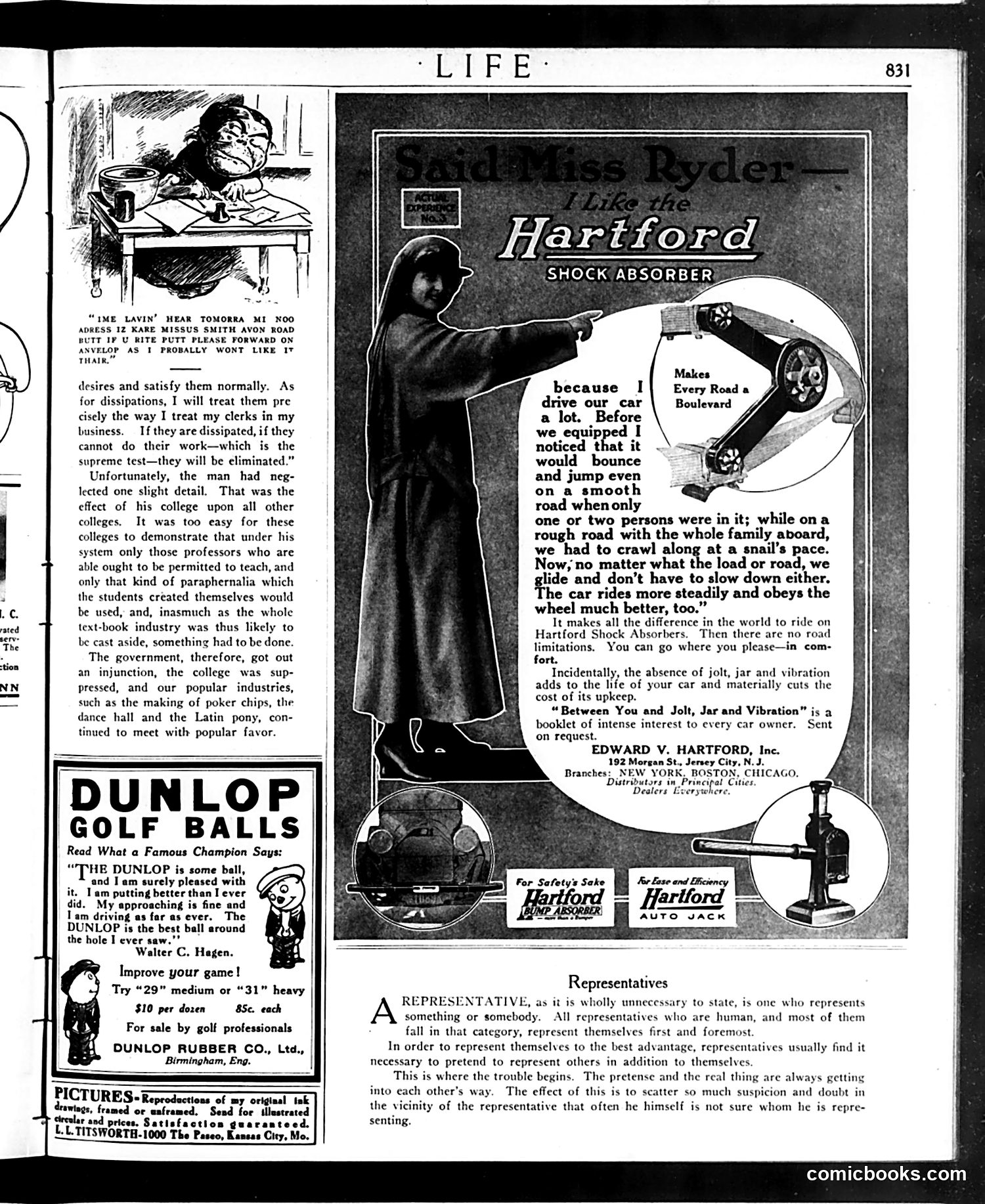
This page is primarily **advertising**, with a brief editorial piece on "Representatives" at the bottom. The left side features a **Dunlop Golf Balls ad** with a testimonial from famous golfer Walter C. Hagen, promoting their quality. The dominant image is a **Hartford Shock Absorber advertisement** showing a woman demonstrating the product's benefits. The ad uses a customer testimonial explaining how the shock absorber improved their family car's ride on rough roads—no more bouncing or jumping. The bottom **editorial column on "Representatives"** is satirical commentary on political/professional representatives. It mocks how representatives claim to serve others while primarily serving themselves, and how this creates confusion about whose interests they actually represent. This appears to be general social satire about conflicting loyalties in representative roles, rather than targeting specific figures. The garbled note at top-left appears to be a humorous letter-writing example, though its exact satirical point is unclear.
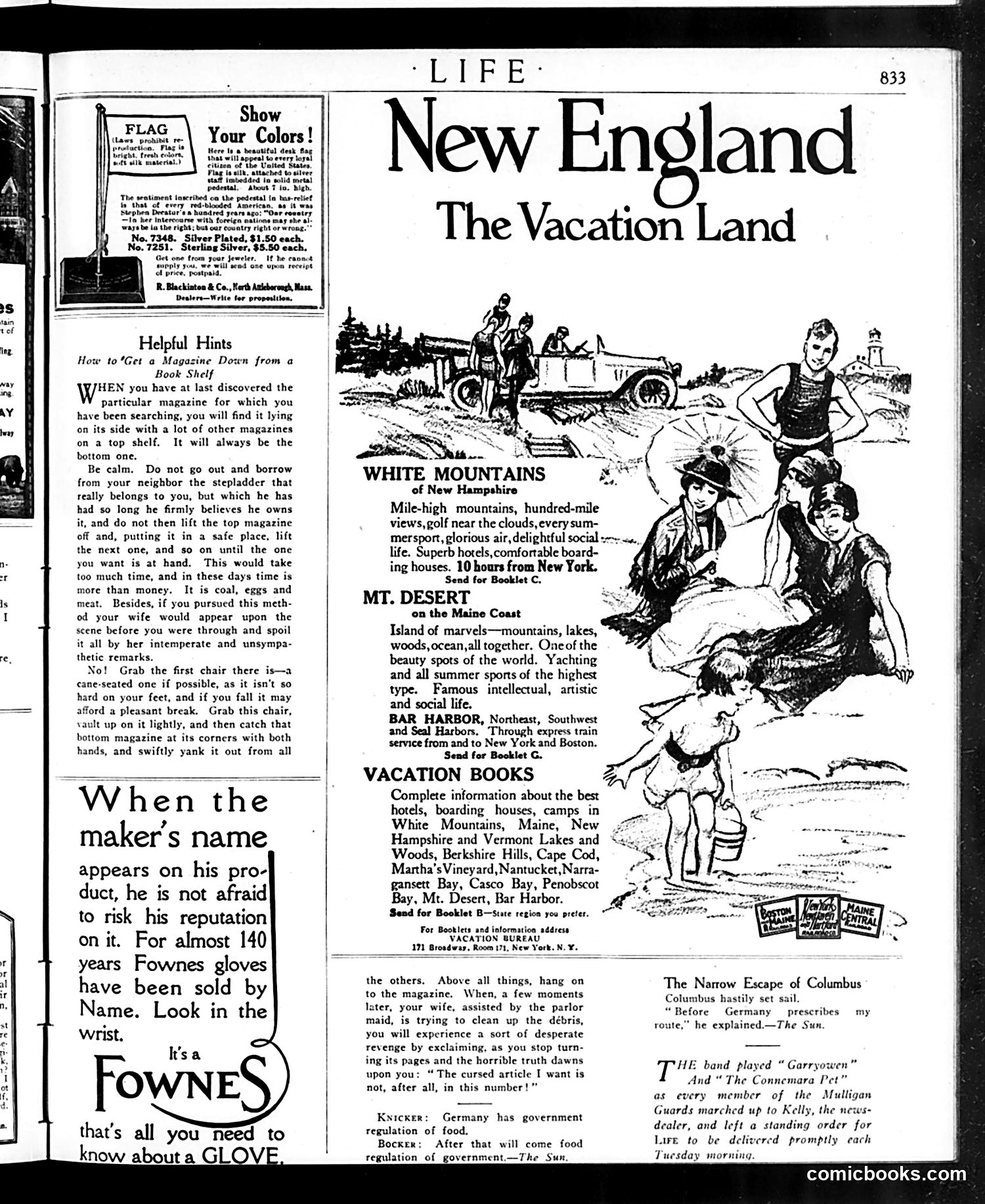
This page is primarily **advertising and humor content**, not political satire. The main content includes: 1. **"Show Your Colors" ad**: A patriotic desk flag with Stephen Decatur's 1816 quote about national loyalty—standard jingoistic advertising of the era. 2. **"Helpful Hints" humor column**: A comedic piece about retrieving magazines from crowded shelves, using exaggerated domestic scenarios typical of Life's lighthearted social commentary. 3. **Fownes Gloves advertisement**: Emphasizing brand reputation and quality. 4. **New England vacation promotion**: Tourism ads for White Mountains, Mt. Desert, and Bar Harbor—typical travel marketing. 5. **Two brief political jokes** at bottom: - A quip about German food regulation - A Columbus joke implying Germany was prescriptive/controlling (likely referencing pre-WWI German militarism) The Columbus and food-regulation jokes suggest **mild anti-German sentiment** common during this pre-WWI period, but the page is primarily commercial rather than satirical in nature.
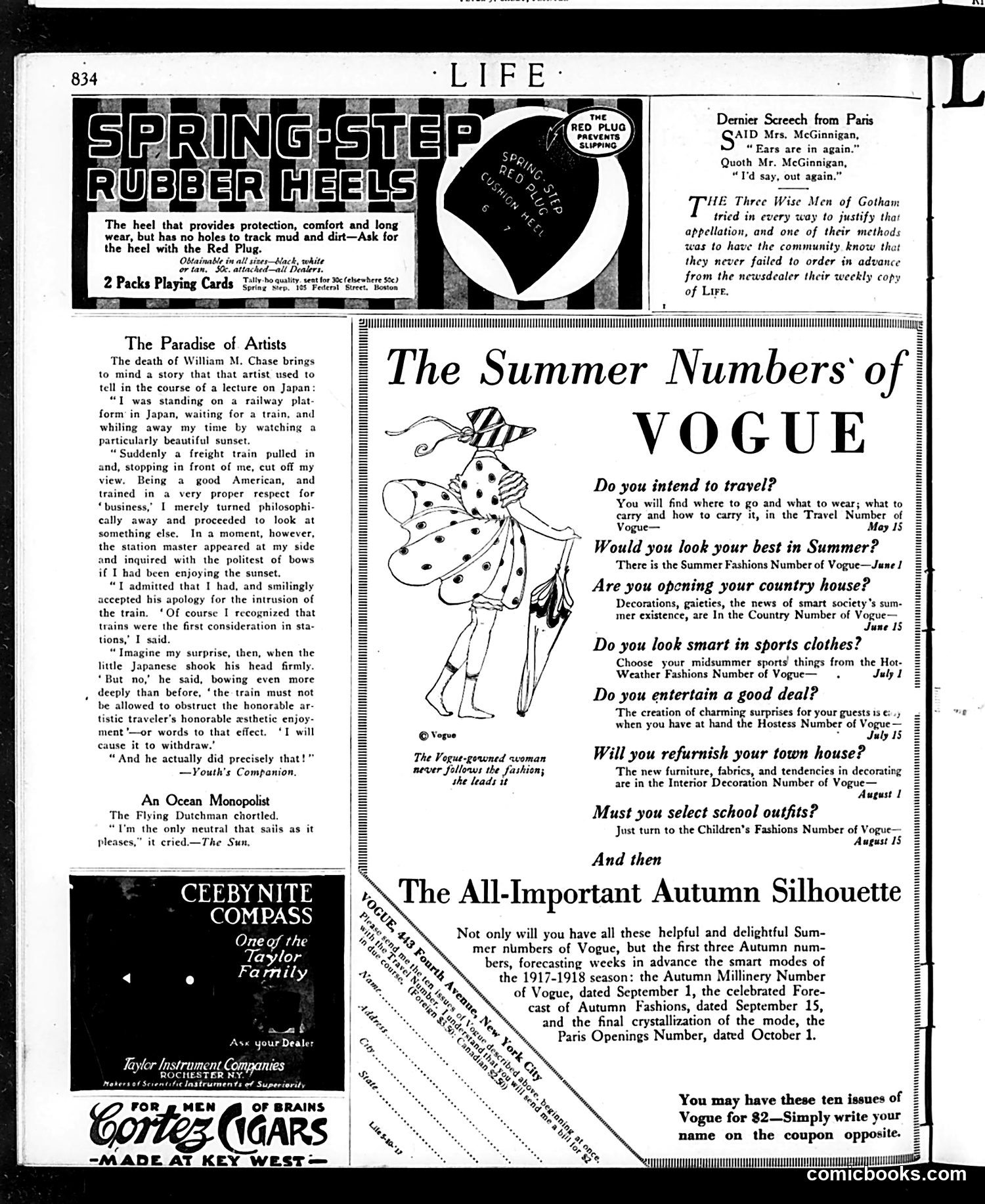
This page is primarily **advertising and promotional content** rather than political satire. The dominant feature is a large advertisement for Vogue magazine's summer issues, featuring an illustrated woman in fashionable dress. The small satirical items are minor: **"Dernier Screech from Paris"** jokes about women's ears being "in fashion" again—a light social commentary on the absurdity of fashion trends that declare body parts fashionable or unfashionable. **"The Paradise of Artists"** recounts an anecdote about William M. Chase (a recently deceased American painter) regarding artistic sensibility in Japan, illustrating cultural differences in values—suggesting Japanese culture prioritized art over commercial efficiency, unlike America. **"An Ocean Monopolist"** is a brief, cryptic reference to the Flying Dutchman claiming neutrality—likely a WWI-era joke about maritime commerce, though context is unclear without knowing the specific historical moment. The page primarily serves to promote Vogue's specialized seasonal issues to potential subscribers through descriptive questions about travel, entertaining, and fashion needs.