
Life, 1917-05-03 · page 21 of 42
Life — May 3, 1917 — page 21: what you’re looking at
What you’re looking at
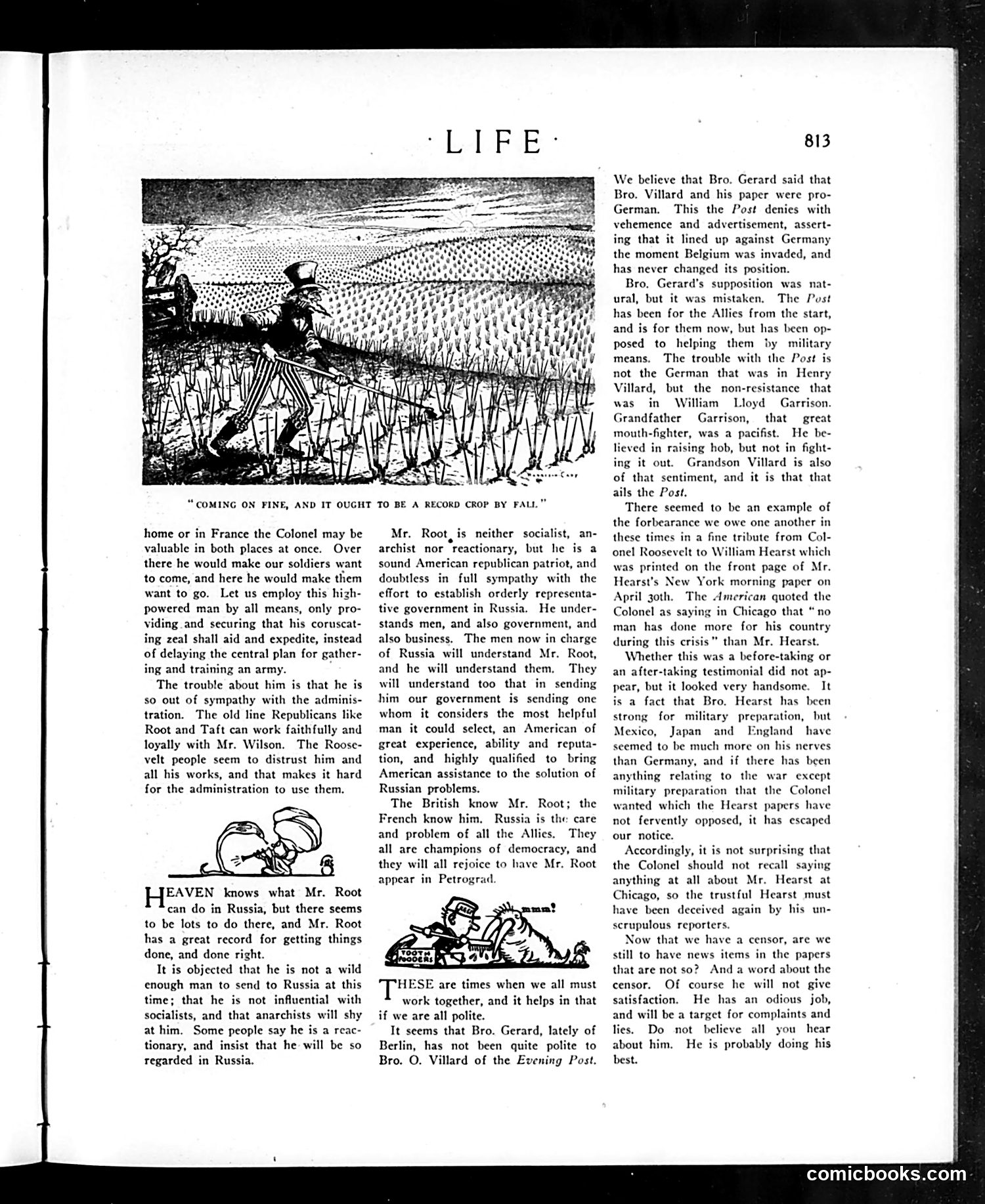
This page contains political editorials rather than cartoons. The main illustration shows a farmer in a field with the caption "Coming on fine, and it ought to be a record crop by fall"—likely a metaphor for American military preparation during World War I. The text discusses sending Elihu Root (a Republican elder statesman) to Russia as a diplomatic envoy, arguing he's qualified despite being viewed as insufficiently radical for dealing with Russian socialists. It also addresses a dispute between Ambassador James Gerard (former Berlin envoy) and Oswald Garrison Villard of the *Evening Post*, accusing the Post of pacifism inherited from abolitionist William Lloyd Garrison. Finally, it praises William Randolph Hearst for supporting military preparedness, citing Roosevelt's public endorsement. The underlying theme: unity and civility are needed during wartime, even among those with political disagreements.
📄 Transcribed text from this page (OCR, searchable)
Machine-transcribed from the original scan — historical spelling and the odd misread are preserved.
“ COMING ON FINE, AND IT OUGHT TO BE A RECORD CROP BY FALI." home or in France the Colonel may be valuable in both places at once. Over there he would make our soldiers want to come, and here he would make them want to go. Let us employ this high- powered man by all means, only pro- viding and securing that his coruscat- ing zeal shall aid and expedite, instead of delaying the central plan for gather- ing and training an army. The trouble about him is that he is so out of sympathy with the adminis- tration. The old line Republicans like Root and Taft can work faithfully and loyally with Mr. Wilson. The Roose- velt people seem to distrust him and all his works, and that makes it hard for the administration to use them. R EAVEN knows what Mr. Root can do in Russia, but there seems to be lots to do there, and Mr. Root has a great record for getting things done, and done right. It is objected that he is not a wild enough man to send to Russia at this time; that he is not influential with socialists, and that anarchists will shy at him. Some people say he is a reac- tionary, and insist that he will be so regarded in Russia. Mr. Root, is neither socialist, an- archist nor reactionary, but he is a sound American republican patriot, and doubtless in full sympathy with the effort to establish orderly representa- tive government in Russia. He under- stands men, and also government, and also business, The men now in charge of Russia will understand Mr. Root, and he will understand them. They will understand too that in sending him our government is sending one whom it considers the most helpful man it could select, an American of great experience, ability and reputa- tion, and highly qualified to bring American assistance to the solution of Russian problems. The British know Mr. Root; the French know him. Russia is the care and problem of all the Allies. They all are champions of democracy, and they will all rejoice to have Mr. Root appear in Petrograd. ZSE are times when we all must work together, and it helps in that if we are all polite. It seems that Bro. Gerard, lately of Berlin, has not been quite polite to Bro. O. Villard of the Evening Post. 813 We believe that Bro. Gerard said that Bro. Villard and his paper were pro- German. This the Post denies with vehemence and advertisement, assert- ing that it lined up against Germany the moment Belgium was invaded, and has never changed its position. Bro. Gerard's supposition was nat- ural, but it was mistaken, The Post has been for the Allies from the start, and is for them now, but has been op- posed to helping them by military means. The trouble with the Post is not the German that was in Henry Villard, but the non-resistance that was in William) Lloyd Garrison. Grandfather Garrison, that great mouth-fighter, was a pacifist. He be- lieved in raising hob, but not in fight- ing it out. Grandson Villard is also of that sentiment, and it is that that ails the Post. There seemed to be an example of the forbearance we owe one another in these times in a fine tribute from Col- onel Roosevelt to William Hearst which was printed on the front page of Mr. Hearst’s New York morning paper on April 30th, The American quoted the Colonel as saying in Chicago that “no man has done more for his country during this crisis” than Mr. Hearst. Whether this was a before-taking or an after-taking testimonial did not ap- pear, but it looked very handsome. It is a fact that Bro. Hearst has been strong for military preparation, but Mexico, Japan and England have seemed to be much more on his nerves than Germany, and if there has been anything relating to the war except military preparation that the Colonel wanted which the Hearst papers have not fervently opposed, it has escaped our notice. Accordingly, it is not surprising that the Colonel should not recall saying anything at all about Mr. Hearst at Chicago, so the trustful Hearst must have been deceived again by his un- scrupulous reporters. Now that we have a censor, are we still to have news items in the papers that are not so? And a word about the censor. Of course he will not give satisfaction. He has an odious job, and will be a target for complaints and lies. Do not believe all you hear about him. He is probably doing his best. comicbooks.com