
Life, 1917-05-03 · page 28 of 42
Life — May 3, 1917 — page 28: what you’re looking at
What you’re looking at
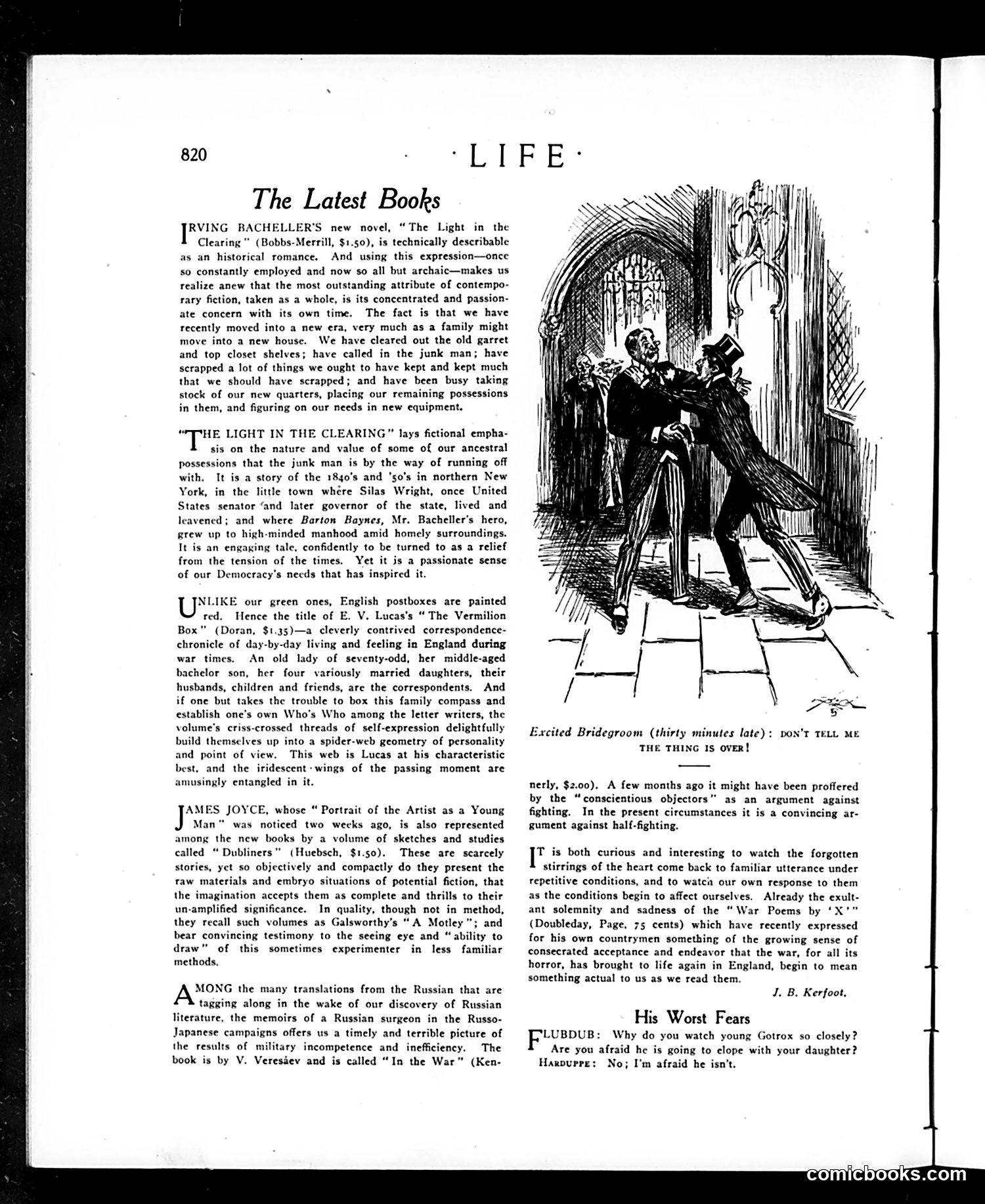
This is a book review page from *Life* magazine featuring literary criticism, not political cartoons. The small illustration shows an "Excited Bridegroom (thirty minutes late)" rushing into what appears to be a wedding ceremony, with the caption "DON'T TELL ME THE THING IS OVER!" This is a humorous domestic scene playing on the anxiety of arriving late to one's own wedding—a timeless source of comedy. The cartoon has no political content; it's simply a light joke about wedding day jitters. The page reviews contemporary novels including Irving Bacheller's "The Light in the Clearing" (historical fiction set in 1840s New York), E.V. Lucas's "The Vermilion Box" (wartime correspondence), James Joyce's "Dubliners," and a Russian memoir about military incompetence. The reviews discuss how modern literature focuses on contemporary concerns rather than historical romance.
📄 Transcribed text from this page (OCR, searchable)
Machine-transcribed from the original scan — historical spelling and the odd misread are preserved.
‘LIF E* The Latest Books RVING BACHELLER'S new novel, “The Light in the Clearing ” (Bobbs-Merrill, $1.50), is technically describable as an historical romance. And using this expression—once so constantly employed and now so all but archaic—makes us realize anew that the most outstanding attribute of contempo- rary fiction, taken as a whole, is its concentrated and passion- ate concern with its own time. The fact is that we have recently moved into a new era, very much as a family might move into a new house. We have cleared out the old garret and top closet shelves; have called in the junk man; have scrapped a lot of things we ought to have kept and kept much that we should have scrapped; and have been busy taking stock of our new quarters, placing our remaining possessions in them, and figuring on our needs in new equipment. “PTHE LIGHT IN THE CLEARING” lays fictional empha- sis on the nature and value of some of our ancestral possessions that the junk man is by the way of running off with. It is a story of the 1840's and ’so’s in northern New York, in the little town whére Silas Wright, once United States senator ‘and later governor of the state, lived and leavened; and where Barton Baynes, Mr. Bacheller's hero, grew up to high-minded manhood amid homely surroundings. It is an en ing tale, confidently to be turned to as a relief from the tension of the times. Yet it is a passionate sense of our Democracy’s necds that has inspired it. U LIKE our green ones, English postboxes are painted red. Hence the title of E. V. Lucas’s “ The Vermilion Box” (Doran, $1.35)—a cleverly contrived correspondence- chronicle of day-by-day living and feeling in England during war times. An old lady of seventy-odd, her middle-aged bachelor son, her four variously married daughters, their husbands, children and friends, are the correspondents. And if one but takes the trouble to box this family compass and establish one’s own Who's Who among the letter writers, the volume’s criss-crossed threads of self-expression delightfully build themselves up into a spider-web geometry of personality and point of view. This web is Lucas at his characteristic best, and the iridescent -wings of the passing moment are amusingly entangled in it. AMES JOYCE, whose “ Portrait of the Artist as a Young Man” was noticed two weeks ago, is also represented among the new books by a volume of sketches and studies called “ Dubliners" (Huebsch, $1.50). These are scarcely stories, yet so objectively and compactly do they present the raw materials and embryo situations of potential fiction, that the imagination accepts them as complete and thrills to their un-amplified significance. In quality, though not in method, they recall such volumes as Galsworthy’s “A Motley”; and bear convincing testimony to the seeing eye and “ability to draw” of this sometimes experimenter in less familiar methods. MONG the many translations from the Russian that are tagging along in the wake of our discovery of Russian literature, the memoirs of a Russian surgeon in the Russo- Japanese campaigns offers us a timely and terrible picture of the results of military incompetence and inefficiency. The book is by V. Veresiev and is called “In the War” (Ken- Excited Bridegroom (thirty minutes late): poN’T TELL ME THE THING IS ovER! nerly, $2.00). A few months ago it might have been proffered by the “conscientious objectors” as an argument against fighting. In the present circumstances it is a convincing ar- gument against half-fighting. [Ti Both curious and interesting to watch the forgotten stirrings of the heart come back to familiar utterance under repetitive conditions, and to watcia our own response to them as the conditions begin to affect ourselves. Already the exult- ant solemnity and sadness of the “War Poems by ‘X’” (Doubleday, Page, 75 cents) which have recently expressed for his own countrymen something of the growing sense of consecrated acceptance and endeavor that the war, for all its horror, has brought to life again in England, begin to mean something actual to us as we read them. J. B. Kerfoot, His Worst Fears LUBDUB: Why do you watch young Gotrox so closely? Are you afraid he is going to elope with your daughter? Harvurre: No; I'm afraid he isn’t.