
Life, 1917-05-03 · page 25 of 42
Life — May 3, 1917 — page 25: what you’re looking at
What you’re looking at
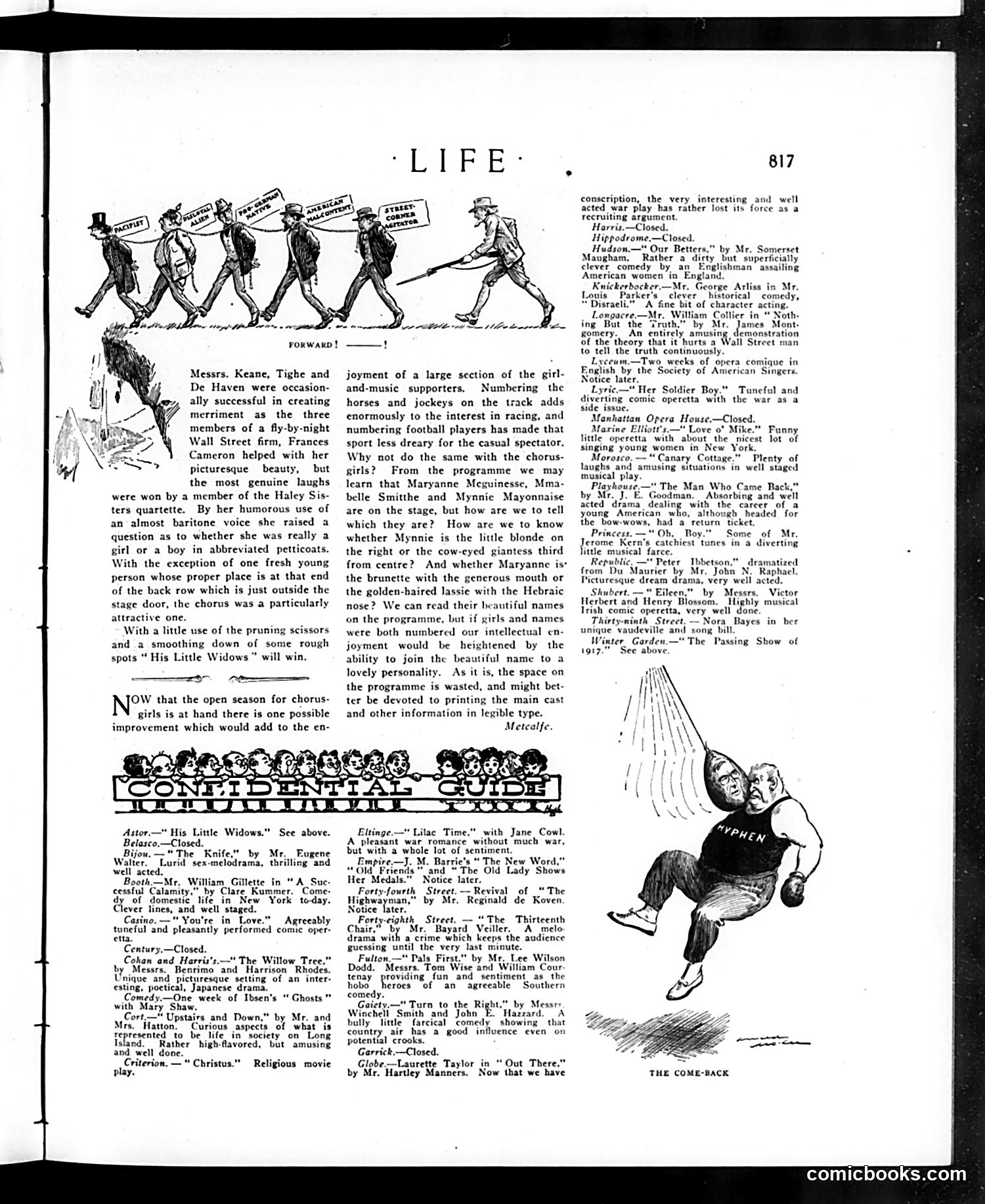
The top cartoon depicts five figures labeled as Wall Street financial firms being pulled forward by a sixth figure—likely representing the government or regulatory authority—using a rope. The caption "FORWARD!" suggests governmental pressure pushing reluctant businessmen toward compliance or reform during the Progressive Era. Below, the text reviews theatrical productions, with particular satire directed at chorus girls. The critic proposes numbering chorus girls like horses at racetracks or football players, arguing this would enhance audience enjoyment by allowing spectators to match names from programs to actual performers on stage. This tongue-in-cheek suggestion satirizes both the objectification of female performers and the contemporary obsession with quantification and organization in entertainment and sport. The review mocks theater management for wasting program space while suggesting the reduction of women to mere numbered objects.
📄 Transcribed text from this page (OCR, searchable)
Machine-transcribed from the original scan — historical spelling and the odd misread are preserved.
rorwarp! Messrs. Keane, Tighe and De Haven were occasion- ally successful in creating merriment as the three members of a fly-by-night Wall Street firm, Frances Cameron helped with her picturesque beauty, but the most genuine laughs were won by a member of the Haley Sis- ters quartette. By her humorous use of an almost baritone voice she raised a question as to whether she was really a gitl or a boy in abbreviated petticoats. With the exception of one fresh young person whose proper place is at that end of the back row which is just outside the stage door, the chorus was a particularly attractive one. With a little use of the pruning scissors and a smoothing down of some rough spots “ His Little Widows ” will win. OW that the open season for chorus- girls is at hand there is one possible improvement which would add to the en- “His Little Widows.” See above. Belasco.—Closed. Bijou. —“ The by Mr. Eugene Walter.” Lurid sex-melodrama, thrilling and well acted William, Gillette in“ A_Su ‘alamity.” by Clare Kummer. Com of domestic’ life in New York to-day. ver lines, and well staged. Casino. —" You're in Love.” Agreeably tuneful and pleasantly performed comic oper- eta, Century.—Closed. Cohan and Harris's.—" The Willow Tree,” by Messrs. Benrimo and Harrison Rhodes. Unique and picturesque setting of an inter- esting, poetical, Japanese drama. Comedy.—One week of Ibsen's “ Ghosts ” with Mary Shaw. Cort.—" Upstairs and Down,” by Mr. and Mrs. Hatton. Curious aspects of what is represented to be life in society on Long Island. Rather high-flavored, but amusing and well done. Criterion. — “ Christus.” Religious movie Play. joyment of a large section of the girl- and-music supporters. Numbering the horses and jockeys on the track adds enormously to the interest in racing, and numbering football players has made that sport less dreary for the casual spectator. Why not do the same with the chorus- girls? From the programme we may learn that Maryanne Mcguinesse, Mma- belle Smitthe and Mynnie Mayonnaise are on the stage, but how are we to tell which they are? How are we to know whether Mynnie is the little blonde on the right or the cow-eyed giantess third from centre? And whether Maryanne is- the brunette with the generous mouth or the golden-haired lassie with the Hebraic nose? We can read their beautiful names on the programme, but if girls and names were both numbered our intellectual en- joyment would be heightened by the ability to join the beautiful name to a lovely personality. As it is, the space on the programme is wasted, and might bet- ter be devoted to printing the main cast and other information in legible type. Metcalfe. Eltinge.—" Lilac Time," with Jane Cowl. A pleasant war romance without much war, but with a whole lot of sentiment. Empire.—J. M. Barrie's “ The New Word,” “ Old. Friends” ‘and “The Old Lady Shows Her Medals.” Notice later. Forty-fourth Street. — Revival of |“ The Highwayman,” by Mr. Reginald de Koven. Notice later. Forty-eighth Street, — “The Thirteenth Chair,” by Mr. Bayard Veiller. A melo drama with a.crime which keeps the audience guessing until the very last minute. Fulton.—" Pals First.” by Mr, Lee Wilson Dodd, Messrs. Tom Wise and William Cour tenay providing fun and sentiment as the hobo Rerocs Nof an agreeable Southern comedy. Gaiety. Winchell Smith and John E. “Hazzard. A bully little farcical comedy showing that country air has a good influence even on potential crooks. Garrick.—Closed. Globe—Laurette Taylor in “Out There.” by Mr. Hartley Manners. Now that we have "Tarn to the Right.” by Messe: 817 conscription, the very interesting and well acted war play has rather lost its force as a recruiting argument. Harris.—Closed. Higpodrome.—Closed Hudson.—" Our Bette Maugham, Rather a di clever comedy by an Englishman’ assailing American women in Engiand, Knickerbocker—Mr. George Arliss in Mr. Louis "s_ clever historical comedy, ‘A fine bit of character ai Longacre.—Mr, William Collier in ing But the Trath” by Mr. Ja gomery. An entirely amusing. demonstration of the theory that it hurts a Wall Street man to tell the truth continuously. Lxceum.—Two, weeks of opera comique in English by the Society of American Singers. Notice later, Lyric.—" Her Soldier Boy.” Tuneful and diverting comic operetta with the war as a side issue. Manhattan Opera House.—Closed. Marine Elliott's.—" Love o' Mike.” Funny little operetta with about the nicest lot of singing young women in New York. Morosco. — “Canary Cottage.” Plenty of laughs and amusing situations in well staged musical play Playhous) .” by Mr. Somerset but superficially “The Man Who Came Back,” by Mr. J. E. Goodman. Absorbing and well acted drama. dealing with the career of a young American who, although headed for the bow-wows, had a return ticket Princess. —" Oh, Boy." Some of Mr. Jerome Kern's catchiest tunes in a diverting little musical farce. Republic. —" Peter Ihbetson,” dramatized from Du Maurier by Mr. John N. Raphael. Picturesque dream drama, very well acted. Shubert. —" Eileen,” by Messrs. Victor Herbert and Henry Biossom. Highly musical Trish comic operetta, very well done. Thirty-ninth Street. — Nora Bayes in her unique vaudeville and song bill, Winter. Garden.—" The Passing Show of 1917." See abov THE COME-BACK comicbooks.com