
Life, 1917-05-03 · page 10 of 42
Life — May 3, 1917 — page 10: what you’re looking at
What you’re looking at
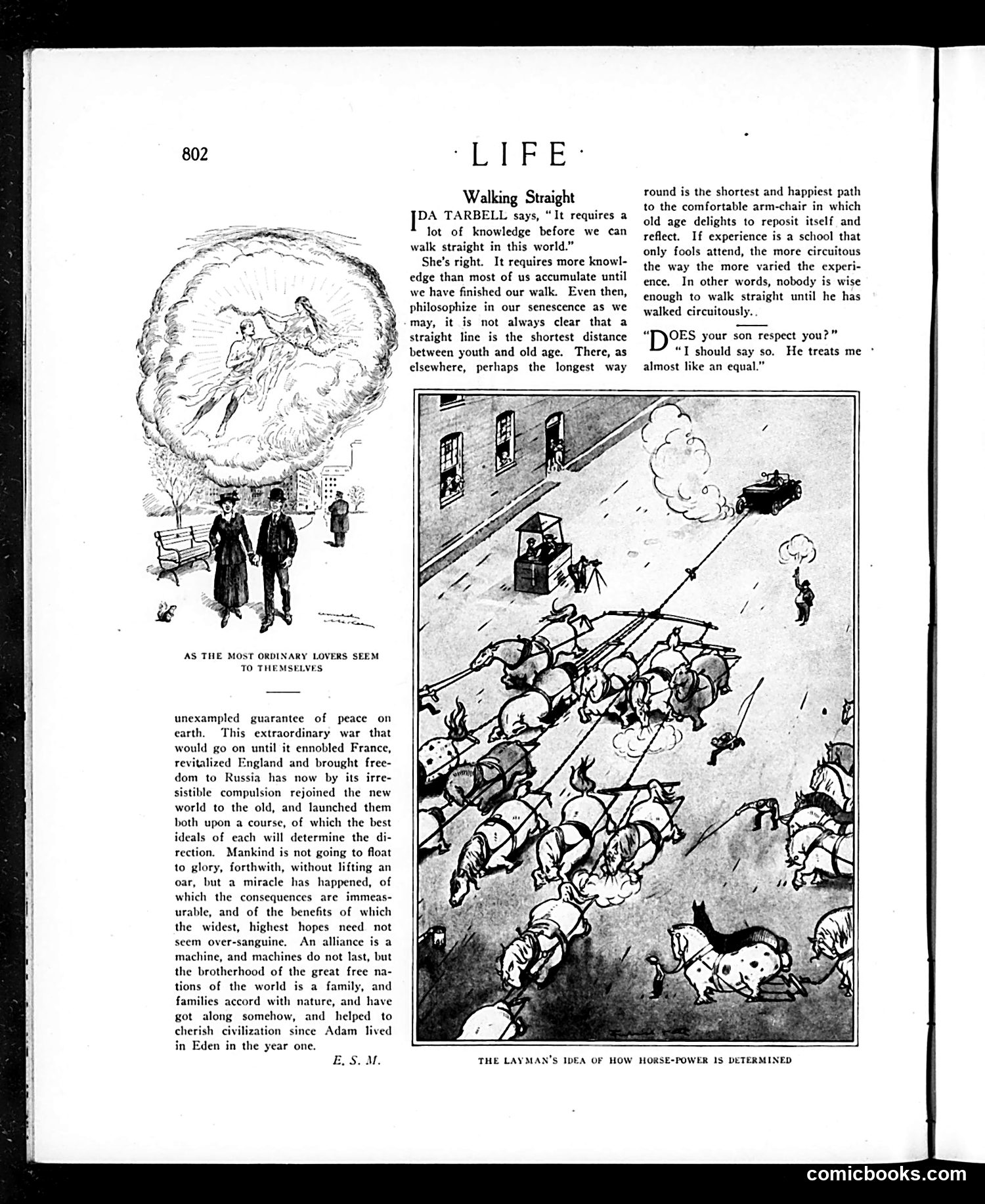
This page contains two distinct elements: **Top section:** An essay by IDA TARBELL arguing that walking a "straight line" through life requires more wisdom than we typically possess. The accompanying sketch shows an ordinary couple under a large tree, illustrating romance. **Bottom cartoon:** Titled "The Layman's Idea of How Horse-Power Is Determined," this is satirical commentary on measuring mechanical power. It depicts horses literally pulling a large load of people/workers, with observers measuring or calculating the effort—a visual pun mocking how laypeople misunderstand the technical term "horsepower" (the unit of mechanical power, not actual horse strength). The page also contains philosophical text about war, peace, and mankind's progress, attributed to E.S.M.
📄 Transcribed text from this page (OCR, searchable)
Machine-transcribed from the original scan — historical spelling and the odd misread are preserved.
AS THE MOST ORDINARY LOVERS SEEM TO THEMSELVES unexampled guarantee of peace on earth. This extraordinary war that would go on until it ennobled France, revitalized England and brought free- dom to Russia has now by its irre- sistible compulsion rejoined the new world to the old, and launched them both upon a course, of which the best ideals of each will determine the di- rection. Mankind is not going to float to glory, forthwith, without lifting an oar, but a miracle has happened, of which the consequences are immeas- urable, and of the benefits of which the widest, highest hopes need not seem over-sanguine. An alliance is a machine, and machines do not last, but the brotherhood of the great free na- tions of the world is a family, and families accord with nature, and have got along somehow, and helped to cherish civilization since Adam lived in Eden in the year one. E.S.M. ‘LIFE: Walking Straight [PA TARBELL says, “It requires a lot of knowledge before we can walk straight in this world.” She's right. It requires more knowl- edge than most of us accumulate until we have finished our walk. Even then, philosophize in our senescence as we may, it is not always clear that a straight line is the shortest distance between youth and old age. There, as elsewhere, perhaps the longest way round is the shortest and happiest path to the comfortable arm-chair in which old age delights to reposit itself and reflect. If experience is a school that only fools attend, the more circuitous the way the more varied the experi- ence. In other words, nobody is wise enough to walk straight until he has walked circuitously. “DOES your son respect you?” “T should say so. almost like an equal.” THE LAYMAN’S IDEA OF HOW HORSE-POWER 1S DETERMINED He treats me * comicbooks.com