
Life, 1917-05-03 · page 9 of 42
Life — May 3, 1917 — page 9: what you’re looking at
What you’re looking at
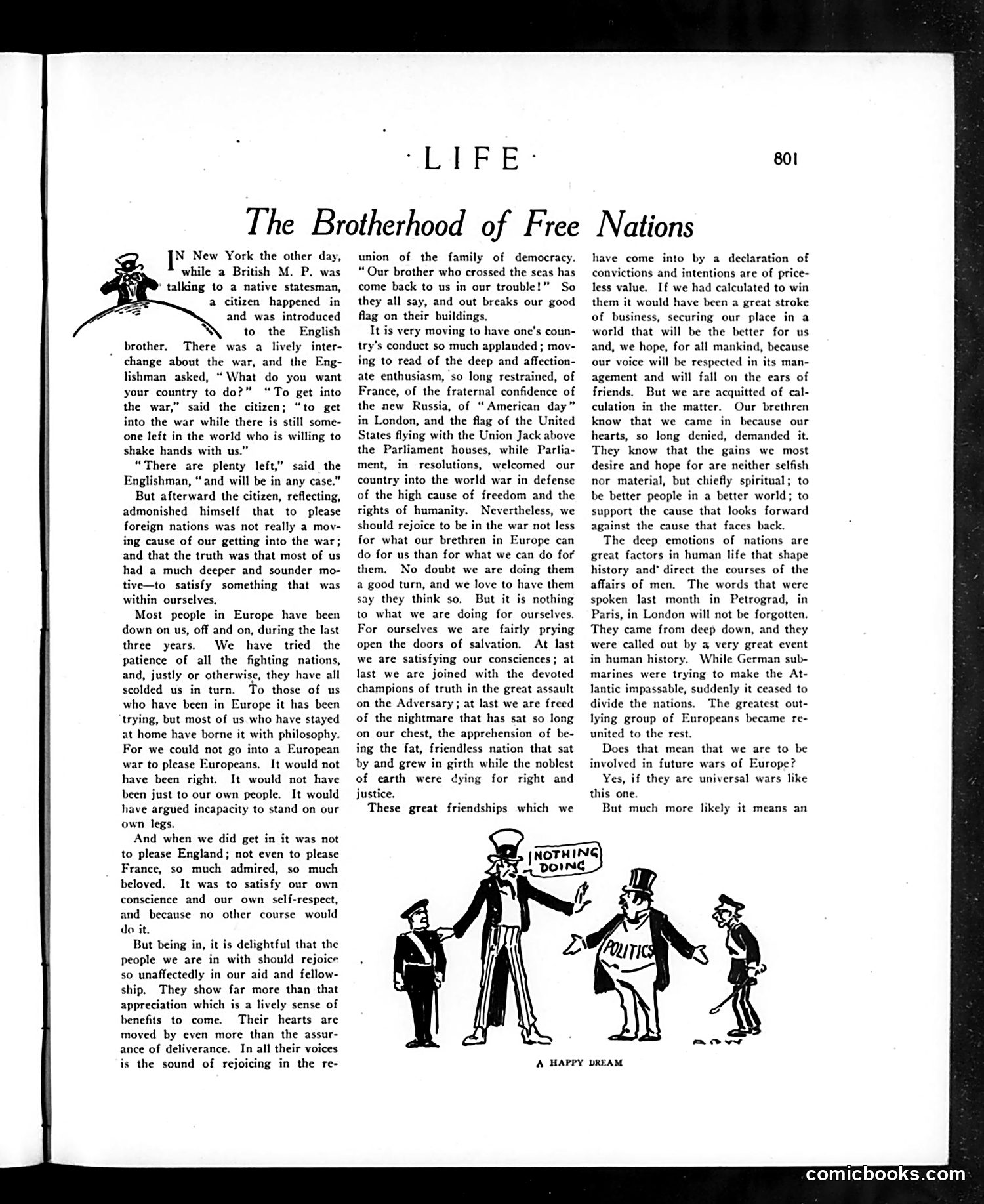
The article discusses Allied unity during WWI, celebrating how Britain, France, Russia, and America joined together for democracy and freedom. The accompanying cartoon, titled "A Happy Dream," satirizes this brotherhood. The central figure appears to be **Uncle Sam** (representing America), gesturing toward three smaller figures labeled with national identities. One figure is labeled "**POLITICS**"—likely representing divisive domestic political interests. Uncle Sam declares "NOTHING DOING," suggesting America will not let partisan politics interfere with the war effort and international unity. The satire suggests that while nations publicly celebrate brotherhood, domestic political factions threaten to undermine this unity. The "happy dream" is precisely that—idealistic but fragile.
📄 Transcribed text from this page (OCR, searchable)
Machine-transcribed from the original scan — historical spelling and the odd misread are preserved.
A. $B: The Brotherhood of Free Nations N New York the other day, while a British M. P. was talking to a native statesman, a citizen happened in and was introduced to the English brother. There was a lively inter- change about the war, and the Eng- lishman asked, “What do you want your country to do?” “To get into the war,” said the citizen; “to get into the war while there is still some- one left in the world who is willing to shake hands with us.” “There are plenty left,” said the Englishman, “and will be in any case.” But afterward the citizen, reflecting, admonished himself that to please foreign nations was not really a mov- ing cause of our getting into the war; and that the truth was that most of us had a much deeper and sounder mo- tive—to satisfy something that was within ourselves, Most people in Europe have been down on us, off and on, during the last three years. We have tried the patience of all the fighting nations, and, justly or otherwise, they have all scolded us in turn. To those of us who have been in Europe it has been trying, but most of us who have stayed at home have borne it with philosophy. For we could not go into a European war to please Europeans. It would not have been right. It would not have been just to our own people. It would have argued incapacity to stand on our own legs. And when we did get in it was not to please England; not even to please France, so much admired, so much beloved. It was to satisfy our own conscience and our own self-respect, and because no other course would do it. But being in, it is delightful that the people we are in with should rejoice so unaffectedly in our aid and fellow- ship. They show far more than that appreciation which is a lively sense of benefits to come. Their hearts are moved by even more than the assur- ance of deliverance. In all their voices is the sound of rejoicing in the re- union of the family of democracy. “Our brother who crossed the seas has come back to us in our trouble!” So they all say, and out breaks our good flag on their buildings. It is very moving to have one’s coun- try’s conduct so much applauded ; mov- ing to read of the deep and affection- ate enthusiasm, so long restrained, of France, of the fraternal confidence of the new Russia, of “American day” in London, and the flag of the United States flying with the Union Jack above the Parliament houses, while Parlia- ment, in resolutions, welcomed our country into the world war in defense of the high cause of freedom and the rights of humanity. Nevertheless, we should rejoice to be in the war not less for what our brethren in Europe can do for us than for what we can do for them. No doubt we are doing them a good turn, and we love to have them say they think so. But it is nothing to what we are doing for ourselves. For ourselves we are fairly prying open the doors of salvation. At last we are satisfying our consciences; at last we are joined with the devoted champions of truth in the great assault on the Adversary; at last we are freed of the nightmare that has sat so long on our chest, the apprehension of be- ing the fat, friendless nation that sat by and grew in girth while the noblest of earth were dying for right and justice. These great friendships which we have come into by a declaration of convictions and intentions are of price- less value. If we had calculated to win them it would have been a great stroke of business, securing our place in a world that will be the better for us and, we hope, for all mankind, because our voice will be respected in its man- agement and will fall on the ears of friends. But we are acquitted of cal- culation in the matter. Our brethren know that we came in because our hearts, so long denied, demanded it. They know that the gains we most desire and hope for are neither selfish nor material, but chiefly spiritual; to be better people in a better world; to support the cause that looks forward against the cause that faces back. The deep emotions of nations are great factors in human life that shape history and’ direct the courses of the affairs of men. The words that were spoken last month in Petrograd, in Paris, in London will not be forgotten. They came from deep down, and they were called out by a very great event in human history. While German sub- marines were trying to make the At- lantic impassable, suddenly it ceased to divide the nations. The greatest out- lying group of Europeans became re- united to the rest. Does that mean that we are to be involved in future wars of Europe? Yes, if they are universal wars like this one. But much more likely it means an A HAPPY DREAM comicbooks.com