
Life, 1917-05-03 · page 30 of 42
Life — May 3, 1917 — page 30: what you’re looking at
What you’re looking at
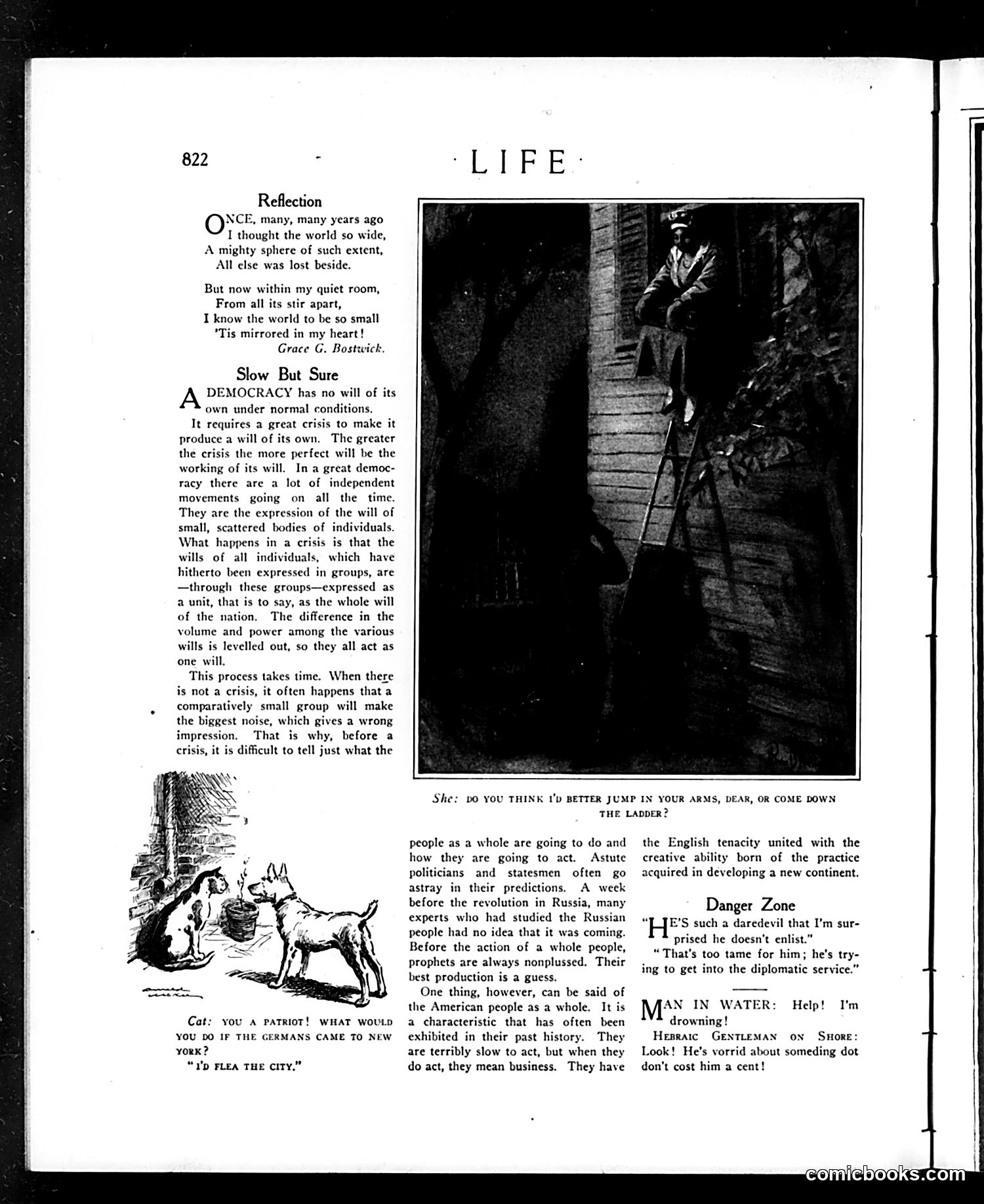
This page contains three satirical elements reflecting American anxieties during World War I: **"Cat" cartoon (lower left):** A cat claims it would "flee the city" if Germans invaded New York—mocking pacifists or cowards who prioritize self-preservation over patriotic duty. **"She/Ladder" cartoon (upper right):** A woman on a ladder asks a man below whether to jump into his arms or climb down—likely satirizing dramatic or foolish behavior during wartime hysteria. **"Man in Water" cartoon (lower right):** Features an immigrant character (indicated by dialect: "vorrid," "someding dot") drowning, while a bystander ironically notes he's worried about "something dot don't cost him a cent"—mocking immigrant concerns about monetary loss during a life-threatening crisis, or satirizing immigrant attitudes toward wealth. The page's essay "Slow But Sure" discusses democracy's need for crisis to unite citizens, contextualizing these cartoons as commentary on American readiness and social divisions during the war period.
📄 Transcribed text from this page (OCR, searchable)
Machine-transcribed from the original scan — historical spelling and the odd misread are preserved.
Reflection NCE, many, many years ago I thought the world so wide, A mighty sphere of such extent, All else was lost beside. But now within my quiet room, From all its stir apart, I know the world to be so small ’Tis mirrored in my heart! Grace G. Bostwick Slow But Sure DEMOCRACY has no will of its own under normal conditions. It requires a great crisis to make it produce a will of its own. The greater the crisis the more perfect will be the working of its will. In a great democ- racy there are a lot of independent movements going on all the time. They are the expression of the will of small, scattered bodies of individuals. What happens in a crisis is that the wills of all individuals, which have hitherto been expressed in groups, are —through these groups—expressed as a unit, tha to say, as the whole will of the nation. The difference in the volume and power among the various wills is levelled out, so they all act as one will. This process takes time. When there is not a crisis, it often happens that a comparatively small group will make the biggest noise, which gives a wrong impression, That is why, before a crisis, it is difficult to tell just what the Cat: you a Patriot! WHAT woULD YOU DO IF THE GERMANS CAME TO NEW YORK? “W'D FLEA THE CITY,” She: po you THINK 1’b BETTER JUMP IN YOUR ARMS, DEAR, OR COME DOWN THE LADDER? people as a whole are going to do and how they are going to act. Astute politicians and statesmen often go astray in their predictions. A week before the revolution in Russia, many experts who had studied the Russian people had no idea that it was coming. Before the action of a whole people, prophets are always nonplussed. Their best production is a guess. One thing, however, can be said of the American people as a whole. It is a characteristic that has often been exhibited in their past history. They are terribly slow to act, but when they do act, they mean business. They have the English tenacity united with the creative ability born of the practice acquired in developing a new continent. Danger Zone such a daredevil that I'm sur- prised he doesn't enlist.” H “That's too tame for him; he's try- ing to get into the diplomatic service.” AN IN WATE I'm drowning! Hesraic GENTLEMAN ON SHORE: Look! He's vorrid about someding dot don’t cost him a cent! Help!