
Life, 1917-05-03 · page 24 of 42
Life — May 3, 1917 — page 24: what you’re looking at
What you’re looking at
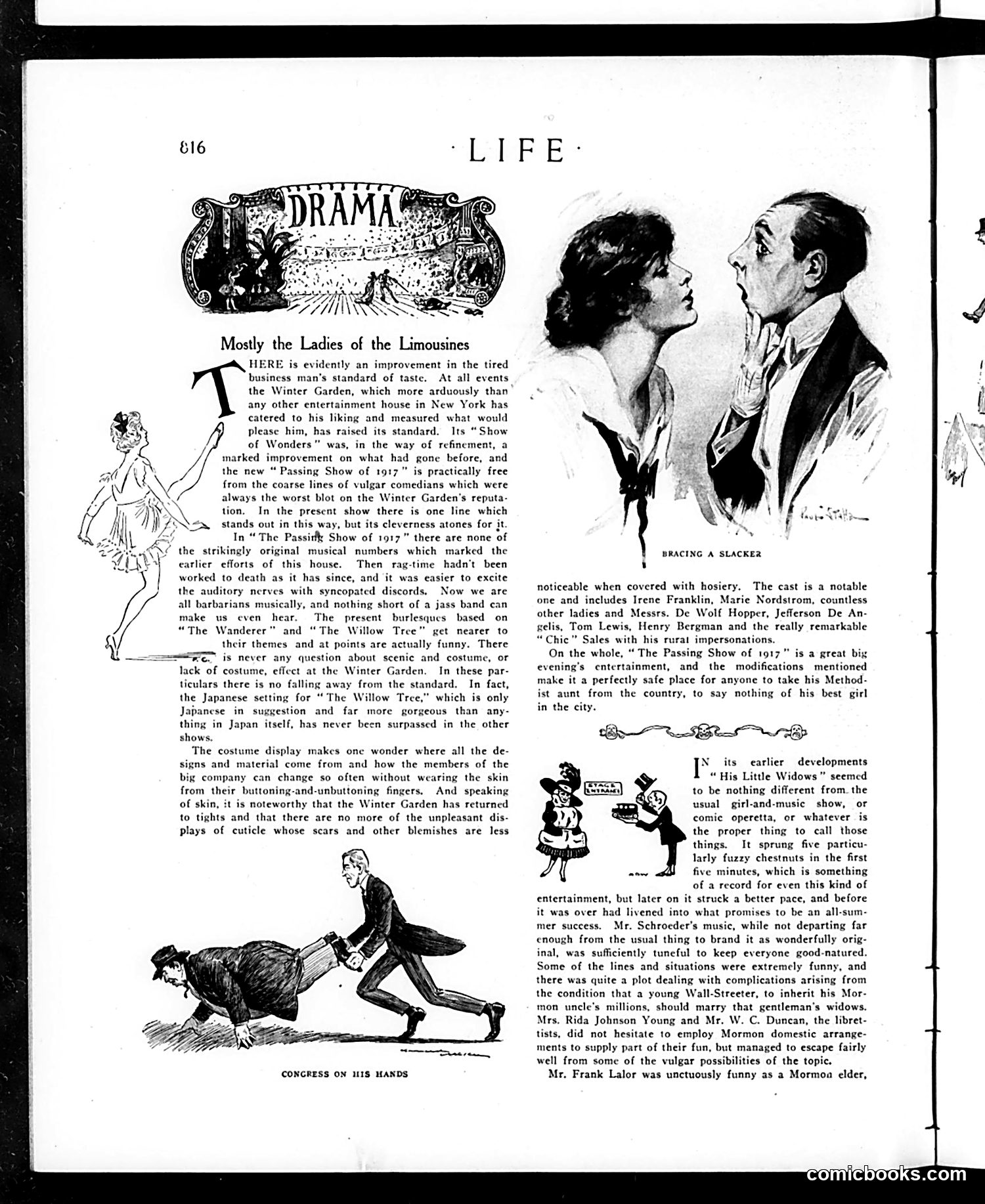
This page reviews two Broadway shows at the Winter Garden theater. The main article praises "The Passing Show of 1917" for raising standards at a venue historically known for catering to "tired business men" with vulgar comedy. The reviewer notes improvements in refinement while acknowledging the shows lack original musical numbers—ragtime having been "worked to death." The cartoons illustrate the shows' appeal: "Bracing a Slacker" depicts a romantic scene (the couple shown in profile), while "Congress on His Hands" (bottom left) shows a man apparently struggling with a woman, likely satirizing the comedic physical business typical of these revues. The secondary review of "His Little Widows" describes a plot involving a Wall Street man marrying multiple widows to inherit a Mormon uncle's fortune—using contemporary concerns about inheritance and unconventional marriage arrangements for comedic effect. The "Ladies of the Limousines" subtitle suggests these shows appealed to wealthy female audiences, not just businessmen.
📄 Transcribed text from this page (OCR, searchable)
Machine-transcribed from the original scan — historical spelling and the odd misread are preserved.
Mostly the Ladies of the Limousines HERE is evidently an improvement in the tired business man’s standard of taste, At all events the Winter Garden, which more arduously than any other entertainment house in New York has catered to his liking and measured what would please him, has raised its standard. Its “Show of Wonders" was, in the way of refinement, a marked improvement on what had gone before, and the new “Passing Show of 1917" is practically free from the coarse lines of vulgar comedians which were always the worst blot on the Winter Garden's reputa- tion. In the present show there is one line which stands out in this way, but its cleverness atones for it. In “ The Passi Show of 1917” there are none of “\¢ the strikingly original musical numbers which marked the earlier efforts of this house. Then rag-time hadn't been worked to death as it has since, and it was easier to excite the auditory nerves with syncopated discords, Now we are all barbarians musically, and nothing short of a jass band can make us even hear. The present burlesques based on “The Wanderer” and “The Willow Tree” get nearer to their themes and at points are actually funny. There is never any question about scenic and costume, oF lack of costume, effect at the Winter Garden. In these par- ticulars there is no falling away from the standard. In fact, the Japanese setting for “The Willow Tree,” which is only Japanese in suggestion and far more gorgeous than any- thing in Japan itself, has never been surpassed in the other shows. The costume display makes one wonder where all the de- signs and material come from and how the members of the big company can change so often without wearing the skin from their buttoning-and-unbuttoning fingers. And speaking of skin, it is noteworthy that the Winter Garden has returned to tights and that there are no more of the unpleasant dis- plays of cuticle whose scars and other blemishes are less See ore CONGRESS ON 1118 HANDS BRACING A SLACKER 1 noticeable when covered with hosiery. The cast is a notable one and includes Irene Franklin, Marie Nordstrom, countless other ladies and Messrs. De Wolf Hopper, Jefferson De An- gelis, Tom Lewis, Henry Bergman and the really remarkable “Chic” Sales with his rural impersonations. On the whole, “ The Passing Show of 1917" is a great big evening's entertainment, and the modifications mentioned make it a perfectly safe place for anyone to take his Method- ist aunt from the country, to say nothing of his best girl in the city. | its earlier developments “ His Little Widows” seemed to be nothing different fromthe usual girl-and-music show, or comic operetta, or whatever is the proper thing to call those things. It sprung five particu- larly fuzzy chestnuts in the first five minutes, which is something of a record for even this kind of entertainment, but later on it struck a better pace, and before it was over had livened into what promises to be an all-sum- mer success. Mr. Schroeder’s music, while not departing far enough from the usual thing to brand it as wonderfully orig- inal, was sufficiently tuneful to keep everyone good-natured. Some of the lines and situations were extremely funny, and there was quite a plot dealing with complications arising from the condition that a young Wall-Streeter, to inherit his Mor- mon uncle's millions, should marry that gentleman's widows. Mrs. Rida Johnson Young and Mr. W. C. Duncan, the libret- tists, did not hesitate to employ Mormon domestic arrange- ments to supply part of their fun, but managed to escape fairly well from some of the vulgar possibilities of the topic. Mr. Frank Lalor was unctuously funny as a Mormon elder,