
A complete issue · 42 pages · 1917
Life — February 15, 1917
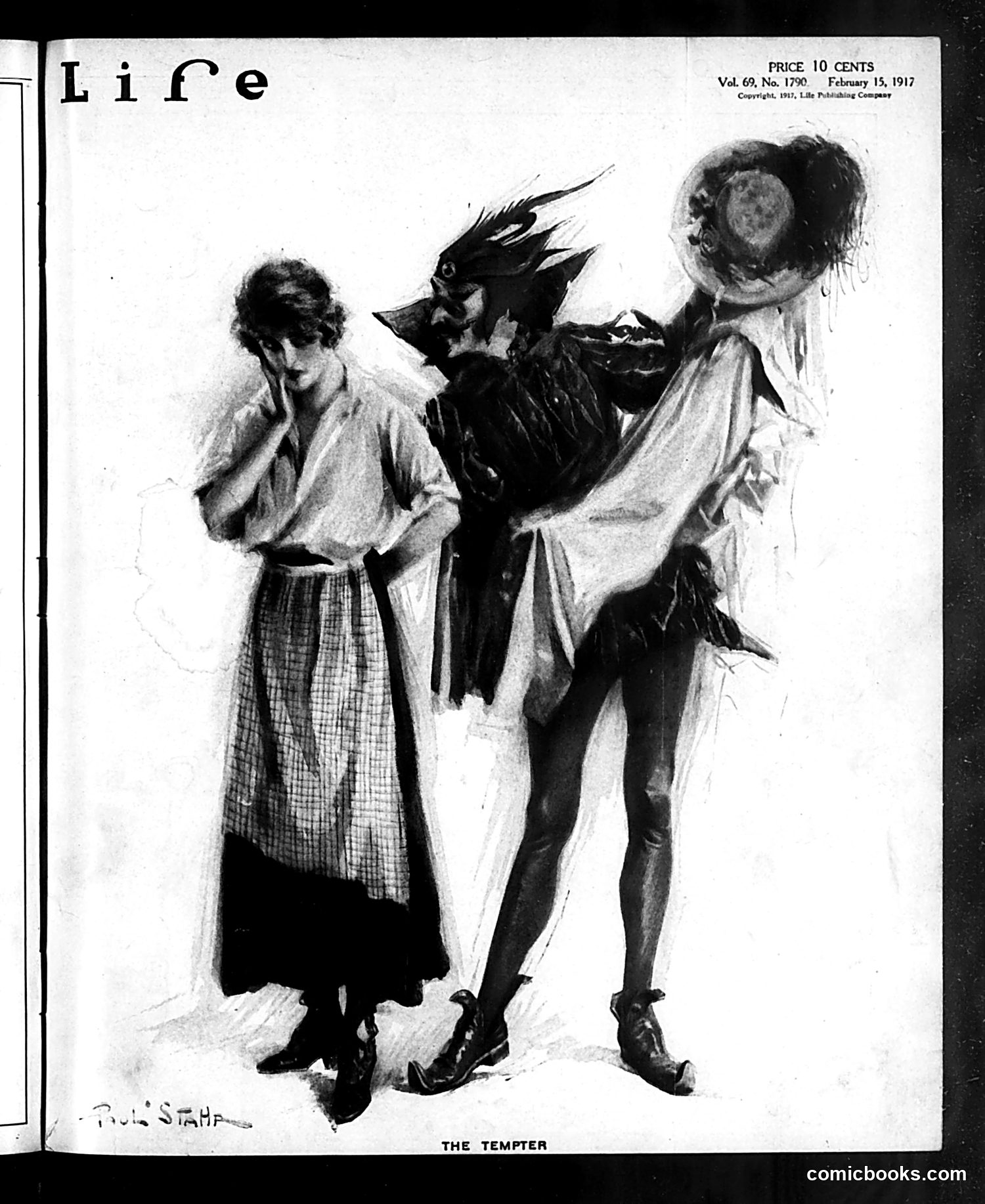
This satirical illustration by Paul Stahr depicts a winged, demonic figure in the center—apparently representing Temptation or Vice—positioning two women in a compromising situation. The figure on the left, shown modest and downcast, contrasts sharply with the figure on the right, who displays her legs and appears to be undressing or being undressed. The cartoon likely critiques the perceived moral corruption of women during the early 20th century, particularly regarding changing attitudes toward dress, behavior, and sexual propriety. The demonic "tempter" suggests external corrupting influences drawing women away from traditional Victorian morality toward more liberated conduct—a common satirical anxiety of the era.
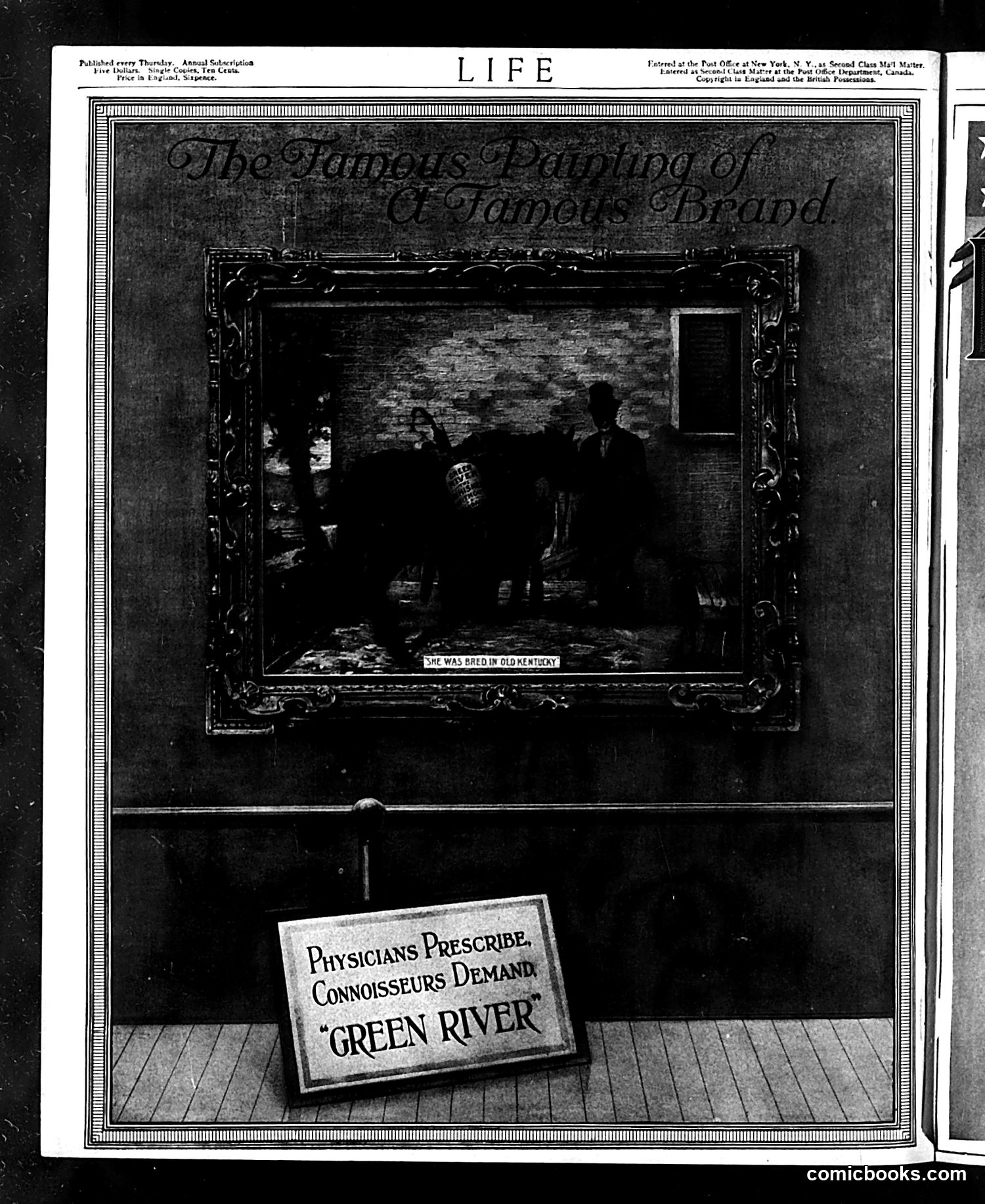
This page advertises a film called "Green River" with the tagline "Physicians Prescribe, Connoisseurs Demand." The main image shows silhouetted figures in what appears to be an interior scene labeled "She Was Bred in Old Kentucky." The advertisement uses satirical language suggesting the film is a remedy or luxury good worthy of professional endorsement. The silhouettes and Kentucky reference suggest a period drama, likely dealing with regional American themes popular in silent cinema. Without clearer identification of the film's plot or production details, I cannot definitively explain the specific satirical point. The ad appears to mock either the film industry's marketing hyperbole or contemporary attitudes about cinema as entertainment—presenting a movie as if it were a medicinal product requiring doctor's orders.
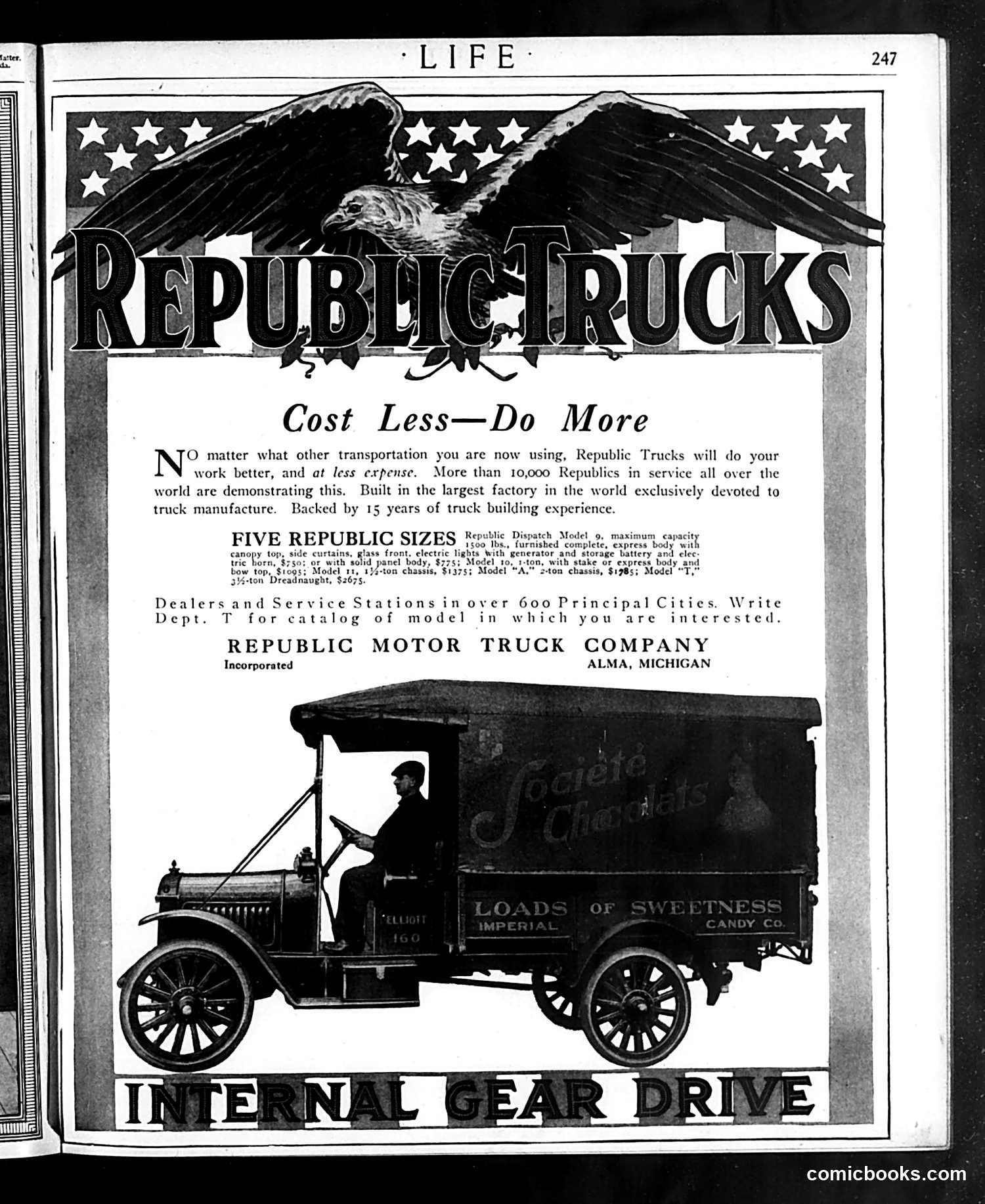
This is primarily a **straightforward advertisement**, not political satire. It promotes Republic Motor Trucks, manufactured in Alma, Michigan, emphasizing their cost-efficiency ("Cost Less—Do More"). The page features: - An eagle logo with stars (patriotic branding) - Five truck models listed with specifications and prices - An illustration of an early 1900s delivery truck carrying candy for "Loads of Sweetness Imperial Candy Co." - Marketing copy claiming 10,000 Republic trucks in service worldwide and 15 years of manufacturing experience - Information about dealers and service stations in 600+ cities There is **no political cartoon or satire present**. This is a vintage commercial advertisement typical of Life magazine's advertising content from the early automotive era.
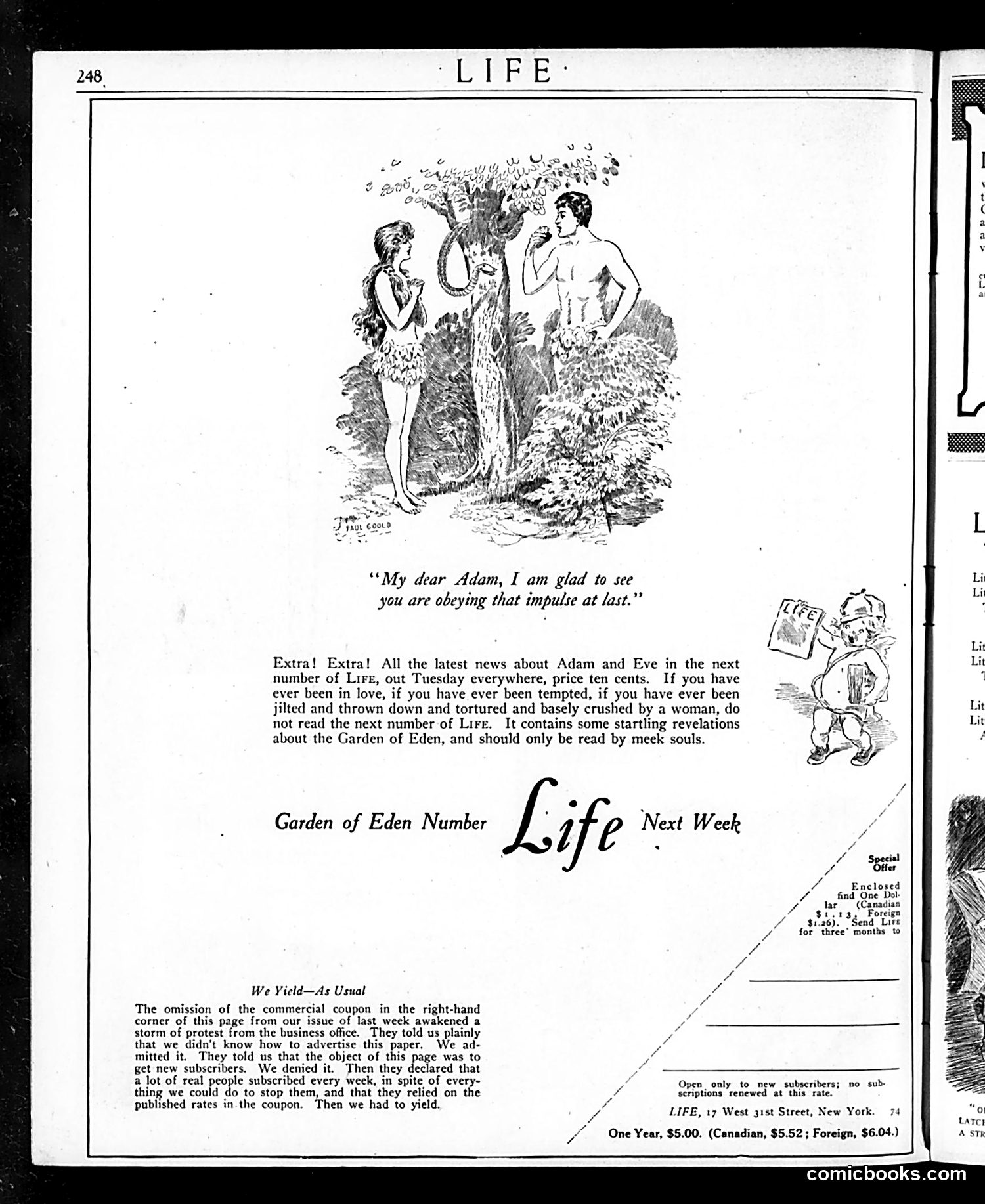
This page features a cartoon satirizing the Biblical Adam and Eve story. The illustration shows two partially clothed figures beside a tree, with Eve saying to Adam: "My dear Adam, I am glad to see you are obeying that impulse at last." The joke plays on the Genesis narrative—likely referencing temptation and obedience to impulse (the forbidden fruit). The satire appears to mock romantic/sexual behavior by framing it through the Adam and Eve mythology. Below the cartoon, Life advertises its upcoming "Garden of Eden Number," promoting sensational content about "Adam and Eve" for readers interested in romantic scandal. The accompanying text humorously warns that this issue should only be read by "meek souls," suggesting titillating or provocative content within. The page also includes publisher notes about subscription policies and pricing.
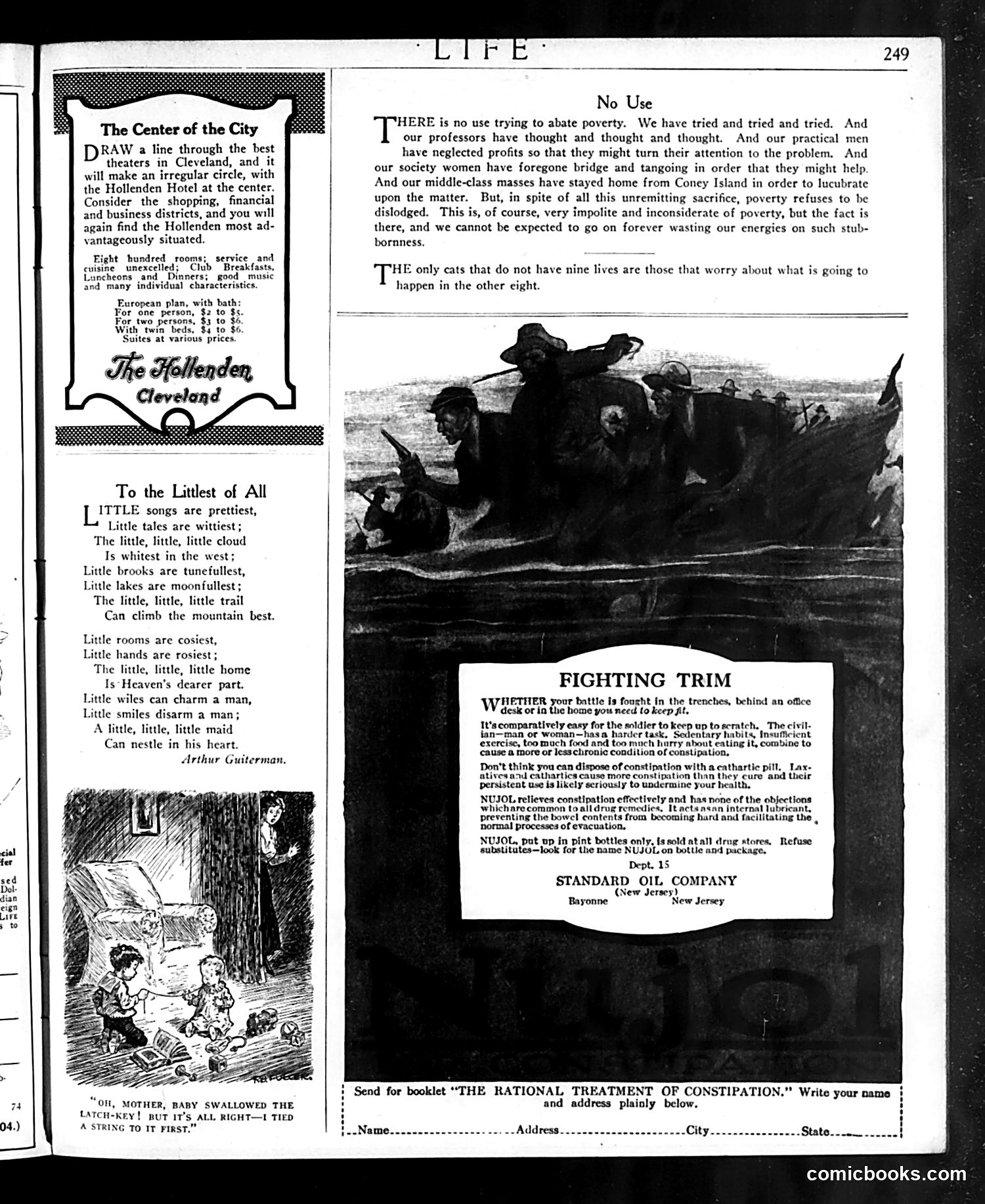
This page contains three distinct elements: **Left side:** A hotel advertisement for the Hollendon in Cleveland, and a poem titled "To the Littlest of All" by Arthur Guterman celebrating small things. Below is an illustration showing children with what appears to be a catch-key scenario. **Center/Right:** An editorial titled "No Use" arguing that efforts to eliminate poverty have failed despite attempts by professors, practical men, and society women. It concludes cynically that poverty persists because efforts prove ineffective. **Bottom:** A Standard Oil Company advertisement for "Nujol," a laxative product, featuring a photograph of soldiers in a trench (likely WWI-era) and promoting the product as treatment for constipation—a common wartime complaint among troops. The page juxtaposes social commentary about poverty with commercial appeals.
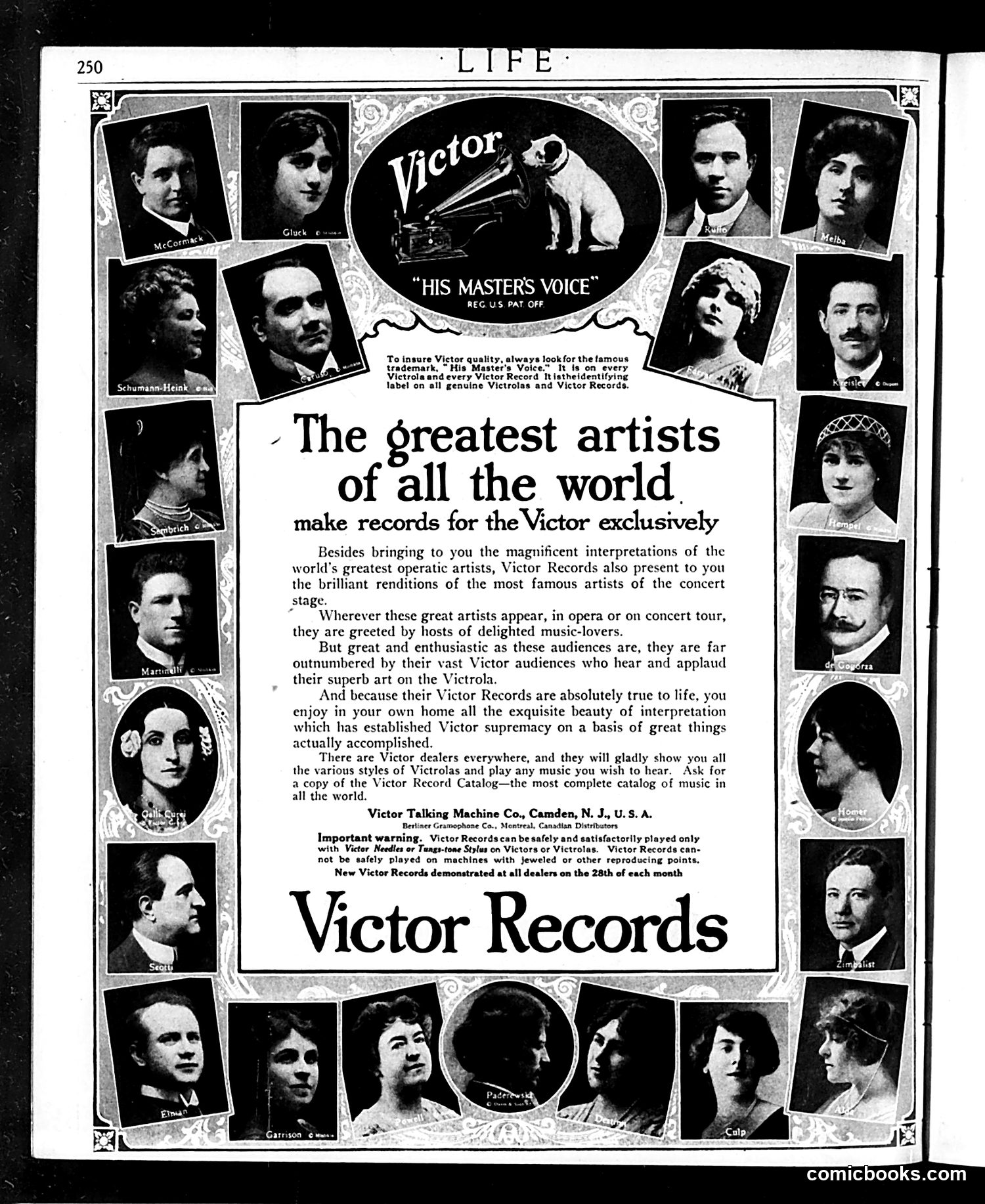
This is not satire or political commentary—it's a straightforward **commercial advertisement** for Victor Records (later RCA Victor), a major recording company of the early 20th century. The ad promotes Victor's exclusive contracts with famous opera singers and concert artists of the era. The central image shows the Victor trademark: a dog listening to a phonograph ("His Master's Voice"). The surrounding photographs display various classical musicians and opera performers whose recordings Victor claimed to offer. The advertisement's pitch emphasizes that Victor recordings capture these world-class artists' performances in your home, rivaling live concert experiences. It advertises Victor's phonograph machines and urges readers to visit dealers or request the Victor Record Catalog. This represents early mass-market promotion of recorded music technology.
This satirical piece presents a telephone conversation between "Hubert" and "Elmer," humorously reversing gender roles. The satire mocks stereotypical female behavior by depicting a man (Hubert) exhibiting exaggerated traits traditionally associated with women: gossiping extensively about acquaintances, obsessing over fashion details, emotional dramatics, and constant social preoccupation. The humor relies on early 20th-century gender stereotypes—the implication being that such behavior would be ridiculous if men engaged in it. The comic sketch satirizes women's perceived frivolousness while simultaneously critiquing men's social pretensions when adopting these behaviors. References to contemporary figures (Mary Jones, Chauncey Waxing, Rupert Railbird) and social activities (horse shows, tea-dances) ground the satire in the magazine's contemporary upper-class milieu.
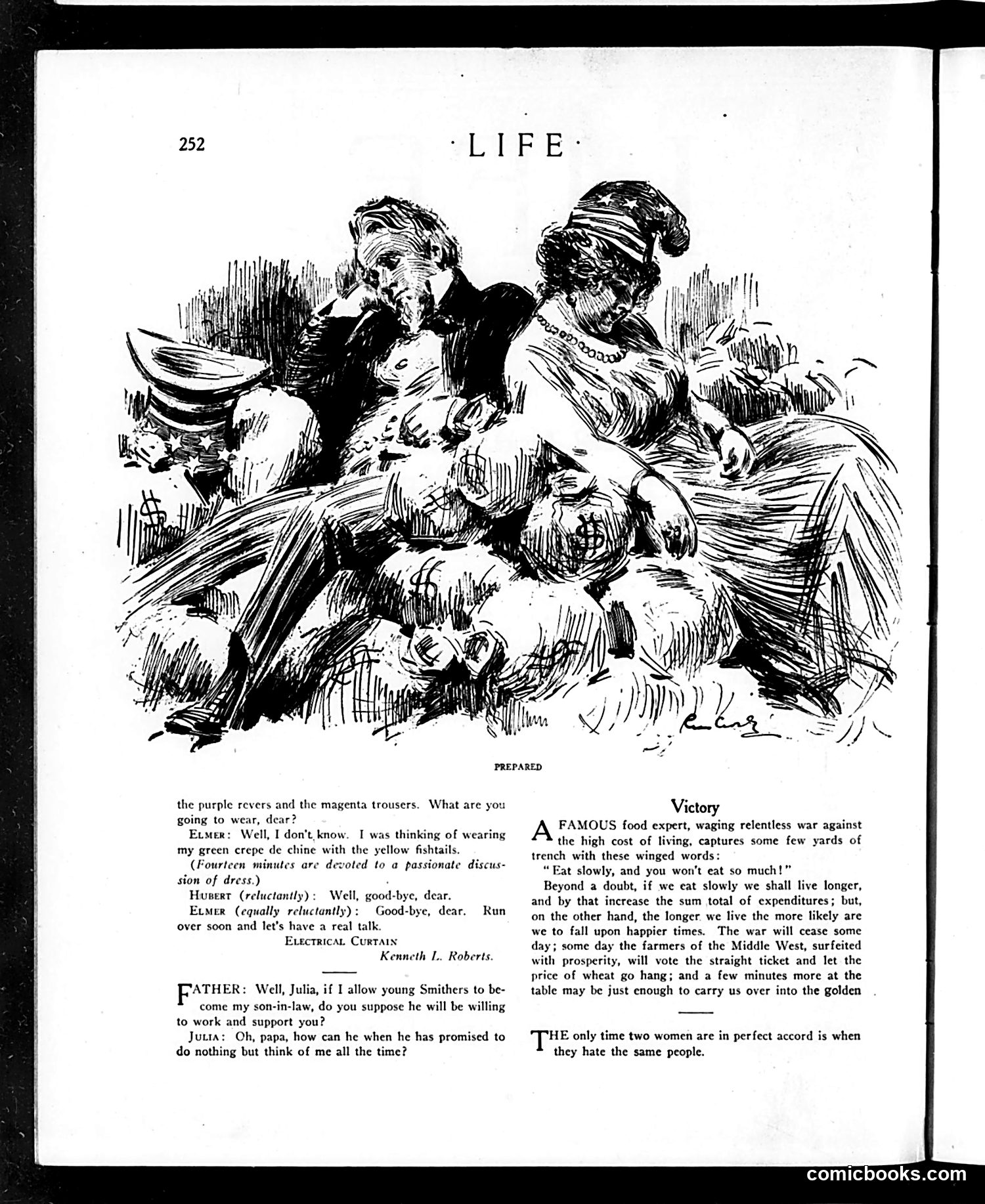
This page from *Life* magazine contains two satirical pieces: **"Prepared"** (dialogue at bottom left) mocks upper-class fashion discussions. Elmer and Hubert debate outfit choices using affected language ("passionate discussion of dress"), while an "Electrical Curtain" joke by Kenneth L. Roberts follows. **"Victory"** (upper right) is political satire on wartime economics. A "famous food expert" argues that eating slowly reduces food consumption and household expenses—a cost-of-living concern during what appears to be WWI. The expert cynically suggests that only farmers in the Middle West will prosper enough to afford "the golden table," implying ordinary citizens will struggle. The illustration (top) depicts well-dressed figures in conversation, supporting the fashion-focused satire below. **Overall theme:** Class-based humor mocking both frivolous fashion concerns and hollow wartime economic advice.
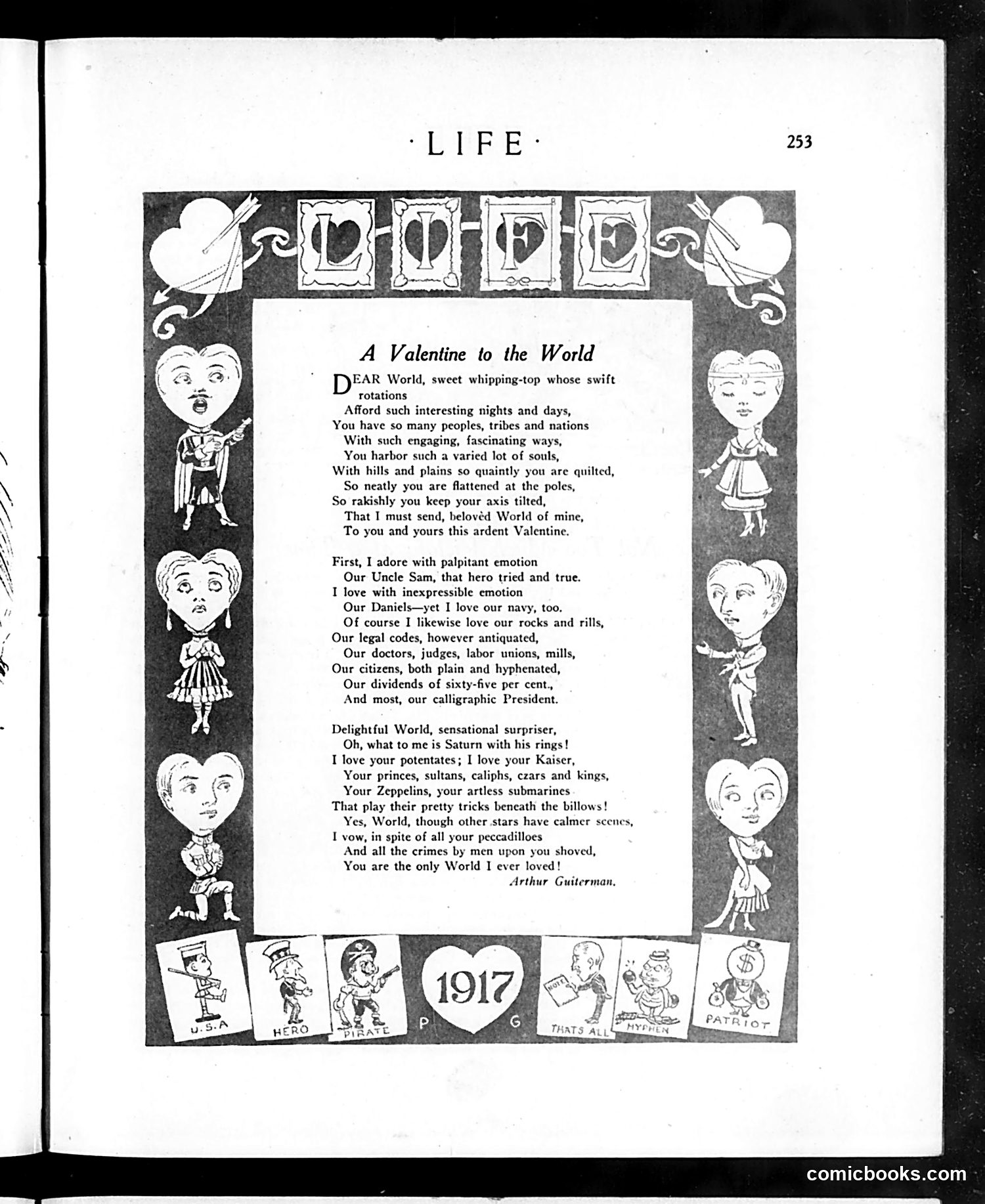
This satirical poem by Arthur Guiterman, published in *Life* magazine (page 253), uses Valentine's Day framing to critique American attitudes and interests during World War I. The poem affectionately catalogs what America loves: Uncle Sam, the Navy, legal institutions, doctors, and notably "our calligraphic President" (likely Woodrow Wilson). It celebrates American technology and military power (Zeppelins, submarines, Kaiser references). The decorative border features whimsical face illustrations and patriotic imagery including "U.S.A.," "HERO," "1917," and "PATRIOT"—reinforcing nationalistic sentiment during America's WWI involvement (declared April 1917). The satire is gentle: affectionate exaggeration of American pride and enthusiasm during wartime mobilization.
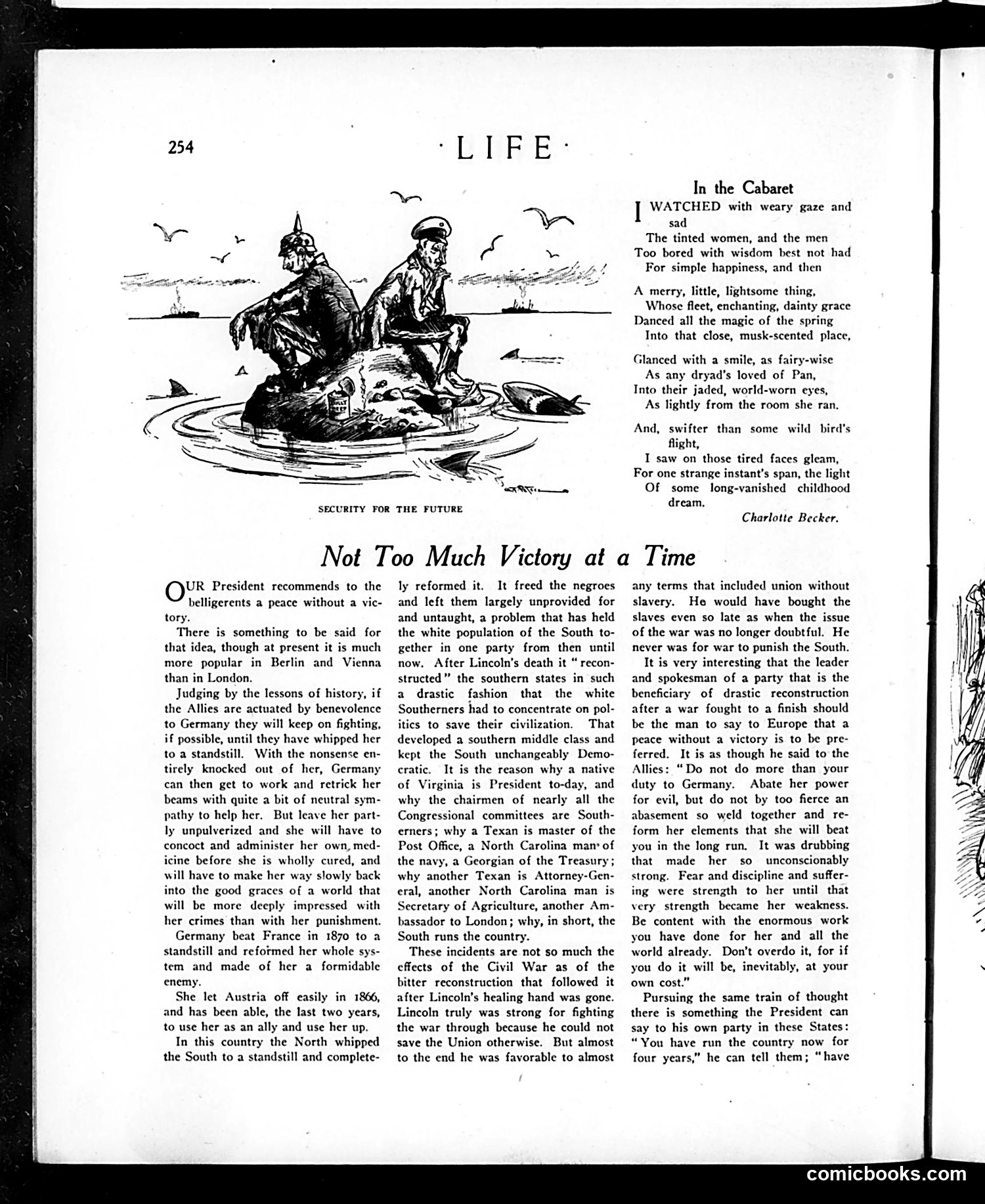
**The Cartoon ("Security for the Future"):** Two figures sit on what appears to be a nest or platform surrounded by water. The image suggests vulnerability and precariousness despite the title's promise of "security." The cartoon likely satirizes post-Civil War Reconstruction policies toward the South—the nest metaphor implies the South's unstable position rather than genuine security. **The Article ("Not Too Much Victory at a Time"):** This piece critiques President Lincoln's (or his successor's) Reconstruction approach. It argues against punitive measures toward the defeated South, instead advocating a moderate policy that would allow Southern states to gradually rebuild. The text references Lincoln's death and debates over whether to impose harsh terms or foster reconciliation. The satire mocks the notion that restraint in victory serves national interest.
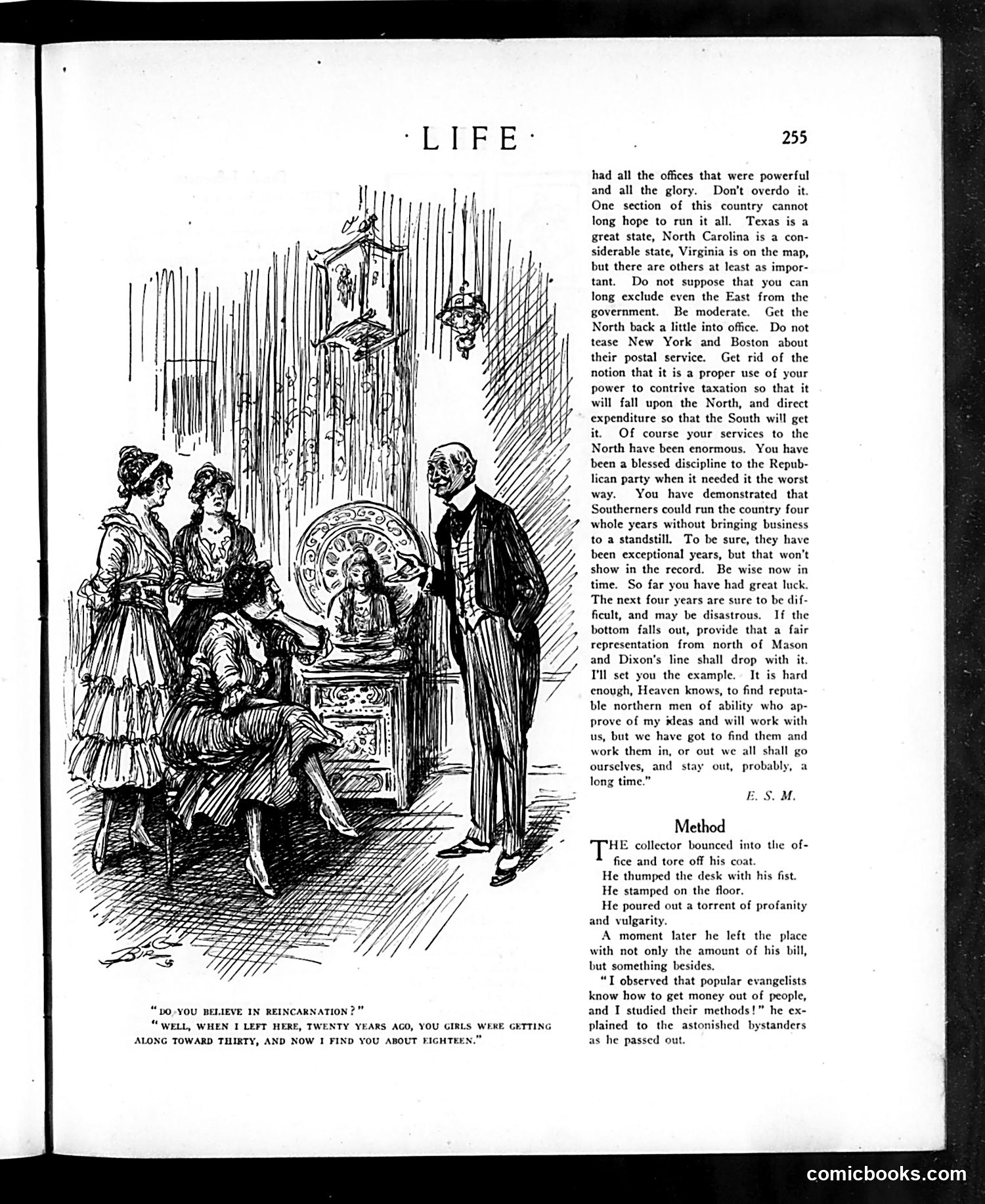
The illustration depicts a scene of political negotiation, likely from the Reconstruction era following the Civil War. A well-dressed man (possibly a Northern politician or official) stands among three women, suggesting discussion about governance and regional policy. The accompanying text addresses Southern political leaders, urging moderation in their demands for power and cautioning against attempts to monopolize national government. It explicitly references North-South tensions, Mason-Dixon's line, and debates over resource distribution between regions. The satirical "Method" section below mocks a corrupt tax collector's aggressive tactics, implying criticism of government overreach and bribery—common Reconstruction-era complaints about carpetbagger misconduct and administrative corruption in the occupied South.
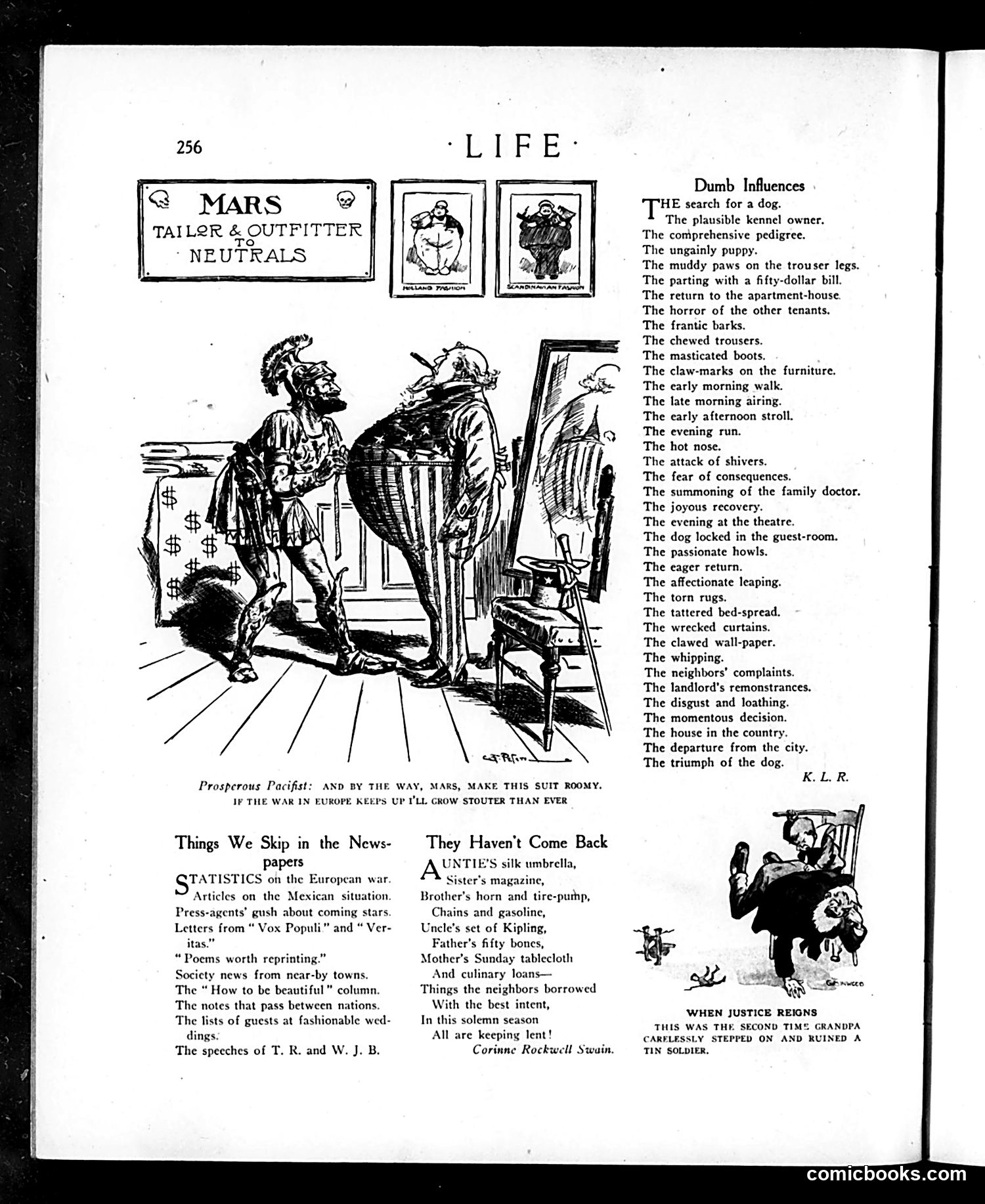
This page contains satirical commentary on dog ownership during wartime (likely WWI era, given European war references). The main cartoon shows two well-dressed men examining a dog, captioned "Prosperous Pacifist: and by the way, Mars, make this suit roomy. If the war in Europe keeps up, I'll grow stouter than ever." The satire mocks wealthy civilians who profit from war while remaining personally uninvolved—suggesting their prosperity and comfort will increase their girth. The poem "Dumb Influences" humorously catalogs the chaos caused by owning a dog in an apartment building, listing damages and social consequences. Below are two unrelated sections: "Things We Skip in Newspapers" (listing tedious wartime coverage) and "They Haven't Come Back" (listing borrowed items neighbors won't return), typical satirical observations on civilian wartime life and social friction.
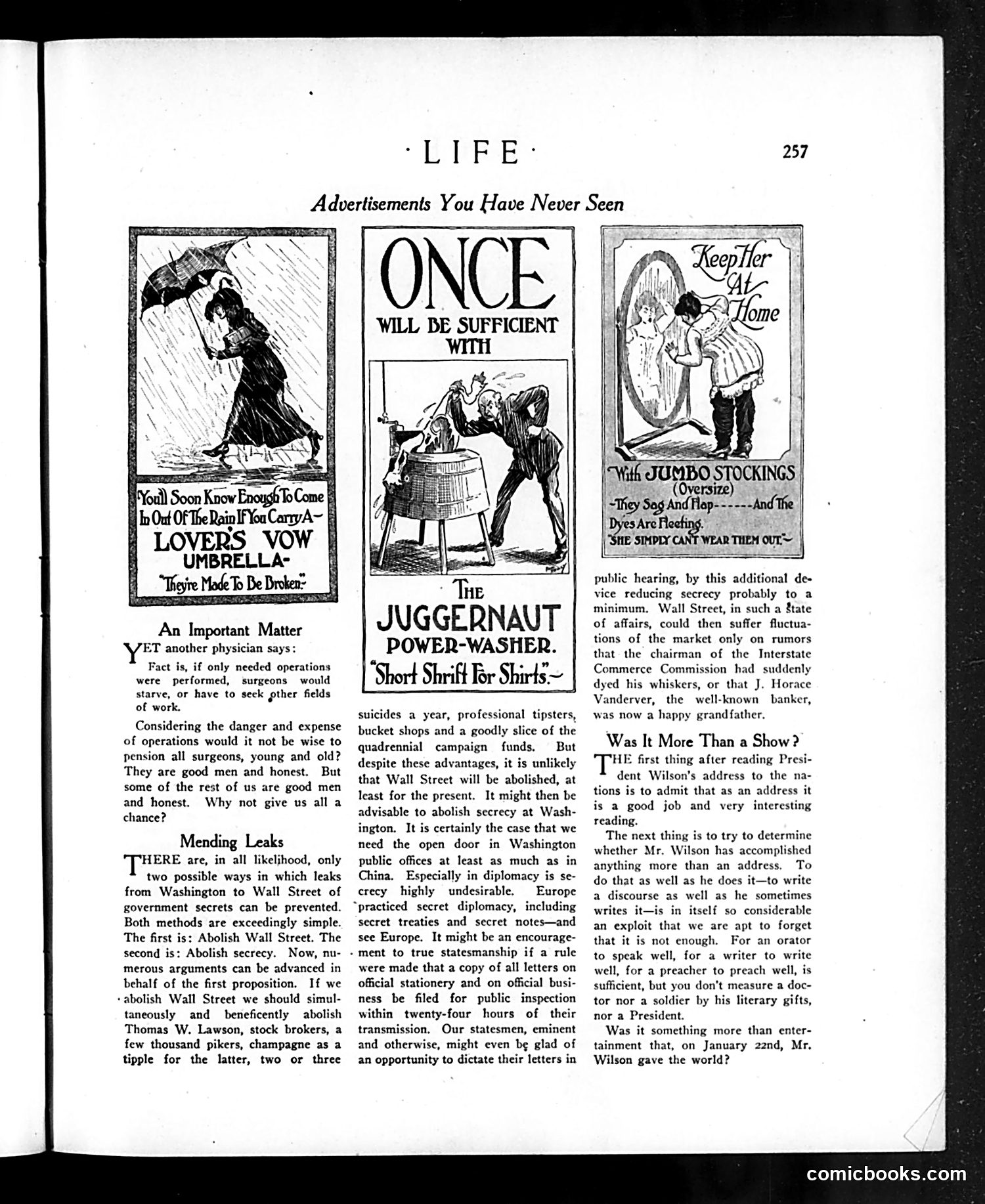
This page contains **satirical advertisements** (fake product ads) and political commentary typical of Life magazine's humor format. The three fake ads mock consumer products and domestic life: - A "Lovers Vow Umbrella" plays on romantic notions - "The Juggernaut Power-Washer" for laundry - "Jumbo Stockings" marketed as durable The main article discusses **President Wilson's recent address** on government secrecy, debating whether it was substantive or merely entertainment. It also proposes abolishing the U.S. State Department's secrecy practices, comparing American diplomacy unfavorably to European openness. The satire targets government opacity and bureaucratic inefficiency—perennial targets of Life's commentary. Without dating this precisely, the Wilson reference and diplomatic focus suggest early 20th-century publication.
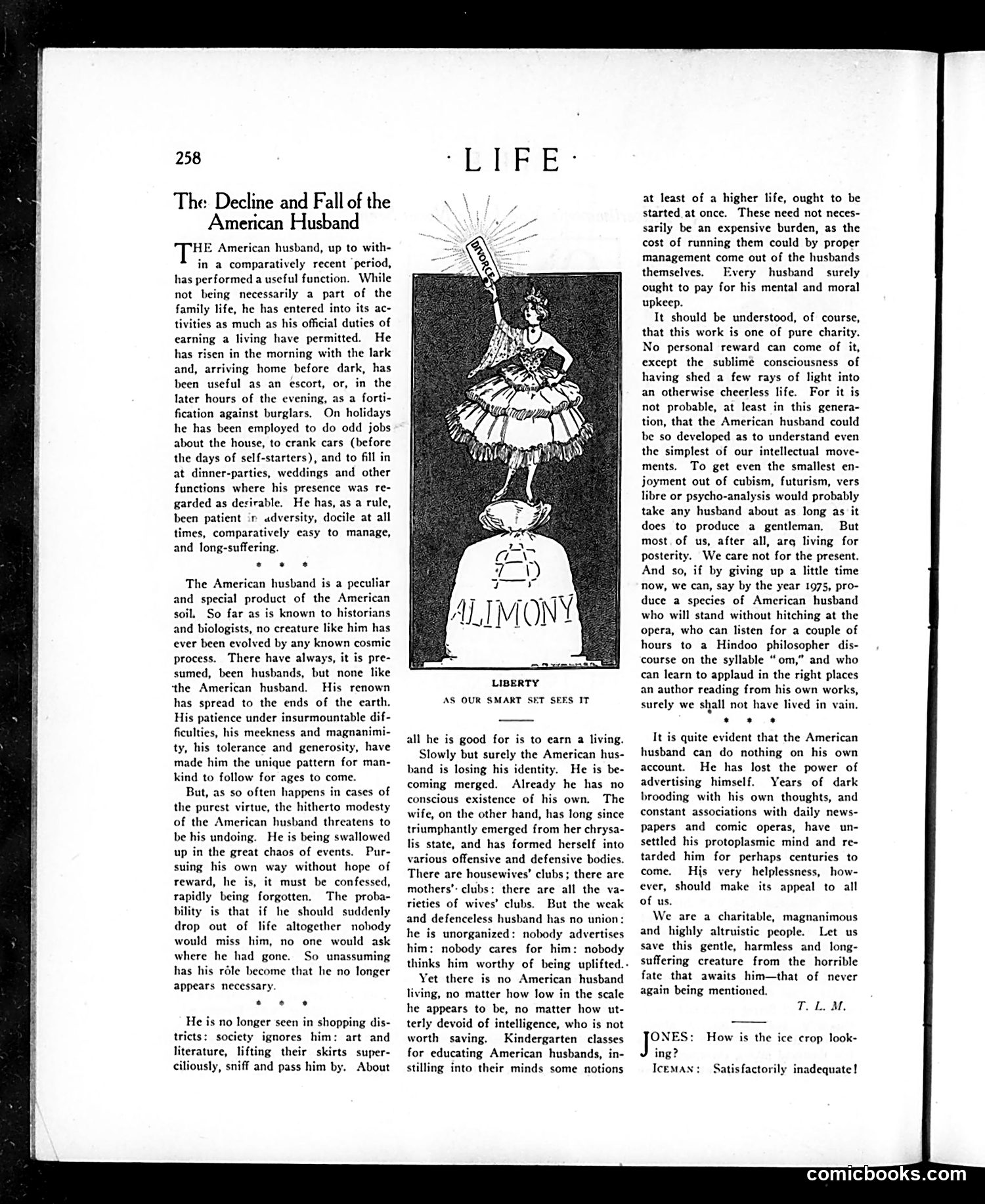
This satirical article critiques the changing role of American husbands in early 20th-century society. The central cartoon depicts a woman labeled "Liberty" standing triumphantly atop a pedestal labeled "Alimony," illustrated as her literal foundation. The satire suggests that wives' growing independence and organization—through "housewives' clubs" and "mothers' clubs"—has diminished husbands' authority and identity. The author argues American husbands have lost their power of self-advertisement and influence, becoming financially drained (via alimony) and socially irrelevant. The cartoon's visual message is direct: modern female liberty now rests upon mandatory financial support from men, presenting this as an ironic inversion of traditional power structures. This reflects anxieties about women's increasing autonomy in the early 1900s.
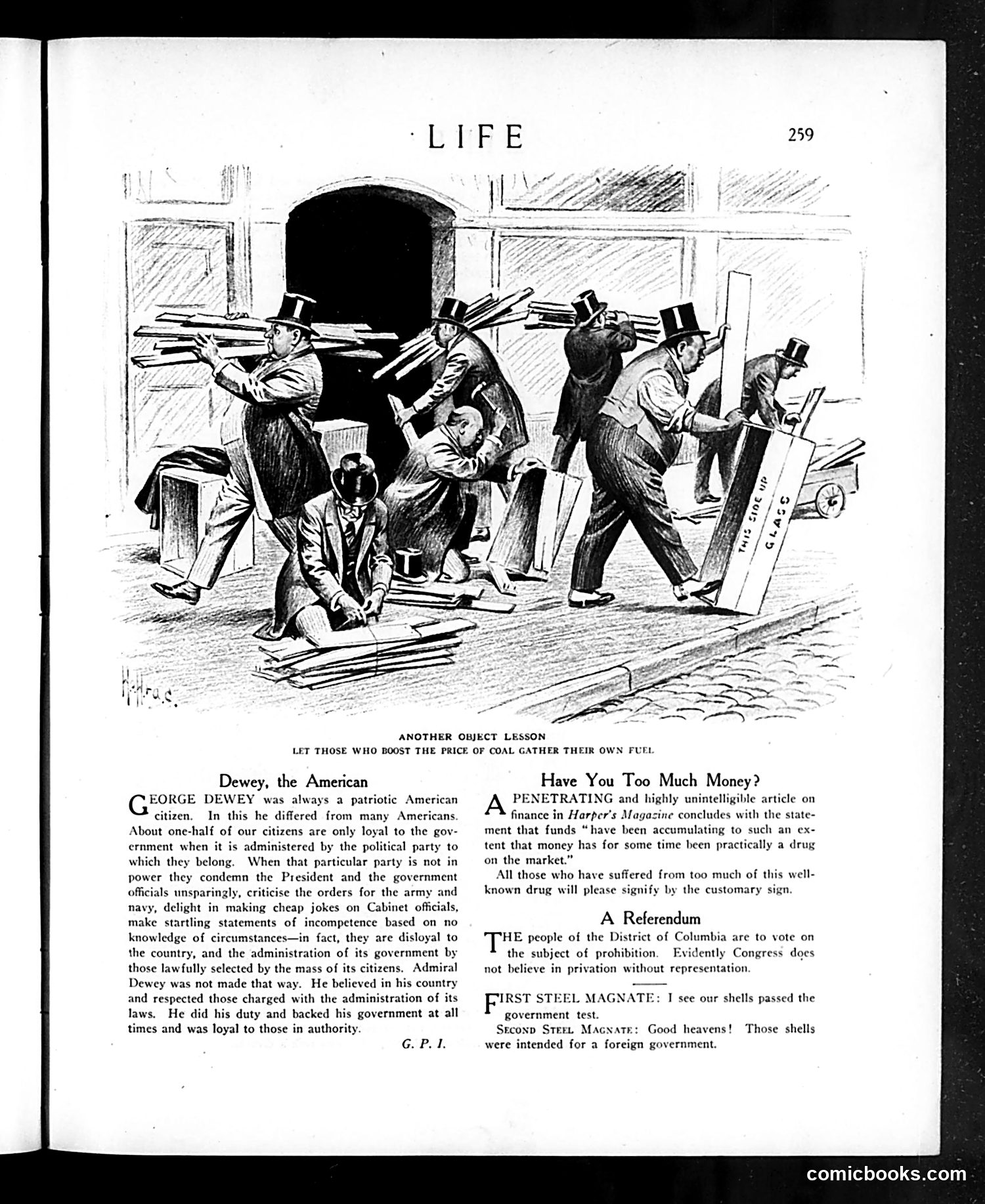
This cartoon satirizes wealthy industrialists and financiers who profited from high coal prices during what appears to be an energy crisis. The caption reads: "Let those who boost the price of coal gather their own fuel." The illustration shows top-hatted businessmen and well-dressed figures struggling to manually handle coal and lumber—physically labor that they'd normally have others do. The satire mocks their disconnection from actual work while they manipulated market prices for personal gain. The accompanying text about George Dewey emphasizes patriotic civic duty and loyalty to proper authority, suggesting these profiteers lacked such virtue. The overall message critiques wealthy elites for exploiting essential resources while avoiding any real consequences or labor themselves.
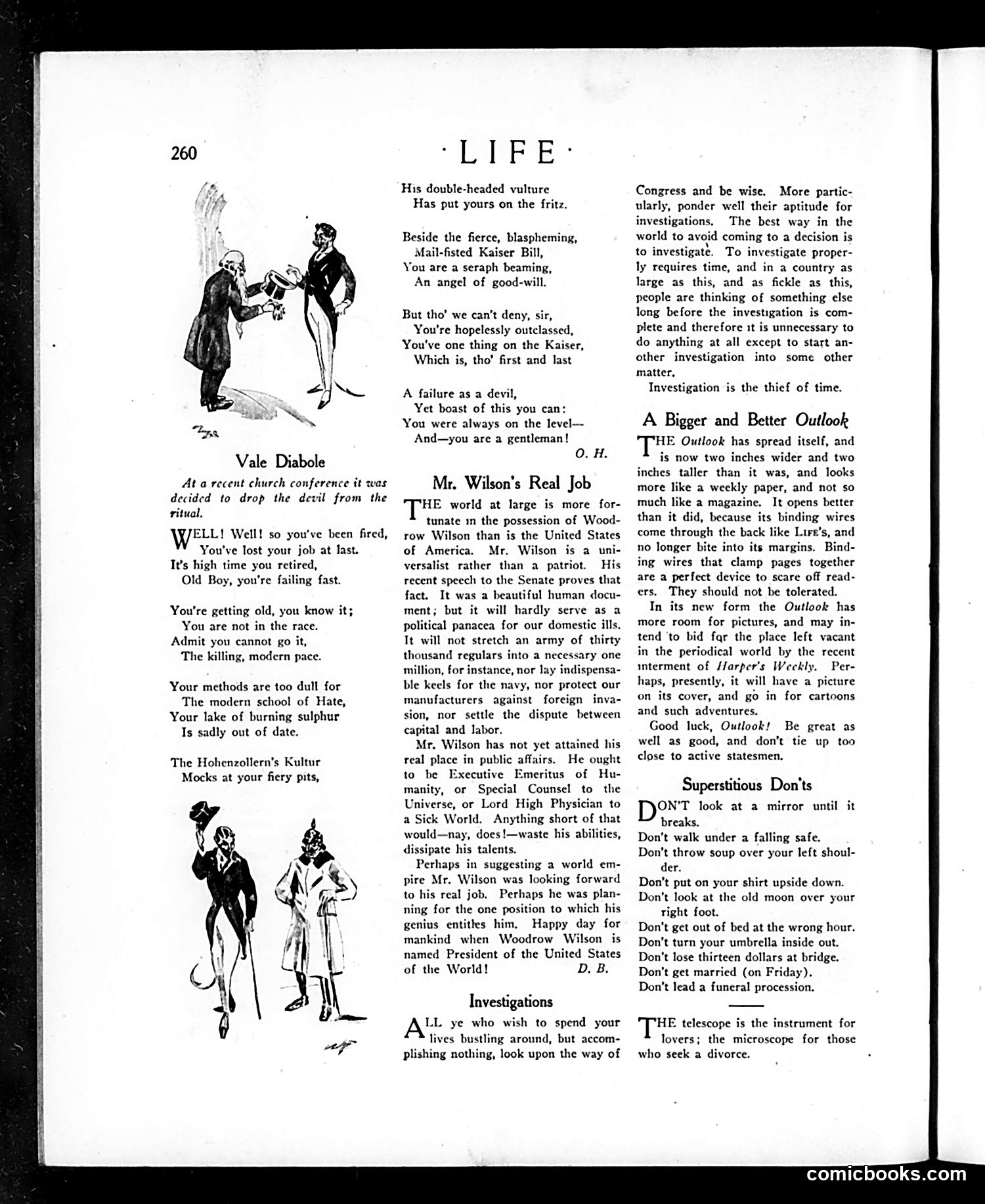
This page contains early 20th-century American satire, likely from WWI era based on references to "Kaiser Bill." **"Vale Diabole"** is a poem mocking the Devil's obsolescence. A recent church conference decided to remove Satan from ritual, prompting this farewell. The satire suggests the Devil has been "fired" because modern warfare—specifically German "Kultur" and the Kaiser's brutality—has superseded even Hell's wickedness. The cartoon shows the Devil being dismissed. The poem's ironic conclusion credits Satan with at least maintaining gentlemanly honor, unlike the Kaiser. **"Mr. Wilson's Real Job"** satirizes President Woodrow Wilson as too idealistic for practical governance. The author mocks Wilson's universalist speeches while criticizing his failure to address domestic military readiness, naval strength, and labor disputes. It suggests Wilson is better suited to abstract positions like "President of the United States of the World" than actual American leadership. **"Investigations"** critiques Congress for endlessly launching inquiries without reaching conclusions—a tactic to avoid making decisions. The remaining sections announce format changes to *The Outlook* magazine and list superstitions.
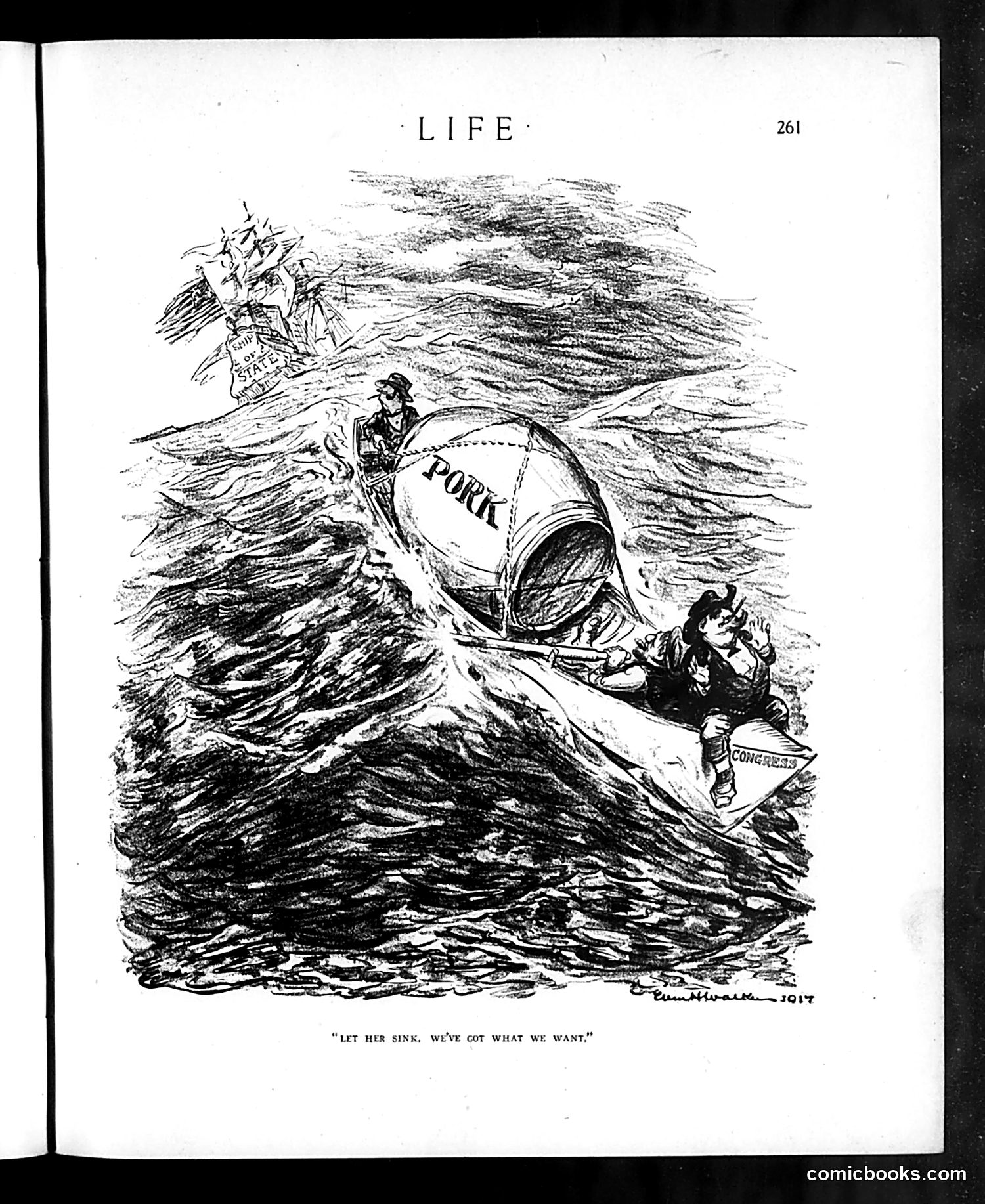
This 1917 cartoon depicts a ship sinking in turbulent waters while a figure labeled "PORK" is being extracted by congressmen labeled "CONGRESS." The American flag appears damaged in the background, suggesting national crisis. The satire criticizes Congress for prioritizing "pork barrel" spending (wasteful appropriations benefiting specific districts) over national welfare during what appears to be a wartime emergency. The drowning ship likely represents the nation or military effort, while the congressmen callously secure their political benefits regardless of the larger crisis. The caption "Let her sink, we've got what we want" makes explicit the accusation: politicians care only about personal/district gain, indifferent to national peril. This reflects Progressive Era criticism of legislative corruption and self-interest.
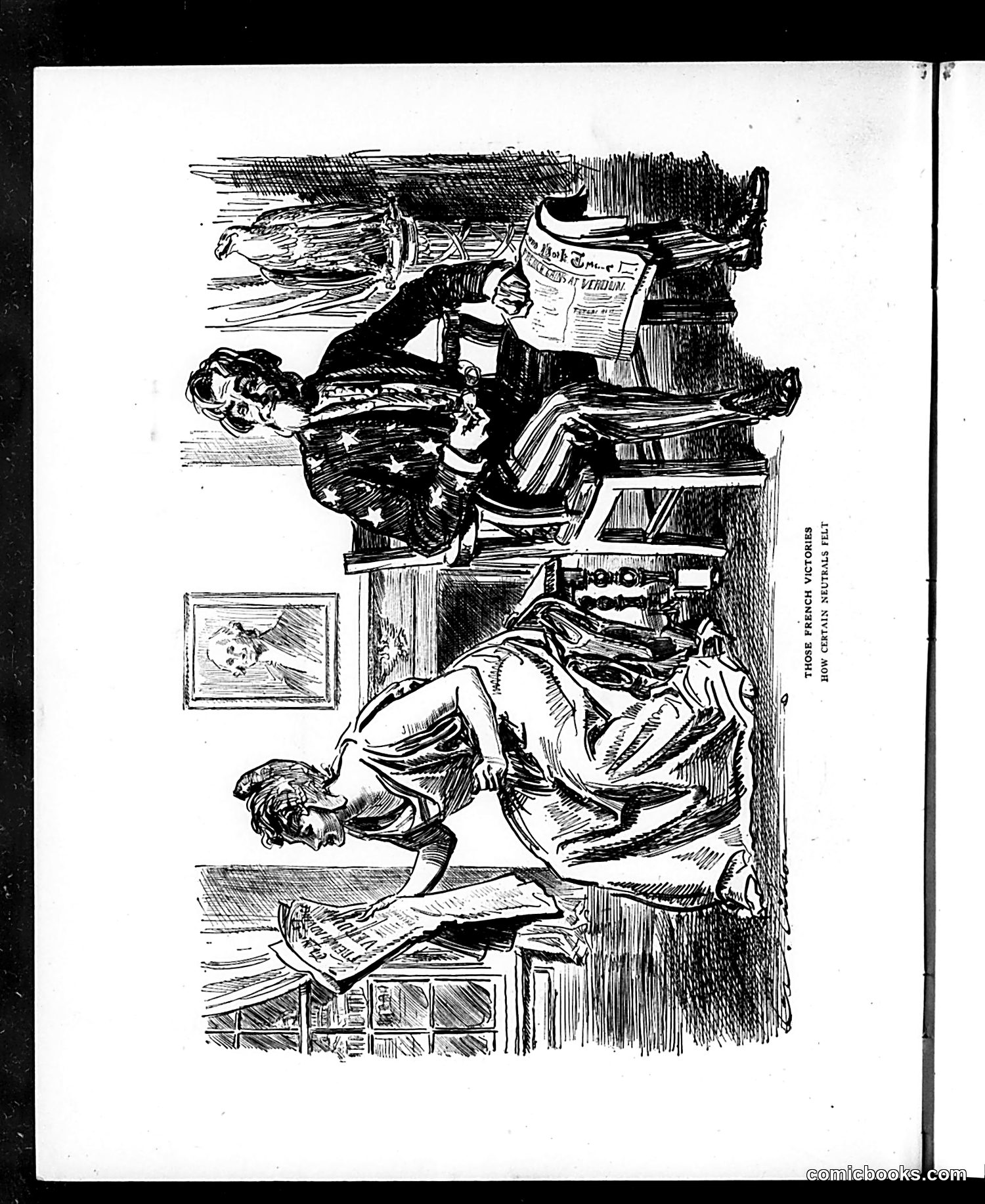
This cartoon satirizes American neutrals' reactions to French military victories, likely during World War I. The image shows two figures: one seated reading a newspaper announcing French victories, appearing agitated or distressed, while another figure (appearing to represent Uncle Sam or American authority) stands above in a more composed position. The satire targets Americans who, despite official U.S. neutrality, held strong pro-German sympathies or business interests. The cartoon mocks how certain neutrals—possibly German-American immigrants or those with economic ties to Germany—would feel troubled rather than pleased by French success on the battlefield. The title "How Certain Neutrals Felt" emphasizes the irony: neutrality supposedly means impartiality, yet these figures reveal their true allegiances through their distressed reactions to Allied victories.
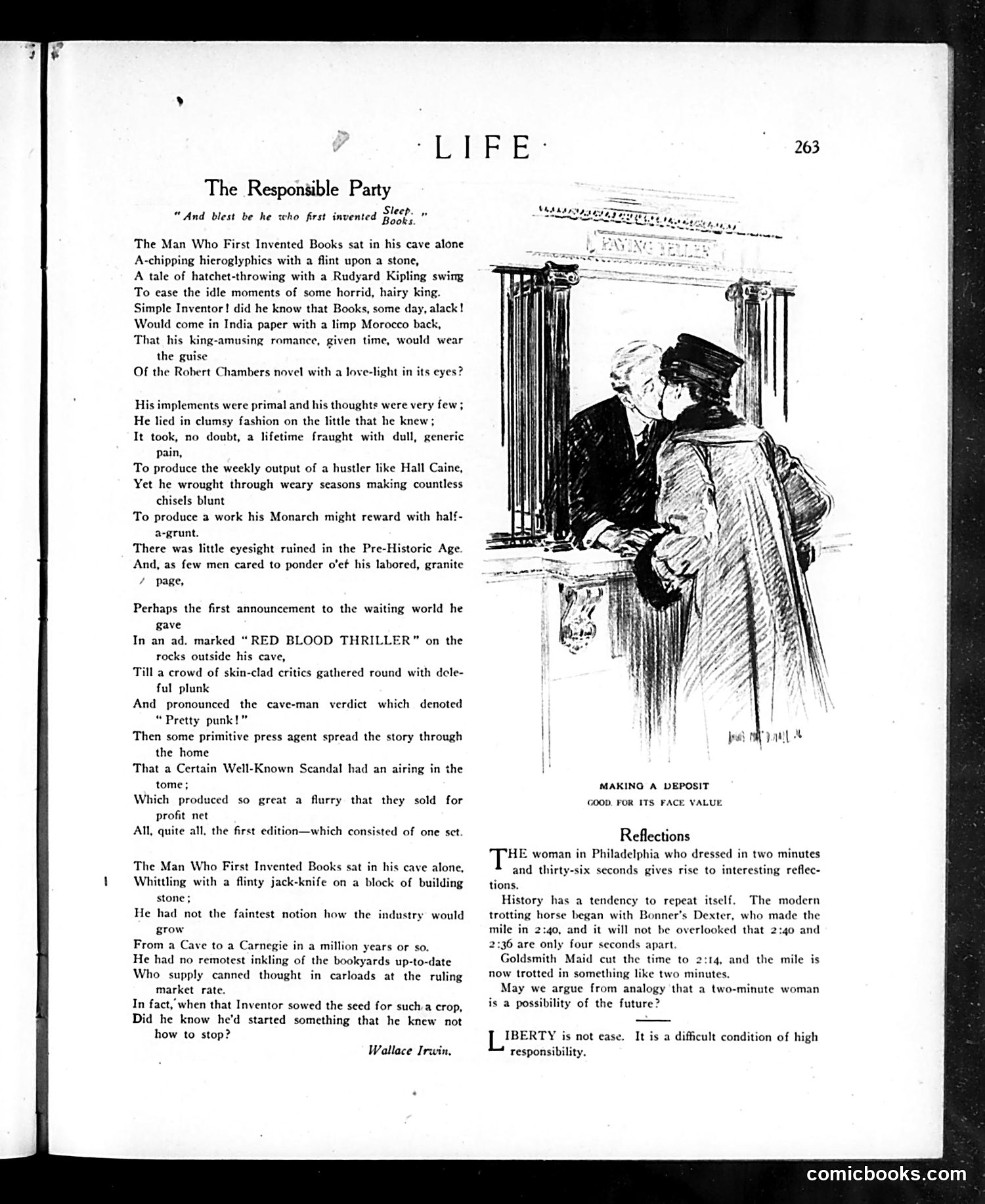
This poem by Wallace Irwin satirizes the unintended consequences of inventing something transformative. The "Man Who First Invented Books" naively created a simple tool for entertainment, never imagining how the publishing industry would evolve—from cave hieroglyphics to mass-market novels. The satire targets several things: the commodification of literature (books become profitable merchandise), the sensationalism of the era (marketing "Red Blood Thrillers" and scandals to boost sales), and the industrialization of writing itself (authors like Hall Caine producing "canned thought in carloads"). The cartoon illustration shows a figure making a deposit—likely a publisher or author literally banking profits from the "face value" of books as commercial products rather than art. The accompanying "Reflections" section uses sports analogies about speed records to humorously extend the theme of progress and human efficiency becoming absurd extremes. The final line about liberty being responsibility suggests irony: the inventor unleashed something impossible to control.
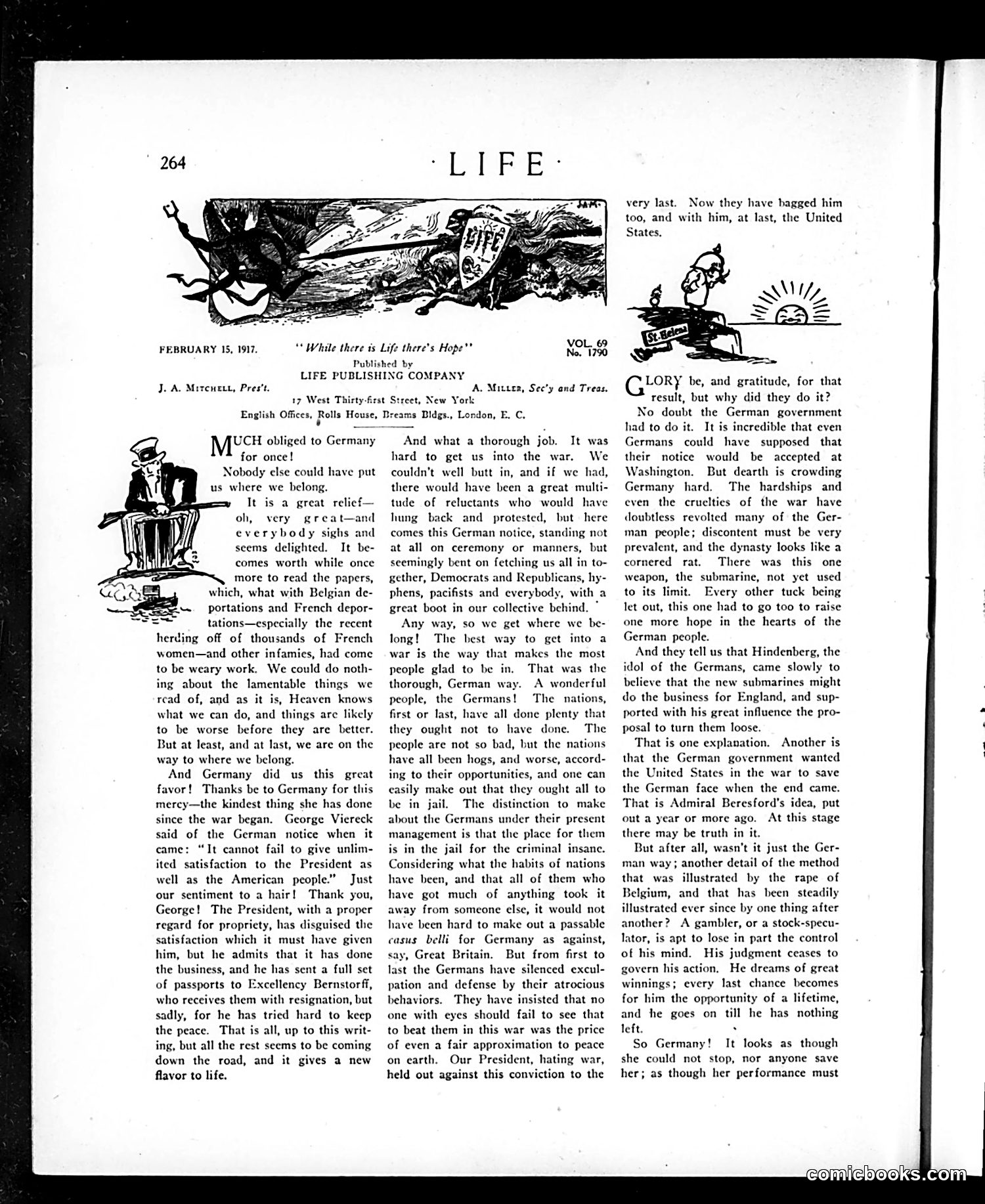
This editorial cartoon celebrates Germany's recent declaration of unrestricted submarine warfare, which finally pushed the reluctant United States toward entering World War I. The author sarcastically thanks Germany for accomplishing what diplomacy could not: uniting Americans (Democrats, Republicans, pacifists, hyphenates) behind the war effort. The piece mocks American hesitation to enter the conflict, suggesting that only Germany's brutal tactics—explicitly referencing Belgian deportations and atrocities—could overcome widespread reluctance. The author paradoxically praises Germany's "thoroughness" while condemning the German government as belonging "in the jail for the criminal insane," arguing their atrocities made defeating them a moral necessity. The cartoon expresses resigned acceptance: President Wilson, who hated war, finally had no choice. The title's bitter irony—"hope" lies in military conflict—encapsulates the grim logic of entering what would become World War I.
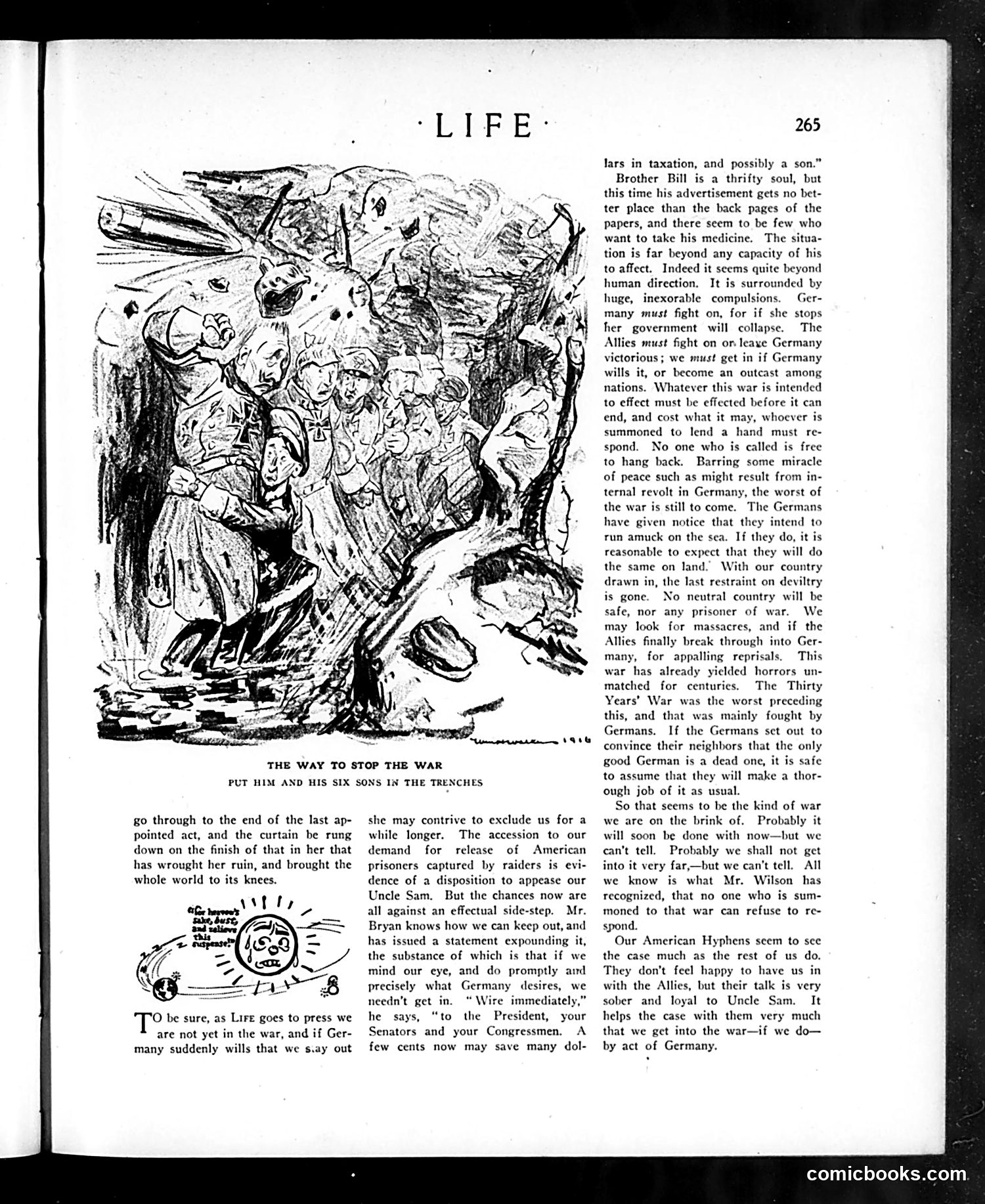
The cartoon attacks **William Jennings Bryan** (identified in text as "Brother Bill"), who served as Secretary of State under Wilson. The image depicts him as a skeletal, death-like figure—likely representing his pacifist stance during WWI. The headline "Put Him and His Six Sons in the Trenches" is bitter satire: Bryan publicly advocated keeping America out of war through appeasement of Germany, but Life's editors mock his position as cowardly and naive. They suggest his "few cents" spent on telegrams to Congress promoting pacifism are worthless against inevitable German aggression. The text sarcastically notes his advertisement appears only "in the back pages" because few support his isolationism anymore. Life argues that forces beyond human control—Germany's need to fight, Allied necessity, American honor—make neutrality impossible. The satire's point: Bryan's pacifism is both morally bankrupt and practically irrelevant to coming American involvement in the war.
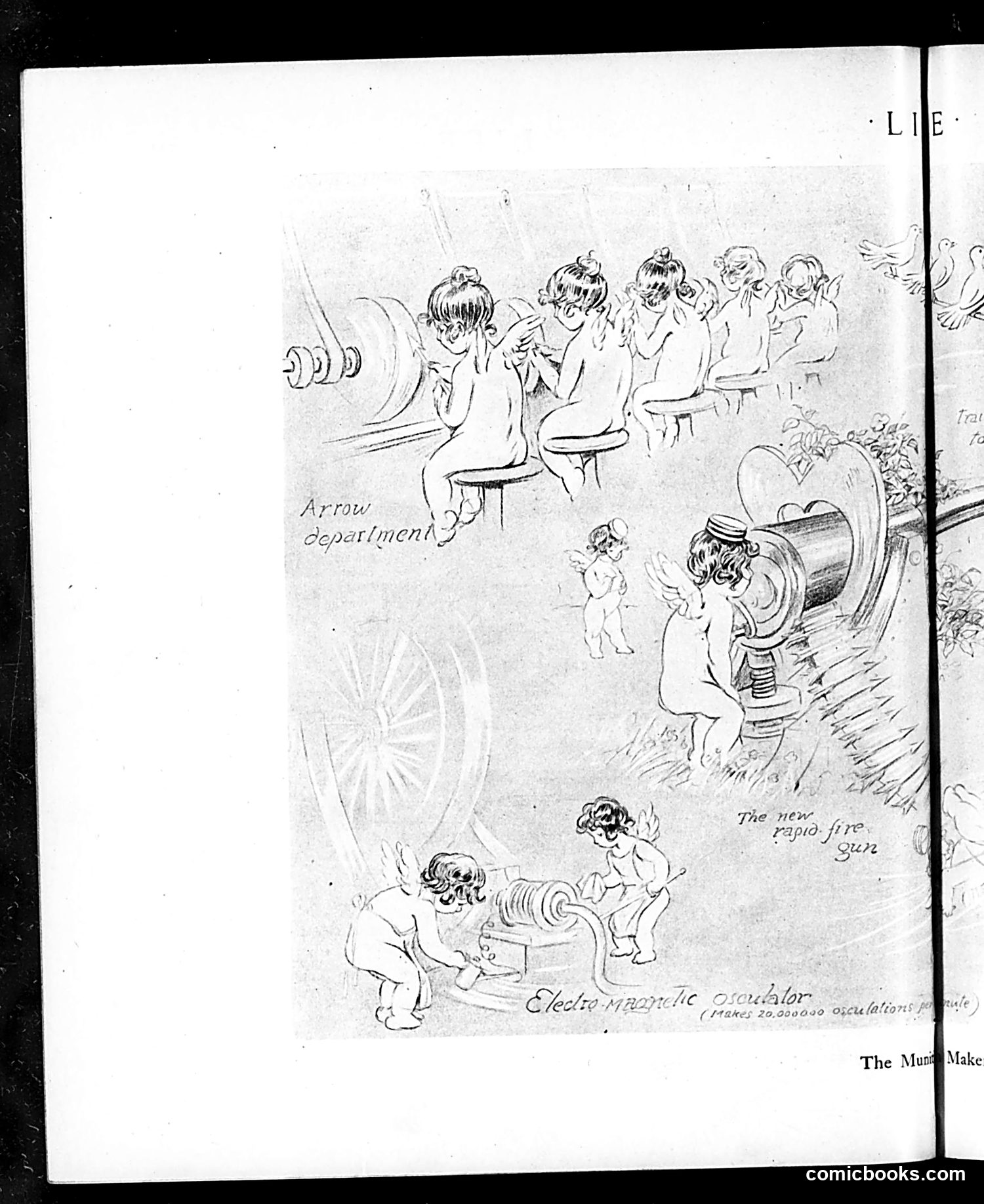
This appears to be a humorous illustration depicting cherubs or cupids in various industrial/mechanical scenarios, likely satirizing modern technological advancement or factory work. The labeled sections reference: - "Arrow department" (top) - showing figures at what appears to be a production line - "The new rapid-fire sun" (middle right) - featuring some kind of mechanical device - "Electromagnetic oscillator" (bottom) - depicting cherubs with electrical equipment The satire seems to mock how modern industrial innovations and electrical technology were being applied to traditionally romantic or leisure activities. By placing innocent cupids in factory settings with mechanical equipment, the cartoonist suggests the dehumanizing or absurd nature of industrialization encroaching on all aspects of life—even love and romance. The style and references suggest early 20th-century concerns about technology's social impact.
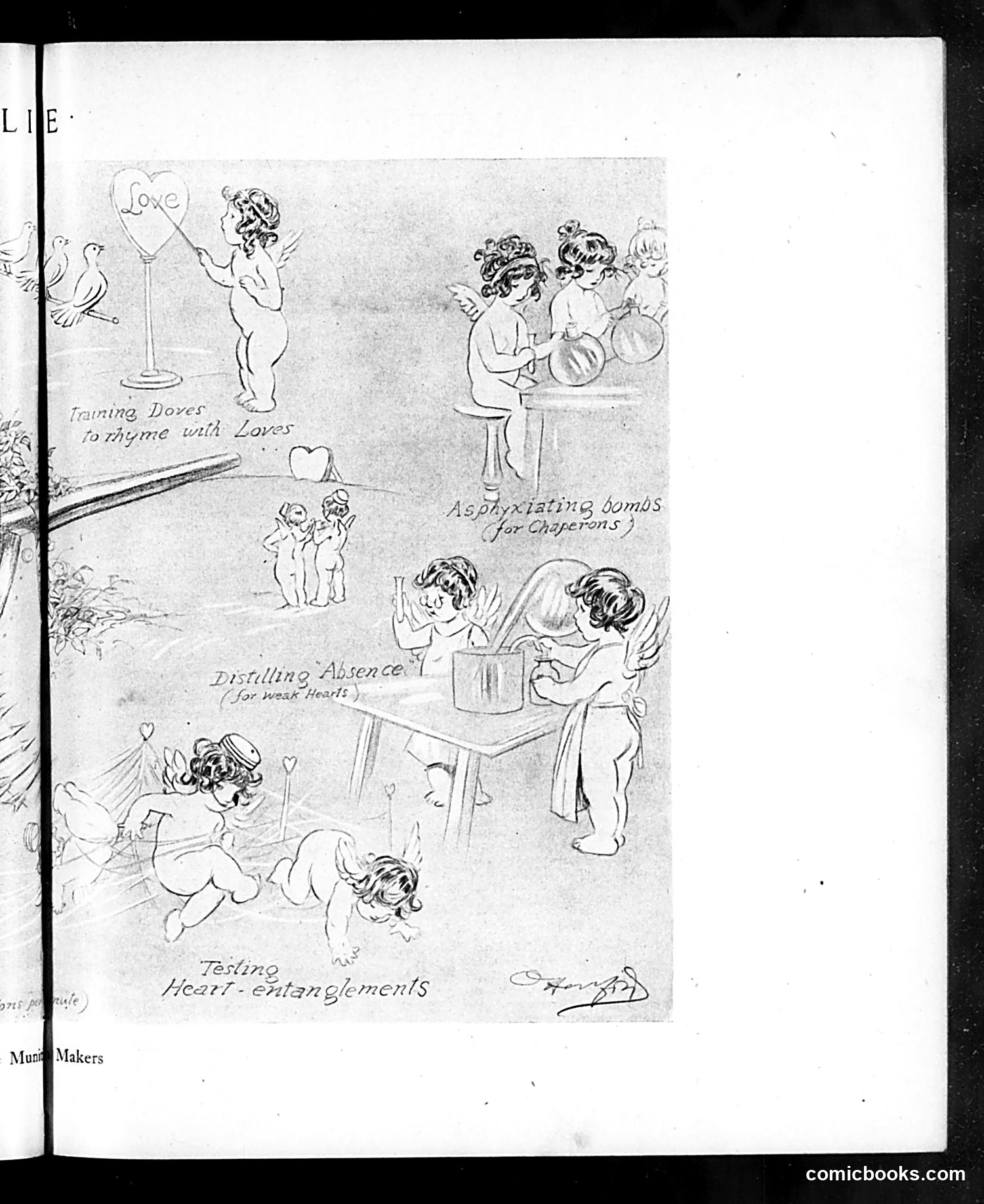
This page depicts cherubs engaged in various "love-making" activities presented as recipes or chemical processes. The captions—"Testing Doves to Rhyme with Loves," "Asphyxiating Bombs for Chaperons," "Distilling Absence (for Weak Hearts)," and "Testing Heart-Entanglements"—satirize romantic sentimentality and courtship rituals. The cartoon mocks Victorian-era romance conventions by treating love as a scientific or culinary endeavor. References to "chaperons" and "weak hearts" target period anxieties about proper courtship. The cherub imagery invokes traditional love symbolism (Cupid) while the pseudo-scientific framing ridicules how overwrought and artificial romance had become in popular culture and literature.
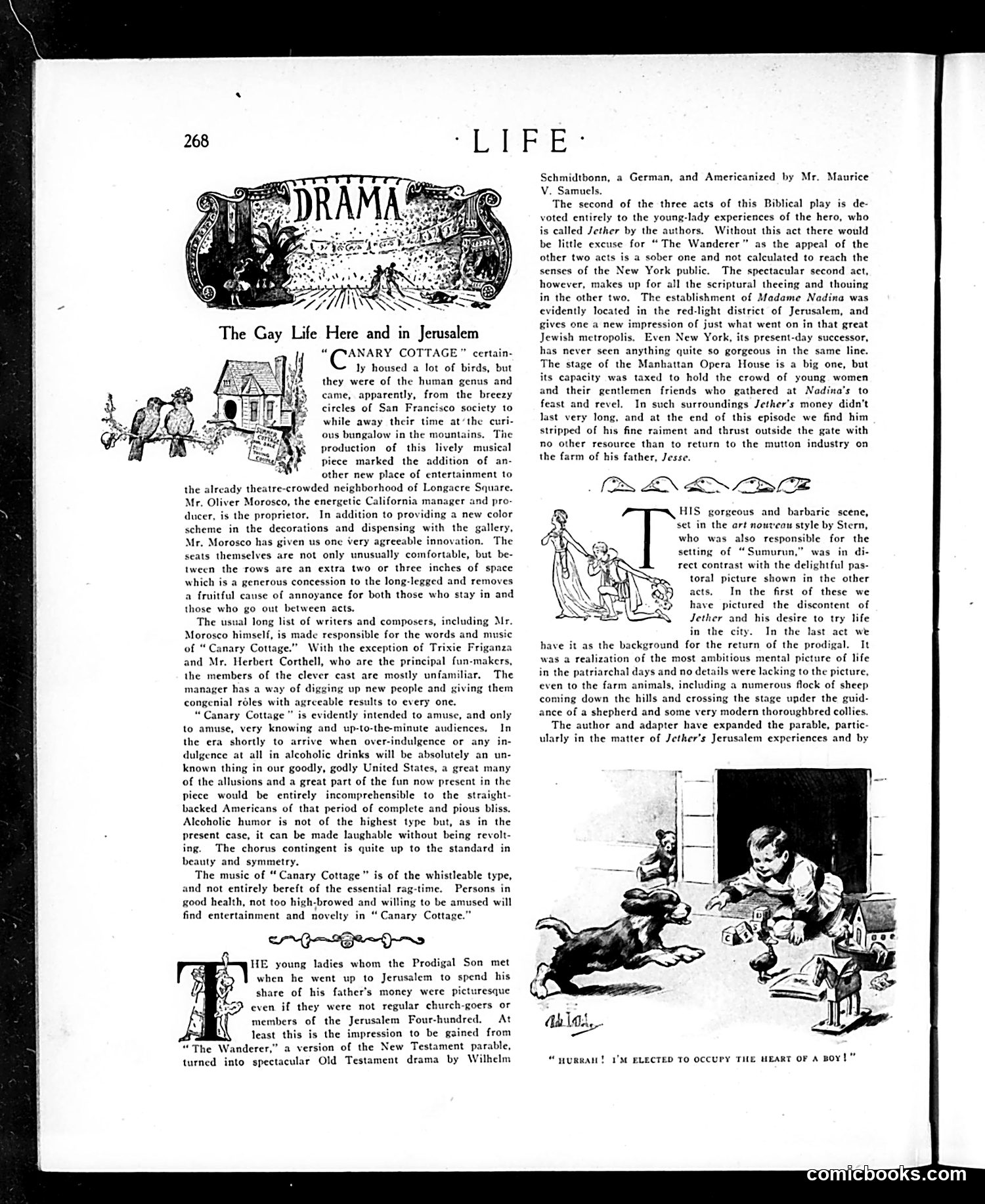
This 1910s theater review page discusses two Broadway productions. "Canary Cottage" is a musical comedy set in San Francisco featuring society people, notable for alcohol-based humor—the reviewer notes this will soon seem incomprehensible when Prohibition arrives (which it did in 1920). The show's appeal relies on knowing, sophisticated audiences who appreciate drinking jokes. "The Wanderer" adapts the Biblical parable of the Prodigal Son, relocating it to Jerusalem. The review candidly states the play's real draw is Act Two, which depicts the hero's encounters with women in Jerusalem's "red-light district"—essentially a brothel scene. The reviewer notes this scandalous material is necessary to attract New York audiences, as the actual religious narrative is "sober" and unmarketable. Both reviews reveal early 1900s theater catering to male audiences through alcohol and sexual content, with frank acknowledgment that morality tales require salacious elements to succeed commercially.
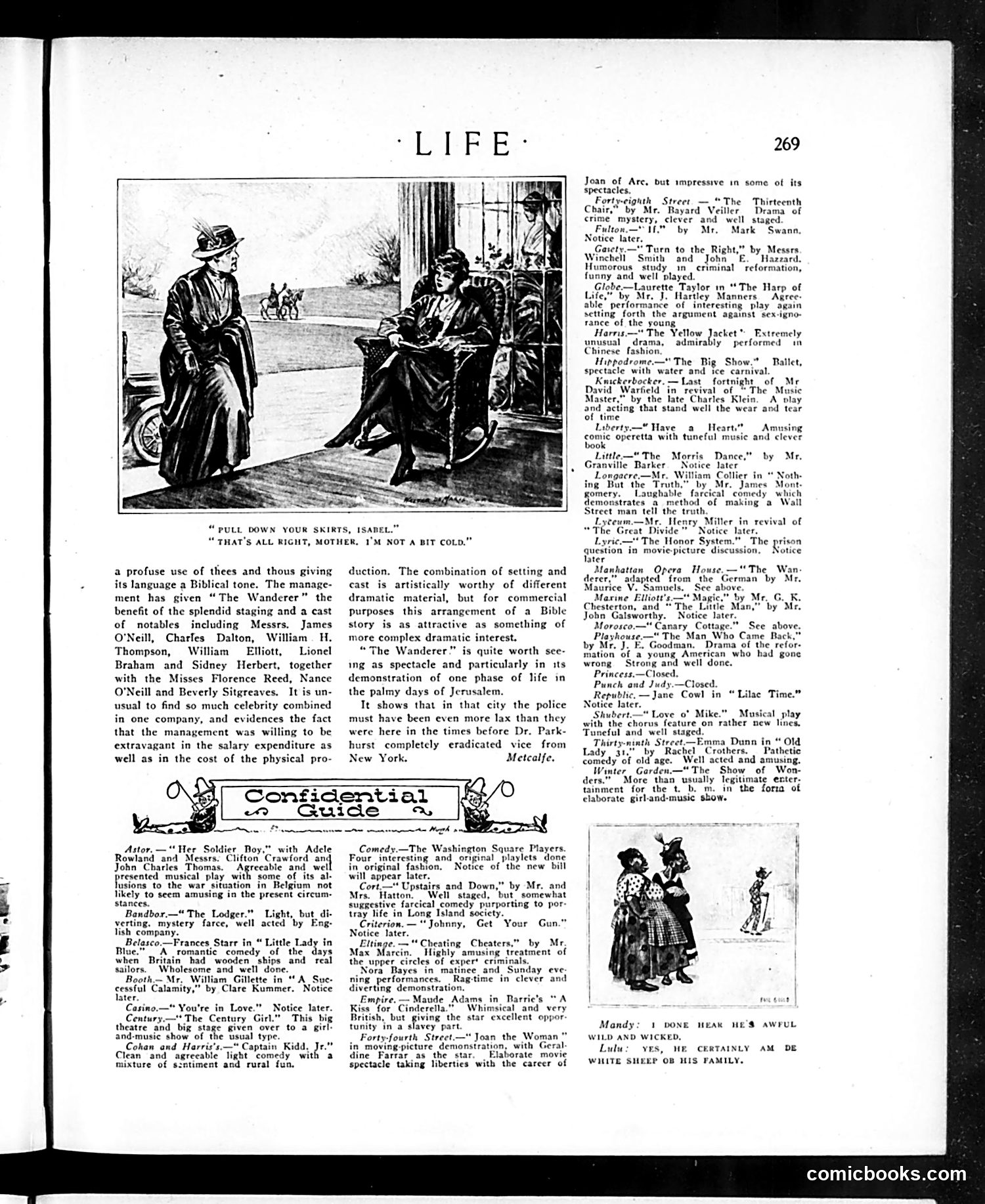
The main illustration depicts a woman standing outdoors while a man sits nearby. The caption reads: "Pull down your skirts, Isabel." / "That's all right, mother, I'm not a bit cold." This is a satire on changing women's fashion and social attitudes circa 1910s. The joke relies on the generational conflict between a concerned older woman (likely the mother) and a younger woman (Isabel) who is adopting shorter skirts—considered scandalously immodest by Victorian standards. The mother's fussy concern about propriety contrasts with the daughter's casual indifference, suggesting the younger generation's rejection of restrictive social conventions around female dress and behavior. The cartoon mocks both the mother's anxious moralism and the daughter's modern defiance.
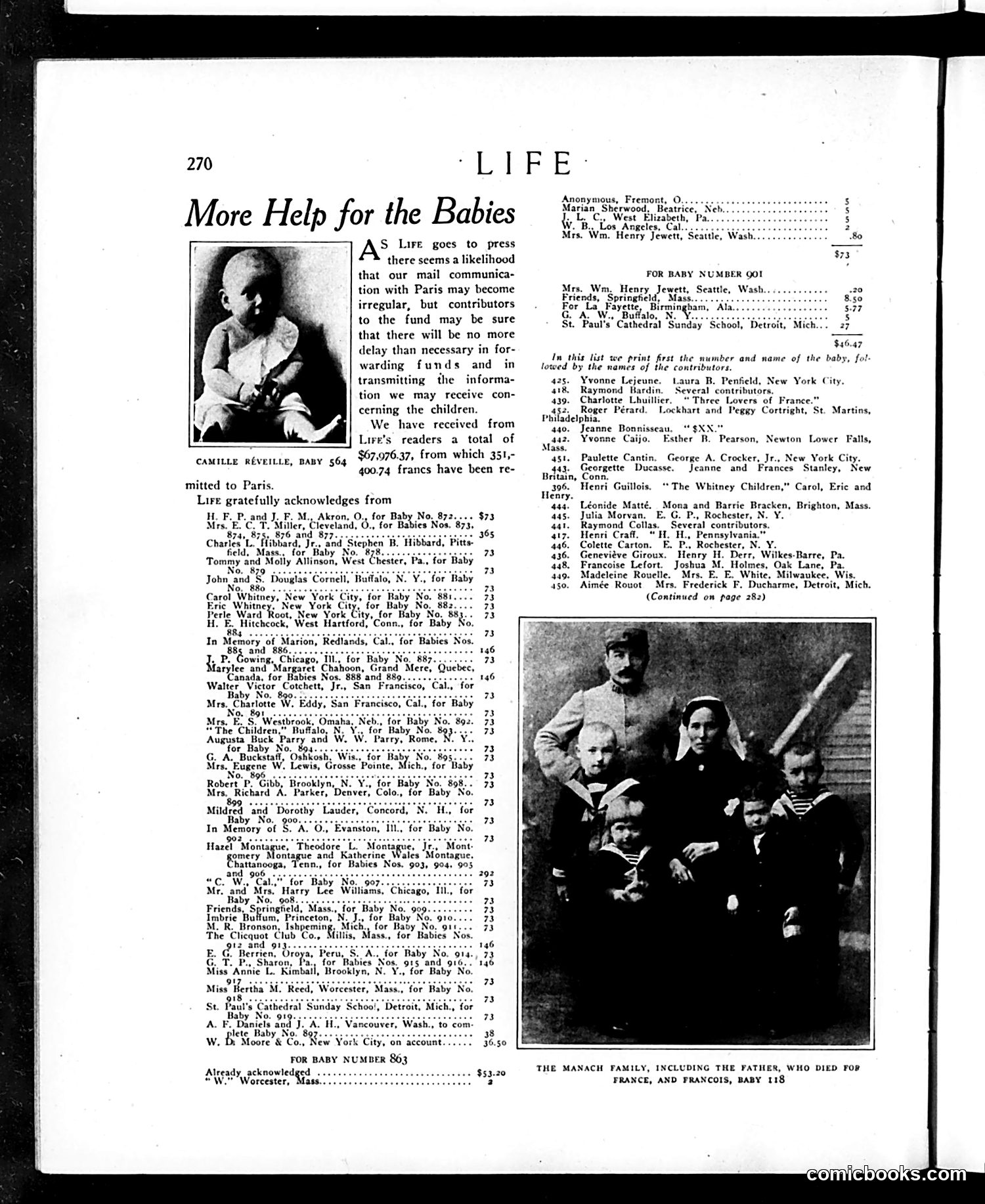
This page documents **Life magazine's fundraising drive for French war orphans**, likely from World War I. The heading "More Help for the Babies" and references to sending funds to Paris indicate this is a charity campaign supporting children displaced by the war. The photograph shows **the Manach family**—including "the father, who died for France, and François, Baby 118"—presented as a human example of why donations matter. These real families embodied the campaign's emotional appeal. The bulk of the page lists contributors' names and amounts donated, organized by baby number (Baby 564, Baby 001, etc.). Each French child apparently had an assigned number and was "sponsored" by American donors who received updates on that specific child's welfare. This represents **Progressive Era American philanthropy**: Life leveraged its readership to systematize charitable giving during wartime, creating direct (if distant) donor-to-beneficiary connections. The $67,076.37 raised demonstrates the campaign's success in mobilizing middle-class Americans for foreign relief.
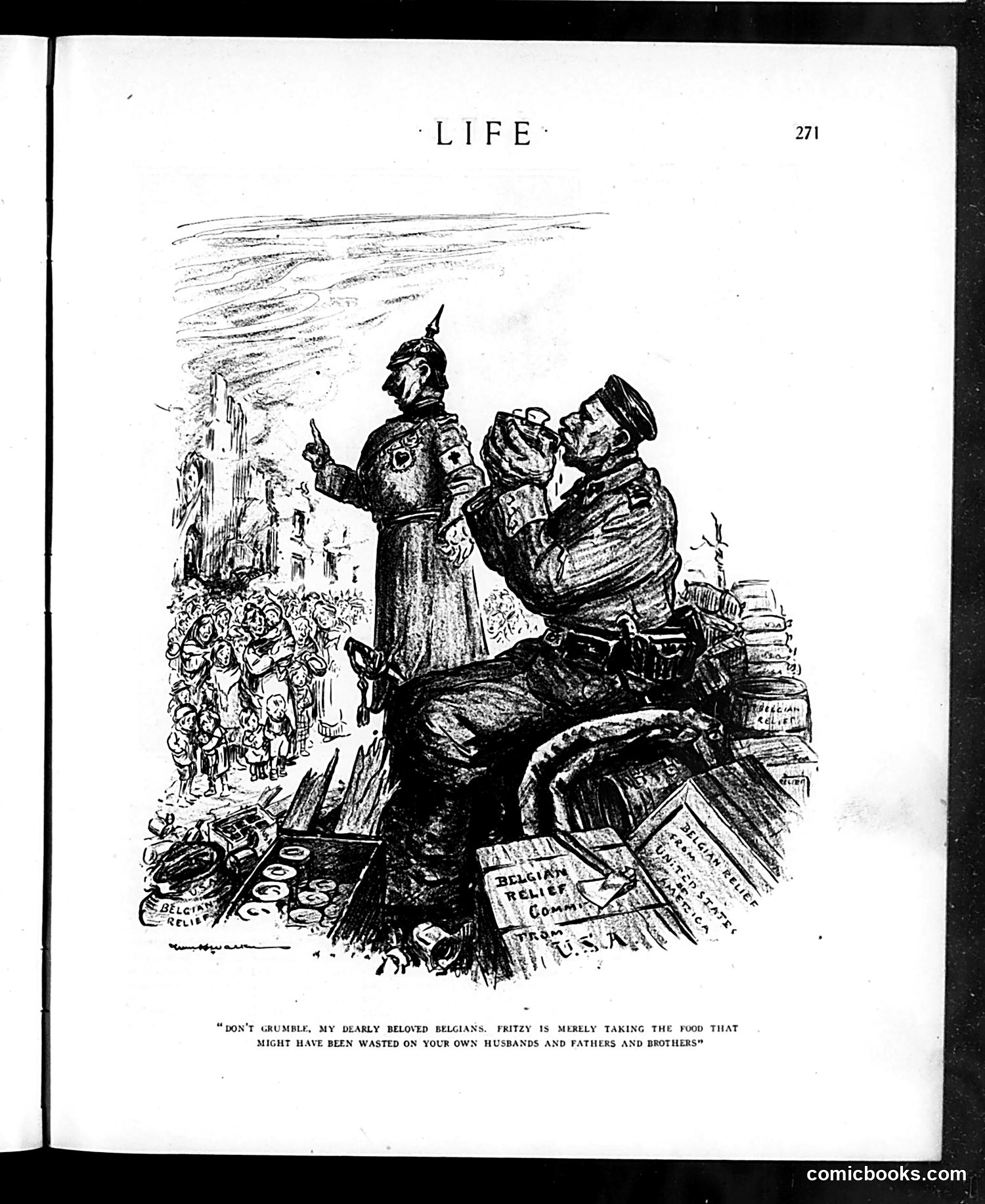
This WWI-era satirical cartoon depicts a German military figure (labeled "Fritzy," a derogatory term for Germans) addressing Belgian civilians. The figure stands above starving Belgians while confiscating their food supplies—labeled items visible include "Belgium Relief" boxes. The caption presents cynical justification for German appropriation of Belgian food: the stolen provisions would have "wasted" on Belgian soldiers and male relatives anyway (implying they're dead or conscripted). This is dark satire mocking German occupation policies and the starvation of Belgian civilians during WWI. The cartoon criticizes both German theft and the absurd propaganda attempting to rationalize it. Life magazine's American audience would recognize this as commentary on the humanitarian crisis in occupied Belgium—a major propaganda point favoring the Allied cause.
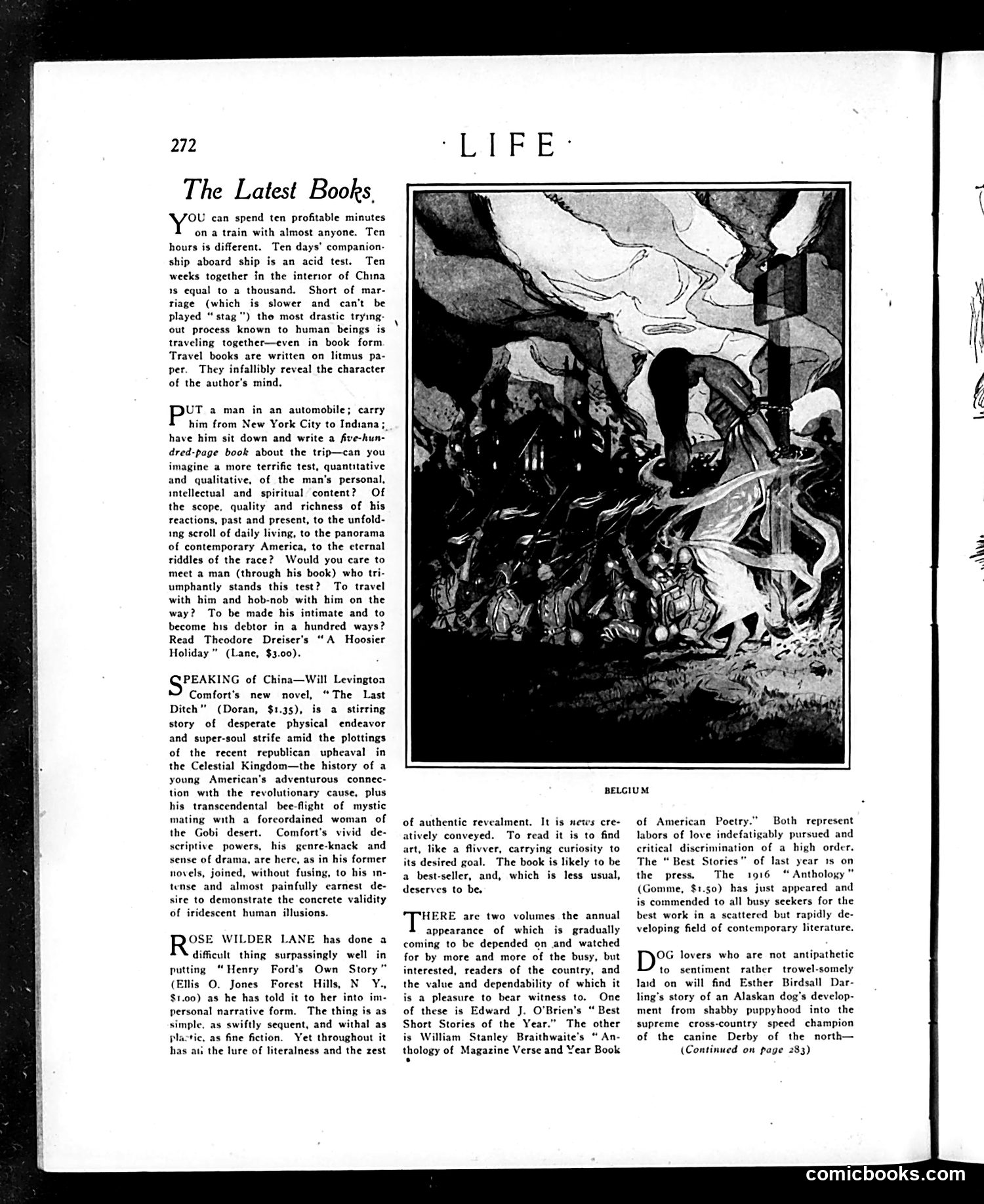
This is a **book review section** from Life magazine (page 272), not a political cartoon. The page discusses contemporary literature, primarily travel and adventure novels. The main illustrated image labeled "BELGIUM" appears to be an artistic illustration—likely accompanying discussion of adventure or war-related fiction, given Belgium's prominence in World War I (this page dates to around 1916 based on references). **Key reviews mentioned:** - Theodore Dreiser's "A Hoosier Holiday"—praised as a character-revealing travel narrative - Will Levington Comfort's "The Last Ditch"—about American involvement in China's republican upheaval - Rose Wilder Lane's biography of Henry Ford - Annual literary anthologies by Edward J. O'Brien and William Stanley Braithwaite The satirical tone typical of Life appears in the opening: the reviewer humorously argues that traveling together reveals true character better than marriage. The page emphasizes how travel books expose an author's intellectual and spiritual depth—a literary criticism approach standard for the era.
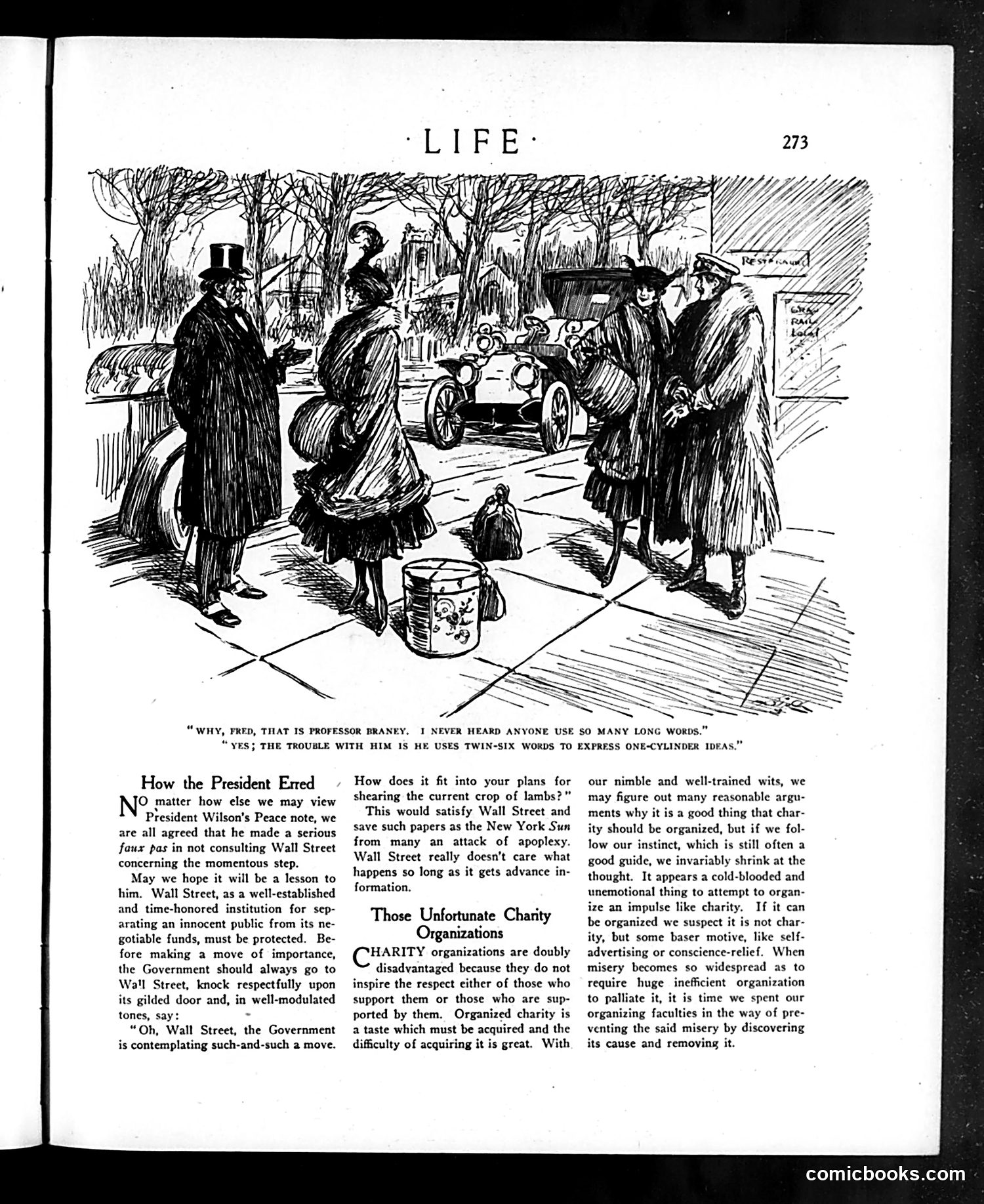
The cartoon satirizes President Wilson's handling of his Peace Note (likely referring to WWI peace negotiations) by mocking him for not consulting Wall Street before making important diplomatic decisions. The satire is bitterly ironic: Life suggests the government should defer to Wall Street's financial interests, portraying the financial establishment as so powerful and self-interested that it deserves advance notice of all government actions to protect its profit opportunities ("shearing the current crop of lambs"). The accompanying text ridicules both Wilson's verbosity (the caption jokes about using overly complex words for simple ideas) and organized charity as inherently suspect—arguing that institutionalized charity lacks genuine compassion and serves ulterior motives like self-promotion. The overall tone reflects progressive-era skepticism toward both political elites and financial power brokers during the Wilson presidency.
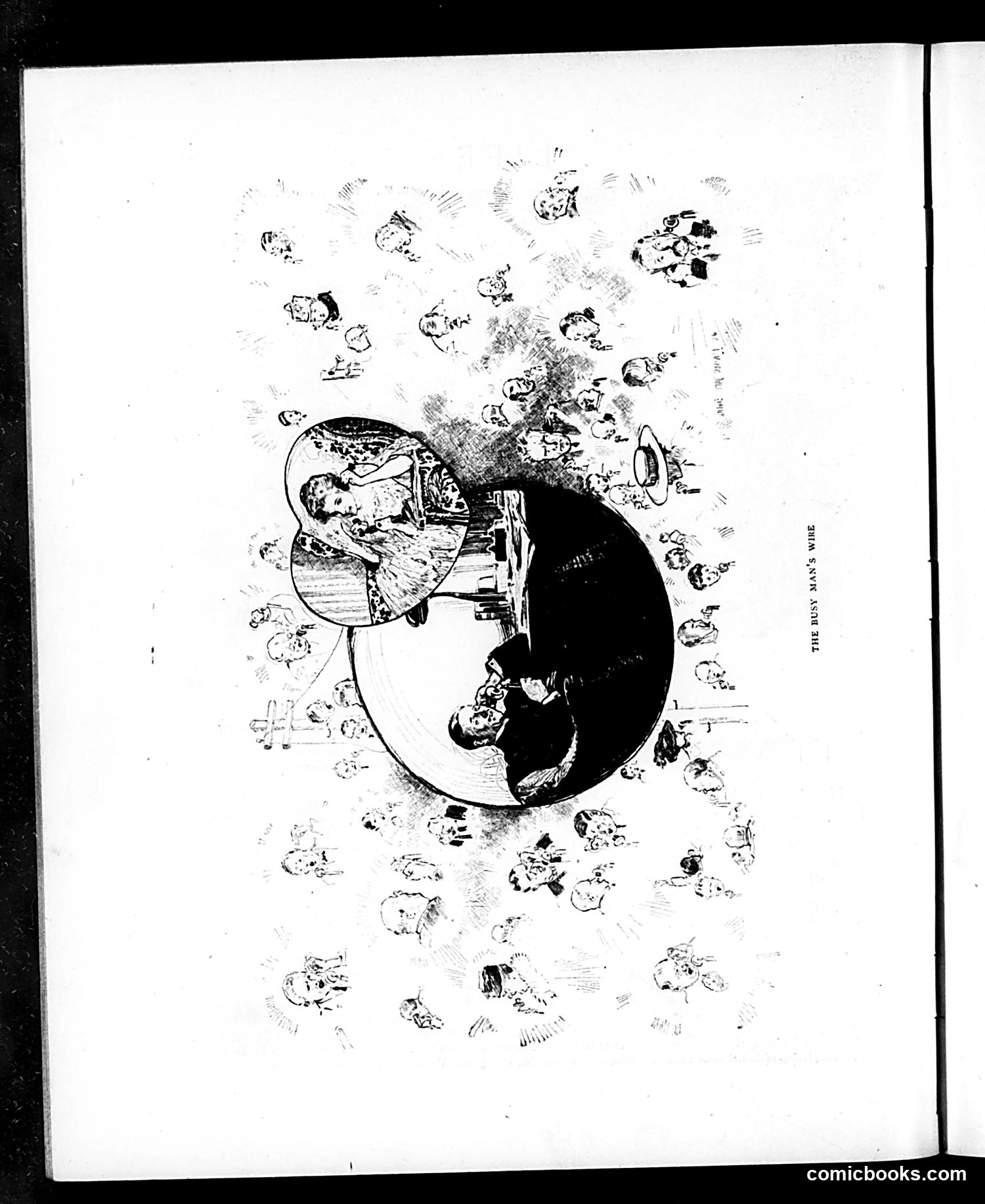
This page displays a circular illustration with two figures positioned like a yin-yang symbol. The upper half shows a woman in Victorian-era dress seated at what appears to be a writing desk or vanity, while the lower half depicts a man in dark formal clothing in a contrasting pose. Numerous small caricatured faces radiate outward around the circle. The OCR text is largely illegible, making the specific satirical subject unclear. However, the composition suggests commentary on gender roles or domestic relations—a common theme in Life magazine's social satire. The contrasting positioning of the male and female figures implies ironic comparison or conflict. Without clearer text identification, the specific political or social reference remains uncertain, though the ornate style suggests late 19th or early 20th-century publication.
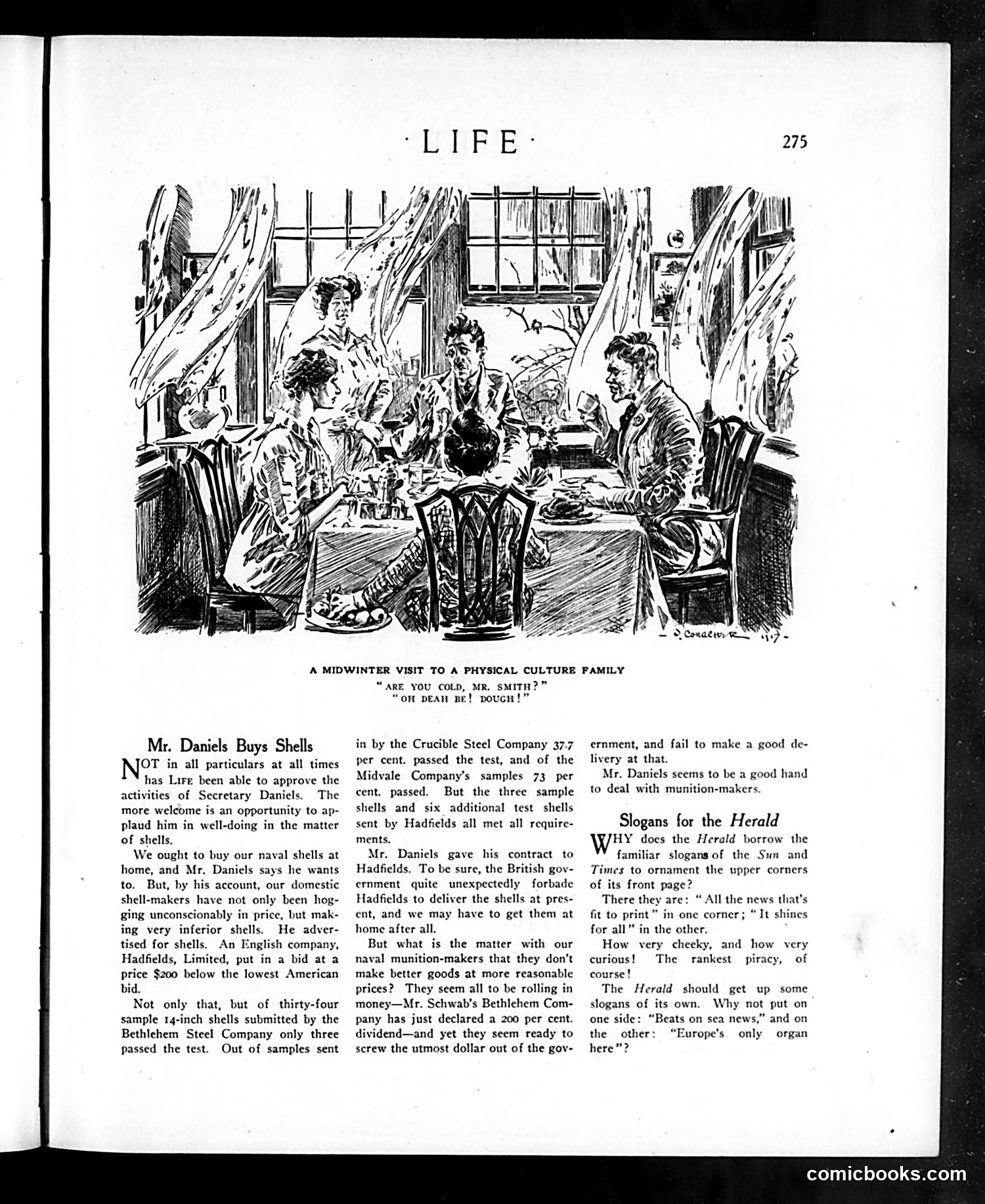
The page contains two separate items: **Top cartoon** depicts a "physical culture family" (health-conscious people) dining together during winter. The humor is visual—the family appears cold despite their athletic lifestyle, with one guest asking "Are you cold, Mr. Smith?" and receiving the response "Oh dear me! Pouch!"—suggesting discomfort despite their fitness regimen. **Main article** criticizes American naval shell manufacturers. Secretary of the Navy Daniels attempted to buy shells domestically but found American companies (Bethlehem Steel, Crucible Steel, Midvale) produced inferior products at inflated prices—only 3-73% of samples passed testing. British firm Hadfields submitted superior shells at lower cost, though the British government later blocked delivery. The satire attacks American munitions makers for profiteering (Schwab's company declared 200% dividends) while delivering poor quality to the government. Daniels is praised for holding them accountable—a rare editorial endorsement of his judgment.
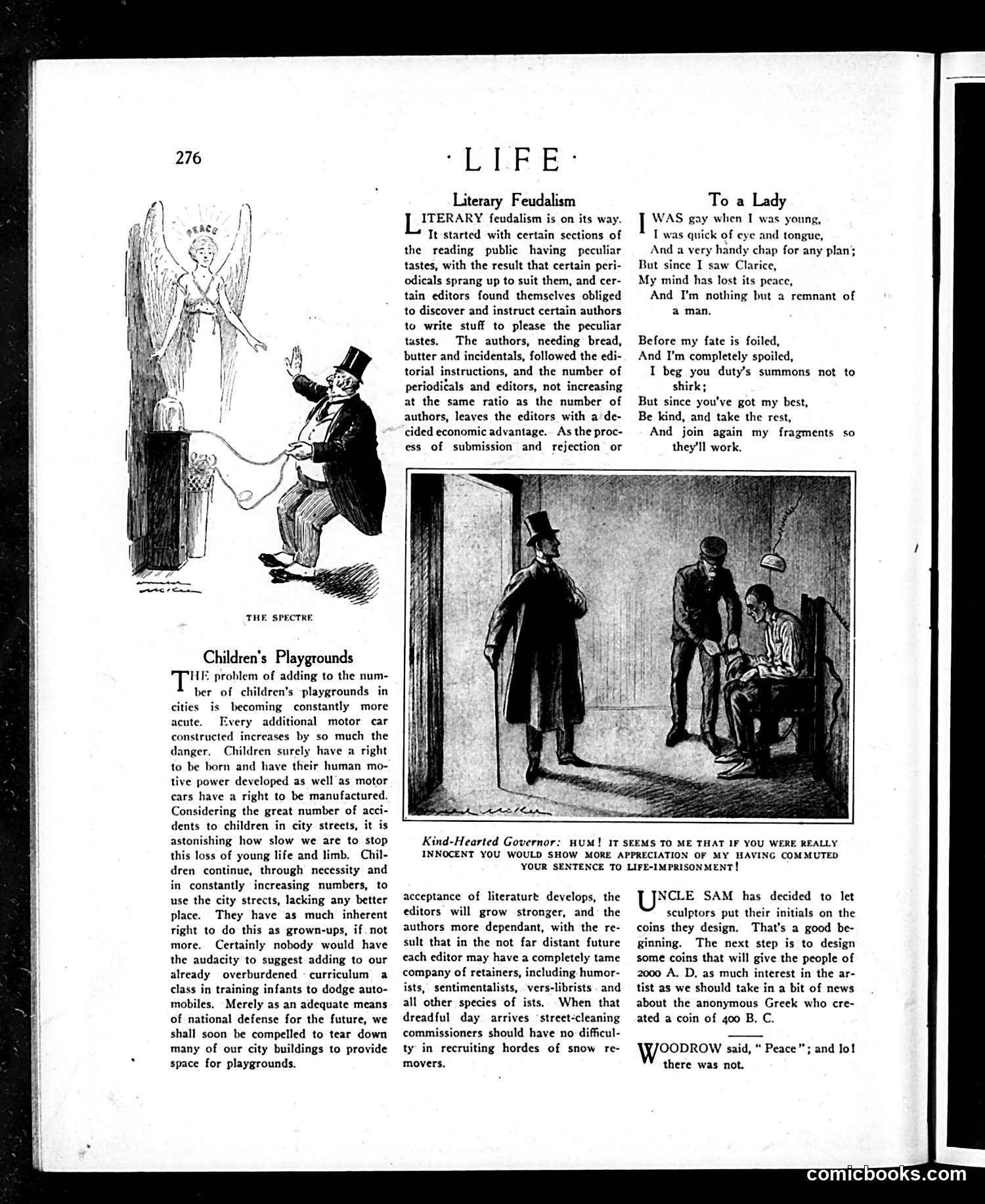
**"The Spectre" (cartoon):** A satirical sketch showing a well-dressed man in a top hat encountering a ghost-like female figure. The caption suggests this depicts "Literary Feudalism"—likely the specter of economic inequality haunting the publishing world. **"Literary Feudalism" (essay):** Criticizes how editors now control authors. As specialized periodicals proliferate to serve niche reading tastes, editors gain economic power over desperate writers who need income. The satire predicts a "feudal" system where authors become dependent retainers to wealthy editors—humorists, sentimentalists, and poets reduced to interchangeable servants. **"Children's Playgrounds":** Advocates for urban play spaces, arguing that as automobiles multiply, cities become deadlier for children. The piece sarcastically notes society won't train kids to dodge cars, so cities must demolish buildings to create safe playgrounds—treating child safety as a national defense priority. **Other content includes** light verse about romantic disappointment and a cartoon mocking a governor's condescension toward a commuted prisoner.
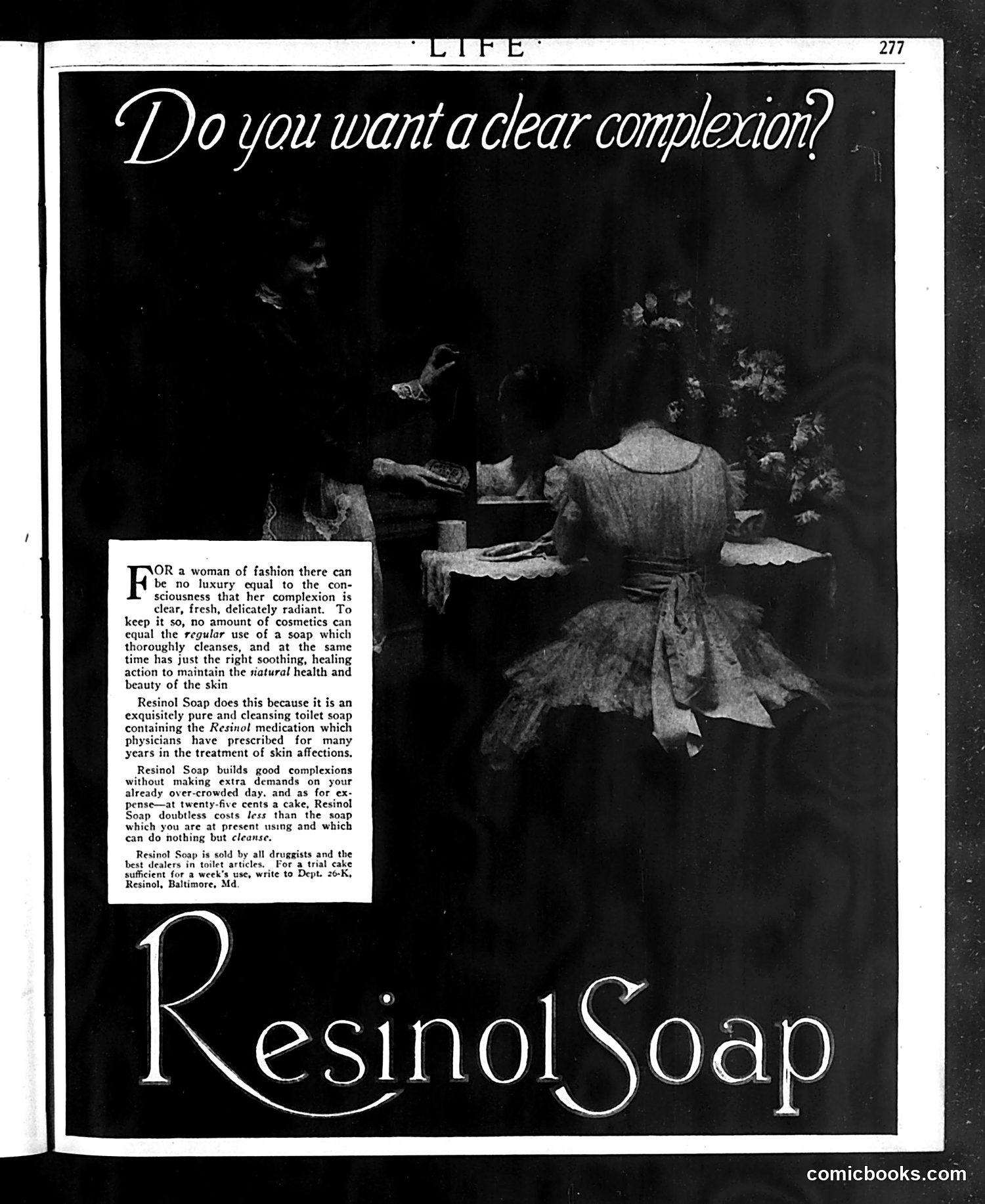
This is a **product advertisement**, not a political cartoon. The page shows a woman at her toilette (grooming routine) with the headline "Do you want a clear complexion?" **Content:** The ad promotes Resinol Soap as a medical-grade cleansing product containing "Resinol medication" prescribed by physicians for skin conditions. It positions clear skin as a luxury aspiration for fashionable women and frames the soap as superior to ordinary cleaners—costing only 25 cents per cake. **Historical context a modern reader needs:** This reflects early-20th-century marketing that blurred the line between cosmetics and medicine, claiming soap could treat skin affections. The appeal to "fashion" and social status through appearance was standard in women's advertising of this era. The emphasis on "natural health and beauty" versus mere cosmetics reflects period debates about beauty standards and women's vanity. **No satire is present**—this is straightforward commercial persuasion.
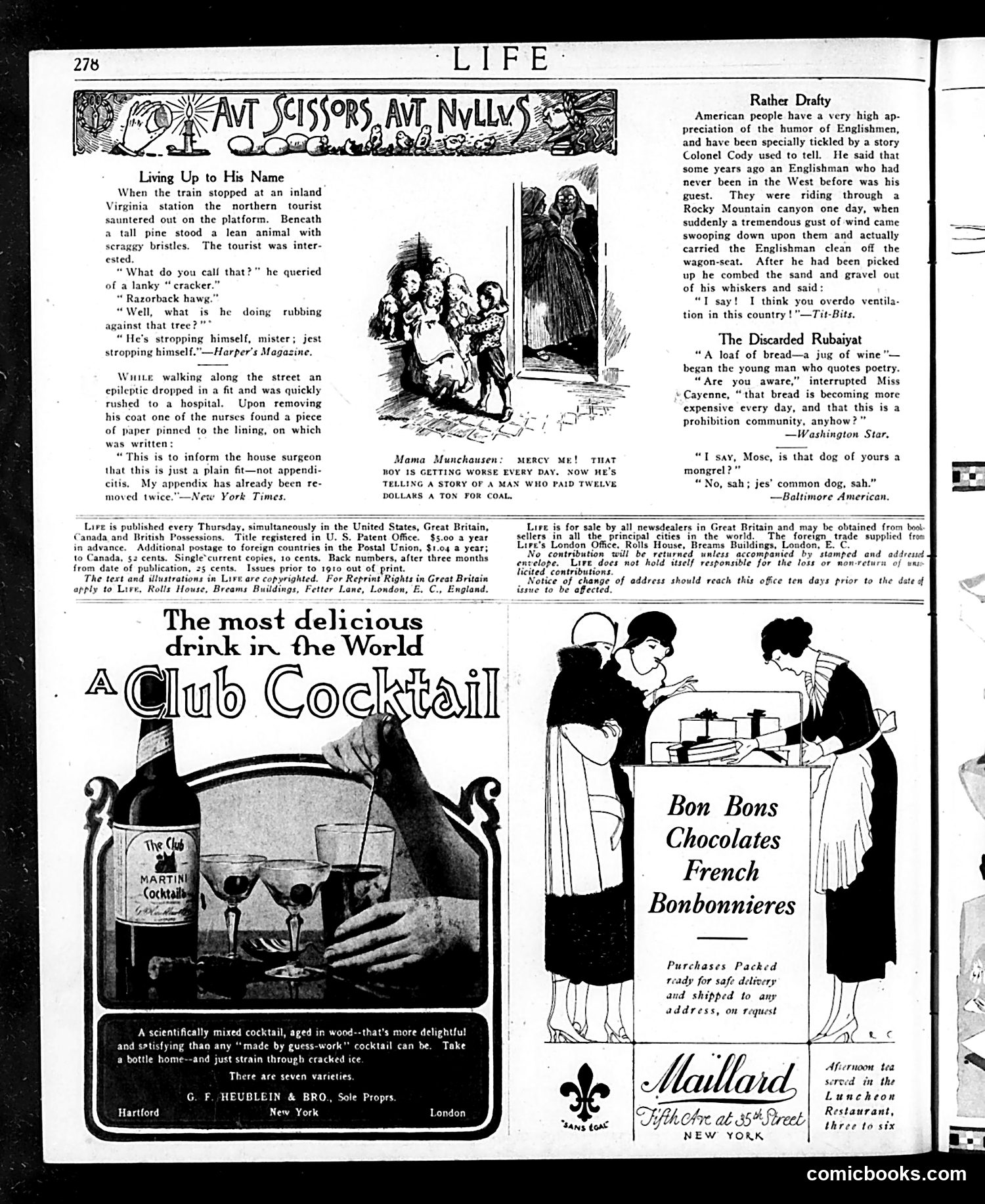
This page contains three brief humorous anecdotes typical of Life's satirical style, plus period advertisements. **"Living Up to His Name"** mocks rural Southern dialect and appearance. A Northern tourist encounters a scraggly pig ("razorback") and asks a poor white farmer ("cracker") what it is. The farmer's reply—that the pig is "stropping himself" (sharpening himself) against the tree—plays on the animal's lean, bristly appearance and the farmer's colloquial speech. **The hospital anecdote** jokes about a man with epilepsy who pre-emptively informs doctors his condition is epilepsy, not appendicitis, having already had appendix removals. It satirizes both hypochondria and medical overtreatment. **"Rather Drafty"** repeats a Buffalo Bill anecdote about an English visitor blown from a wagon by Rocky Mountain wind, commenting dryly on American ventilation. It plays on English understatement and cultural shock. The page is primarily filled with period advertisements for Club Cocktails, Bon Bons Chocolates, and Maillard chocolates—typical luxury goods marketed in this era.
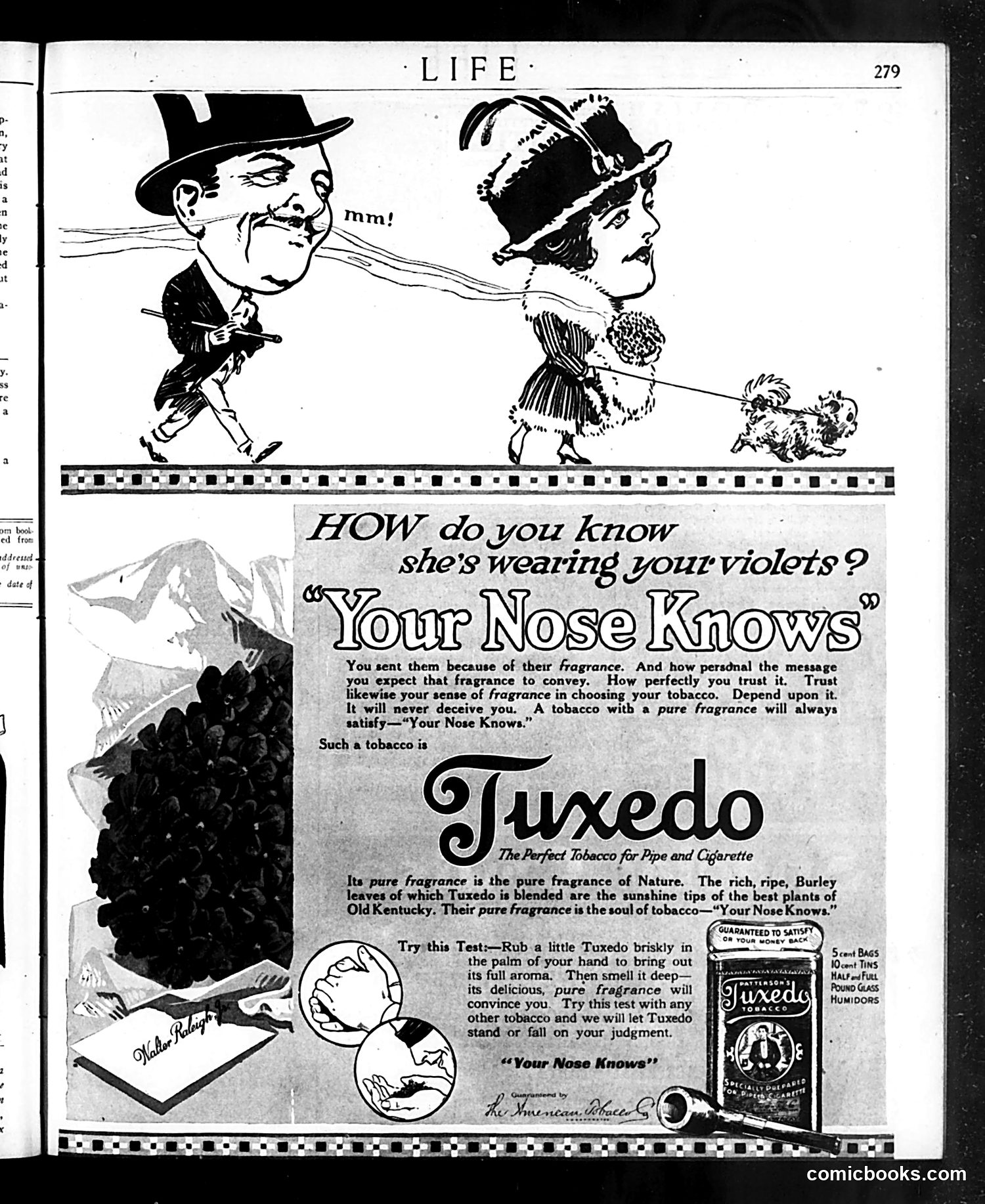
This page is primarily a **tobacco advertisement**, not political satire. The cartoon at top depicts a man in a top hat (appearing to send flowers) and a woman receiving them—establishing the premise that fragrance conveys personal messages. The ad uses this romantic framing to sell **Tuxedo brand tobacco**, arguing that just as you trust a flower's fragrance to communicate sincerity, you should trust tobacco's fragrance to indicate quality. The tagline "Your Nose Knows" suggests the nose is a reliable judge. The advertisement includes a "test" instructing readers to rub Tuxedo in their palm to release aroma, then compare it favorably to competitors. This represents early 20th-century **advertising strategy**: linking a product to refined, romantic sensibilities to appeal to middle-class consumers. The appeal to the senses and trust was standard marketing before tobacco's health dangers became widely acknowledged.
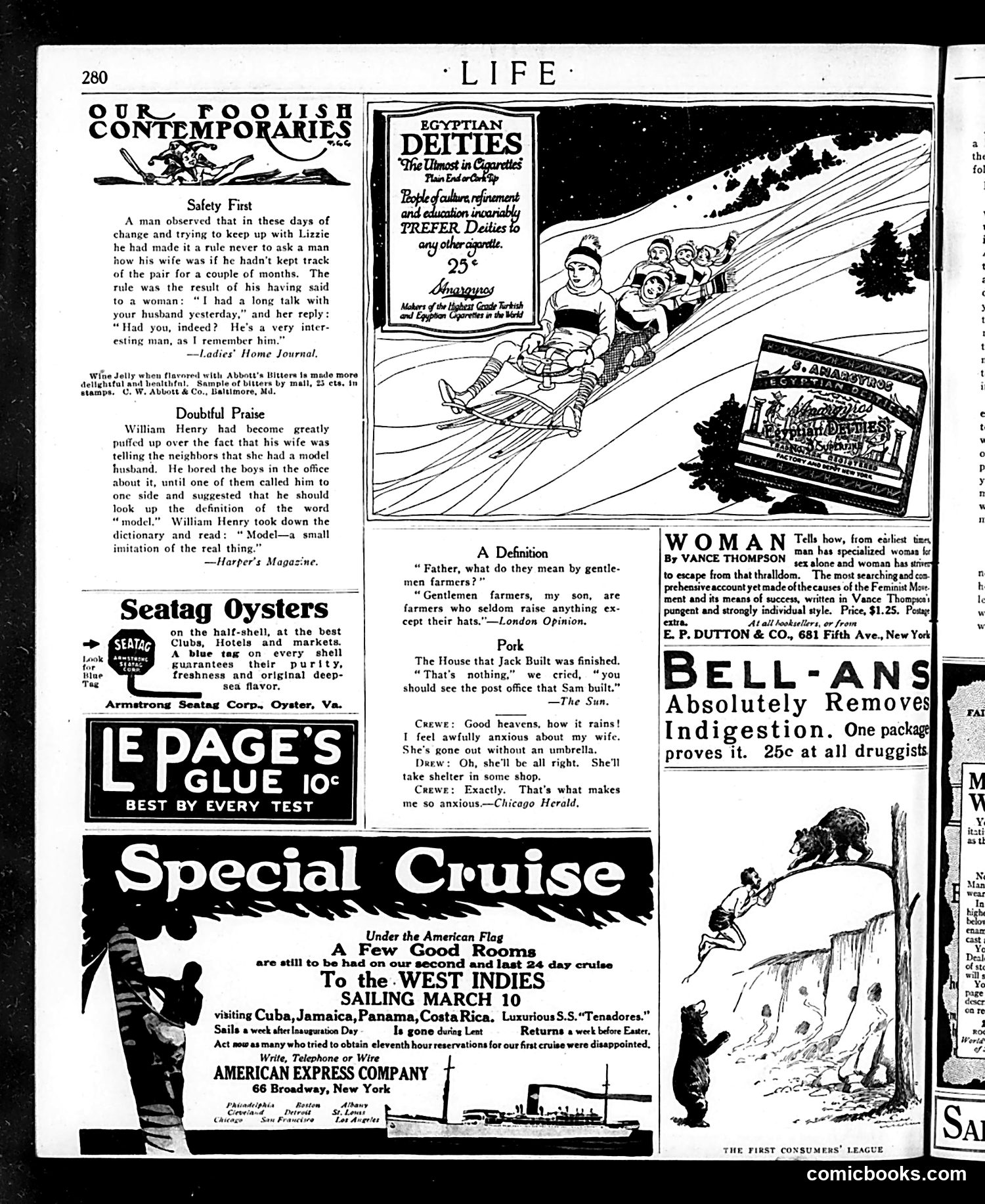
This page is primarily **advertising with scattered humor columns**, typical of Life's satirical format. The main content consists of brief jokes mocking contemporary social situations: - **"Safety First"** satirizes how quickly marriages change—a man can't even remember a woman's husband after a few months apart, suggesting the rapid social upheaval of the era. - **"Doubtful Praise"** jokes about the word "model" meaning a small imitation, implying a "model husband" is merely an inferior copy of a real one—humor at masculine pride. - **"Gentlemen Farmers"** ridicules wealthy urban men who pose as farmers but only "raise" their hats—satirizing affectation among the upper classes. The remaining content is **period advertisements** for oysters, glue, Egyptian cigarettes, a cruise to the West Indies, and Vance Thompson's book about feminism. The sledding illustration at top appears decorative advertising copy, not satirical commentary. Overall, this is a typical early 20th-century magazine mixing light social humor with commercial promotions.
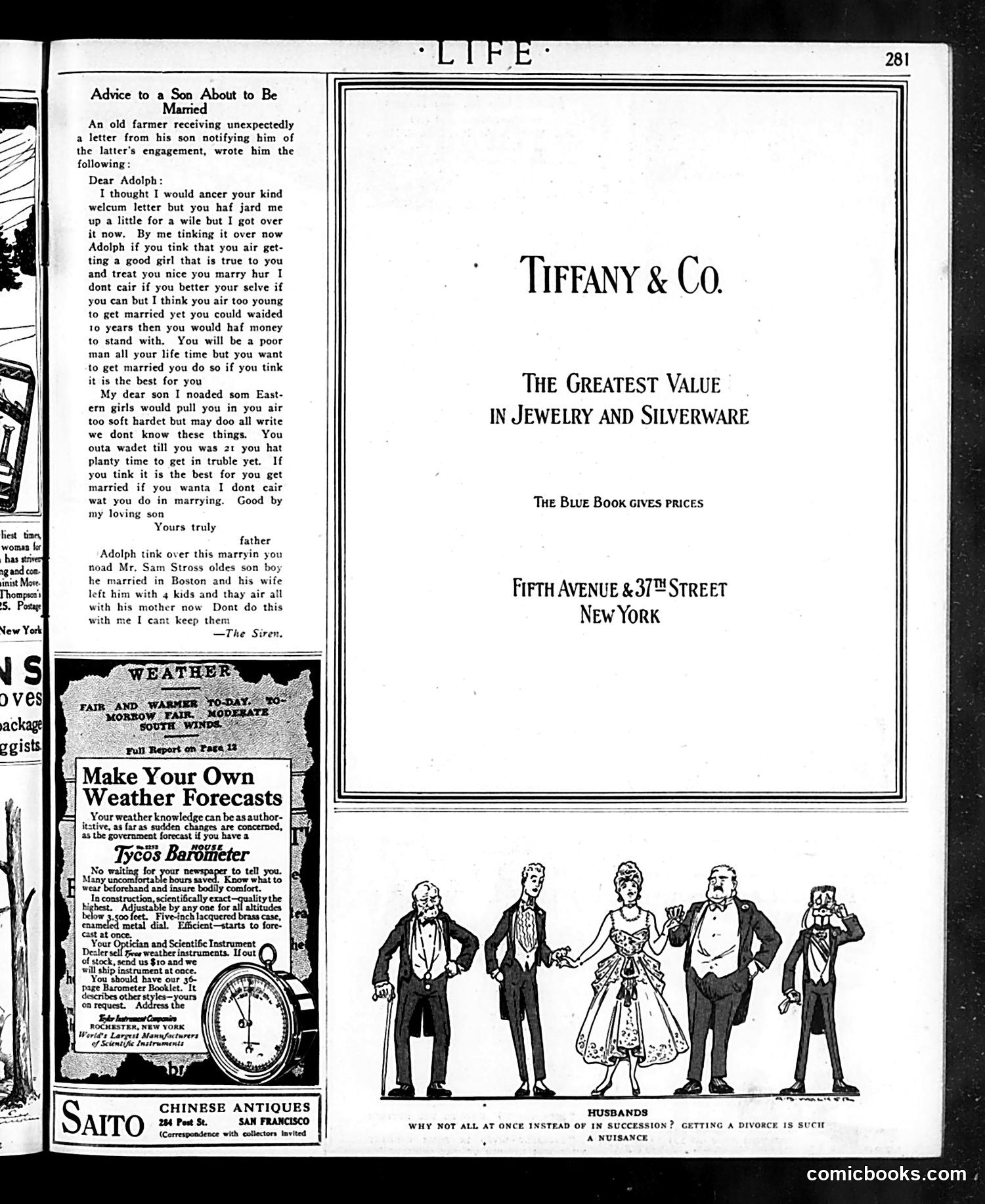
This page contains two distinct pieces: **Left side:** A humorous "advice letter" from an illiterate farmer father to his son Adolph about marriage. The satire works through heavy dialect and malapropisms ("ancer" for "answer," "haf jard me" for "have jarred me")—mocking both rural speech patterns and the father's folksy, contradictory wisdom. He warns against marrying young while simultaneously giving permission, and cautions about a cautionary tale: a man named Sam Stross whose Boston wife left him with four children. The humor lies in the gap between the father's rambling concerns and his ultimate indifference. **Right side:** The bottom cartoon titled "Husbands" depicts five figures (two men in formal wear, a woman in a wedding dress, a stout man, and a boy) with a caption joking about divorce. The satire suggests getting all divorces "at once instead of in succession" would be more efficient—dark humor about the prevalence and messiness of divorce proceedings in the era. Both pieces use satirical commentary on marriage and relationships, common Life magazine fare from this period.
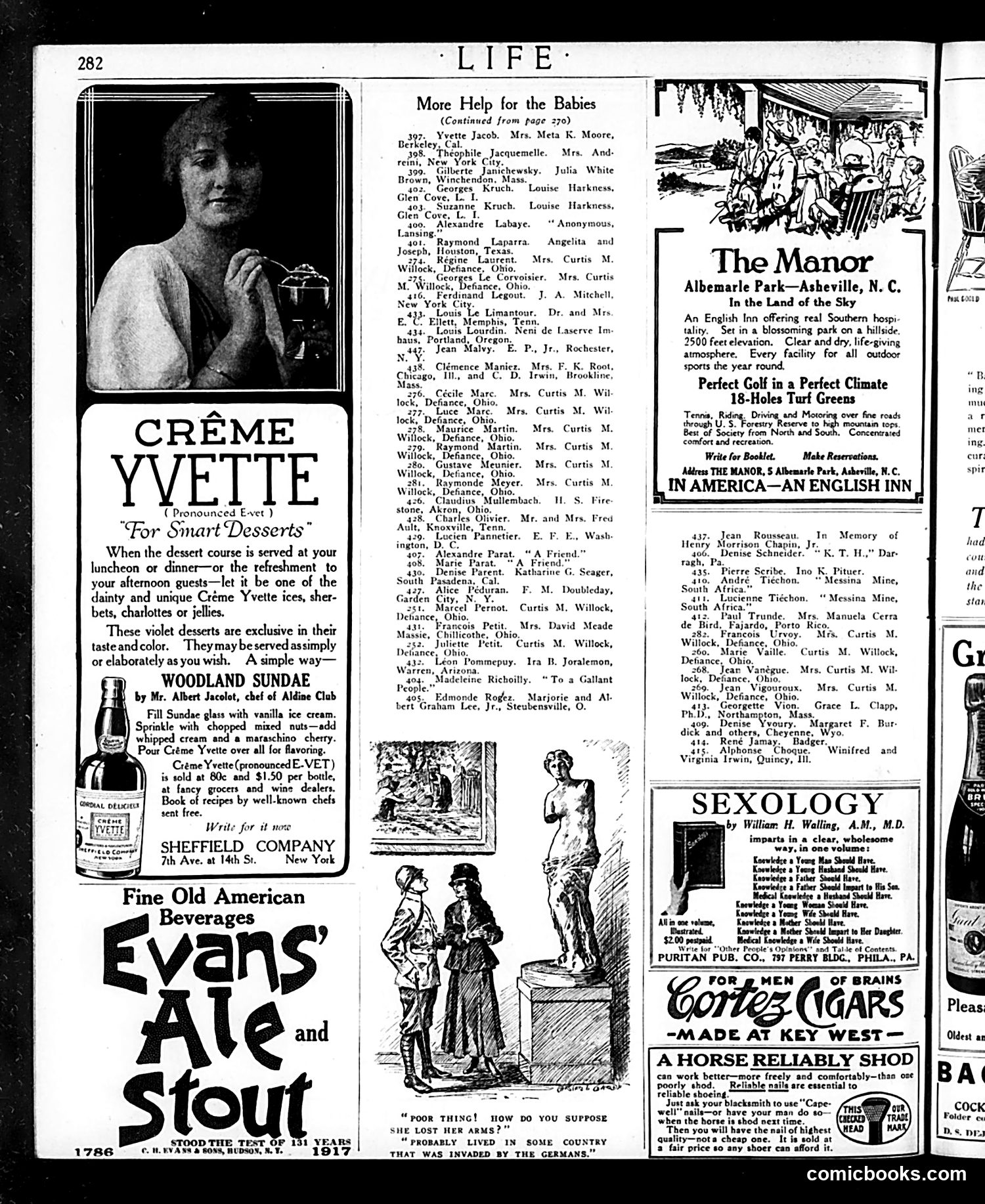
This page is primarily **advertising and administrative content**, not political satire. It contains: 1. **"More Help for the Babies"** — A continuation of what appears to be a charitable fundraising list, crediting donors who sponsored French war orphans or relief efforts (names like "Régine Laurent," "Alexandre Labaye" suggest post-WWI humanitarian work). 2. **Advertisements** for luxury goods: Crème Yvette dessert liqueur, Evans Ale and Stout (established 1786), The Manor resort in Asheville, North Carolina, and Cortez Cigars from Key West. 3. **Educational advertisement** for "Sexology" by William H. Walling, M.D. The decorative illustrations appear to be generic classical or allegorical imagery typical of 1910s-1920s magazine design — not specific political cartoons. The page reflects post-WWI American consumer culture and charitable causes of the era.
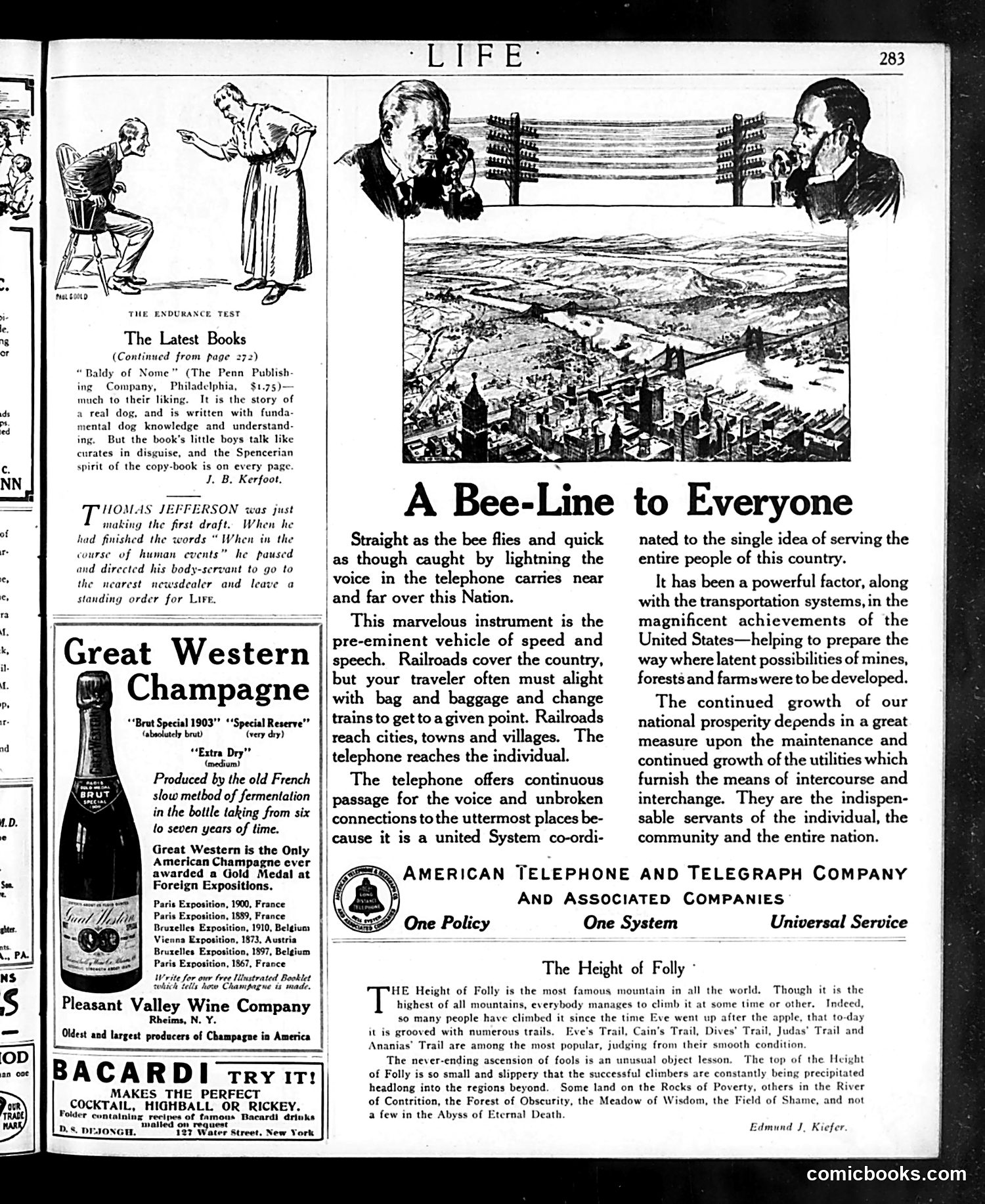
**The Main Cartoon:** "The Endurance Test" (top left) shows a man sitting while a woman stands, apparently lecturing him. The joke satirizes marriage or domestic relationships—the "endurance test" being a wife's patience or her ability to tolerate her husband's behavior. **Thomas Jefferson Reference:** Below this is a humorous aside: Jefferson, drafting the Declaration of Independence, pauses after writing "When in the course of human events" to order a standing subscription to *Life* magazine. This is self-promotional satire—a joke about *Life's* own importance and wit. **The Main Feature:** "A Bee-Line to Everyone" is an advertisement for American Telephone and Telegraph Company, using nationalist rhetoric about the telephone's role in American progress. It emphasizes universal service and the telephone's superiority to railroads for reaching individuals. **"The Height of Folly":** A satirical essay (bottom) cataloging famous "trails" people foolishly climb—Eve's, Cain's, Judas's, Ananias's—ending with people falling into poverty and disgrace. The page mixes humor, advertising, and moral commentary typical of early 20th-century *Life* magazine.
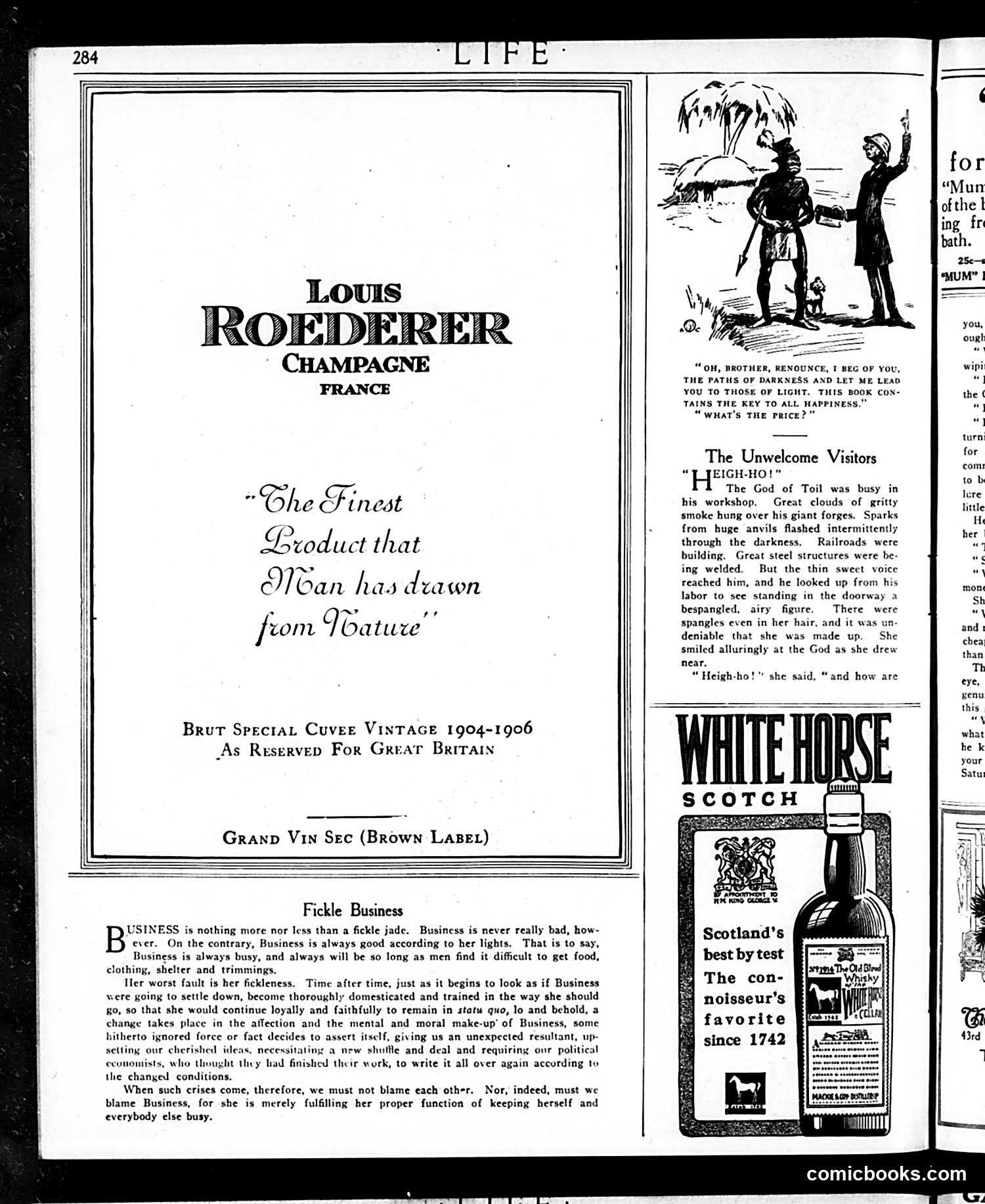
This page mixes advertising with two distinct pieces of satirical content: **"The Unwelcome Visitors"** depicts an allegorical encounter between the "God of Toil" (representing labor and industry) and a bespangled, made-up female figure (likely representing Pleasure, Distraction, or frivolity). The satire suggests that idle pursuits interrupt productive work—a common Progressive Era anxiety about labor efficiency and moral discipline. **"Fickle Business"** is an extended essay personifying Business as an unreliable woman ("fickle jade") who constantly changes her moods and demands. The piece argues that when economic conditions shift unexpectedly, we shouldn't blame each other or Business itself—she's simply doing her nature. This appears to address business cycle volatility and the need for acceptance rather than recrimination during economic disruptions. Both pieces use gendered allegory typical of early 20th-century satirical writing. The surrounding advertisements (Roederer Champagne, White Horse Scotch) are period luxury goods.
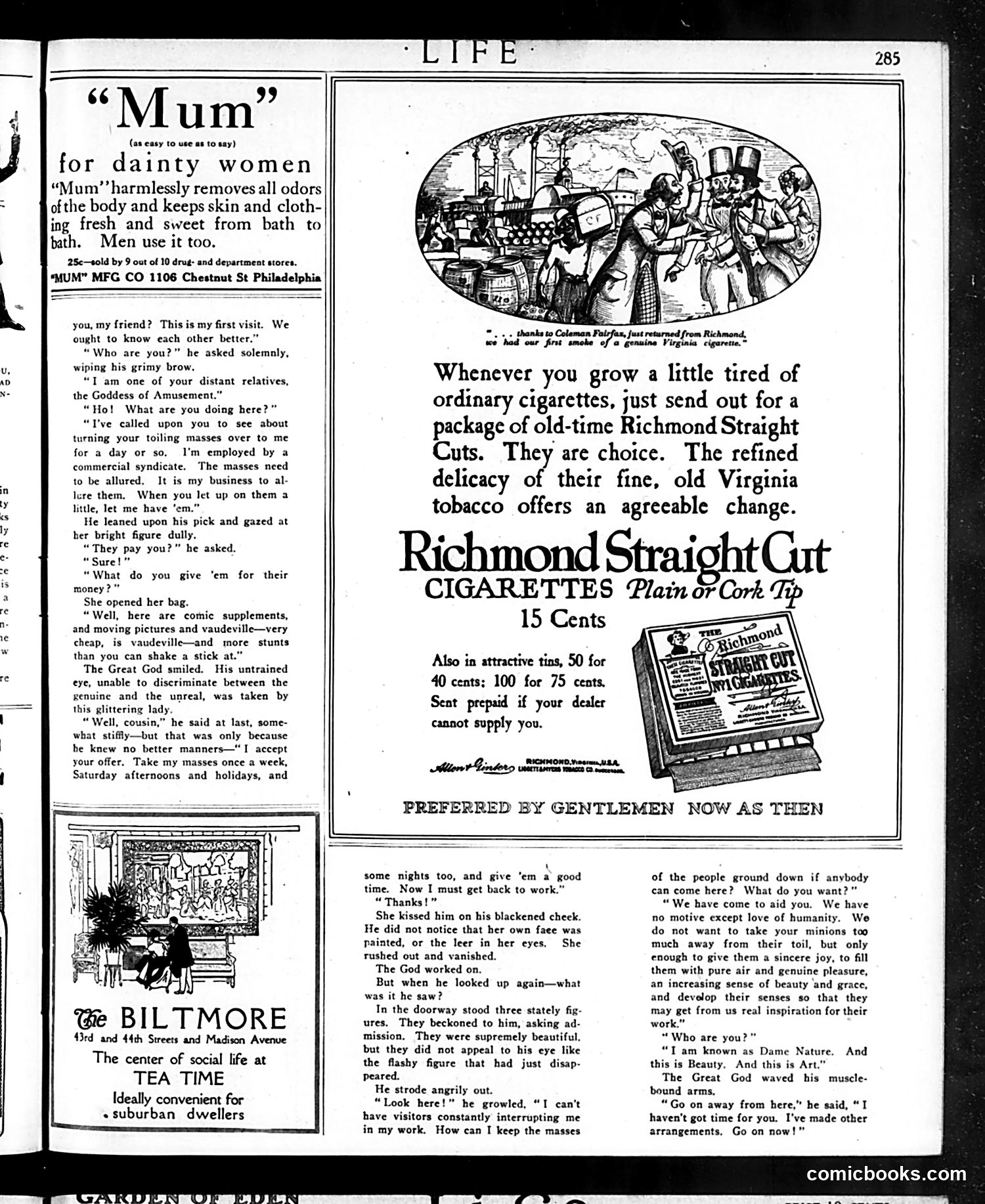
This page contains a **satirical allegory about labor and leisure**. The main narrative depicts "the Great God" (representing Labor or the Working Class) being visited by three figures: 1. **The Goddess of Amusement** — a flashy, painted woman offering cheap entertainment (comic supplements, moving pictures, vaudeville) that the Great God eagerly accepts for Saturday afternoons. 2. **Dame Nature, Beauty, and Art** — three dignified figures offering genuine joy, beauty, and spiritual uplift, whom the Great God rudely rejects. **The satire's point**: Modern industrial society prioritizes cheap, commercial entertainment over genuine cultural enrichment and natural beauty. Workers are manipulated into accepting shallow amusements that keep them complacent rather than pursuing real sources of joy and inspiration. The page also contains **period advertisements** for "Mum" deodorant (targeting women's "daintiness") and Richmond Straight Cut cigarettes, which ironically exemplify the commercial culture the cartoon critiques.
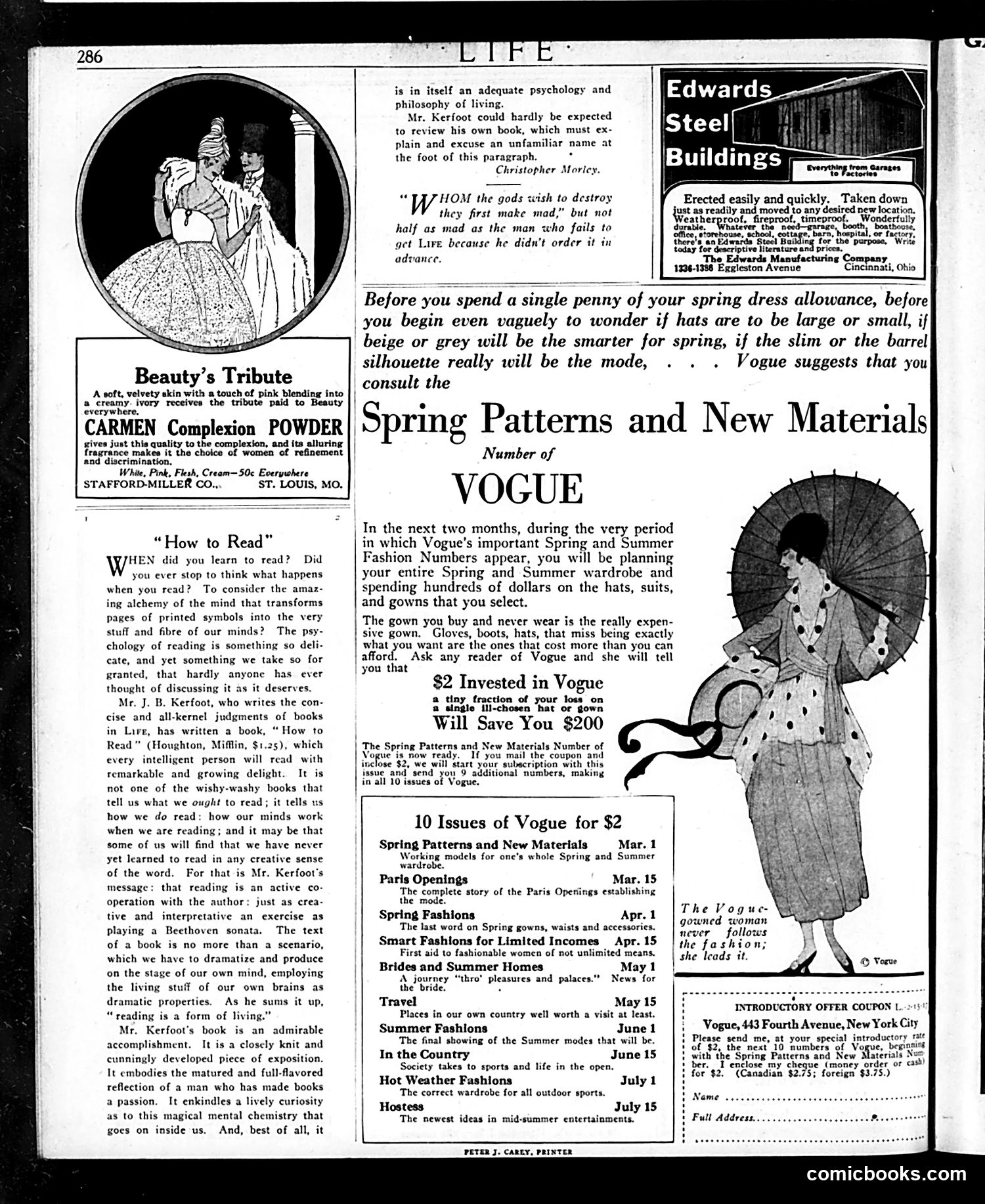
This page is primarily **advertising and promotional content** rather than political satire. It contains: 1. **Carmen Complexion Powder ad** (top left): A beauty advertisement emphasizing "soft, velvety skin" for women of "refinement and discrimination"—typical early 20th-century cosmetics marketing targeting affluent female consumers. 2. **"How to Read" book review** (left column): Literary criticism by Christopher Morley reviewing J.B. Kerfoot's book about reading as an active, creative mental process—positioning reading as intellectual work rather than passive consumption. 3. **Edwards Steel Buildings ad** (top right): Industrial/commercial advertisement for portable steel structures. 4. **Vogue magazine promotion** (center/right): The dominant content, advertising Vogue's Spring Fashion issues and subscription offer ($2 for 10 issues). Features an illustrated fashionable woman with an umbrella. The page reflects **1920s consumer culture**: targeted advertising to middle/upper-class women about fashion, beauty, and self-improvement. No political cartoons or satirical commentary appear here.