
Life, 1917-02-15 · page 19 of 42
Life — February 15, 1917 — page 19: what you’re looking at
What you’re looking at
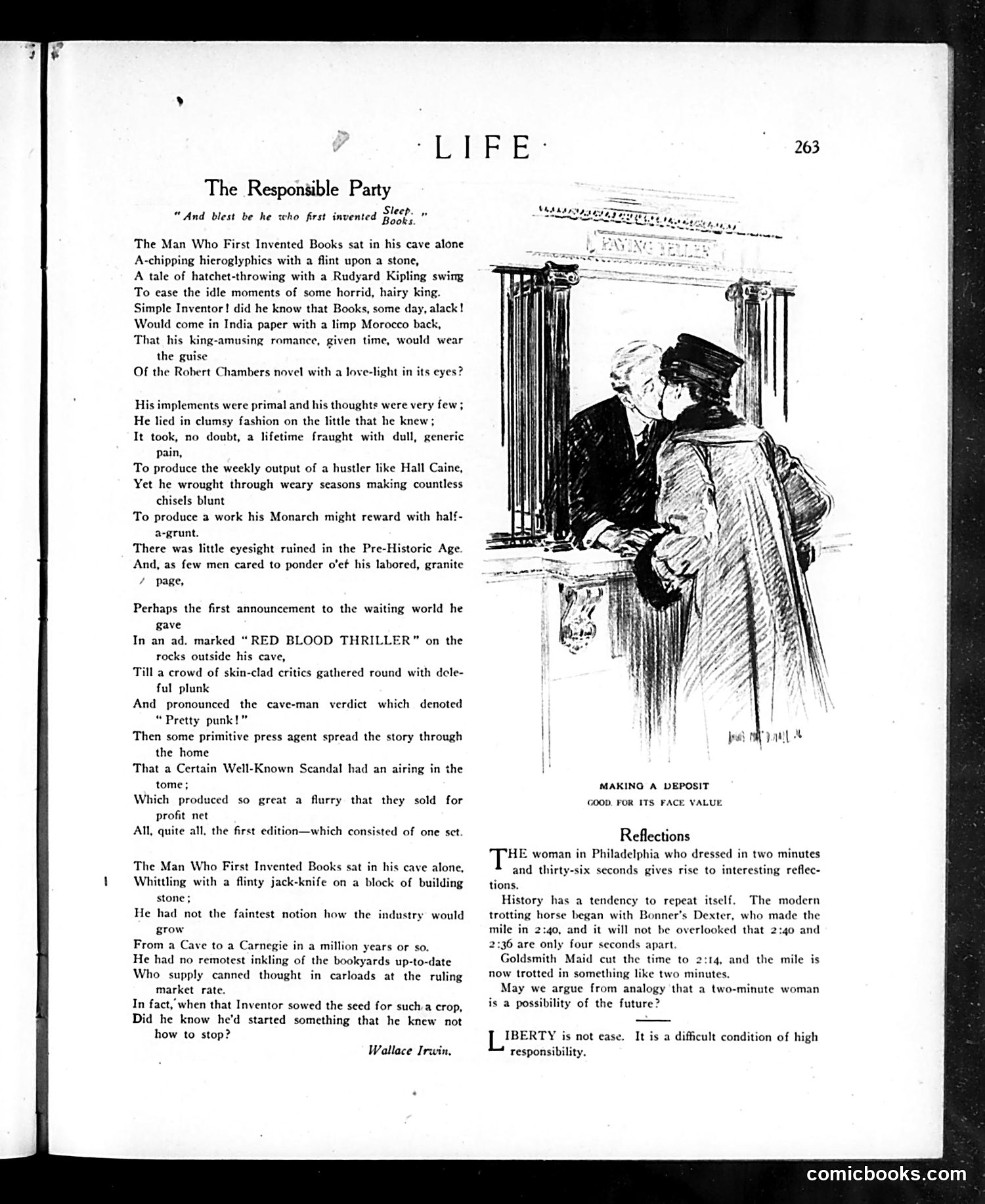
This poem by Wallace Irwin satirizes the unintended consequences of inventing something transformative. The "Man Who First Invented Books" naively created a simple tool for entertainment, never imagining how the publishing industry would evolve—from cave hieroglyphics to mass-market novels. The satire targets several things: the commodification of literature (books become profitable merchandise), the sensationalism of the era (marketing "Red Blood Thrillers" and scandals to boost sales), and the industrialization of writing itself (authors like Hall Caine producing "canned thought in carloads"). The cartoon illustration shows a figure making a deposit—likely a publisher or author literally banking profits from the "face value" of books as commercial products rather than art. The accompanying "Reflections" section uses sports analogies about speed records to humorously extend the theme of progress and human efficiency becoming absurd extremes. The final line about liberty being responsibility suggests irony: the inventor unleashed something impossible to control.
📄 Transcribed text from this page (OCR, searchable)
Machine-transcribed from the original scan — historical spelling and the odd misread are preserved.
eRe Ey The Responsible Party “And blest be he who first invented Bie. » The Man Who First Invented Books sat in his cave alone A-chipping hieroglyphics with a flint upon a stone, A tale of hatchet-throwing with a Rudyard Kipling swing To case the idle moments of some horrid, hairy king. Simple Inventor! did he know that Books, some day, alack! Would come in India paper with a limp Morocco back, That his king-amusing romance, given time, would wear the guise Of the Robert Chambers novel with a love-light in its eyes? His implements were primal and his thoughts were very few; He lied in clumsy fashion on the little that he knew; It took, no doubt, a lifetime fraught with dull, generic pain, To produce the weekly output of a hustler like Hall Caine, Yet he wrought through weary seasons making countless chisels blunt To produce a work his Monarch might reward with half- a-grunt. There was little eyesight ruined in the Pre-Historic Age. And, as few men cared to ponder o’ef his labored, granite 7 page, Perhaps the first announcement to the waiting world he gave In an ad. marked “RED BLOOD THRILLER” on the rocks outside his cave, Till a crowd of skin-clad critics gathered round with dole- ful plunk And pronounced the cave-man verdict which denoted “Pretty punk!” Then some primitive press agent spread the story through the home That a Certain Well-Known Scandal had an airing in the tome; Which produced so great a flurry that they sold for profit net All, quite all, the first edition—which consisted of one set. The Man Who First Invented Books sat in his cave alone, Whittling with a flinty jack-knife on a block of building stone; He had not the faintest notion how the industry would grow From a Cave to a Carnegie in a million years or so. He had no remotest inkling of the bookyards up-to-date Who supply canned thought in carloads at the ruling market rate. In fact,’ when that Inventor sowed the seed for sucha crop, Did he know he'd started something that he knew not how to stop? Wallace Irwin, MAKING A DEPOSIT GOOD. FOR ITS FACE VALUE Reflections 'HE woman in Philadelphia who dressed in two minutes and thirty-six seconds gives rise to interesting reflec- tions. History has a tendency to repeat itself. The modern trotting horse began with Bonner’s Dexter, who made the mile in 2:40, and it will not be overlooked that 2:40 and 2:36 are only four seconds apart. Goldsmith Maid cut the time to 2:14, and the mile is now trotted in something like two minutes. May we argue from analogy that a two-minute woman is a possibility of the future? IBERTY is not ease. It is a difficult condition of high responsibility. comicbooks.com