
Life, 1917-02-15 · page 14 of 42
Life — February 15, 1917 — page 14: what you’re looking at
What you’re looking at
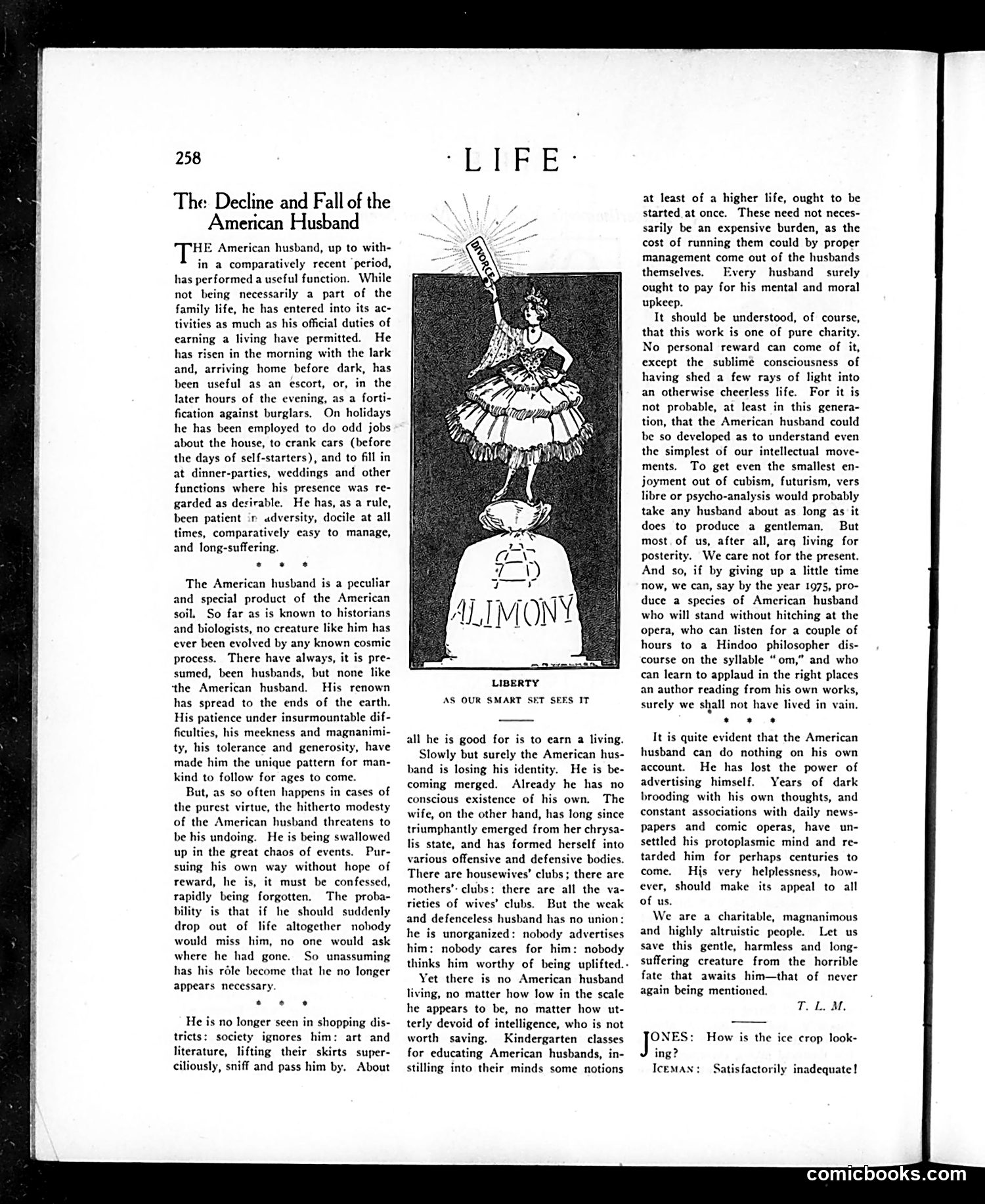
This satirical article critiques the changing role of American husbands in early 20th-century society. The central cartoon depicts a woman labeled "Liberty" standing triumphantly atop a pedestal labeled "Alimony," illustrated as her literal foundation. The satire suggests that wives' growing independence and organization—through "housewives' clubs" and "mothers' clubs"—has diminished husbands' authority and identity. The author argues American husbands have lost their power of self-advertisement and influence, becoming financially drained (via alimony) and socially irrelevant. The cartoon's visual message is direct: modern female liberty now rests upon mandatory financial support from men, presenting this as an ironic inversion of traditional power structures. This reflects anxieties about women's increasing autonomy in the early 1900s.
📄 Transcribed text from this page (OCR, searchable)
Machine-transcribed from the original scan — historical spelling and the odd misread are preserved.
258 The Decline and Fall of the American Husband HE American husband, up to with- in a comparatively recent period, has performed a useful function. While not being necessarily a part of the family life, he has entered into its ac- tivities as much as his official duties of earning a living have permitted. He has risen in the morning with the lark and, arriving home before dark, has been useful as an escort, or, in the later hours of the evening, as a forti- fication against burglars. On holidays he has been employed to do odd jobs about the house, to crank cars (before the days of self-starters), and to fill in at dinner-parties, weddings and other functions where his presence was re- garded as desirable. He has, as a rule, been patient ir adversity, docile at all times, comparatively casy to manage, and long-suffering. eee The American husband is a peculiar and special product of the American soil, So far as is known to historians and biologists, no creature like him has ever been evolved by any known cosmic process. There have always, it is pre- sumed, been husbands, but none like ‘the American husband. His renown has spread to the ends of the earth. His patience under insurmountable di ficulties, his meekness and magnanimi- ty, his tolerance and generosity, have made him the unique pattern for man- kind to follow for ages to come. But, as so often happens in cases of the purest virtue, the hitherto modesty of the American husband threatens to be his undoing. He is being swallowed up in the great chaos of events, Pur- suing his own way without hope of reward, he is, it must be confessed, rapidly being forgotten. The proba- bility is that if he should suddenly drop out of life altogether nobody would miss him, no one would ask where he had gone. So unassuming has his rdle become that he no longer appears necessary. oe He is no longer seen in shopping dis- tricts: society ignores him: art and literature, lifting their skirts super- ciliously, sniff and pass him by. About LIBERTY AS OUR SMART SET SEES IT all he is good for is to earn a living. Slowly but surely the American hus- band is losing his identity. He is be- coming merged. Already he has no conscious existence of his own. The wife, on the other hand, has long since triumphantly emerged from her chrysa- lis state, and has formed herself into various offensive and defensive bodies. There are housewives’ clubs; there are mothers’: clubs: there are all the va- rieties of wives’ clubs. But the weak and defenceless husband has no union: he is unorganized: nobody advertises him: nobody cares for him: nobody thinks him worthy of being uplifted.- Yet there is no American husband living, no matter how low in the scale he appears to be, no matter how ut- terly devoid of intelligence, who is not worth saving. Kindergarten classes for educating American husbands, in- stilling into their minds some notions at least of a higher life, ought to be started at once. These need not neces- sarily be an expensive burden, as the cost of running them could by proper management come out of the husbands themselves. Every husband surely ought to pay for his mental and moral upkeep. It should be understood, of course, that this work is one of pure charity. No personal reward can come of it, except the sublime consciousness of having shed a few rays of light into an otherwise cheerless life. For it is not probable, at least in this genera- tion, that the American husband could be so developed as to understand even the simplest of our intellectual move- ments. To get even the smallest en- joyment out of cubism, futurism, vers libre or psycho-analysis would probably take any husband about as long as it does to produce a gentleman, But most. of us, after all, arg living for posterity. We care not for the present. And so, if by giving up a little time now, we can, say by the year 1975, pro- duce a species of American husband who will stand without hitching at the opera, who can listen for a couple of hours to a Hindoo philosopher dis- course on the syllable “om,” and who can learn to applaud in the right places an author reading from his own work: surely we shall not have lived in vain. see It is quite evident that the American husband can do nothing on his own account. He has lost the power of advertising himself. Years of dark brooding with his own thoughts, and constant associations with daily news- papers and comic operas, have un- settled his protoplasmic mind and re- tarded him for perhaps centuries to come. His very helplessness, how- ever, should make its appeal to all of us. We are a charitable, magnanimous and highly altruistic people. Let us save this gentle, harmless and long- suffering creature from the horrible fate that awaits him—that of never again being mentioned. T. L. M. ONES: ing? IcEMAN: How is the ice crop look- Satisfactorily inadequate! comicbooks.com