
Life, 1917-02-15 · page 21 of 42
Life — February 15, 1917 — page 21: what you’re looking at
What you’re looking at
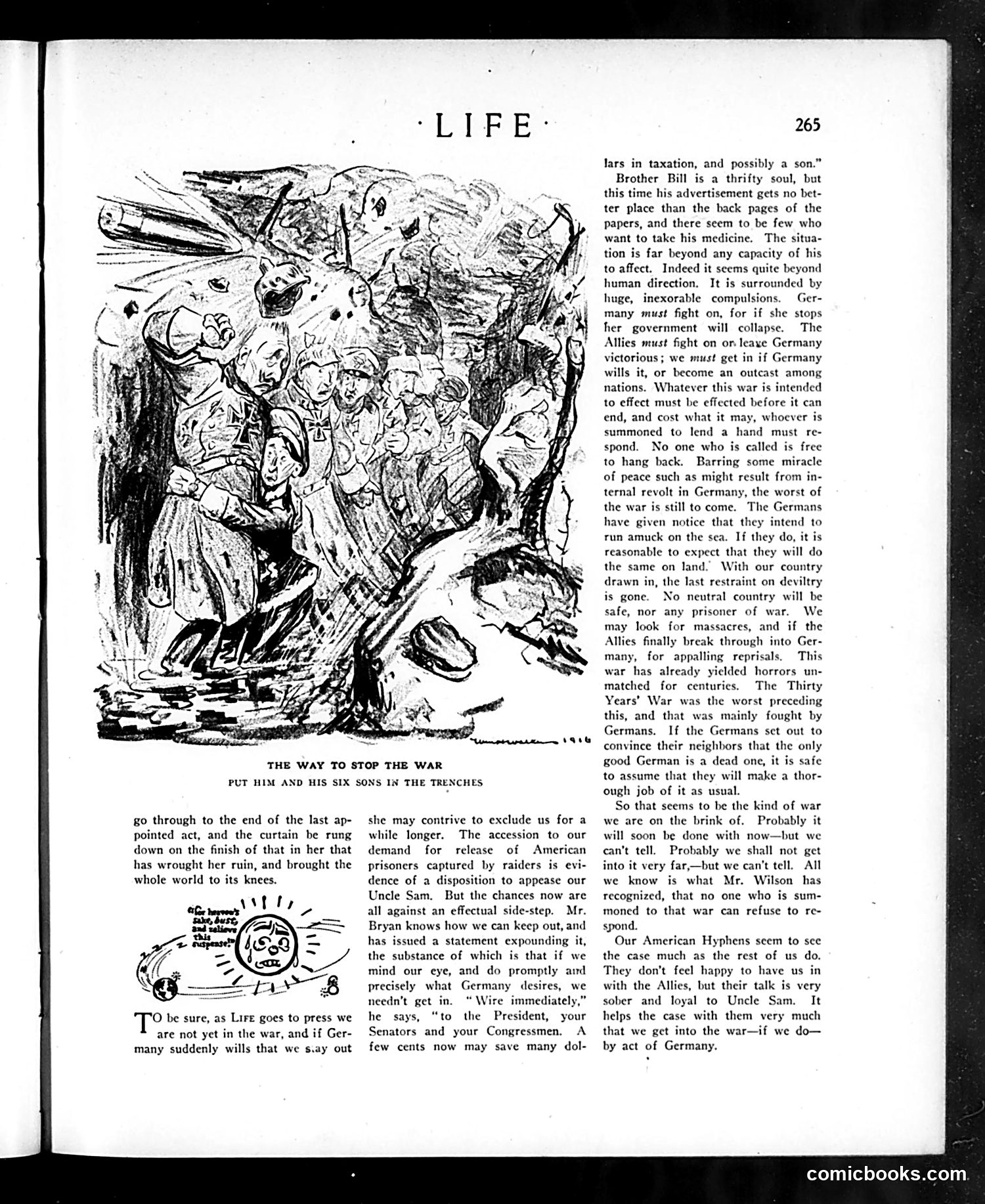
The cartoon attacks **William Jennings Bryan** (identified in text as "Brother Bill"), who served as Secretary of State under Wilson. The image depicts him as a skeletal, death-like figure—likely representing his pacifist stance during WWI. The headline "Put Him and His Six Sons in the Trenches" is bitter satire: Bryan publicly advocated keeping America out of war through appeasement of Germany, but Life's editors mock his position as cowardly and naive. They suggest his "few cents" spent on telegrams to Congress promoting pacifism are worthless against inevitable German aggression. The text sarcastically notes his advertisement appears only "in the back pages" because few support his isolationism anymore. Life argues that forces beyond human control—Germany's need to fight, Allied necessity, American honor—make neutrality impossible. The satire's point: Bryan's pacifism is both morally bankrupt and practically irrelevant to coming American involvement in the war.
📄 Transcribed text from this page (OCR, searchable)
Machine-transcribed from the original scan — historical spelling and the odd misread are preserved.
THE WAY TO STOP THE WAR PUT HIM AND HIS SIX SONS IN THE TRENCHES go through to the end of the last ap- pointed act, and the curtain be rung down on the finish of that in her that has wrought her ruin, and brought the whole world to its knees. 'O be sure, as Lire goes to press we are not yet in the war, and if Ger- many suddenly wills that we s.ay out she may contrive to exclude us for a while longer. The accession to our demand for release of American prisoners captured by raiders is evi- dence of a disposition to appease our Uncle Sam. But the chances now are all against an effectual side-step. Mr. Bryan knows how we can keep out, and has issued a statement expounding it, the substance of which is that if we mind our eye, and do promptly aid precisely what Germany desires, we needn't get in. “ Wire immediately,” he says, “to the President, your Senators and your Congressmen. A few cents now may save many dol- 265 lars in taxation, and possibly a son.” Brother Bill is a thrifty soul, but this time his advertisement gets no bet- ter place than the back pages of the papers, and there seem to be few who want to take his medicine. The situa- tion is far beyond any capacity of his to affect. Indeed it seems quite beyond human direction. It is surrounded by huge, inexorable compulsions. Ger- many must fight on, for if she stops her government will collapse. The Allies must fight on or leaxe Germany victorious; we must get in if Germany wills it, or become an outcast among nations. Whatever this war is intended to effect must be effected before it can end, and cost what it may, whoever is summoned to lend a hand must re- spond. No one who is called is free to hang back, Barring some miracle of peace such as might result from in- ternal revolt in Germany, the worst of the war is still to come. The Germans have given notice that they intend to run amuck on the sea. If they do, it is reasonable to expect that they will do the same on land. With our country drawn in, the last restraint on deviltry is gone. No neutral country will be safe, nor any prisoner of war. We may look for massacres, and if the Allies finally break through into Ger- many, for appalling reprisals. This war has already yielded horrors un- matched for centuries. The Thirty Years’ War was the worst preceding this, and that was mainly fought by Germans. If the Germans sct out to convince their neighbors that the only good German is a dead one, it is safe to assume that they will make a thor- ough job of it as usual. So that seems to be the kind of war we are on the brink of. Probably it will soon be done with now—but we can't tell. Probably we shall not get into it very far,—but we can’t tell. All we know is what Mr. Wilson has recognized, that no one who is sum- moned to that war can refuse to re- spond. Our American Hyphens seem to see the case much as the rest of us do, They don't feel happy to have us in with the Allies, but their talk is very sober and loyal to Uncle Sam. It helps the case with them very much that we get into the war—if we do— by act of Germany. comicbooks.com.