
Life, 1917-02-15 · page 20 of 42
Life — February 15, 1917 — page 20: what you’re looking at
What you’re looking at
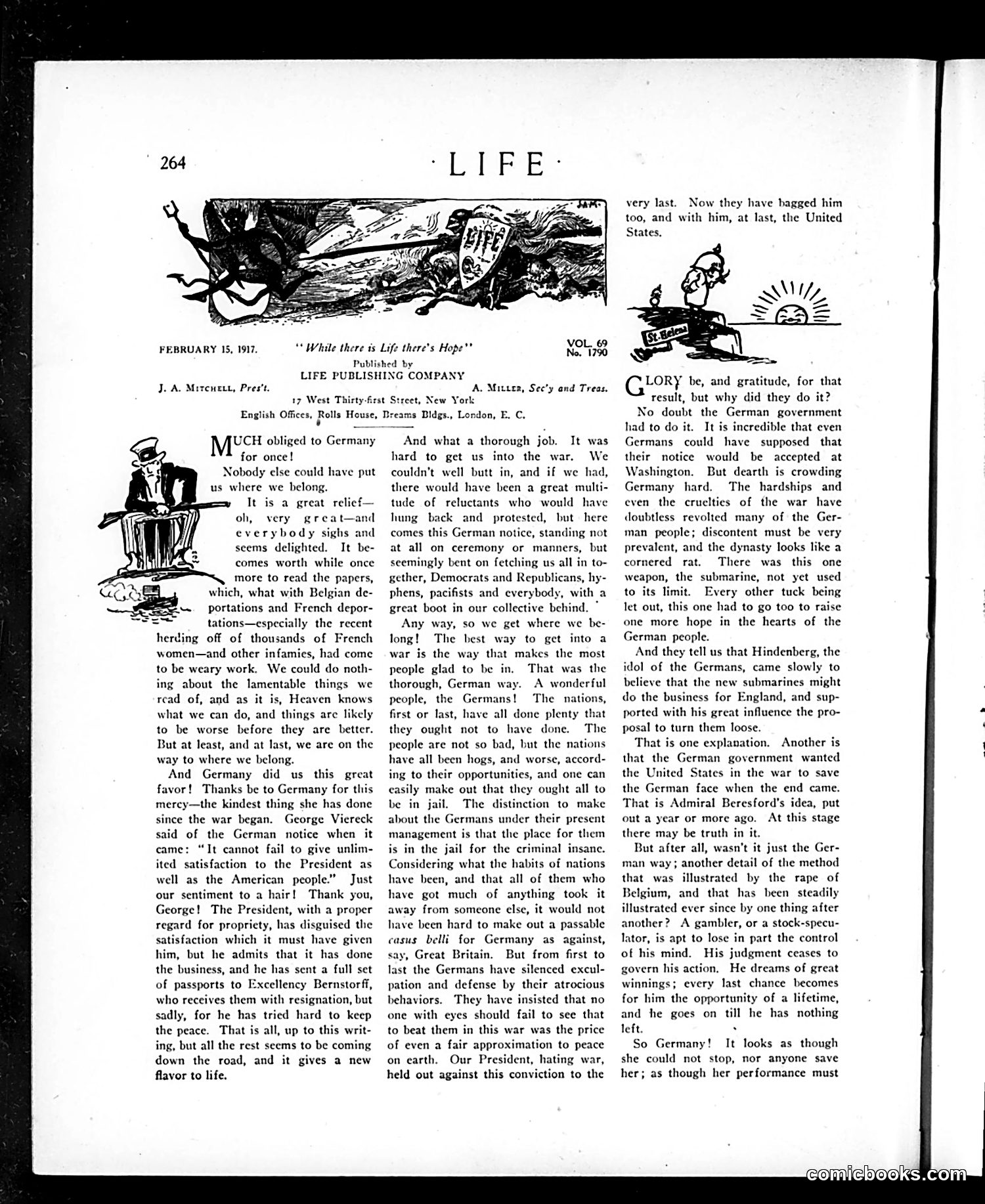
This editorial cartoon celebrates Germany's recent declaration of unrestricted submarine warfare, which finally pushed the reluctant United States toward entering World War I. The author sarcastically thanks Germany for accomplishing what diplomacy could not: uniting Americans (Democrats, Republicans, pacifists, hyphenates) behind the war effort. The piece mocks American hesitation to enter the conflict, suggesting that only Germany's brutal tactics—explicitly referencing Belgian deportations and atrocities—could overcome widespread reluctance. The author paradoxically praises Germany's "thoroughness" while condemning the German government as belonging "in the jail for the criminal insane," arguing their atrocities made defeating them a moral necessity. The cartoon expresses resigned acceptance: President Wilson, who hated war, finally had no choice. The title's bitter irony—"hope" lies in military conflict—encapsulates the grim logic of entering what would become World War I.
📄 Transcribed text from this page (OCR, searchable)
Machine-transcribed from the original scan — historical spelling and the odd misread are preserved.
Sse (rane ae. FEBRUARY 15, 1917. “* While there is Life there's Hope" Published by LIFE PUBLISHING COMPANY J. A. Mirenent, Pres’t. A. Mitura, Sec’y and Treas. 17 West Thirty-first Street, New York English Offices, Fue House, Breams Bidgs., London, E. C. UCH obliged to Germany for once! Nobody else could have put us where we belong. It is a great relief— oh, very great—and everybody sighs and seems delighted. It be- comes worth while once more to read the papers, which, what with Belgian de- portations and French depor- tations—especially the recent herding off of thousands of French women—and other infamies, had come to be weary work. We could do noth- ing about the lamentable things we read of, and as it is, Heaven knows what we can do, and things are likely to be worse before they are better. But at least, and at last, we are on the way to where we belong. And Germany did us this great favor! Thanks be to Germany for this mercy—the kindest thing she has done since the war began. George Viereck said of the German notice when it came: “It cannot fail to give unlim- ited satisfaction to the President as well as the American people.” Just our sentiment to a hair! Thank you, George! The President, with a proper regard for propriety, has disguised the satisfaction which it must have given him, but he admits that it has done the business, and he has sent a full set of passports to Excellency Bernstorff, who receives them with resignation, but sadly, for he has tried hard to keep the peace. That is all, up to this writ- ing, but all the rest seems to be coming down the road, and it gives a new flavor to life. And what a thorough job. It was hard to get us into the war. We couldn’t well butt in, and if we had, there would have been a great multi- tude of reluctants who would have hung back and protested, but here comes this German notice, standing not at all on ceremony or manners, but seemingly bent on fetching us all in to- gether, Democrats and Republicans, hy- phens, pacifists and everybody, with a great boot in our collective behind. © Any way, so we get where we be- long! The best way to get into a war is the way that makes the most people glad to be in. That was the thorough, German w: A wonderful people, the Germans! The nations, first or last, have all done plenty that they ought not to have done. The people are not so bad, but the nations have all been hogs, and worse, accord- ing to their opportunities, and one can easily make out that they ought all to be in jail. The distinction to make about the Germans under their present management is that the place for them is in the jail for the criminal insane. Considering what the habits of nations have been, and that all of them who have got much of anything took it away from someone else, it would not have been hard to make out a passable casus belli for Germany as against, ay, Great Britain. But from first to last the Germans have silenced excul- pation and defense by their atrocious behaviors. They have insisted that no one with eyes should fail to see that to beat them in this war was the price of even a fair approximation to peace on earth. Our President, hating war, held out against this conviction to the very last. Now they have bagged him too, and with him, at last, the United States, XS GORY. be, and gratitude, for that result, but why did they do it? No doubt the German government had to do it. It is incredible that even Germans could have supposed that their notice would be accepted at Washington. But dearth is crowding Germany hard. The hardships and even the cruelties of the war have doubtless revolted many of the Ger- man people; discontent must be very prevalent, and the dynasty looks like a cornered rat. There was this one weapon, the submarine, not yet used to its limit. Every other tuck being let out, this one had to go too to raise one more hope in the hearts of the German people. And they tell us that Hindenberg, the idol of the Germans, came slowly to believe that the new submarines might do the business for England, and sup- ported with his great influence the pro- posal to turn them loose. That is one explanation. Another is that the German government wanted the United States in the war to save the German face when the end came. That is Admiral Beresford's idea, put out a year or more ago. At this stage there may be truth in it. But after all, wasn’t it just the Ger- man way; another detail of the method that was illustrated by the rape of Belgium, and that has been steadily illustrated ever since by one thing after another? A gambler, or a stock-specu- lator, is apt to lose in part the control of his mind. His judgment ceases to govern his action. He dreams of great winnings; every last chance becomes for him the opportunity of a lifetime, and he goes on till he has nothing left. . So Germany! It looks as though she could not stop, nor anyone save her; as though her performance must