
Life, 1917-02-15 · page 10 of 42
Life — February 15, 1917 — page 10: what you’re looking at
What you’re looking at
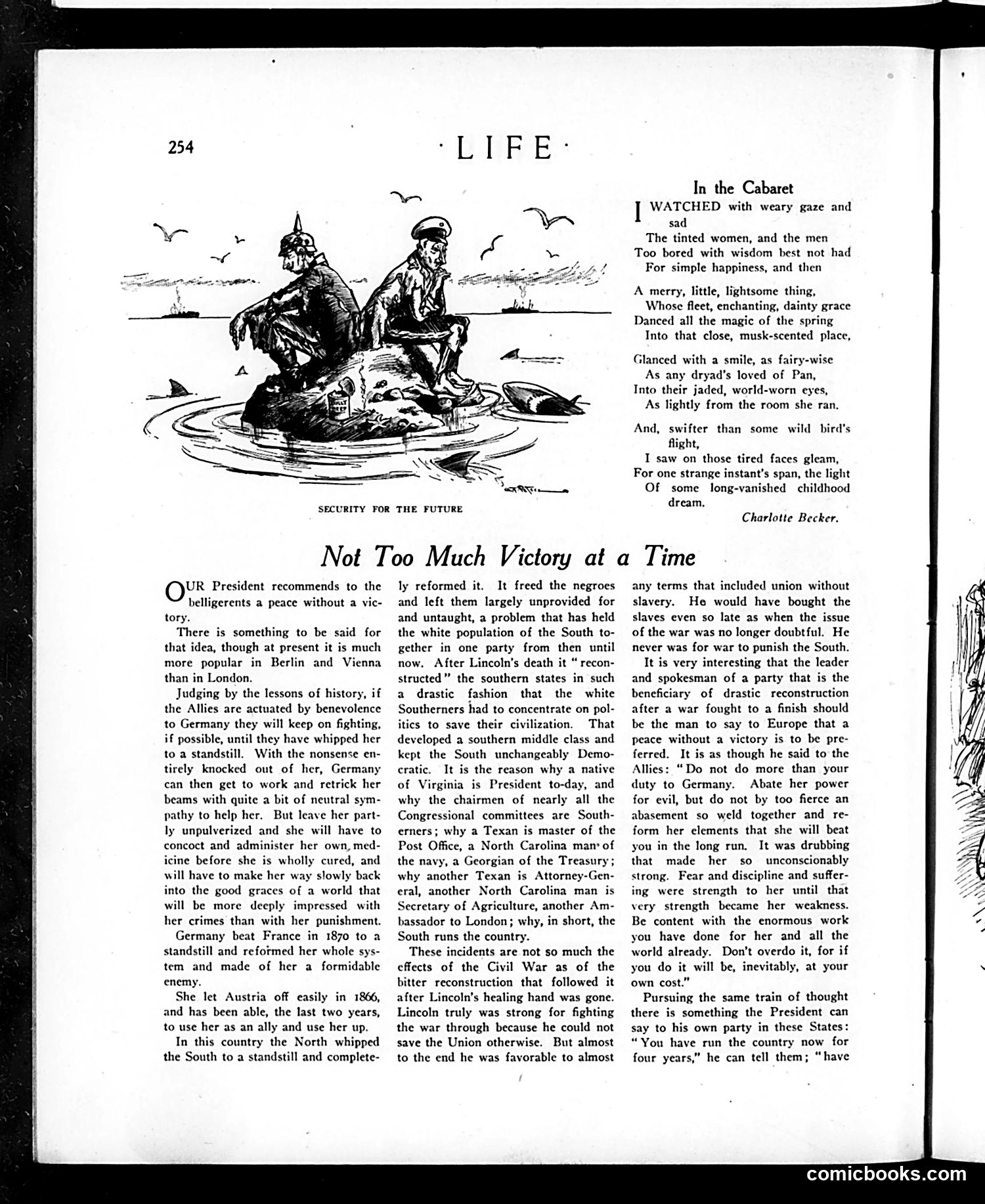
**The Cartoon ("Security for the Future"):** Two figures sit on what appears to be a nest or platform surrounded by water. The image suggests vulnerability and precariousness despite the title's promise of "security." The cartoon likely satirizes post-Civil War Reconstruction policies toward the South—the nest metaphor implies the South's unstable position rather than genuine security. **The Article ("Not Too Much Victory at a Time"):** This piece critiques President Lincoln's (or his successor's) Reconstruction approach. It argues against punitive measures toward the defeated South, instead advocating a moderate policy that would allow Southern states to gradually rebuild. The text references Lincoln's death and debates over whether to impose harsh terms or foster reconciliation. The satire mocks the notion that restraint in victory serves national interest.
📄 Transcribed text from this page (OCR, searchable)
Machine-transcribed from the original scan — historical spelling and the odd misread are preserved.
SECURITY FOR THE FUTURE Not Too Much Victory at a Time UR President recommends to the belligerents a peace without a vic- tory. There is something to be said for that idea, though at present it is much more popular in Berlin and Vienna than in London. Judging by the lessons of history, if the Allies are actuated by benevolence to Germany they will keep on fighting, if possible, until they have whipped her to a standstill. With the nonsense en- tirely knocked out of her, Germany can then get to work and retrick her beams with quite a bit of neutral sym- pathy to help her. But leave her part- ly unpulverized and she will have to concoct and administer her own, med- icine before she is wholly cured, and will have to make her way slowly back into the good graces of a world that will be more deeply impressed with her crimes than with her punishment. Germany beat France in 1870 to a standstill and reformed her whole sys- tem and made of her a formidable enemy. She let Austria off easily in 1866, and has been able, the last two years, to use her as an ally and use her up. In this country the North whipped the South to a standstill and complete- ly reformed it. It freed the negroes and left them largely unprovided for and untaught, a problem that has held the white population of the South to- gether in one party from then until now, After Lincoln's death it “ recon- structed” the southern states in such a drastic fashion that the white Southerners had to concentrate on pol- itics to save their civilization. That developed a southern middle class and kept the South unchangeably Demo- cratic. It is the reason why a native of Virginia is President to-day, and why the chairmen of nearly all the Congressional committees are South- erners; why a Texan is master of the Post Office, a North Carolina man: of the navy, a Georgian of the Treasury; why another Texan is Attorney-Gen- eral, another North Carolina man is Secretary of Agriculture, another Am- bassador to London; why, in short, the South runs the country. These incidents are not so much the effects of the Civil War as of the bitter reconstruction that followed it after Lincoln's healing hand was gone. Lincoln truly was strong for fighting the war through because he could not save the Union otherwise. But almost to the end he was favorable to almost In the Cabaret I WATCHED with weary gaze and sad The tinted women, and the men Too bored with wisdom best not had For simple happiness, and then A merry, little, lightsome thing, Whose fleet, enchanting, dainty grace Danced all the magic of the spring Into that close, musk-scented place, Glanced with a smile, as fairy-wise As any dryad’s loved of Pan, Into their jaded, world-worn eyes, As lightly from the room she ran. And, swifter than some wild bird's flight, I saw on those tired faces gleam, For one strange instant’s span, the light Of some long-vanished childhood dream, Charlotte Becker, any terms that included union without slavery. He would have bought the slaves even so late as when the issue of the war was no longer doubtful. He never was for war to punish the South. It is very interesting that the leader and spokesman of a party that is the beneficiary of drastic reconstruction after a war fought to a finish should be the man to say to Europe that a peace without a victory is to be pre- ferred. It is as though he said to the Allies: “Do not do more than your duty to Germany. Abate her power for evil, but do not by too fierce an abasement so weld together and re- form her elements that she will beat you in the long run. It was drubbing that. made her so unconscionably strong. Fear and discipline and suffer- ing were strength to her until that very strength became her weakness. Be content with the enormous work you have done for her and all the world already. Don’t overdo it, for if you do it will be, inevitably, at your own cost.” Pursuing the same train of thought there is something the President can say to his own party in these States: “You have run the country now for four years,” he can tell them; “have comicbooks.com