
Life, 1917-02-15 · page 29 of 42
Life — February 15, 1917 — page 29: what you’re looking at
What you’re looking at
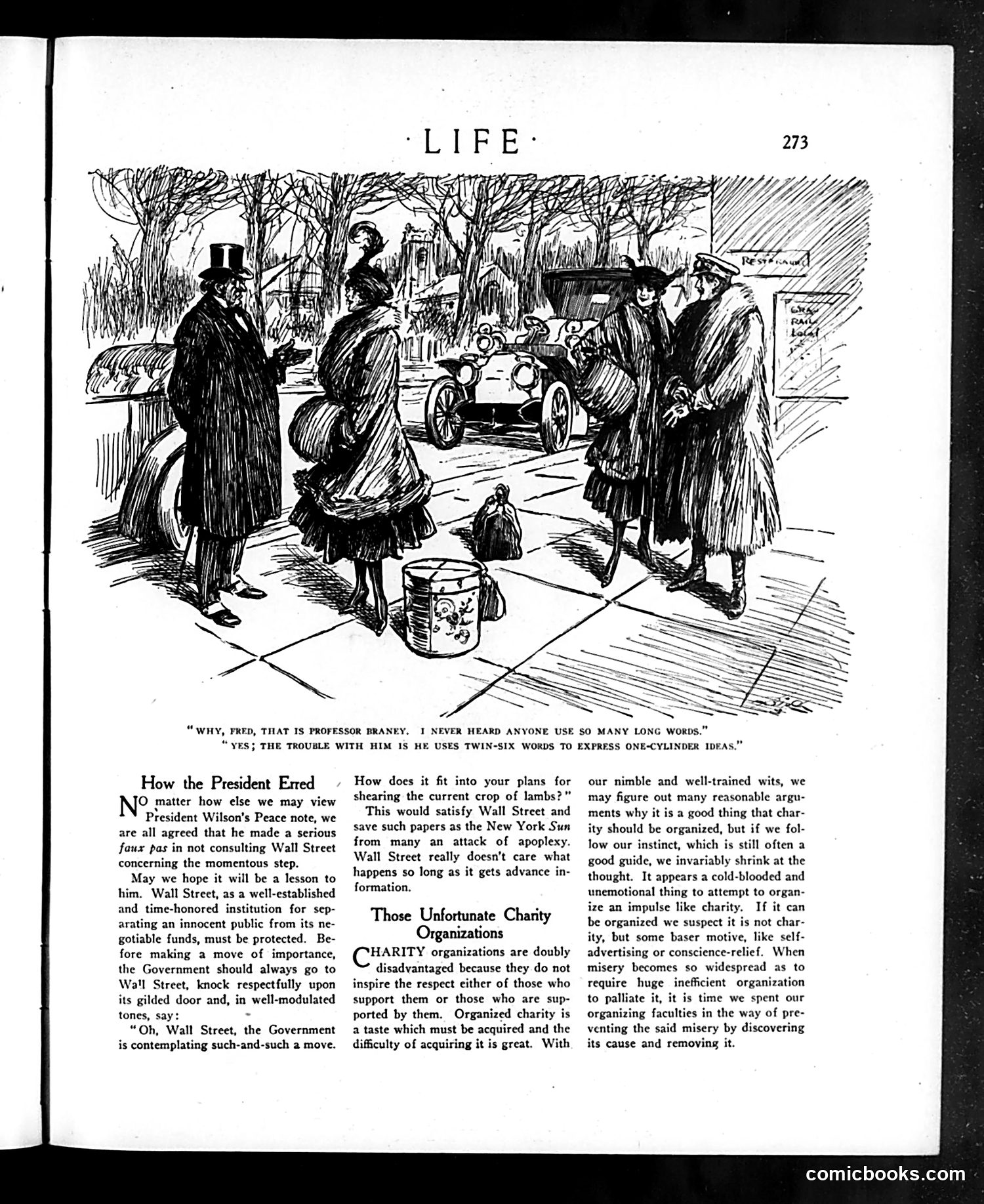
The cartoon satirizes President Wilson's handling of his Peace Note (likely referring to WWI peace negotiations) by mocking him for not consulting Wall Street before making important diplomatic decisions. The satire is bitterly ironic: Life suggests the government should defer to Wall Street's financial interests, portraying the financial establishment as so powerful and self-interested that it deserves advance notice of all government actions to protect its profit opportunities ("shearing the current crop of lambs"). The accompanying text ridicules both Wilson's verbosity (the caption jokes about using overly complex words for simple ideas) and organized charity as inherently suspect—arguing that institutionalized charity lacks genuine compassion and serves ulterior motives like self-promotion. The overall tone reflects progressive-era skepticism toward both political elites and financial power brokers during the Wilson presidency.
📄 Transcribed text from this page (OCR, searchable)
Machine-transcribed from the original scan — historical spelling and the odd misread are preserved.
D, THAT IS PROFESSOR BRANEY. I NEVER HEARD ANYONE USE SO MANY LONG WoxDs.” 3 THE TROUBLE WITH HIM 1S HE USES TWIN-SIX WORDS TO EXPRESS ONE-CYLINDER IDEAS.” How the President Ered N° matter how else we may view President Wilson's Peace note, we are all agreed that he made a serious faux pas in not consulting Wall Street concerning the momentous step. May we hope it will be a lesson to him. Wall Street, as a well-established and time-honored institution for sep- arating an innocent public from its ne- gotiable funds, must be protected. Be- fore making a move of importance, the Government should always go to Wall Street, knock respectfully upon its gilded door and, in well-modulated tones, say: = “Oh, Wall Street, the Government is contemplating such-and-such a move. How does it fit into your plans for shearing the current crop of lambs?" This would satisfy Wall Street and save such papers as the New York Sun from many an attack of apoplexy. Wall Street really doesn’t care what happens so long as it gets advance in- formation. Those Unfortunate Charity Organizations CH organizations are doubly disadvantaged because they do not inspire the respect either of those who support them or those who are sup- ported by them. Organized charity is a taste which must be acquired and the difficulty of acquiring it is great. With our nimble and well-trained wits, we may figure out many reasonable argu- ments why it is a good thing that char- ity should be organized, but if we fol- low our instinct, which is still often a good guide, we invariably shrink at the thought. It appears a cold-blooded and unemotional thing to attempt to organ- ize an impulse like charity. If it can be organized we suspect it is not char- ity, but some baser motive, like self- advertising or conscience-relief. When misery becomes so widespread as to require huge inefficient organization to palliate it, it is time we spent our organizing faculties in the way of pre- venting the said misery by discovering its cause and removing it. comicbooks.com