
A complete issue · 46 pages · 1916
Life — October 26, 1916
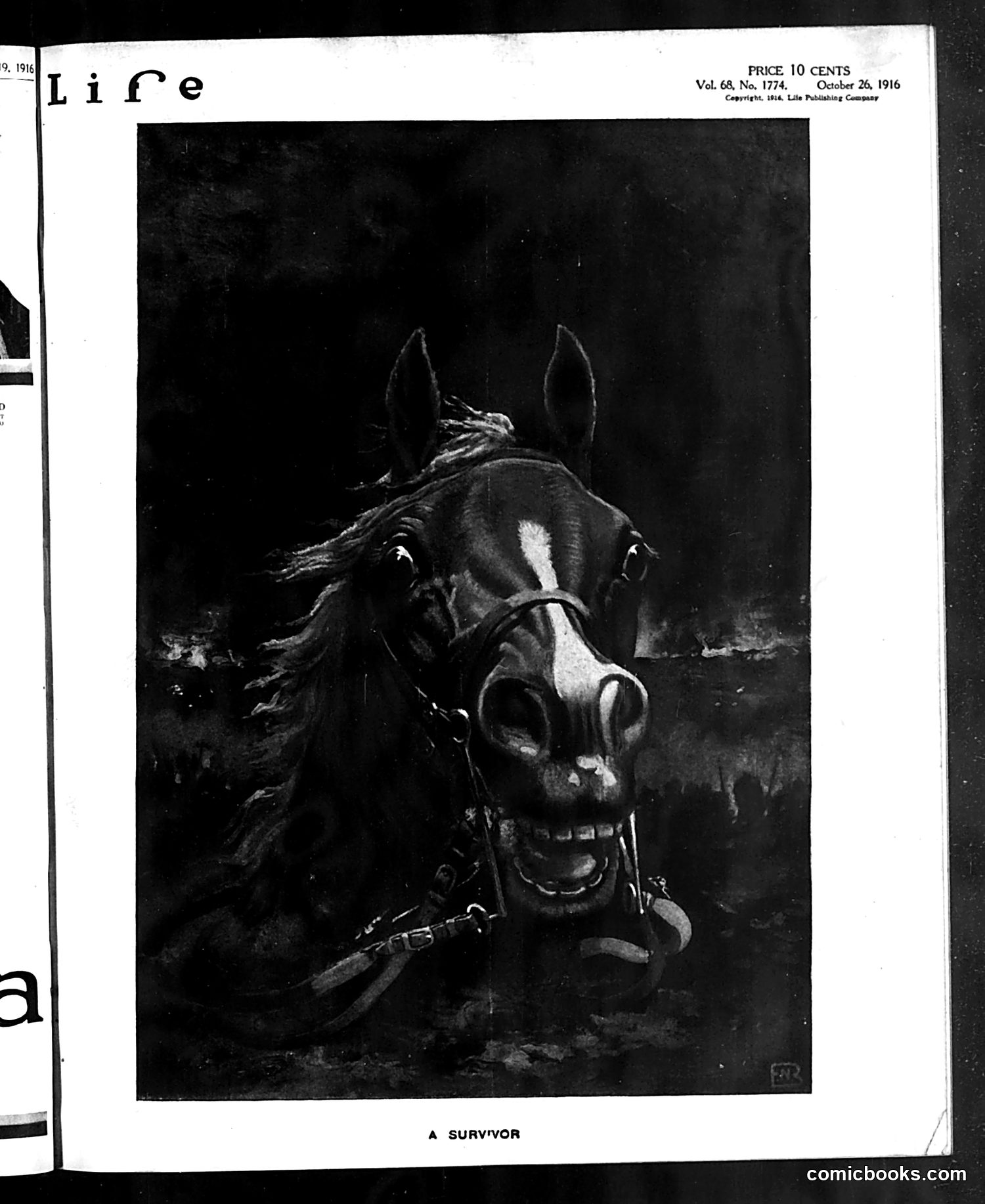
This image shows a horse's head in profile, wearing military tack and bearing visible wounds or scars. The title "A Survivor" references World War I, which was devastating European battlefields in 1916. The cartoon appears to be a sympathetic commentary on the immense animal casualties of the war. Horses were essential military assets—used for cavalry, transport, and artillery—and died in enormous numbers during WWI (estimates suggest millions). By depicting a scarred, exhausted horse as a "survivor," the cartoonist evokes pathos for forgotten victims of modern industrial warfare. This reflects contemporary American concern about war's human and animal costs, during a period when the U.S. remained officially neutral but increasingly aware of the conflict's brutality.
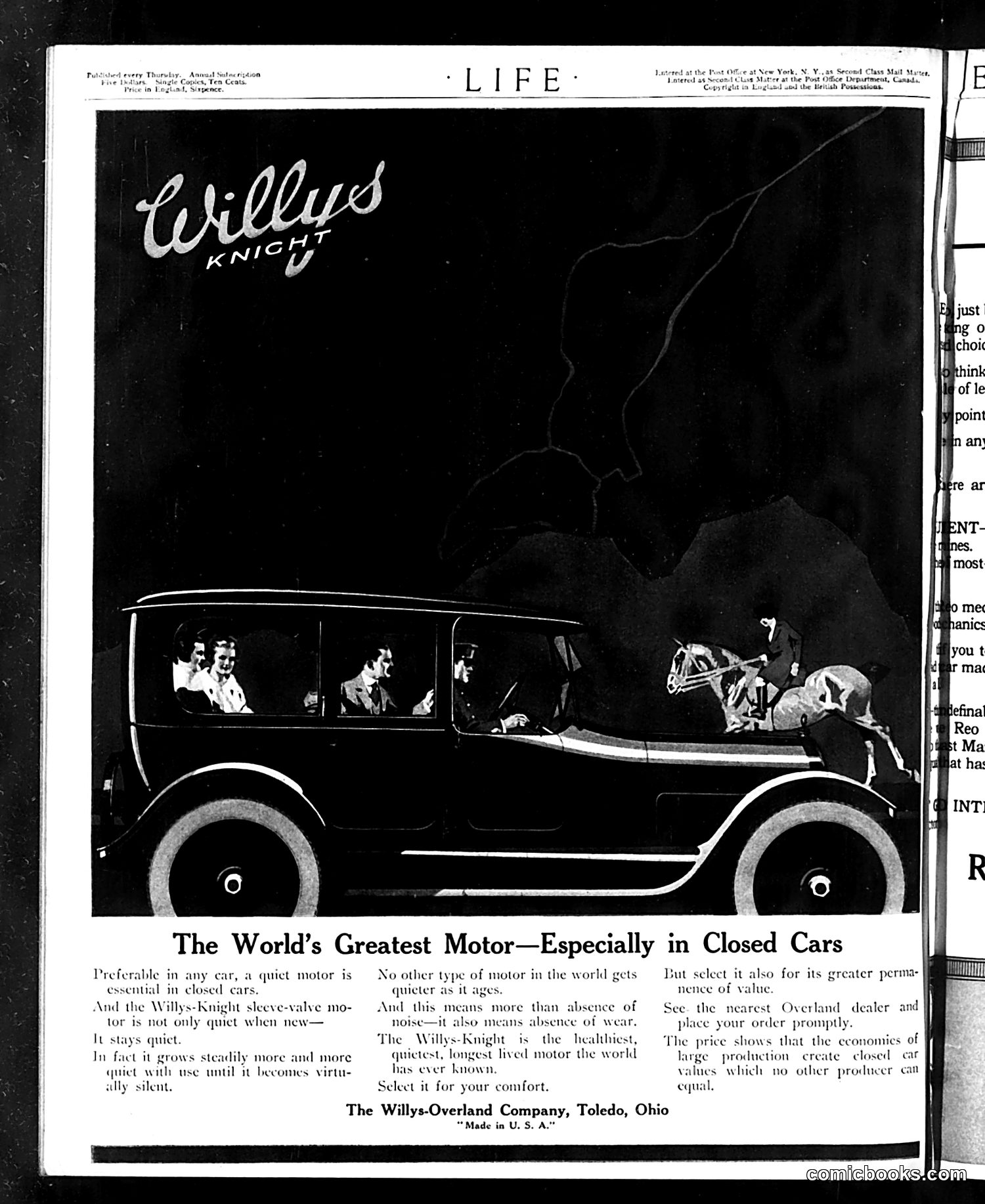
This is primarily **an advertisement, not a political cartoon**. It promotes the Willys-Knight automobile, manufactured by the Willys-Overland Company in Toledo, Ohio. The image shows a closed car with passengers, illustrating the advertisement's main claim: that the Willys-Knight engine is "The World's Greatest Motor—Especially in Closed Cars" because it operates quietly. The text emphasizes that the sleeve-valve motor grows quieter with age and is superior for closed vehicles where silence matters for comfort. The illustration depicts the car at night (suggested by the dark sky and silhouettes), possibly to convey luxury and nighttime travel. This is straightforward product marketing typical of 1920s magazine advertising, not satire or political commentary.
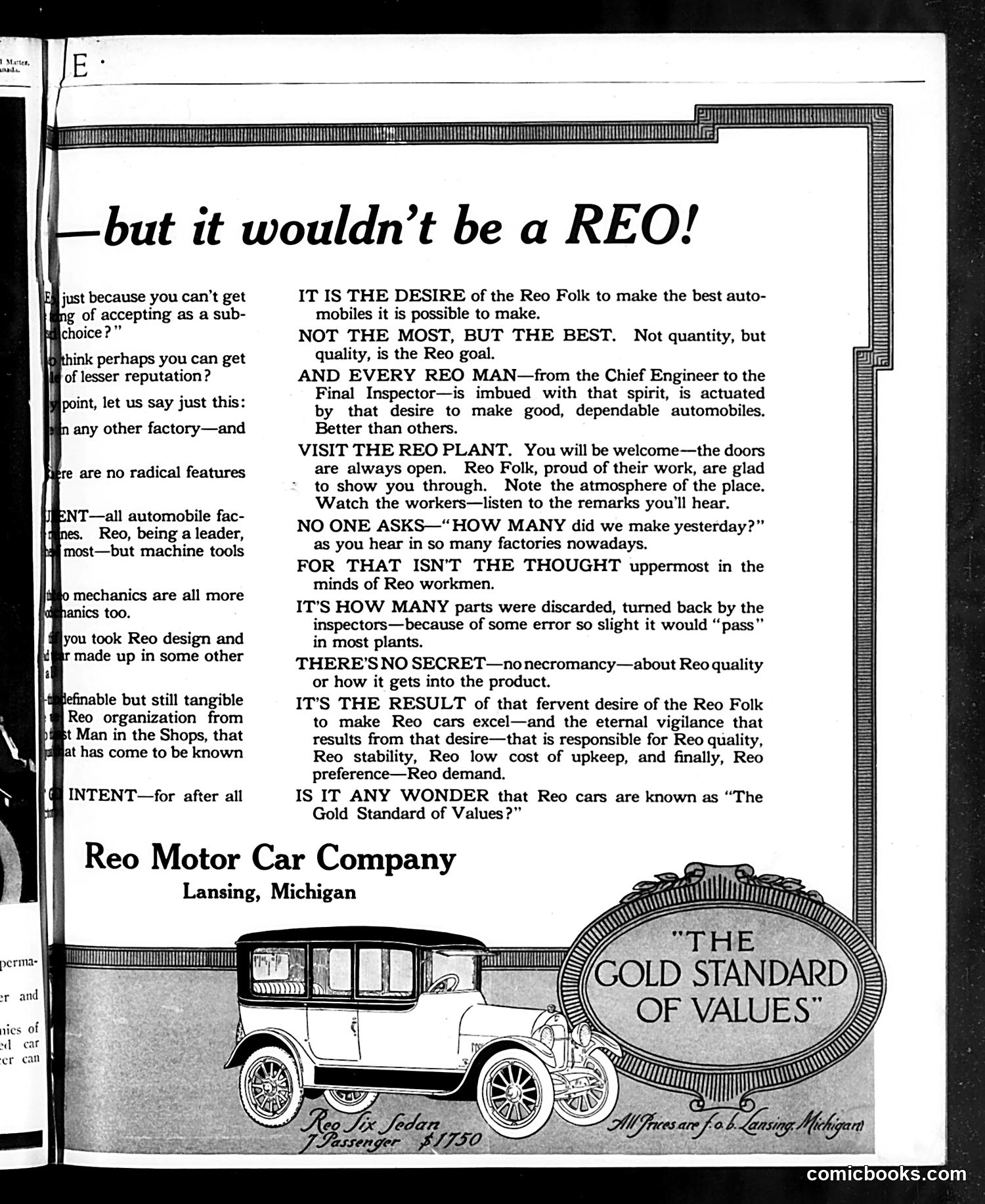
This is a **vintage automobile advertisement**, not a political cartoon. It's from REO Motor Car Company (Lansing, Michigan), promoting their vehicles as "The Gold Standard of Values." The ad uses aspirational messaging rather than satire, claiming REO cars represent quality over quantity—emphasizing that every worker from chief engineer to inspector embodies a commitment to excellence. The company invites factory visits to demonstrate transparency and worker pride. The vintage car illustration shows a REO Six Sedan touring model. This appears to be early 20th-century advertising, likely from the 1920s based on the car design and typography. The "gold standard" tagline suggests REO positioned itself as a premium yet affordable option in the competitive automotive market of that era.
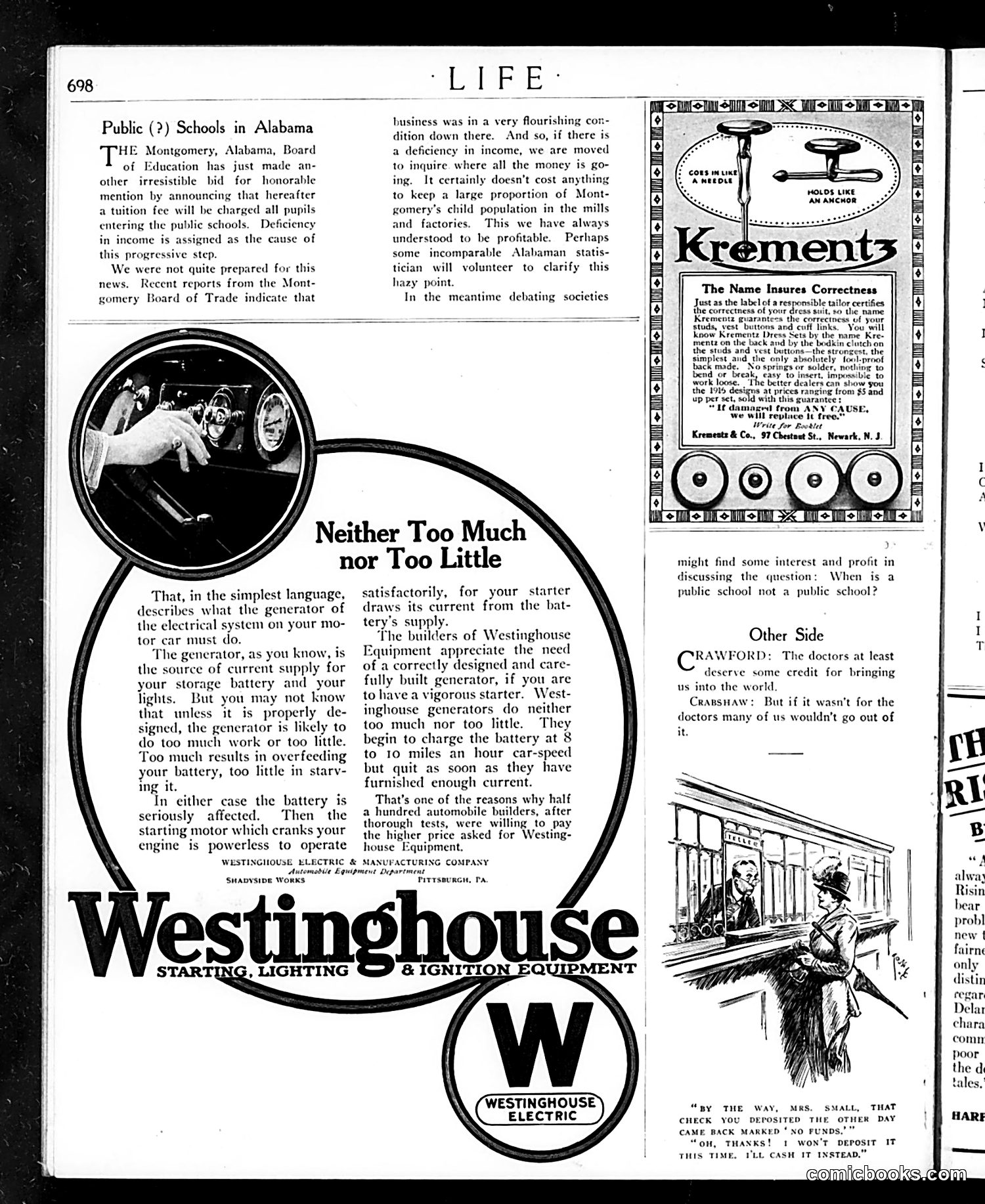
This page is primarily **advertising**, not satire or political commentary. The dominant feature is a **Westinghouse Electric advertisement** for automobile electrical equipment (starting, lighting, and ignition systems). The ad uses a technical explanation ("Neither Too Much nor Too Little") to explain how generators regulate battery charging—avoiding overcharging or undercharging. This was a genuine concern for early automotive owners. The circular inset shows a driver at the wheel, illustrating the practical application. The page also includes: - An article on **Alabama public schools** funding - A **Krement's corset advertisement** - A brief comedic dialogue ("Other Side") about doctors and public schools The content reflects 1920s concerns: automotive reliability, women's fashion, and educational policy.
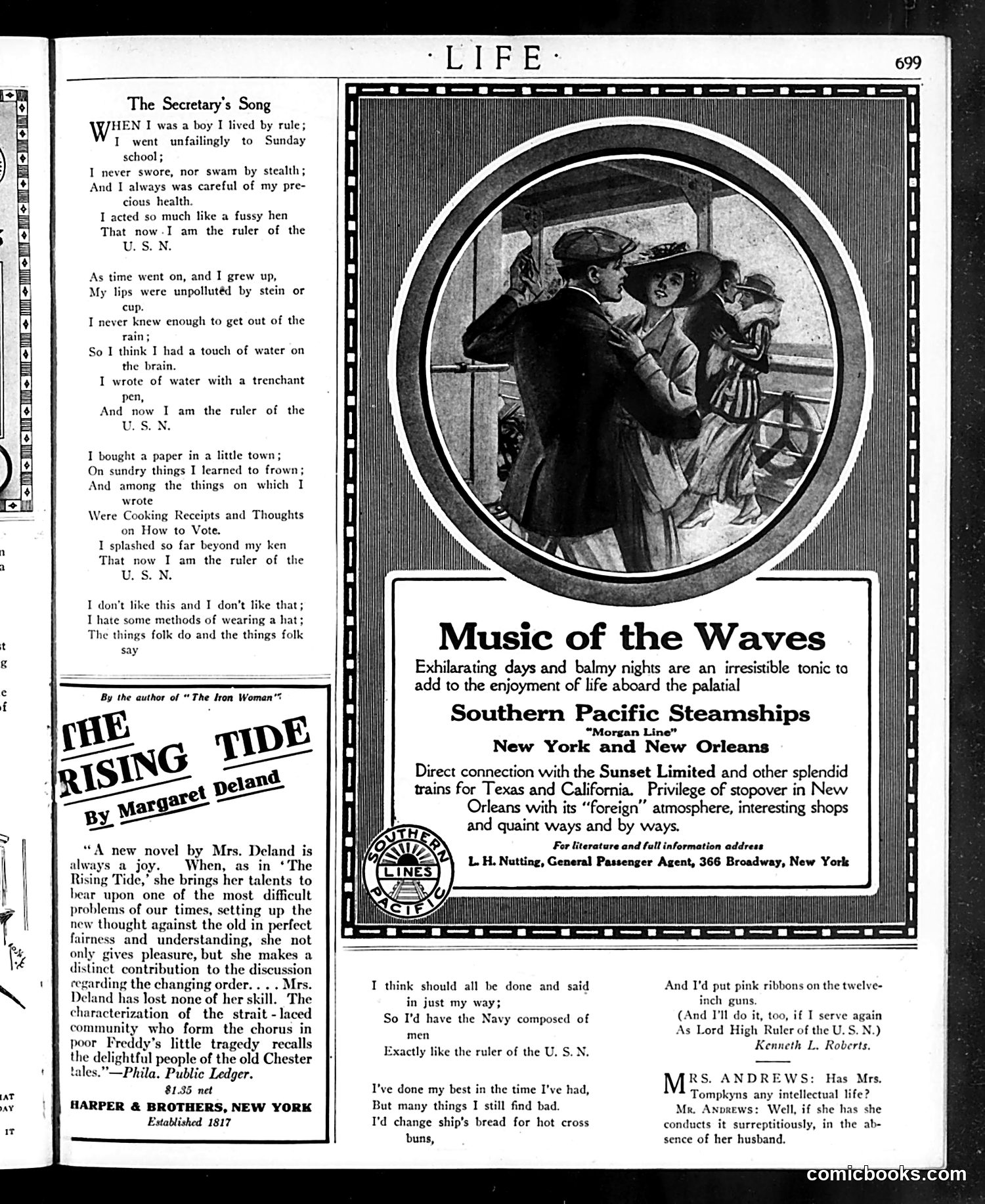
This page contains primarily **literary and advertising content** rather than political cartoons. The main poem, "The Secretary's Song," appears to be **satire about women's expanding roles**. It depicts a woman who progressed from a rule-following girl to someone who "ruled the U.S.N." (U.S. Navy), learned about voting and cooking, and now questions traditional gender expectations ("I don't like this and I don't like that; I have some methods of wearing a hat"). The advertisement for **Southern Pacific Steamships** and the book promotion for Margaret Deland's novel "The Rising Tide" suggest the page targets **educated women readers**, likely reflecting early 20th-century debates about women's education, suffrage, and changing social roles. The humor lies in the woman's journey from strict conformity to assertive independence.
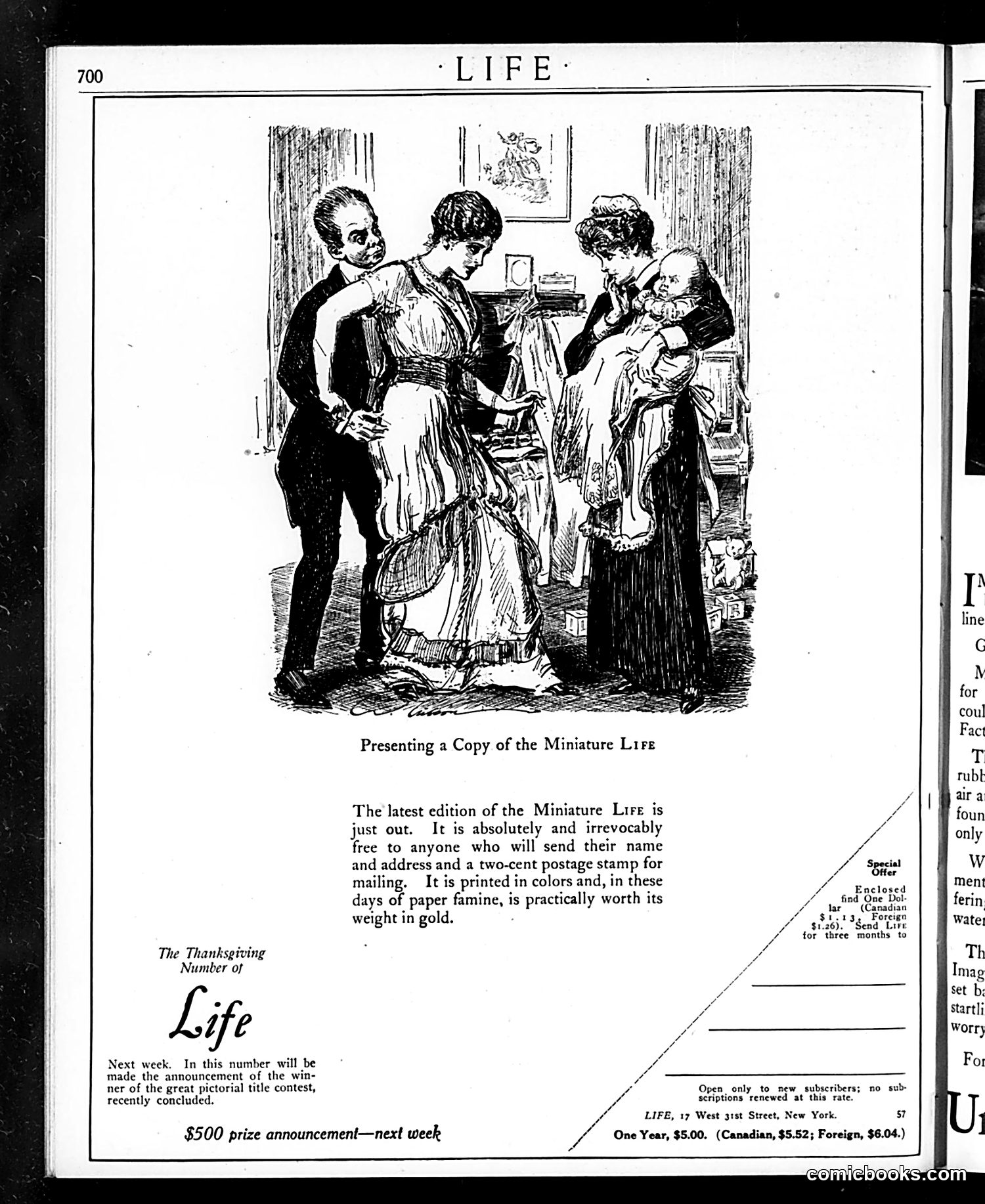
This page is primarily **advertising**, not political satire. The main illustration shows a social scene of well-dressed Victorian-era figures presenting "a Copy of the Miniature Life" — the magazine itself is being promoted as a gift. The text announces that Life magazine's miniature edition is "absolutely and irrevocably free" to new subscribers who send their name, address, and two cents postage. It's described as valuable ("practically worth its weight in gold"), likely hyperbole given the stated paper shortage context. Below is an announcement for Life's upcoming "Thanksgiving Number" featuring "the great pictorial title contest" winner, with a $500 prize announcement promised for the following week. The page functions as a subscription promotion wrapped in period-appropriate illustration, rather than satirical commentary.
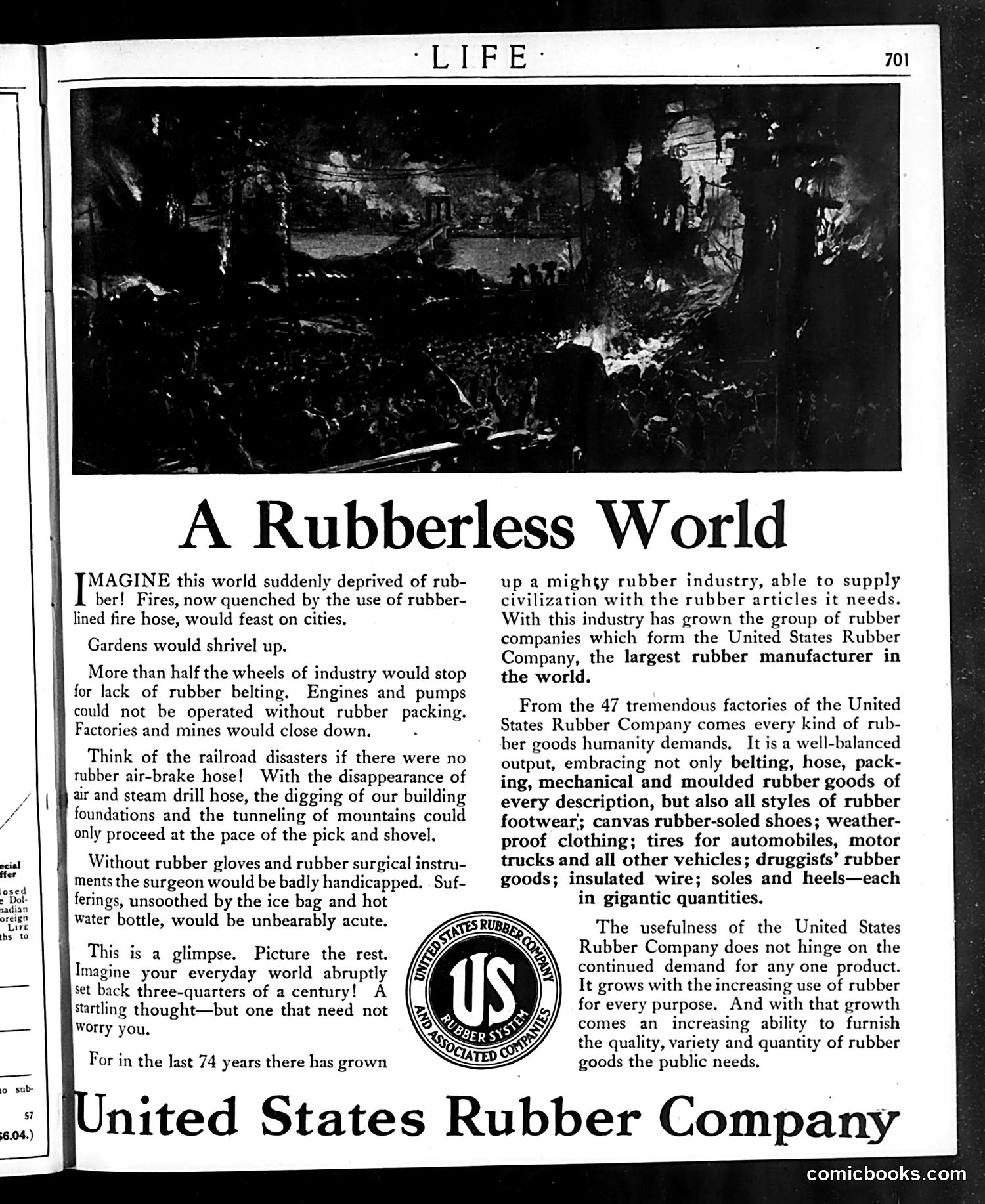
This is a **corporate advertisement**, not political satire. The page presents a speculative thought experiment: imagining civilization without rubber. The left column catalogs catastrophic consequences—fires would rage unchecked without rubber hoses, industrial machinery would fail without rubber belts and packing, surgical instruments couldn't function, railroad air brakes would disappear. The text emphasizes rubber's invisible but essential role in modern infrastructure. The right column pivots to promoting the **United States Rubber Company** as the solution, highlighting their 47 factories and comprehensive product range: belts, hoses, footwear, tires, wire insulation, and heels. The advertisement uses fear of societal collapse to justify the company's importance and presumably encourage consumer loyalty or investment. It's early-20th-century corporate boosterism disguised as practical reasoning.
This page is **not a cartoon or satire** — it's a straightforward advertisement for the Locomobile Company of America, appearing in *Life* magazine (page 702). The ad promotes the Locomobile automobile, emphasizing its low-built chassis designed for custom coachwork. It highlights the car's qualities: harmony, taste, and "well-bred simplicity," with limited production to ensure quality. Pricing is listed: chassis from $4,600 to $6,800, and custom-bodied vehicles from $5,600 to $8,250. The ornate decorative border and formal typography reflect early-20th-century luxury advertising conventions, positioning the Locomobile as a prestigious, high-end vehicle for wealthy consumers. This is period advertising, not editorial content.
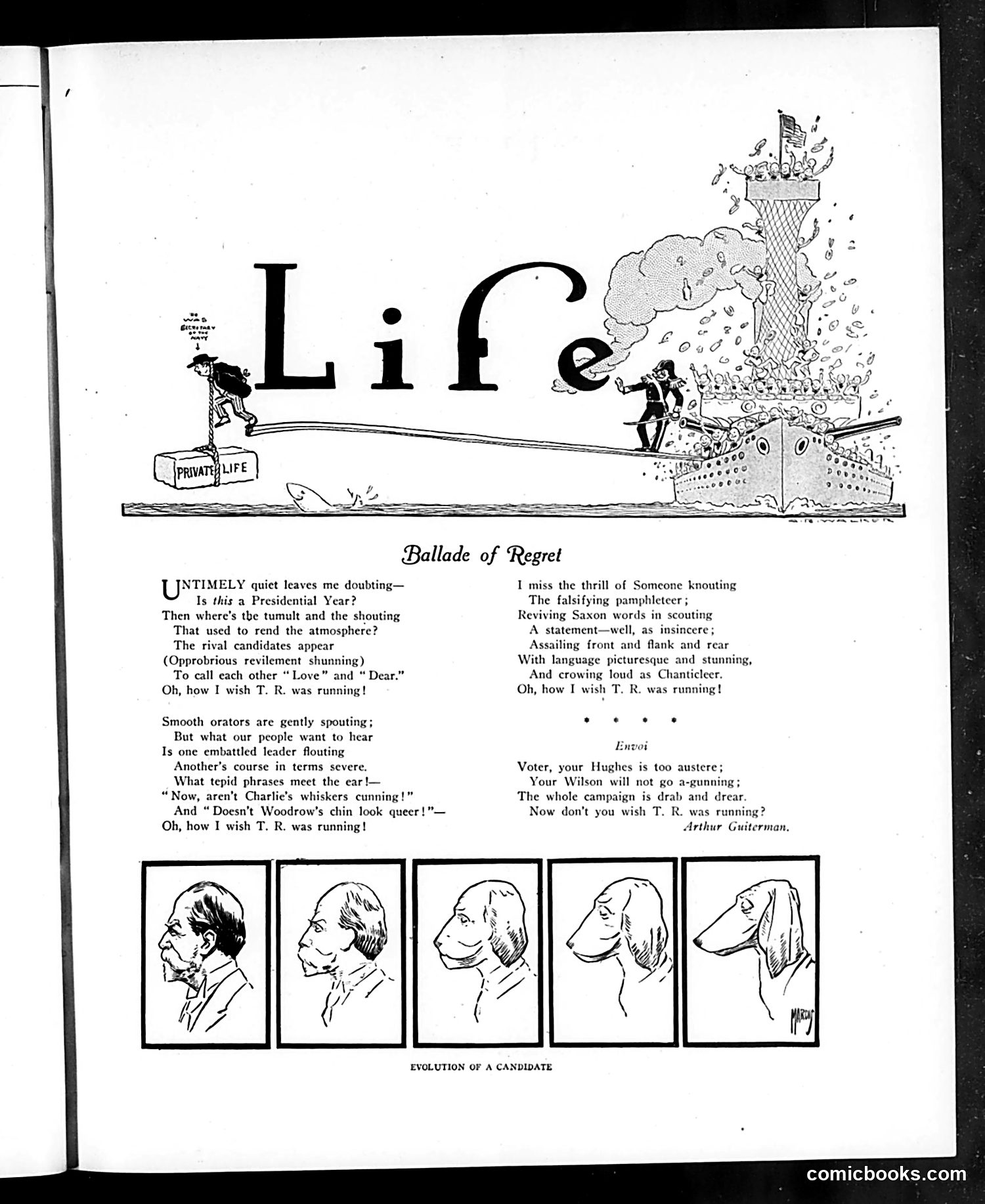
This page satirizes the 1916 U.S. presidential election. The poem "Ballade of Regret" laments the lack of dynamic leadership, with repeated wishes that "T.R. was running!"—referring to Theodore Roosevelt, who had left the presidency in 1909. The satire criticizes the current candidates (appearing to reference Woodrow Wilson and Charles Evans Hughes) as uninspiring compared to Roosevelt's vigor. The poem mocks their bland campaign rhetoric and suggests voters miss Roosevelt's forceful personality. The bottom illustration, "Evolution of a Candidate," shows a face progressively degenerating across five panels—satirizing how candidates become worn down or diminished through the electoral process, or perhaps how their character deteriorates or becomes less defined. The overall message: nostalgia for Roosevelt's leadership during a disappointing election cycle.
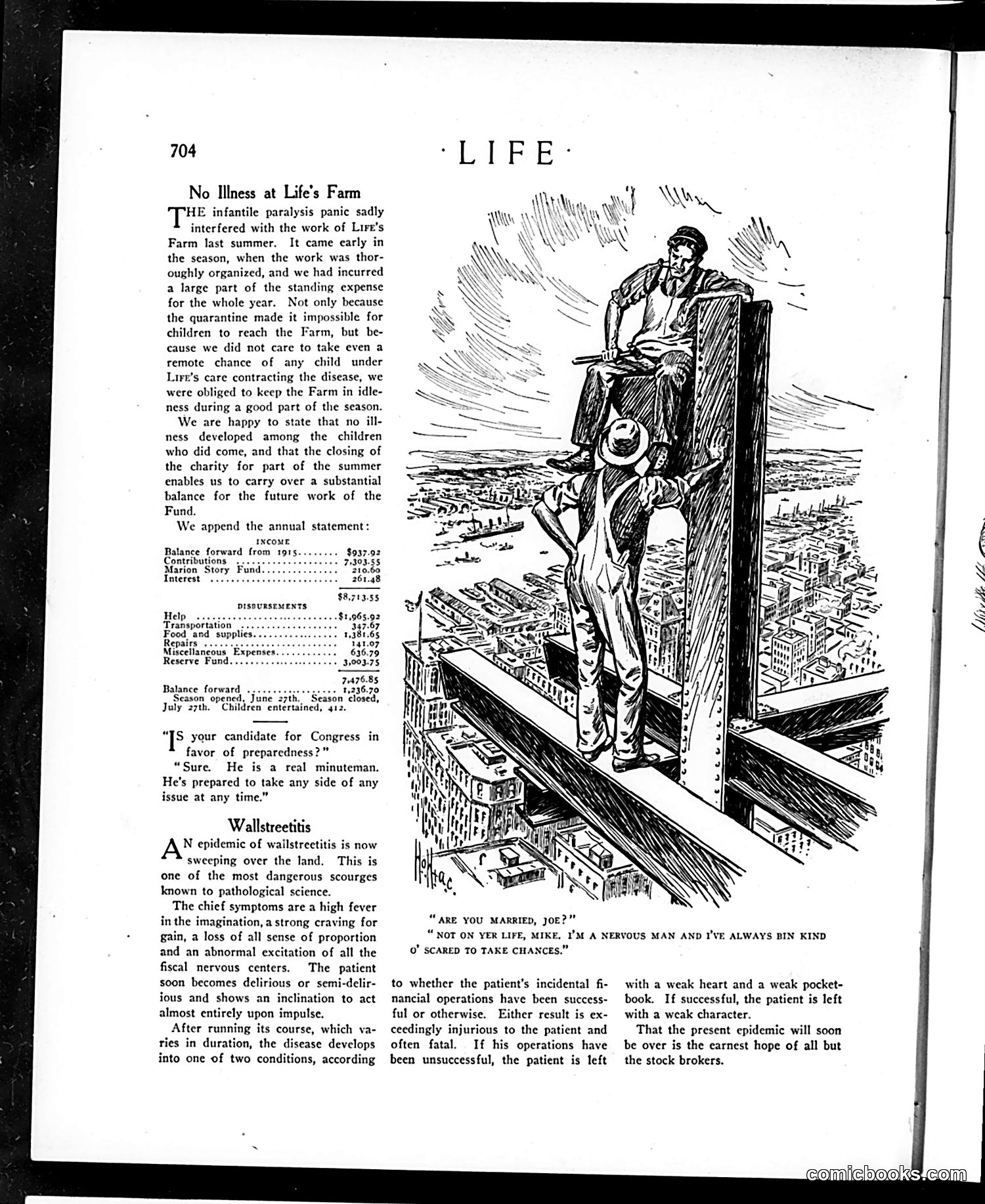
The main illustration depicts a man in a suit and hat standing atop a tall building overlooking a cityscape, appearing to contemplate suicide. The caption reads: "ARE YOU MARRIED, JOE?" / "NOT ON YER LIFE, MIKE. I'M A NERVOUS MAN AND I'VE ALWAYS BIN KIND O' SCARED TO TAKE CHANCES." This is dark satirical humor about marriage. The joke inverts expectations: a man standing on a building ledge—typically suggesting suicidal despair—claims he avoids marriage because he's "nervous" and fears "taking chances." The satire mocks marriage as more dangerous than literal suicide. The accompanying text discusses "Wallstreetitis," describing an epidemic of mental illness affecting businessmen during financial volatility, with symptoms including high fever, delirium, and impulse-driven behavior—likely referencing 1920s stock market volatility and its psychological toll.
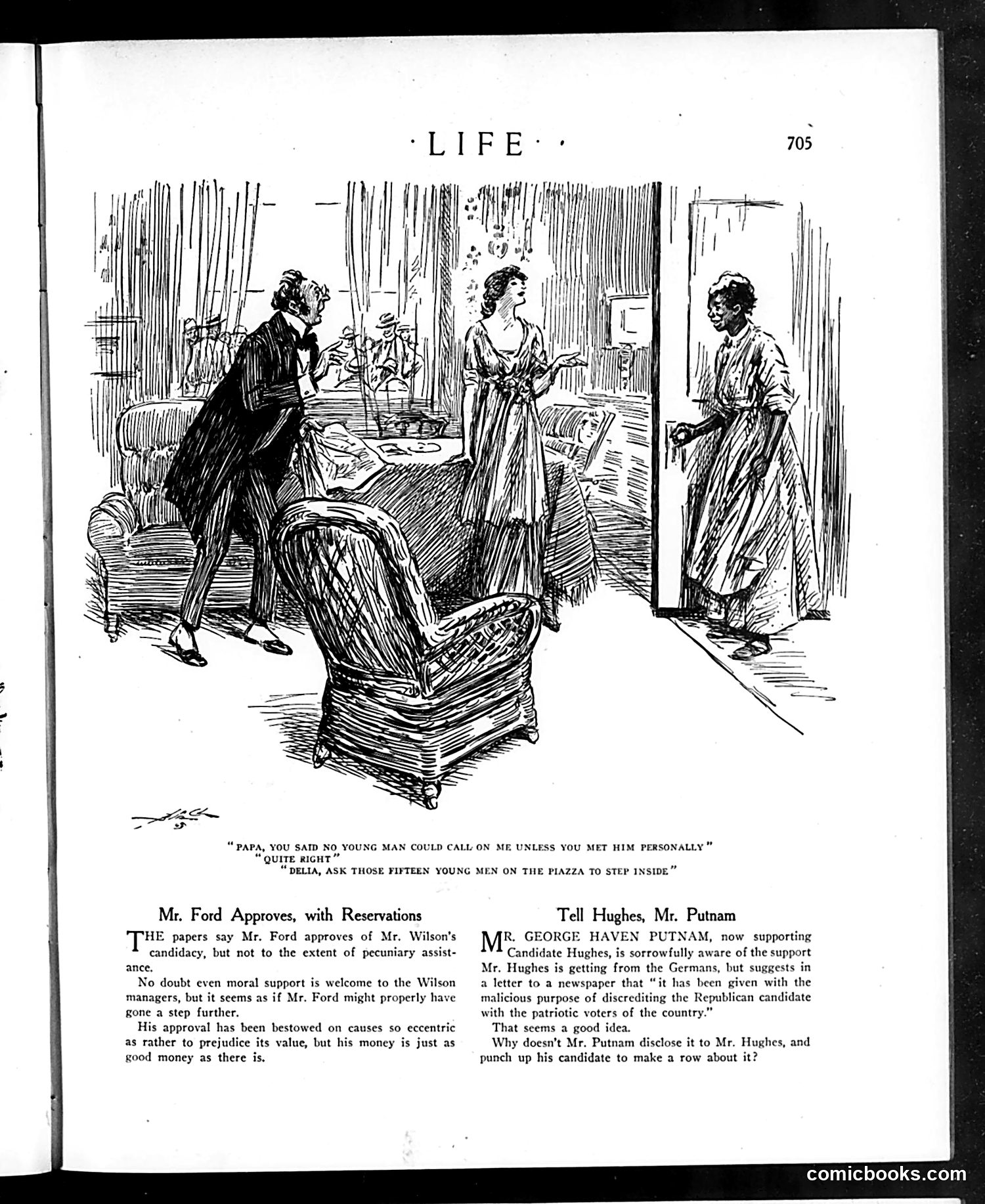
This page from *Life* magazine contains political commentary on the 1912 U.S. presidential election. The cartoon depicts a domestic scene where a woman appears to be giving instructions about accepting visitors. The caption references a father's rule that no young man could call without meeting him personally, and mentions "fifteen young men on the piazza." The accompanying articles discuss: 1. **"Mr. Ford Approves, with Reservations"** — critiquing Henry Ford's endorsement of Wilson's candidacy as insufficiently committed (moral support without financial backing). 2. **"Tell Hughes, Mr. Putnam"** — addressing George Haven Putnam's concerns about a letter allegedly discrediting Republican candidate Charles Evans Hughes, suggesting Putnam should confront Hughes directly about the controversy rather than complain to newspapers. The satire targets political maneuvering and insufficient commitment during this pivotal election year.
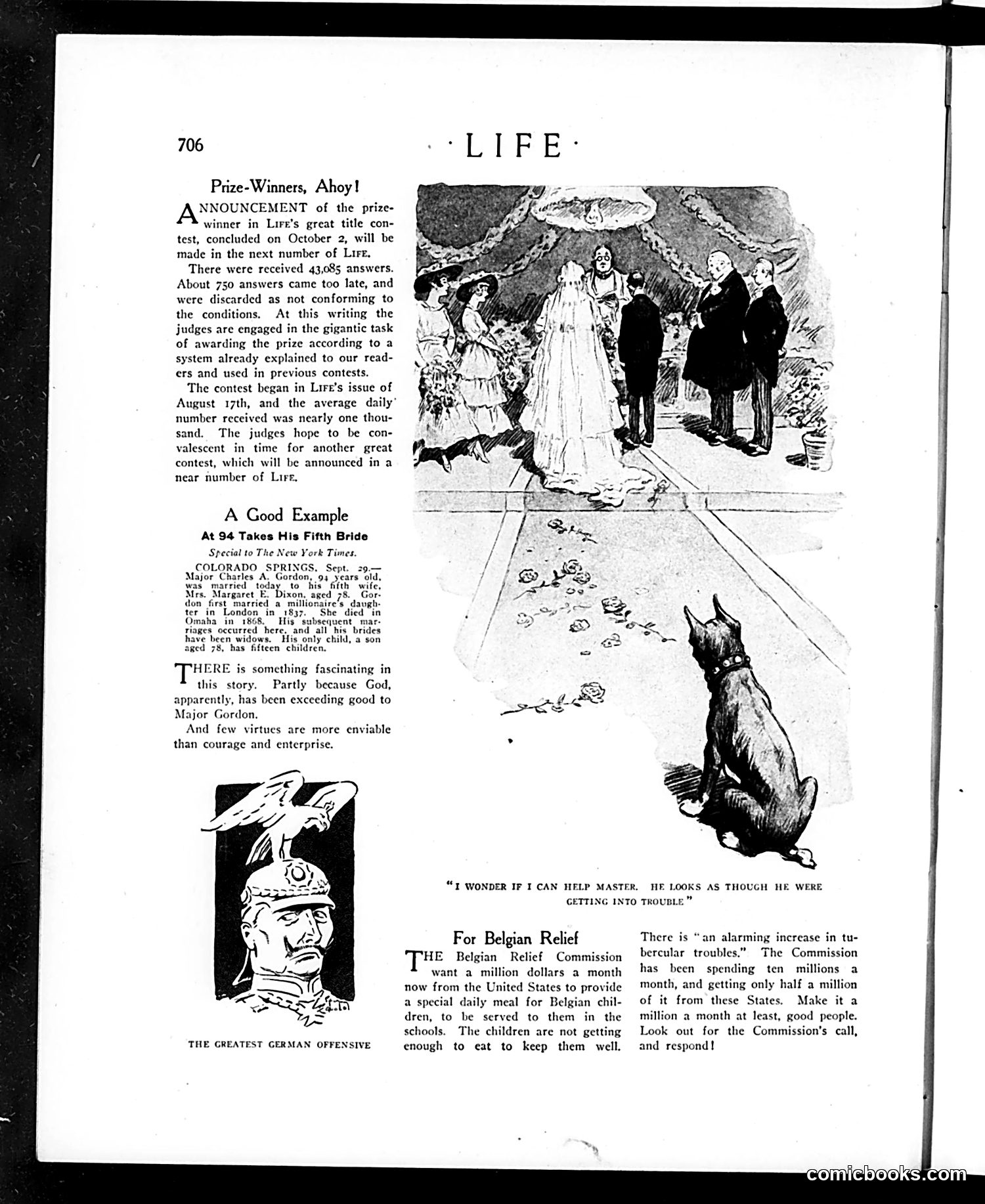
This page contains three separate items: 1. **"Prize-Winners, Ahoy!"** announces results of Life's title-contest competition. About 750 answers were received; judges are selecting winners using criteria explained in previous contests. 2. **"A Good Example"** (main article) reports that Major Charles Gordon, 94 years old, married his fifth bride—a millionaire's daughter. The accompanying cartoon depicts an elderly groom looking worried, with the caption "I wonder if I can help master. He looks as though he were getting into trouble." 3. **"For Belgian Relief"** requests funds for feeding Belgian children, noting the Belgian Relief Commission needs one million dollars monthly from the United States. The page appears to be from WWI era (Belgian relief context), mixing light satire about marriage with serious humanitarian appeals.
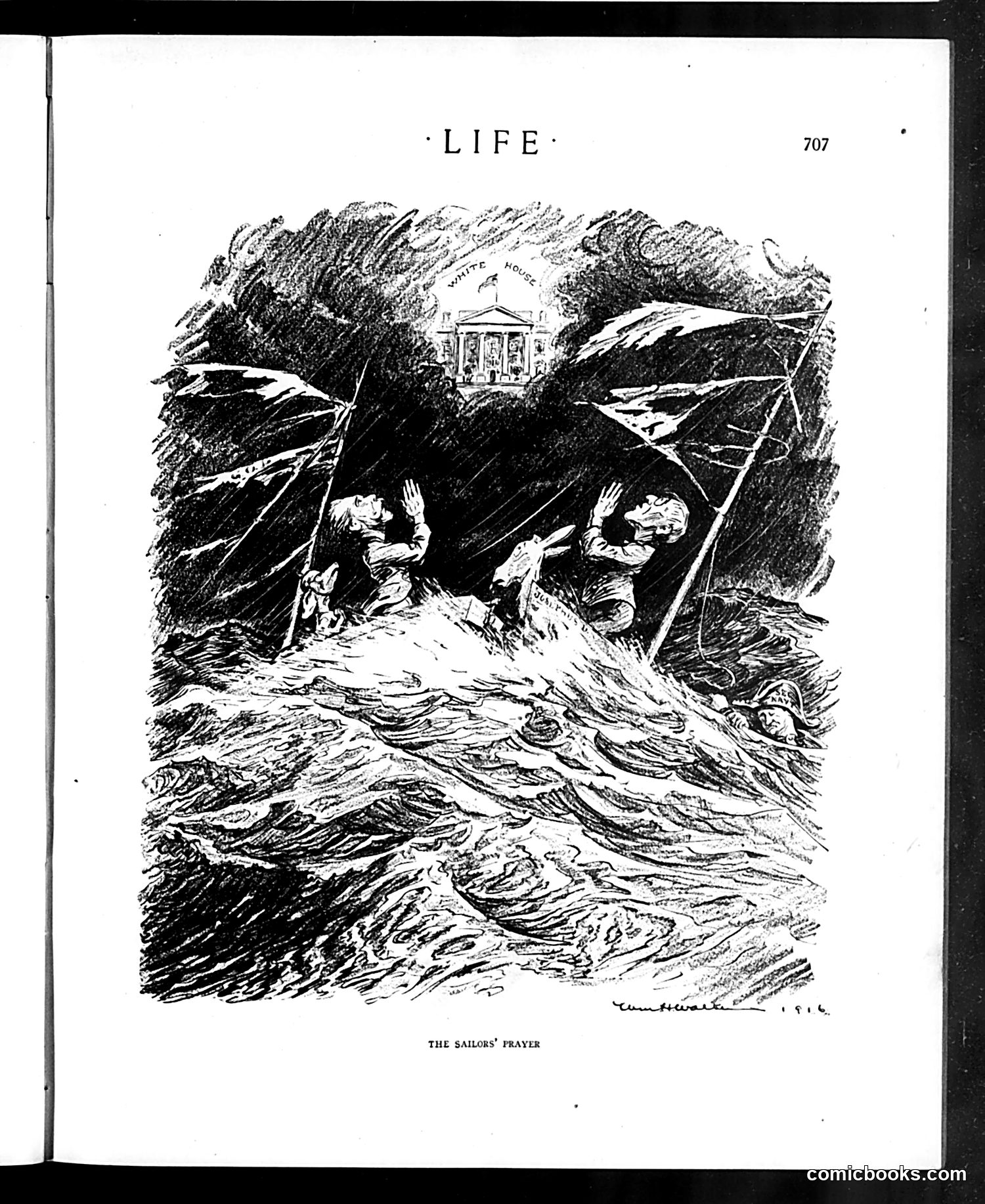
This cartoon depicts two sailors huddled under a tent during a storm, with the White House visible in the background on a hill. The image appears to be satirizing the sailors' reliance on prayer during dangerous maritime conditions, with the White House looming symbolically above them—suggesting either divine providence, government protection, or perhaps ironic commentary on where real safety lies. The sketch style and composition emphasize the vulnerability of the sailors against nature's forces. Without additional context about the specific date or political moment, the exact satirical target remains unclear, though it likely comments on either military readiness, naval safety standards, or the relationship between ordinary servicemen and government leadership during this period.
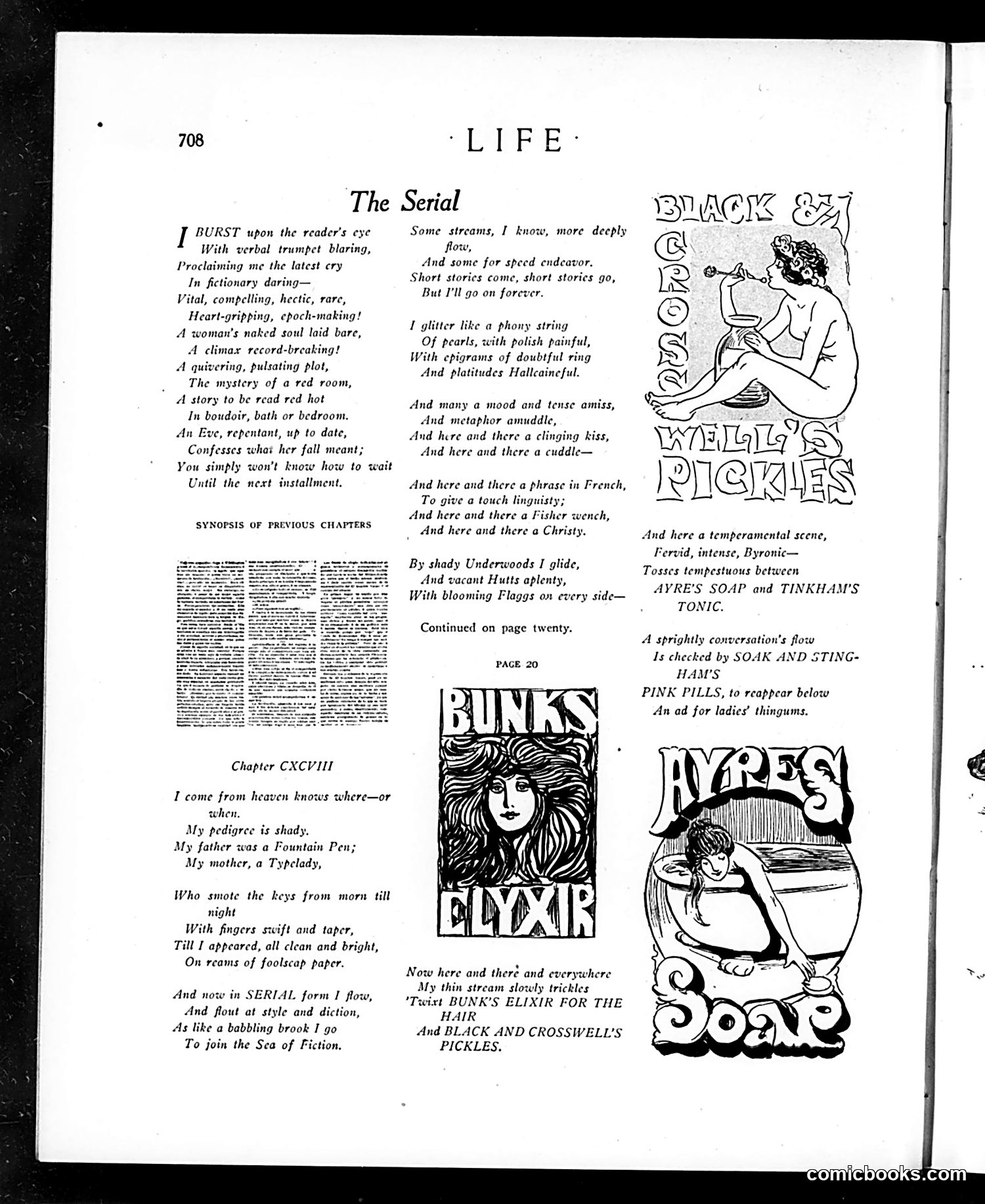
This page from *Life* magazine features "The Serial"—a poem celebrating serialized fiction in publications. The left column contains verse praising dramatic serial narratives that keep readers in suspense between installments ("You simply won't know how to wait / Until the next installment"). The right side contains four product advertisements styled as Art Deco illustrations, appearing to parody serialized drama through commercialism: - **Black & Orange Wells Pickles** - **Bunk's Elixir** (hair product) - **Ayre's Soap** (with competing brands mentioned in accompanying text) - **Pink Pills** (ladies' product) The satire juxtaposes the magazine's celebration of gripping fiction with frivolous consumer goods, suggesting advertisers exploit the same suspense-building techniques to sell mundane products. It's commentary on how advertising mimics narrative drama to manipulate readers into purchases.
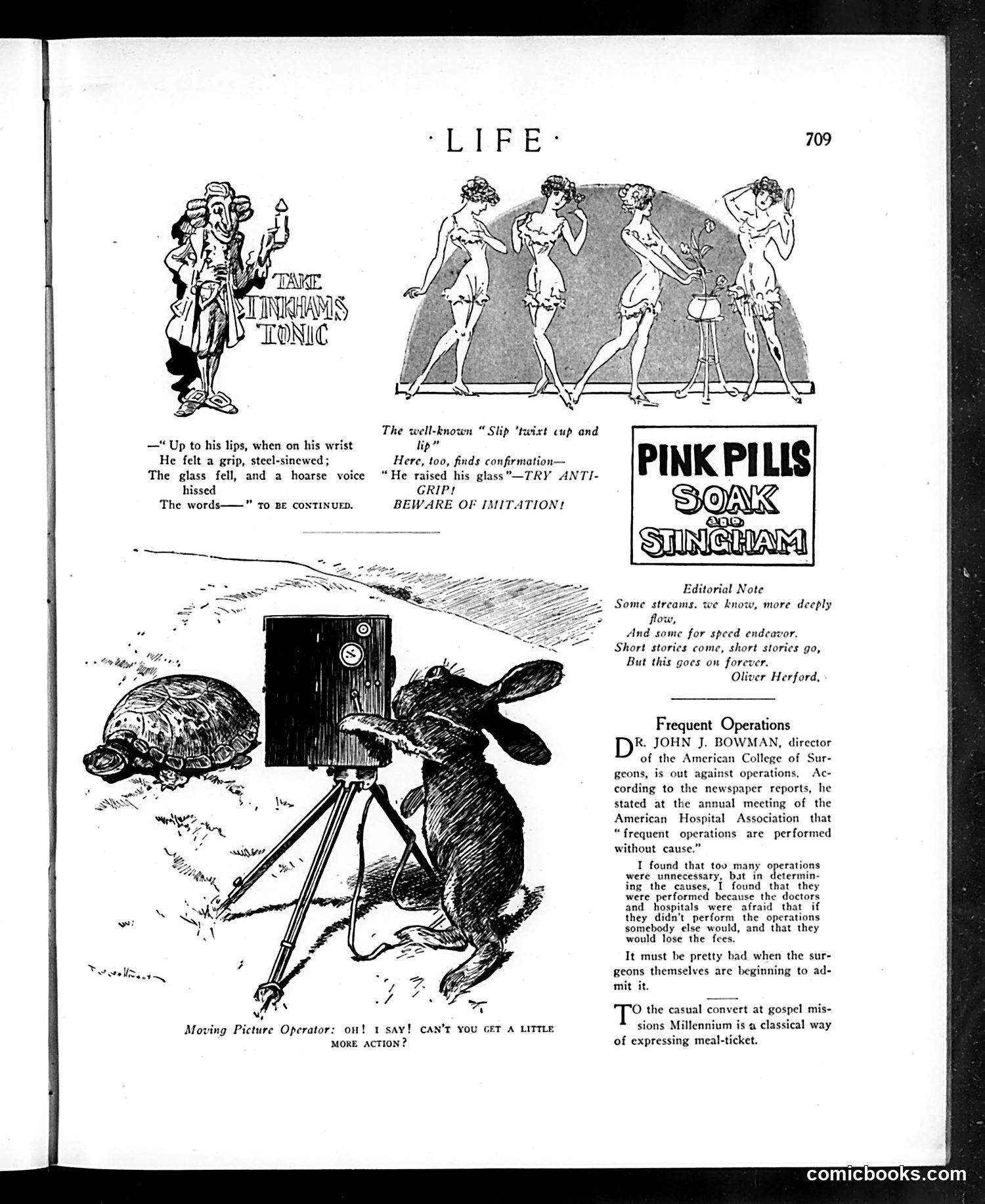
This page contains three distinct pieces of satirical content: 1. **"Take Lingham's Tonic"**: A humorous advertisement showing a man with an exaggerated facial expression, likely mocking patent medicine ads common in early 20th-century publications. 2. **The dancing women illustration**: Depicts five women in 1920s-style bathing suits performing "the Slip twist," with text warning readers to "try anti-grip" and "beware of imitation." This satirizes fad dances and the craze for novelty movements of the era. 3. **"Moving Picture Operator"**: A cartoon showing a rabbit and turtle operating a film camera, with the rabbit demanding "more action." This likely satirizes both early cinema's technical limitations and the industry's drive for increasingly sensational content. The "Pink Pills Soak and Stingham" advertisement appears to be another patent medicine parody.
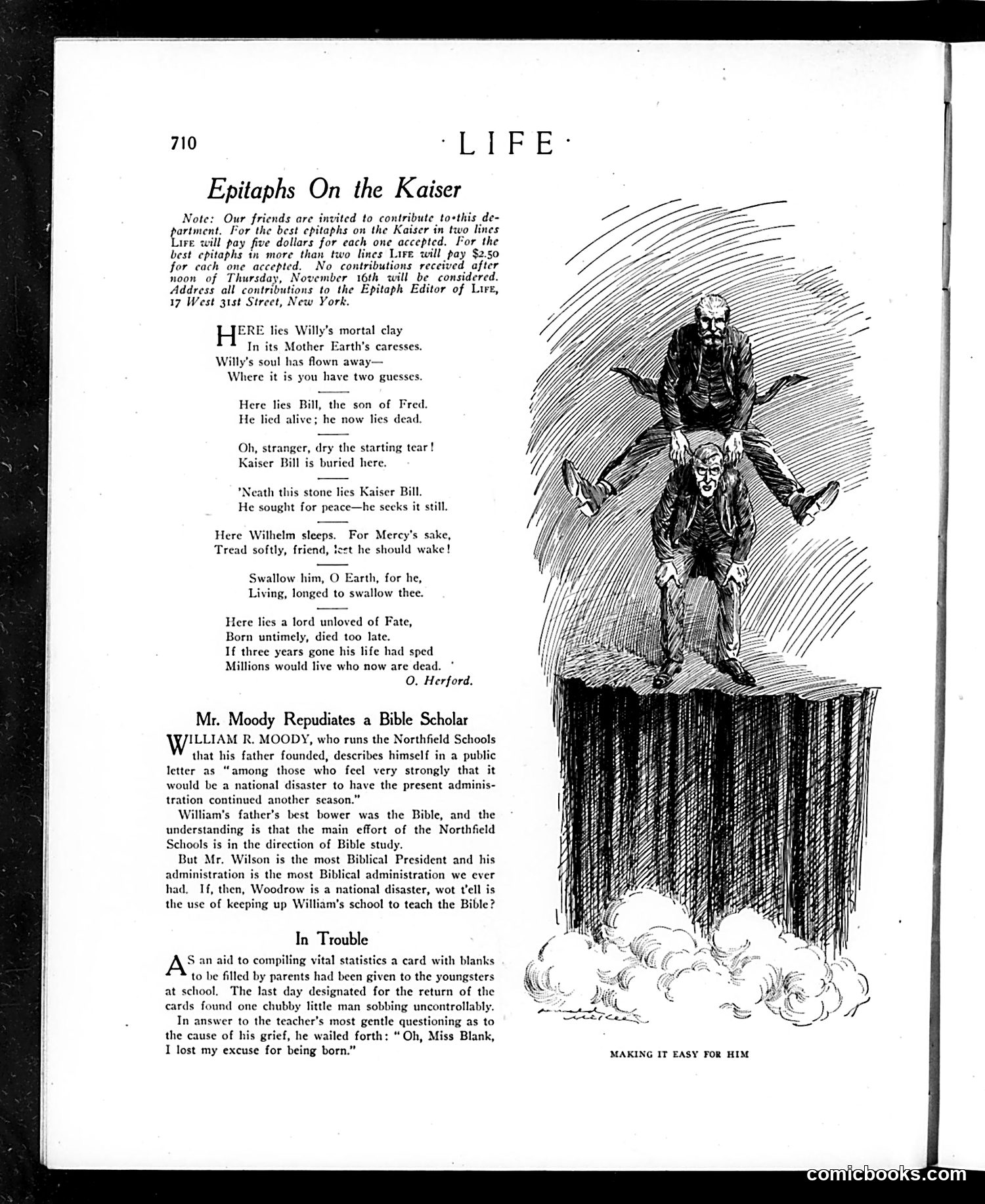
This page contains **satirical content from WWI-era America**, likely 1918 or later: **"Epitaphs On the Kaiser"**: Life magazine solicited reader-submitted epitaphs mocking Kaiser Wilhelm II of Germany, offering payment ($5 for two-line verses, $2.50 for longer ones). The published examples celebrate his death/defeat with dark humor—"He lied alive; he now lies dead," and "If three years gone his life had sped / Millions would live who now are dead" (O. Herford). The accompanying illustration shows the Kaiser being literally buried or crushed beneath the earth, depicting German defeat. **"Mr. Moody Repudiates a Bible Scholar"**: This satirizes William R. Moody (running his father's Northfield Schools, a Bible-focused institution) for claiming President Woodrow Wilson is a "national disaster," despite Wilson being exceptionally devout. The satire questions the hypocrisy: if Bible study is the school's mission, why oppose a Biblical president? **"In Trouble"**: A brief humorous anecdote about a schoolboy who lost his "excuse for being born"—a form his parents were supposed to fill out. All reflect American wartime sentiment and domestic politics.
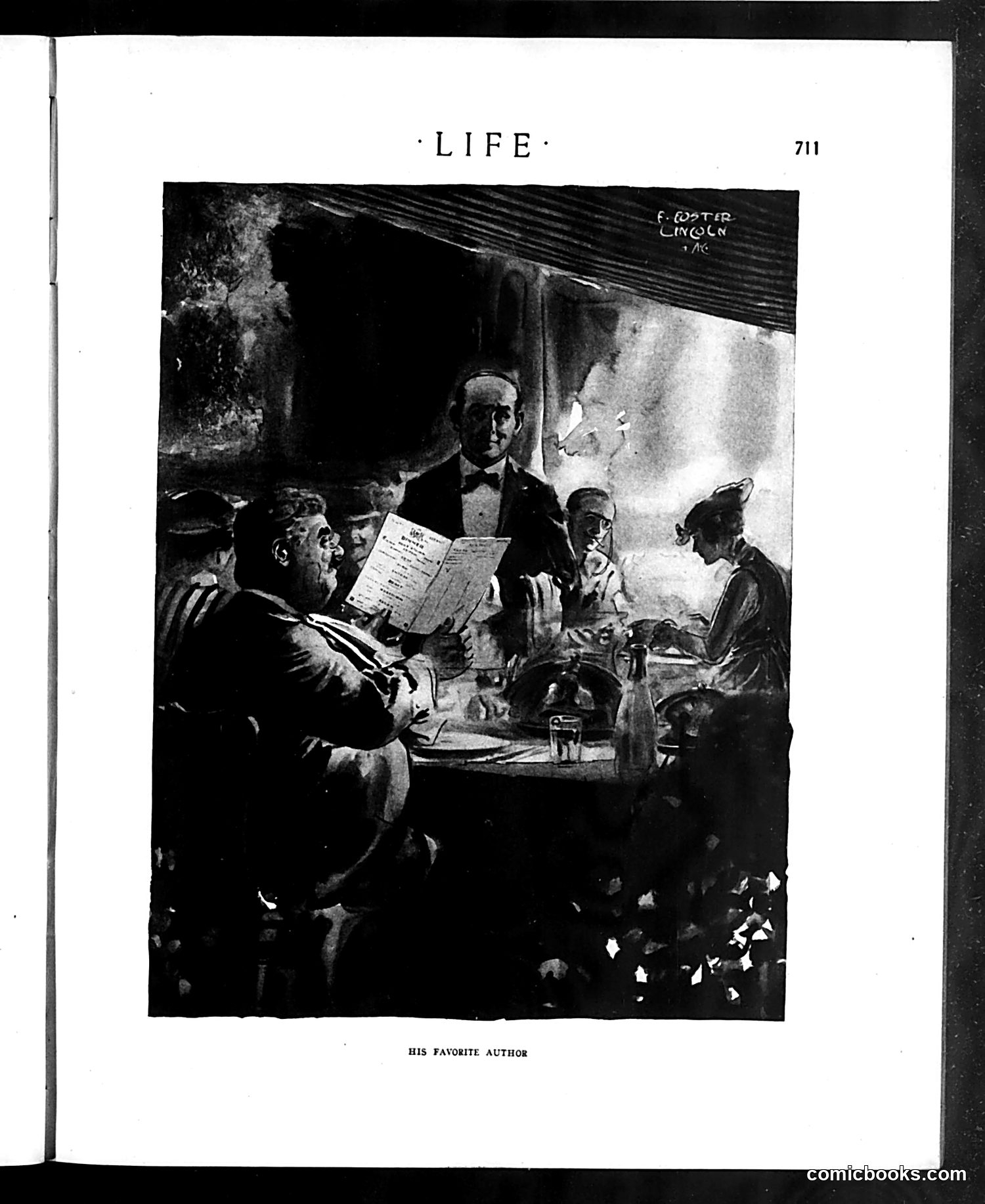
This page from *Life* magazine shows a black and white illustration titled "His Favorite Author." The image depicts a man reading what appears to be a menu or program at a dining table, surrounded by other diners in formal attire. A handwritten notation in the upper right identifies this as "E. FOSTER LINCOLN" (though the artist credit is unclear). The satire appears to play on the phrase "favorite author"—treating a menu as literature. This is likely mocking either someone's pretensions (treating a mundane document as great literature) or making a joke about dining/gastronomy culture. Without additional context about the specific issue date, the exact political or social figure being referenced remains unclear, though the formal dinner setting suggests commentary on elite social circles.
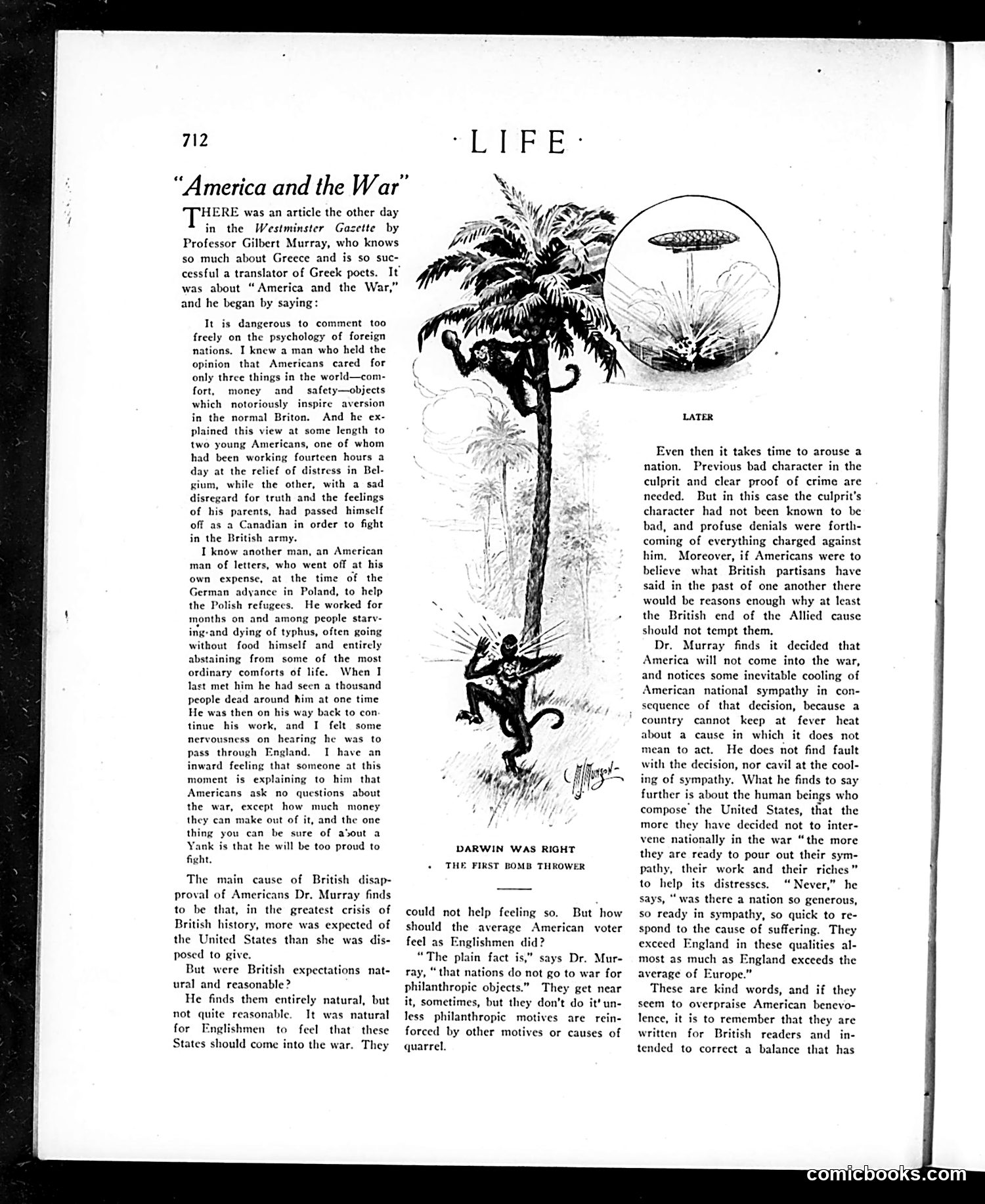
This page discusses Professor Gilbert Murray's essay defending American neutrality during WWI (likely 1914-1916). The cartoon shows a figure labeled "Darwin Was Right—The First Bomb Thrower," depicting an ape throwing a bomb from a palm tree, with a UFO-like object above. **The satire's point:** Murray argues that British expectations for American intervention were natural but unreasonable. He refutes the stereotype that Americans only care about "comfort, money and safety"—citing counterexamples of Americans working without compensation in Belgium and Poland. The cartoon appears to mock primitive nationalism or warlike impulses as evolutionary regression ("Darwin was right"), suggesting that demands for America to join the war reflect base, uncivilized thinking rather than rational policy. The piece advocates for understanding America's decision to remain neutral while acknowledging American humanitarian contributions, challenging British criticism of American selfishness.
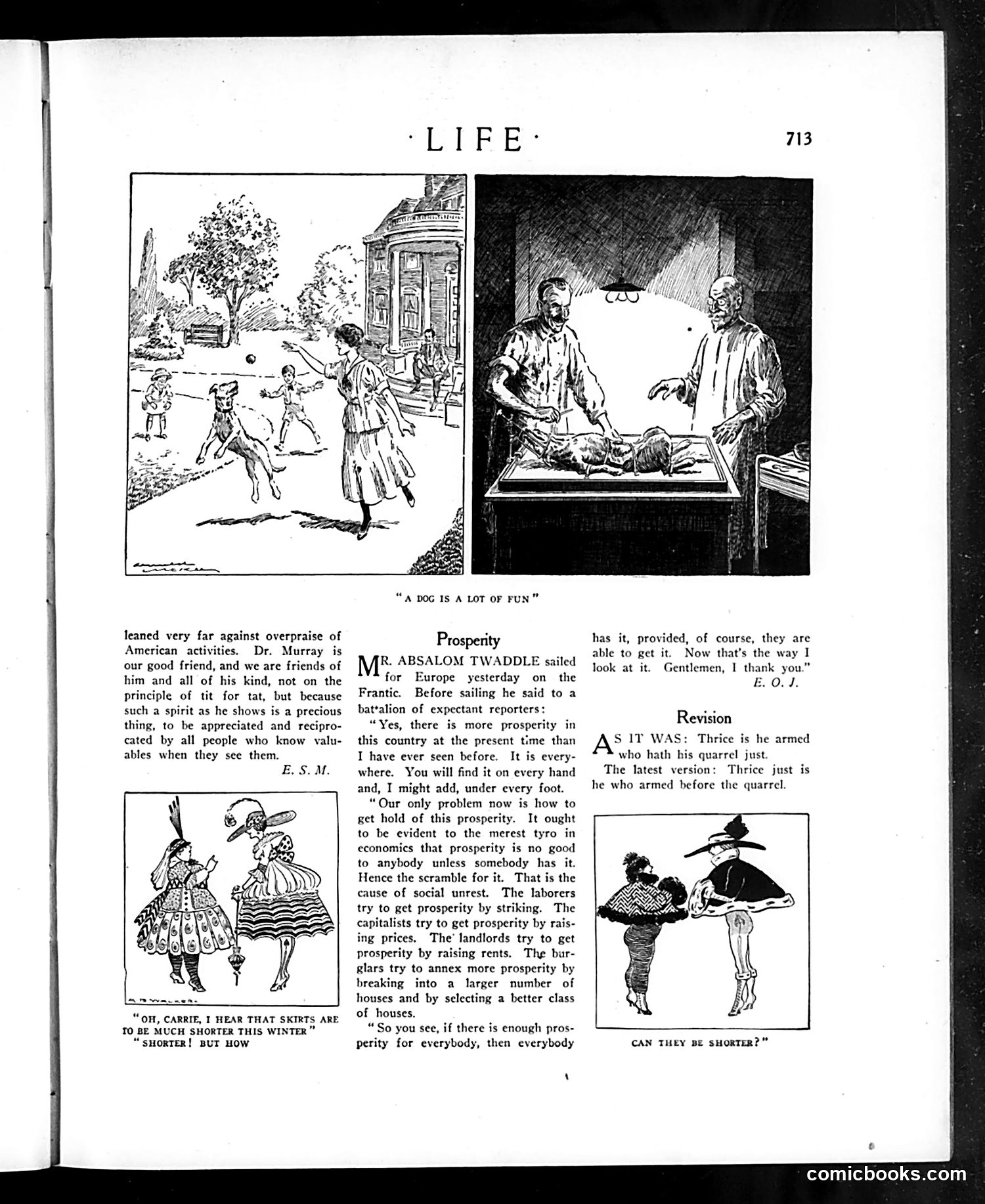
This page satirizes early 20th-century American economic inequality and competing claims about national prosperity. **Main Article ("Prosperity"):** A character named Mr. Absalom Twaddle delivers ironic commentary on widespread prosperity claims. He notes prosperity exists everywhere—"under every foot"—yet everyone scrambles to possess it. The satire exposes the absurdity: laborers strike, capitalists raise prices, landlords raise rents, and burglars break into houses to "annex" prosperity. Twaddle's circular logic ("if there's enough for everybody, everybody has it") mocks hollow political rhetoric claiming universal prosperity while inequality clearly persists. **Cartoons:** The top-left shows leisure-class children at play (suggesting carefree wealth). The fashion cartoon about shorter skirts plays on women's fashion debates. Bottom-right cartoon appears unrelated. The piece targets self-satisfied politicians and economists who proclaim prosperity without addressing structural inequality or the desperate measures people employ to survive economically.
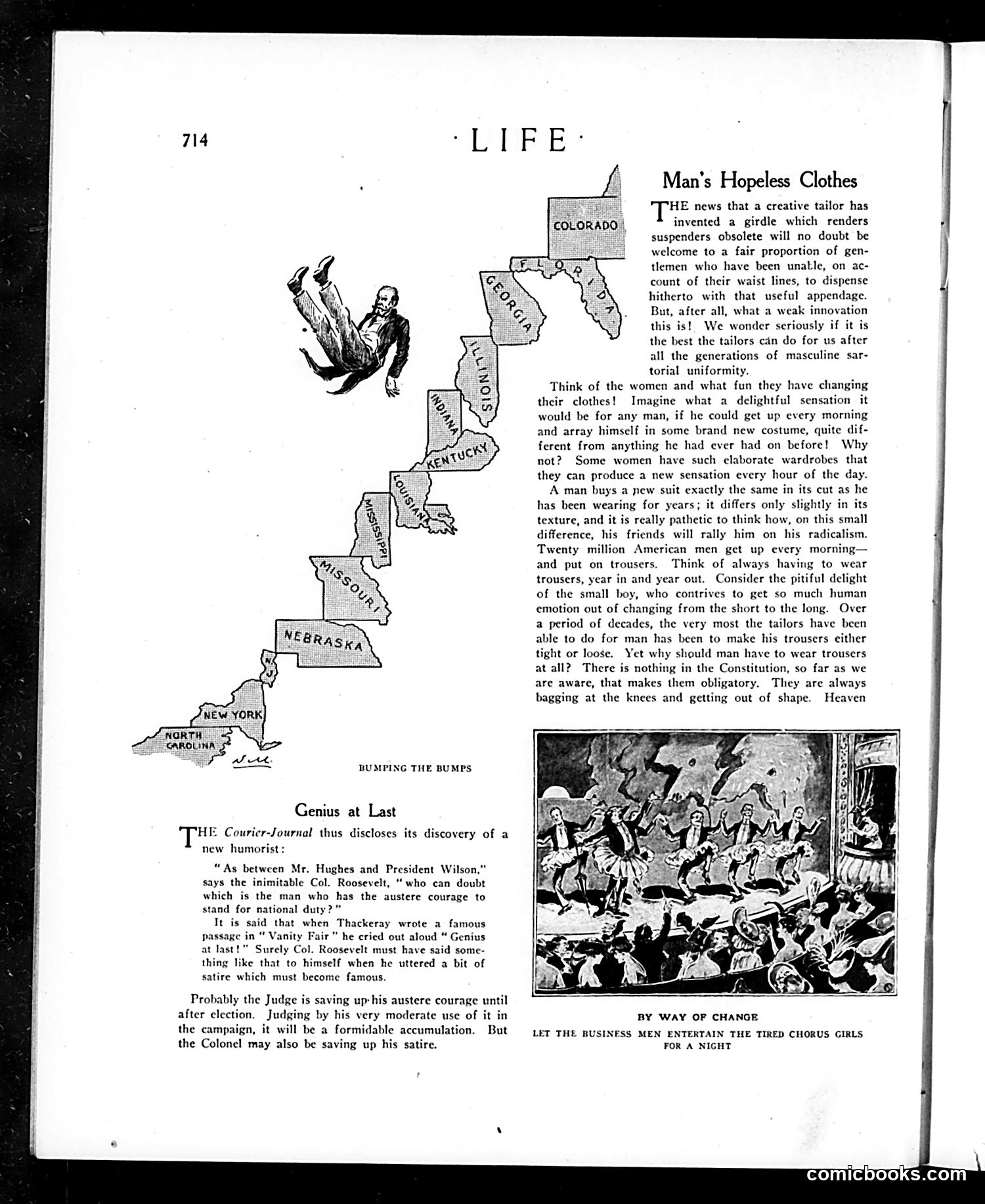
**"Bumping the Bumps"** (left cartoon): A map shows a man tumbling down the central United States. This satirizes Theodore Roosevelt's 1912 presidential campaign, where he ran as a third-party "Progressive" candidate, literally disrupting the two-party system. **"Genius at Last"** (text): Life magazine mocks Roosevelt's claimed moral superiority over President Wilson and Republican Hughes. The piece sarcastically suggests Roosevelt's self-righteous statements about "austere courage" and "national duty" constitute his wit—implying his political posturing is pretentious rather than genuinely clever. **"Man's Hopeless Clothes"** (right): A humorous essay lamenting men's fashion monotony. It contrasts women's varied wardrobes with men's uniform trousers, mocking how men face social ridicule for minor sartorial changes while women enjoy constant wardrobe innovation. The essay questions why men are obligated to wear trousers, treating the question as absurd yet serious commentary on rigid masculine convention. The page overall satirizes both political hypocrisy and social conformity.
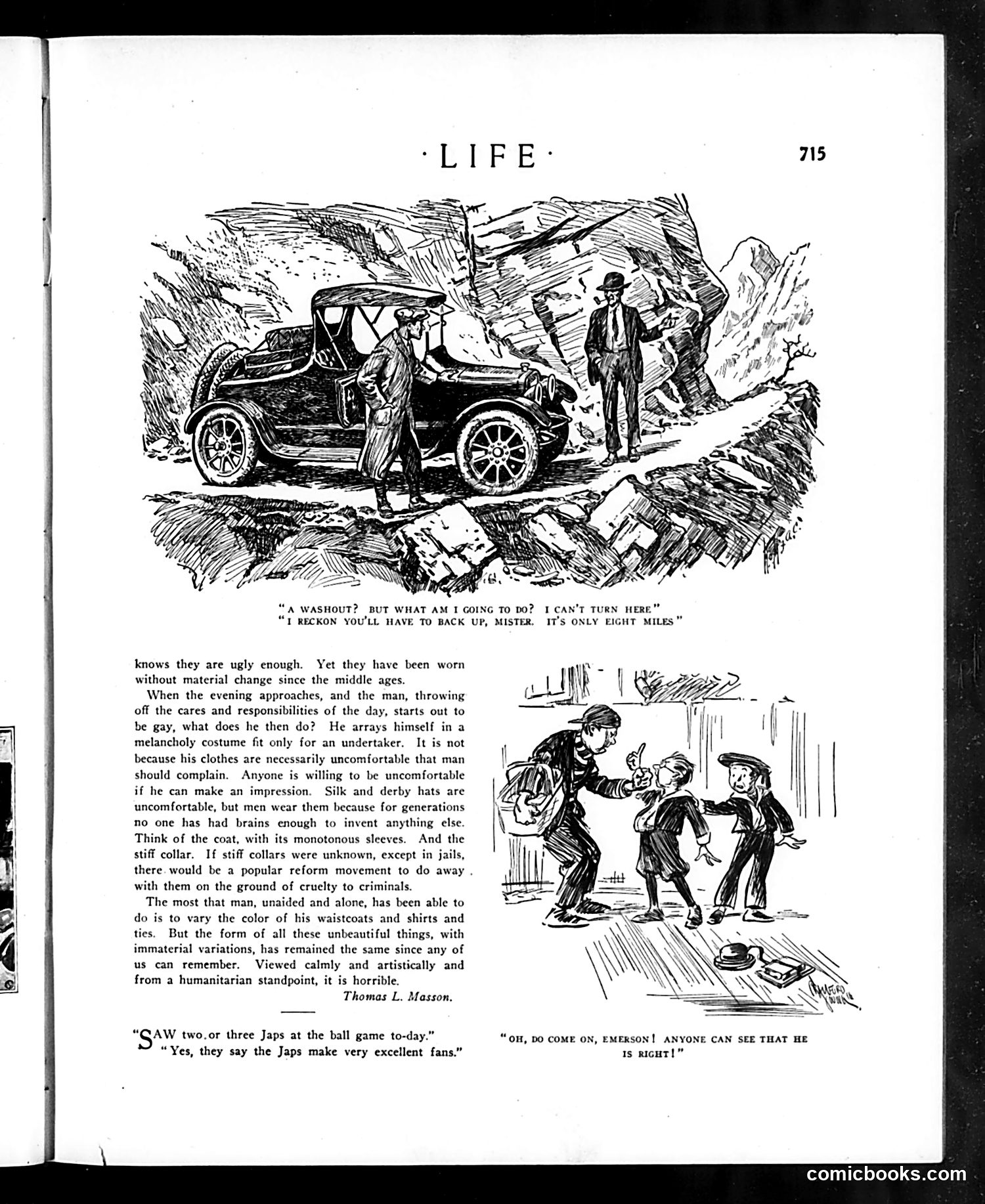
This page contains two separate cartoons and an essay by Thomas L. Masson critiquing men's formal fashion. **Top cartoon**: Shows a car stuck in a rural mountain road. The driver asks for directions, only to learn he must back up eight miles—a humorous commentary on poor road conditions and early automobile travel difficulties. **Bottom cartoon**: Depicts children playing, with one child (Emerson) appearing to be "right" about something, while another insists "anyone can see that he is right"—likely satirizing blind conformity or peer pressure. **Masson's essay**: A lengthy satire arguing that men's formal evening wear (tuxedos, stiff collars, derby hats, coats) is absurdly unchanged since medieval times and fundamentally ugly. He criticizes men's unwillingness to reform these uncomfortable fashions, comparing stiff collars to torture devices. The piece advocates for fashion reform from a "humanitarian standpoint." The page also includes a brief joke about Japanese baseball fans, reflecting early 20th-century American interest in Japan.
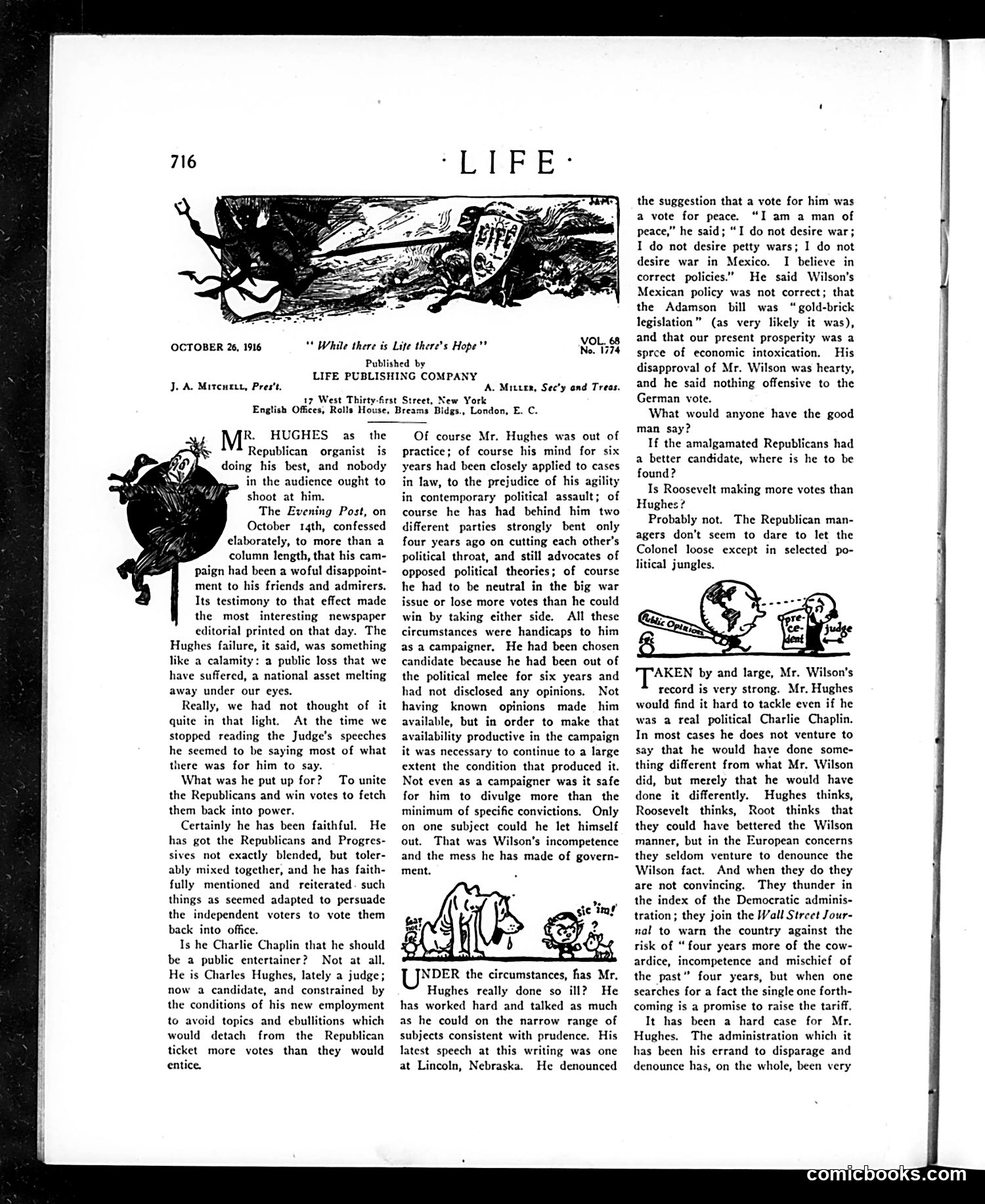
This editorial defends Republican presidential candidate Charles Evans Hughes against criticism that his campaign has been disappointing. The author argues Hughes faced impossible constraints: he was a recently-retired judge forced to avoid controversial statements to keep together the Republican and Progressive parties (recently split). Hughes couldn't take clear positions on the major issue—American entry into WWI—without losing votes. The cartoons (drawn in the margins) satirize Hughes as a rigid, mechanical campaigner ("organist") going through the motions. The text acknowledges Hughes could only safely attack Wilson's competence and Mexican policy. The author essentially argues Hughes deserves credit for doing as well as possible under these handicapping circumstances. This appears written days before the 1916 election, defending Hughes against fellow Republicans who felt he'd failed to energize the base.
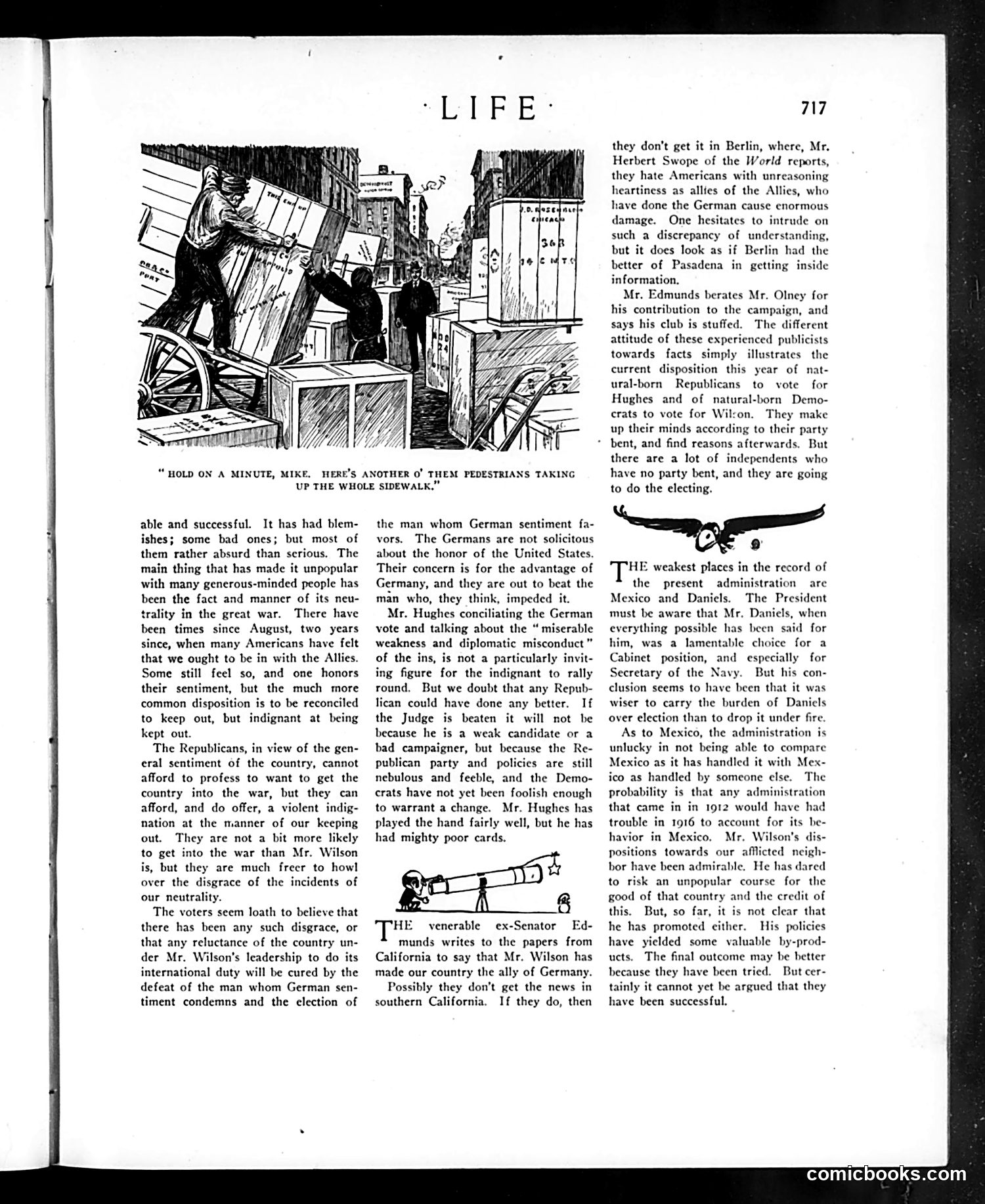
The cartoon depicts a chaotic urban street scene labeled "Hold on a minute, Mike, here's another o' them pedestrians taking up the whole sidewalk," showing a man struggling with an enormous pile of boxes and cargo while pedestrians navigate around him—a visual metaphor for obstruction and disorder. The accompanying text discusses the 1916 presidential election between incumbent Democrat Woodrow Wilson and Republican challenger Charles Evans Hughes. The author criticizes both parties: Republicans exploit anti-war sentiment while lacking genuine policy differences; Hughes is hampered by poor "cards" (policies). The piece attacks ex-Senator Edmunds and Navy Secretary Josephus Daniels as embarrassingly inconsistent—claiming Wilson made America "Germany's ally" while Germans view America as an Allied enemy. The author suggests independent voters, not party loyalists, will decide the election, and that Wilson's handling of Mexico and Daniels represent genuine weaknesses in his administration.
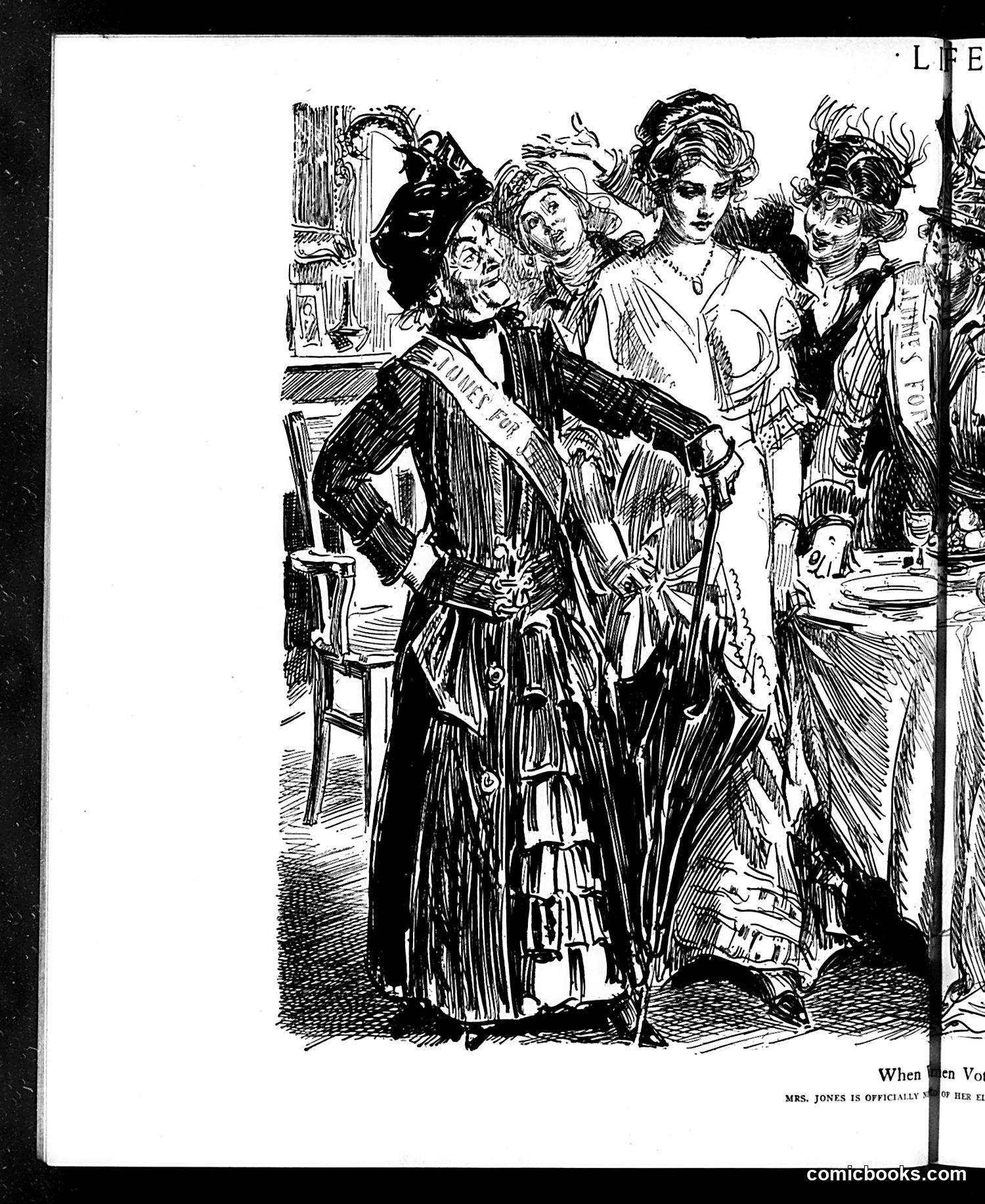
This appears to be a satirical illustration from *Life* magazine depicting a formal social gathering, likely from the early 20th century based on the art style and fashion. The caption references "Mrs. Jones is officially [text cut off]" — the visible text is incomplete, making the specific satirical target unclear. The illustration shows a woman in the center wearing a sash (suggesting an official position or honor) surrounded by well-dressed figures at what appears to be a formal event or reception. Without the complete caption text, I cannot definitively identify Mrs. Jones or explain the specific satire intended. The image likely mocks either a social pretension, a women's political movement, or a specific public figure's official appointment, but the exact point requires the missing text to interpret accurately.
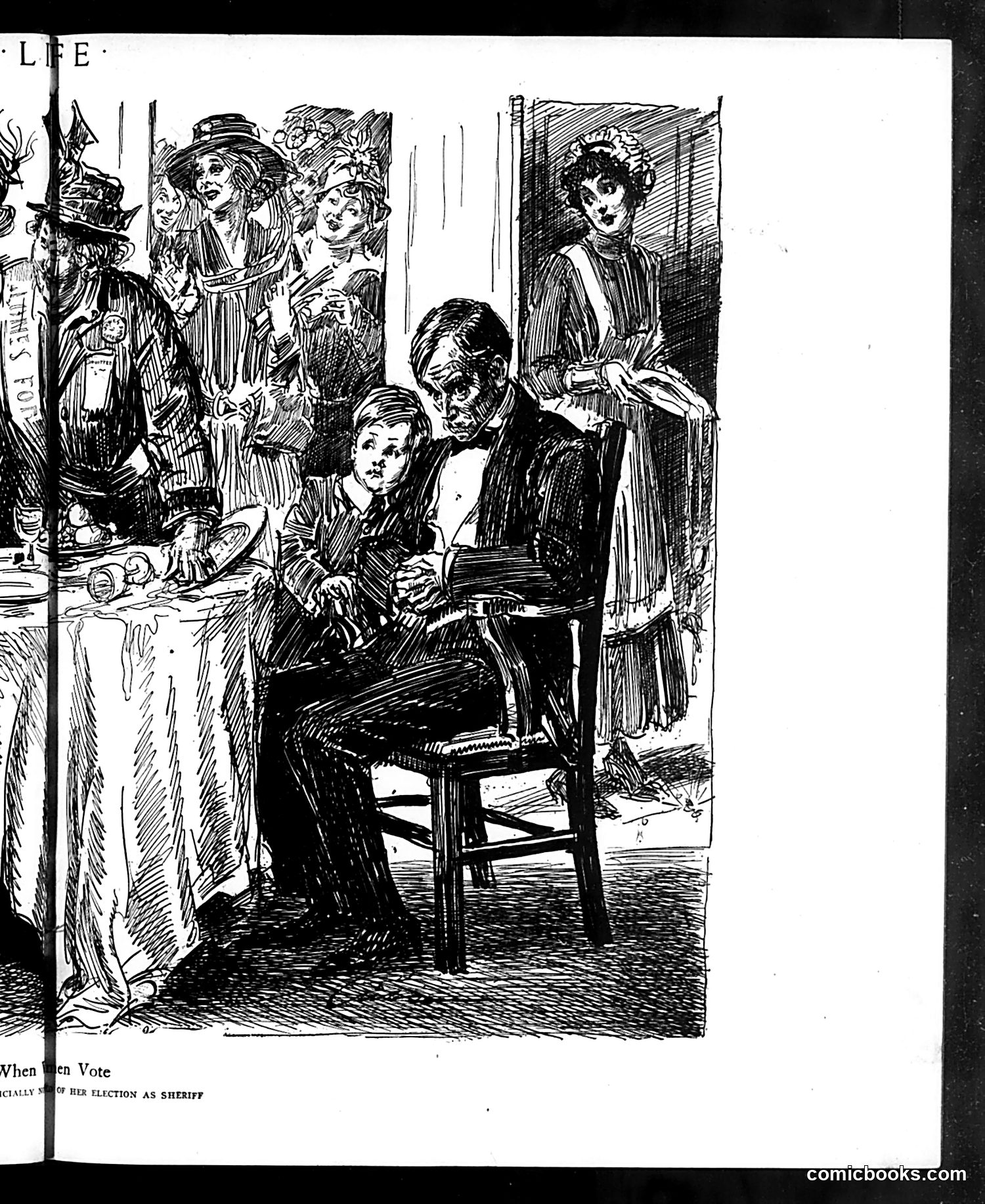
This satirical cartoon depicts a social anxiety common in early 20th-century America: women's political participation. The caption reads "When Women Vote" with a subtitle about "her election as sheriff." The image shows a young boy seated at a table surrounded by well-dressed women observers, suggesting role reversal or confusion about gender and authority. The cartoon mocks the idea of female voters and elected officials by presenting it as an absurd, inverted scenario. This reflects the pre-suffrage era's resistance to women's voting rights—a major social debate resolved only in 1920 with the 19th Amendment. The satire assumes readers would find female sheriffs ridiculous, using humor to reinforce traditional gender hierarchies.
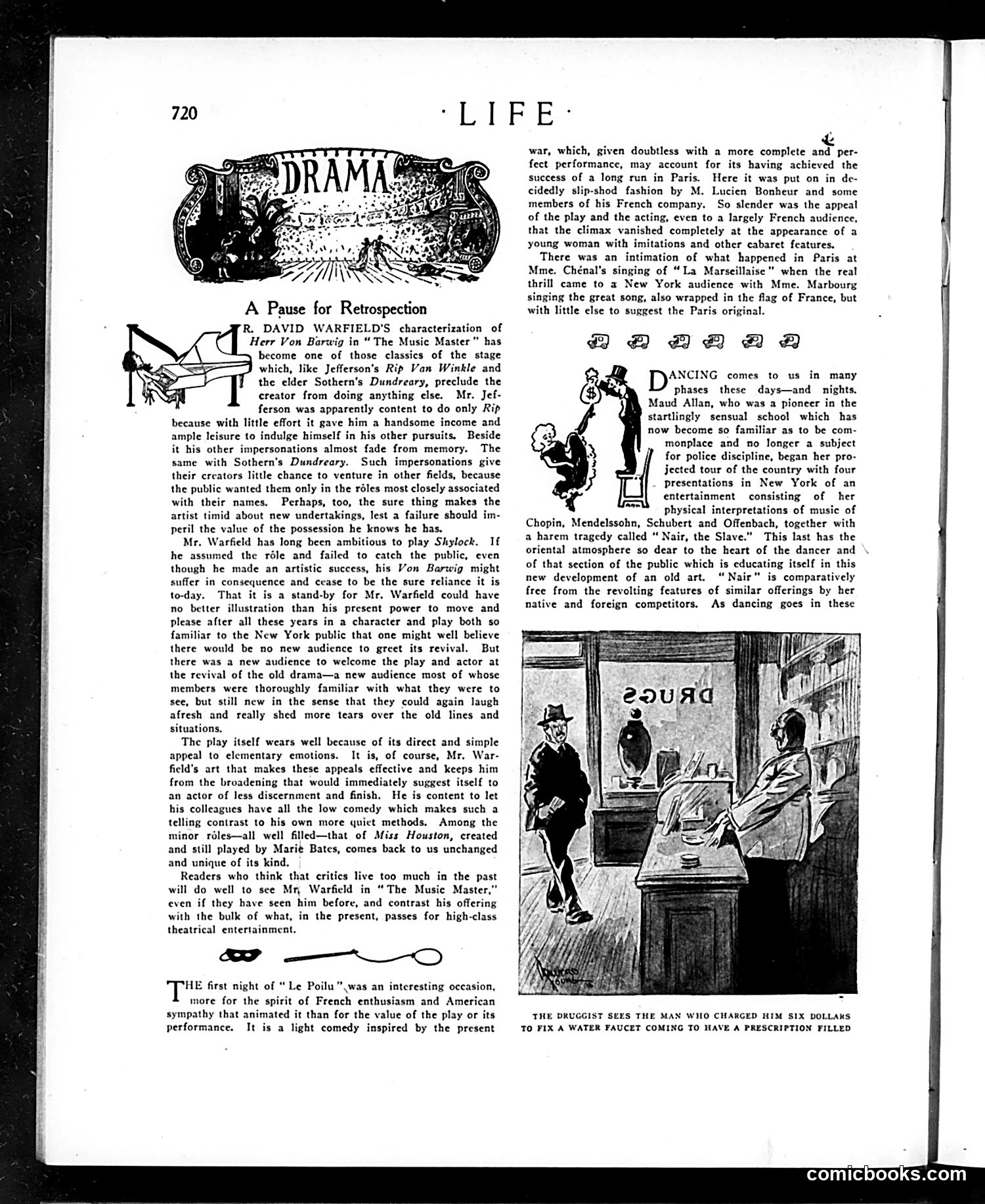
This drama criticism page contains two theatrical reviews. The main article praises actor David Warfield's iconic role as Herr Von Barwig in "The Music Master," arguing that while such signature roles guarantee income and audience loyalty, they can trap actors unable to attempt new parts. Warfield's continued success in revivals demonstrates the play's enduring emotional appeal. The second review critiques "Le Poilu," a French comedy about WWI (the "present war"). The critic dismisses the production as poorly executed, noting the play's thin appeal even to French audiences. The real dramatic moment came not from the script but from actress Mme. Marbourg's patriotic rendition of "La Marseillaise" wrapped in a French flag—the genuine national emotion overwhelming the theatrical performance itself. The caption's cartoon satirizes American commercialism: a druggist prioritizes profit over healthcare, charging six dollars to fix a leaky faucet rather than filling a prescription.
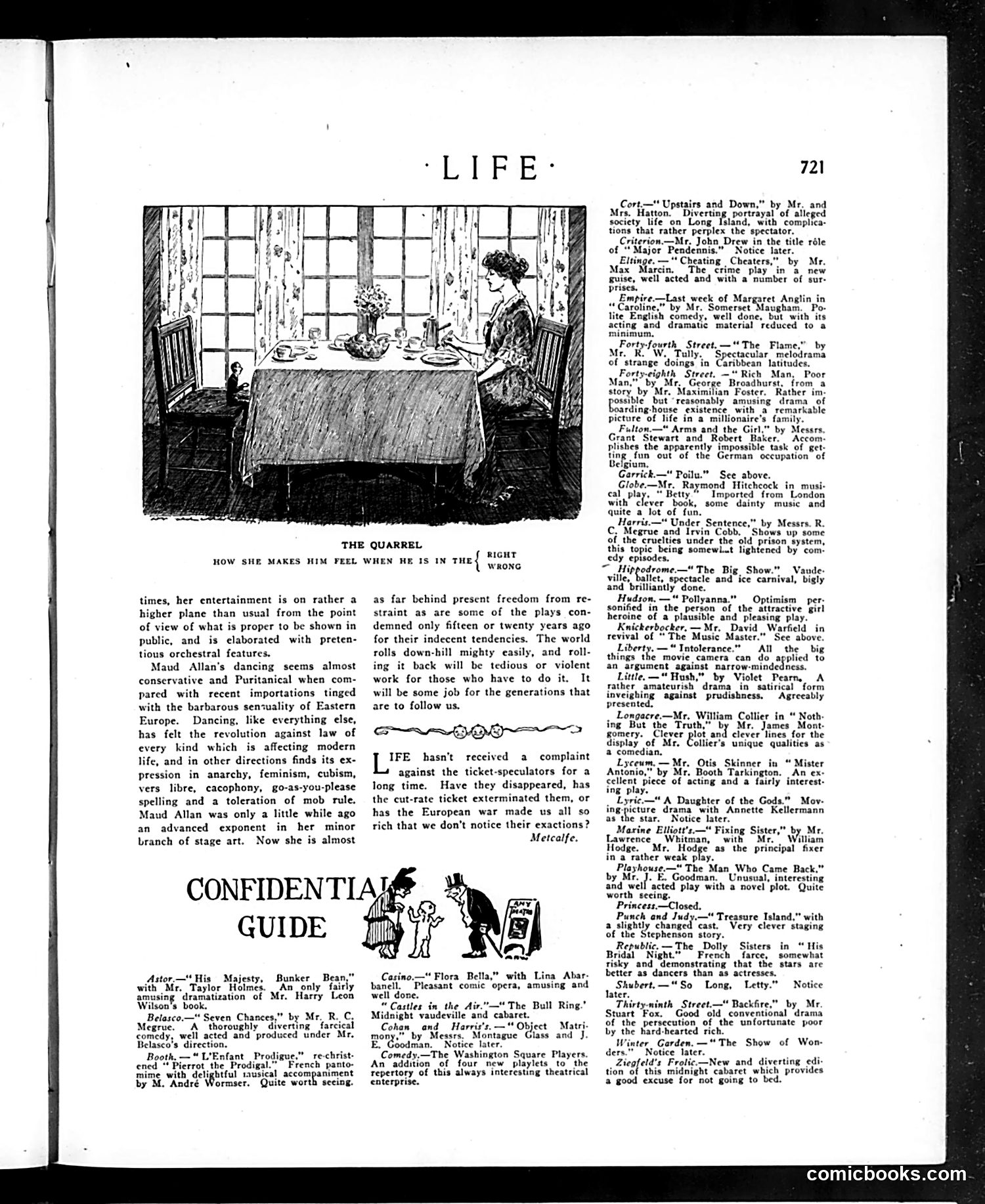
This illustration satirizes domestic conflict. The image shows a woman sitting alone at a table by a window, appearing composed and content, while the caption's title and "RIGHT/WRONG" labels suggest the joke: when a couple quarrels, the woman who is "in the right" somehow makes her male partner feel worse than if she were actually wrong. The accompanying article critiques modern theatrical dance and morality, referencing Maud Allan (a real dancer known for controversial performances). The author argues that society has swung from Victorian prudishness toward excessive permissiveness in "anarchy, feminism, cubism, vers libre"—listing contemporary progressive movements as symptoms of moral decline. The piece laments that reversing this cultural "roll down-hill" will require difficult generational work. This reflects conservative anxiety about post-WWI social changes.
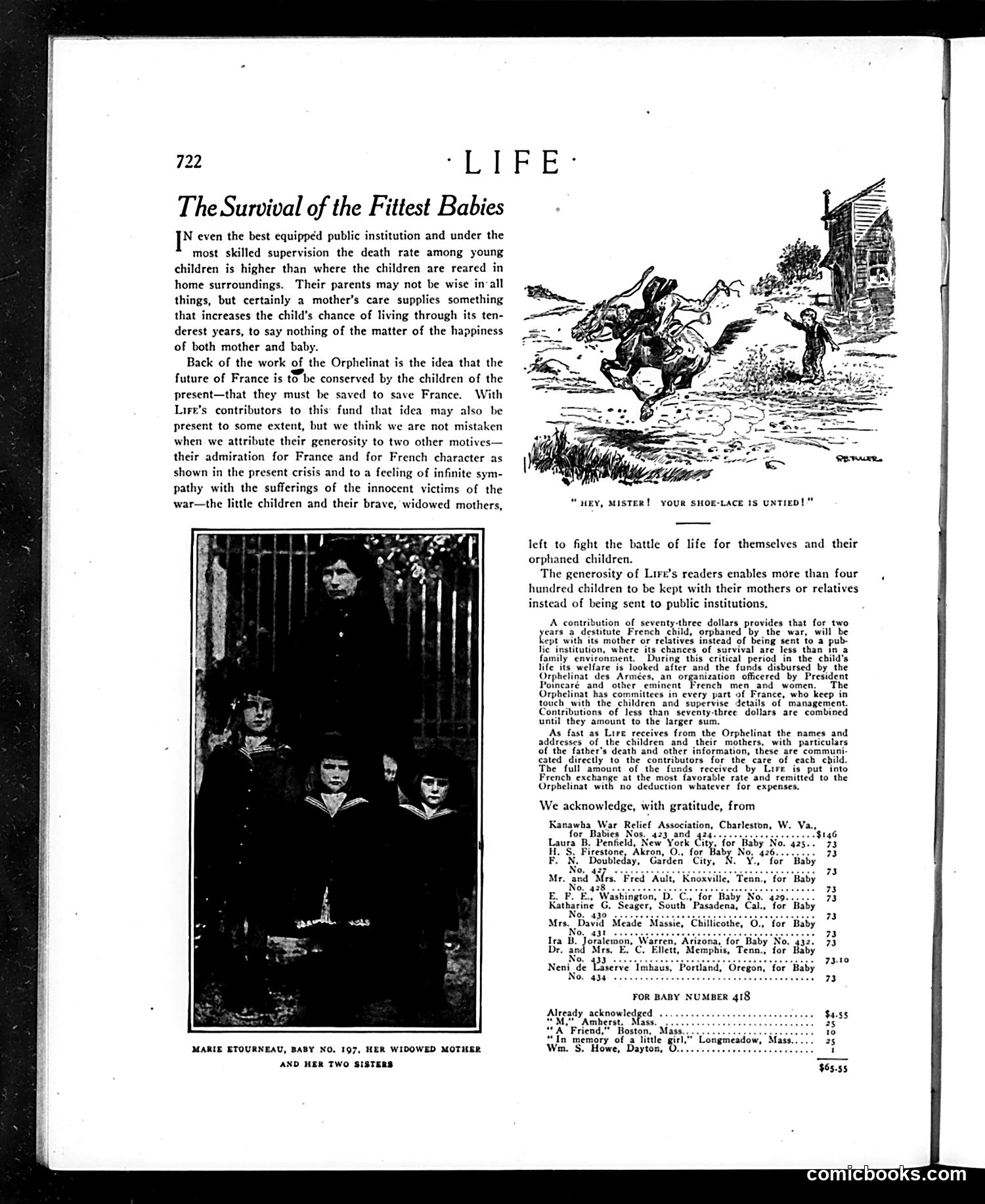
This page promotes a World War I relief fund for French war orphans and widows. The accompanying sketch shows a child warning a soldier his shoelace is untied—a poignant reminder of childhood innocence amid warfare. The article argues that orphaned French children survive better with their mothers than in institutions, and that keeping families together preserves France's future. It describes the "Orphelinat des Armées" (Army Orphanage), backed by French President Poincaré, which keeps 400+ children with relatives instead of institutionalizing them. The photograph shows Marie Etourneau (Baby No. 197), her widowed mother, and two sisters—representing the war's human cost. The bulk of the page lists donors contributing $73 each to support two years of a child's care. This combines humanitarian concern for "innocent victims of war" with patriotic support for France during the conflict.
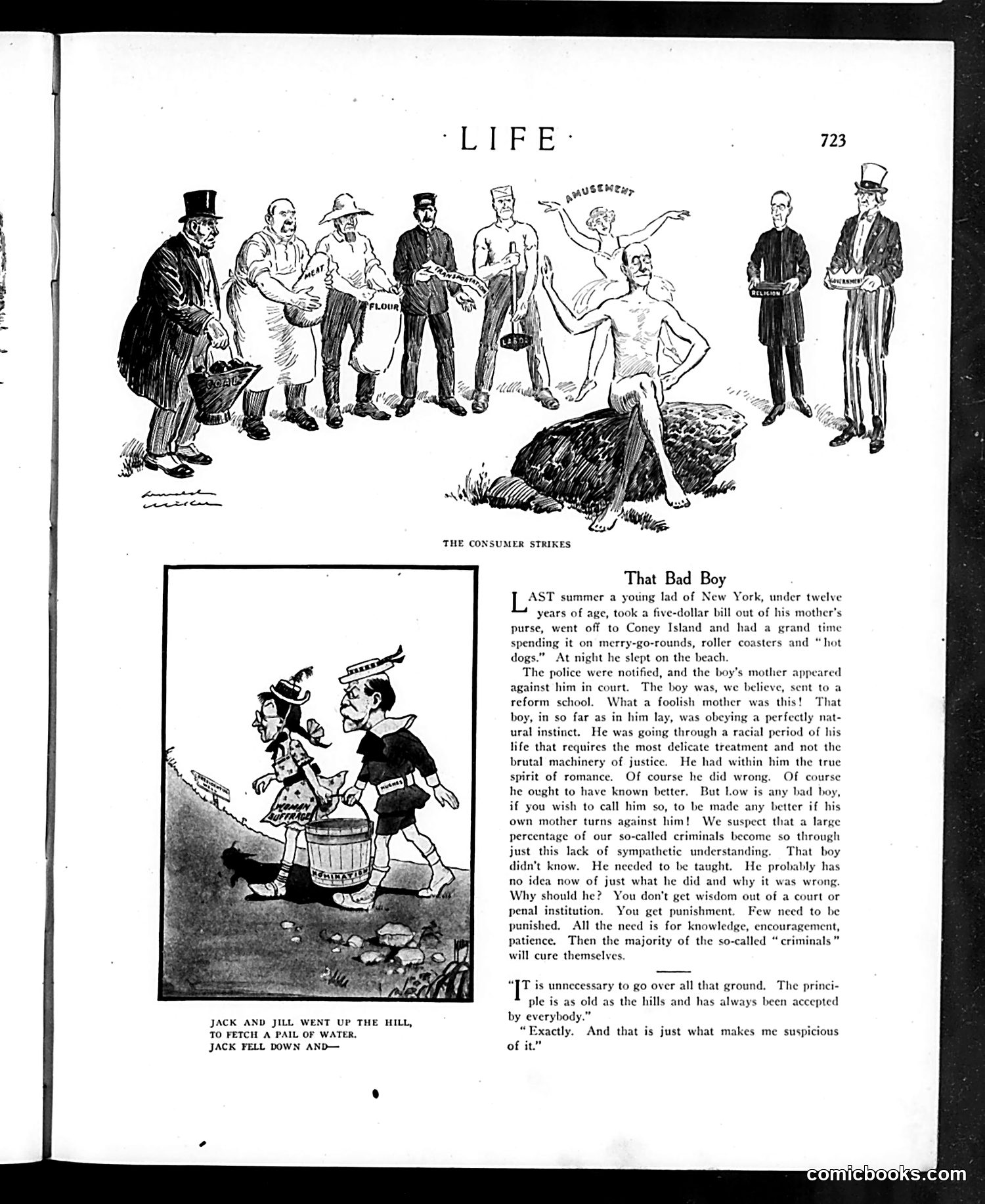
The top cartoon depicts a shirtless youth standing on a rock, surrounded by various tradespeople (baker, butcher, laborer, etc.) and well-dressed gentlemen. The figure represents the "consumer" who has "struck"—withdrawn from normal commercial activity. The accompanying article, "That Bad Boy," describes a twelve-year-old from New York who stole five dollars from his mother and spent it entirely on Coney Island amusements (rides, food). Rather than condemning the boy, Life's writer praises his "natural instinct" and "spirit of romance," sarcastically criticizing the mother for having him sent to reform school. **The satire's point**: The piece mocks both excessive consumerism and sentimental attitudes toward juvenile delinquency. By treating the boy's theft as an innocent expression of consumer desire rather than actual wrongdoing, Life ridicules both the commercialization of youth culture and the notion that criminals need "understanding" rather than consequences. The "consumer strike" cartoon likely comments on consumer power in the economy.
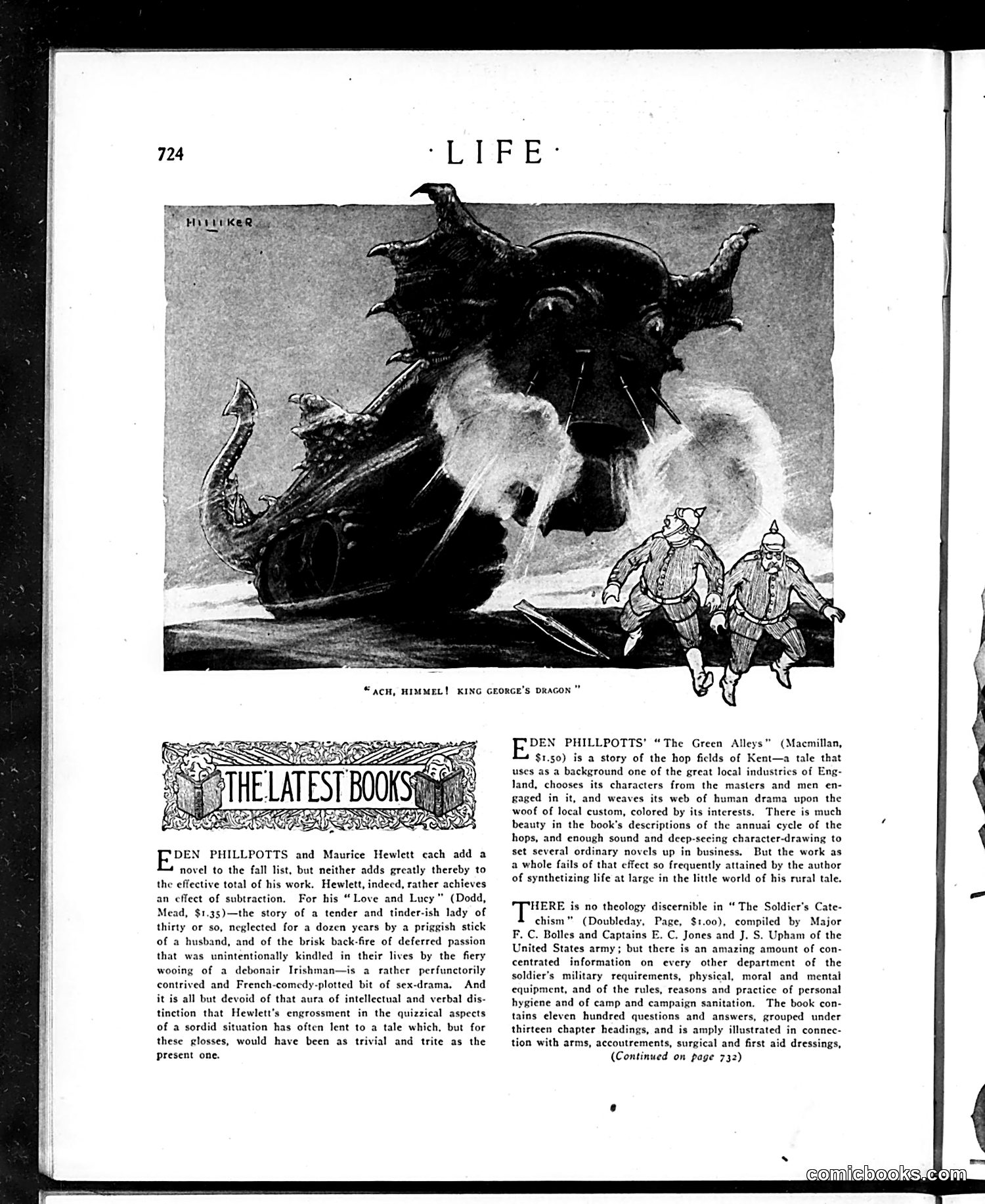
The cartoon depicts a grotesque dragon labeled "King George's Dragon"—a satirical reference to German militarism and Kaiser Wilhelm II during World War I. The exaggerated creature with multiple heads and menacing features represents the threat posed by Germany. Two small soldiers in military uniforms flee from it in terror, emphasizing the perceived danger. The German exclamation "Ach, Himmel!" (Oh, heavens!) reinforces the German enemy identification. This appears in *Life* magazine's "Latest Books" section, so the cartoon likely accompanies or comments on war-related literature from the period when America was engaged with or concerned about German aggression—probably around WWI era. The image serves as political satire mocking Germany's military power while bolstering American resolve.
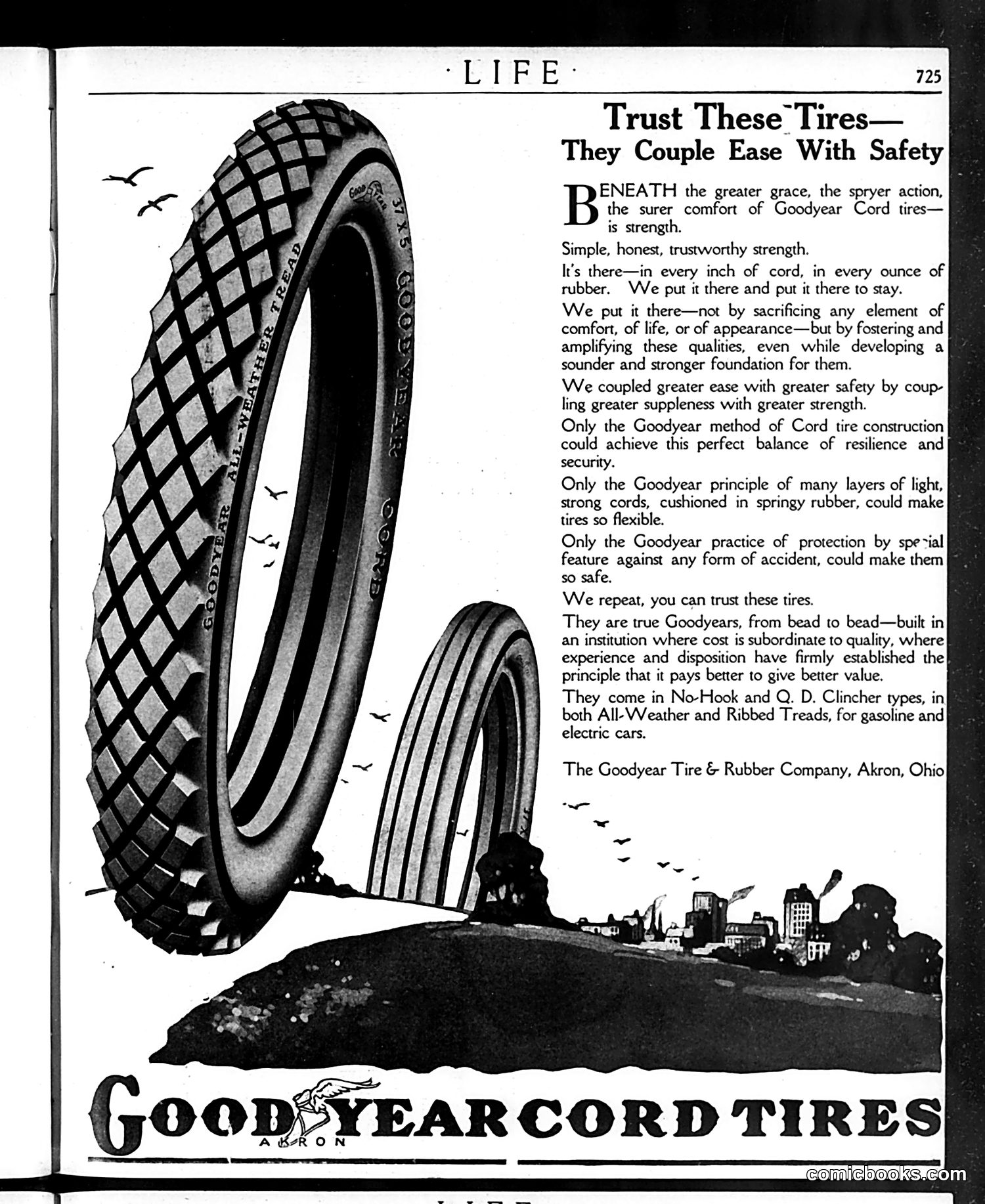
This is a **straightforward product advertisement**, not satire or political commentary. The page promotes Goodyear Cord tires in *Life* magazine (page 725). The visual shows two large tires displayed dramatically against an industrial cityscape. The accompanying text emphasizes that Goodyear achieves "safety" and "ease" simultaneously through superior construction—specifically their patented cord tire method using "many layers of light, strong cords, cushioned in springy rubber." The ad's rhetoric stresses **trustworthiness and quality over cost**: the company prioritizes durability and performance rather than cheap manufacturing. It mentions specific tire types (No-Hook, Q.D. Clincher) and notes compatibility with both gasoline and electric automobiles—reflecting the transitional automotive market of the era. There is **no cartoon or satire present**—this is period advertising copy emphasizing engineering innovation as a selling point to middle-class consumers.
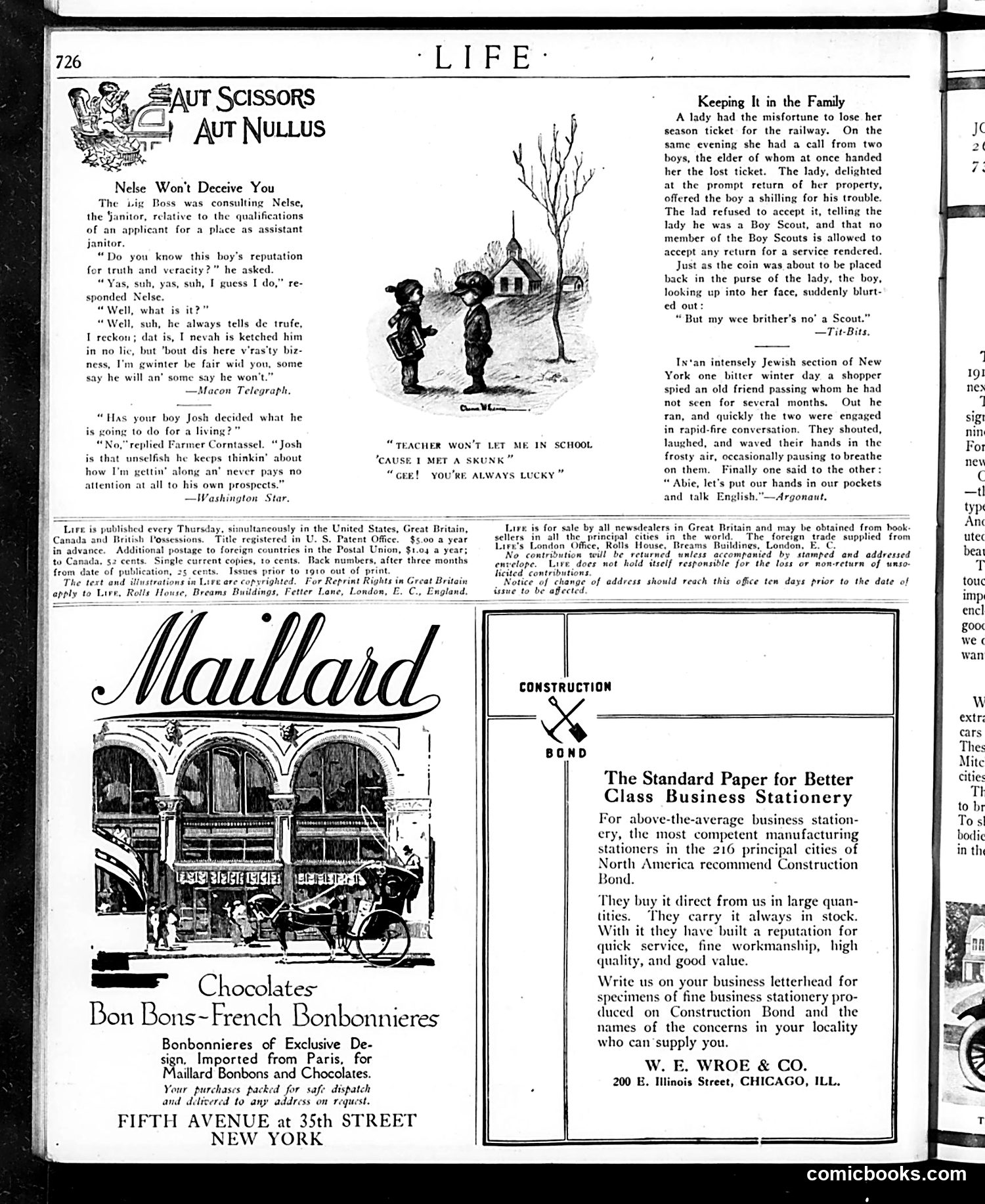
This page contains three brief humorous anecdotes typical of Life's satirical humor: **"Nelse Won't Deceive You"** mocks racial dialect humor common to the era, featuring a Black janitor praising a boy's honesty while admitting uncertainty about his character—the joke playing on contradictory logic. **"Keeping It in the Family"** satirizes Boy Scout ethics: a Scout refuses payment for returning a lost railway ticket, but his younger brother has no such scruples, suggesting the younger generation lacks the moral standards the organization claims to instill. **The Jewish section anecdote** relies on ethnic stereotyping, depicting Jewish immigrants speaking loudly and gesticulating in Yiddish, then switching to English indoors—mocking perceived cultural differences in communication style. The page also contains advertisements for Maillard Chocolates and Construction Bond paper. These jokes reflect early 20th-century American magazine humor that freely employed racial and ethnic caricatures as entertainment.
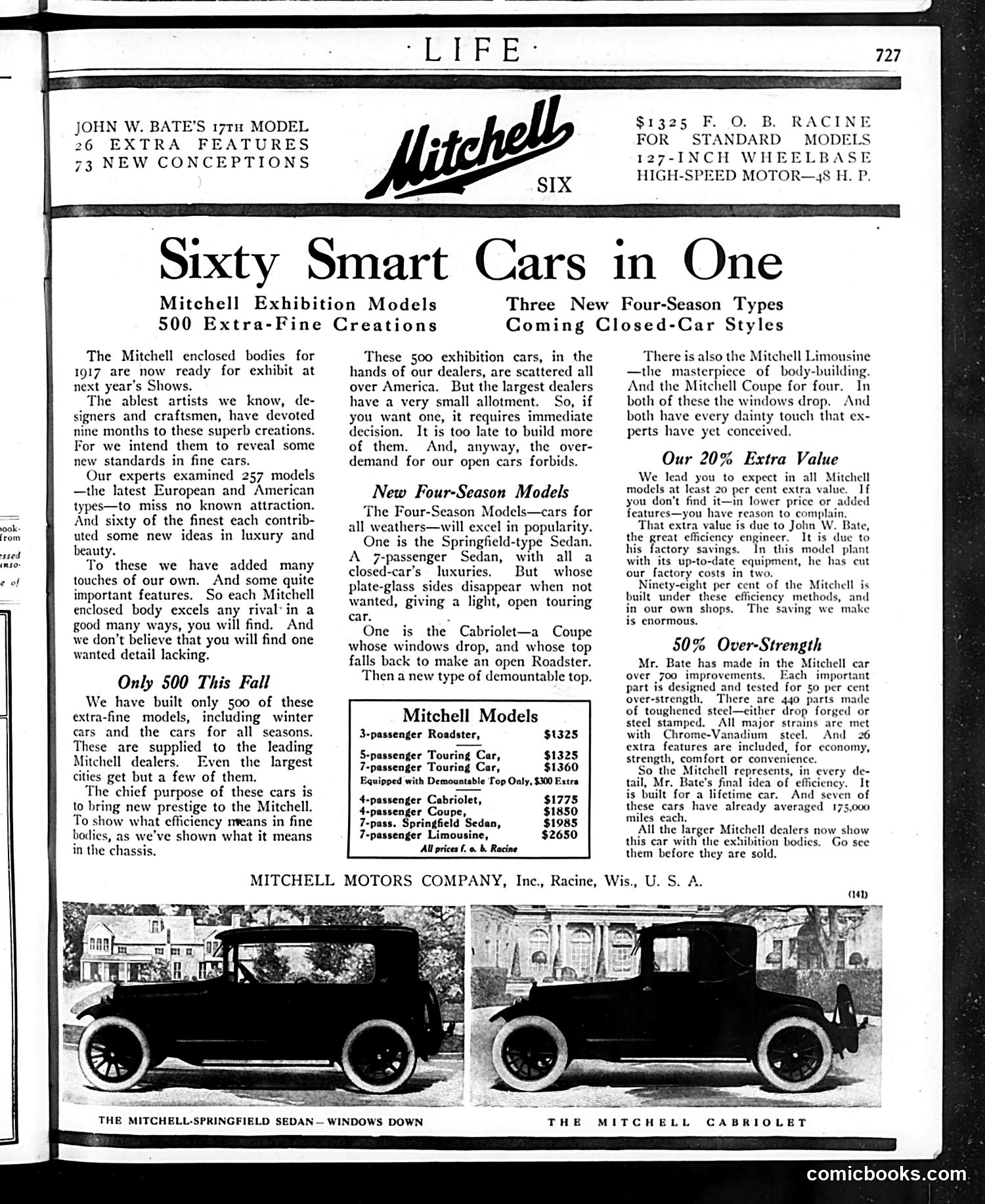
This page is **not a cartoon or satirical content** — it's a straightforward automobile advertisement from Life magazine's 1917 issue. The ad promotes Mitchell Motors Company's 1917 car models, particularly their "500 Extra-Fine Creations" featuring new four-season vehicle types (convertible sedans and cabriolets with drop windows and removable tops). Key selling points emphasized: - **20% extra value** due to engineer John W. Bate's efficiency innovations - **50% over-strength** with toughened steel components - Limited availability (only 500 exhibition models) - Multiple body styles for different seasons/weather Two photographs show the Mitchell-Springfield Sedan and Mitchell Cabriolet in profile. The advertisement reflects early automotive marketing tactics: emphasizing engineering specifications, exclusivity through limited production, and practical features (convertible tops, drop windows) that addressed real consumer concerns about open versus enclosed cars in an era before fully standardized vehicle designs.
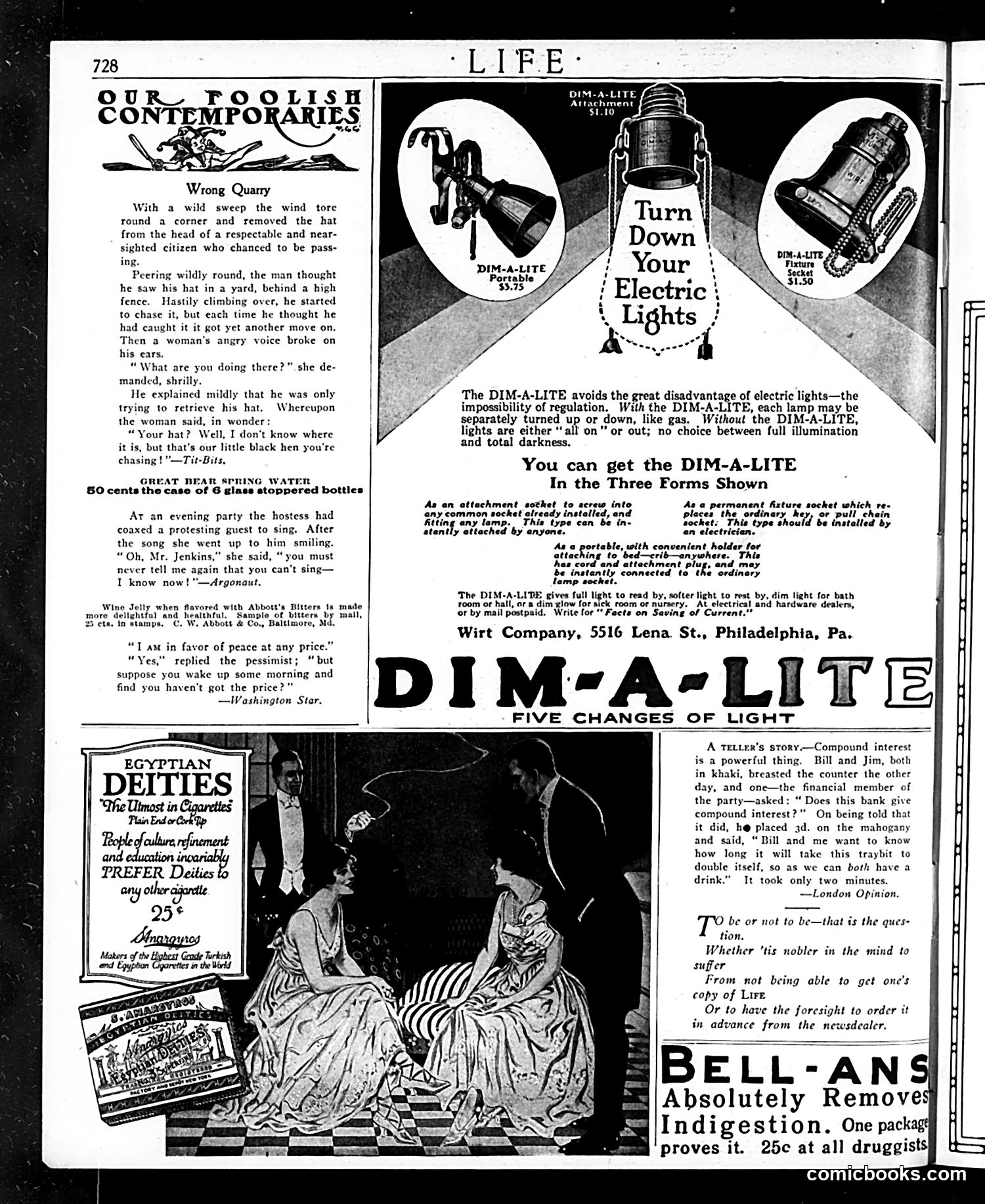
This page mixes humor columns with period advertisements. **"Our Foolish Contemporaries"** presents three brief satirical anecdotes mocking everyday human foolishness: a man chasing his own hat thinking it's in a neighbor's yard (actually chasing their hen); a woman's backhanded compliment about a guest's singing; and a pessimist's quip about "peace at any price." The dominant content is advertising for the **DIM-A-LITE**, an electrical light dimmer attachment—a genuine product innovation allowing households to regulate electric lamp brightness (rather than the binary "all on/all off" of standard switches). The ad emphasizes convenience and energy savings. Secondary ads promote Abbott's Bitters (a patent medicine tonic), Egyptian Deities cigarettes, and Bell-Ans antacid. The page reflects early 20th-century American consumer culture: nascent electrical conveniences, patent medicines marketed as cure-alls, and cigarette brands with exotic (Egyptophile) branding. The humor is gentle, domestic, and era-typical.
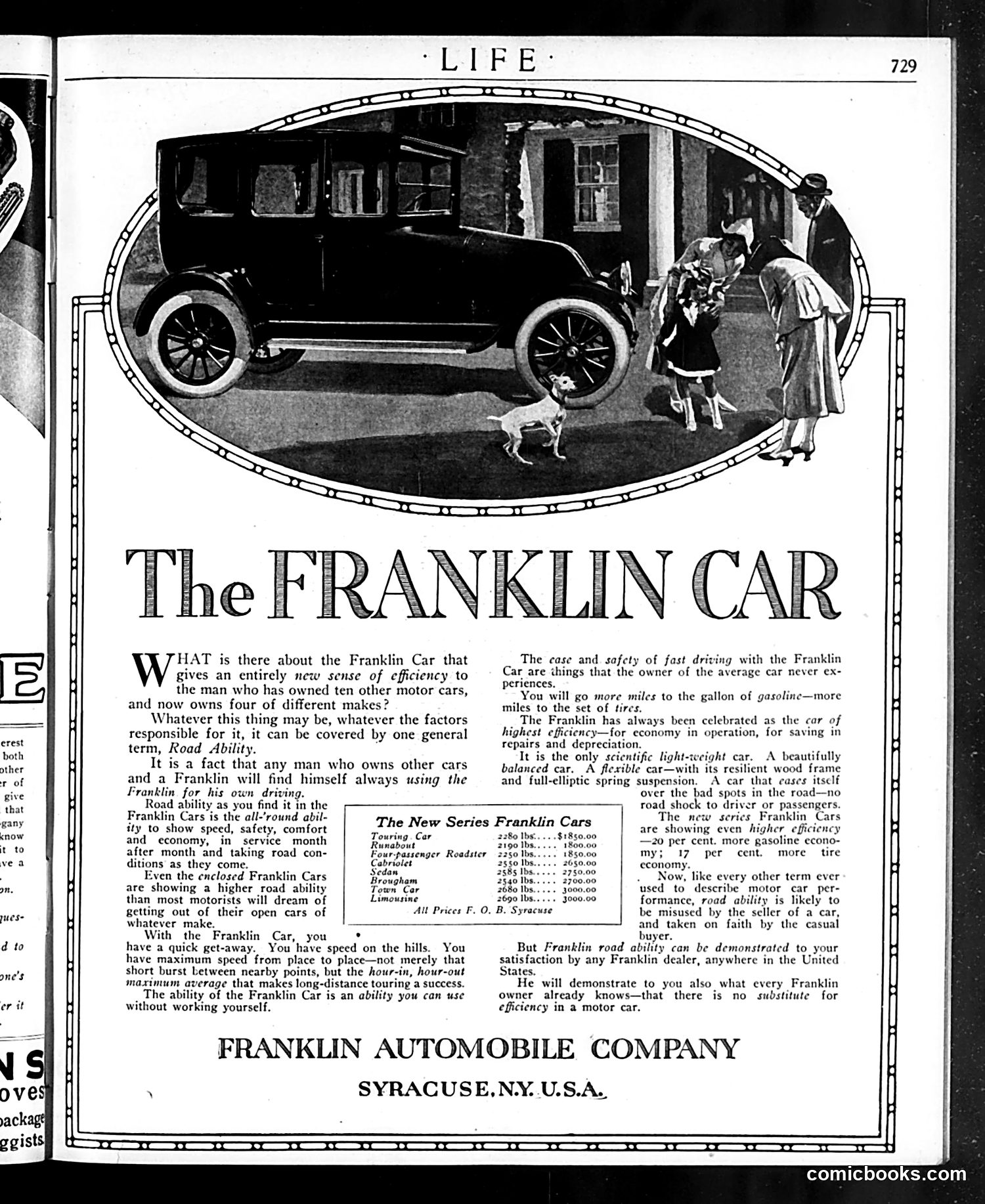
This is **not a cartoon or satire**—it's a full-page automobile advertisement from Life magazine (page 729). The Franklin Automobile Company of Syracuse, New York is promoting their cars through advertising copy that emphasizes engineering efficiency and performance. The text highlights specific selling points: superior gasoline mileage, tire durability, lightweight construction, and smooth ride quality. A price list shows models ranging from $1,850 to $3,000. The illustration shows a black sedan with well-dressed figures and a small dog, positioned in front of a residential building—a common advertising convention suggesting reliability and respectability for the middle-class buyer. This represents early 20th-century automotive marketing, when companies competed on technical specifications and economy rather than style or status symbols. The Franklin was an actual luxury car manufacturer (1902-1934) known for air-cooled engines, not a satirical target.
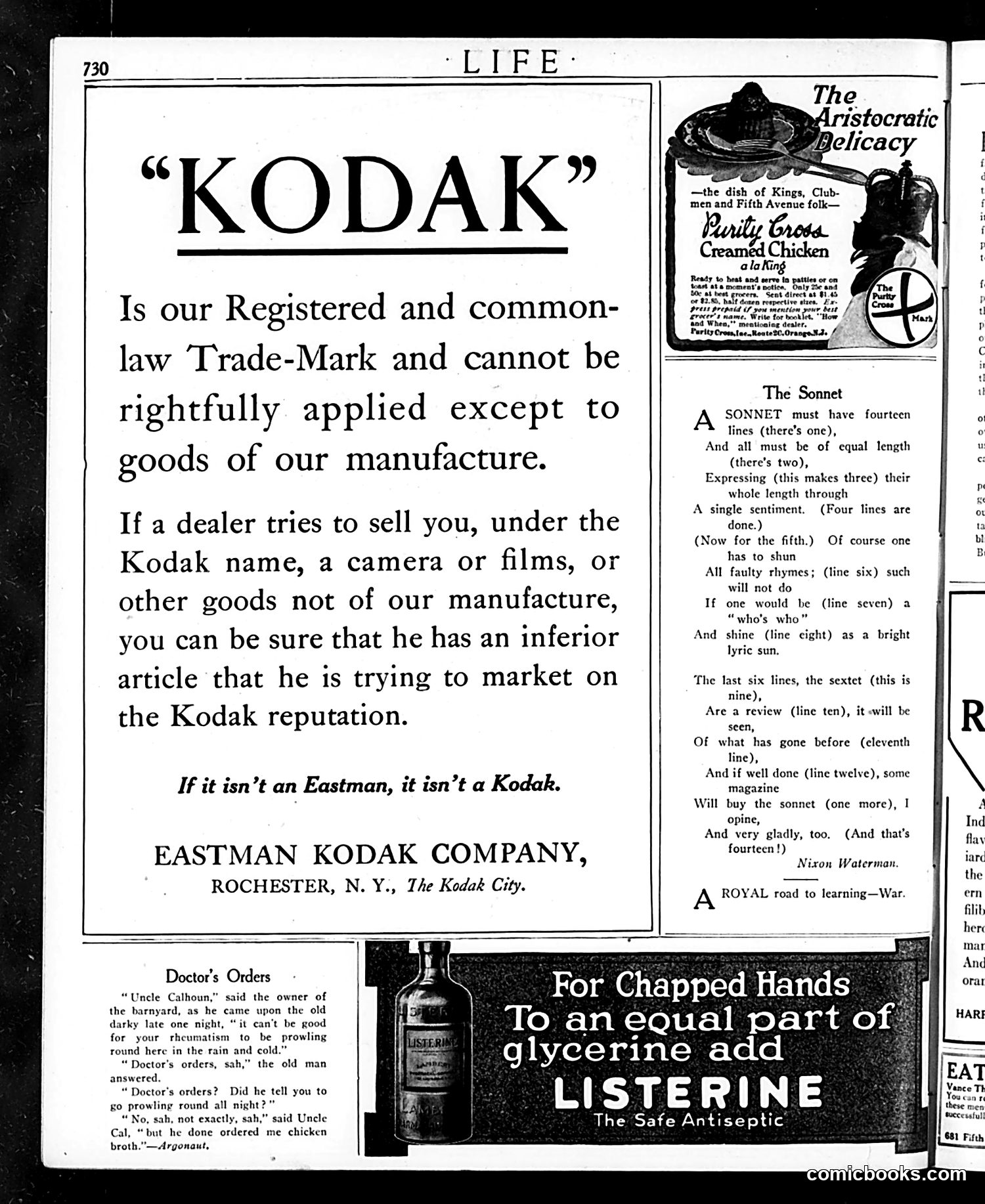
This page consists primarily of **advertisements and literary content** rather than political satire. The main Kodak ad (left) is a **trademark protection notice**, warning consumers that "Kodak" is an exclusive trade-mark belonging to Eastman Kodak Company. It warns dealers selling non-Kodak products under the Kodak name are marketing inferior goods. The slogan "If it isn't an Eastman, it isn't a Kodak" emphasizes brand exclusivity. The right side contains **three unrelated items**: an advertisement for "Purity Cross Creamed Chicken," a poem titled "The Sonnet" by Nixon Waterman (with technical instructions about sonnet structure), and a humorous anecdote titled "Doctor's Orders" from *Argonaut* magazine about an elderly Black man who interprets his doctor's advice literally. At the bottom, a **Listerine advertisement** for treating chapped hands appears. The page reflects early 20th-century magazine layout: mixed advertising, poetry, and humor rather than sustained political commentary.
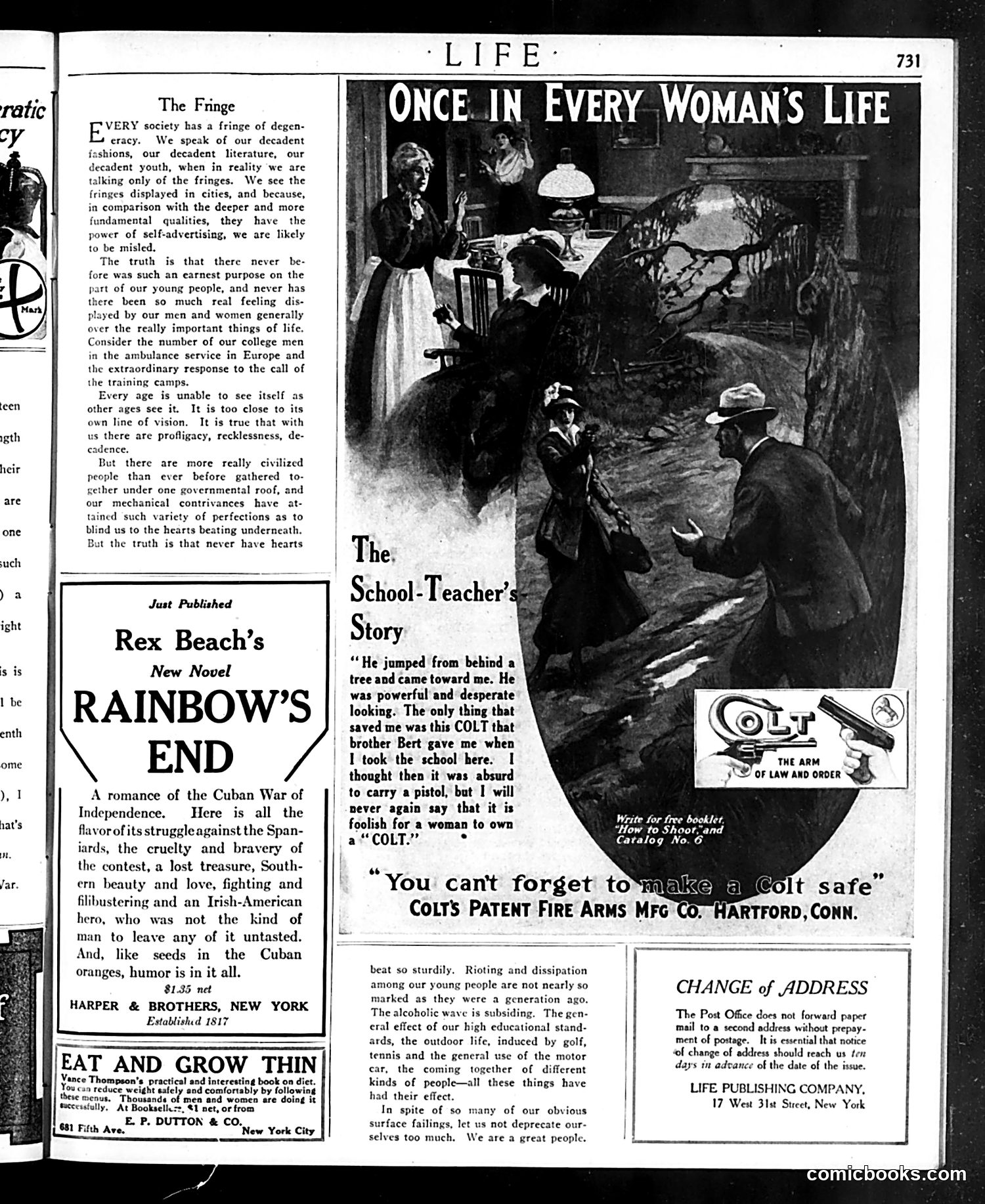
This page mixes editorial commentary with period advertisements. **"The Fringe" essay** defends American youth against contemporary criticism, arguing that while society displays "decadent" fashions and behavior, these represent only a small fringe. The author credits young people's genuine earnestness, pointing to college men serving in ambulance corps in Europe and strong responses to military training camps—references to World War I involvement (likely 1917-1918). The piece dismisses contemporary moral panic as myopic, insisting American civilization runs deeper than surface degeneracy. **The advertisement** for Colt firearms uses a school-teacher's dramatic testimonial: a woman credits a pistol her brother gave her with saving her from assault. The advertisement exploits fear and validates female gun ownership as practical self-defense. **Other ads** promote Rex Beach's novel *Rainbow's End* (Cuban War romance) and a diet book. The page reflects WWI-era anxieties about youth morality while simultaneously promoting defensive weaponry—tensions between reassuring earnestness and underlying social vulnerability.
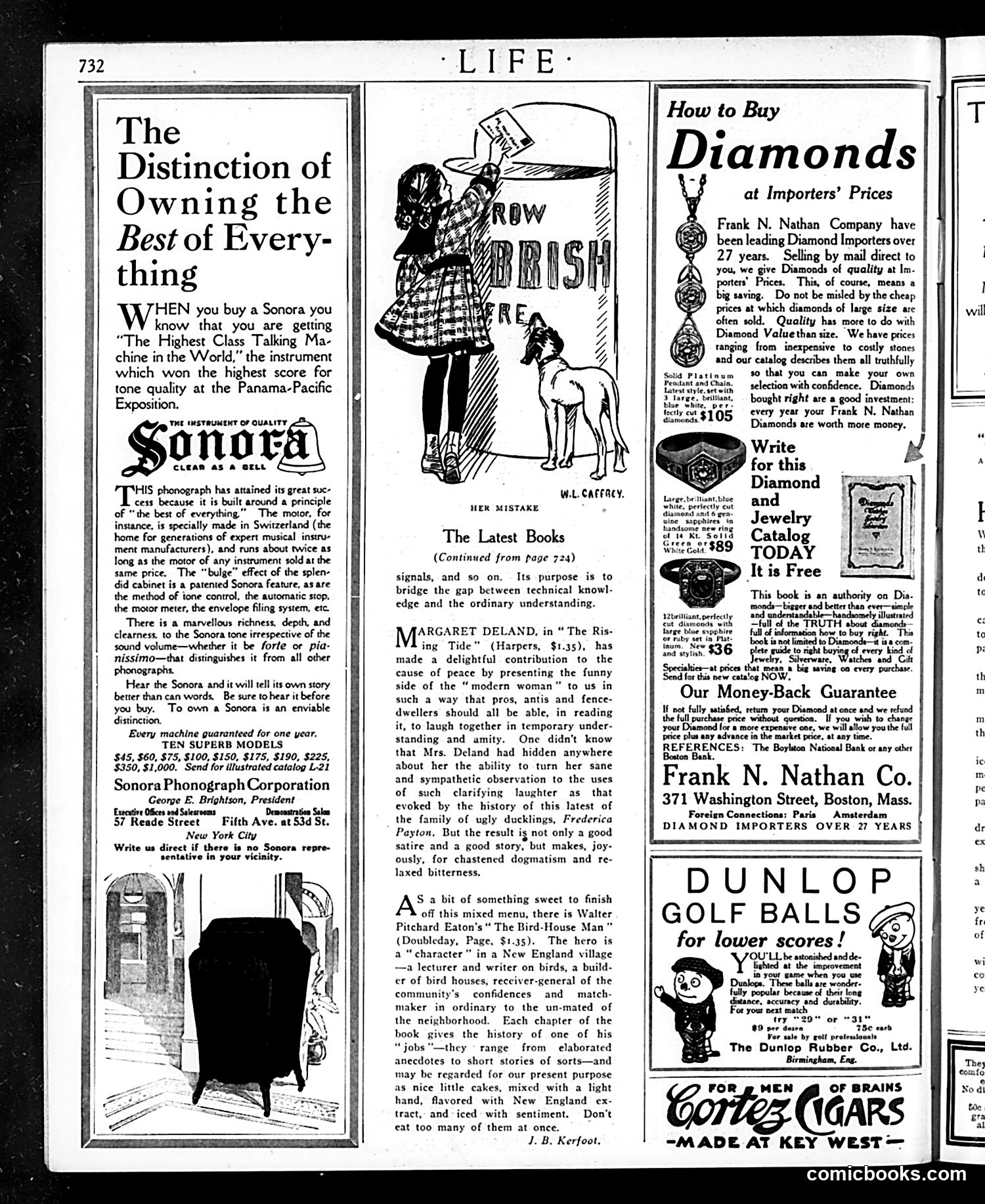
This page is primarily **advertising** with one cartoon sidebar. The main cartoon, titled "Her Mistake" by W.L. Caffrey, depicts a woman in 1920s dress attempting to reach a box labeled "BRISK BREAD" on a high shelf while a dog watches below. The humor appears to rest on a visual pun or social commentary about women's behavior—likely satirizing either the "modern woman" or domestic/consumer culture of the era. The page's dominant content consists of advertisements for luxury goods (Sonora phonographs, diamonds, golf balls, cigars) interspersed with a book review section. The satire is subtle and context-dependent; without additional period knowledge, the specific "mistake" in the cartoon remains unclear, though it relates to consumerism or gender roles typical of 1920s Life magazine humor.
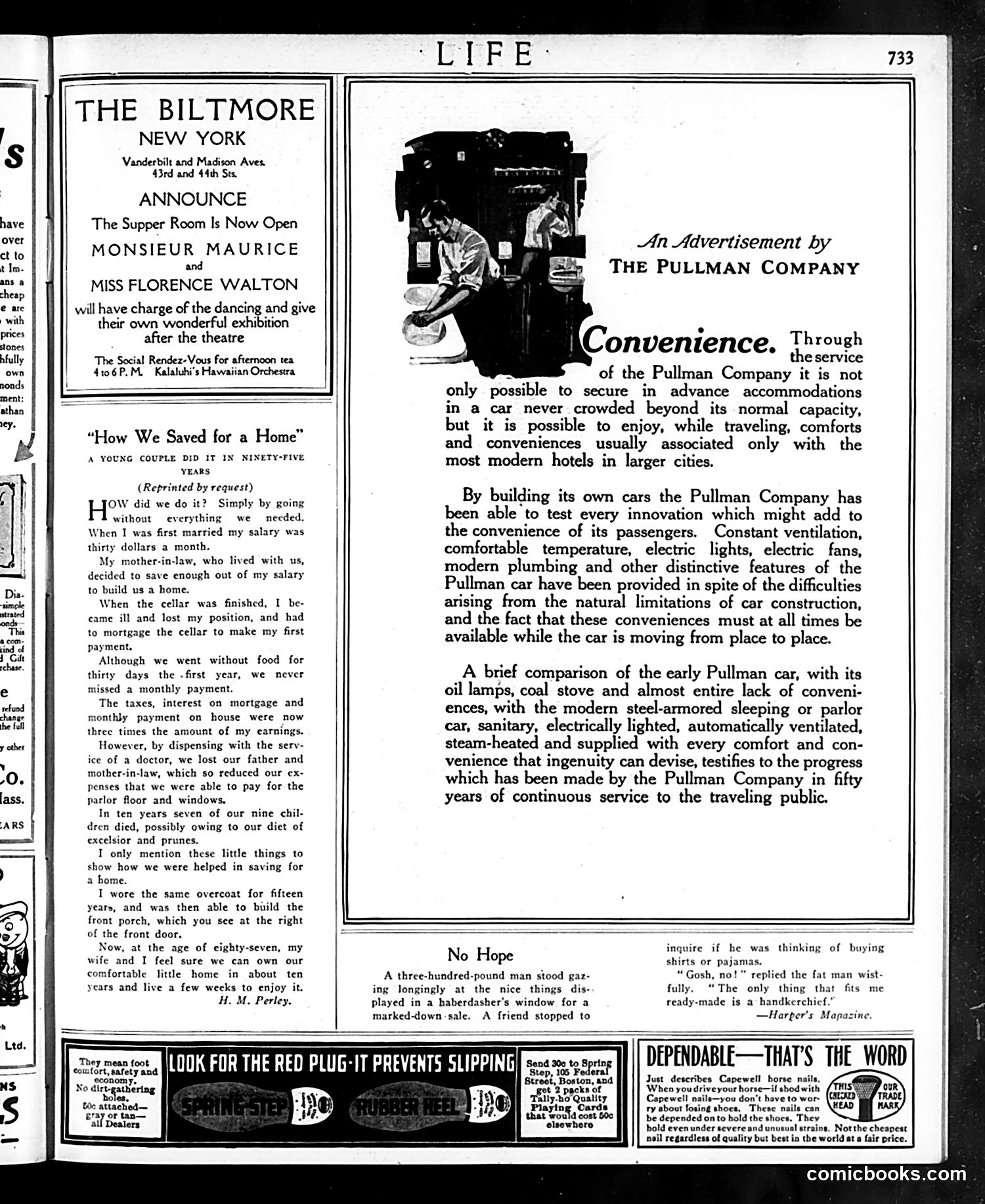
This page is primarily **advertising and filler content**, not political satire. The main elements are: **"How We Saved for a Home"** is a darkly humorous short piece satirizing the supposed "American Dream" of homeownership. It mocks the notion that ordinary workers can afford homes by depicting absurd sacrifice: a couple endures thirty days without food, loses family members due to poverty, wears the same coat for fifteen years—yet after eighty-seven years of labor, can only *almost* afford a modest house. The joke is bitter social commentary on wage stagnation and impossible housing costs. **The Pullman Company advertisement** promotes luxury railroad sleeping cars, emphasizing modern conveniences like electric lights and plumbing. **"No Hope"** is a brief joke about a fat man who cannot find ready-made clothing that fits—the punchline being a handkerchief is his only option. It's a simple size-based gag unrelated to broader issues. These are typical Life magazine filler pieces: humor derived from everyday frustrations rather than specific political events.
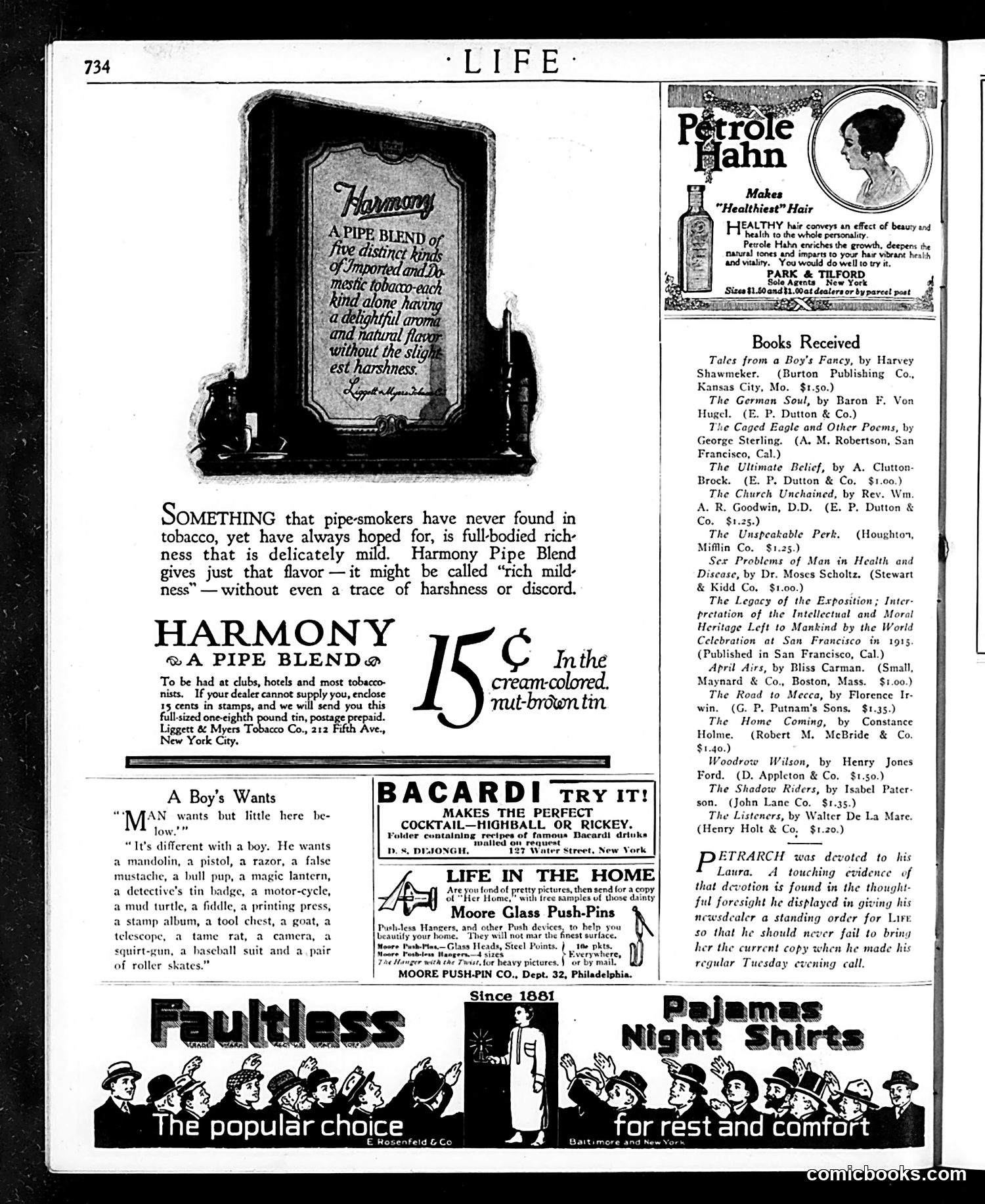
This page is primarily **advertising and book reviews**, not political satire. The content reflects early 20th-century consumer culture. **Key Elements:** - **Harmony Pipe Blend ad**: Markets tobacco as delivering "rich mildness" without harshness—a pitch emphasizing smooth smoking experience. - **"A Boy's Wants" section**: Light humor listing absurd items boys allegedly desire (mandolin, false mustache, mud turtle, etc.). This is gentle satire on consumerism and childhood materialism, not political commentary. - **Other ads**: Bacardi rum cocktails, Petróle Hahn hair tonic, Moore Push-Pins, and pajamas—typical period product marketing. - **Books Received**: Lists contemporary publications on religion, poetry, and social topics (notably "Sex Problems of Man"), suggesting Life's educated readership. - **Petrarch closing joke**: Mocks the poet's devotion to Laura by suggesting he'd appreciate a standing newsstand order—humor about literary romance versus practical modern life. The page captures 1910s-20s consumer advertising and gentle, non-political humor rather than sharp political satire.
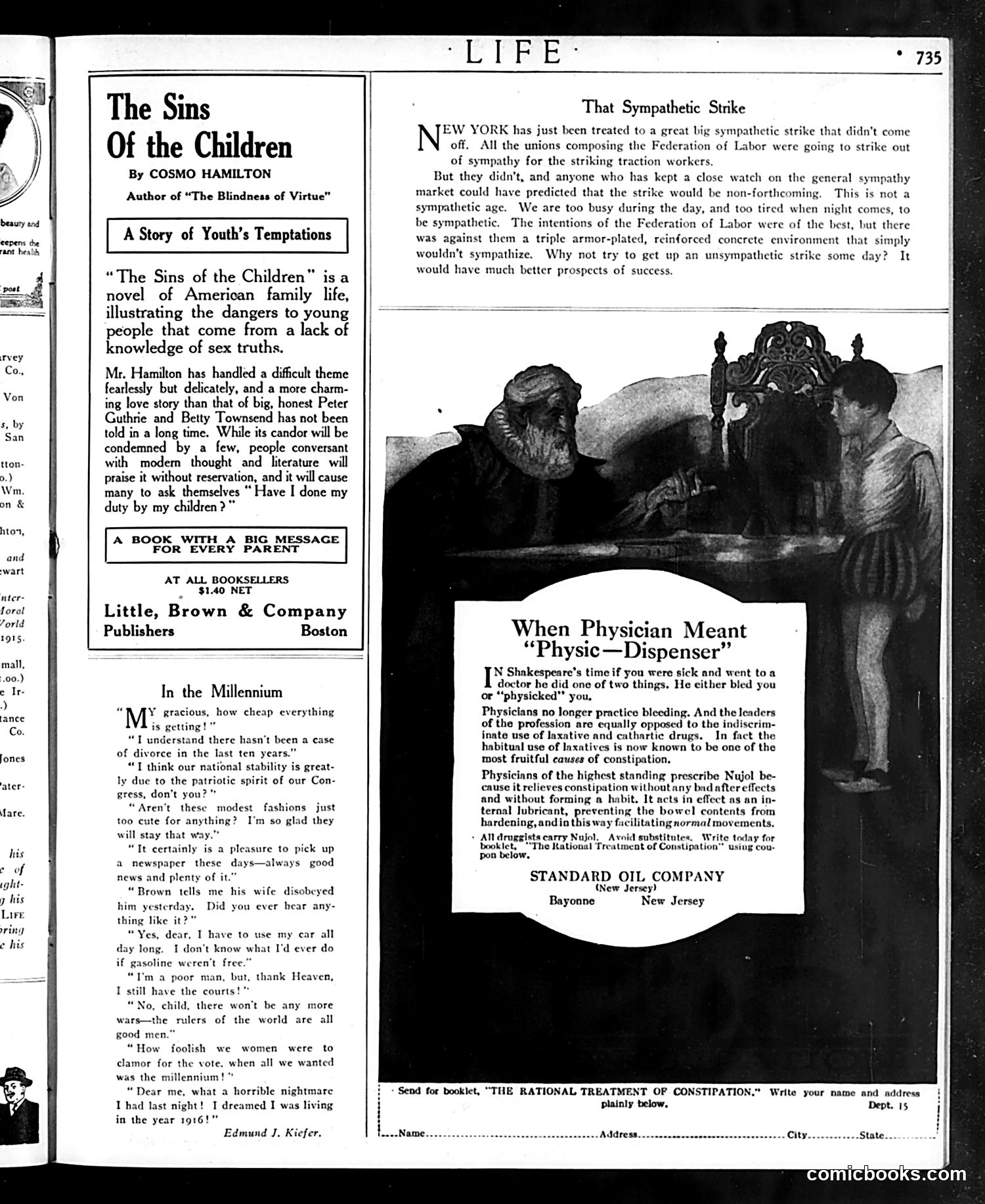
This page mixes book advertising, satirical commentary, and patent medicine ads typical of early 1910s publications. **Left column:** Advertises *The Sins of the Children* by Cosmo Hamilton—a novel about dangers young Americans face from sexual ignorance. The pitch emphasizes it's frank but morally serious. **"In the Millennium" section:** Satirizes turn-of-century optimism through ironic dialogue. A speaker describes an imaginary future (presented as utopian) where there's no divorce, wars have ceased, modest fashion persists, newspapers contain only good news, and women regret seeking voting rights. The final joke—someone nightmares about living in 1916—suggests the author's actual present is already dystopian. This mocks naive progressivism and contemporary gender politics. **Right page:** Contains a Standard Oil Company advertisement for Nujol laxative, framed as medical education. It claims physicians once "bled" patients or administered harsh purgatives, but now recommend Nujol as a gentler "internal lubricant." This represents typical early pharmaceutical marketing disguised as scientific advancement.
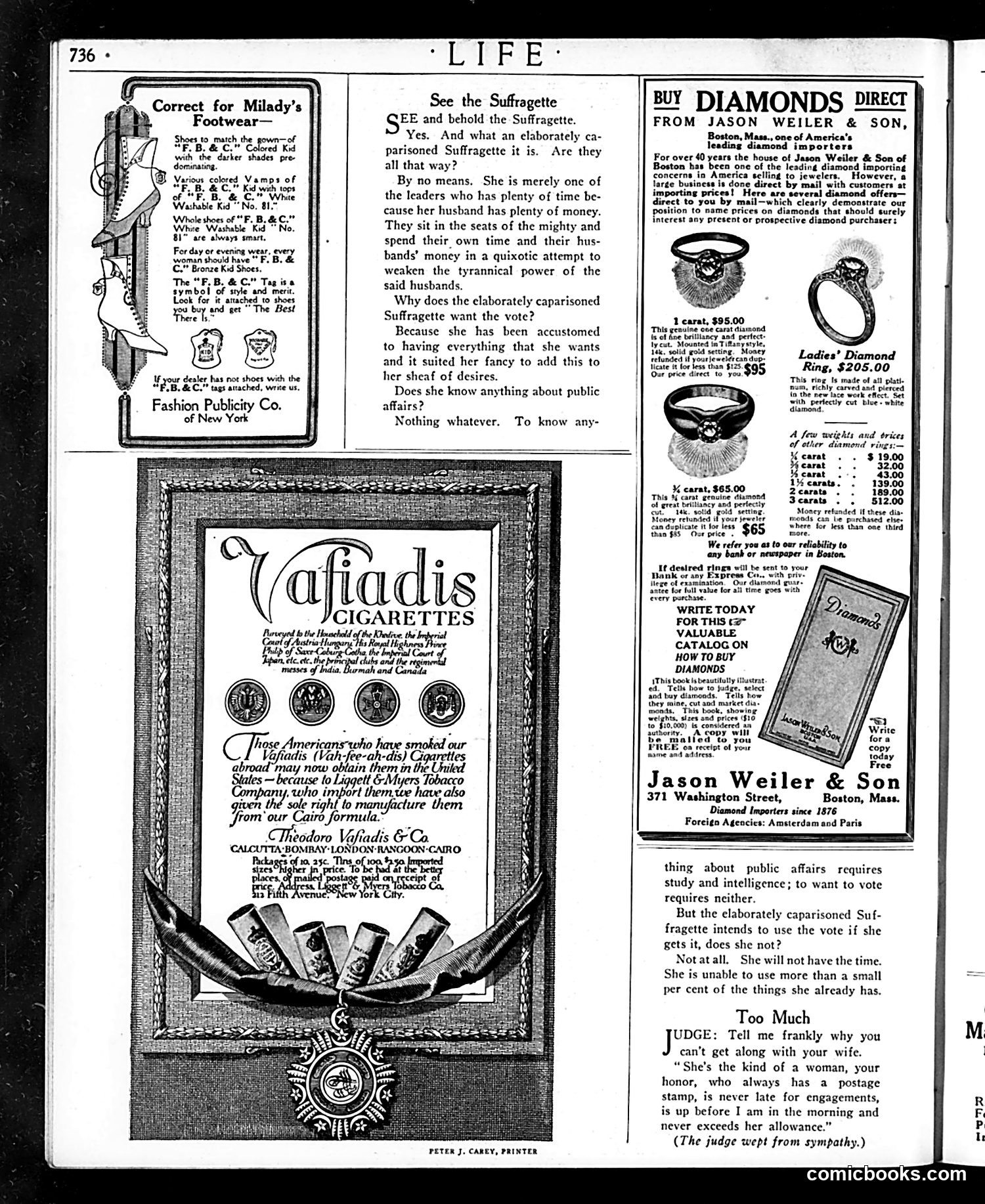
This page contains a scathing anti-suffrage cartoon disguised as social commentary. The central text "See the Suffragette" mocks women's suffrage activists by portraying a wealthy, fashionably-dressed suffragette leader as frivolous and uninformed. The satire's logic is deliberately circular and insulting: the woman wants voting rights merely because she wants everything; she knows nothing about public affairs; yet she'll supposedly never use her vote anyway because she's too busy shopping and socializing. The piece ridicules suffragettes as wealthy dilettantes whose husbands fund their activism—a common anti-suffrage argument of the era. The cartoon dismisses women's political engagement as a whimsical luxury item, no more serious than the shoe and diamond advertisements surrounding it. This juxtaposition reinforces the message that women's political participation is frivolous consumption rather than legitimate civic participation.
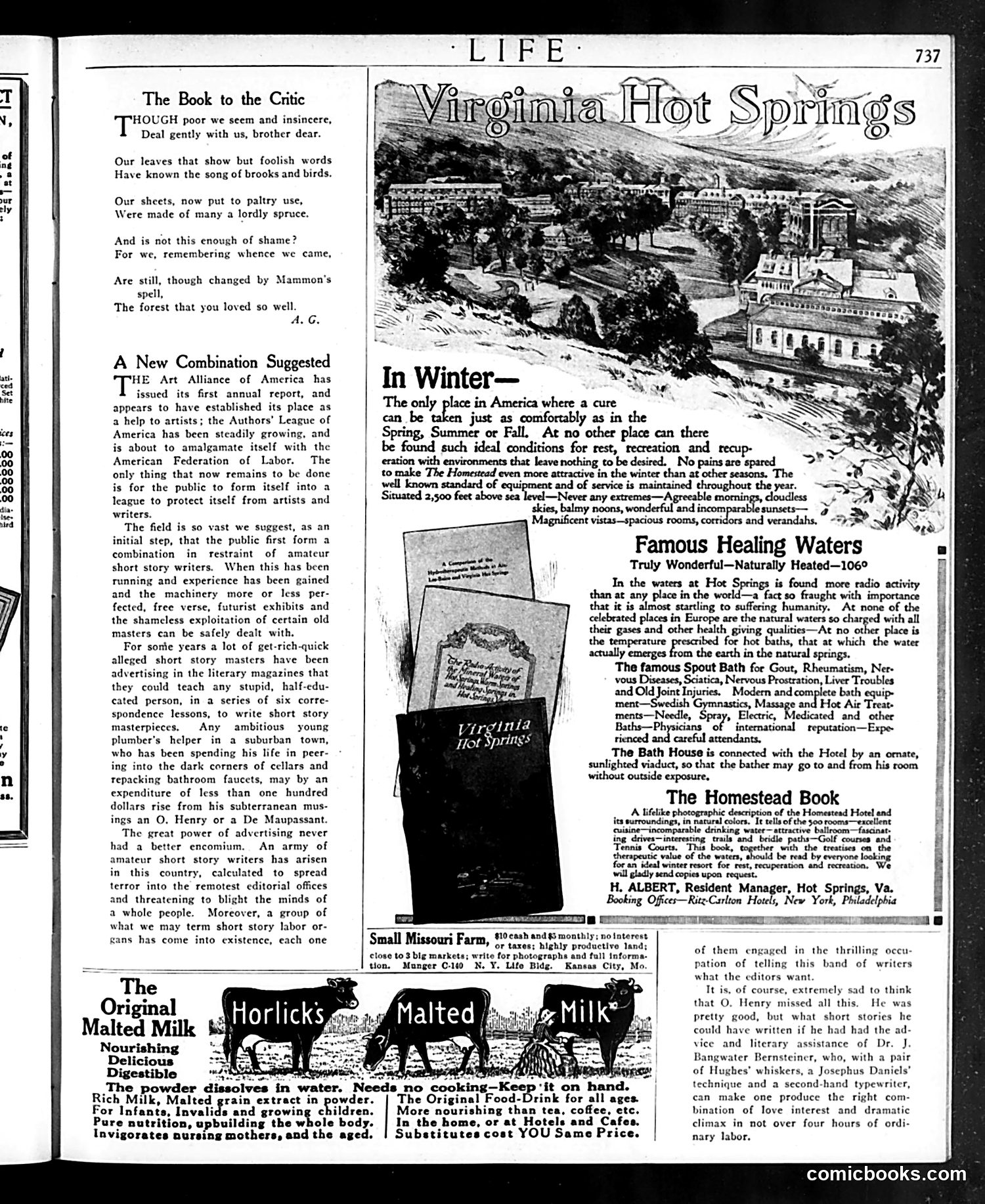
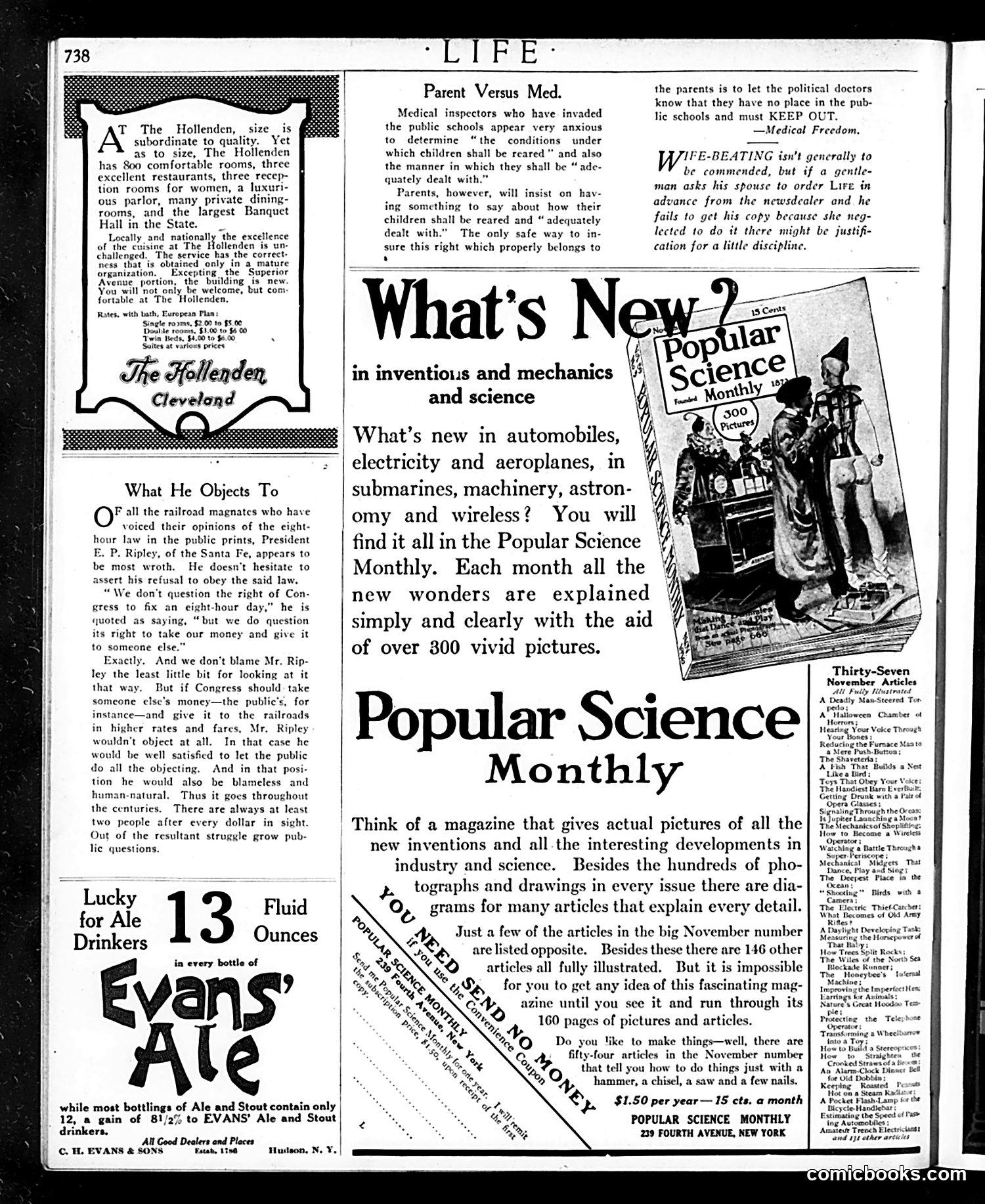
This page mixes editorial commentary with advertisements. The main satirical content addresses two distinct issues: **"Parent Versus Med."** critiques medical inspectors invading public schools. The piece argues parents—not government "political doctors"—should control how children are reared, framing mandatory medical inspection as governmental overreach into family autonomy. **"What He Objects To"** targets E. P. Ripley, president of the Santa Fe Railroad, who publicly refused to obey the eight-hour workday law. Life's satire highlights the hypocrisy: Ripley objects to Congress redistributing his money to workers, yet would cheerfully accept Congress raising fares to benefit railroads. The piece mocks his selective outrage about government intervention depending on whose interests it serves. The remainder consists of hotel and product advertisements (The Hollenden, Evans' Ale, Popular Science Monthly), typical of Life's revenue model.
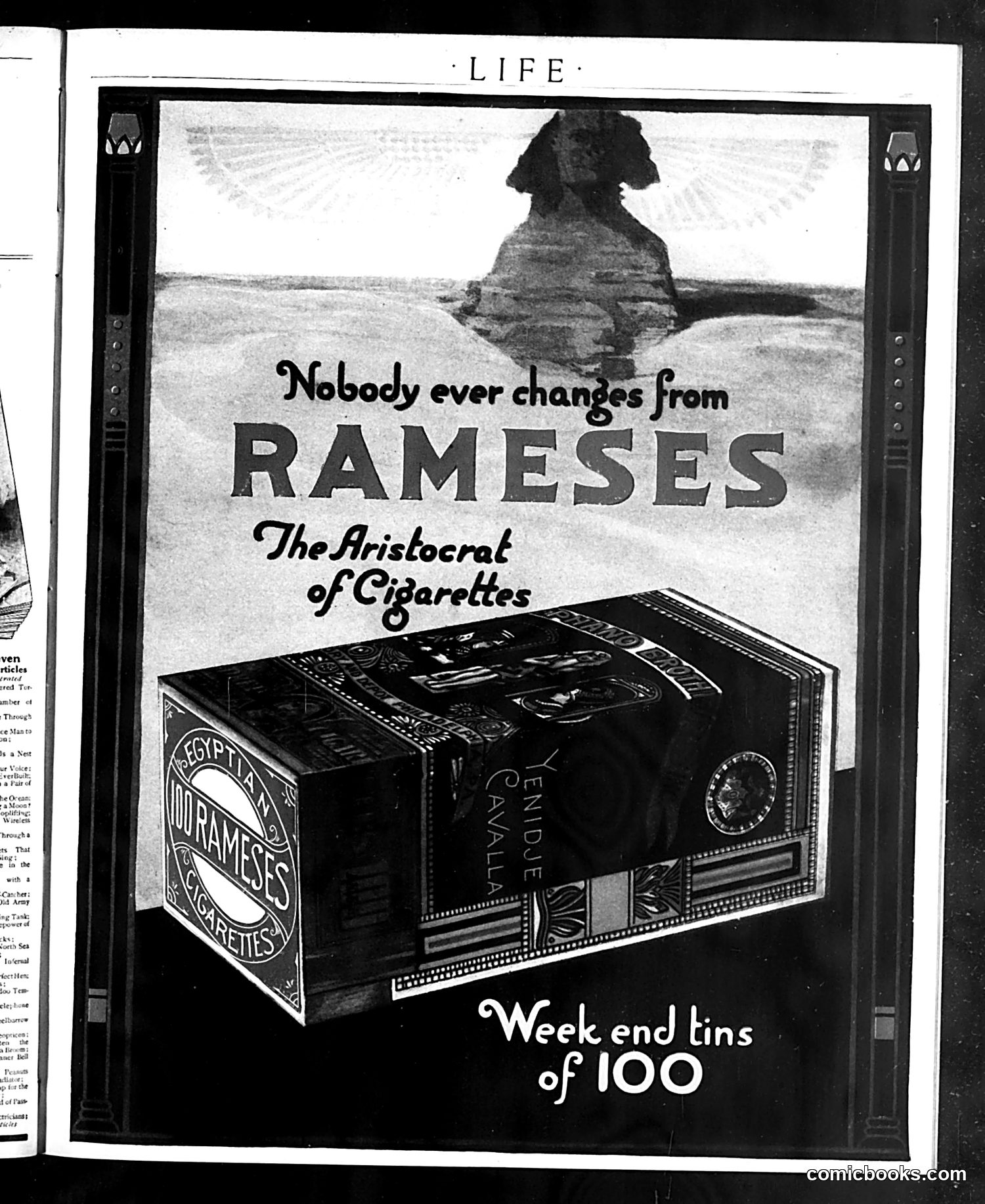
This is a cigarette advertisement for Rameses brand, appearing in Life magazine. The ad features the Great Sphinx of Giza in the background, with a large Rameses cigarette package displayed prominently below. The headline reads "Nobody ever changes from Rameses" and subtitles claim it offers "The Aristocrat of Cigarettes" with "Week end tins of 100." The ad exploits the Egyptian imagery and Rameses' pharaonic associations to suggest the brand's timeless prestige and superiority. The Sphinx reference implies ancient permanence and authority. The messaging suggests Rameses smokers are loyal to a premium product—that switching brands would be abandoning quality. This reflects early 20th-century advertising's use of exoticism and claims of aristocratic distinction to market consumer goods.
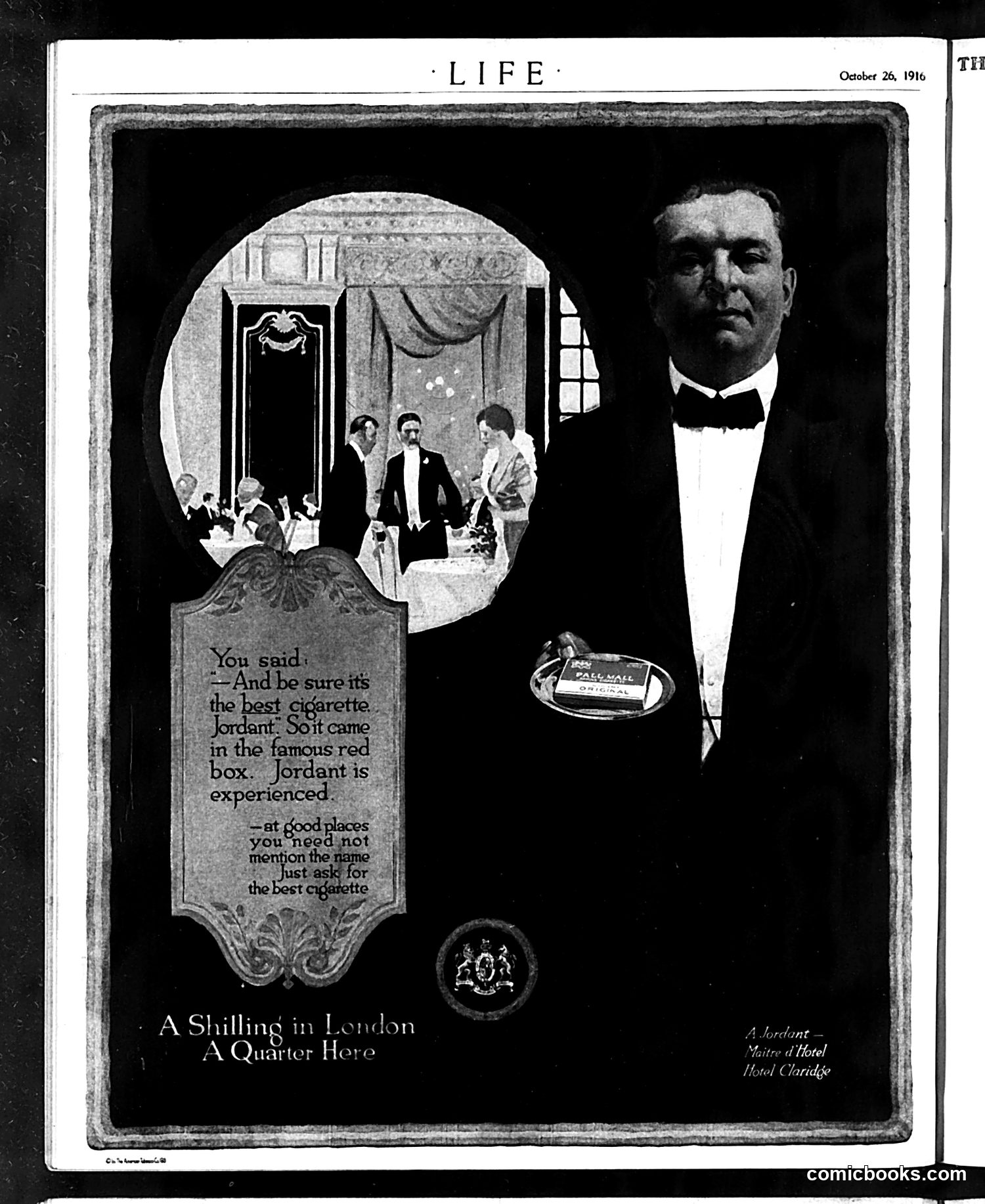
This is primarily a **Jordant cigarette advertisement** from Life magazine (October 26, 1916), not political satire. The ad features a well-dressed man in formal evening wear alongside a scene of refined diners at what appears to be an upscale London hotel (Hotel Claridge is mentioned). The copy plays on transatlantic pricing differences: "A Shilling in London / A Quarter Here," suggesting Jordant cigarettes cost less in America than Britain despite being a premium product. The advertisement's messaging emphasizes exclusivity and sophistication—at "good places," one simply asks for "the best cigarette" without naming the brand, implying Jordant's established prestige among the wealthy. The formal attire and elegant setting reinforce positioning this as a luxury item for refined gentlemen.