
Life, 1916-10-26 · page 27 of 46
Life — October 26, 1916 — page 27: what you’re looking at
What you’re looking at
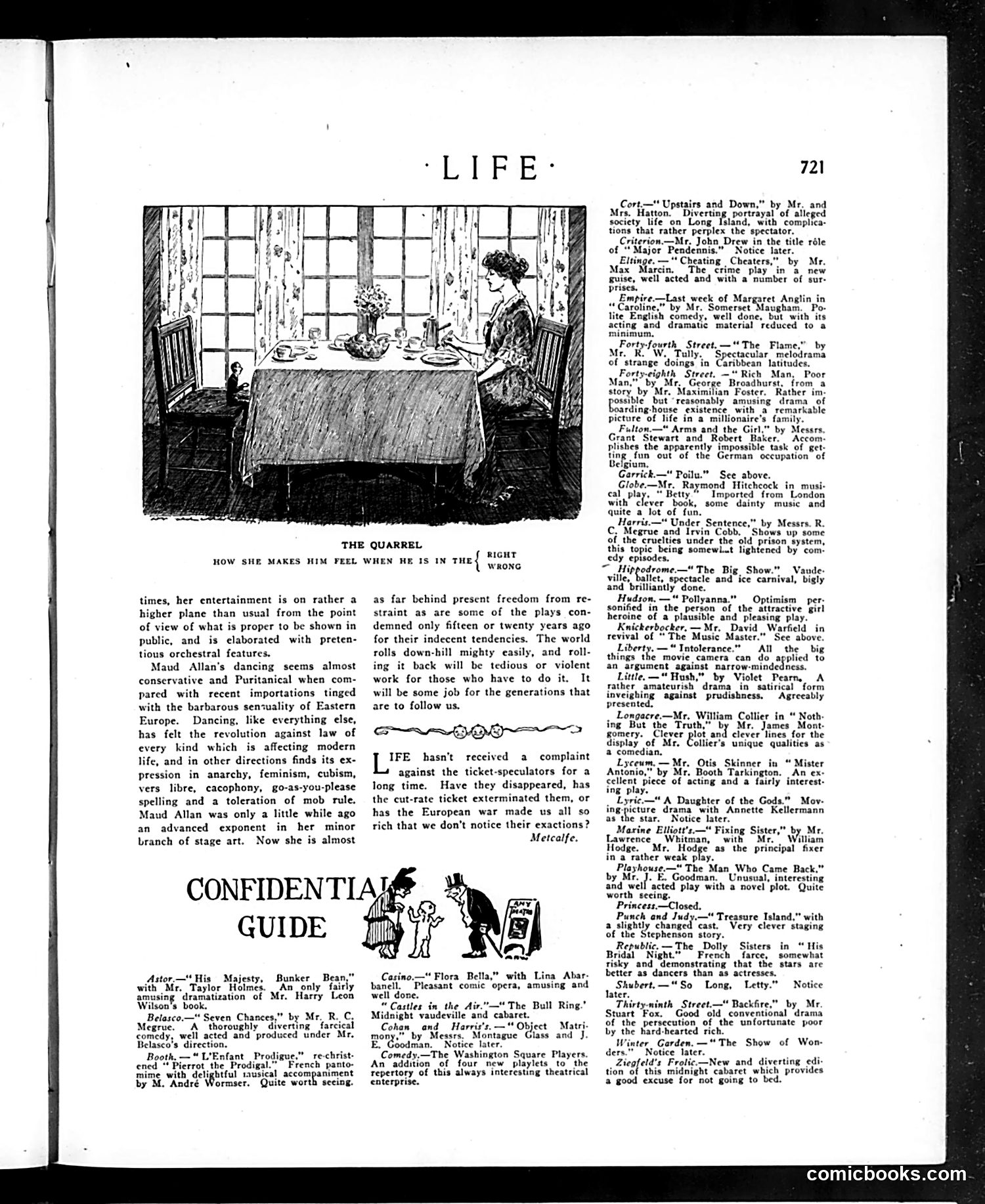
This illustration satirizes domestic conflict. The image shows a woman sitting alone at a table by a window, appearing composed and content, while the caption's title and "RIGHT/WRONG" labels suggest the joke: when a couple quarrels, the woman who is "in the right" somehow makes her male partner feel worse than if she were actually wrong. The accompanying article critiques modern theatrical dance and morality, referencing Maud Allan (a real dancer known for controversial performances). The author argues that society has swung from Victorian prudishness toward excessive permissiveness in "anarchy, feminism, cubism, vers libre"—listing contemporary progressive movements as symptoms of moral decline. The piece laments that reversing this cultural "roll down-hill" will require difficult generational work. This reflects conservative anxiety about post-WWI social changes.
📄 Transcribed text from this page (OCR, searchable)
Machine-transcribed from the original scan — historical spelling and the odd misread are preserved.
SS SS SSS THE QUARREL HOW SHE MAKES iM veEL witEN He Is in THE{ times, her entertainment is on rather a higher plane than usual from the point of view of what is proper to be shown in public, and is elaborated with preten- tious orchestral features. Maud Allan's dancing seems almost conservative and Puritanical when com- pared with recent importations tinged with the barbarous sensuality of Eastern Europe. Dancing, like everything else, has felt the revolution against law of every kind which is affecting modern life, and in other directions finds its ex- pression in anarchy, feminism, cubism, vers libre, cacophony, go-as-you-please spelling and a toleration of mob rule, Maud Allan was only a little while ago an advanced exponent in her minor branch of stage art. Now she is almost Astor —“His Majesty, Bunker _ Bean,” with Mr. Taylor Holmes. (An only fairly amusing dramatization of Mr. Harry Leon Wilson's book. Belasco.—" Seven Chances,” by Mr, B.C. Megrue. A thoroughly diverting farcical comedy, well acted and produced under Mr. Belasco’s direction, Booth, —“L'Enfant Prodigue.” _re-christ- * Pierrot the Prodigal.” French panto- mime with delightful tausical accompaniment by M. “André ‘Quite worth seeing. RIGHT WRONG as far behind present freedom from re- straint as are some of the plays con- demned only fifteen or twenty years ago for their indecent tendencies. The world rolls down-hill mighty easily, and roll- ing it back will be tedious or violent work for those who have to do it. It will be some job for the generations that are to follow us. CAR ROOEIEO? IFE hasn't received a complaint against the ticket-speculators for a long time. Have they disappeared, has the cut-rate ticket exterminated them, or has the European war made us all so rich that we don’t notice their exactions? Metcalfe. Cosino.—" Flora Bella,” with Lina Abar- banell. Pleasant comic ‘opera, amusing and well done. " Castles in, the Air.” —"The Bull Ring.” Midnight vaudeville and cabaret. Cohan. end Harris's. —" Object Matri- mony,” by Messrs, Montague Glass and J. E. Goodman, Notice later. Comedy.—The Washington Square Players. An addition of four new. playlets to the Fepertory of this always interesting theatrical enterprise. — Hippodrome.—" The Big Show.” Cort.—"* Upstairs an ; Mrs. Hatton. Diverting portrayal of alleged society life on Long Island, with complica- tions that rather perplex the spectator. iterion.—Mr. John, Drew in the title réle lajor Penden’ Notice later. Eltinge. —“* Cheating Cheaters,” by Mr. Max Marcin. The crime play'in a new guise, well acted and with a number of sur- Last week of Margaret Anglin in . . Somerset Maugham. Po- lite English comedy, well done, but with its acting and dramatic ‘material reduced to a mlaimivs Forty-fourth Street. —“ The Flame,” by Mr. "RW. Tully. Spectacular, meledrama of strange doings in Caribbean latitudes. Forty-eighth Street. ~“* Rich Man, Poor Man,” by Mr. George Broadhurst, from a story by Mr. Ma: ilian Foster. Rather im- posible: but reasonably amusing drama of rdinghouse existence with a remarkable picture of life in a millionaire’s family, Fulton.—" Arms and the Girl.” by Messrs. Grant Stewart and Robert Baker. Accom: plishes the apparently impossible task of get- “fun out of the German occupation of Poilu.” See above. Mr. Raymond Hitchcock in musi- cal play.“ Betty "Imported from London with clever book, some dainty music and quite a lot of fun. Harris.—* Under Sentence,” by Messrs. R. C, Megrue and Irvin Cobb, "Shows up some of the cruelties under the old prison system, this topic being somewLat lightened by com: edy episodes. i Vaude- ville, ballet, spectacle and ice carnival, bigly and ‘brilliantly done. Hudson. —* Pollyanna.” Optimism _per- sonified in the person of the attractive gifl heroine of a plausible and pleasing play. Knickerbocker. — Mr. David, Warfield in revival of “The Music Master.” See above. Liberty. —“Tntolerance.” All the big things the movie camera can do applied to an argument against narrow-mindedness, Little, —“ Hush,” by Violet Pearn, A rather amateurish’ drama in satirical form inveighing against prudishness, — Agreeably presented. . Longacre.—Mr. William Collier in “ Noth: ing But the Truth,” by Mr. James Mont- gomery. Clever plot and clever lines for the display of Mr. Col unique qualities as a comedian. —Mr. Otis Skinner in “ Mister Mr. Booth Tarkington. An ex- cellent piece of acting and a fairly interest- ing play. _ Lyric.—" A Daughter of the Gods.” Mov- ing:picture drama with Annette Kellermann as the star. Notice later. Maxine Elliot y. Lawrence | Whitman, William Hodge. Mr. Hodge’ as the principal fixer in a rather weak play. Playhouse.—“ The Man Who Came Back,” by Mr. J. E Goodman. “Unusual, interesting and well ‘acted play with a novel ‘plot. Quite worth seeing. Princess.—Closed, Punch and Judy.—" Treasure Island,” with a slightly changed cast. Very clever staging of the Stephenson story. Dolly Sisters in“ His French farce, somewhat ing that the stars are as actresses. Letty.” Republic. — The Bridal Night. risky and demonst; better as dancers Shubert, —“So Long, later. Thirty-ninth Street.—" Backfire,” by Mr. Stuart Fox. Good old conventional drama of the persecution of the unfortunate poor by the hard-hearted rich. Winter Garden. —“ The ders.” "Notice later. Ziegfeld’s Frolic.—New and diverting edi- tion of this midnight cabaret which provides a good excuse for not going to bed Notice Show of Won- comicbooks.com