
Life, 1916-10-26 · page 30 of 46
Life — October 26, 1916 — page 30: what you’re looking at
What you’re looking at
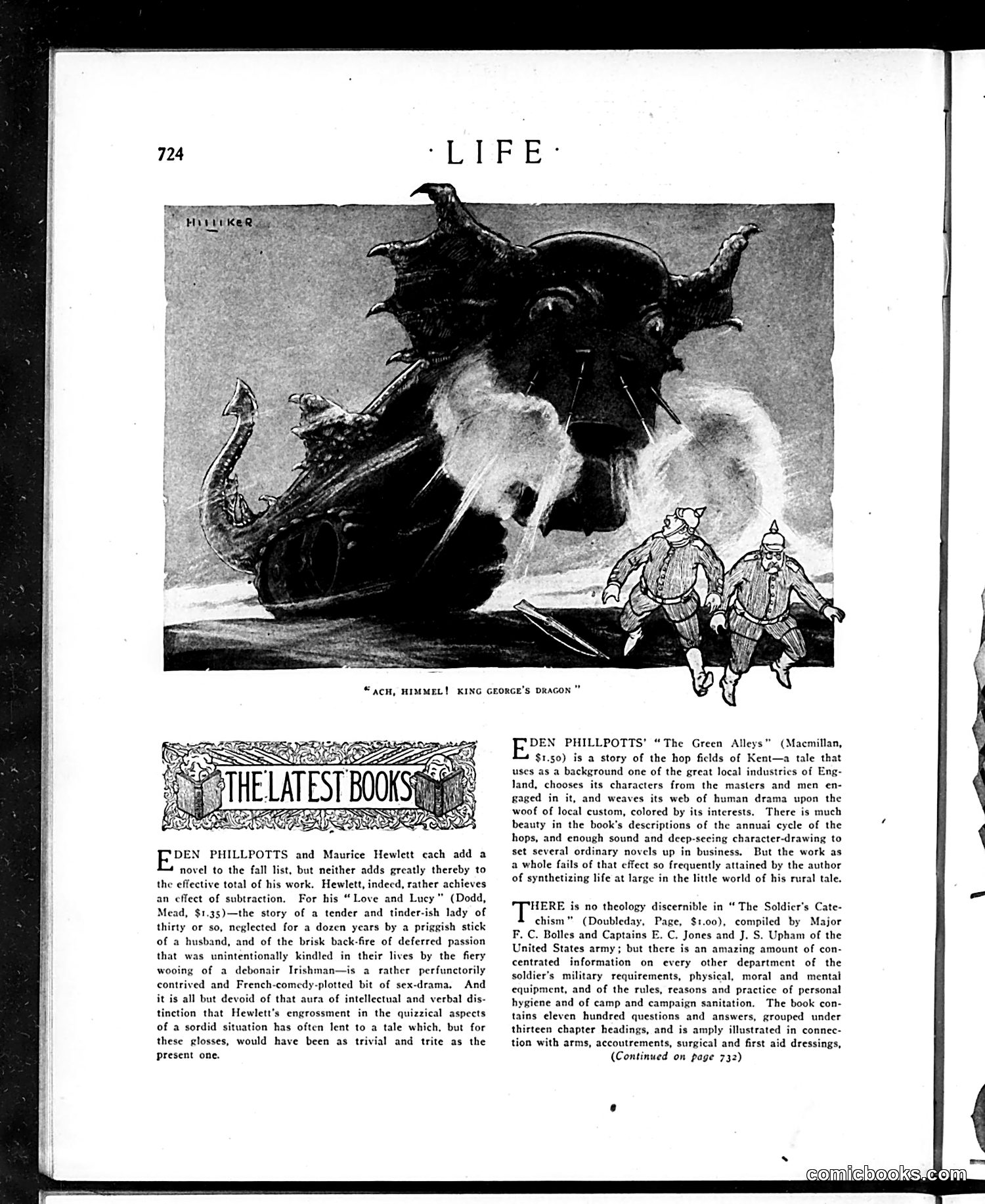
The cartoon depicts a grotesque dragon labeled "King George's Dragon"—a satirical reference to German militarism and Kaiser Wilhelm II during World War I. The exaggerated creature with multiple heads and menacing features represents the threat posed by Germany. Two small soldiers in military uniforms flee from it in terror, emphasizing the perceived danger. The German exclamation "Ach, Himmel!" (Oh, heavens!) reinforces the German enemy identification. This appears in *Life* magazine's "Latest Books" section, so the cartoon likely accompanies or comments on war-related literature from the period when America was engaged with or concerned about German aggression—probably around WWI era. The image serves as political satire mocking Germany's military power while bolstering American resolve.
📄 Transcribed text from this page (OCR, searchable)
Machine-transcribed from the original scan — historical spelling and the odd misread are preserved.
“ACH, HIMMEL! KING GEORGE'S DRAGON ” DEN PHILLPOTTS and Maurice Hewlett cach add a novel to the fall list, but neither adds greatly thereby to the effective total of his work. Hewlett, indeed, rather achieves an effect of subtraction. For his “Love and Lucy” (Dodd, Mead, $1.35)—the story of a tender and tinder-ish lady of thirty or so, neglected for a dozen years by a priggish stick of a husband, and of the brisk back-fire of deferred passion that was unintentionally kindled in their lives by the fiery wooing of a debonair Irishman—is a rather perfunctorily contrived and French-comedy-plotted bit of sex-drama, And it is all but devoid of that aura of intellectual and verbal dis- tinction that Hewlett’s engrossment in the quizzical aspects of a sordid situation has often lent to a tale which, but for these glosses, would have been as trivial and trite as the Present one. DEN PHILLPOTTS’ “The Green Alleys” (Macmillan, $1.50) is a story of the hop ficlds of Kent—a tale that uses as a background one of the great local industrics of Eng- land, chooses its characters from the masters and men en- gaged in it, and weaves its web of human drama upon the woof of local custom, colored by its interests. There is much beauty in the book's descriptions of the annuai cycle of the hops, and enough sound and deep-secing character-drawing to set several ordinary novels up in business. But the work as a whole fails of that effect so frequently attained by the author of synthetizing life at large in the little world of his rural tale. HERE is no theology discernible in “The Soldicr’s Cate- chism” (Doubleday, Page, $1.00), compiled by Major F. C. Bolles and Captains F. C. Jones and J. S$. Upham of the United States army; but there is an amazing amount of con- centrated information on every other department of the soldier's military requirements, physical, moral and mental ipment, and of the rules, reasons and practice of personal iene and of camp and campaign sanitation. The book con- tains eleven hundred questions and answers, grouped under thirteen chapter headings, and is amply illustrated in connec- tion with arms, accoutrements, surgical and first aid dressings, (Continued on page 732)