
Life, 1916-10-26 · page 23 of 46
Life — October 26, 1916 — page 23: what you’re looking at
What you’re looking at
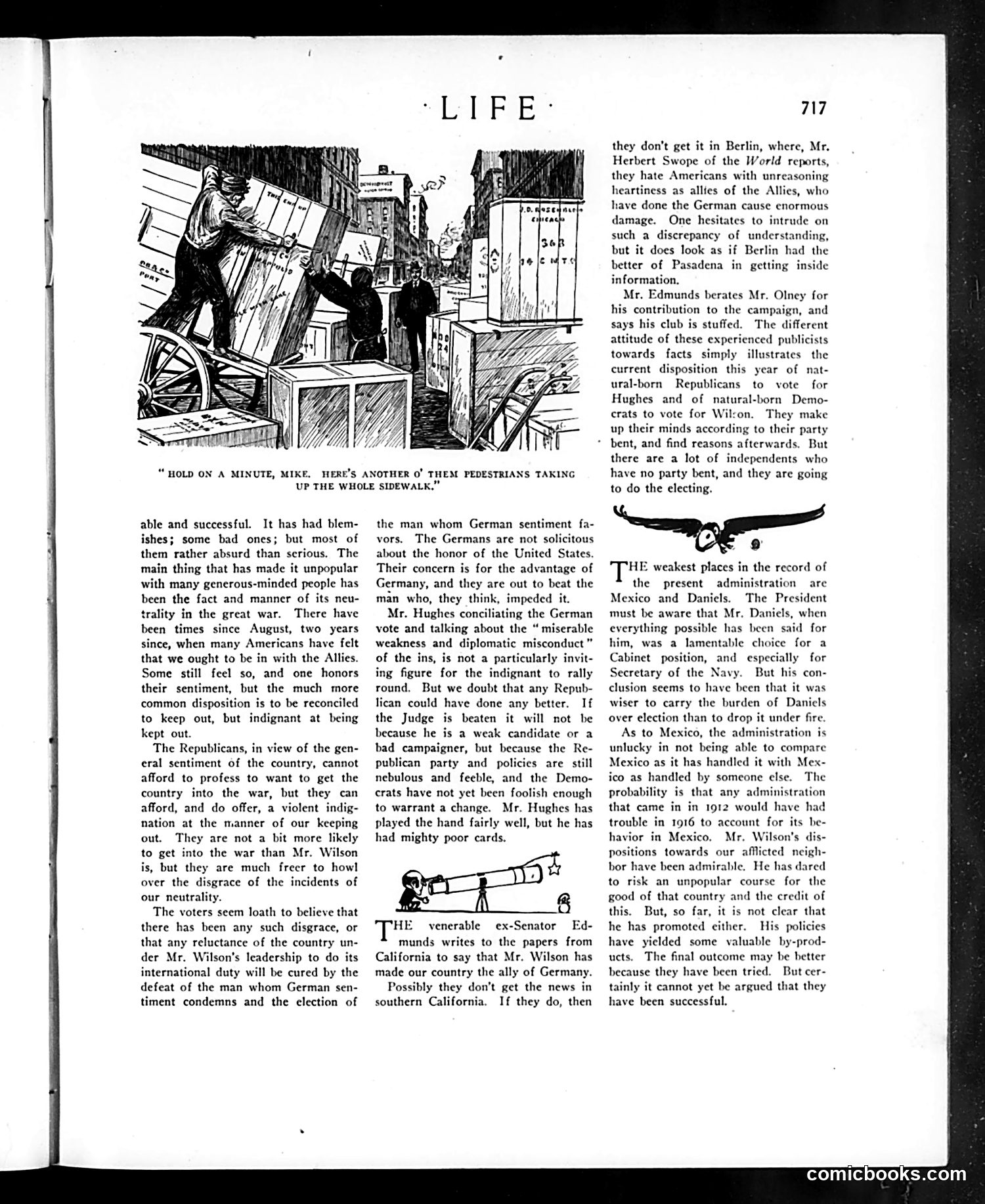
The cartoon depicts a chaotic urban street scene labeled "Hold on a minute, Mike, here's another o' them pedestrians taking up the whole sidewalk," showing a man struggling with an enormous pile of boxes and cargo while pedestrians navigate around him—a visual metaphor for obstruction and disorder. The accompanying text discusses the 1916 presidential election between incumbent Democrat Woodrow Wilson and Republican challenger Charles Evans Hughes. The author criticizes both parties: Republicans exploit anti-war sentiment while lacking genuine policy differences; Hughes is hampered by poor "cards" (policies). The piece attacks ex-Senator Edmunds and Navy Secretary Josephus Daniels as embarrassingly inconsistent—claiming Wilson made America "Germany's ally" while Germans view America as an Allied enemy. The author suggests independent voters, not party loyalists, will decide the election, and that Wilson's handling of Mexico and Daniels represent genuine weaknesses in his administration.
📄 Transcribed text from this page (OCR, searchable)
Machine-transcribed from the original scan — historical spelling and the odd misread are preserved.
“HOLD ON A MINUTE, MIKE, HERE’S ANOTHER 0’ THEM PEDESTRIANS TAKING UP THE WHOLE SIDEWALK,” able and successful. It has had blem- ishes; some bad ones; but most of them rather absurd than serious. The main thing that has made it unpopular with many generous-minded people has been the fact and manner of its neu- trality in the great war. There have been times since August, two years since, when many Americans have felt that we ought to be in with the Allies. Some still feel so, and one honors their sentiment, but the much more common disposition is to be reconciled to keep out, but indignant at being kept out. The Republicans, in view of the gen- eral sentiment of the country, cannot afford to profess to want to get the country into the war, but they can afford, and do offer, a violent indig- nation at the manner of our keeping out. They are not a bit more likely to get into the war than Mr. Wilson is, but they are much freer to howl over the disgrace of the incidents of our neutrality. The voters seem loath to believe that there has been any such disgrace, or that any reluctance of the country un- der Mr. Wilson's leadership to do its international duty will be cured by the defeat of the man whom German sen- timent condemns and the election of the man whom German sentiment fa- vors. The Germans are not solicitous about the honor of the United States. Their concern is for the advantage of Germany, and they are out to beat the man who, they think, impeded it. Mr. Hughes conciliating the German vote and talking about the “ miserable weakness and diplomatic misconduct” of the ins, is not a particularly invit- ing figure for the indignant to rally round, But we doubt that any Repub- lican could have done any better. If the Judge is beaten it will not be because he is a weak candidate or a bad campaigner, but because the Re- publican party and policies are still nebulous and feeble, and the Demo- crats have not yet been foolish enough to warrant a change. Mr. Hughes has played the hand fairly well, but he has had mighty poor cards. 8 HE venerable ex-Senator Ed- munds writes to the papers from California to say that Mr. Wilson has made our country the ally of Germany. Possibly they don’t get the news in southern California. If they do, then 717 they don’t get it in Berlin, where, Mr. Herbert Swope of the World reports, they hate Americans with unreasoning heartiness as allies of the Allies, who have done the German cause enormous damage. One hesitates to intrude on such a discrepancy of understanding, but it does look as if Berlin had the better of Pasadena in getting inside information, Mr. Edmunds berates Mr. Olney for his contribution to the campaign, and says his club is stuffed. The different attitude of these experienced publicists towards facts simply illustrates the current disposition this year of nat- ural-born Republicans to vote for Hughes and of natural-born Demo- crats to vote for Wilson. They make up their minds according to their party bent, and find reasons afterwards. But there are a lot of independents who have no party bent, and they are going to do the electing. ry Te weakest places in the record of the present administration are Mexico and Daniels. The President must be aware that Mr. Daniels, when everything possible has been 1 for him, was a lamentable choice for a Cabinet position, and especially for Secretary of the Navy. But his con- clusion seems to have been that it was wiser to carry the burden of Daniels over election than to drop it under fire. As to Mexico, the administration is unlucky in not being able to compare Mexico as it has handled it with Mex- ico as handled by someone el: The probability is that any administration that came in in 1912 would have had trouble in 1916 to account for its be- havior in Mexico. Mr. Wilson's dis positions towards our afflicted neigh- bor have been admirable, He has dared to risk an unpopular course for the good of that country and the credit of this. But, so far, it is not clear that he has promoted cither. His policies have yielded some valuable by-prod- ucts. The final outcome may be better because they have been tried. But cer- tainly it cannot yet be argued that they have been successful. comicbooks.com