
Life, 1916-10-26 · page 22 of 46
Life — October 26, 1916 — page 22: what you’re looking at
What you’re looking at
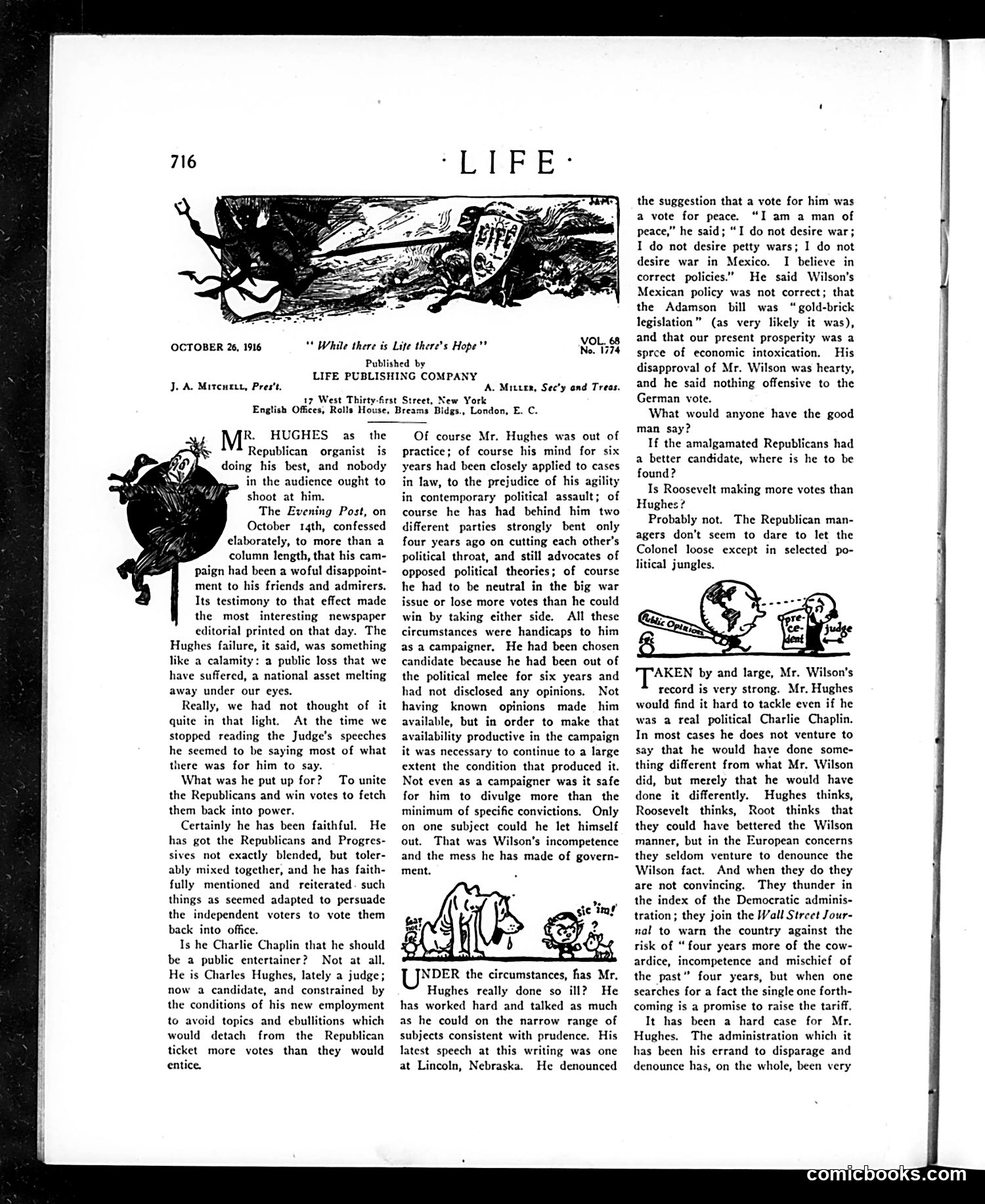
This editorial defends Republican presidential candidate Charles Evans Hughes against criticism that his campaign has been disappointing. The author argues Hughes faced impossible constraints: he was a recently-retired judge forced to avoid controversial statements to keep together the Republican and Progressive parties (recently split). Hughes couldn't take clear positions on the major issue—American entry into WWI—without losing votes. The cartoons (drawn in the margins) satirize Hughes as a rigid, mechanical campaigner ("organist") going through the motions. The text acknowledges Hughes could only safely attack Wilson's competence and Mexican policy. The author essentially argues Hughes deserves credit for doing as well as possible under these handicapping circumstances. This appears written days before the 1916 election, defending Hughes against fellow Republicans who felt he'd failed to energize the base.
📄 Transcribed text from this page (OCR, searchable)
Machine-transcribed from the original scan — historical spelling and the odd misread are preserved.
OCTOBER 26, 1916 “* While there is Lite there’s Hope"* VOL. 68 No. 1774 Published by LIFE PUBLISHING COMPANY J. A. Mitenett, Pres’t. A. Mitutx, Sec’y and Treas. 17 West Thirty-first Street, New York English Offices, Rolls House, Breams Bidgs., London, E. C. M*® HUGHES as the Republican organist is doing his best, and nobody in the audience ought to shoot at him. The Evening Post, on October 14th, confessed elaborately, to more than a column length, that his cam- paign had been a woful disappoint- ment to his friends and admirers. Its testimony to that effect made the most interesting newspaper editorial printed on that day. The Hughes failure, it said, was something like a calamity: a public loss that we have suffered, a national asset melting away under our eyes. Really, we had not thought of it quite in that light. At the time we stopped reading the Judge's speeches he seemed to be saying most of what there was for him to say. What was he put up for? To unite the Republicans and win votes to fetch them back into power. Certainly he has been faithful. He has got the Republicans and Progres- sives not exactly blended, but toler- ably mixed together, and he has faith- fully mentioned and reiterated. such things as seemed adapted to persuade the independent voters to vote them back into office. Is he Charlie Chaplin that he should be a public entertainer? Not at all. He is Charles Hughes, lately a judge; now a candidate, and constrained by the conditions of his new employment to avoid topics and ebullitions which would detach from the Republican ticket. more votes than they would entice, Of course Mr. Hughes was out of practice; of course his mind for six years had been closely applied to cases in law, to the prejudice of his agility in contemporary political assault; of course he has had behind him two different parties strongly bent only four years ago on cutting each other’s political throat, and still advocates of opposed political theories; of course he had to be neutral in the big war issue or lose more votes than he could by taking either side. All these circumstances were handicaps to him as a campaigner, He had been chosen candidate because he had been out of the political melee for six years and had not disclosed any opinions, Not having known opinions made him available, but in order to make that availability productive in the campaign it was necessary to continue to a large extent the condition that produced it. Not even as a campaigner was it safe for him to divulge more than the minimum of specific convictions. Only on one subject could he let himself out. That was Wilson's incompetence and the mess he has made of govern- ment. NDER the circumstances, has Mr. Hughes really done so ill? He has worked hard and talked as much as he could on the narrow range of subjects consistent with prudence. His latest speech at this writing was one at Lincoln, Nebraska. He denounced the suggestion that a vote for him was a vote for peace. “I am a man of peace,” he said; “I do not desire war; I do not desire petty wars; I do not desire war in Mexico. I believe in correct policies.” He said Wilson’s Mexican policy was not correct; that the Adamson bill was “ gold-brick legislation” (as very likely it was), and that our present prosperity was a sprce of economic intoxication. His disapproval of Mr. Wilson was hearty, and he said nothing offensive to the German vote. What would anyone have the good man say? If the amalgamated Republicans had a better candidate, where is he to be found? Is Roosevelt making more votes than Hughes? Probably not. The Republican man- agers don’t seem to dare to let the Colonel loose except in selected po- litical jungles. ‘AKEN by and large, Mr. Wilson’s record is very strong. Mr. Hughes would find it hard to tackle even if he was a real political Charlie Chaplin. In most cases he does not venture to say that he would have done some- thing different from what Mr. Wilson did, but merely that he would have done it differently. Hughes thinks, Roosevelt thinks, Root thinks that they could have bettered the Wilson manner, but in the European concerns they seldom venture to denounce the Wilson fact. And when they do they are not convincing. They thunder in the index of the Democratic adminis- tration; they join the Wall Street Jour- nal to warn the country against the risk of “four years more of the cow- ardice, incompetence and mischief of the past” four years, but when one searches for a fact the single one forth- coming is a promise to raise the tariff. It has been a hard case for Mr. Hughes, The administration which it has been his errand to disparage and denounce has, on the whole, been very