
Life, 1916-10-26 · page 18 of 46
Life — October 26, 1916 — page 18: what you’re looking at
What you’re looking at
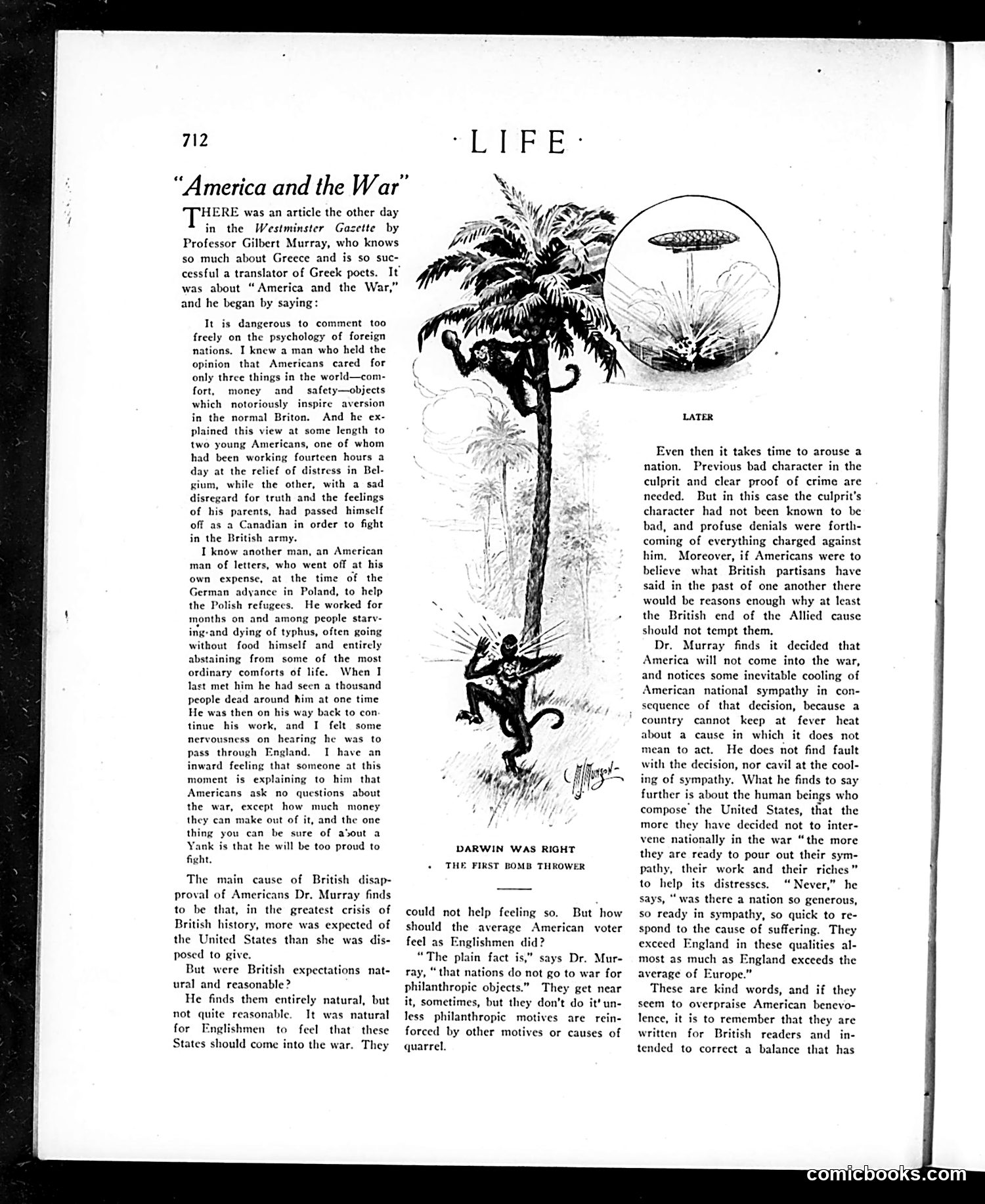
This page discusses Professor Gilbert Murray's essay defending American neutrality during WWI (likely 1914-1916). The cartoon shows a figure labeled "Darwin Was Right—The First Bomb Thrower," depicting an ape throwing a bomb from a palm tree, with a UFO-like object above. **The satire's point:** Murray argues that British expectations for American intervention were natural but unreasonable. He refutes the stereotype that Americans only care about "comfort, money and safety"—citing counterexamples of Americans working without compensation in Belgium and Poland. The cartoon appears to mock primitive nationalism or warlike impulses as evolutionary regression ("Darwin was right"), suggesting that demands for America to join the war reflect base, uncivilized thinking rather than rational policy. The piece advocates for understanding America's decision to remain neutral while acknowledging American humanitarian contributions, challenging British criticism of American selfishness.
📄 Transcribed text from this page (OCR, searchable)
Machine-transcribed from the original scan — historical spelling and the odd misread are preserved.
712 “America and the War if fuss was an article the other day in the Westminster Gazette by Professor Gilbert Murray, who knows so much about Greece and is so suc- cessful a translator of Greek pocts. It’ was about “America and the War,” and he began by saying: Tt is dangerous to comment too freely on the psychology of foreign nations. I knew a man who held the opinion that Americans cared for only three things in the world—com- fort, money and safety—objects which notoriously inspire aversion in the normal Briton. And he ex- plained this view at some length to two young Americans, one of whom had been working fourteen hours a day at the relief of distress in Bel- gium, while the other, with a sad disregard for truth and the feelings of his parents, had passed himself off as a Canadian in order to fight in the British army. I know another man, an American man of letters, who went off at his own expense, at the time of the German adyance in Poland, to help the Polish refugees. He worked for months on and among people starv- ing-and dying of typhus, often going without food himself and entirely abstaining from some of the most ordinary comforts of life. When I last met him he had seen a thousand people dead around him at one time He was then on his way back to con: tinue his work, and I felt some nervousness on hearing he was to pass through England. I have an inward feeling that someone at this moment is explaining to him that Americans ask no questions about the war, except how much money they can make out of it, and the one thing you can be sure of about a Yank is that he will be too proud to fight. The main cause of British disap- proval of Americans Dr. Murray finds to be that, in the greatest crisis of British history, more was expected of the United States than she was dis- posed to give. But were British expectations nat- ural and reasonable? He finds them entirely natural, but not quite reasonable. It was natural for Englishmen to feel that these States should come into the war. They DARWIN WAS RIGHT + THE FIRST BOMB THROWER But how should the average American voter feel as Englishmen did? “The plain fact is,” says Dr. Mur- could not help feeling so. ray, “ that nations do not go to war for philanthropic objects.” They get near it, sometimes, but they don’t do it'un- less philanthropic motives are rein- forced by other motives or causes of quarrel. LATER Even then it takes time to arouse a nation. Previous bad character in the culprit and clear proof of crime are needed. But in this case the culprit's character had not been known to be bad, and profuse denials were forth- coming of everything charged against him, Moreover, if Americans were to believe what British partisans have said in the past of one another there would be reasons enough why at least the British end of the Allied cause should not tempt them. Dr. Murray finds it decided that America will not come into the war, and notices some inevitable cooling of American national sympathy in con- sequence of that decision, because a country cannot keep at fever heat about a cause in which it does not mean to act. He does not find fault with the decision, nor cavil at the cool- ing of sympathy, What he finds to say further is about the human beings who compose’ the United States, that the more they have decided not to inter- vene nationally in the war “the more they are ready to pour out their sym- pathy, their work and their riches” to help its distresses. “Never,” he says, “was there a nation so generous, so ready in sympathy, so quick to re- spond to the cause of suffering. They exceed England in these qualities al- most as much as England exceeds the average of Europe.” These are kind words, and if they seem to overpraise American benevo- lence, it is to remember that they are written for British readers and in- tended to correct a balance that has