
Life, 1916-10-26 · page 20 of 46
Life — October 26, 1916 — page 20: what you’re looking at
What you’re looking at
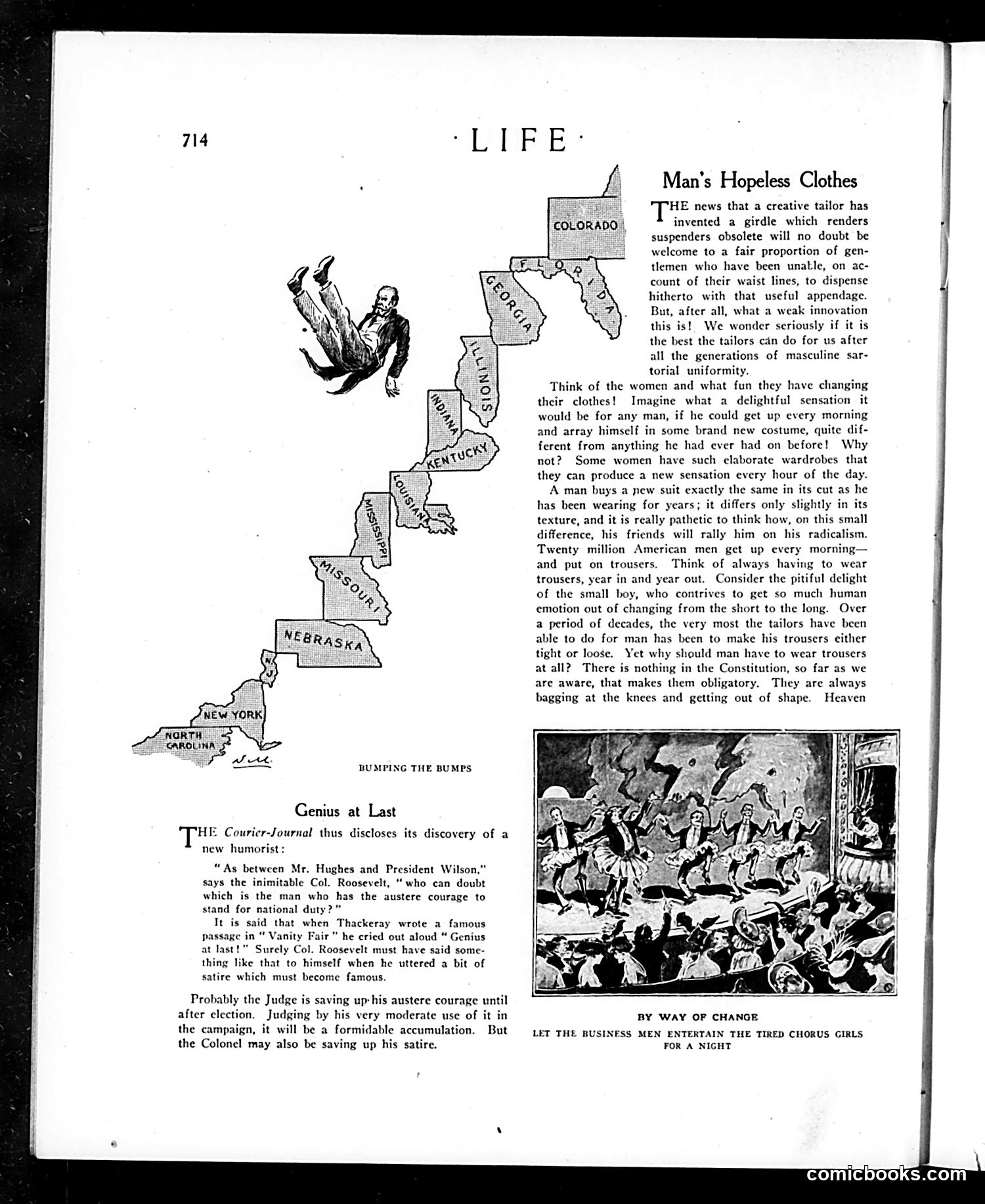
**"Bumping the Bumps"** (left cartoon): A map shows a man tumbling down the central United States. This satirizes Theodore Roosevelt's 1912 presidential campaign, where he ran as a third-party "Progressive" candidate, literally disrupting the two-party system. **"Genius at Last"** (text): Life magazine mocks Roosevelt's claimed moral superiority over President Wilson and Republican Hughes. The piece sarcastically suggests Roosevelt's self-righteous statements about "austere courage" and "national duty" constitute his wit—implying his political posturing is pretentious rather than genuinely clever. **"Man's Hopeless Clothes"** (right): A humorous essay lamenting men's fashion monotony. It contrasts women's varied wardrobes with men's uniform trousers, mocking how men face social ridicule for minor sartorial changes while women enjoy constant wardrobe innovation. The essay questions why men are obligated to wear trousers, treating the question as absurd yet serious commentary on rigid masculine convention. The page overall satirizes both political hypocrisy and social conformity.
📄 Transcribed text from this page (OCR, searchable)
Machine-transcribed from the original scan — historical spelling and the odd misread are preserved.
BUMPING THE BUMPS Genius at Last HE Courier-Journal thus discloses its discovery of a new humorist: “As between Mr. Hughes and President Wilson,” says the inimitable Col. Roosevelt, “who can doubt which is the man who has the austere courage to stand for national duty?” Tt is said that when Thackeray wrote a famous passage in “ Vanity ir” he cried out aloud “ Genius at last!" Surely Col. Roosevelt must have said some- thing like that to himself when he uttered a bit of satire which must become famous. Probably the Judge is saving up: his austere courage until after election. Judging by his very moderate use of it in the campaign, it will be a formidable accumulation. But the Colonel may also be saving up his satire. Man’s Hopeless Clothes 'HE news that a creative tailor has invented a girdle which renders suspenders obsolete will no doubt be welcome to a fair proportion of gen- tlemen who have been unable, on ac- count of their waist lines, to dispense hitherto with that useful appendage. But, after all, what a weak innovation this is! We wonder seriously if it is the best the tailors can do for us after all the generations of masculine sar- torial uniformity. Think of the women and what fun they have changing their clothes!’ Imagine what a delightful sensation it would be for any man, if he could get up every morning and array himself in some brand new costume, quite dif- ferent from anything he had ever had on before! Why not? Some women have such elaborate wardrobes that they can produce a new sensation every hour of the day. A man buys a new suit exactly the same in its cut as he has been wearing for years; it differs only slightly in its texture, and it is really pathetic to think how, on this small difference, his friends will rally him on his radicalism. Twenty million American men get up every morning— and put on trousers. Think of always having to wear trousers, year in and year out. Consider the pitiful delight of the small boy, who contrives to get so much human emotion out of changing from the short to the long. Over a period of decades, the very most the tailors have been able to do for man has been to make his trousers either tight or loose. Yet why should man have to wear trousers at all? There is nothing in the Constitution, so far as we are aware, that makes them obligatory. They are always bagging at the knees and getting out of shape. Heaven COLORADO. BY WAY OF CHANGE LET THE BUSINESS MEN ENTERTAIN THE TIRED CHORUS GIRLS FOR A NIGHT