
A complete issue · 34 pages · 1916
Life — August 31, 1916
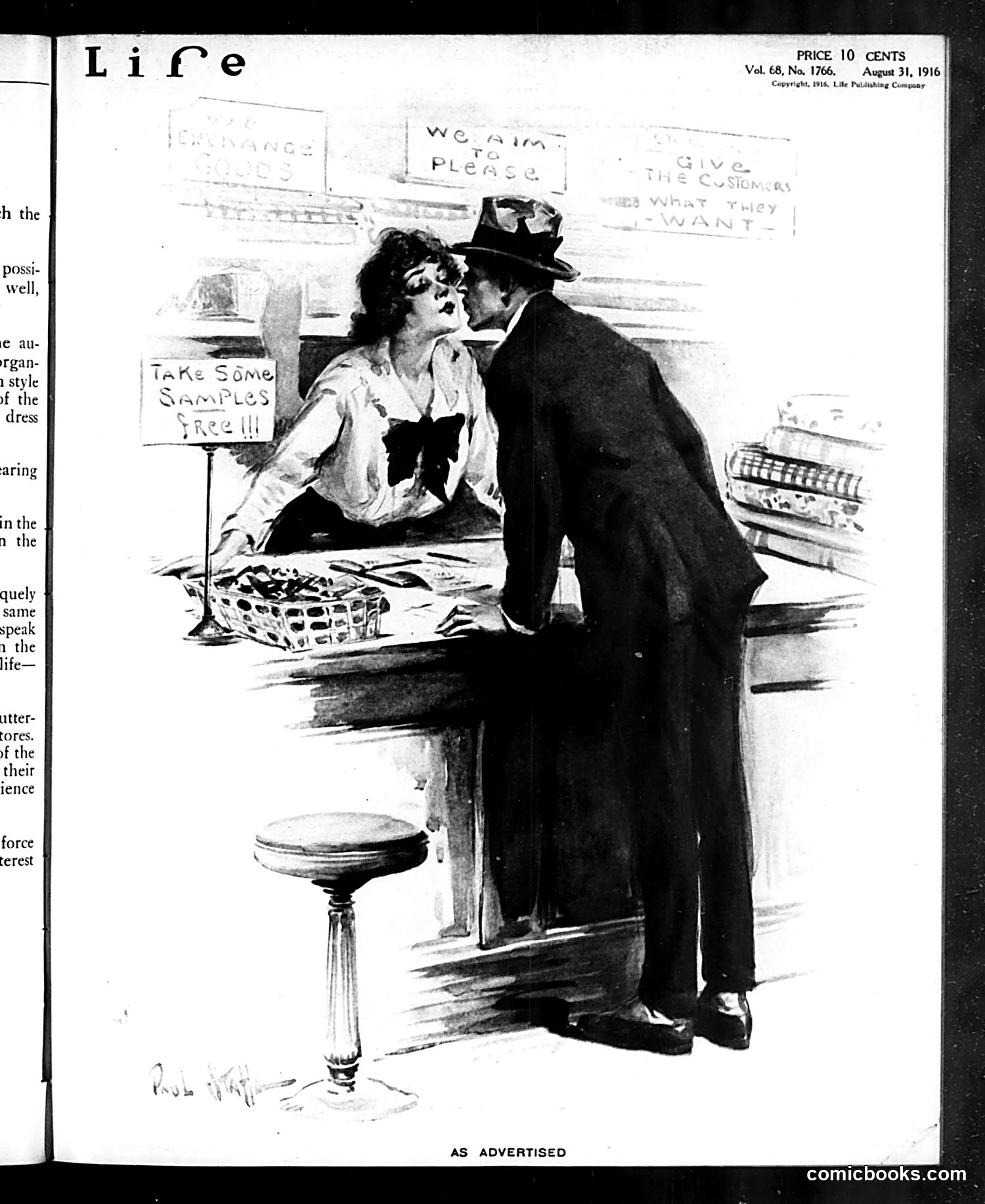
This Life magazine cover (August 31, 1916) shows a flirtatious scene titled "AS ADVERTISED." A well-dressed man in a suit and hat leans toward a woman at what appears to be a shop counter displaying fabric samples. Signs visible include "WE AIM TO PLEASE," "GIVE THE CUSTOMER WHAT THEY WANT," and "TAKE SOME SAMPLES FREE!!!" The satire appears to critique retail sales tactics and male-female dynamics in commerce. The woman's surprised expression and the man's forward posture suggest the "advertisement" promises of customer service are being taken literally—or too personally. This likely mocks both exaggerated retail marketing claims of the era and contemporary attitudes about flirtation and gender relations in commercial spaces. The humor derives from the gap between professional salesmanship and actual behavior.
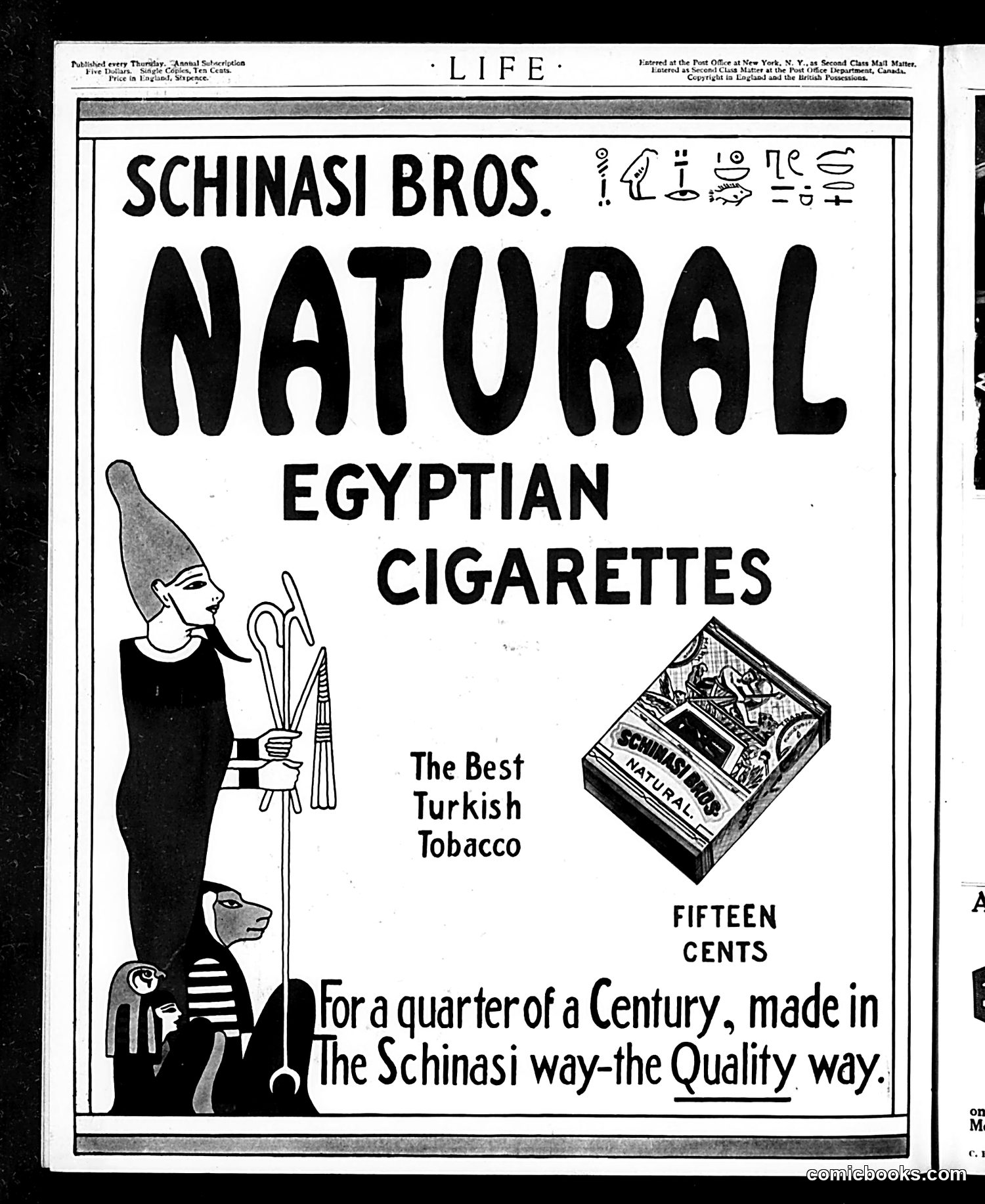
This is a straightforward cigarette advertisement, not political satire. The ad promotes "Natural Egyptian Cigarettes" by Schinasi Bros., priced at fifteen cents. The imagery uses Egyptian iconography—a figure in pharaonic dress with hieroglyphics—as a marketing device to suggest exotic sophistication and quality tobacco. The tagline claims the product has been "made in the Schinasi way—the quality way" for a quarter-century. This reflects early 20th-century advertising conventions: using foreign/orientalist imagery to market luxury goods, and Egyptian cigarettes were genuinely popular and prestigious at this time. The ad makes no apparent political commentary—it's simply commercial copy capitalizing on cultural associations between Egypt and refined tobacco products.
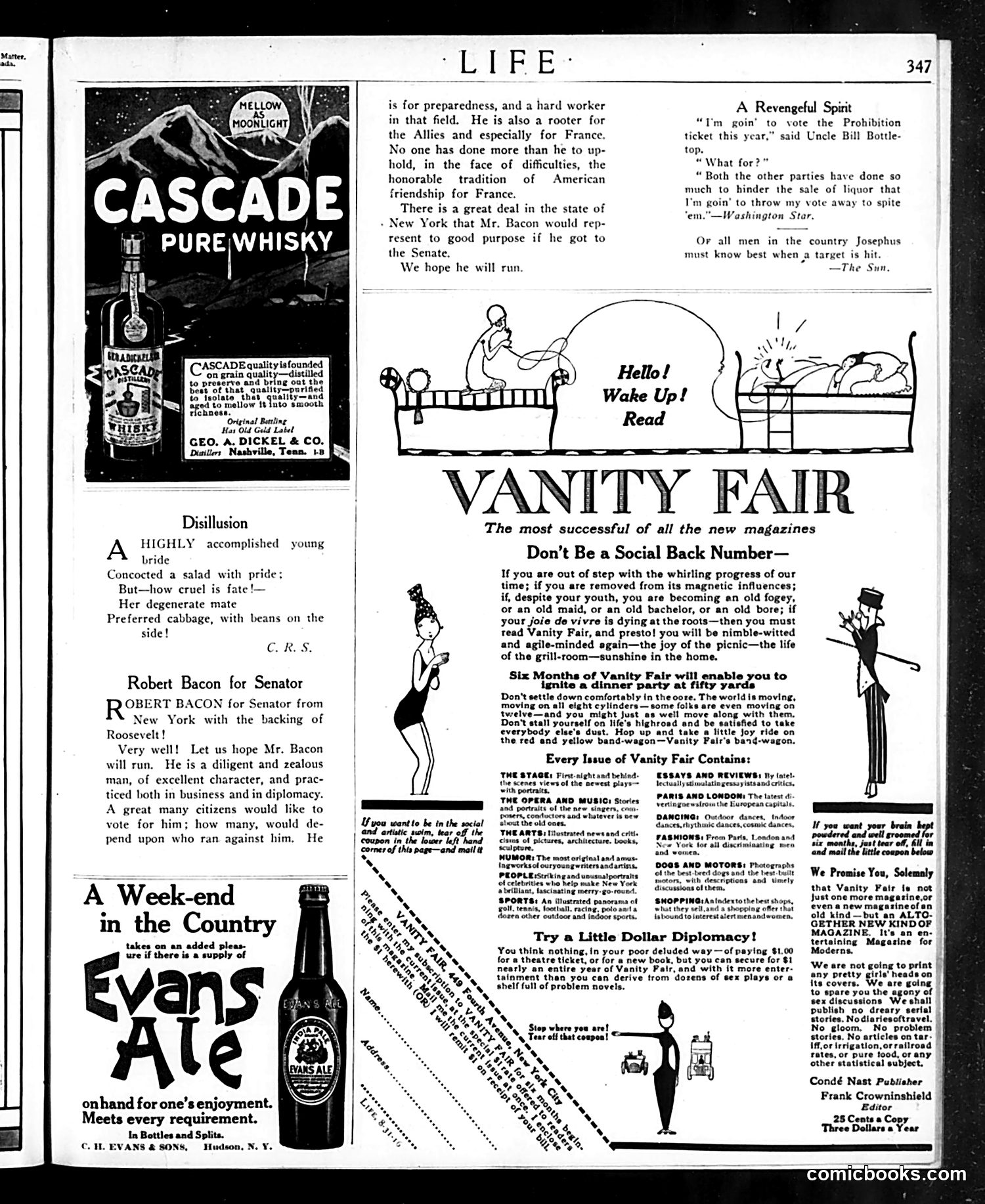
This page is primarily **advertising and editorial content** rather than political satire. The main elements include: - **Cascade Pure Whisky advertisement** (top left) - **Evans Ale advertisement** (bottom left) - **Vanity Fair magazine promotion** (center/right) - describing it as "the most successful of all the new magazines" and listing its features (fashion, essays, humor, arts, sports, shopping) - **Political editorial** supporting Robert Bacon for New York Senator, praising him as "diligent and zealous" with "excellent character" - A brief satirical poem titled "Disillusion" about a bride and cabbage The page reflects **1920s consumer culture** and magazine marketing rather than sharp political cartooning. The Bacon endorsement appears straightforward rather than satirical.
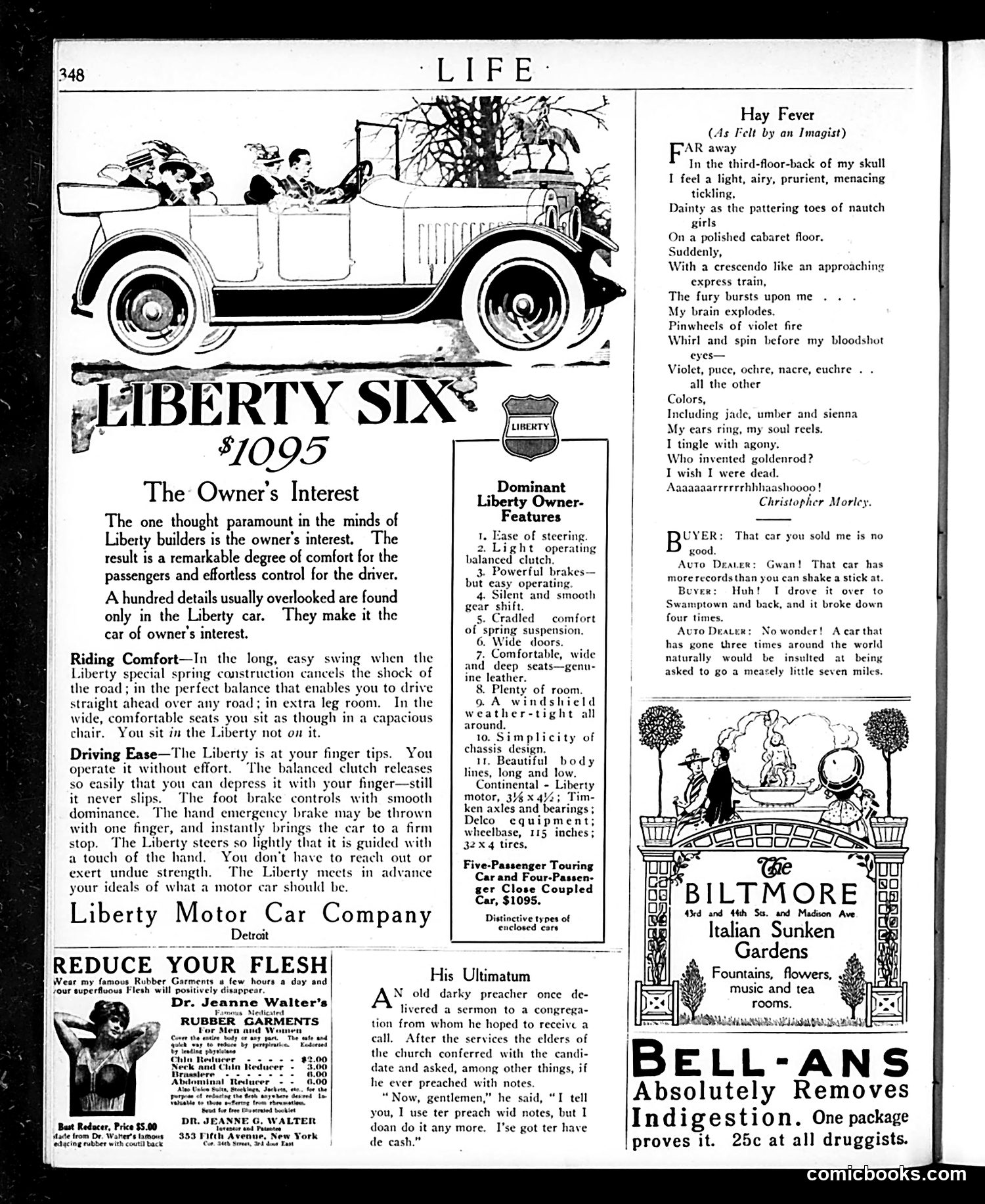
This page is primarily **advertising and product content** from a 1920s American magazine. The main feature is a **Liberty Six automobile advertisement** ($1,095), emphasizing owner comfort through detailed mechanical features and driving ease. The ad includes a humorous dialogue between a buyer and auto dealers—satirizing salesmen's exaggerated claims about car durability and performance. Above the auto ad is a poem titled **"Hay Fever"** by Christopher Morley, humorously describing the sensory chaos of an allergic reaction using vivid, modernist language ("pinwheels of violet fire"). The page also contains period advertisements for rubber garments, the Biltmore Gardens, and Bell-Ans indigestion remedy—typical 1920s consumer products. There is **no political cartoon** on this page; it's a commercial publication page mixing poetry with product marketing.
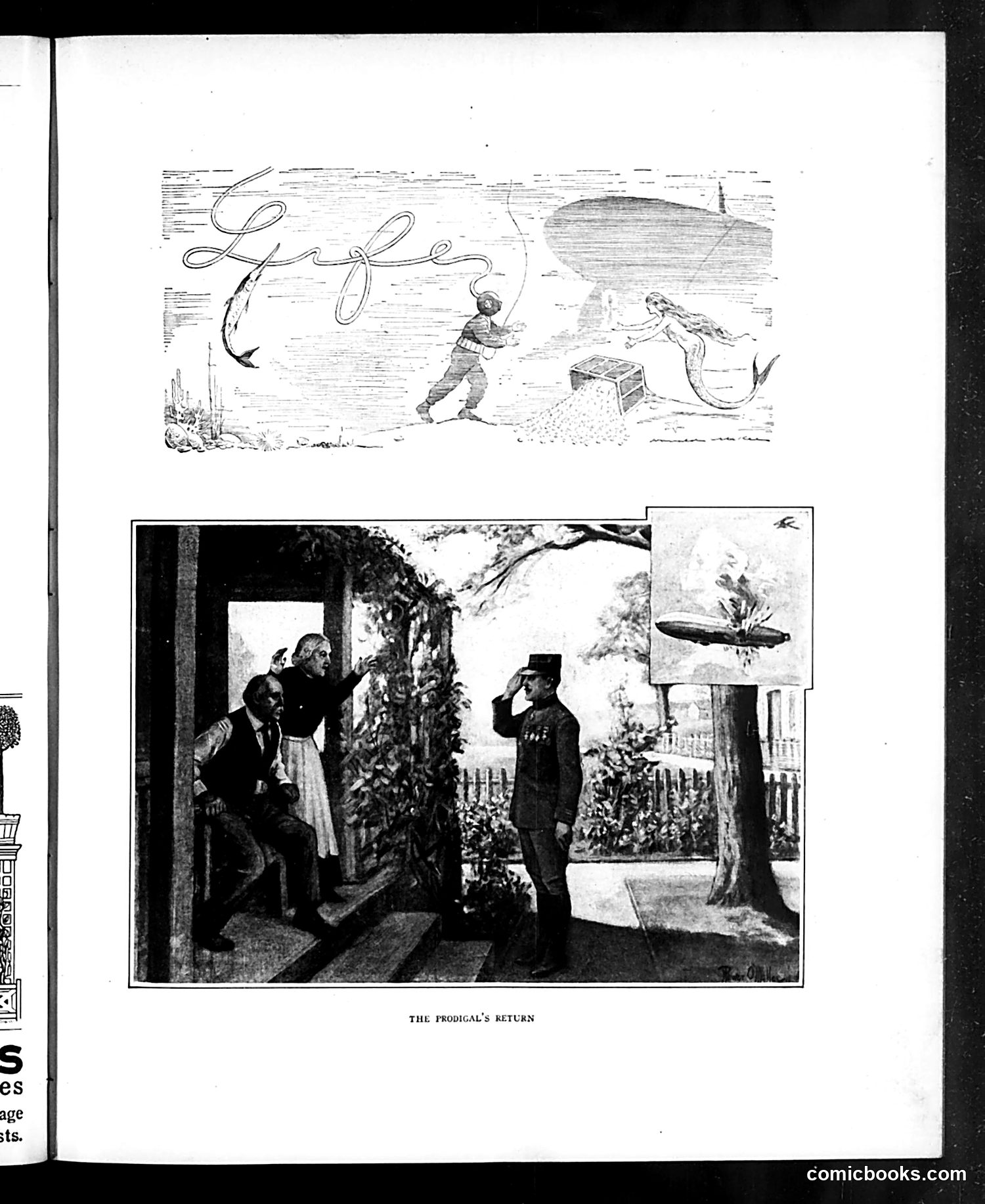
This page contains two illustrations. The top sketch shows underwater figures labeled "Life" — depicting fishing, a diver, and a mermaid in a whimsical underwater scene. The bottom illustration, titled "The Prodigal's Return," depicts a dramatic domestic scene. Two men in formal attire (one appears elderly, one younger in military uniform) stand in a garden setting while a woman gestures from a doorway. A small inset shows what appears to be an airship or zeppelin. Without additional context, the military uniform and airship reference suggest this may satirize either a return from military service or possibly relates to early 20th-century aviation/warfare themes. The "prodigal" reference suggests someone returning after absence or disgrace, but the specific political or social commentary remains unclear from the image alone.
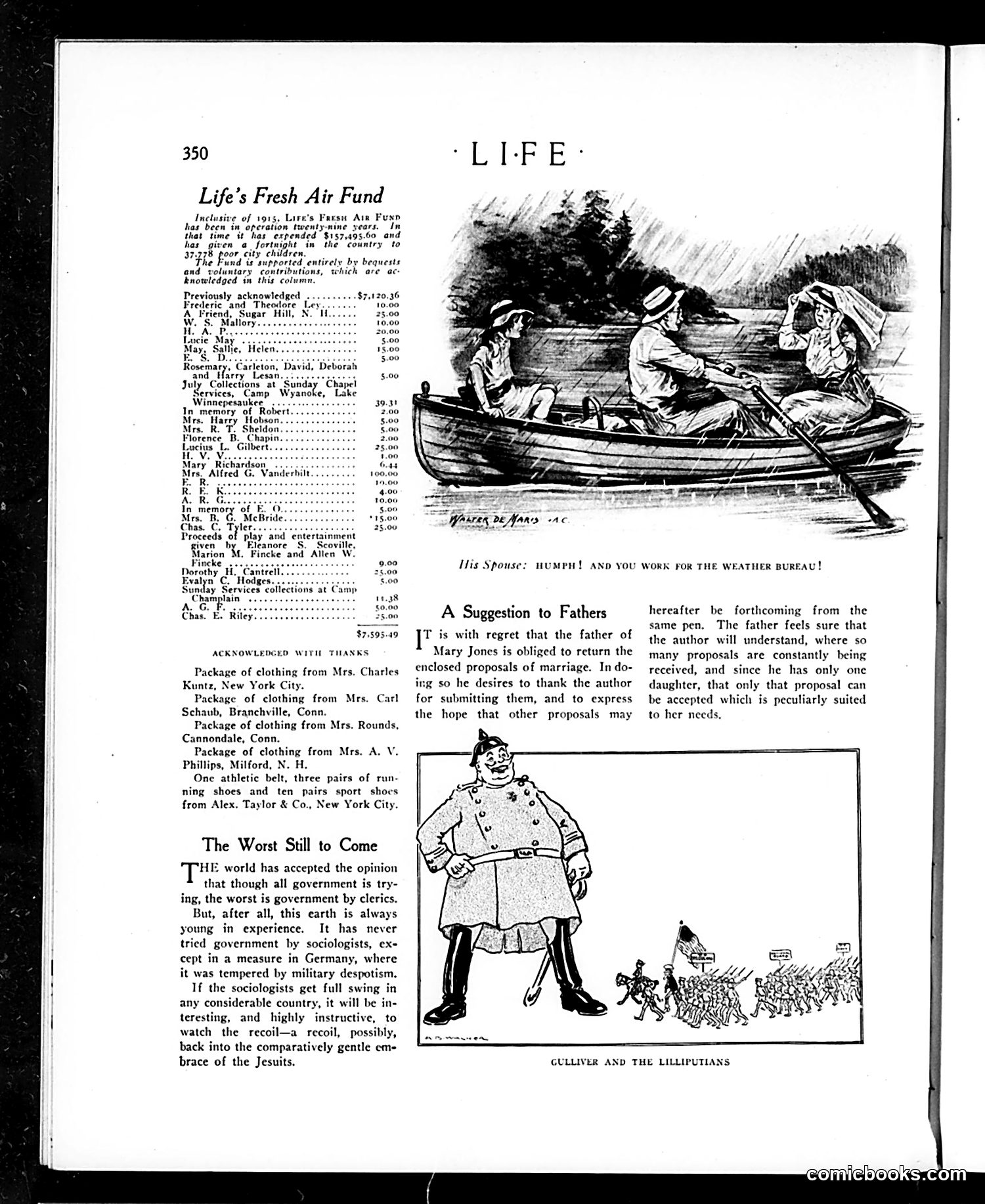
**Top Illustration: "His Spouse: Humph! And You Work for the Weather Bureau!"** This cartoon depicts a couple in a rowboat. The wife appears skeptical or critical of her husband, who apparently works for the Weather Bureau. The joke likely plays on marital discord—the husband predicts weather professionally but cannot manage his domestic situation, or perhaps his weather predictions are as unreliable as their relationship. **Bottom Illustration: "Gulliver and the Lilliputians"** This cartoon shows a large, well-dressed figure (Gulliver) towering over tiny people (Lilliputians). It references Jonathan Swift's *Gulliver's Travels*, likely satirizing how someone in power or authority dominates smaller, weaker opponents or populations—a commentary on power dynamics or bullying.
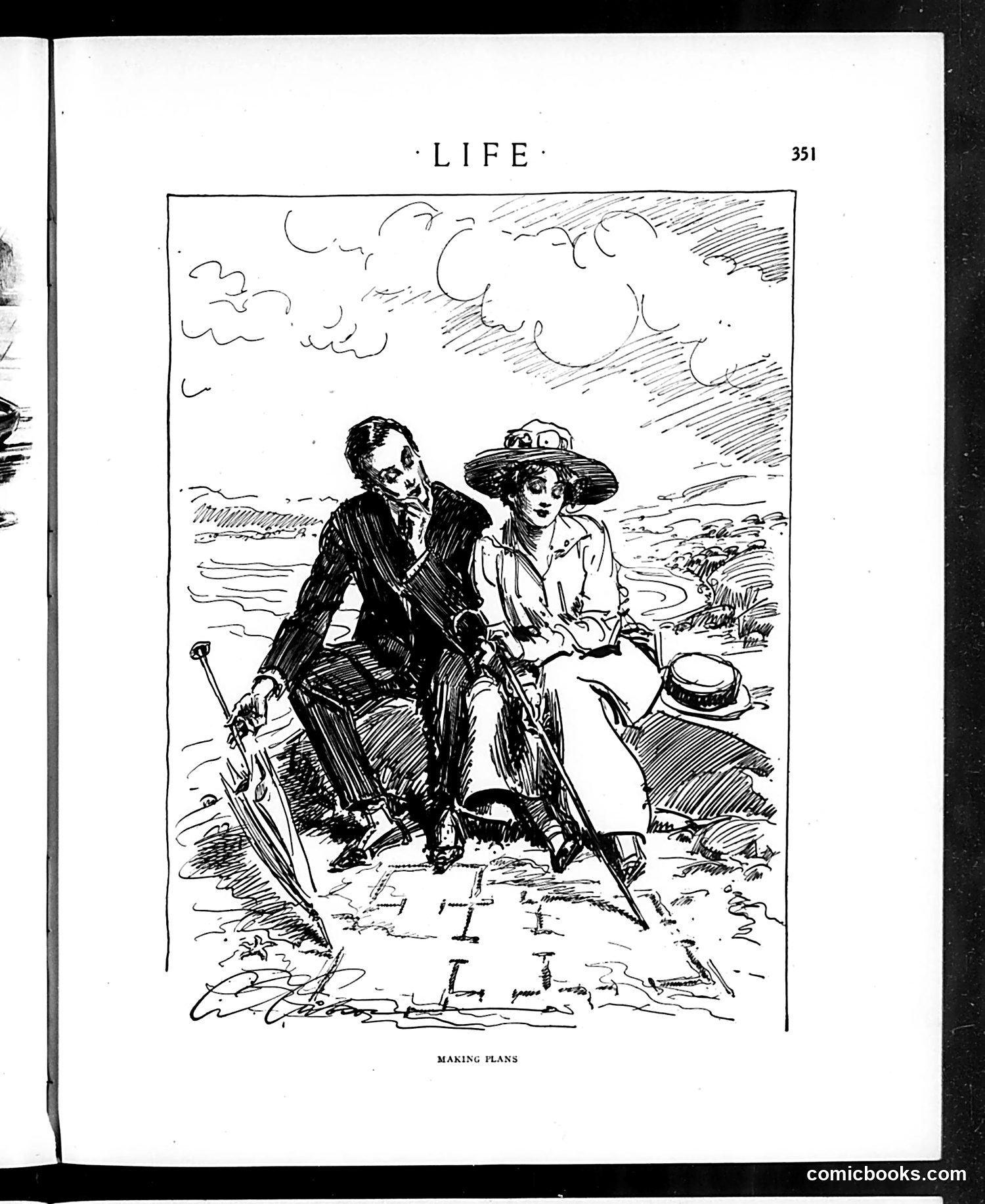
This cartoon depicts a well-dressed man in a pinstriped suit and a woman in a wide-brimmed hat sitting outdoors, examining what appear to be architectural or surveying plans laid on the ground. Various surveying tools (stakes, measuring implements) are scattered around them. The caption "Making Plans" suggests a romantic or social scenario, likely satirizing urban couples engaged in leisure activities or vacation planning. The detailed surveying equipment and formal attire in a rural setting create incongruity—the joke appears to be about aspirational or pretentious urban people attempting outdoor activities or property development schemes. The specific social criticism remains somewhat unclear without additional context about Life magazine's contemporary concerns.
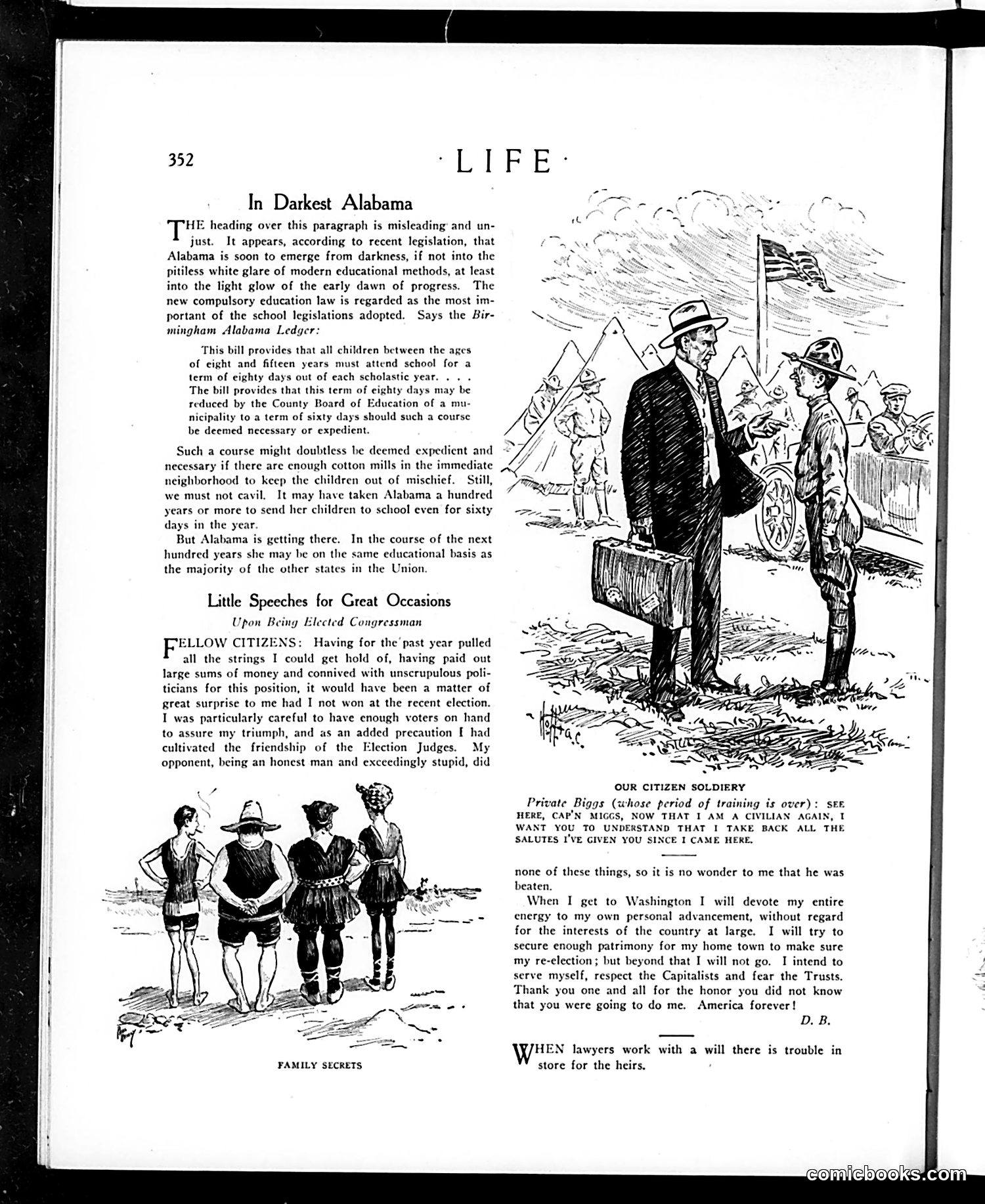
This page contains satirical commentary on Alabama's education law and a humorous political speech. **"In Darkest Alabama"** criticizes Alabama's compulsory education law as inadequate—requiring only 60 days of schooling yearly for children ages 8-15, which the author argues is insufficient progress compared to other states. **"Little Speeches for Great Occasions"** presents a mock Congressional victory speech (signed "D.B.") from an elected official thanking supporters while promising to prioritize personal advancement in Washington. The cartoons illustrate everyday scenes: one shows a traveling salesman or politician greeting rural citizens; another titled "Family Secrets" depicts four figures in conversation, likely representing gossip or private matters becoming public. The page satirizes both political inadequacy regarding education and self-serving politician rhetoric.
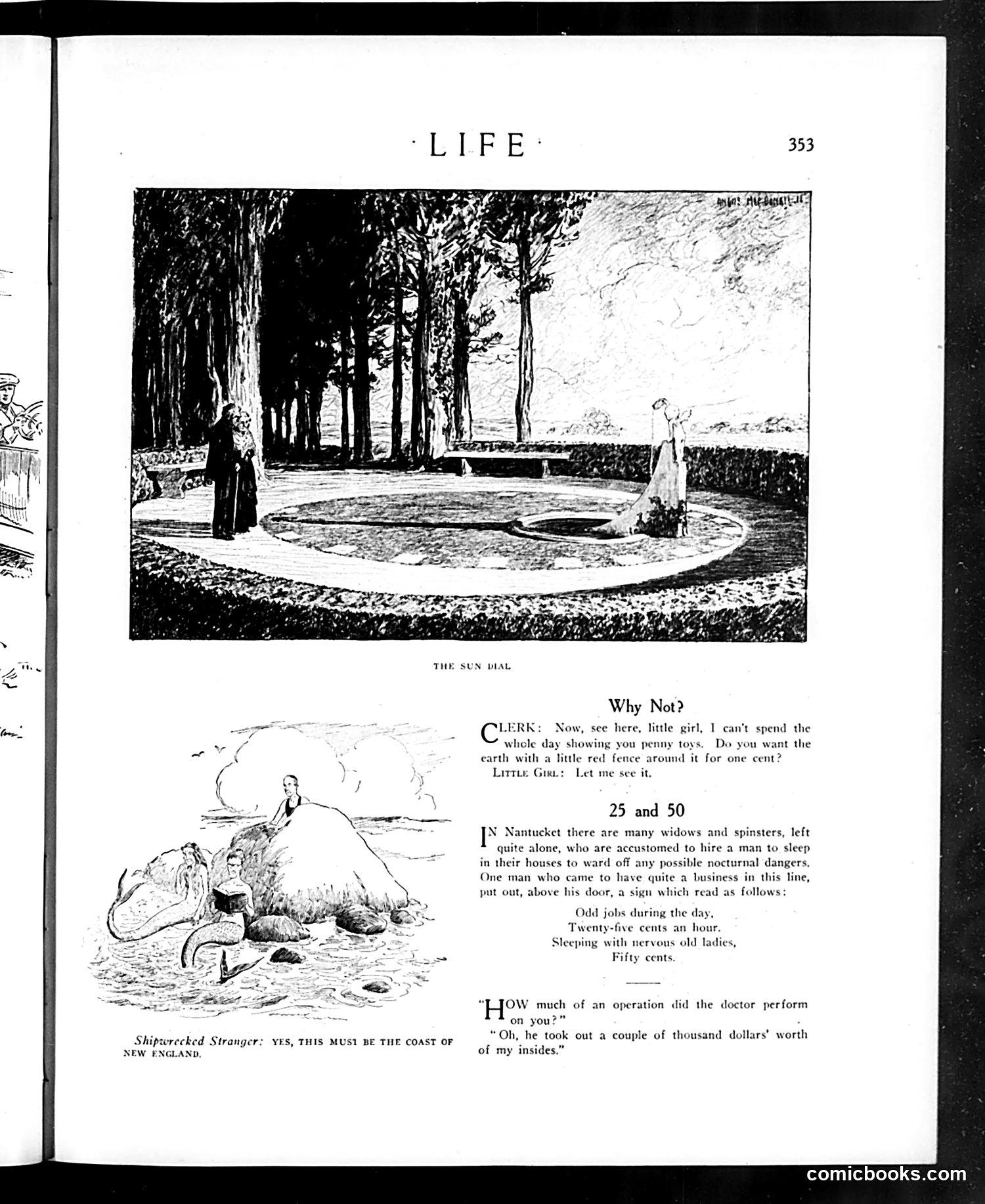
**Top Image:** "The Sun Dial" depicts a formal garden scene with tall trees framing a circular sun dial. This appears to be an architectural or landscape photograph rather than satirical content. **Middle Section - "Why Not?":** A brief dialogue joke where a clerk asks a little girl if she wants to rent a penny toy displayed in a fenced enclosure. The humor derives from the absurdity of charging rental fees for inexpensive children's toys. **Bottom Image & "25 and 50":** The illustration shows a shipwrecked stranger, captioned "YES, THIS MUST BE THE COAST OF NEW ENGLAND." The accompanying text mocks Nantucket's widows who hire men to sleep in their homes as protection against "nocturnal dangers"—charging 25 cents hourly for daytime odd jobs and 50 cents for nighttime security services. The satire targets perceived Yankee frugality and opportunism.
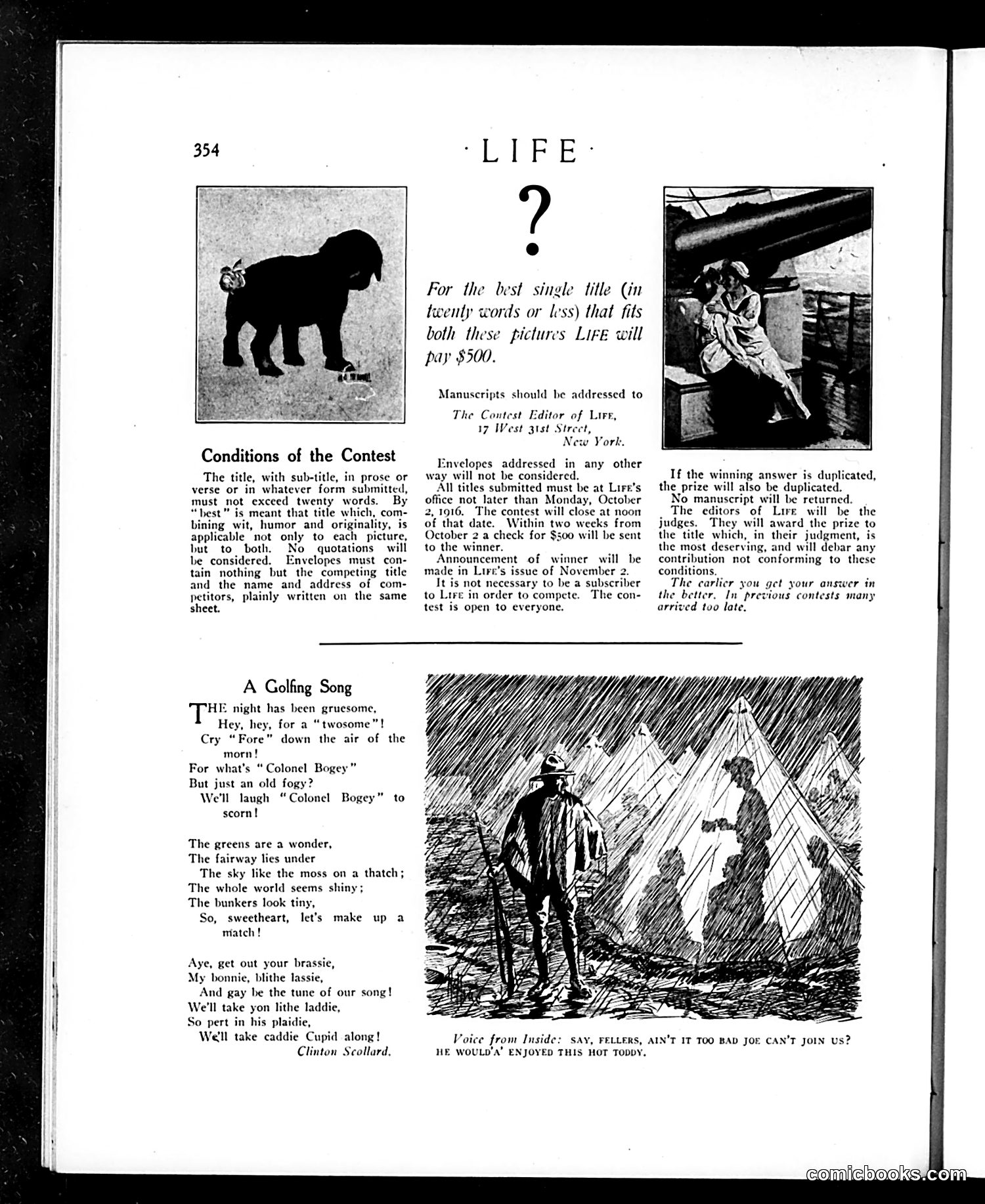
This page contains a **contest announcement** and a **military humorous poem**. **The Contest:** Life is soliciting single-title submissions (20 words or less) to accompany two photographs—one of a dog and one of soldiers. The winner receives $500. Entries close October 2, 1916. **"A Golfing Song" by Clinton Scollard:** This poem mocks an elderly character, "Colonel Bogey," through military camp humor. The verses employ Irish dialect ("brassie," "laddie") and soldier slang, suggesting the poem satirizes either aging military officers or the general absurdity of military life. The accompanying illustration depicts soldiers in a rainy camp with tents. The overall tone is lighthearted wartime satire, typical of Life magazine's editorial content during the WWI era.
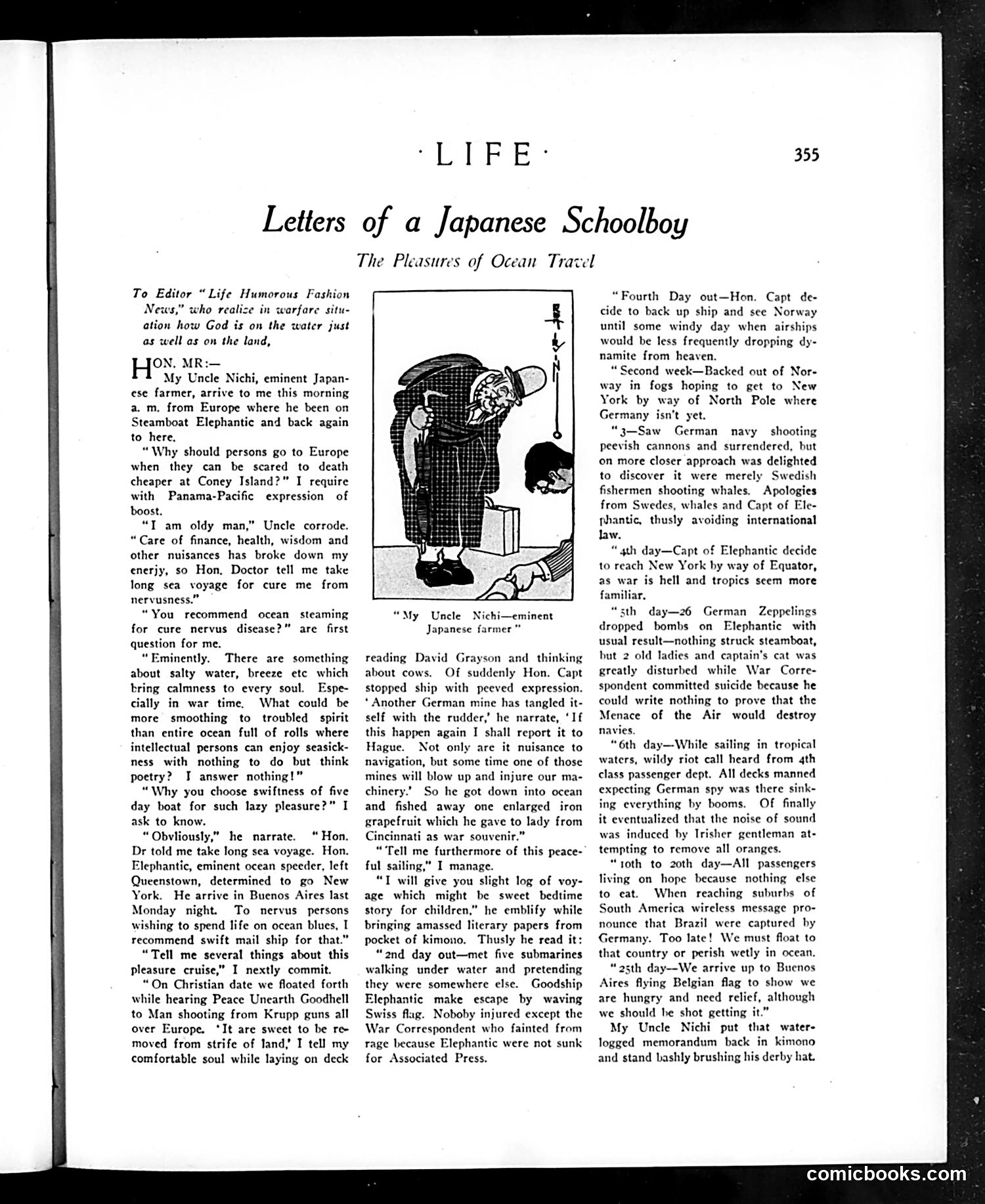
This satirical piece mocks a Japanese farmer ("Uncle Nichi") who has arrived in Europe aboard the steamship *Elephantic*. The cartoon shows him as a stereotypical figure with exaggerated features, dressed in traditional Japanese clothing while appearing bewildered by Western travel. The satire centers on the absurdity of ocean voyage during wartime (context suggests WWI era). The letter humorously catalogs ridiculous maritime incidents: German zeppelins bombing the ship, encounters with Swedish fishermen hunting whales, submarines, and floating grapefruit. The joke plays on cultural clash—a Japanese farmer encountering European warfare and nonsensical maritime chaos—while implicitly mocking the dangers and irrationality of wartime travel. The exaggerated, improbable events escalate the humor throughout.
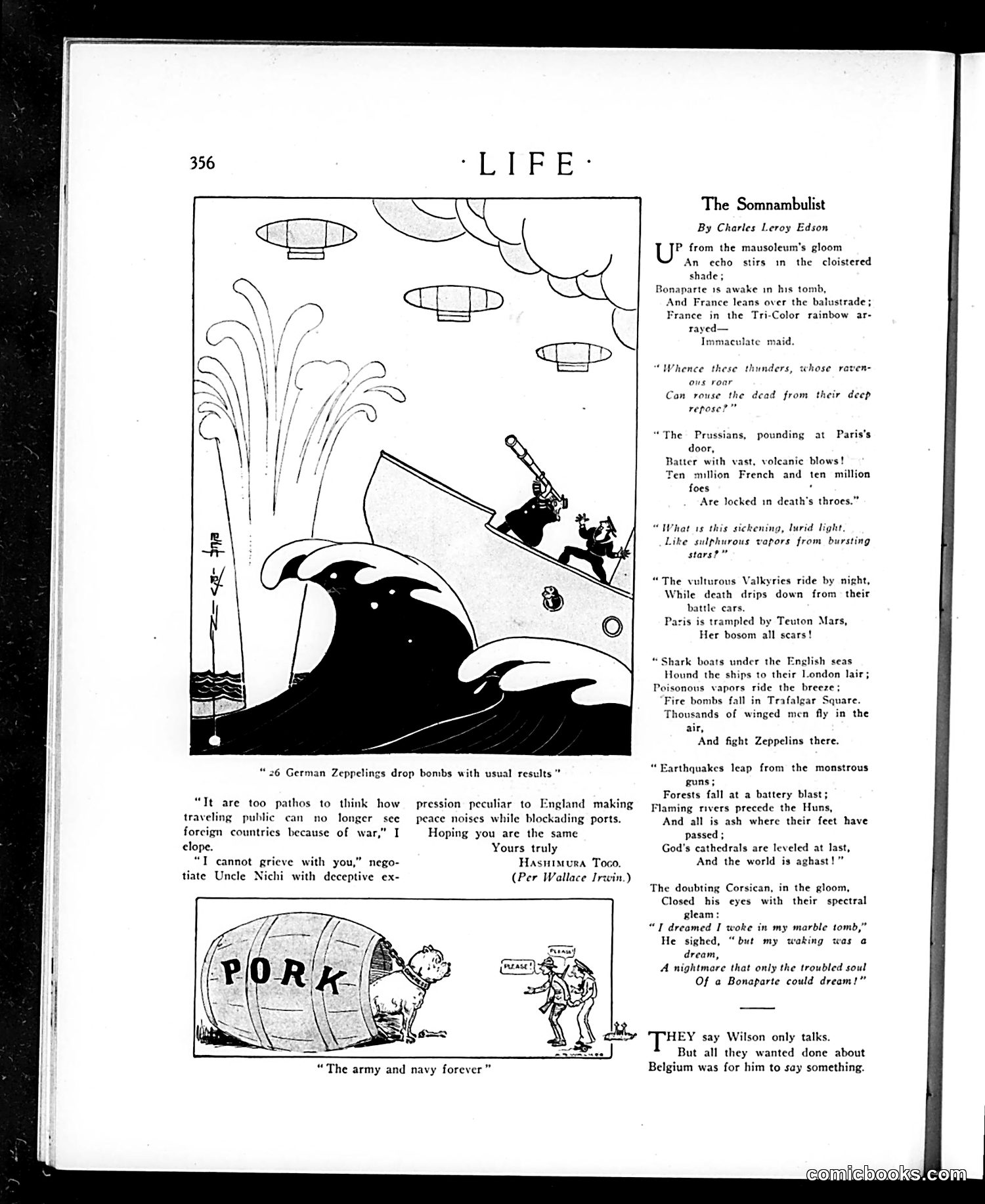
This page satirizes WWI through Charles Leroy Edison's poem about Napoleon Bonaparte sleepwalking through a nightmarish vision of modern warfare. The central cartoon shows German Zeppelins (airships) bombing, with explosions and naval warfare depicted below—referencing actual aerial bombardment that shocked civilians during the war. The bottom cartoon mocks food shortages, showing a pork barrel labeled "PLEASE!" with soldiers fighting over it—satirizing both military supply problems and civilian rationing during WWI. The poem's surreal tone mocks the war's chaos: Prussians attacking Paris, Valkyries, shark boats, English naval conflict, and ultimately destruction ("God's cathedrals are leveled"). The final stanza cynically notes Wilson (U.S. President) merely talks while Belgium suffers—criticizing American hesitation before 1917 entry.
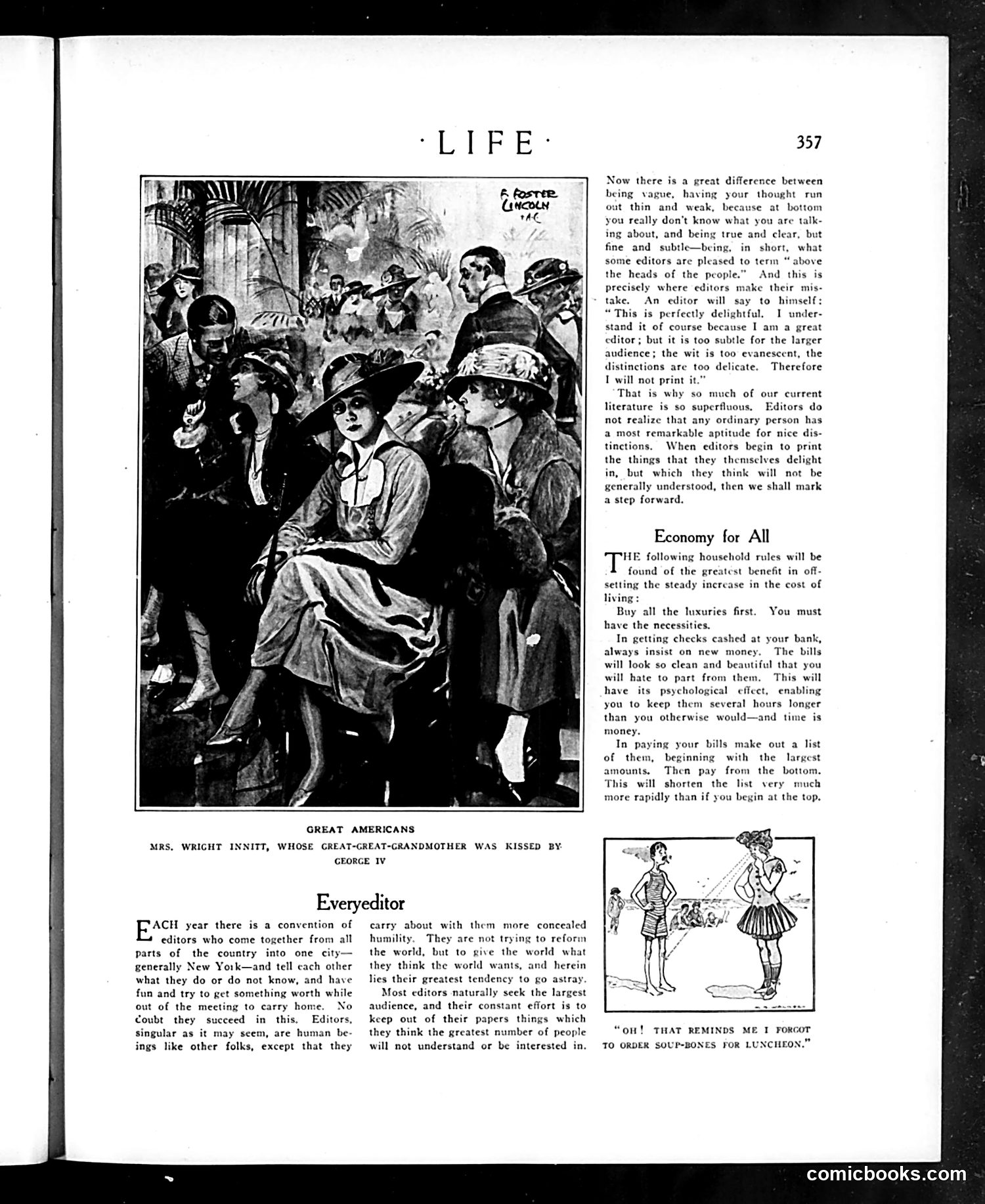
**Main Image:** A crowd scene labeled "Great Americans," featuring Mrs. Wright Innitt, whose "great-great-grandmother was kissed by George IV." This satirizes American social climbing and the obsession with aristocratic connections—the joke being that a distant, dubious royal encounter somehow confers distinction on modern Americans. **"Everyeditor" Section:** Mocks editors who attend annual conventions claiming to represent "what they do or do not know" and return with trivial or irrelevant material their readers won't understand. The satire targets editorial pretension and disconnect from audience interests. **Small Cartoon:** A woman's complaint about forgetting to order soup-boxes for lunch—domestic humor typical of the era. Overall, the page satirizes American snobbery, editorial pomposity, and class consciousness.
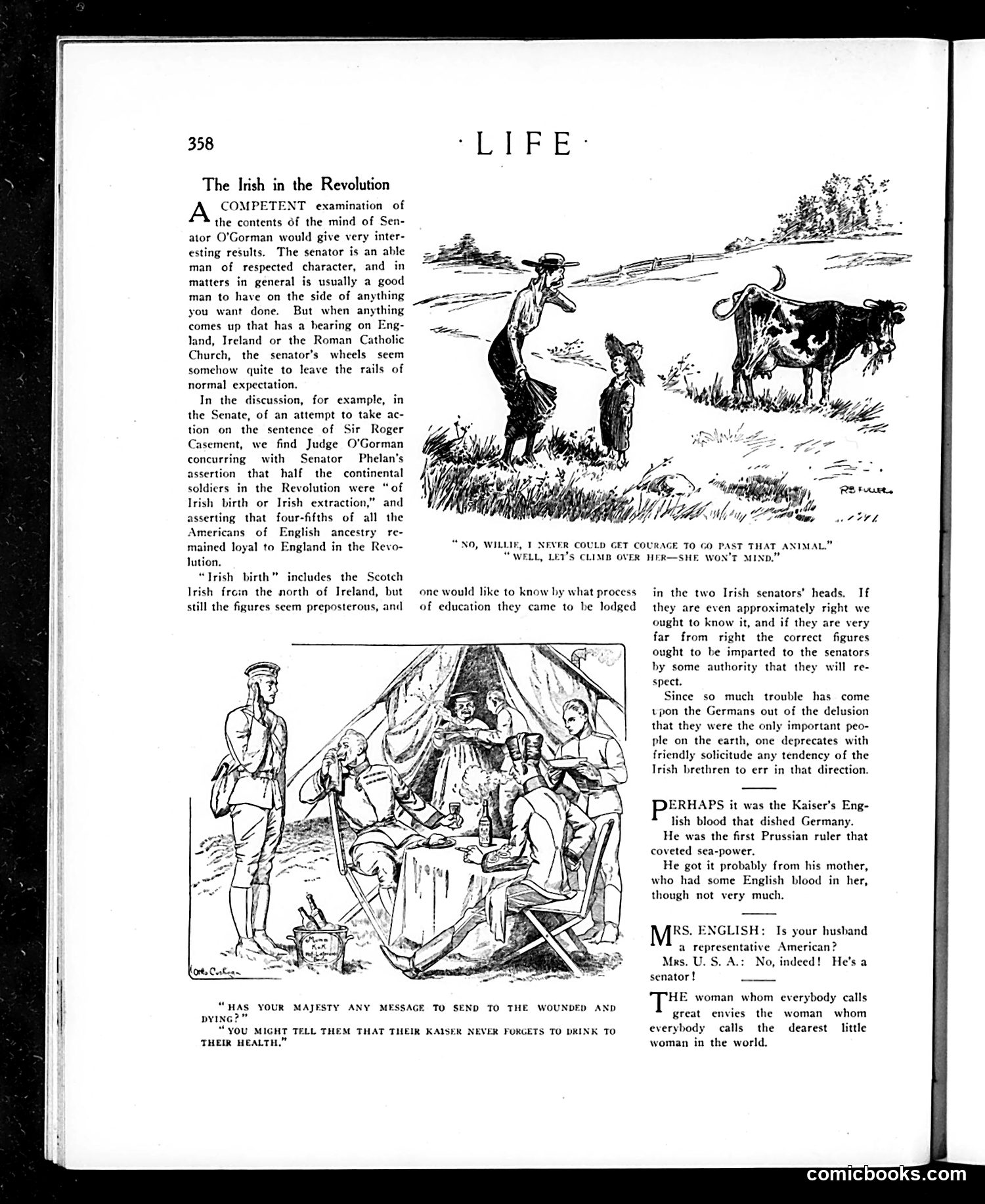
This page satirizes Irish-American senators' knowledge of history. The article critiques Senator O'Gorman's ignorance regarding Sir Roger Casement's execution and claims about Irish soldiers in the American Revolution. The senators apparently contradict themselves—one asserts "half the continental soldiers" were Irish, while another claims all English-descended Americans remained loyal to England during the Revolution. The top cartoon shows Irish rural poverty (a man struggling past cattle), while the lower sketch depicts soldiers in a military tent, likely illustrating the contrast between Irish immigrants' conditions and their claimed Revolutionary War contributions. The satire targets the senators' unreliable historical claims and suggests they lack proper education to make authoritative statements about Irish-American history.
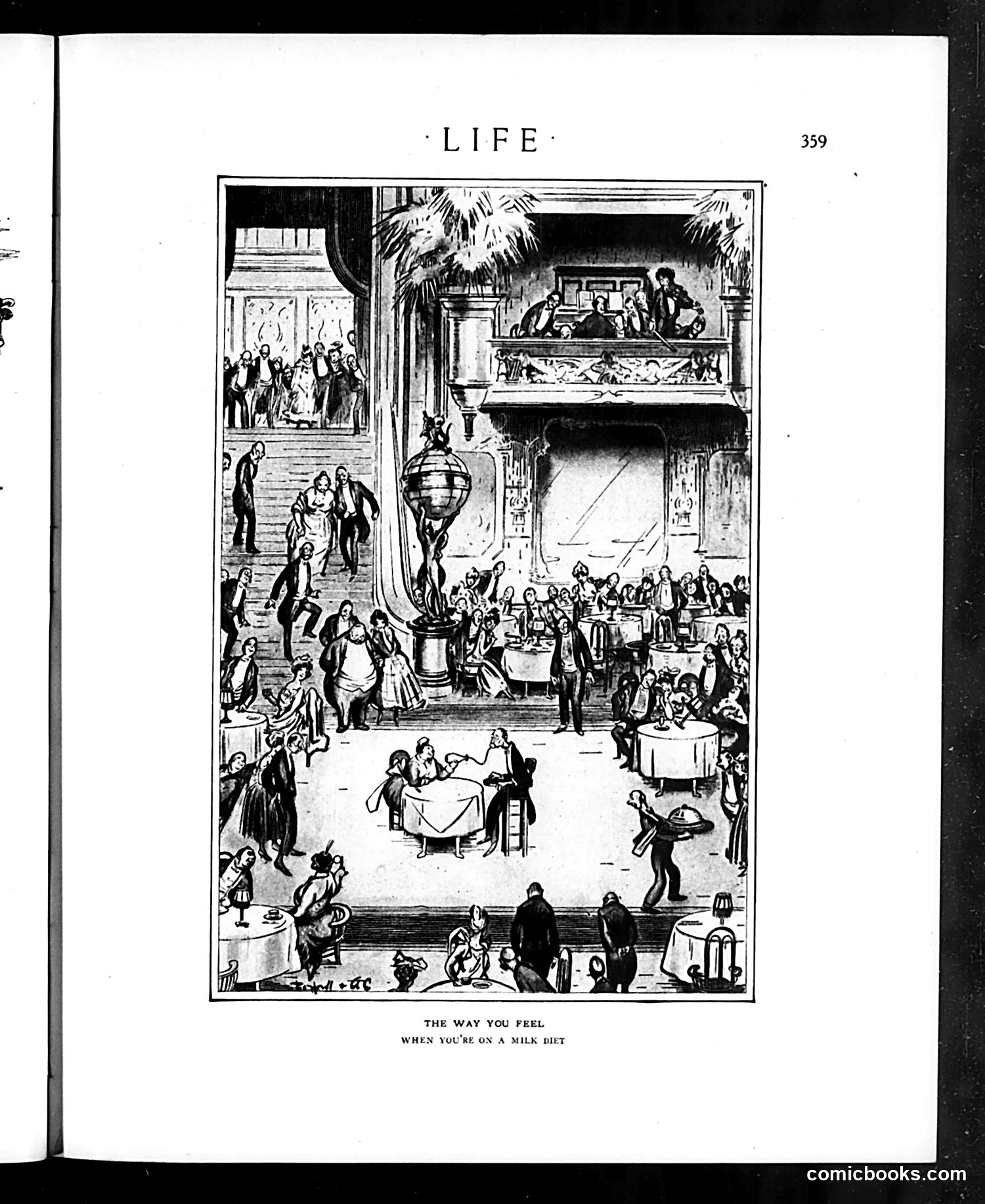
This is a humorous satirical illustration depicting the supposed effects of a milk diet. The engraving shows an elaborate interior space—possibly a ballroom or grand hall—crowded with figures engaged in various activities: dining, socializing, dancing, and general merriment. The scene suggests lightheartedness and buoyant energy. The joke appears to be that consuming milk makes one feel expansive, energetic, and socially vibrant—surrounded by activity and celebration. This serves as implicit advertising for milk's supposed health and mood-boosting benefits. The satirical approach humorously exaggerates these claimed effects through the busy, fantastical scene, likely mocking both health fad claims and the enthusiastic testimonials common in early 20th-century product marketing.
This page discusses two major issues confronting President Wilson: **Railroad Labor Crisis**: The article explains the tension between railroad companies and workers demanding an eight-hour workday and higher wages. Wilson had recently intervened in this dispute. The author argues the issue is complex—while an eight-hour day seems reasonable, railroad work (unlike factory work) cannot easily be constrained by fixed hours since trains must operate on passengers' schedules. The piece notes that if wages must rise whenever labor is scarce, railroads face an unsustainable economic problem. **World War I**: The second section discusses the ongoing killing in Europe and rising hatred between belligerents. The author notes that observers see no signs of peace, and explains the Allies (fighting to liberate France and Belgium) won't accept a negotiated settlement with Germany. The Pope reportedly instructed Italian Cardinals to pray for Allied victory, believing Germans must be defeated for lasting peace. The cartoon illustrations appear generic satirical imagery rather than specific caricatures of identifiable figures.
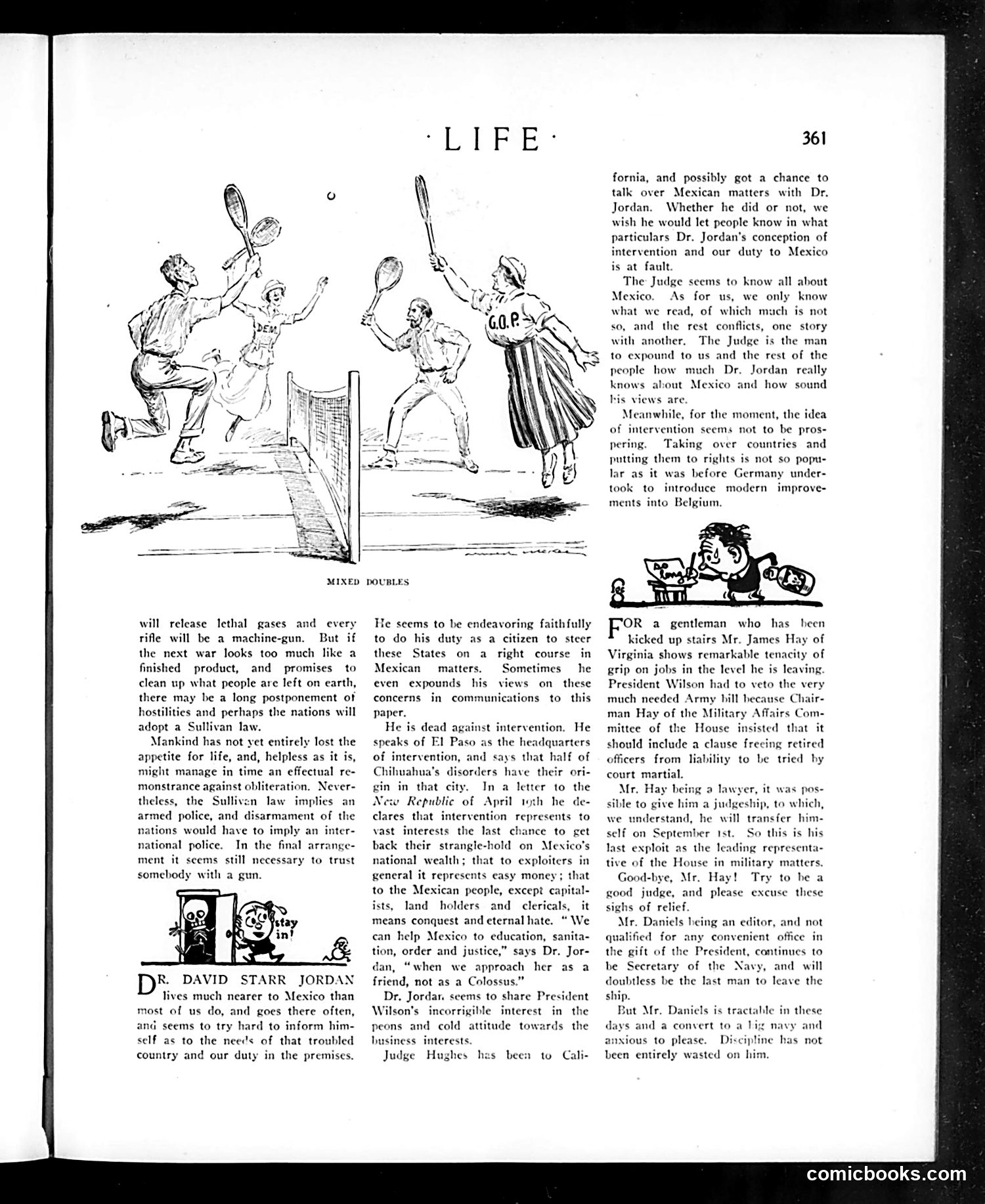
**The "Mixed Doubles" Cartoon:** Depicts a tennis match where figures representing different political positions on Mexico play against each other. The satire mocks the debate over U.S. intervention in Mexico during the Wilson administration. **Key Figures Referenced:** - **Dr. David Starr Jordan**: A real academic/public intellectual opposed to U.S. military intervention in Mexico, advocating approaching Mexico "as a friend, not as a Colossus" - **Judge Hughes**: Apparently favors intervention; Life challenges him to publicly explain what Jordan gets wrong about Mexico - **President Wilson**: Shares Jordan's skepticism toward business interests exploiting Mexico **The Satire's Point:** Life ridicules both the intervention debate and those involved. The magazine suggests that intervention was becoming unpopular (referencing Germany's invasion of Belgium as a cautionary example). It also mocks various government figures—Congressman Hay for clinging to power and Secretary Daniels for his political flexibility—using gentle mockery about their careers and competence. The overall tone: skeptical, sardonic commentary on American foreign policy confusion and political self-interest regarding Mexico.
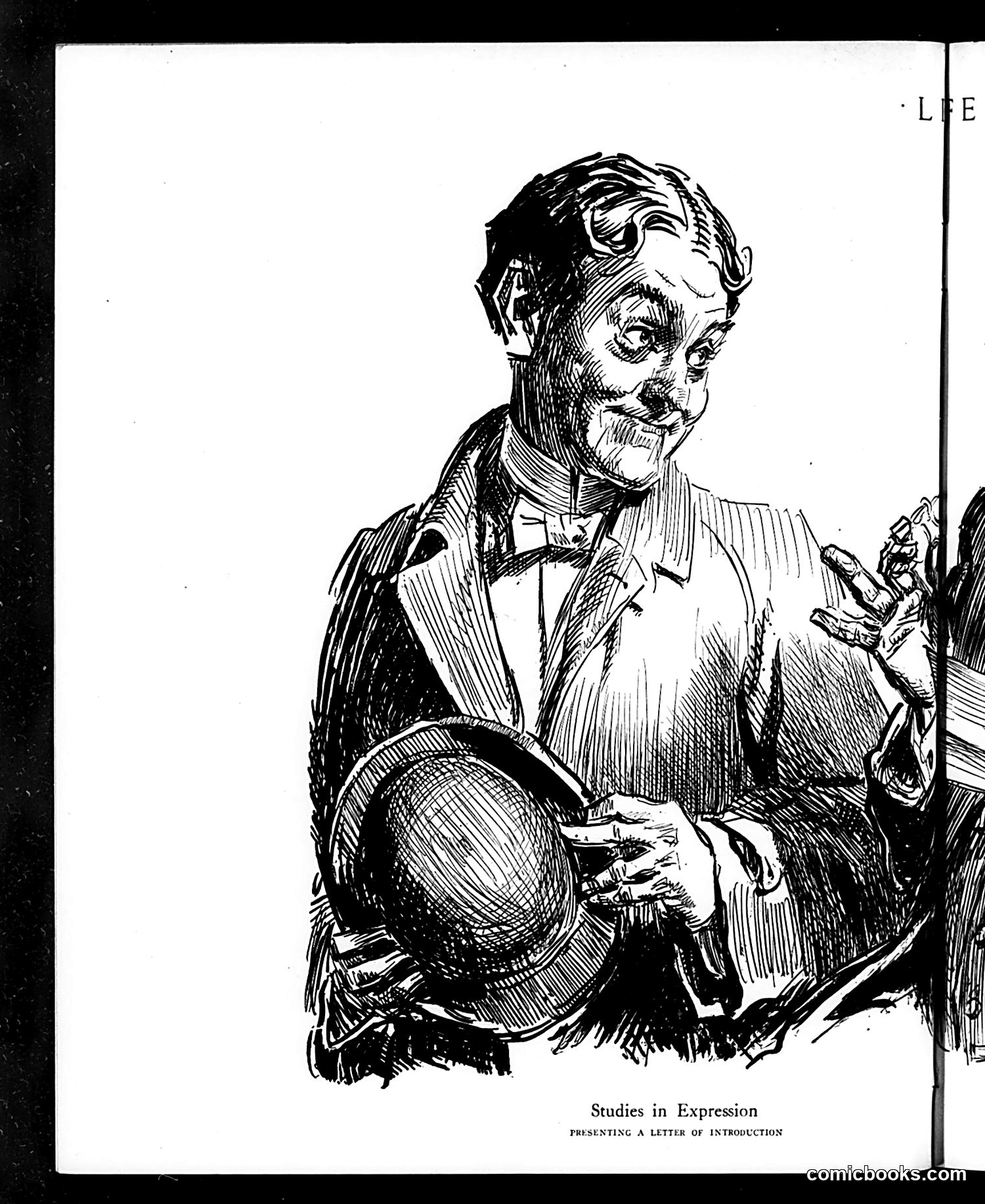
This page features a single ink sketch titled "Studies in Expression: Presenting a Letter of Introduction." It depicts a well-dressed gentleman in formal attire (jacket, bow tie) holding a hat in one hand while gesturing with the other. His facial expression appears somewhat anxious or ingratiating. The title suggests this is satirizing the social practice of formal letters of introduction—a convention where someone would present a letter to gain entry into society or business circles. The man's body language and expression seem to mock the obsequious behavior such situations demanded. Without additional context or identifying details visible in the image, the specific target of this satire remains unclear, though it appears to critique Victorian-era social pretension and formal etiquette.
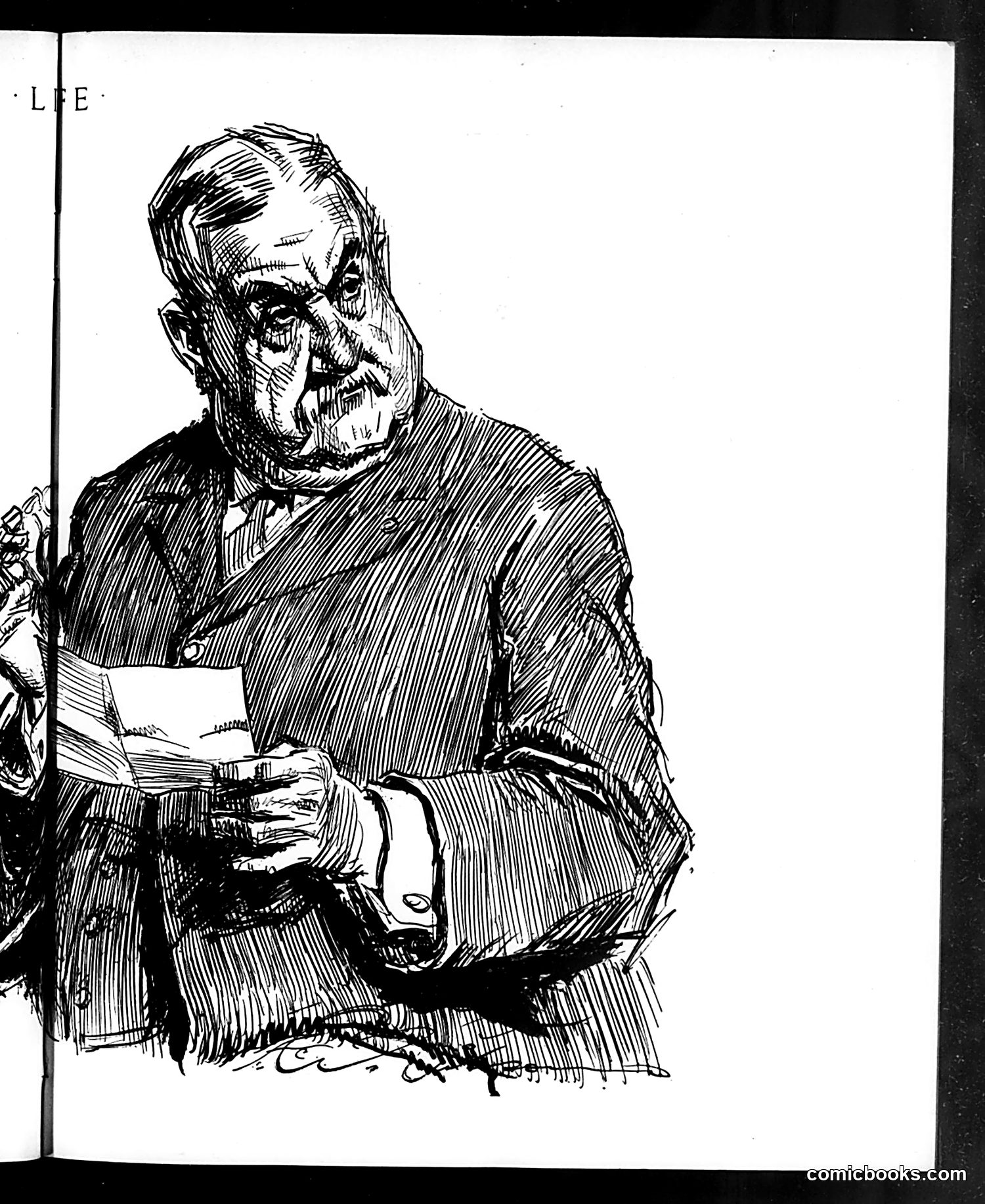
This page from *Life* magazine shows a sketch-style portrait of a middle-aged man in formal Victorian-era attire (suit jacket with bow tie), holding what appears to be papers or documents. The drawing style uses heavy cross-hatching typical of late 19th-century satirical illustration. However, the OCR text is too corrupted to identify the specific figure or political reference. Without legible text or a caption, I cannot definitively say who this person represents or what social/political issue the cartoon addresses. The formal dress and document-holding suggest a political or business figure of importance, but the satire's target and point remain unclear from the image alone.
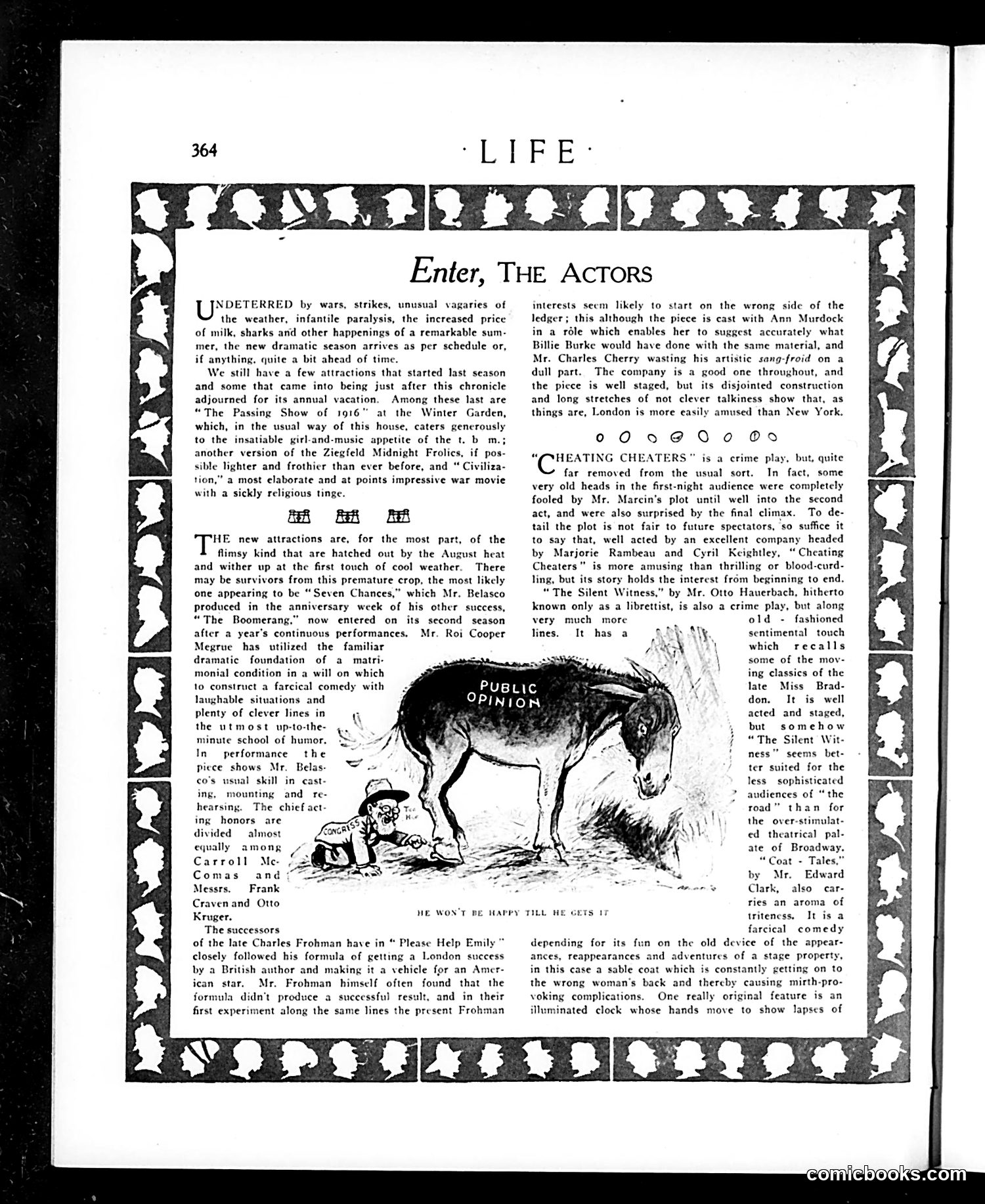
This cartoon illustrates a satirical commentary on public opinion during a tumultuous period (text mentions wars, strikes, infantile paralysis, and inflation). The image shows a donkey labeled "PUBLIC OPINION" being led by a small figure—likely representing politicians, media, or special interests. The caption "He Won't Be Happy Till He Gets It" suggests that public opinion is being manipulated or dissatisfied regardless of what's offered. The donkey's stubborn nature metaphorically represents how difficult it is to satisfy or control the fickle public mood during times of crisis and social upheaval. The cartoon critiques how public sentiment becomes a tool or obstacle that various interests must manage, particularly during the chaotic summer of 1916 referenced in the surrounding theater review text.
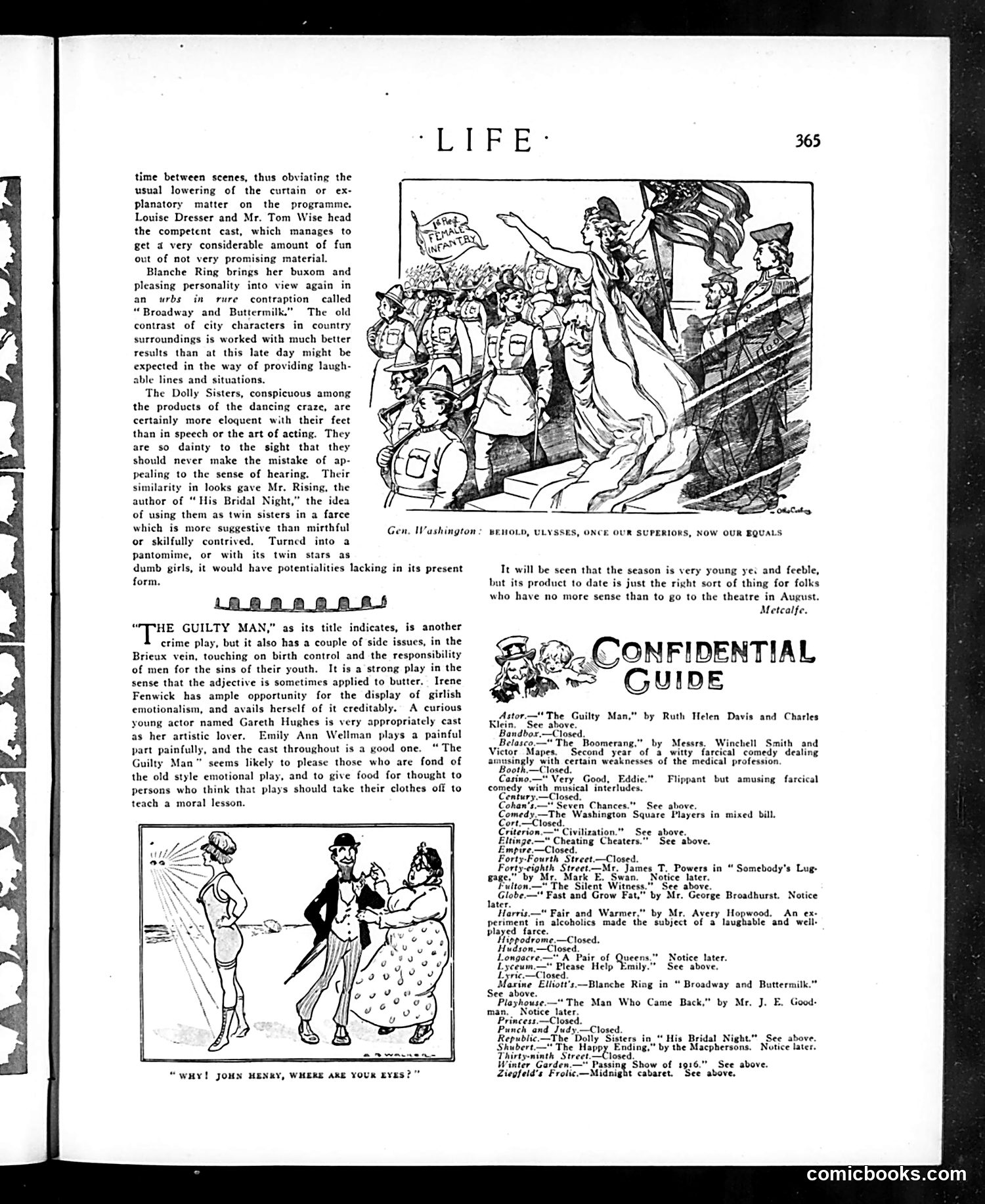
This page reviews Broadway shows from August, a slow theater season. The critic (Metcalfe) dismisses the plays as mediocre fare for summer audiences with poor judgment. **Key reviews mentioned:** - "The Guilty Man" - a crime drama dealing with birth control and male responsibility, criticized as emotionally overwrought - "Broadway and Buttermilk" - starring Blanche Ring, a city-versus-country farce - "His Bridal Night" - featuring the Dolly Sisters (famous dancers), described as "more suggestive than mirthful" **The cartoons:** The upper illustration shows a patriotic/military scene with General Washington and Ulysses S. Grant, captioned "Behold, Ulysses, once our superiors, now our equals" - likely satirizing democratic leveling or changing social hierarchies. The lower cartoon ("Why! John Henry, where are your eyes?") appears to depict a flirtation or romantic entanglement, typical of Life's satirical humor about courtship and relationships. The "Confidential Guide" lists theater closures and current productions, standard for entertainment journalism of the era.
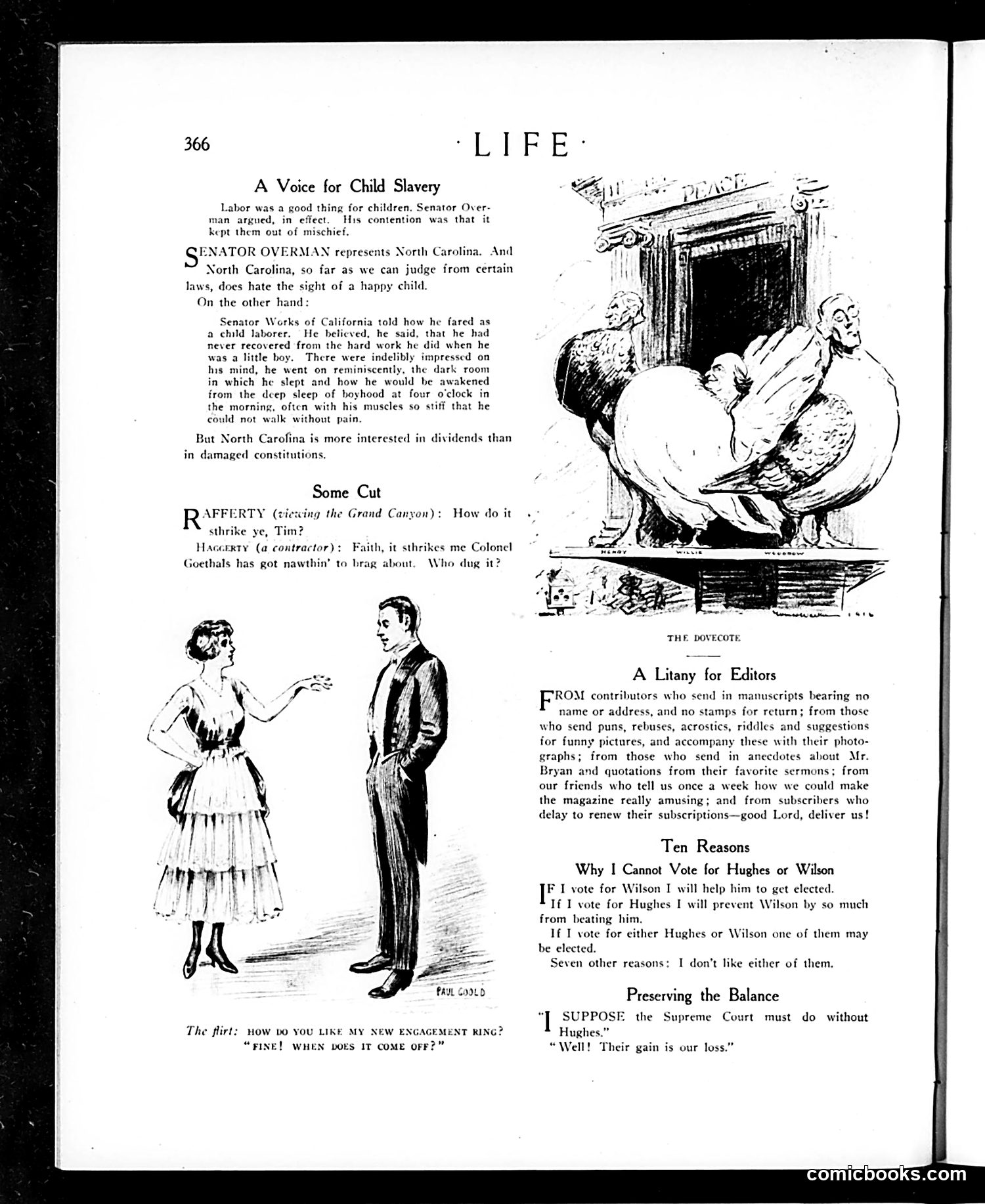
This page contains three satirical pieces from an era of American political debate (likely 1916, based on Hughes/Wilson references). **"A Voice for Child Slavery"** criticizes Senator Overman of North Carolina for defending child labor as beneficial ("keeps them out of mischief"), contrasting his position with Senator Works of California, who recounted the physical damage of his own childhood labor. The satire targets North Carolina's prioritization of industrial profits over children's welfare. **"Some Cut"** is a brief Irish-dialect joke mocking Colonel Goethals (who engineered the Panama Canal) by suggesting the Grand Canyon's formation rivals his achievement—absurdist humor deflating grand accomplishments. **"Ten Reasons Why I Cannot Vote for Hughes or Wilson"** satirizes voter indecision in the 1916 presidential election through circular logic: voting for either candidate either helps one or hurts the other, making choice futile. The remaining sections are miscellaneous editorial complaints and a marriage-proposal joke. The page reflects Progressive-era concerns about labor exploitation and political cynicism.
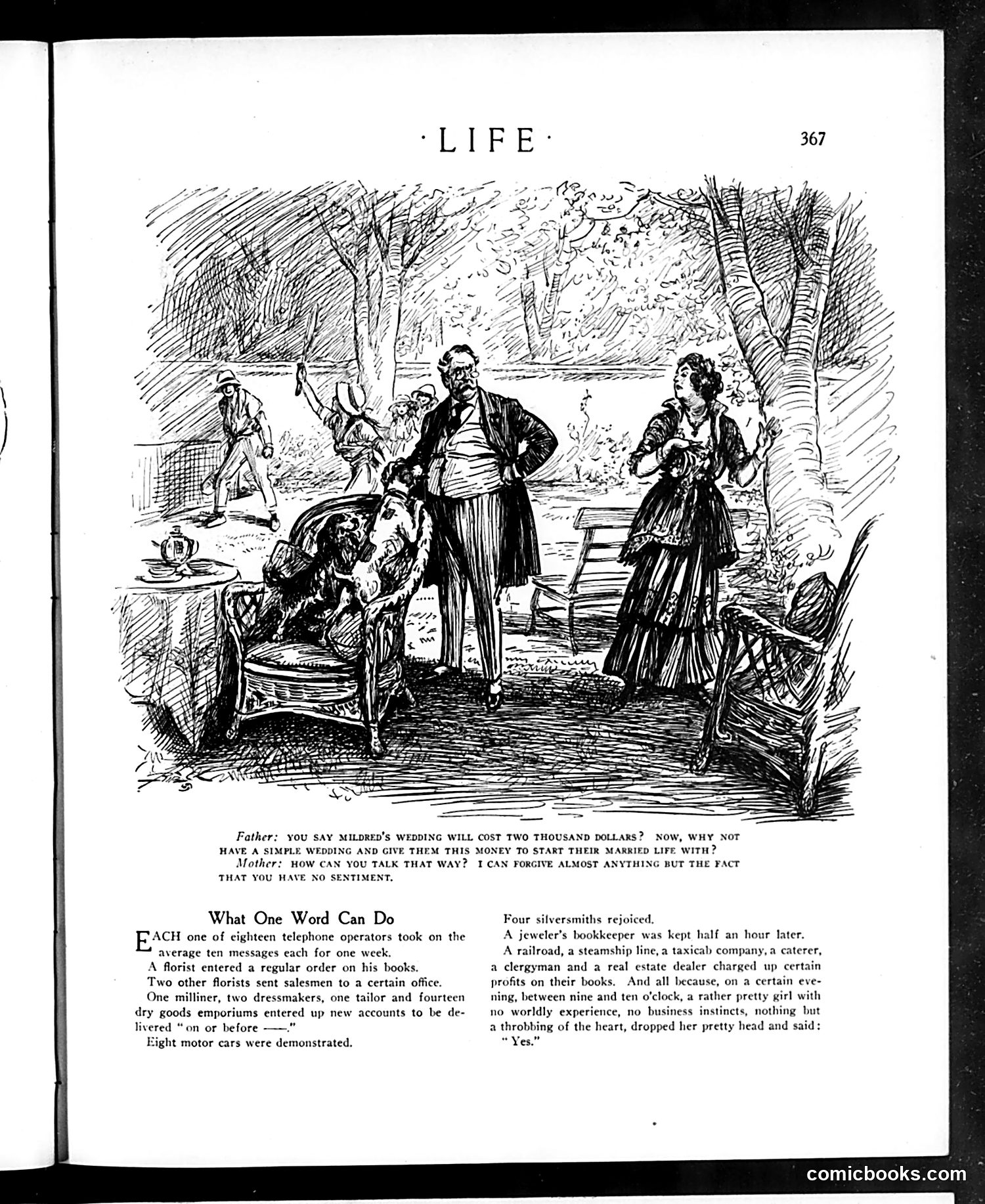
The cartoon satirizes class and gender attitudes about weddings in early 20th-century America. A father suggests giving a couple two thousand dollars instead of spending it on an elaborate wedding ceremony. The mother objects, calling his practicality unsentimentally, implying that elaborate weddings are about emotional and social display rather than the couple's financial security. The accompanying text, "What One Word Can Do," extends this satire by showing how a young woman's single word "Yes" (her engagement) triggers massive economic activity—florists, dressmakers, jewelers, caterers, railroads, and numerous other businesses all profit from wedding preparations. The piece ironically critiques both conspicuous consumption and women's economic powerlessness: the bride has "no worldly experience, no business instincts," yet her one affirmative word generates substantial commerce. The satire targets wasteful spending on weddings while simultaneously highlighting how women's limited agency constrains them to fulfilling expected matrimonial roles.
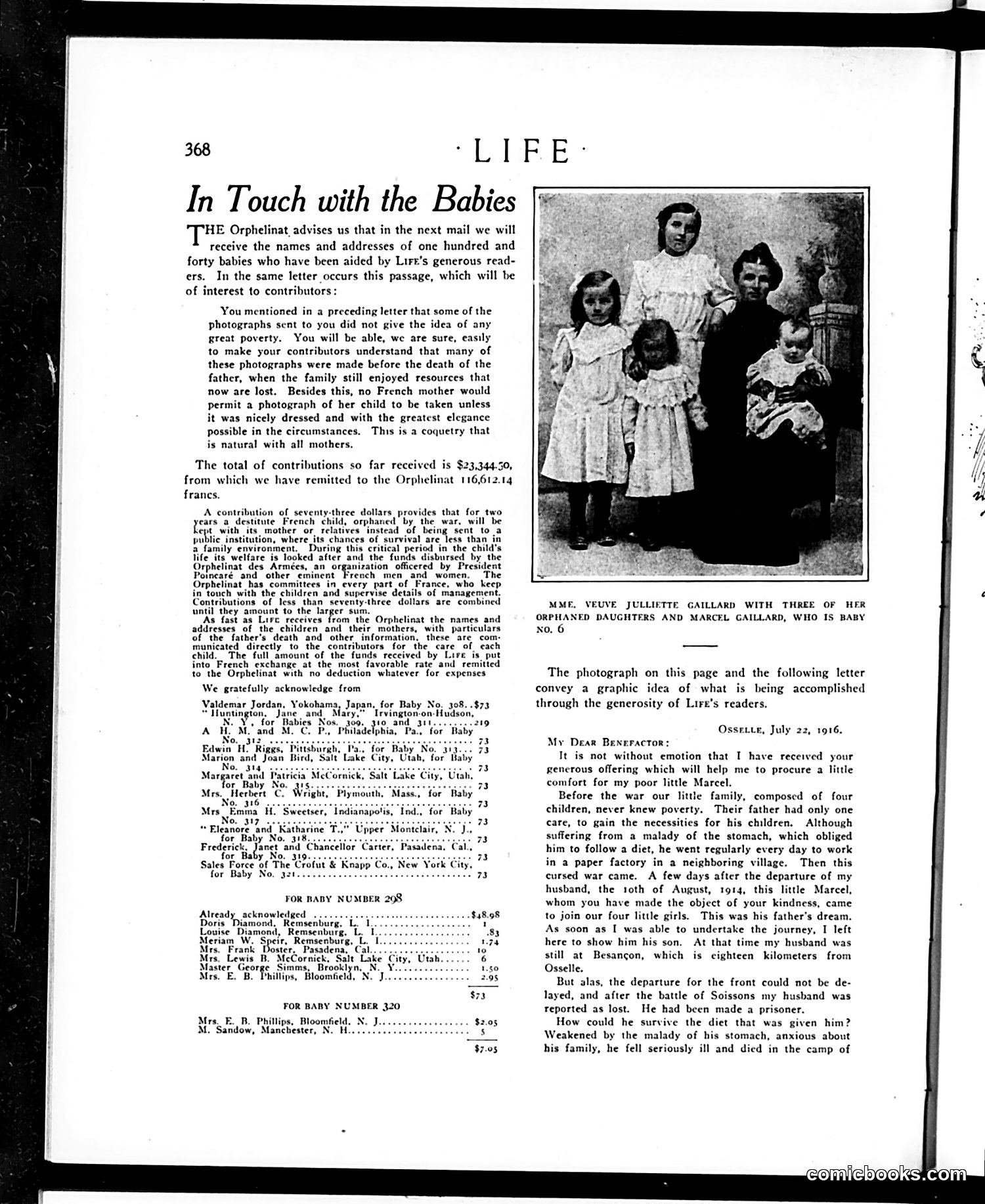
This page documents **Life magazine's charitable campaign to aid French war orphans** during World War I (dated July 1916). It is not a cartoon but rather a fundraising update. The photograph shows **Mme. Veuve Julliette Gaillard with three of her orphaned daughters and Marcel Gaillard (Baby No. 6)**, representing the human impact of the war. The accompanying letter from a French beneficiary explains how her family lost their father and fell into poverty. Before the war, they were respectable and self-sufficient; the photograph shows them "nicely dressed" because French mothers wouldn't permit photos showing actual destitution—a cultural detail meant to assure American donors their contributions go to genuinely deserving (not "undeserving poor") families. The page lists donors and amounts ($73 sustained a child for two years). This represents **Progressive-era American philanthropy addressing European war casualties**, combining moral uplift with documentation of recipient worthiness.
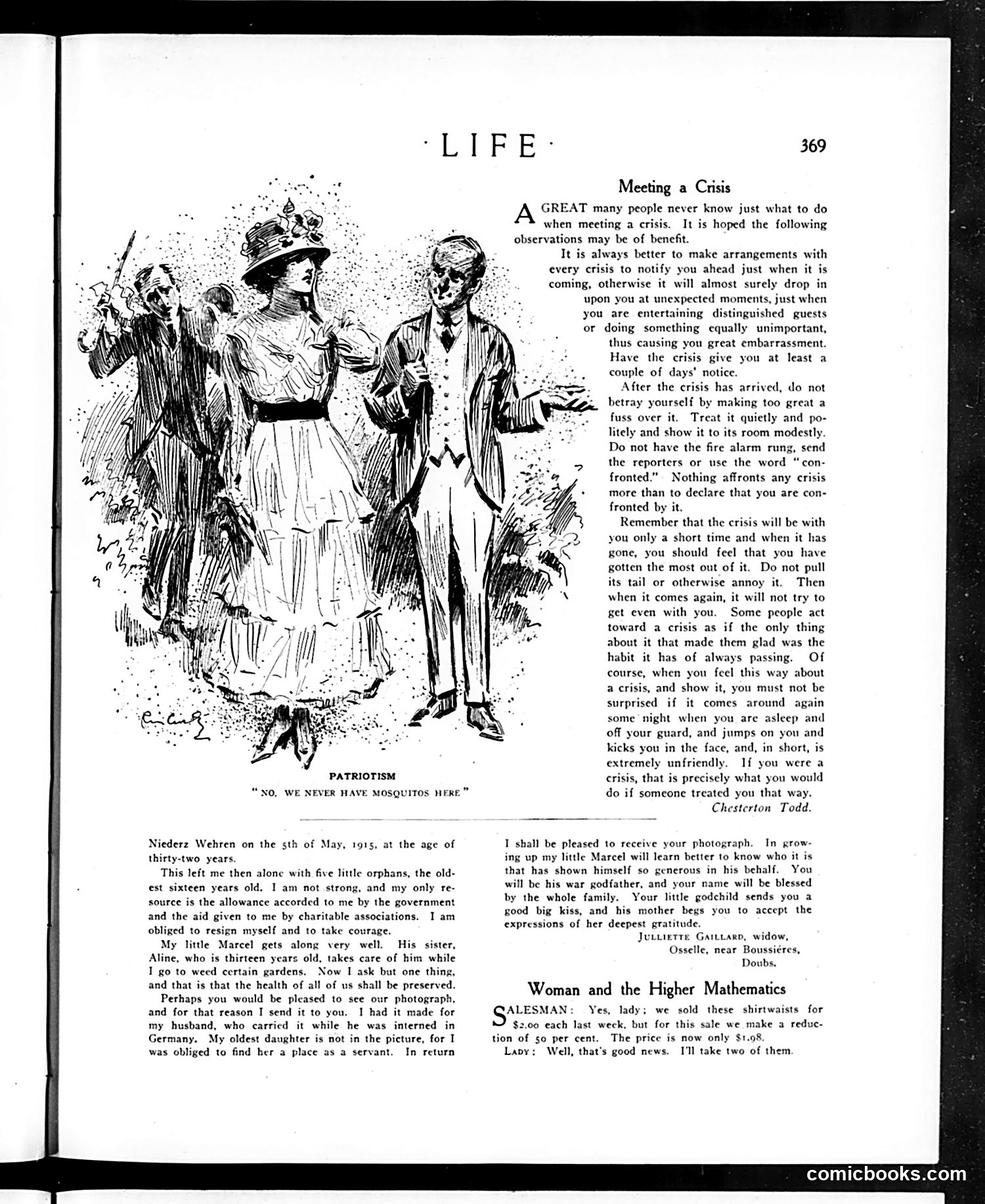
**The Cartoon "Patriotism":** The sketch depicts a woman in fashionable dress speaking to a poorly-dressed man, with the caption "No, we never have mosquitos here." This is satire on patriotic boasting—the woman's comment appears to mock hollow patriotic claims or nationalist superiority despite obvious social problems (the man's evident poverty). The joke suggests people make absurd patriotic declarations while ignoring real hardships. **"Meeting a Crisis":** This humorous essay by Chesterton Todd offers tongue-in-cheek advice on handling crises. It personifies crises as visitors requiring polite treatment, warning against drama or publicity. The satire mocks people who overreact to problems and suggests crises respond better to calm composure. **Historical Context:** The letter from Juliette Gaillon references her husband's 1915 death (likely WWI, given the mention of German internment), showing the page connects patriotic rhetoric to real wartime suffering. This juxtaposes sentiment against actual hardship. **"Woman and the Higher Mathematics":** A brief joke about a saleswoman's poor math—a 50% reduction from $2.00 should be $1.00, not $1.98—reflecting period stereotypes about women's mathematical abilities.
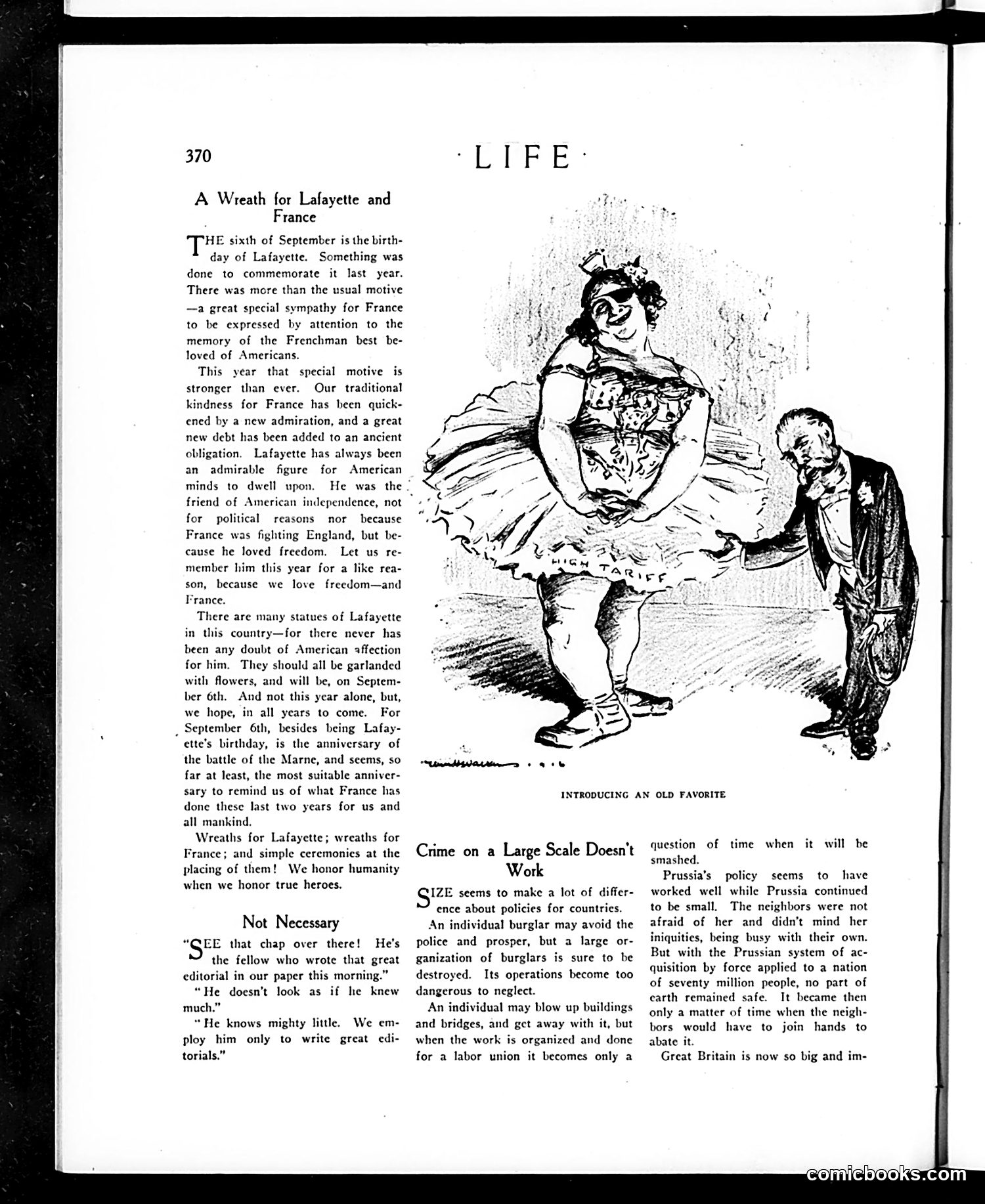
This page contains three distinct satirical pieces about WWI-era American politics and society. **"A Wreath for Lafayette and France"** advocates commemorating Lafayette's September 6th birthday with renewed vigor, linking it to France's WWI sacrifice and the Battle of the Marne. The accompanying sketch shows a woman (representing France) being introduced to a small, formally-dressed man—likely representing America or an American figure—with the caption "Introducing an Old Favorite," suggesting America should renew appreciation for its historical French ally. **"Not Necessary"** mocks incompetent editorialists, depicting a newspaper editor admitting he employs a writer who knows "mighty little" but produces "great editorials"—criticizing pretentious journalism and empty rhetoric. **"Crime on a Large Scale Doesn't Work"** uses criminal analogies to argue that Prussia's aggressive expansion policies, manageable at small scale, become unsustainable when applied to a large nation. This justifies Allied opposition to German imperial ambitions during WWI, suggesting Germany's "crimes" must ultimately be stopped by neighboring powers acting collectively.
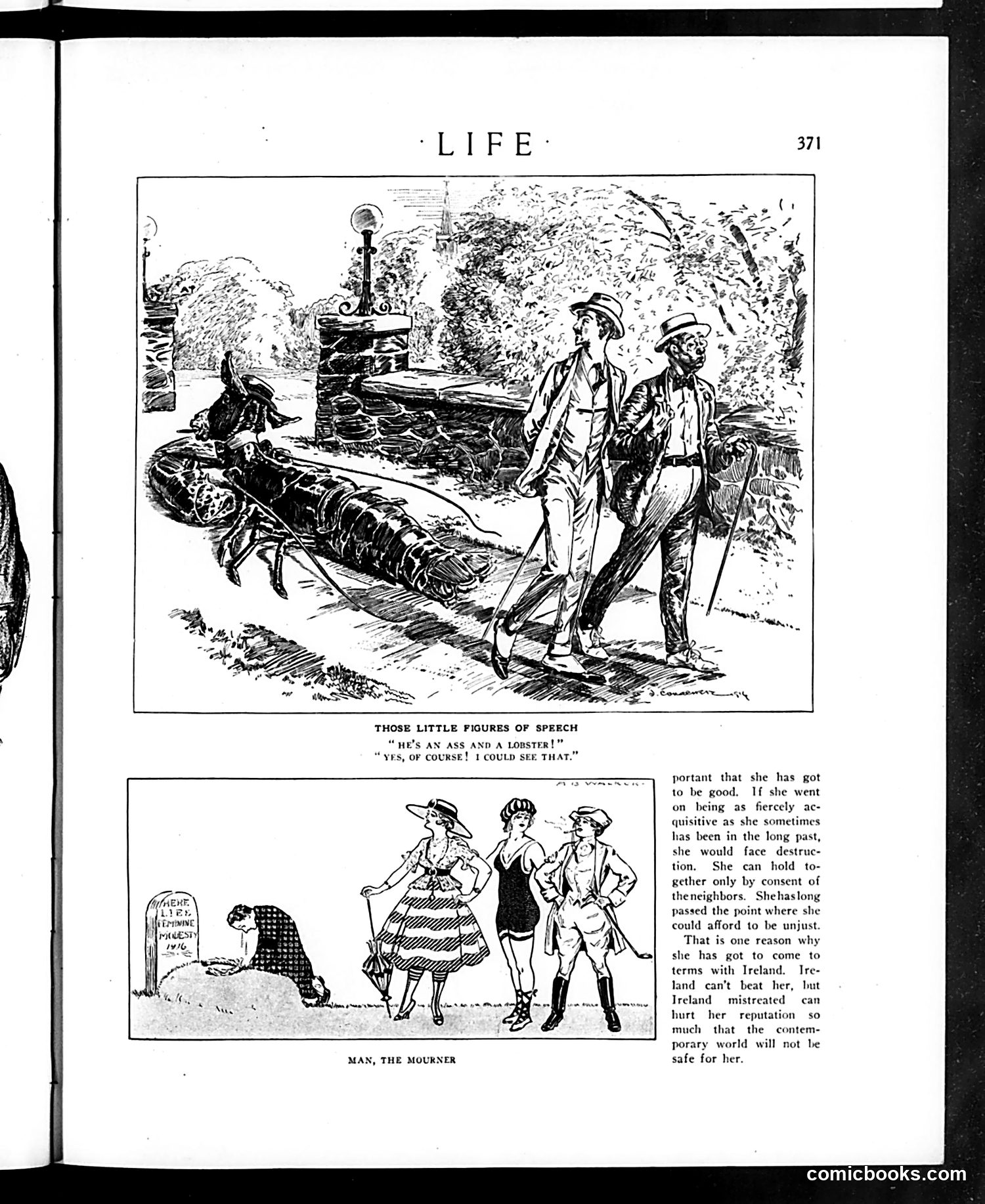
**"Those Little Figures of Speech"** satirizes colorful insults through two cartoons. The top cartoon shows two men observing a literal ass (donkey) and lobster, with one saying "He's an ass and a lobster!" — mocking how people use animal-based insults metaphorically in speech. **"Man, the Mourner"** shows a man at a grave while three women in fashionable dress stand nearby, seemingly indifferent or gossiping. This appears to satirize superficial mourning practices or how society women treat grief casually. The accompanying text (discussing Ireland and reputation) seems unrelated to these cartoons — likely overflow text from another article. The satire critiques human language and social behavior: how we use crude animal comparisons, and how people performatively engage with serious matters like death.
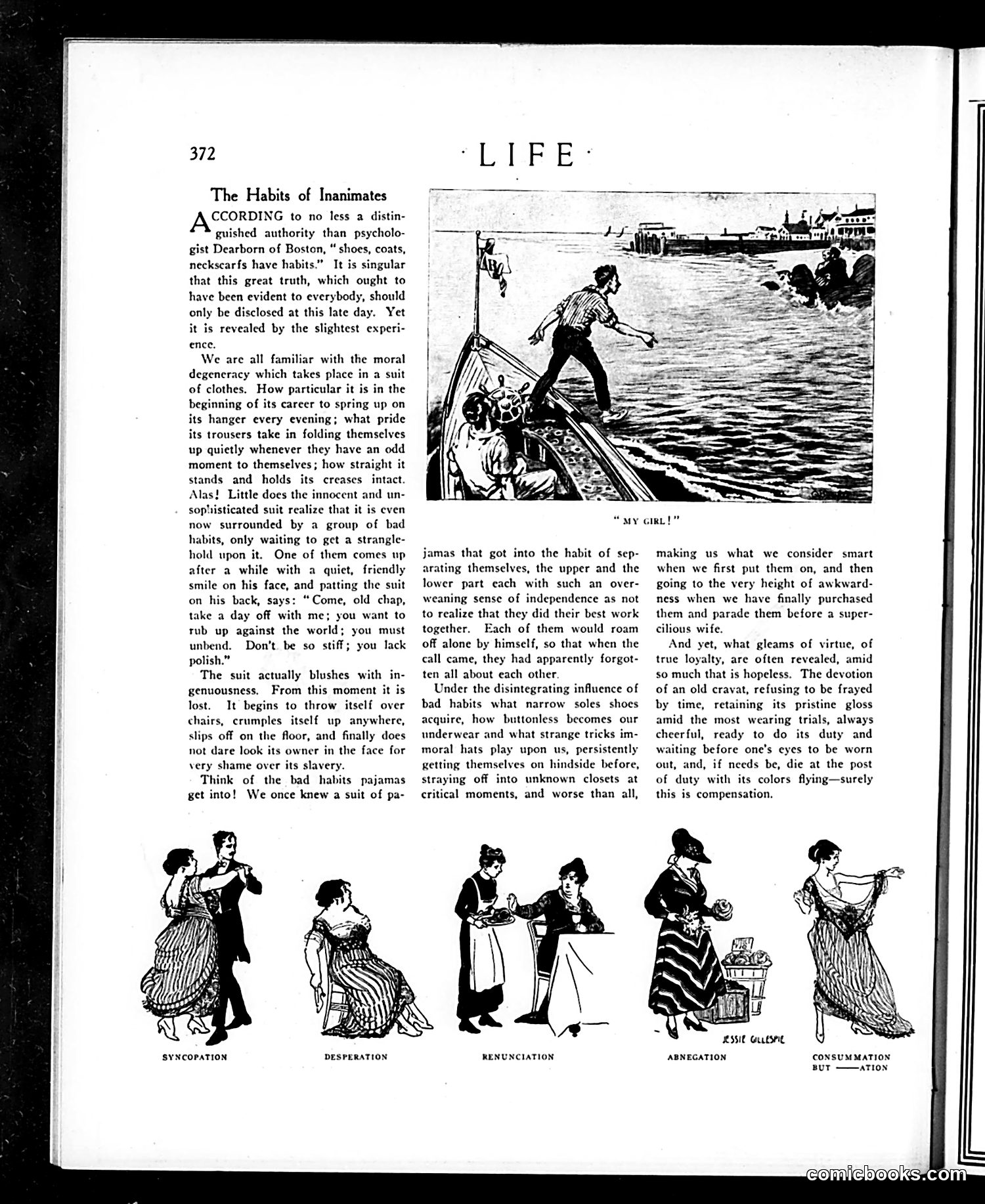
This page satirizes psychologist Darborn of Boston's claim that clothing has "habits"—a pseudo-scientific notion the author treats as absurdly obvious yet somehow newsworthy. The article uses personification as humor: clothes are depicted as moral beings that deteriorate through bad influences. A suit begins pristine and well-behaved, but gets corrupted by a "bad habit" who seduces it into slovenliness. Pajamas separate from each other; shoes lose their shape; hats misbehave. The five illustrated vignettes at bottom—labeled Syncopation, Desperation, Renunciation, Abnegation, and Consummation—appear to show people's relationship struggles (the upper image shows a couple), paralleling the clothes' behavioral decline. The satire mocks both pseudo-scientific pretension and the moral anxiety Victorians/Edwardians projected onto everyday objects, treating material decay as moral failure.
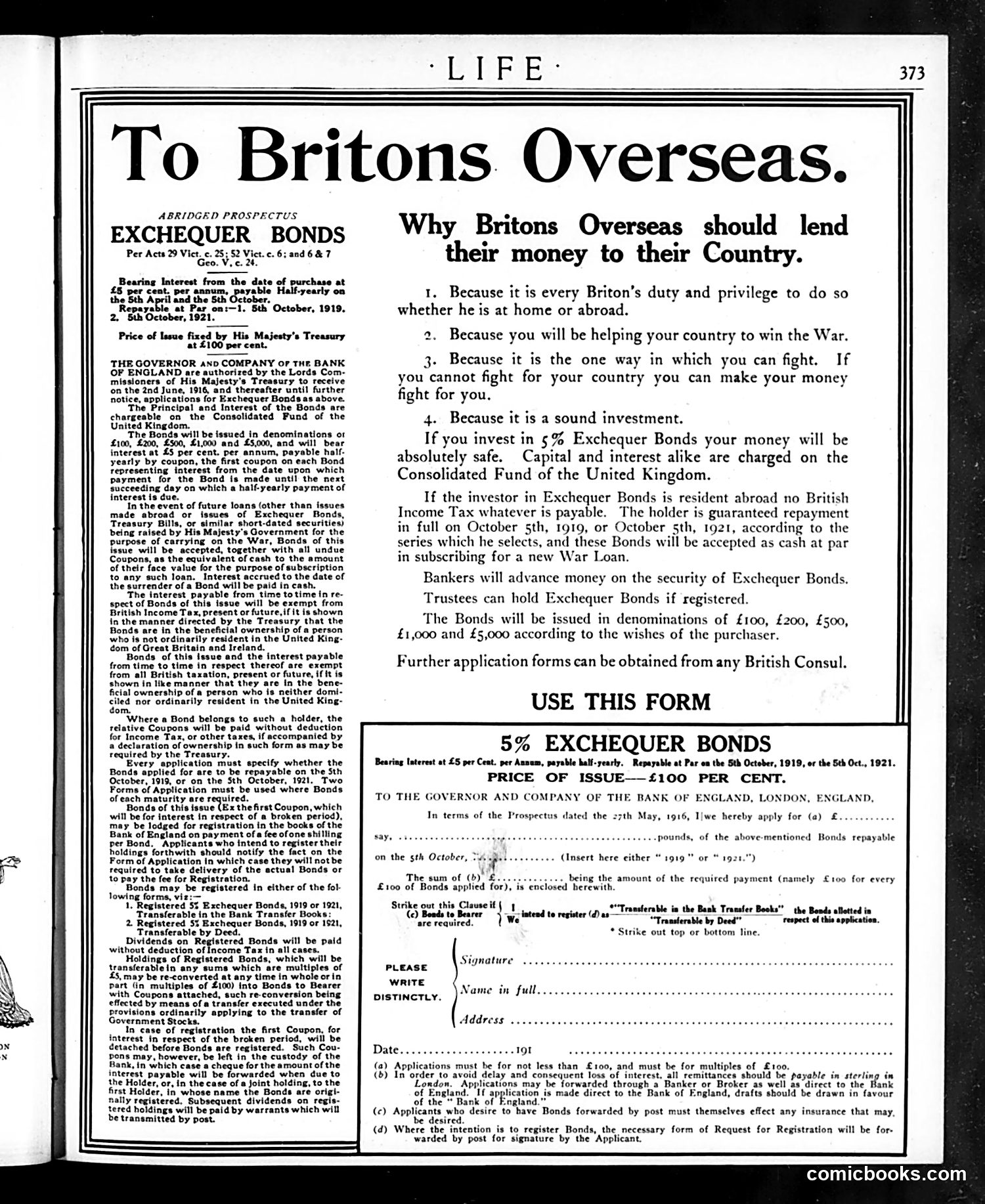
This page is primarily a **government financial advertisement**, not satire. During World War I (the document is dated 1916), the British government solicited loans from overseas British citizens through Exchequer Bonds. The advertisement appeals to patriotic duty: Britons abroad should lend money "to their Country" because "it is every Briton's duty" and investment helps "win the War." It emphasizes the bonds' safety—capital and interest are guaranteed by the Consolidated Fund of the United Kingdom—and tax advantages for non-resident investors. The "USE THIS FORM" section at bottom is an actual subscription form for purchasing 5% Exchequer Bonds, redeemable October 1919 or 1921 at £100 per cent. The historical context: Britain urgently needed wartime financing and appealed to its far-flung imperial population as a patriotic investment opportunity.
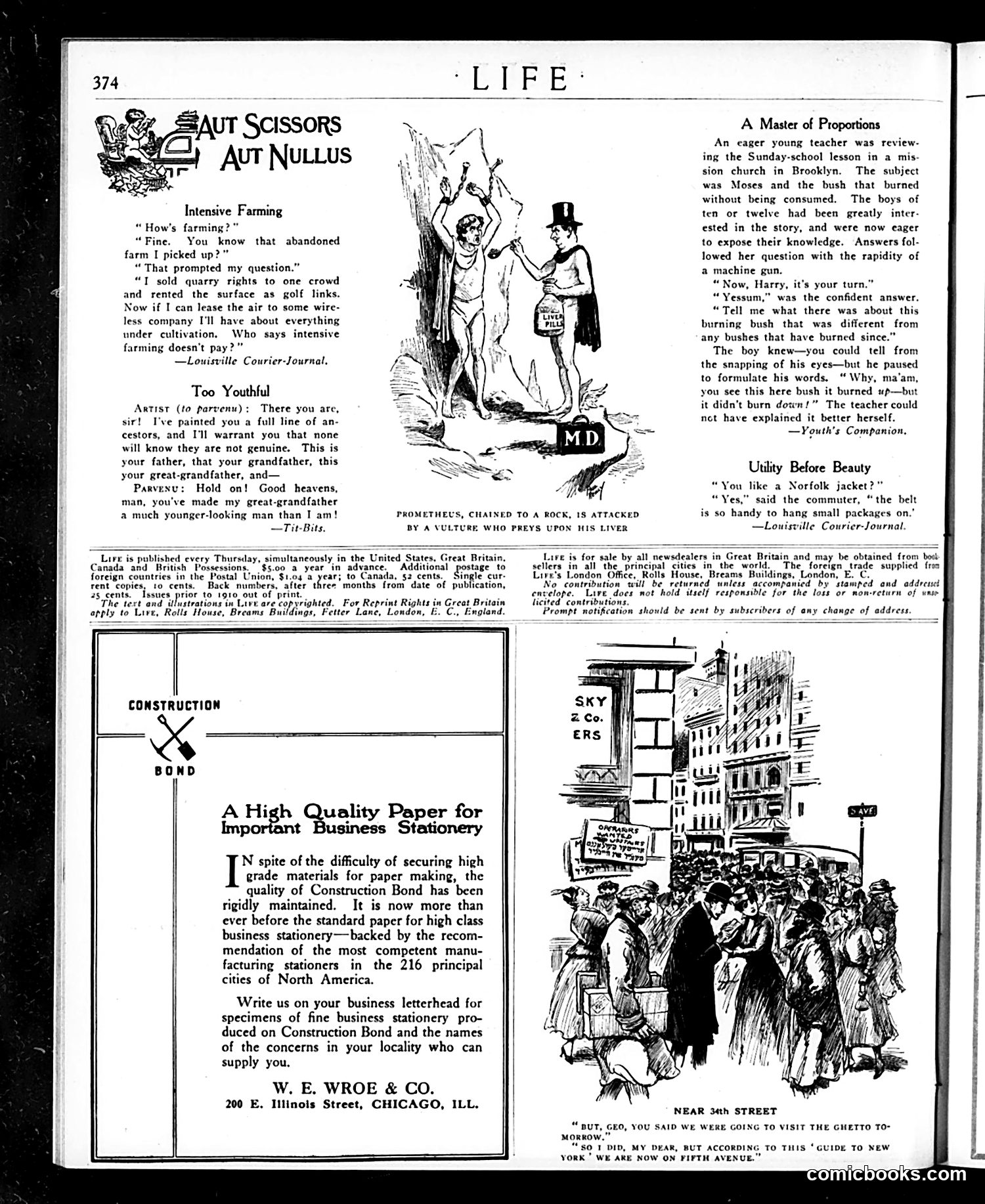
This page contains several short humorous anecdotes typical of early 20th-century American satire: **"Intensive Farming"** mocks wealthy urbanites buying up rural land. A farmer jokes he's maximized profit by selling quarry rights, renting the surface as a golf course, and hoping to lease the airspace to wireless companies—satirizing the absurdity of treating land as purely commercial real estate rather than agricultural. **"Too Youthful"** ridicules nouveau riche parvenus (newly wealthy people) who commission fake ancestry paintings. The joke: the artist accidentally painted the man's "great-grandfather" looking younger than the client himself, exposing the fraud. **"A Master of Proportions"** presents a child's innocent theological logic: when asked what's unique about Moses's burning bush, a Brooklyn boy answers it "burned up" but "didn't burn down"—technically correct but missing the theological point that it burned without being consumed. **"Utility Before Beauty"** is a brief commuter joke about Norfolk jackets' practical belt pockets. The page is mostly advertisements for Construction Bond paper and includes a classical Prometheus illustration. The humor reflects genteel, middle-class concerns about social pretension and modern commercial culture.
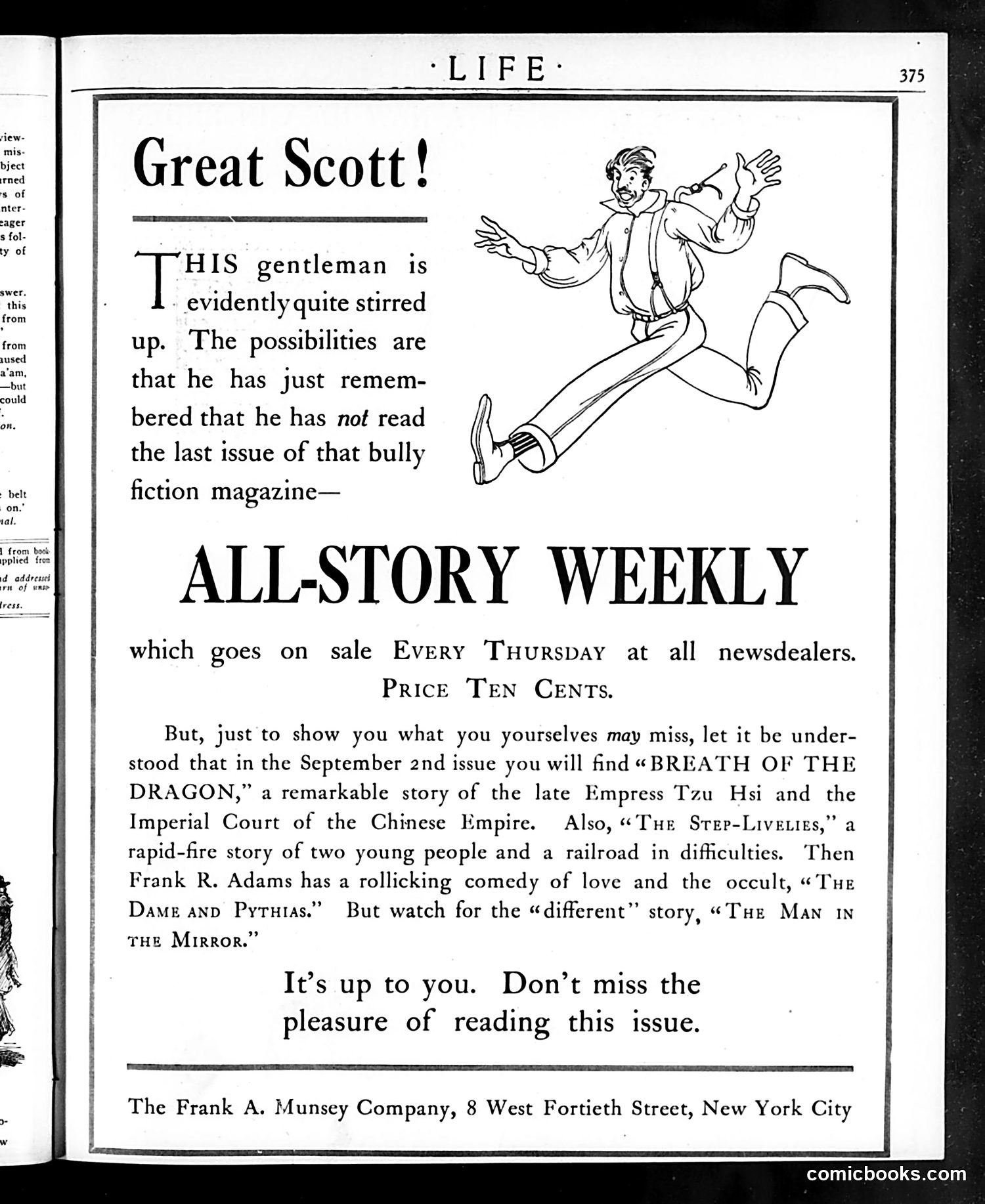
This is a **magazine advertisement** rather than a political cartoon. The page advertises *All-Story Weekly*, a pulp fiction magazine published by Frank Munsey's company. The comic illustration shows an exaggerated, energetic man in mid-leap with an expression of alarm or excitement, captioned "Great Scott!" The joke is straightforward: he's just *remembered* he hasn't read the latest issue of this popular magazine—hence his dramatic, embarrassed reaction. The ad then lists upcoming stories in the September 2nd issue, including tales about Empress Tzu Hsi (the late Chinese Empress), a railroad drama, and stories about love and the supernatural. The appeal is to readers who don't want to "miss" these entertaining tales. This reflects early 20th-century pulp magazine culture, when serialized fiction was mass entertainment. The tone is lighthearted, using relatable anxiety (forgetting to buy something you enjoy) as a marketing hook. No political satire is intended—it's purely commercial.
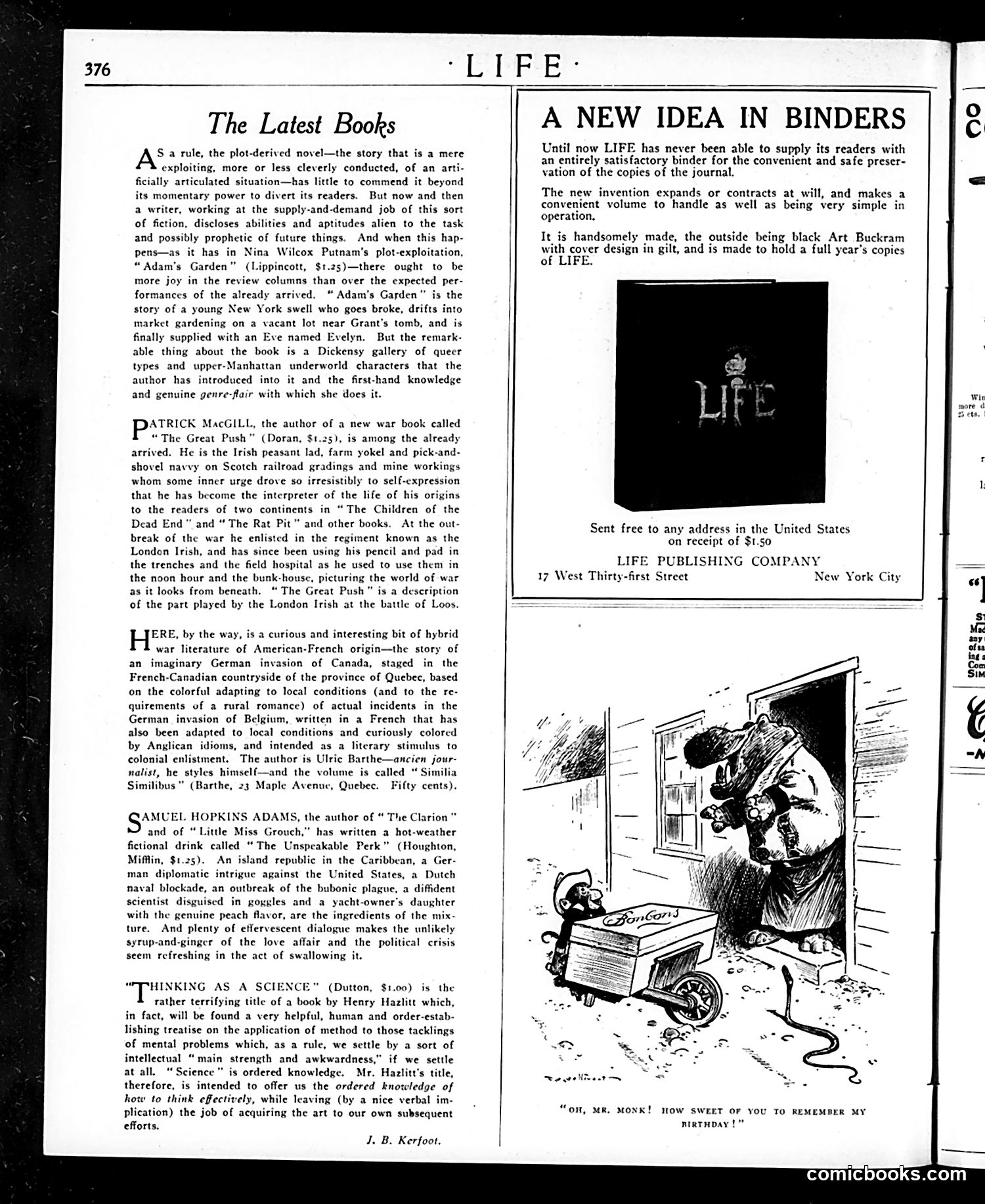
This page contains **book reviews**, not political cartoons. The cartoon at bottom—captioned "Oh, Mr. Monk! How sweet of you to remember my birthday!"—shows a monkey delivering a wrapped gift to what appears to be a woman indoors. It's a humorous illustration unrelated to the book reviews above. The reviews discuss recently published fiction and non-fiction, including war literature by Patrick MacGill (an Irish writer documenting WWI from a soldier's perspective), a romantic comedy about a New York man who becomes a gardener, and adventure fiction set in the Caribbean. The page reflects early-1910s publishing trends: plot-driven novels, war narratives (timely given WWI), and romantic escapism. The monkey cartoon appears to be simple visual humor—a clever animal remembering a birthday—typical of Life magazine's light satirical style.
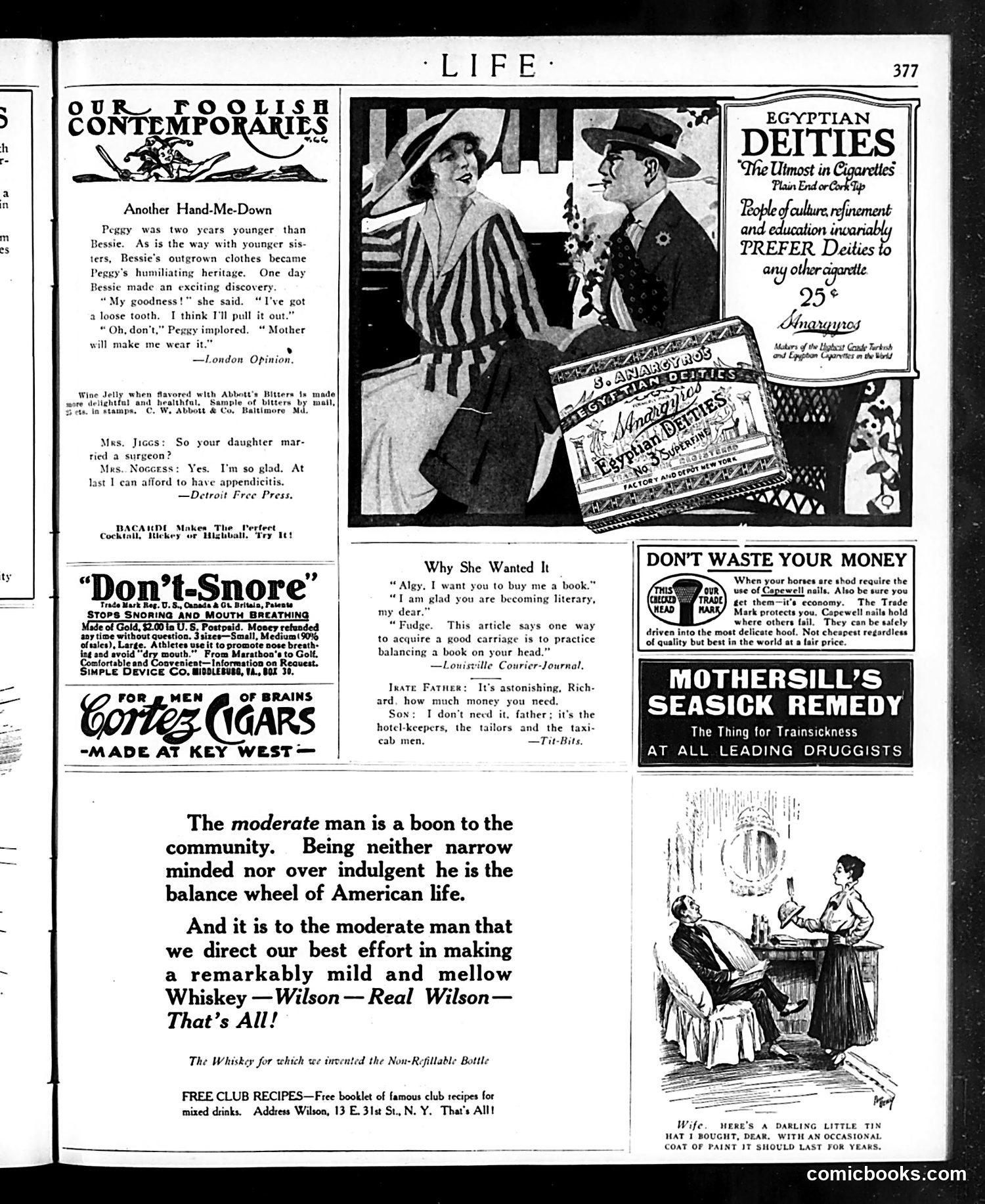
This page from *Life* magazine contains several brief satirical jokes typical of early 20th-century humor: **"Another Hand-Me-Down"** mocks the indignity younger siblings face inheriting older siblings' cast-offs. The joke: younger sister Peggy dreads receiving her older sister Bessie's loose tooth as a "hand-me-down"—absurd, but illustrating how humiliating hand-me-downs were. **Other brief jokes** poke fun at common social situations: a mother celebrating her daughter marrying a surgeon (now she can afford appendicitis surgery as a luxury), and a father confused why his son needs money (it goes to hotels, tailors, taxi drivers—not the son himself). The page is primarily **advertisements** for products like Egyptian Deities cigarettes, Don't-Snore devices, Capewell nails, and Mothersill's seasick remedy. A **Wilson Whiskey advertisement** emphasizes the "moderate man" as society's ideal—neither excessive nor stingy—promoting their "mild and mellow" product as appropriate for balanced living.
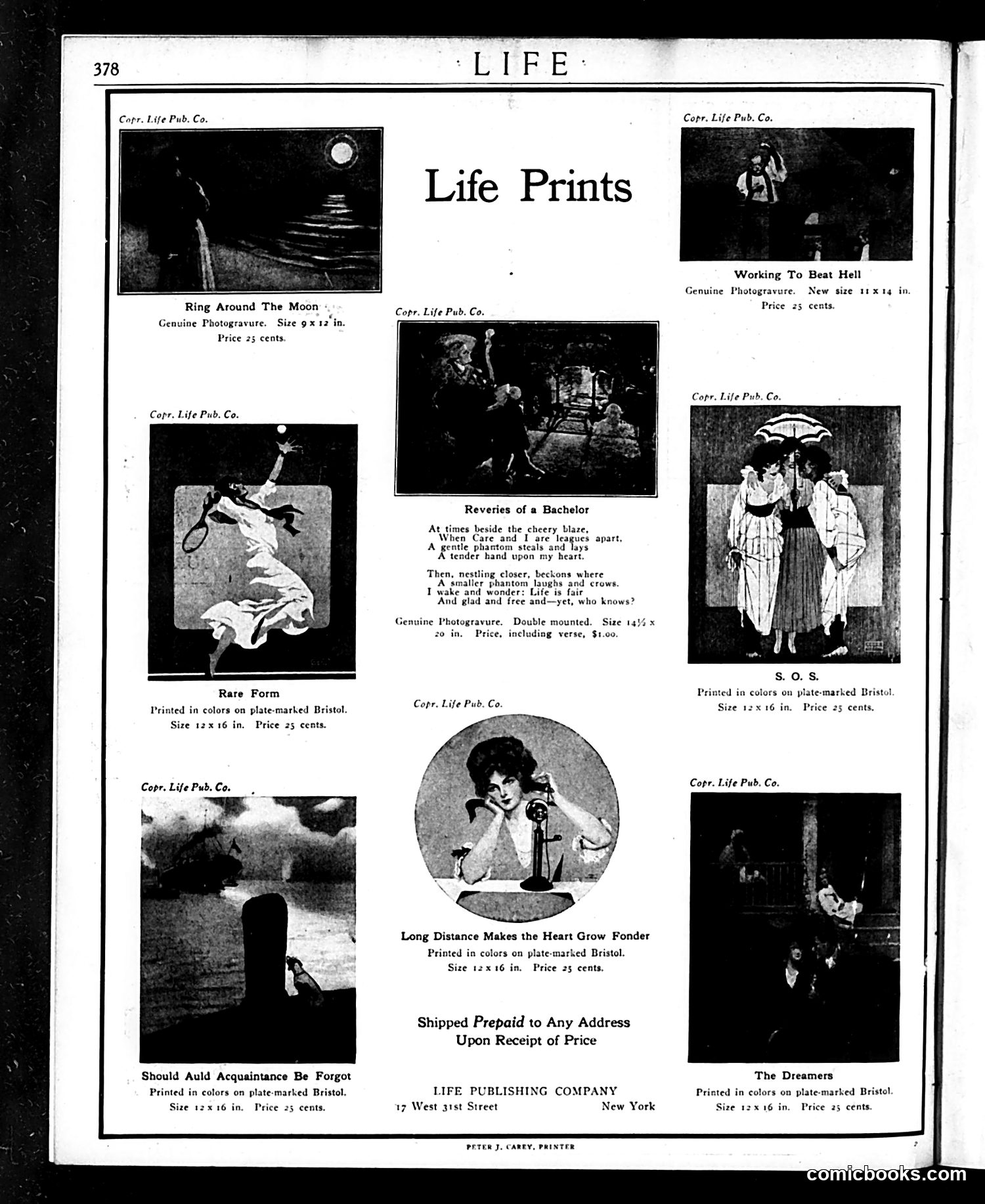
This is an advertising page for the Life Publishing Company selling framed photogravure prints—sentimental, romantic artwork popular in early 20th-century homes. The prints depict nostalgic themes: moonlit romance ("Ring Around The Moon"), domestic yearning ("Reveries of a Bachelor"), long-distance love, and melancholic reverie ("The Dreamers"). Each print cost 25 cents (or $1.00 with verse), marketed as "Genuine Photogravure" on "plate-marked Bristol" paper. The titles and imagery emphasize emotional, romantic subjects—a bachelor's domestic fantasies, couples separated by distance—reflecting period sentimentality. One print, "S.O.S.," appears to show distressed figures. This was essentially mail-order home décor for middle-class Americans seeking affordable art. The page isn't political satire but rather commercial advertising exploiting contemporary romantic and nostalgic sensibilities.