
Life, 1916-08-31 · page 13 of 34
Life — August 31, 1916 — page 13: what you’re looking at
What you’re looking at
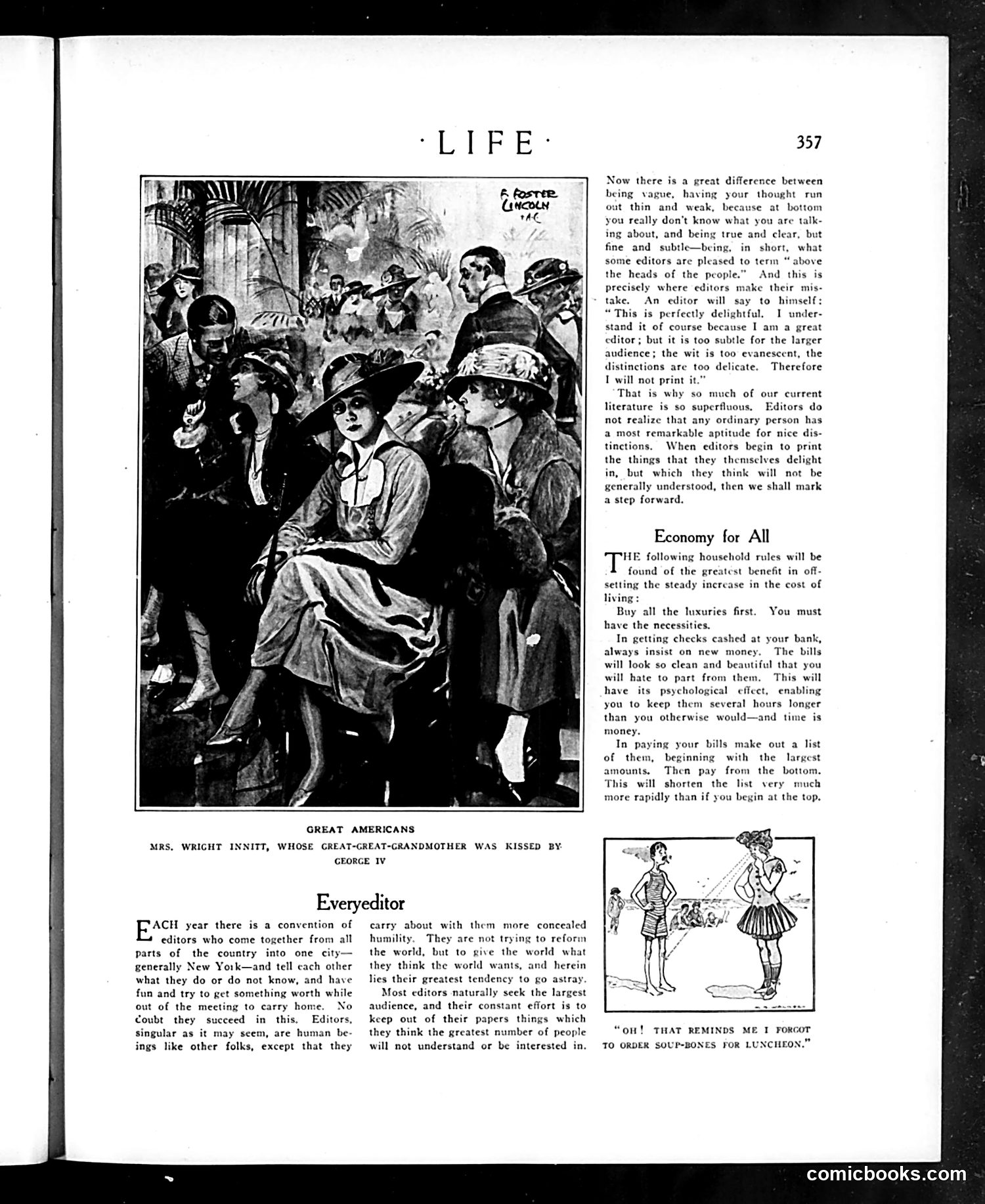
**Main Image:** A crowd scene labeled "Great Americans," featuring Mrs. Wright Innitt, whose "great-great-grandmother was kissed by George IV." This satirizes American social climbing and the obsession with aristocratic connections—the joke being that a distant, dubious royal encounter somehow confers distinction on modern Americans. **"Everyeditor" Section:** Mocks editors who attend annual conventions claiming to represent "what they do or do not know" and return with trivial or irrelevant material their readers won't understand. The satire targets editorial pretension and disconnect from audience interests. **Small Cartoon:** A woman's complaint about forgetting to order soup-boxes for lunch—domestic humor typical of the era. Overall, the page satirizes American snobbery, editorial pomposity, and class consciousness.
📄 Transcribed text from this page (OCR, searchable)
Machine-transcribed from the original scan — historical spelling and the odd misread are preserved.
GREAT AMERICANS MRS. WRIGHT INNITT, WHOSE GREAT-GREAT-GRANDMOTHER WAS KISSED BY. GEORGE IV Everyeditor Face year there is a convention of editors who come together from all parts of the country into one generally New Youk—and tell cach other what they do or do not know, and have fun and try to get something worth while out of the meeting to carry home, No Coubt they succeed in this. Editors, singular as it may seem, are human be: ings like other folks, except that they city— carry about with them more concealed humility. They are not trying to reform the world, but to give the world what they think the world wants, and herein lies their greatest tendency to go astray. Most editors naturally seek the largest audience, and their constant effort is to keep out of their papers things which they think the greatest number of people will not understand or be interested in. 357 Now there is a great difference between being vague, having your thought run out thin and weak, because at bottom you really don’t know what you are talk- ing about, and being true and clear, but fine and subtle—being, in short, what some editors are pleased to term “ above the heads of the people.” And this is precisely where editors make their mis- take. An editor will say to. himself: “This is perfectly delightful. I under- stand it of course because I am a great editor; but it is too subtle for the larger audience; the wit is too evanescent, the distinctions are too delicate. Therefore I will not print i That is why so much of our current literature is so superfluous. Editors do not realize that any ordinary person has a most remarkable aptitude for nice dis- tinctions, When editors begin to print the things that they themselves delight in, but which they think will not be generally understood, then we shall mark a step forward. Economy for All HE following household rules will be found of the greatest benefit in off- setting the steady increase in the cost of living : Buy all the luxuries first. have the necessities. In getting checks cashed at your bank, always insist on new money. The bills will look so clean and beautiful that you will hate to part from them. This will have its psychological effect, enabling you to keep them several hours longer than you otherwise would—and time is money. In paying your bills make out a list of them, beginning with the amounts. Then pay from the bottom. This will shorten the list very much more rapidly than if you begin at the top. You must largest THAT REMINDS ME I FORGOT S FOR LUNCHEON.” “ou! TO ORDER SOUP comicbooks.com