
Life, 1916-08-31 · page 20 of 34
Life — August 31, 1916 — page 20: what you’re looking at
What you’re looking at
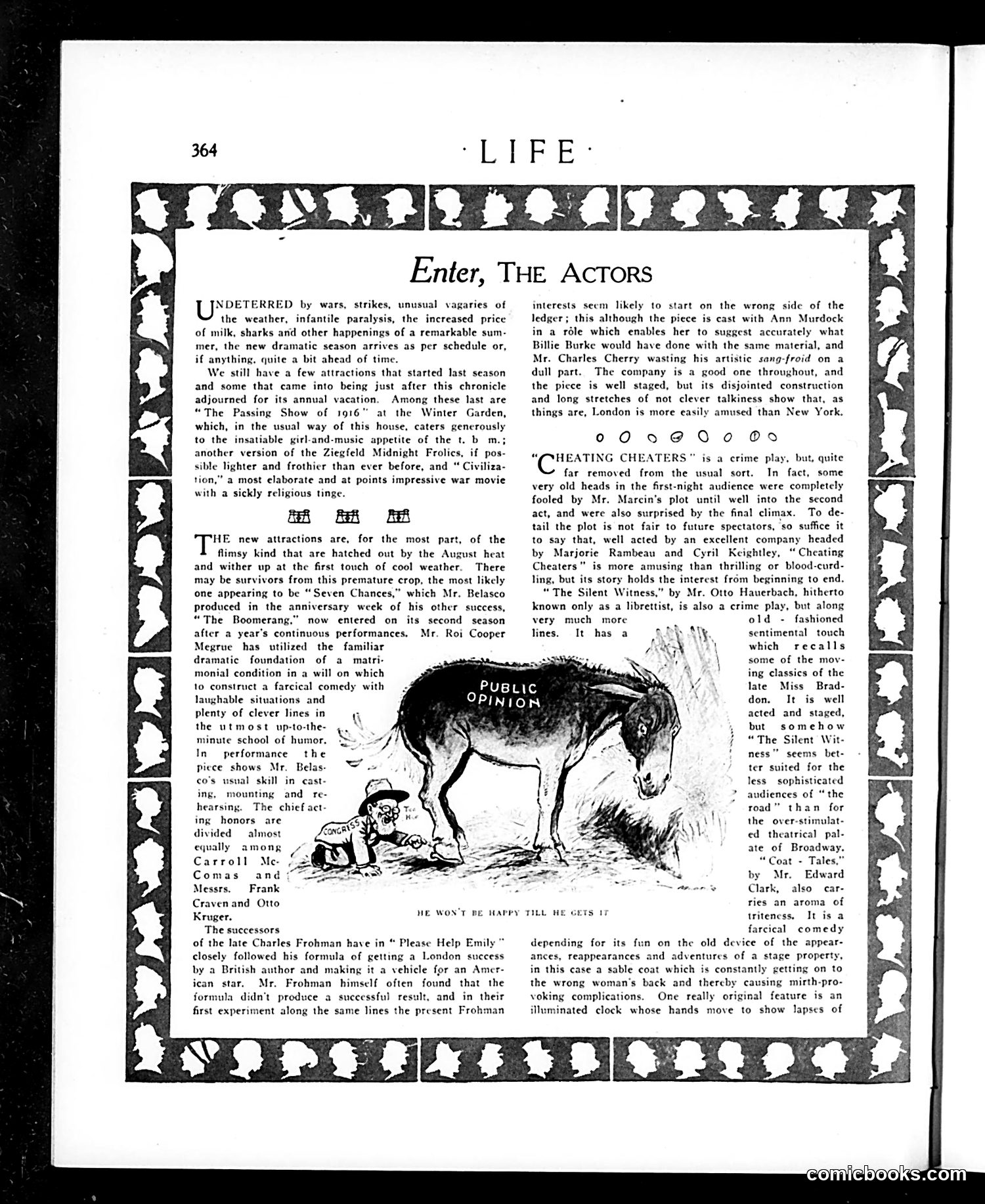
This cartoon illustrates a satirical commentary on public opinion during a tumultuous period (text mentions wars, strikes, infantile paralysis, and inflation). The image shows a donkey labeled "PUBLIC OPINION" being led by a small figure—likely representing politicians, media, or special interests. The caption "He Won't Be Happy Till He Gets It" suggests that public opinion is being manipulated or dissatisfied regardless of what's offered. The donkey's stubborn nature metaphorically represents how difficult it is to satisfy or control the fickle public mood during times of crisis and social upheaval. The cartoon critiques how public sentiment becomes a tool or obstacle that various interests must manage, particularly during the chaotic summer of 1916 referenced in the surrounding theater review text.
📄 Transcribed text from this page (OCR, searchable)
Machine-transcribed from the original scan — historical spelling and the odd misread are preserved.
Enter, THE AcTorRS NDETERRED by wars, strikes, unusual vagaries of the weather, infantile paralysis, the increased price of milk, sharks and other happenings of a remarkable sum- mer, the new dramatic season arrives as per schedule or, if anything. quite a bit ahead of time. We still have a few attractions that started last season and some that came into being just after this chronicle adjourned for its annual vacation. Among these last are “The Passing Show of 1916" at the Winter Garden, which, in the usual way of this house, caters generously to the insatiable girl-and-music appetite of the t. b m.; another version of the Ziegfeld Midnight Frolics, if pos- sible lighter and frothier than ever before, and “ Civiliza- tion,” a most elaborate and at points impressive war movie with a sickly religious tinge. Si i A TE new attractions are, for the most part, of the flimsy kind that are hatched out by the August heat and wither up at the first touch of cool weather. There may be survivors from this premature crop, the most likely one appearing to be “Seven Chances,” which Mr. Belasco produced in the anniversary week of his other success, its second season Mr. Roi Cooper “The Boomerang,” now entered on after a year's continuous performances. Megrue has utilized the familiar dramatic foundation of a matri- monial condition in a will on which to construct a farcical comedy with laughable situations and plenty of clever lines in the utmost up-to-the- minute school of humor, In performance the piece shows Mr. Belas- co's usual skill in cast- ing, mounting and re- hearsing. The chief act- ing honors are divided — almost equally among Carroll Me- Comas and Messrs. Frank Craven and Otto Kruger. The successors of the late Charles Frohman have in “ Please Help Emily * closely followed his formula of getting a London success by a British author and making it a vehicle for an Amer- ican star. Mr. Frohman himself often found that the formula didn't produce a successful result, and in their first experiment along the same lines the present Frohman ME WON'T DE HAPPY TILL HE GETS 17 interests secm likely to start on the wrong side of the ledger; this although the piece is cast with Ann Murdock in a role which enables her to suggest accurately what Billie Burke would have done with the same material, and Mr. Charles Cherry wasting his artistic sang-froid on a dull part. The company is a good one throughout, and the picce is well staged, but its disjointed construction and long stretches of not clever talkiness show that, as things are, London is more easily amused than New York. 000800 09 “(HEATING CHEATERS” is a crime play, but, quite far removed from the usual sort. In fact, some very old heads in the first-night audience were completely fooled by Mr. Marcin’s plot until well into the second act, and were also surprised by the final climax. To de- tail the plot is not fair to future spectators, ‘so suffice it to say that, well acted by an excellent company headed by Marjorie Rambeau and Cyril Keightley, “Cheating Cheaters" is more amusing than thrilling or blood-curd- ling, but its story holds the interest from beginning to end. “The Silent Witness,” by Mr. Otto Hauerbach, hitherto known only as a librettist, is also a crime play, but along very much old + fashioned lines. It sentimental touch which recalls some of the mov- ing classics of the late Miss Brad- don, It is well acted and staged, but somehow “The Silent Wit- ness” seems bet- ter suited for the less sophisticated audiences of “the road” than for the over-stimulat- ed. theatrical pal- ate of Broadway. “Coat - Tales.” by Mr, Edward Clark, also. car- ries an aroma of tritencss. It is a farcical comedy depending for its fun on the old device of the appear- ances, reappearances and adventures of a stage property, in this case a sable coat which is constantly getting on to the wrong woman's back and thereby causing mirth-pro- voking complications. One really original feature is an illuminated clock whose hands move to show lapses of more has a