
Life, 1916-08-31 · page 14 of 34
Life — August 31, 1916 — page 14: what you’re looking at
What you’re looking at
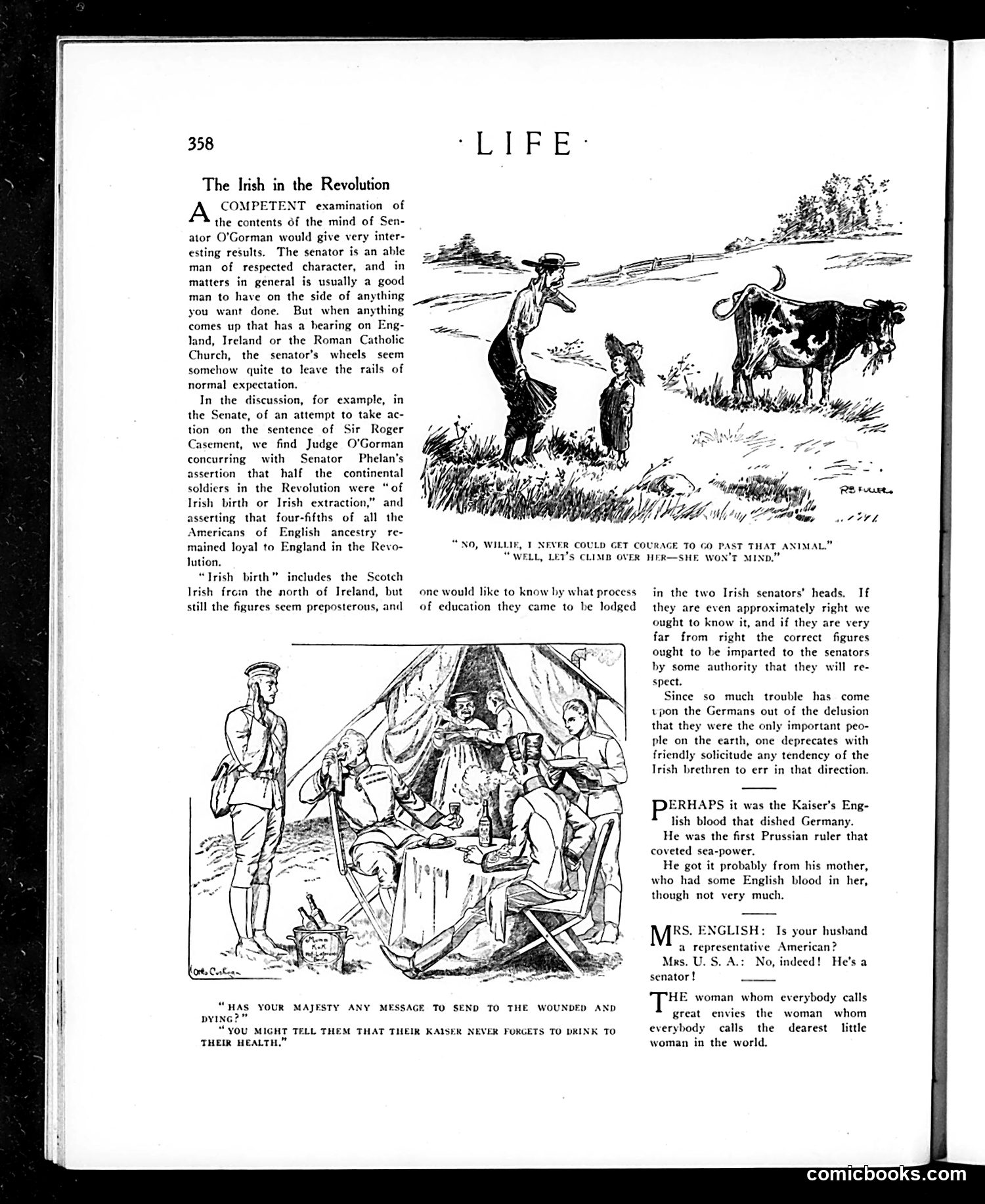
This page satirizes Irish-American senators' knowledge of history. The article critiques Senator O'Gorman's ignorance regarding Sir Roger Casement's execution and claims about Irish soldiers in the American Revolution. The senators apparently contradict themselves—one asserts "half the continental soldiers" were Irish, while another claims all English-descended Americans remained loyal to England during the Revolution. The top cartoon shows Irish rural poverty (a man struggling past cattle), while the lower sketch depicts soldiers in a military tent, likely illustrating the contrast between Irish immigrants' conditions and their claimed Revolutionary War contributions. The satire targets the senators' unreliable historical claims and suggests they lack proper education to make authoritative statements about Irish-American history.
📄 Transcribed text from this page (OCR, searchable)
Machine-transcribed from the original scan — historical spelling and the odd misread are preserved.
358 The Irish in the Revolution COMPETENT examination of the contents 6f the mind of Sen- ator O'Gorman would give very inter- esting results. The senator is an able man of respected character, and in matters in general is usually a good man to have on the side of anything you want done. But when anything comes up that has a bearing on Eng- land, Ireland or the Roman Catholic Church, the senator's wheels seem somehow quite to leave the rails of normal expectation. In the discussion, for example, in the Senate, of an attempt to take ac- tion on the sentence of Sir Roger Casement, we find Judge O'Gorman concurring with Senator Phelan’s assertion that half the continental soldiers in the Revolution were “of Irish birth or Irish extraction,” and asserting that four-fifths of all the Americans of English ancestry re- mained loyal to England in the Revo- lution. “Irish birth” includes the Scotch Irish froin the north of Ireland, but still the figures seem preposterous, and aS “NO, WILLIE, I NEVER COULD GET COURAGE TO GO PAST THAT “WELL, LET’S CLIMB OVER HER—SHE WON'T MIND one would like to know by what process of education they came to be lodged by1 ee HAS YOUR MAJESTY ANY MESSAGE TO SEND TO THE WOUNDED AND YOU MIGHT TELL THEM THAT THEIR KAISER NEVER FORGETS TO DRINK TO THEIR HEALTH,” in the two Irish senators’ heads. If they are even approximately right we ought to know it, and if they are very far from right the correct figures ought to be imparted to the senators by some authority that they will re- spect. Since so much trouble has come upon the Germans out of the delusion that they were the only important peo- ple on the earth, one deprecates with friendly solicitude any tendency of the Irish brethren to err in that direction. EERHAPS it was the Kaiser’s Eng- lish blood that dished Germany. He was the first Prussian ruler that coveted sea-power. He got it probably from his mother, who had some English blood in her, though not very much. RS, ENGLISH: a representative American? Mrs. U. S. No, indeed! He's a senator! —— Is your husband 'HE woman whom great envies the everybody calls the woman in the world. everybody calls woman whom dearest little comicbooks.com