
Life, 1916-08-31 · page 28 of 34
Life — August 31, 1916 — page 28: what you’re looking at
What you’re looking at
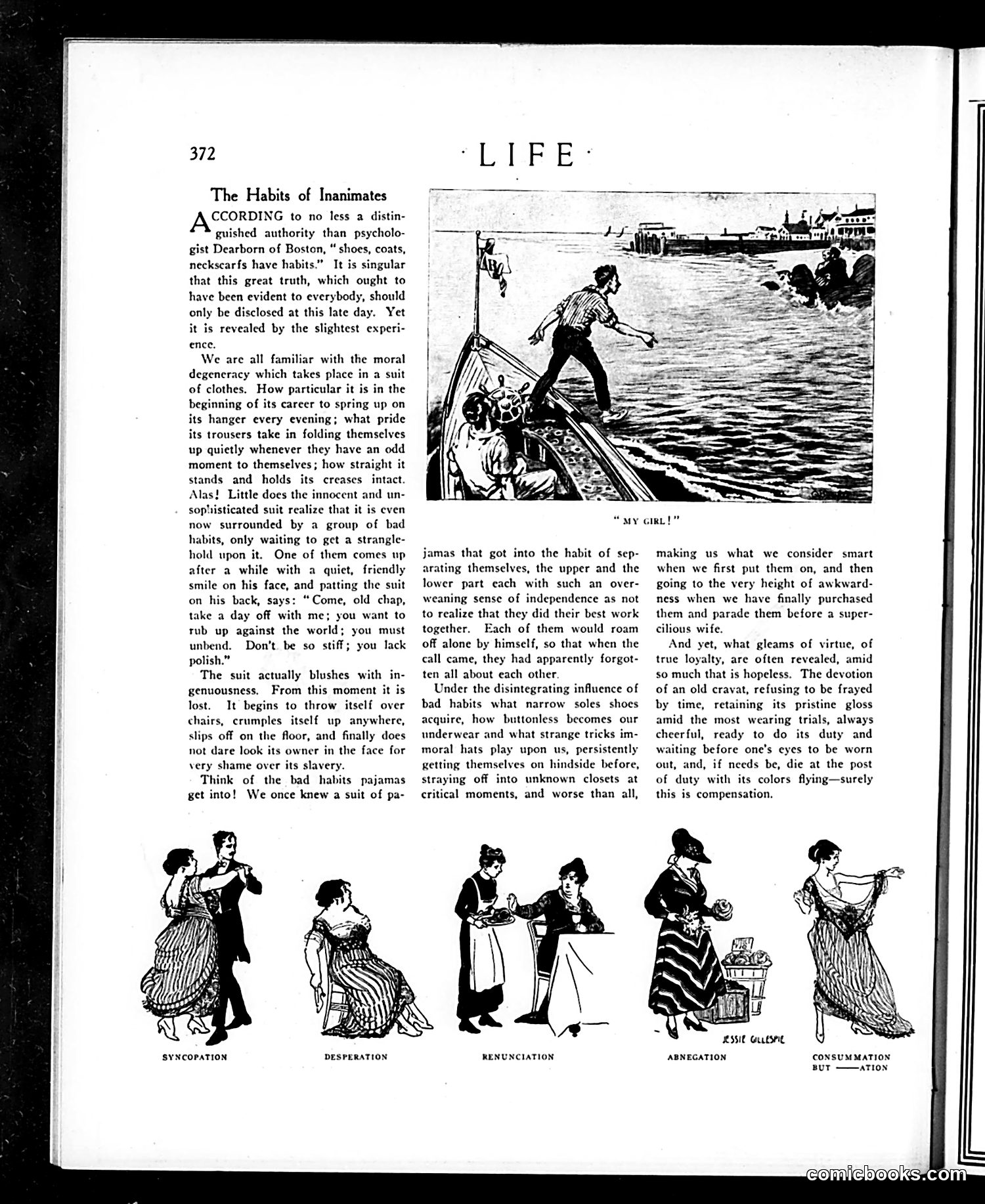
This page satirizes psychologist Darborn of Boston's claim that clothing has "habits"—a pseudo-scientific notion the author treats as absurdly obvious yet somehow newsworthy. The article uses personification as humor: clothes are depicted as moral beings that deteriorate through bad influences. A suit begins pristine and well-behaved, but gets corrupted by a "bad habit" who seduces it into slovenliness. Pajamas separate from each other; shoes lose their shape; hats misbehave. The five illustrated vignettes at bottom—labeled Syncopation, Desperation, Renunciation, Abnegation, and Consummation—appear to show people's relationship struggles (the upper image shows a couple), paralleling the clothes' behavioral decline. The satire mocks both pseudo-scientific pretension and the moral anxiety Victorians/Edwardians projected onto everyday objects, treating material decay as moral failure.
📄 Transcribed text from this page (OCR, searchable)
Machine-transcribed from the original scan — historical spelling and the odd misread are preserved.
SYNCOPATION 372 The Habits of Inanimates CCORDING to no less a distin- guished authority than psycholo- gist Dearborn of Boston, “ shoes, coats, neckscarfs have habits.” It is singular that this great truth, which ought to have been evident to everybody, should only be disclosed at this late day. Yet it is revealed by the slightest experi- ence. We are all familiar with the moral degeneracy which takes place in a suit of clothes. How particular it is in the beginning of its career to spring up on its hanger every evening; what pride its trousers take in folding themselves up quietly whenever they have an odd moment to themselves; how straight it stands and holds its creases intact. Alas! Little does the innocent and un- sophisticated suit realize that it is even now surrounded by a group of bad habits, only waiting to get a strangle- hold upon it. One of them comes up after a while with a quiet, friendly smile on his face, and patting the suit on his back, says: “Come, old chap, take a day off with me; you want to rub up against the world; you must unbend. Don’t. be so stiff; you lack polish.” The suit actually blushes with in- genuousness, From this moment it is lost. It begins to throw itself over chairs, crumples itself up anywhere, slips off on the floor, and finally does not dare look its owner in the face for very shame over its slavery. Think of the bad habits pajamas get into! We once knew a suit of pa- DESPERATION “My GIRL!” jamas that got into the habit of sep- arating themselves, the upper and the lower part each with such an over- weaning sense of independence as not to realize that they did their best work together. Each of them would roam off alone by himself, so that when the call came, they had apparently forgot- ten all about each other. Under the disintegrating influence of bad habits what narrow soles shoes acquire, how buttonless becomes our underwear and what strange tricks im- moral hats play upon us, persistently getting themselves on hindside before, straying off into unknown closets at critical moments, and worse than all, RENUNCIATION making us what we consider smart when we first put them on, and then going to the very height of awkward- ness when we have finally purchased them and parade them before a super- cilious wife. And yet, what gleams of virtue, of true loyalty, are often revealed, amid so much that is hopeless, The devotion of an old cravat, refusing to be frayed by time, retaining its pristine gloss amid the most wearing trials, always cheerful, ready to do its duty and waiting before one’s eyes to be worn out, and, if needs be, die at the post of duty with its colors flying—surely this is compensation. RSSIC Guesrit, ABNEGATION CONSUM MATION BUT ——aTION