
Life, 1916-08-31 · page 17 of 34
Life — August 31, 1916 — page 17: what you’re looking at
What you’re looking at
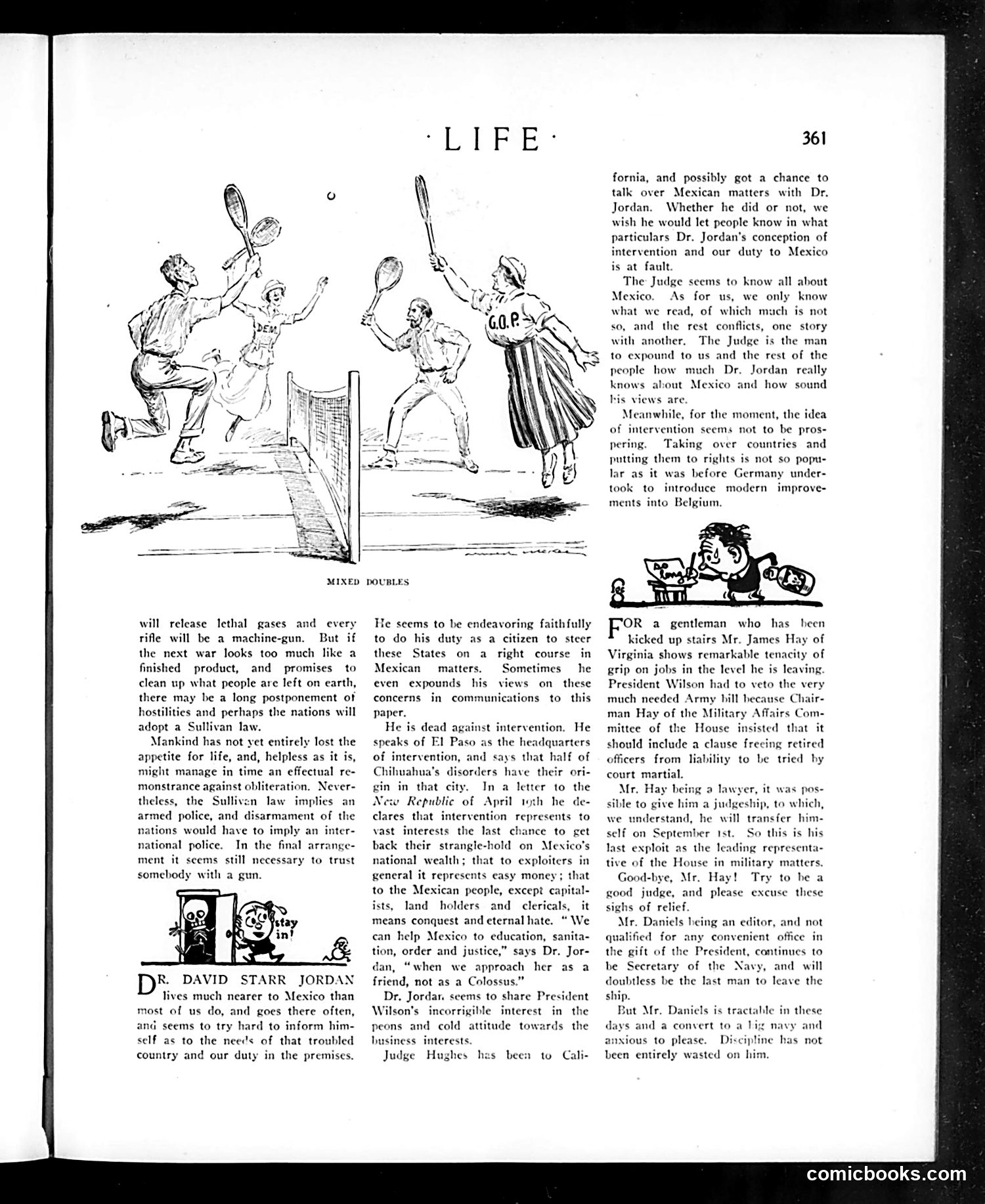
**The "Mixed Doubles" Cartoon:** Depicts a tennis match where figures representing different political positions on Mexico play against each other. The satire mocks the debate over U.S. intervention in Mexico during the Wilson administration. **Key Figures Referenced:** - **Dr. David Starr Jordan**: A real academic/public intellectual opposed to U.S. military intervention in Mexico, advocating approaching Mexico "as a friend, not as a Colossus" - **Judge Hughes**: Apparently favors intervention; Life challenges him to publicly explain what Jordan gets wrong about Mexico - **President Wilson**: Shares Jordan's skepticism toward business interests exploiting Mexico **The Satire's Point:** Life ridicules both the intervention debate and those involved. The magazine suggests that intervention was becoming unpopular (referencing Germany's invasion of Belgium as a cautionary example). It also mocks various government figures—Congressman Hay for clinging to power and Secretary Daniels for his political flexibility—using gentle mockery about their careers and competence. The overall tone: skeptical, sardonic commentary on American foreign policy confusion and political self-interest regarding Mexico.
📄 Transcribed text from this page (OCR, searchable)
Machine-transcribed from the original scan — historical spelling and the odd misread are preserved.
MIXED will release lethal gases and every rifle will be a machine-gun, But if the next war looks too much like a finished product, and promises to clean up what people are left on earth, there may be a long postponement of hostilities and perhaps the nations will adopt a Sullivan law. Mankind has not yet entirely lost the appetite for life, and, helpless as it is, might manage in time an effectual re- monstrance against obliteration, Never- theless, the Sulliven law implies an armed police, and disarmament of the nations would have to imply an inter- national police. In the final arrange- ment it scems still necessary to trust somebody with a gun. D*® DAVID STARR JORDAN lives much nearer to Mexico than most of us do, and goes there often, and seems to try hard to inform him- self as to the needs of that troubled country and our duty in the premises. DOUBLES He seems to be endeavoring faithfully to do his duty as a citizen to steer these States on a right course in Mexican atters, Sometimes he even expounds his views on these concerns in communications to this paper. He is dead against intervention. He speaks of El Paso as the headquarters of intervention, and says that half of Chihuahua's disorders have their ori- gin in that city. In a letter to the New Republic of April ith he de- clares that intervention represents to vast interests the last chance to get back their strangle-hold on Mexico's national wealth; that to exploiters in general it represents easy money; that to the Mexican people, except capital- ists, land holders and clericals, it means conquest and eternal hate. “ We can help Mexico to education, sanita- tion, order and justice,” says Dr. Jor- dan, “when we approach her as a friend, not as a Colossus.” Dr. Jordan. seems to share President Wilson's incorrigible interest’ in’ the peons and cold attitude towards the business interests. Judge Hughes to Cali- hes been 361 fornia, and possibly got a chance to talk over Mexican matters with Dr, Jordan. Whether he did or not, we wish he would let people know in what particulars Dr. Jordan's conception of intervention and our duty to Mexico is at fault The Judge seems to know all about Mexico. As for us, we only know what we read, of which much is not so, and the rest conflicts, one story with another, The Judge is the man to expound to us and the rest of the people how much Dr. Jordan really knows ahout Mexico and how sound his views are. Meanwhile, for the moment, the idea of intervention seems not to be pros- pering. Taking over countries and putting them to rights is not so popu- lar as it was before Germany under- took to introduce modern improve- ments into Belgium. ‘OR a gentleman who has heen kicked up stairs Mr. James Hay of Virginia shows remarkable tenacity of grip on jobs in the level he is leaving. President Wilson had to veto the very much needed Army bill hecause Chair- man Hay of the Military A mittee of the House insisted that it should include a clause freeing retired officers from liability to be tried by court martial. Mr. Hay be sible to give hi we understand, he will transfer him- s on September ist. So this is his last exploit as the le: tive of the House in Good-bye, Mr. Ha: good judge, and please sighs of relief, Mr. Daniels heing an editor, qualified for any convenient office in the gift of the President, cantinues to be Secretary of the Navy, and will doubtless be the last man to leave the ship. But Mr. Daniels is tractable in these days and a convert to a lig navy and anxious to please. Discipline has not been entirely wasted on him. airs Com- ng a lawyer, it was pos- a judgeship, to which, Jing representa- military matters. Try to he a excuse these d not comicbooks.com