
Life, 1916-08-31 · page 32 of 34
Life — August 31, 1916 — page 32: what you’re looking at
What you’re looking at
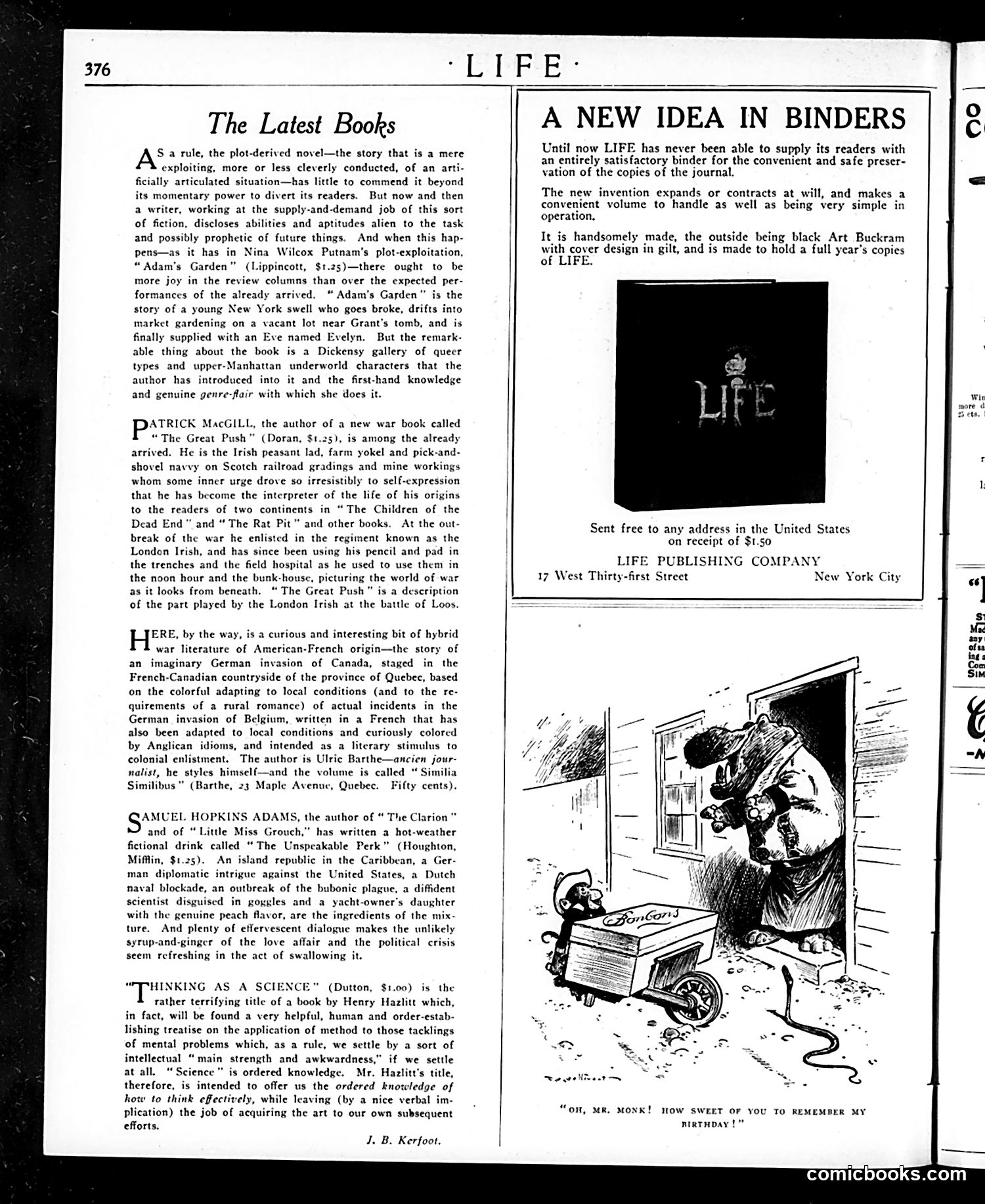
This page contains **book reviews**, not political cartoons. The cartoon at bottom—captioned "Oh, Mr. Monk! How sweet of you to remember my birthday!"—shows a monkey delivering a wrapped gift to what appears to be a woman indoors. It's a humorous illustration unrelated to the book reviews above. The reviews discuss recently published fiction and non-fiction, including war literature by Patrick MacGill (an Irish writer documenting WWI from a soldier's perspective), a romantic comedy about a New York man who becomes a gardener, and adventure fiction set in the Caribbean. The page reflects early-1910s publishing trends: plot-driven novels, war narratives (timely given WWI), and romantic escapism. The monkey cartoon appears to be simple visual humor—a clever animal remembering a birthday—typical of Life magazine's light satirical style.
📄 Transcribed text from this page (OCR, searchable)
Machine-transcribed from the original scan — historical spelling and the odd misread are preserved.
The Latest Books S a rule, the plot-derived novel—the story that is a mere exploiting, more or less cleverly conducted, of an arti- ficially articulated situation—has little to commend it beyond its momentary power to divert its readers. But now and then a writer, working at the supply-and-demand job of this sort of fiction, discloses abilities and aptitudes alien to the task and possibly prophetic of future things. And when this hap- pens—as it has in Nina Wilcox Putnam's plot-exploitation, “Adam's Garden" (Lippincott, $1.25)—there ought to be more joy in the review columns than over the expected per- formances of the already arrived. “Adam's Garden” is the story of a young New York swell who goes broke, drifts into market gardening on a vacant lot near Grant's tomb, and is finally supplied with an Eve named Evelyn. But the remark- able thing about the book is a Dickensy gallery of queer types and upper-Manhattan underworld characters that the author has introduced into it and the first-hand knowledge and genuine genre-flair with which she does it. TRICK MacGILL, the author of a new war book called The Great Push (Doran, $1.25), is among the already arrived. He is the Irish peasant lad, farm yokel and pick-and- shovel navvy on Scotch railroad gradings and mine workings whom some inner urge drove so irresistibly to self-expression that he has become the interpreter of the life of his origins to the readers of two continents in “The Children of the Dead End” and “ The Rat Pit” and other books. At the out- break of the war he enlisted in the regiment known as the London Irish, and has since been using his pencil and pad in the trenches and the field hospital as he used to use them in the noon hour and the bunk-house, picturing the world of war as it looks from beneath. “The Great Push” is a description of the part played by the London Irish at the battle of Loos. H RE, by the way, is a curious and interesting bit of hybrid r literature of American-French origin—the story of an imaginary German invasion of Canada, staged in the French-Canadian countryside of the province of Quebec, based on the colorful adapting to local conditions (and to the re- quirements of a rural romance) of actual incidents in the German invasion of Belgium, written in a French that has also been adapted to local conditions and curiously colored by Anglican idioms, and intended as a literary stimulus to colonial enlistment. The author is Ulric Barthe—ancien jour- nalist, he styles himself—and the volume is called “ Similia Similibus ” (Barthe, 23 Maple Avenue, Quebec. Fifty cents). GAMUEL HOPKINS ADAMS, the author of “ The Clarion ” and of “Little Miss Grouch,” has written a hot-weather fictional drink called “The Unspeakable Perk” (Houghton, Mifflin, $1.25). An island republic in the Caribbean, a Ger- man diplomatic intrigue against the United States, a Dutch naval blockade, an outbreak of the bubonic plague, a diffident scientist disguised in goggles and a yacht-owner's daughter with the genuine peach flavor, are the ingredients of the mix- ture. And plenty of effervescent dialogue makes the unlikel. syrup-and-ginger of the love affair and the political ci seem refreshing in the act of swallowing it. “THINKING AS A SCIENCE” (Dutton, $1.00) is the rather terrifying title of a book by Henry Hazlitt which, in fact, will be found a very helpful, human and order-estab- lishing treatise on the application of method to those tacklings of mental problems which, as a rule, we settle by a sort of intellectual “main strength and awkwardness,” if we settle at all, “Science” is ordered knowledge. Mr. Hazlitt’s title, therefore, is intended to offer us the ordered knowledge of how to think efectively, while leaving (by a nice verbal im- Plication) the job of acquiring the art to our own subsequent efforts. J. B. Kerfoot. A NEW IDEA IN BINDERS Until now LIFE has never been able to supply its readers with an entirely satisfactory binder for the convenient and safe preser- vation of the copies of the journal. The new invention expands or contracts at will, and makes a convenient volume to handle as well as being very simple in operation, It is handsomely made, the outside being black Art Buckram with cover design in gilt, and is made to hold a full year’s copies of LIFE. Sent free to any address in the United States on receipt of $1.50 LIFE PUBLISHING COMPANY 17 West Thirty-first Street New York City wee! MOW SWEET OF YOU TO REMEMBER MY mirtHpay !" “on, MR, MON comicbooks.com