
Life, 1916-08-31 · page 16 of 34
Life — August 31, 1916 — page 16: what you’re looking at
What you’re looking at
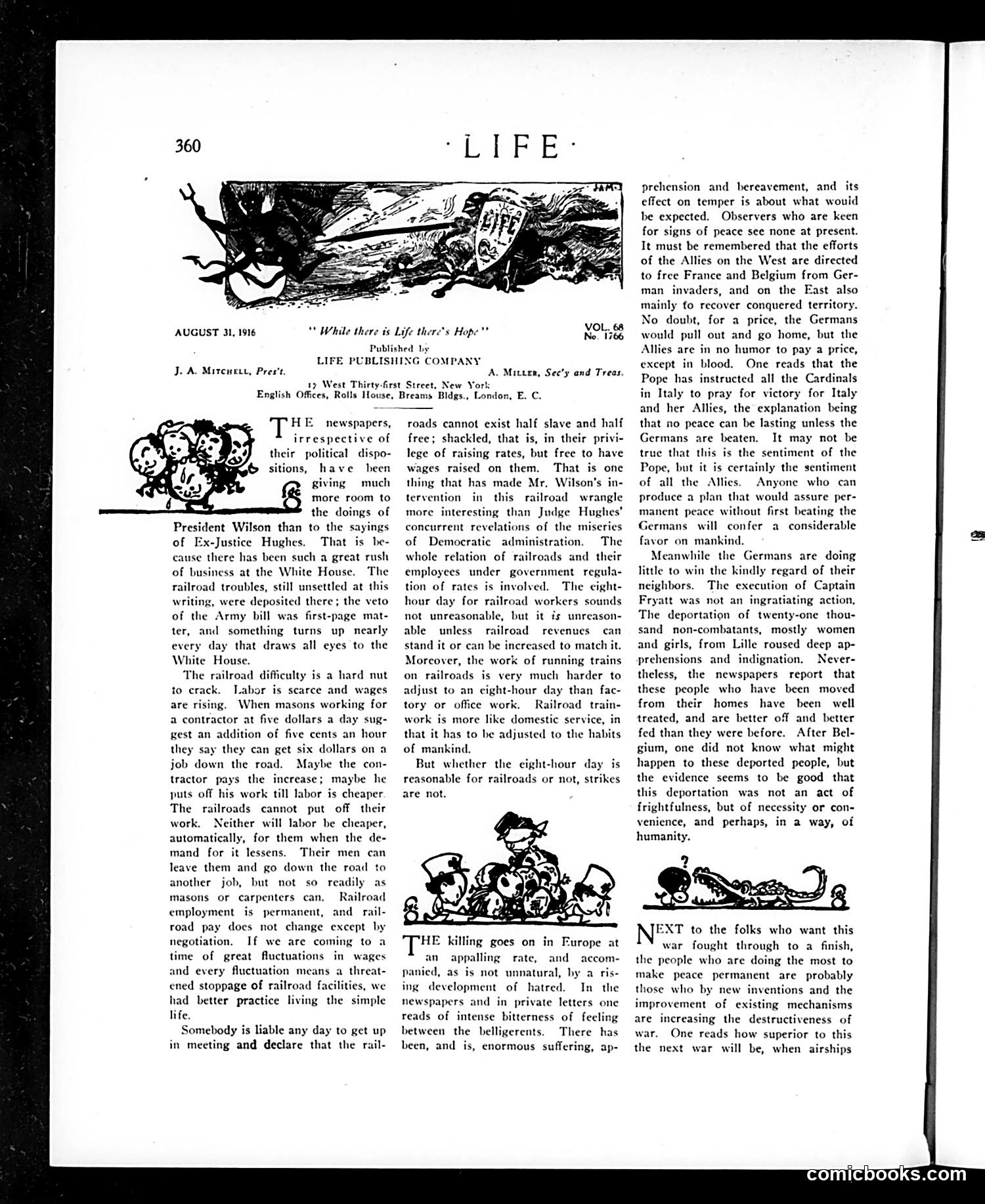
This page discusses two major issues confronting President Wilson: **Railroad Labor Crisis**: The article explains the tension between railroad companies and workers demanding an eight-hour workday and higher wages. Wilson had recently intervened in this dispute. The author argues the issue is complex—while an eight-hour day seems reasonable, railroad work (unlike factory work) cannot easily be constrained by fixed hours since trains must operate on passengers' schedules. The piece notes that if wages must rise whenever labor is scarce, railroads face an unsustainable economic problem. **World War I**: The second section discusses the ongoing killing in Europe and rising hatred between belligerents. The author notes that observers see no signs of peace, and explains the Allies (fighting to liberate France and Belgium) won't accept a negotiated settlement with Germany. The Pope reportedly instructed Italian Cardinals to pray for Allied victory, believing Germans must be defeated for lasting peace. The cartoon illustrations appear generic satirical imagery rather than specific caricatures of identifiable figures.
📄 Transcribed text from this page (OCR, searchable)
Machine-transcribed from the original scan — historical spelling and the odd misread are preserved.
ors ee AUGUST 331, 1916 “While there is Life there's He Published by LIFE PUBLISHING COMPANY J. A. Mirenete, Pres't. 17 West Thirt A. Mitten, Sec’y and Treas. first Street, New York English Offices, Rolls House, Breams Bldgs., London, E. C. HE irrespective of their political dispo- sitions, have been giving much f) more room to the doings of President Wilson than to the sayings of Ex-Justice Hughes. That is be- cause there has been such a great rush of business at the White House. The railroad troubles, still unsettled at this writing, were deposited there; the veto of the Army bill was first-page mat- ter, and something turns up nearly every day that draws all eyes to the White House. The railroad difficulty is a hard nut to crack. Labor is scarce and wages are rising. When masons working for a contractor at five dollars a d sug gest an addition of five cents an hour they say they can get six dollars on a job down the road. Maybe the con- tractor pays the increa: maybe he puts off his work till labor is cheaper The railroads cannot put off their work, Neither will labor be cheaper, automatically, for them when the de- mand for it lessens. Their men can leave them and go down the road to another job, but not so readily as masons or carpenters can, Railroad employment is permanent, and rail- road pay does not change except by negotiation. If we are coming to a time of great fluctuations in wages and every fluctuation means a threat- ened stoppage of railroad facilities, we had better practice living the simple life. Somebody is liable any day to get up in meeting and declare that the rail- newspapers, roads cannot exist half slave and half free; shackled, that is, in their privi: lege of raising rates, but free to have wages raised on them. That is one thing that has made Mr. Wilson’s in- tervention in this railroad wrangle more interesting than Judge Hughes’ concurrent revelations of the miseries of Democratic administration. The whole relation of railroads and their employees under government regula- tion of rates is involved. The cight- hour day for railroad workers sounds not unreasonable, but it is unreason- able unless railroad revenues can stand it or can be increased to match it. Moreover, the work of running trains on railroads is very much harder to adjust to an eight-hour day than fac- tory or office work Railroad train- work is more like domestic service, in that it has to be adjusted to the habits of mankind. But whether the eight-hour day is reasonable for railroads or not, strikes are not. killing goes on in Europe at appalling rate, HE panied, as is not unnatural, by a ris- and accom- ing development of hatred. In the newspapers and in private letters one reads of intense bitterness of feeling between the belligerents. There has been, and is, enormous suffering, ap- prehension and bereavement, and its effect on temper is about what would be expected. Observers who are keen for signs of peace see none at present. It must be remembered that the efforts of the Allies on the West are directed to free France and Belgium from Ger- man invaders, and on the East also mainly fo recover conquered territory. Yo doubt, for a price, the Germans would pull out and go home, but the Allies are in no humor to pay a price, except in blood. One reads that the Pope has instructed all the Cardinals in Italy to pray for victory for Italy and her Allies, the explanation being that no peace can be lasting unless the Germans are beaten. It may not be true that this is the sentiment of the Pope, but it is certainly the sentiment of all the Allies. Anyone who can produce a plan that would assure per- manent peace without first beating the Germans will confer a considerable favor on mankind. Meanwhile the Germans are doing little to win the kindly regard of their neighbors, The execution of Captain Fryatt was not an ingratiating action, The deportation of twenty-one thou- sand non-combatants, mostly women and girls, from Lille roused deep ap- prehensions and indignation. Never- theless, the newspapers report that these people who have been moved from their homes have been well treated, and are better off and better fed than they were before. After Bel- gium, one did not know what might happen to these deported people, but the evidence seems to be good that this deportation was not an act of ightfulness, but of necessity or con- venience, and perhaps, in a way, of humanity. NEXT to the folks who want this war fought through to a finish, the people who are doing the most to make peace permanent are probably those who by new inventions and the improvement of existing mechanisms are increasing the destructiveness of war, One reads how superior to this the next war will be, when airships Ccomicbooks.com