
A complete issue · 42 pages · 1916
Life — July 6, 1916
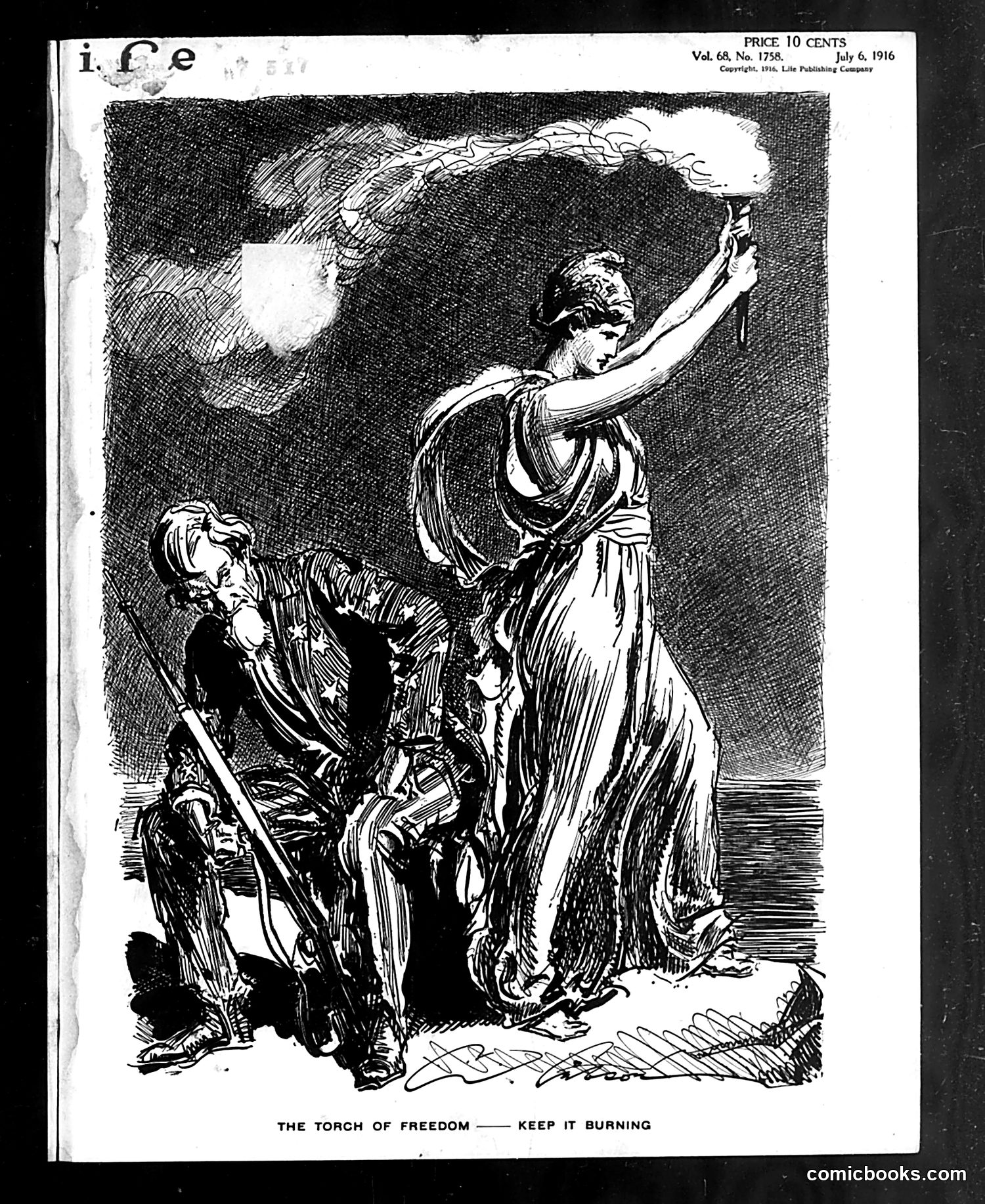
This July 1916 *Life* magazine cover depicts a classical female figure (likely Lady Liberty or Britannia) holding aloft a torch while a soldier in military uniform kneels or sits nearby. The image appears to reference World War I, which the United States had not yet officially entered (entry came in April 1917). The caption urges Americans to maintain commitment to democratic values and freedom during global conflict. The torch symbolizes liberty worth defending, while the soldier represents sacrifice. The allegorical composition—mixing classical mythology with contemporary warfare—was typical propaganda imagery encouraging American support for the Allied cause or military preparedness before official U.S. involvement.
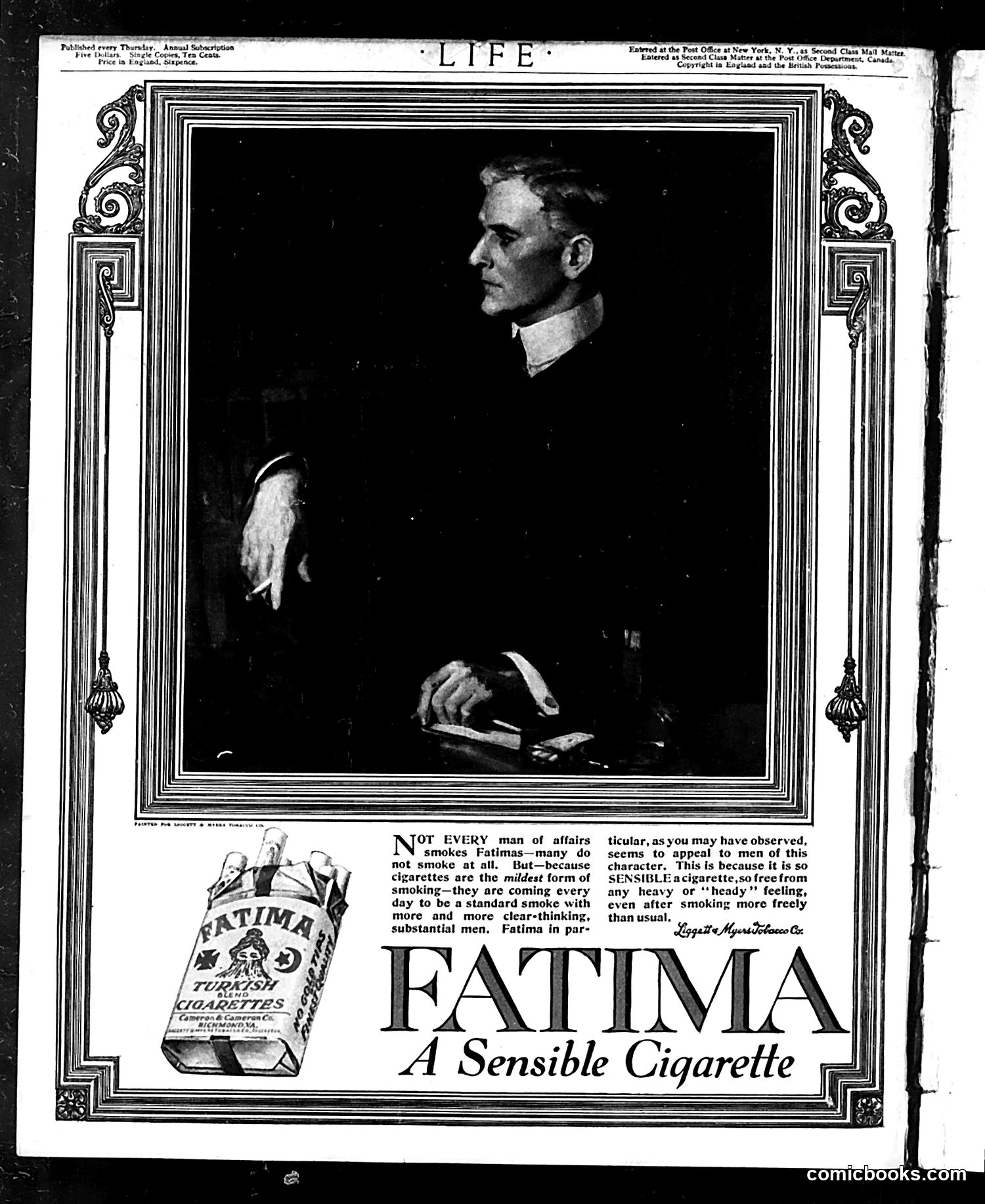
This page is primarily **advertising, not satire or political commentary**. It features a Fatima cigarette advertisement from the early 20th century. The ad shows a formal portrait of an unidentified man in profile, dressed in dark clothing with a white collar. Below, the copy argues that Fatima cigarettes are "a Sensible Cigarette" because they're mild—"the mildest form of smoking"—and appeal to "clear-thinking, substantial men." The advertisement markets the product as sophisticated and refined, suitable for serious professionals. The portrait's formal presentation and the emphasis on the cigarette being "sensible" reflect advertising strategies of the era, which associated products with respectability and social status. No political figures are caricatured here.
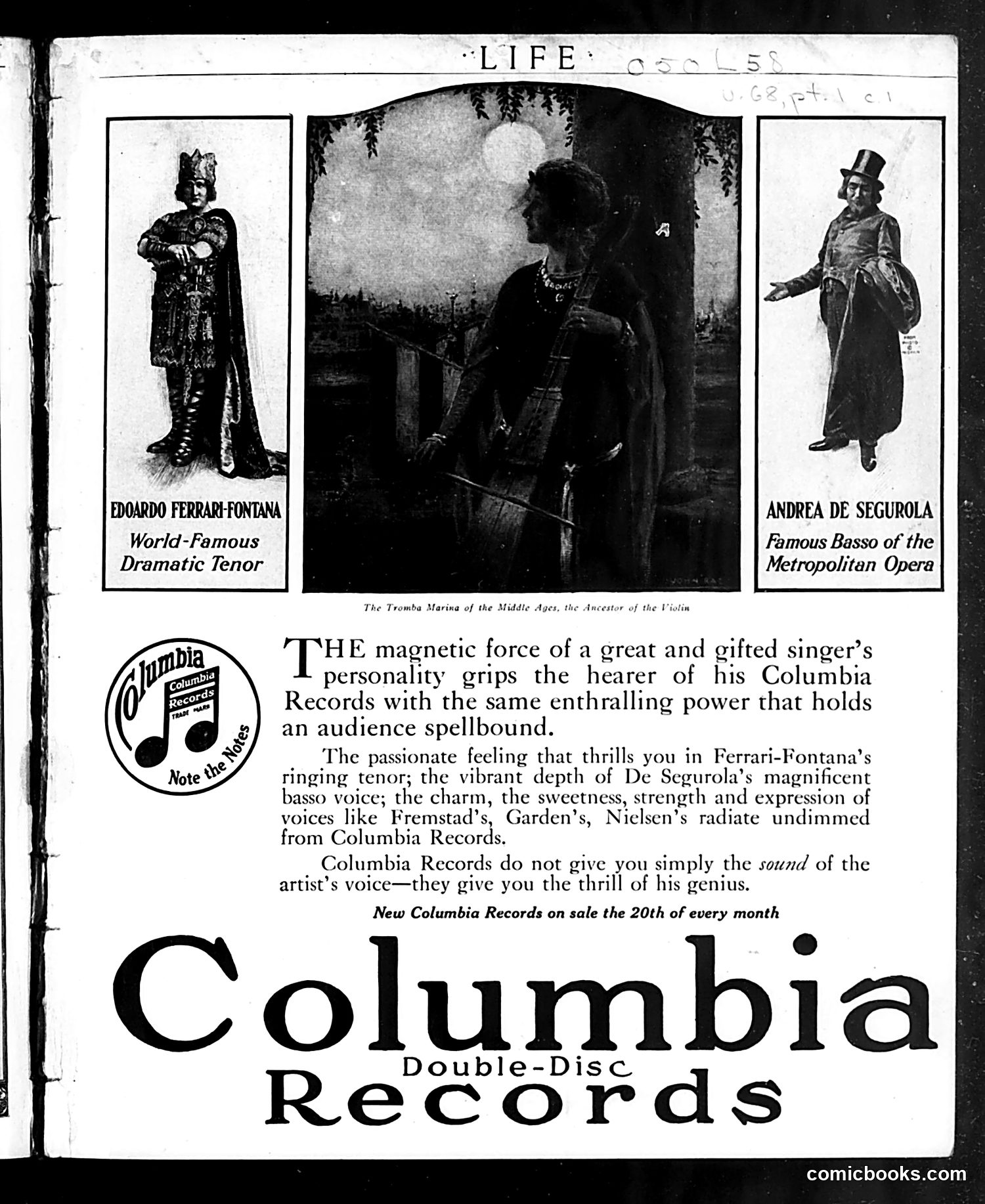
This page is primarily **advertising, not satire or political commentary**. It features a Columbia Records advertisement promoting operatic recordings by two famous singers: Edoardo Ferrari-Fontana (described as a "World-Famous Dramatic Tenor") and Andrea de Segurola (a "Famous Basso of the Metropolitan Opera"). The central image depicts a scene labeled "The Troubador Marina of the Middle Ages, the ancestor of the Violin"—likely an operatic scene for context. The advertisement's pitch emphasizes that Columbia Records captures not just singers' voices but their "genius" and "magnetic force." It mentions other celebrated singers like Fremstad, Garden, and Nielsen. **No political cartoon or satire is present**; this is purely commercial content promoting classical music recordings from the early 20th century.
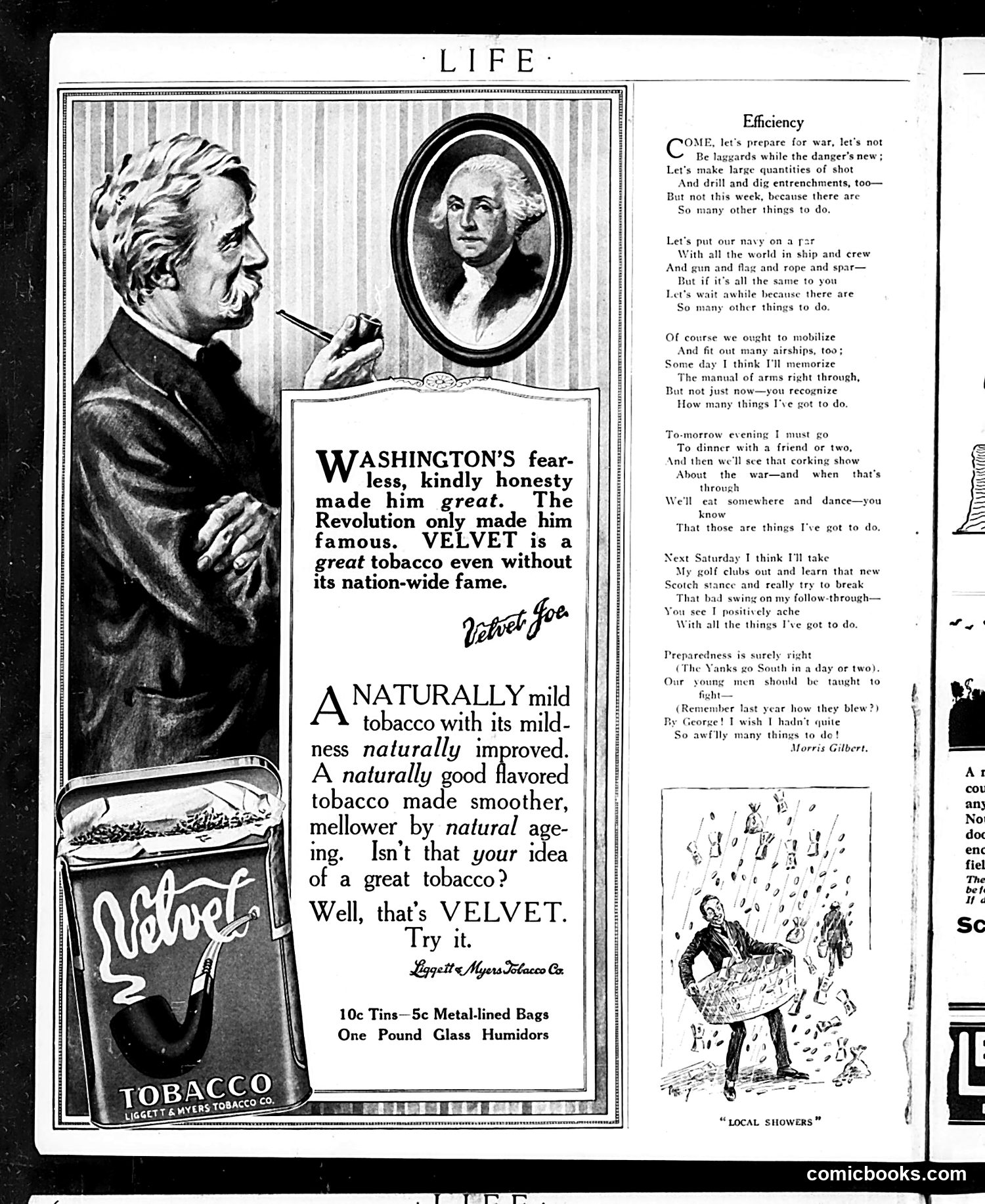
**Main Content:** The left side is a Velvet tobacco advertisement featuring a profile portrait (appears to be a historical figure, possibly meant to evoke Washington based on the styling) examining a tobacco tin. The ad emphasizes "natural" qualities and mild flavor through aging. **Satirical Poem - "Efficiency":** The right side contains a poem by Morris Gilbert mocking wartime preparedness priorities. It satirizes Americans' tendency to postpone military readiness ("let's wait awhile") in favor of leisure activities—golf, social dinners, entertainment—despite war looming. The small illustration shows a man juggling numbered items, visualizing his overwhelming to-do list. The satire suggests Americans are complacently procrastinating about serious national defense while distracted by trivial social obligations.
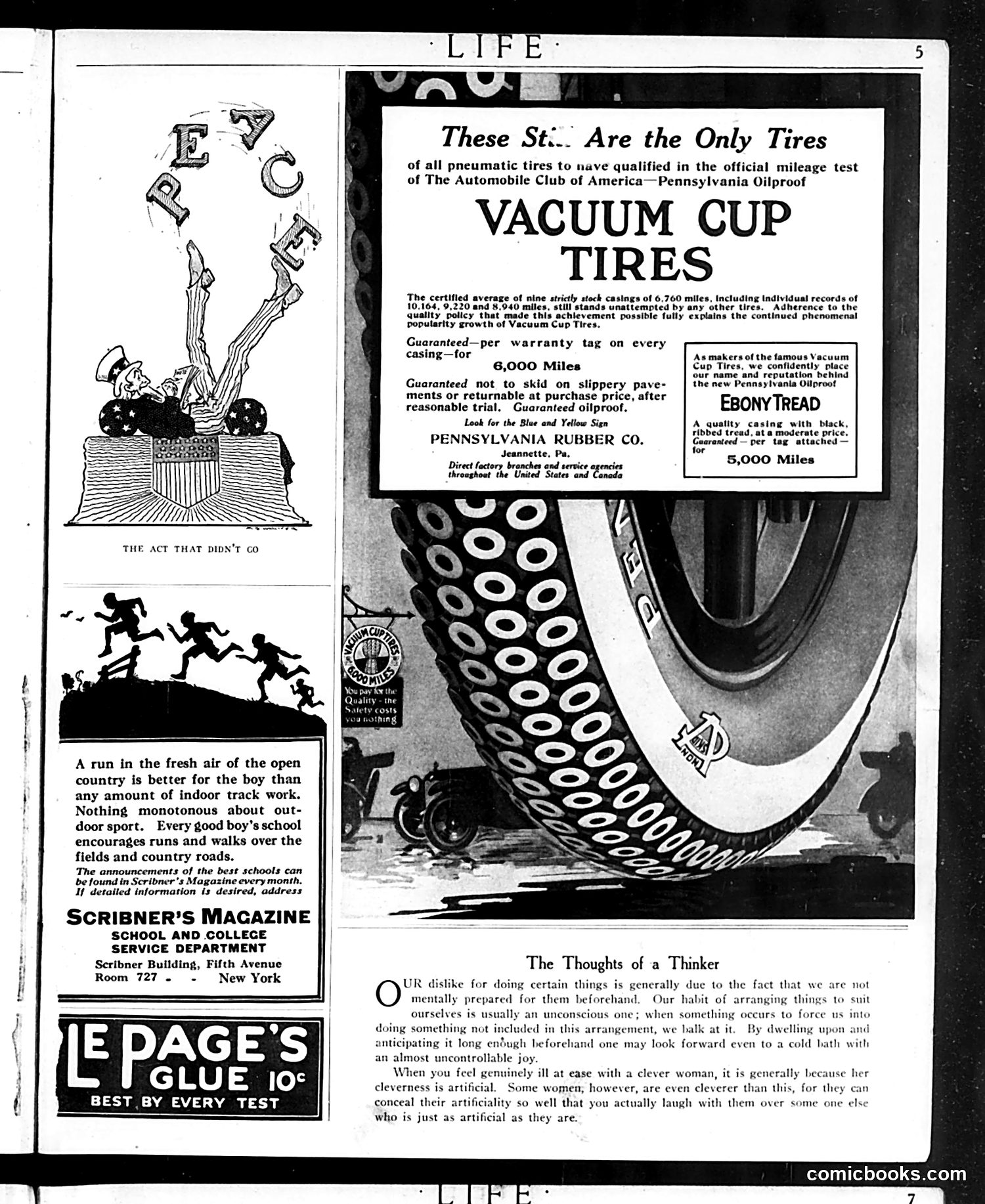
This page is primarily **advertising**, not political satire. The main content features a large advertisement for Vacuum Cup Tires by Pennsylvania Rubber Co., emphasizing durability (6,000-mile guarantee) and an "Ebony Tread" variant promising 5,000 miles. The left sidebar contains unrelated advertisements and a brief article about outdoor exercise from Scribner's Magazine, plus an ad for Le Page's Glue. The only cartoon—"THE ACT THAT DIDN'T GO" (top left)—appears to be a visual pun showing a magician's failed trick, with a skeleton and chaos resulting. The reference is unclear without additional context, but it's a small, standalone joke unrelated to the tire advertisement dominating the page.
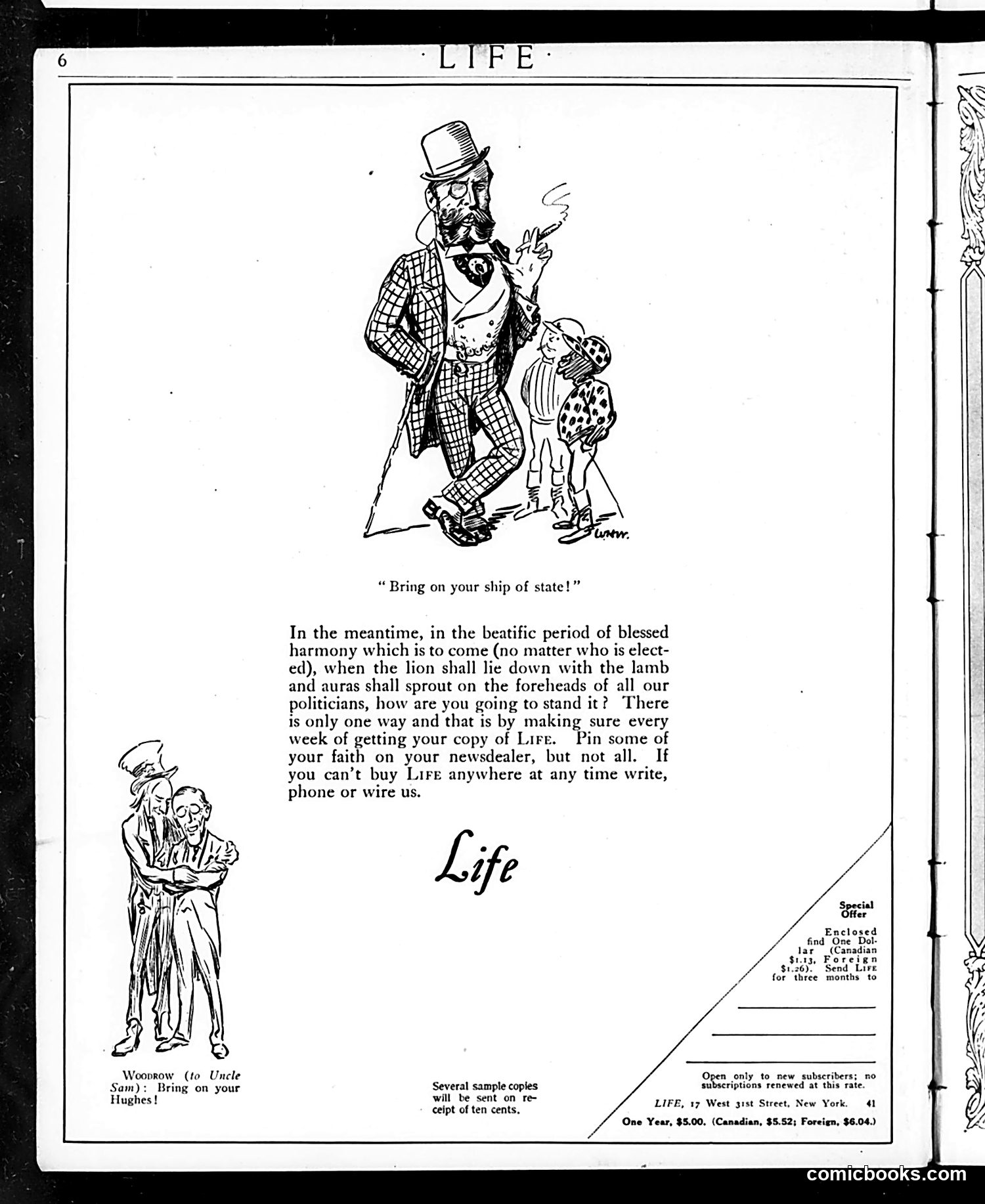
This page is primarily a **subscription advertisement** for *Life* magazine, using political satire to promote readership. The main cartoon depicts a **bearded politician in a checkered suit** with an exaggerated mustache, speaking to a small child, saying "Bring on your ship of state!" The figure appears to be a caricatured political leader, though the specific identity is unclear from the image alone. The accompanying text uses religious imagery ("when the lion shall lie down with the lamb") to satirize political harmony, suggesting that during election periods, politicians make grand promises of unity. The ad then ironically pivots to urge readers: subscribe to *Life* magazine weekly to stay informed and maintain faith during this "beatific period." A second small cartoon shows a figure labeled "Woodrow (to Uncle Sam): Bring on your Hughes!" — this likely references a specific election, though the exact date is unclear.
This is a Dodge Brothers automobile advertisement, not a political cartoon. The full-page ad titled "A Solid Wall of Good Will" uses testimonial-style rhetoric to promote the Dodge Brothers car by claiming consistent, undiminished consumer demand and quality. The text emphasizes the car's reliability, low maintenance costs, fuel efficiency, and strong resale value. It repeatedly uses the phrase "you will hear" to convey word-of-mouth endorsement across America. The ad argues that the car's value derives from its practical performance rather than price, positioning Dodge Brothers as a trusted, widely-respected brand. At the bottom, pricing information for the Touring Car or Roadster appears, suggesting this advertisement is from around the 1910s-1920s based on the price point and automotive context.
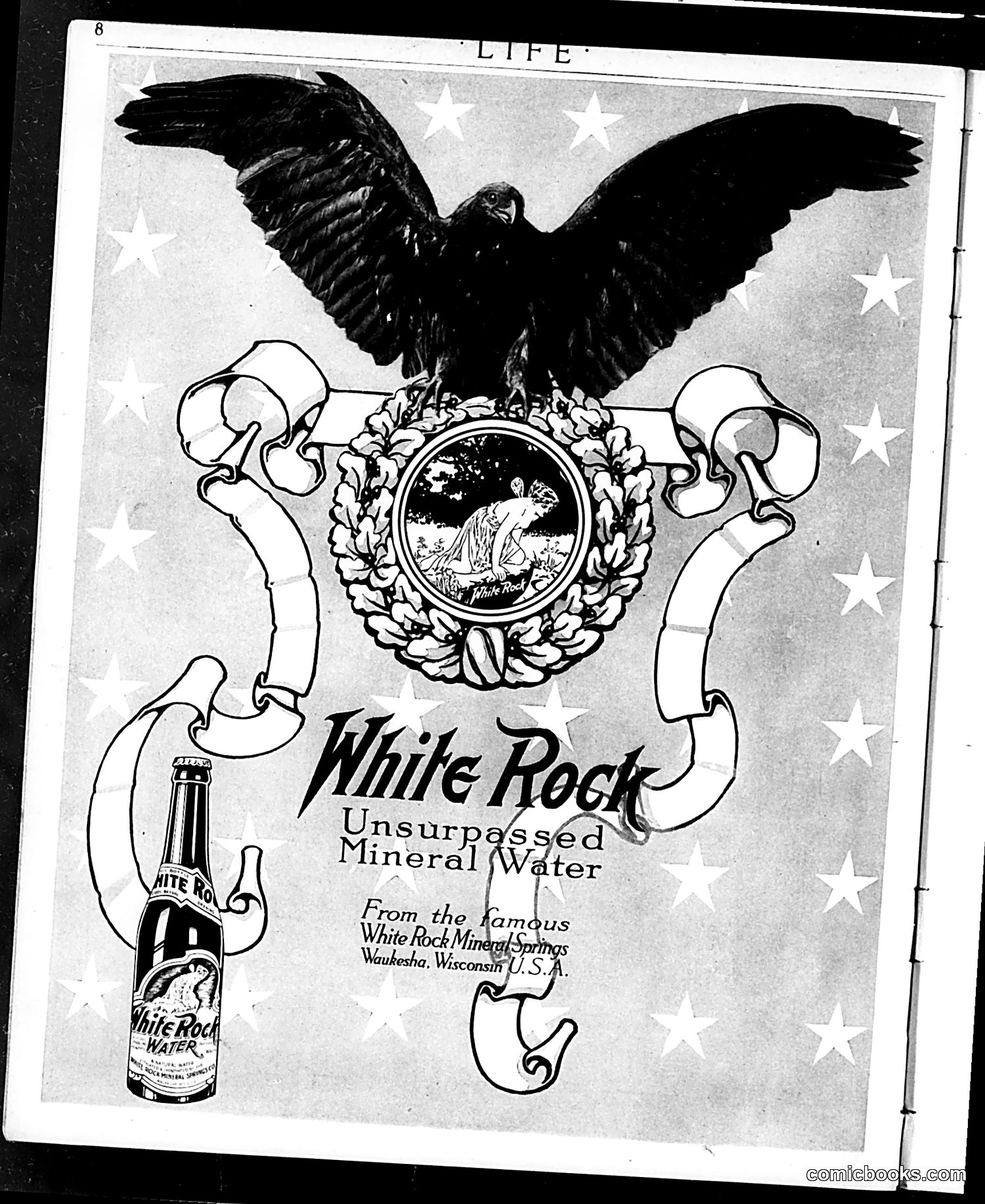
This is a straightforward advertisement, not political satire. It promotes "White Rock Unsurpassed Mineral Water" from White Rock Mineral Springs in Waukesha, Wisconsin. The design uses patriotic imagery: an eagle with spread wings against a starry background, decorative ribbon scrolls, and a central medallion showing a classical female figure (likely the brand's logo). A bottle of White Rock Water appears in the lower left. The "unsurpassed" claim and elaborate heraldic presentation suggest the company was positioning their product as quintessentially American and of superior quality. The patriotic eagle and stars were common branding devices in early-20th-century American advertising to convey trustworthiness and national pride. This appears to be marketing mineral water—then popular for health benefits—to affluent consumers.
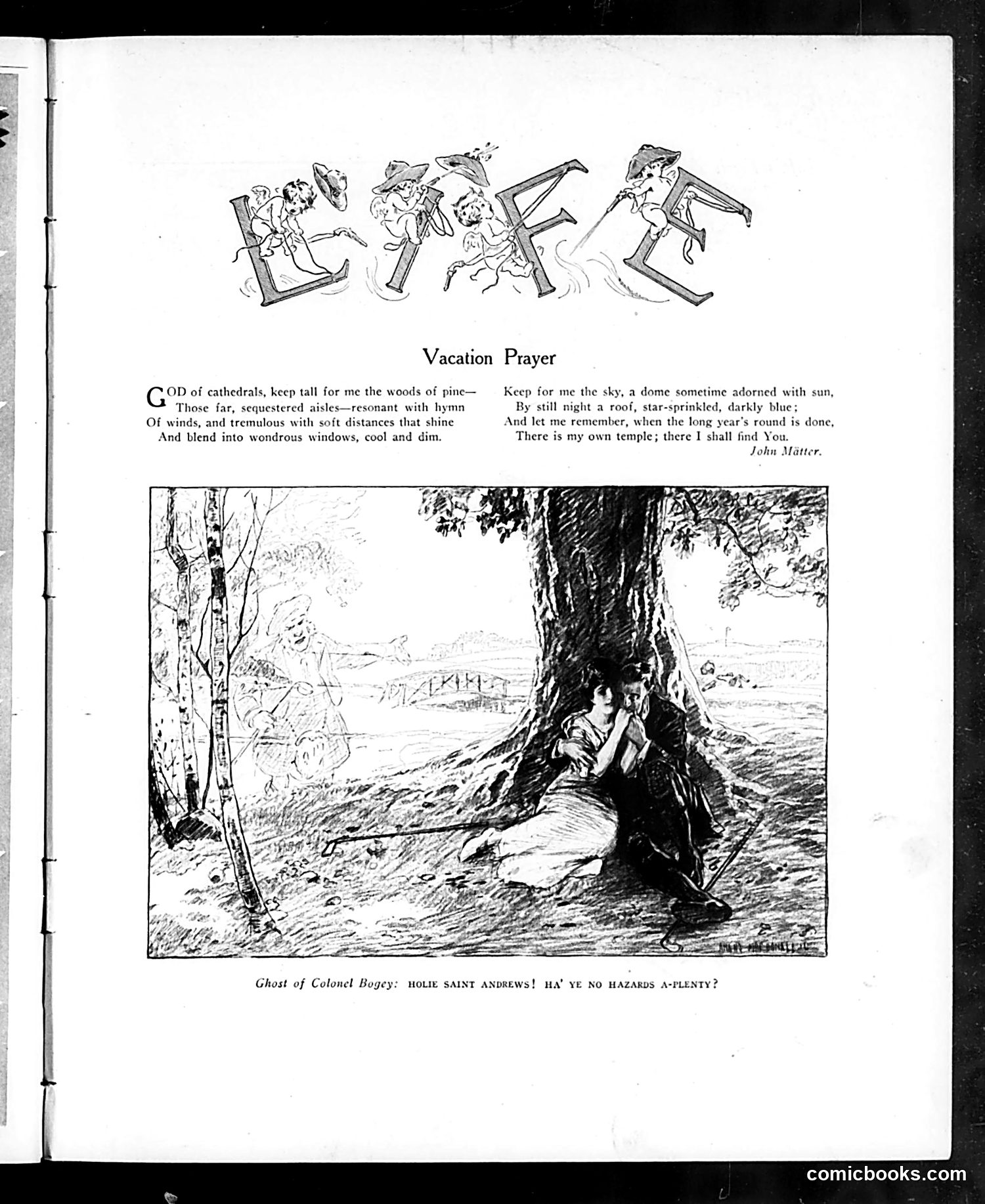
This page contains a poem titled "Vacation Prayer" by John Mather, accompanied by whimsical illustrations. The top shows cartoon figures of vacationing people in various states of hurried travel—carrying luggage, appearing frantic or exhausted. The poem humorously asks God to preserve natural wonders (woods, cathedrals, sky) while the speaker is on vacation, ending with the ironic prayer: "there I shall find You." The bottom illustration shows a woman resting beneath a large tree, captioned "Ghost of Colonel Bogey: HOLIE SAINT ANDREWS! HA' YE NO HAZARDS A-PLENTY?" This appears to reference golf, with "Colonel Bogey" being a golf term (a score one over par), suggesting the vacationer's thoughts turn to golf even during relaxation. The satire targets the modern tourist's inability to truly disconnect from worldly concerns during vacations.
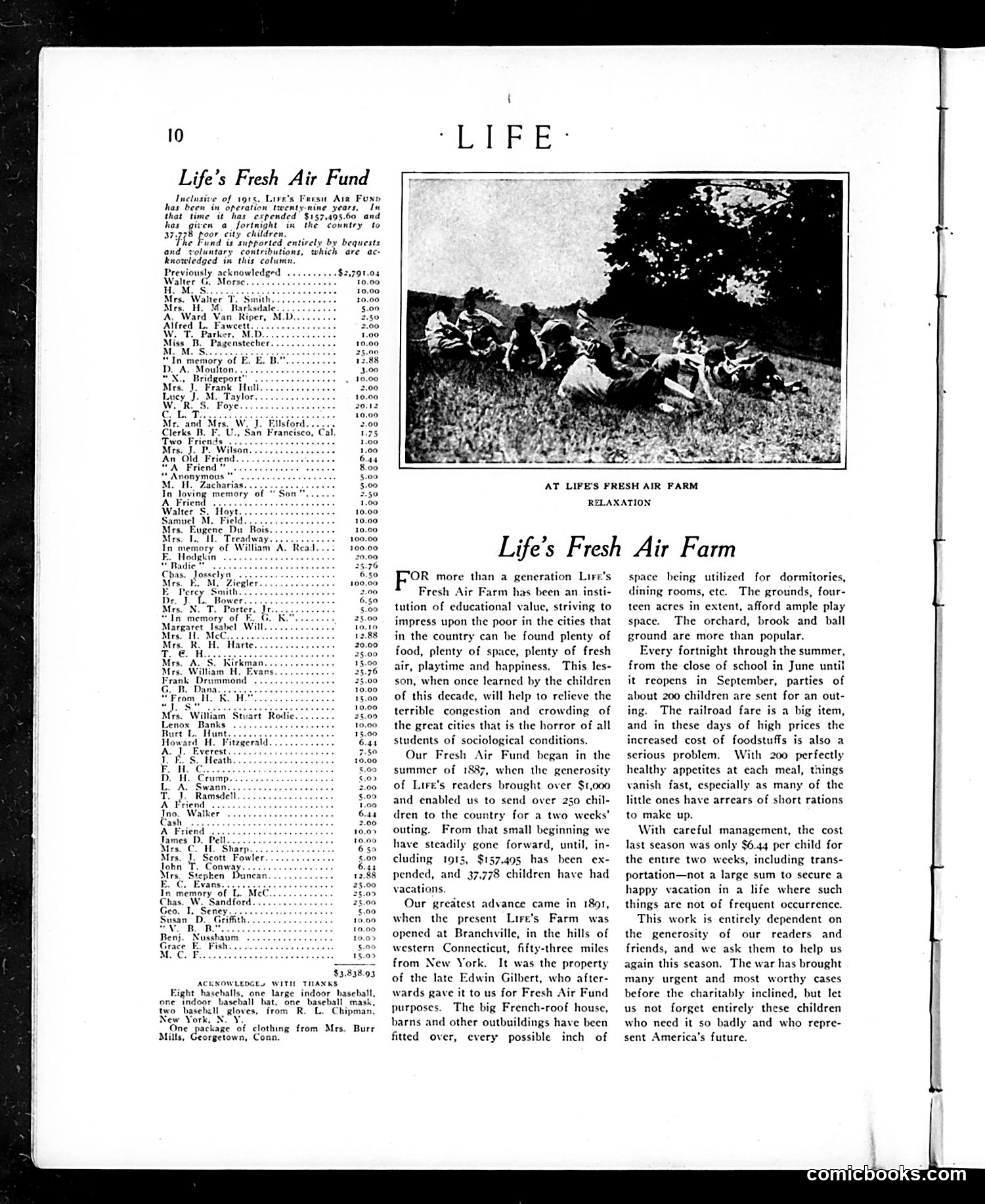
This page documents **Life Magazine's charitable initiative** to send poor urban children to the countryside for summer vacations. The photograph shows children relaxing outdoors at the farm. The accompanying article explains that since 1887, Life's readers had donated over $150,000 to send 37,278 children to the country for two-week stays. The farm itself, opened in 1891 in Branchville, Connecticut, was donated by Edwin Gilbert. The lengthy donor list on the left represents Life's readership contributing to this cause—a common practice where magazines published donor names to encourage further giving. **The satire/point:** This demonstrates Life's mission beyond humor: using its platform for social reform, believing fresh air and rural space could relieve urban poverty's "terrible congestion and crowding."
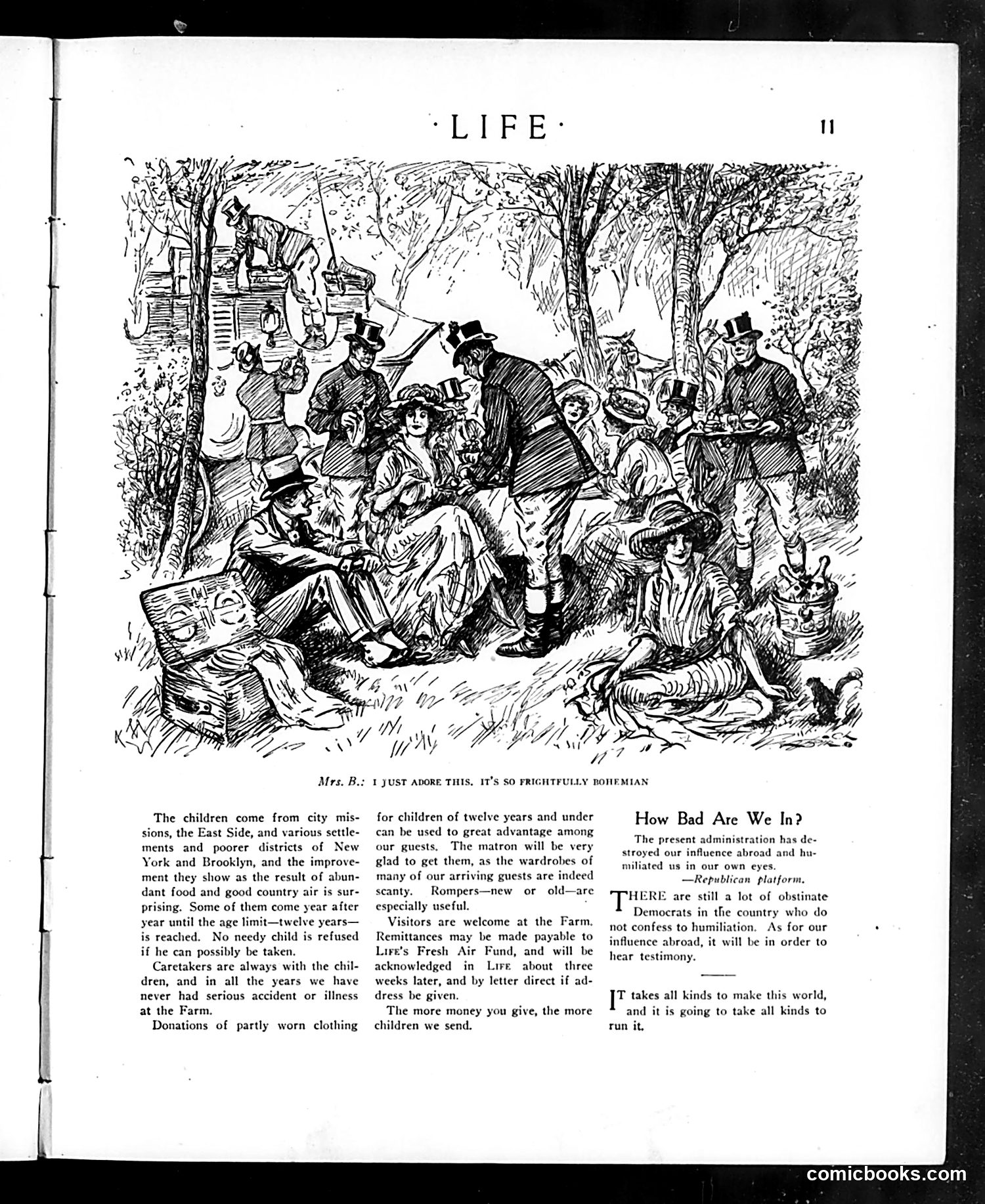
This page depicts a summer picnic or garden party scene with well-dressed Victorian-era figures, captioned "Mrs. B.: I just adore this. It's so frightfully bohemian." The satire appears to target upper-class pretension—specifically the affectation of wealthy urbanites who romanticize "bohemian" (unconventional, artistic) lifestyles while maintaining rigid formality. The irony: the scene shows formally dressed people in top hats at what they call a bohemian gathering, suggesting their idea of being unconventional is superficial performance. The accompanying text discusses children from city missions and charitable work, indicating the page may satirize how the wealthy frame charitable activities as fashionable social events rather than serious moral commitments. The humor lies in the disconnect between claimed bohemian values and actual bourgeois conformity.
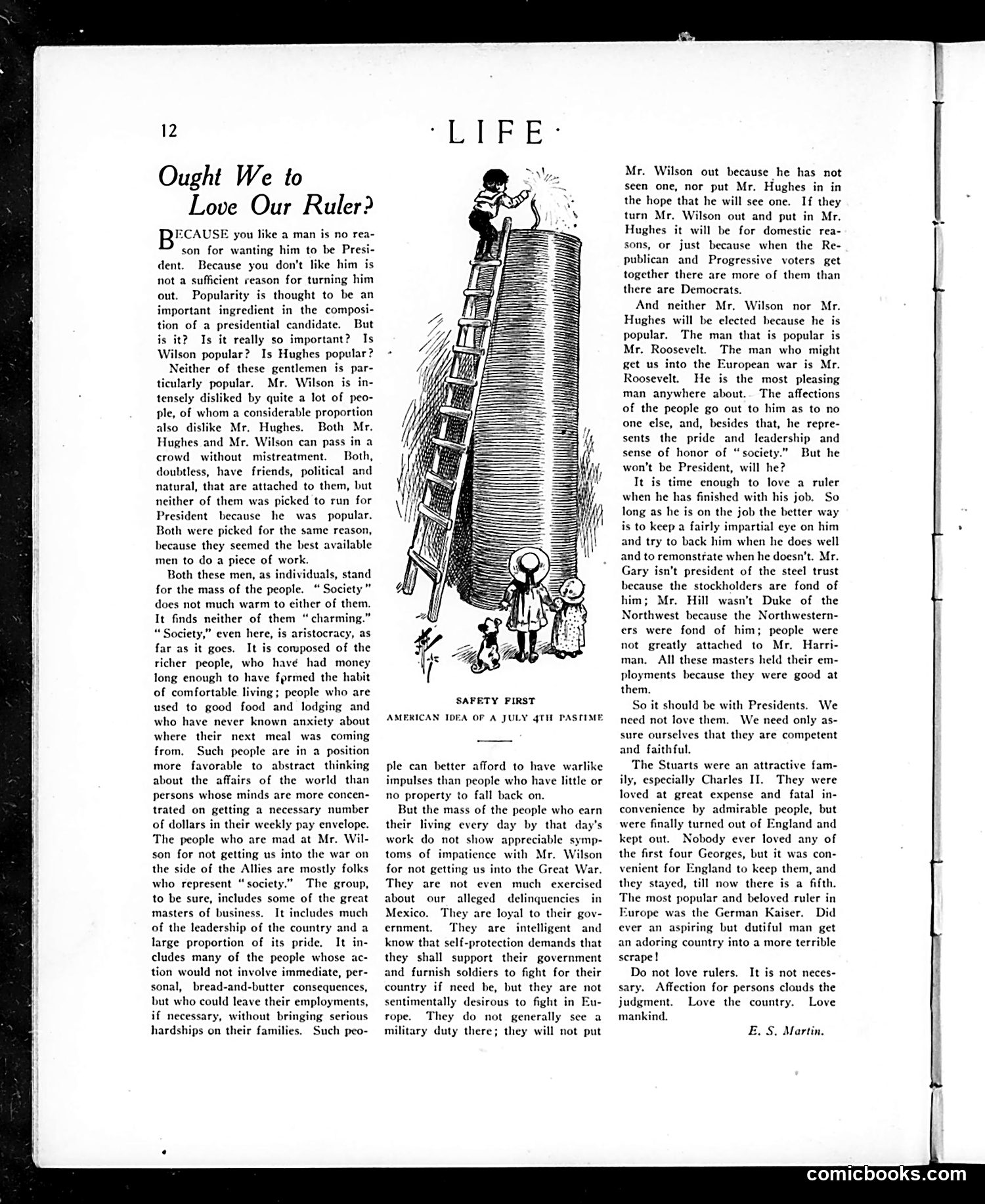
This page critiques American presidential politics, likely from the early 20th century. The cartoon "Safety First" depicts a tall, narrow structure (representing government or leadership) with a small family at its base, illustrating how ordinary citizens are dwarfed by and dependent upon their rulers. The article argues against judging leaders solely on personal popularity. It references Wilson, Hughes, and Roosevelt—suggesting this addresses the 1916 presidential election. The author contends that voters should evaluate candidates based on competence and faithfulness to duty, not affection. The piece dismisses "Society's" preference for charming personalities, arguing that solid work matters more than likability for effective governance.
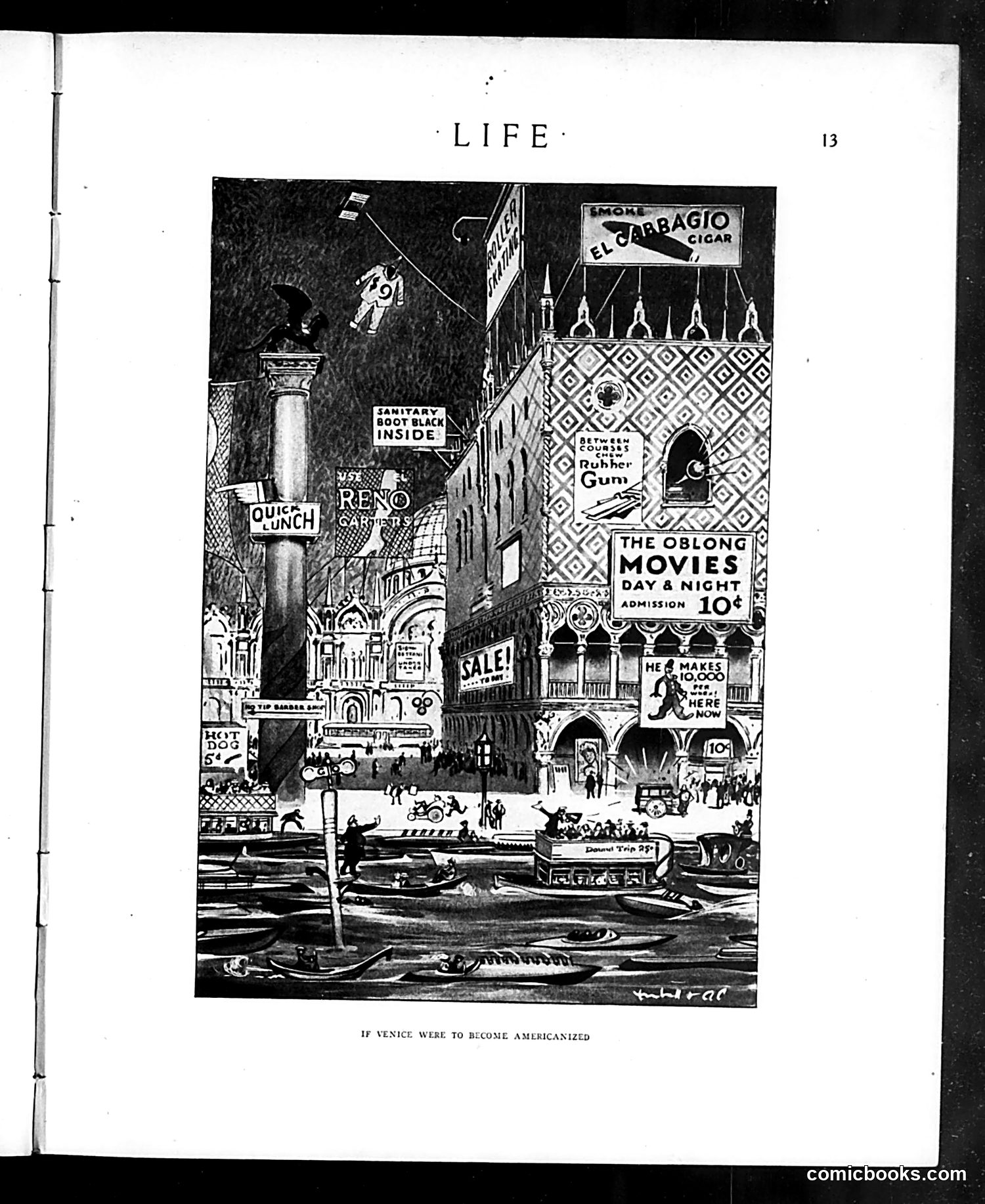
This satirical illustration imagines Venice transformed into a bustling American commercial street. The romantic Italian canal city is reimagined with American advertising billboards, storefronts, and consumer culture—including signs for "El Cabbagio Cigar," "Reno" (likely a casino reference), "Quick Lunch," hot dogs, chewing gum, and "The Oblong Movies" theater (admission 10¢). The joke mocks American commercialism and materialism by showing how American capitalism would obliterate Old World charm and history. Where Venice's historic architecture and canals once stood, crass advertising and cheap entertainment dominate. The title's caption suggests anxiety about American culture's aggressive expansion and its perceived inability to appreciate cultural heritage—a common satirical theme in early-20th-century publications.
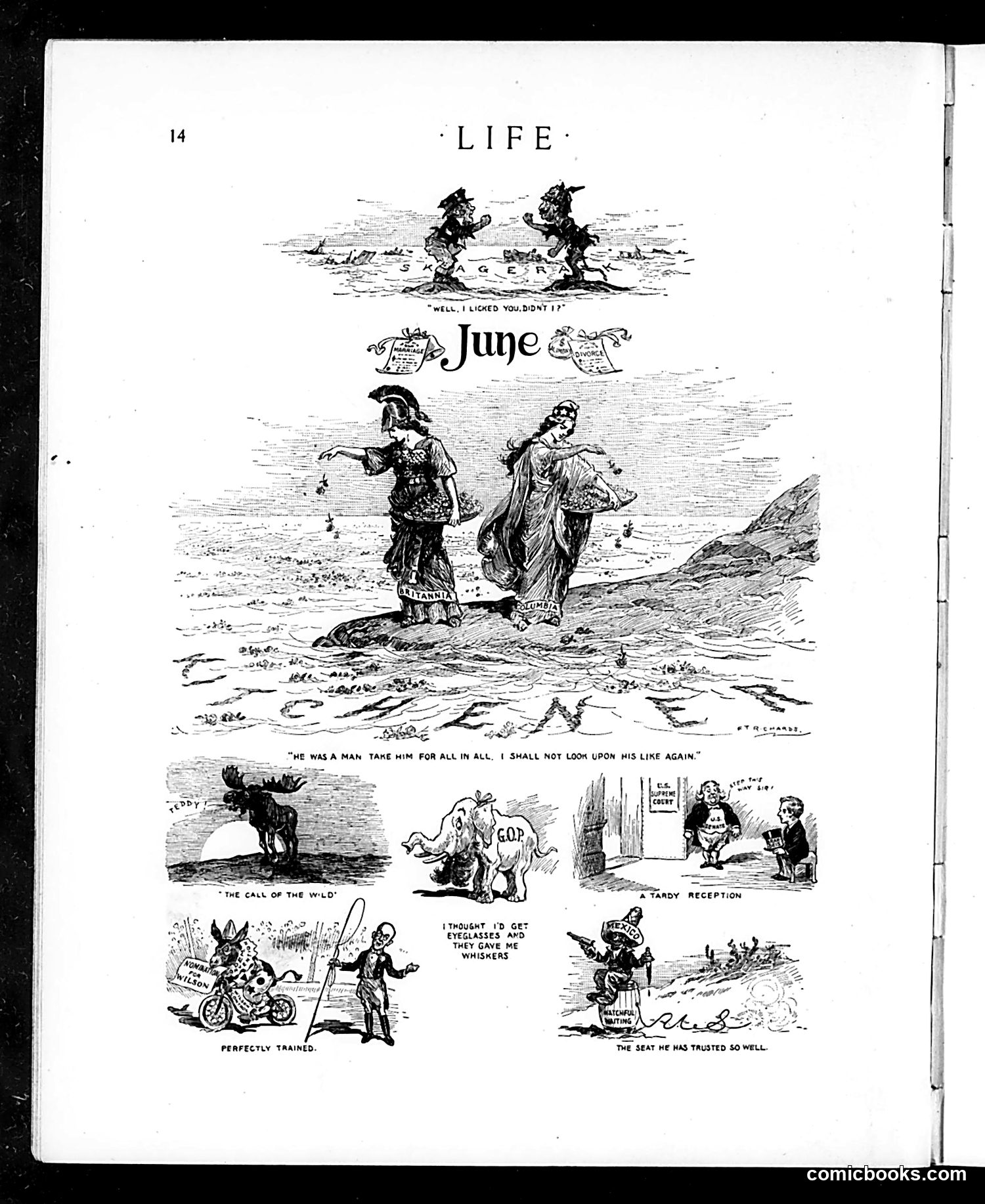
This is a satirical June calendar page featuring multiple comic vignettes about courtship and romance. The top illustration shows two figures by the seaside with the caption "Well, I liked you, didn't I?"—suggesting romantic disappointment. Below are six smaller comics with captions like "The Call of the Wild," "A Tardy Reception," "Perfectly Trained," and "The Seat He Has Trusted So Well," each depicting humorous domestic or romantic situations. The central image shows two Classical female figures labeled "Britannia" and another nation, possibly representing international relations through allegorical female personification—a common Victorian/Edwardian convention. The overall theme appears to satirize male-female relationships and relationship expectations, using both realistic and allegorical approaches typical of early 20th-century American humor magazines.
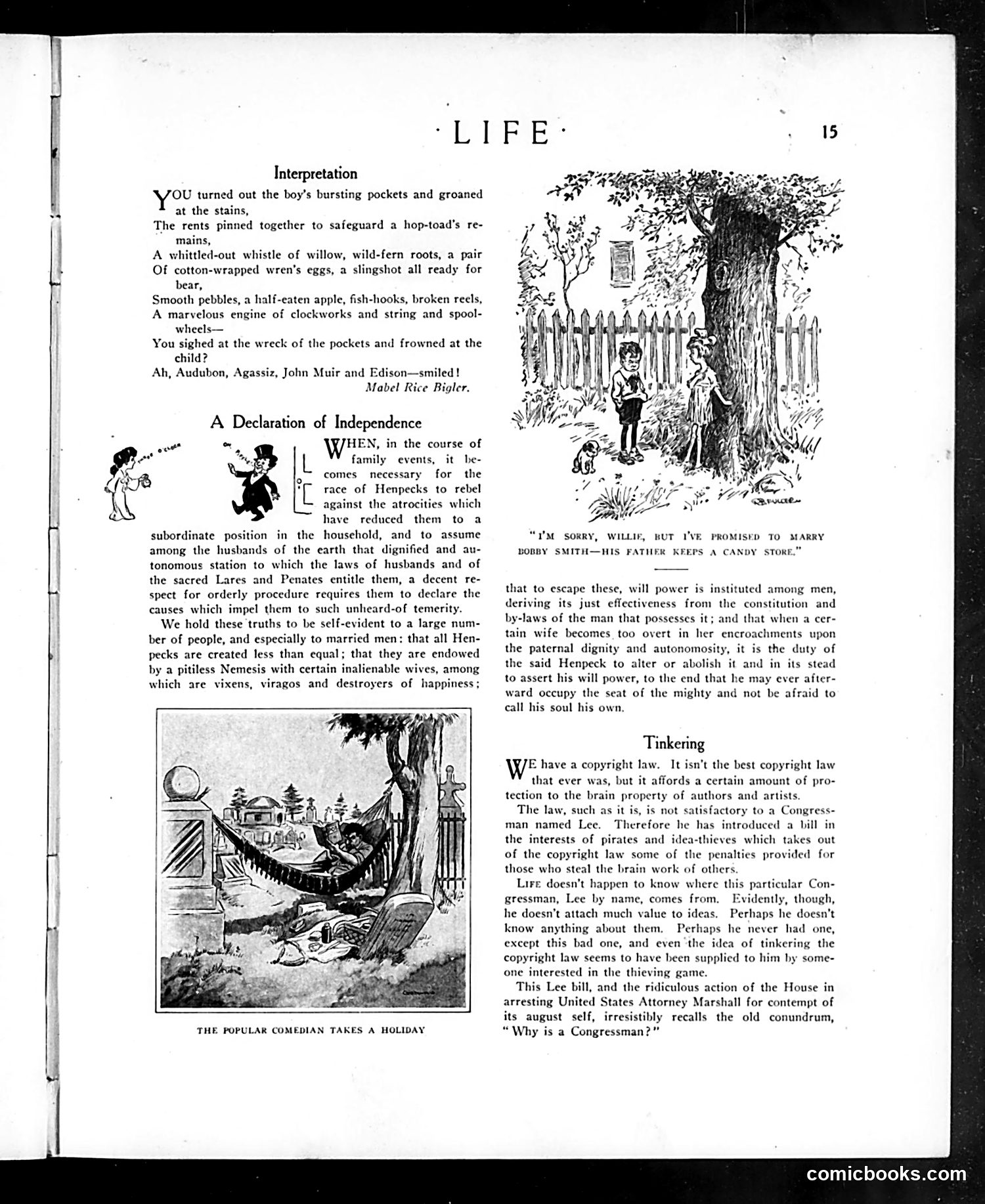
This page contains satirical commentary on two separate topics: **"Interpretation"** (top left): A poem by Mabel Rice Bigler satirizing a child's pockets filled with random treasures—whistles, eggs, broken reels, and "clockwork" contraptions. The satire appears to mock adults' tendency to sentimentalize or over-interpret children's innocent play and collections. **"A Declaration of Independence"** (center): A mock-serious declaration about Henpecked men rebelling against subordinate household status. It's tongue-in-cheek satire on marital power dynamics, particularly women's domestic authority over men—a humorous commentary on gender relations and male frustration with wives' authority. **"Tinkering"** (right): Criticizes Congressman Lee's copyright bill, mocking his apparent lack of understanding about intellectual property and ideas. The satire suggests the congressman is ignorant about what he's legislating. The illustrations depict domestic scenes complementing these social critiques.
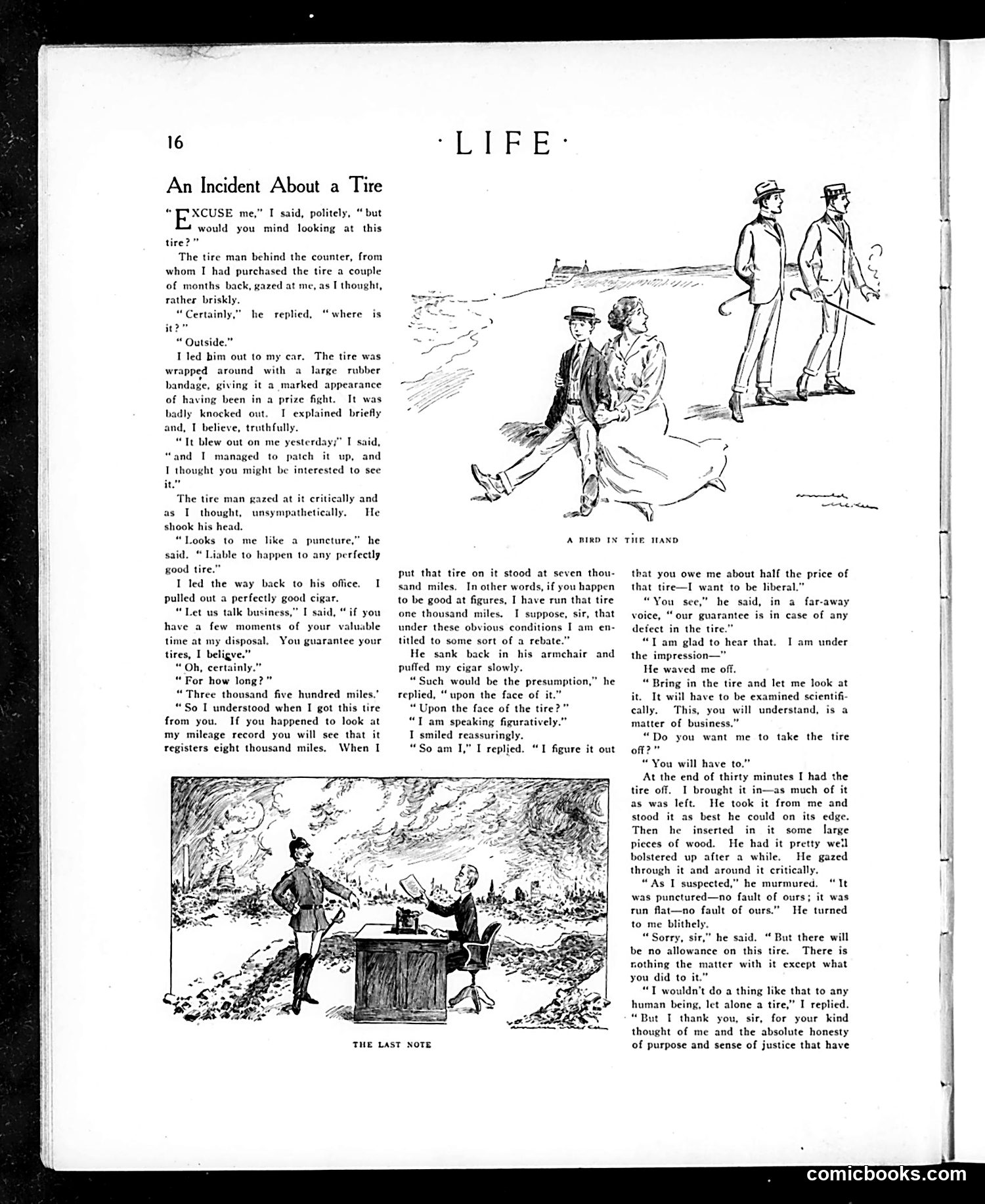
This humorous short story satirizes **tire warranty disputes and retailer dishonesty** in the early automobile era. The unnamed narrator purchases a tire guaranteed for 3,500 miles but experiences a blowout after only 1,000 miles of use—well within warranty. When he requests a refund or rebate, the tire salesman employs classic bad-faith tactics: claiming the damage was the customer's fault (running it flat), using technical language ("speaking figuratively"), and demanding the tire be "examined scientifically"—a delay tactic. Despite obvious warranty violation, the salesman denies all responsibility. The satire targets **commercial dishonesty and warranty fine-print abuse**—practices that frustrated early motorists. The narrator's polite, reasonable approach contrasts sharply with the salesman's evasive, legalistic responses, highlighting how businesses exploited warranty loopholes. The illustrations show gentlemen conducting this absurd negotiation, emphasizing the petty yet infuriating nature of such disputes.
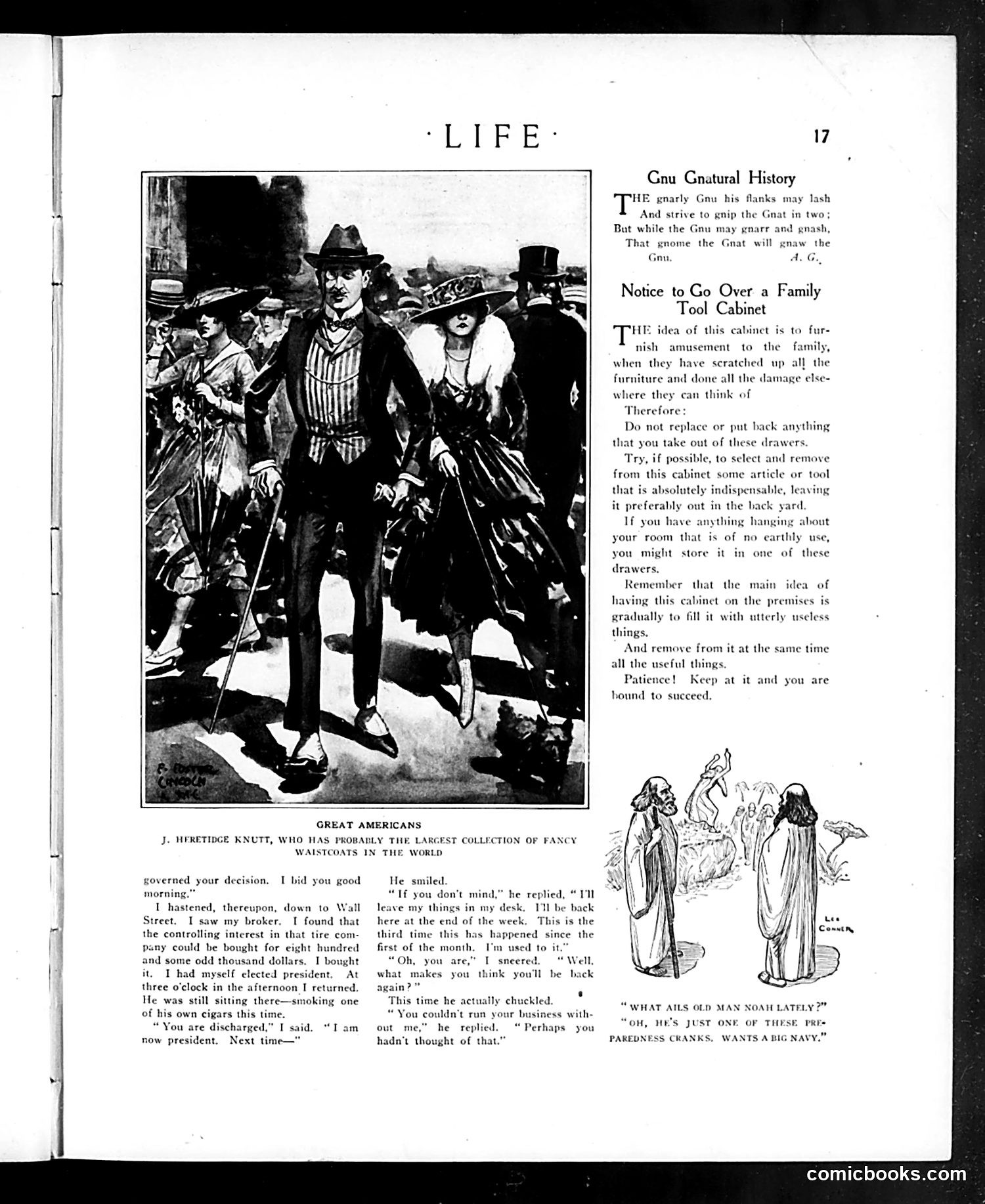
**Main Cartoon: "Great Americans"** This satirizes J. Heretige Knutt (a fictional figure), depicted as a wealthy businessman with an ostentatious waistcoat collection. The story mocks the absurdity of American capitalism: a man fires his employee, then the employee casually reveals he's bought controlling interest in the company and is now president. The joke exposes how in Gilded Age America, wealth could instantly overturn hierarchies—the employee simply outbids his former boss. The satire suggests the instability and absurdity of business competition based purely on money. **Secondary Content:** - **"Gnu Gnatural History"**: A light pun about the animal's "gnarl" and "gnash" sounds. - **"Family Tool Cabinet"**: Humorous advice suggesting families deliberately fill it with useless items—gentle satire on household clutter and domestic inefficiency. - **Bottom cartoon**: References "Preparedness Cranks" wanting a "big navy," likely alluding to early-1910s military expansion debates. The page exemplifies Life's satirical approach to American commercialism and contemporary social issues.
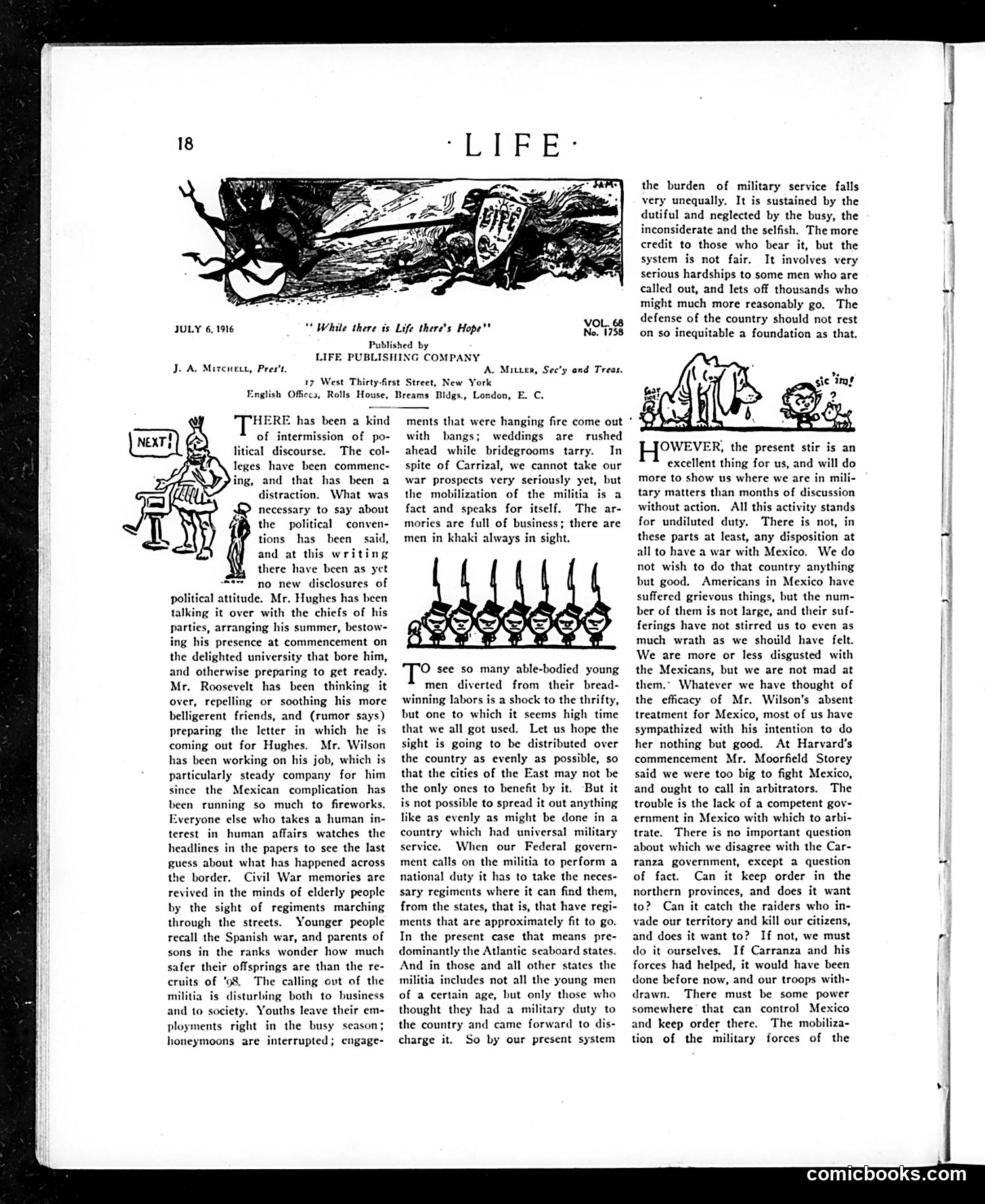
This page discusses the recent calling up of state militia—likely in response to the 1916 Mexican border crisis (the Battle of Carrizal is mentioned). The cartoons and text critique the inequitable burden of military service. The left cartoon labeled "NEXT" appears to mock political figures (Hughes, Roosevelt, Wilson) through a figure in military dress, satirizing their cautious political maneuvering while young men are drafted. The central image shows soldiers in khaki—the visual symbol of mobilization disrupting civilian life: interrupted honeymoons, rushed weddings, youths leaving employment mid-season. The text's main argument: the militia system is *unfair*. Only dutiful volunteers are called; the "busy, inconsiderate and selfish" escape service. Geographically unequal too—Atlantic states bear disproportionate burden. The author advocates for universal military service as more equitable, though stops short of demanding it during peacetime. The overall satire: while mobilization shows patriotic duty, the system exposes American inequality and selective sacrifice.
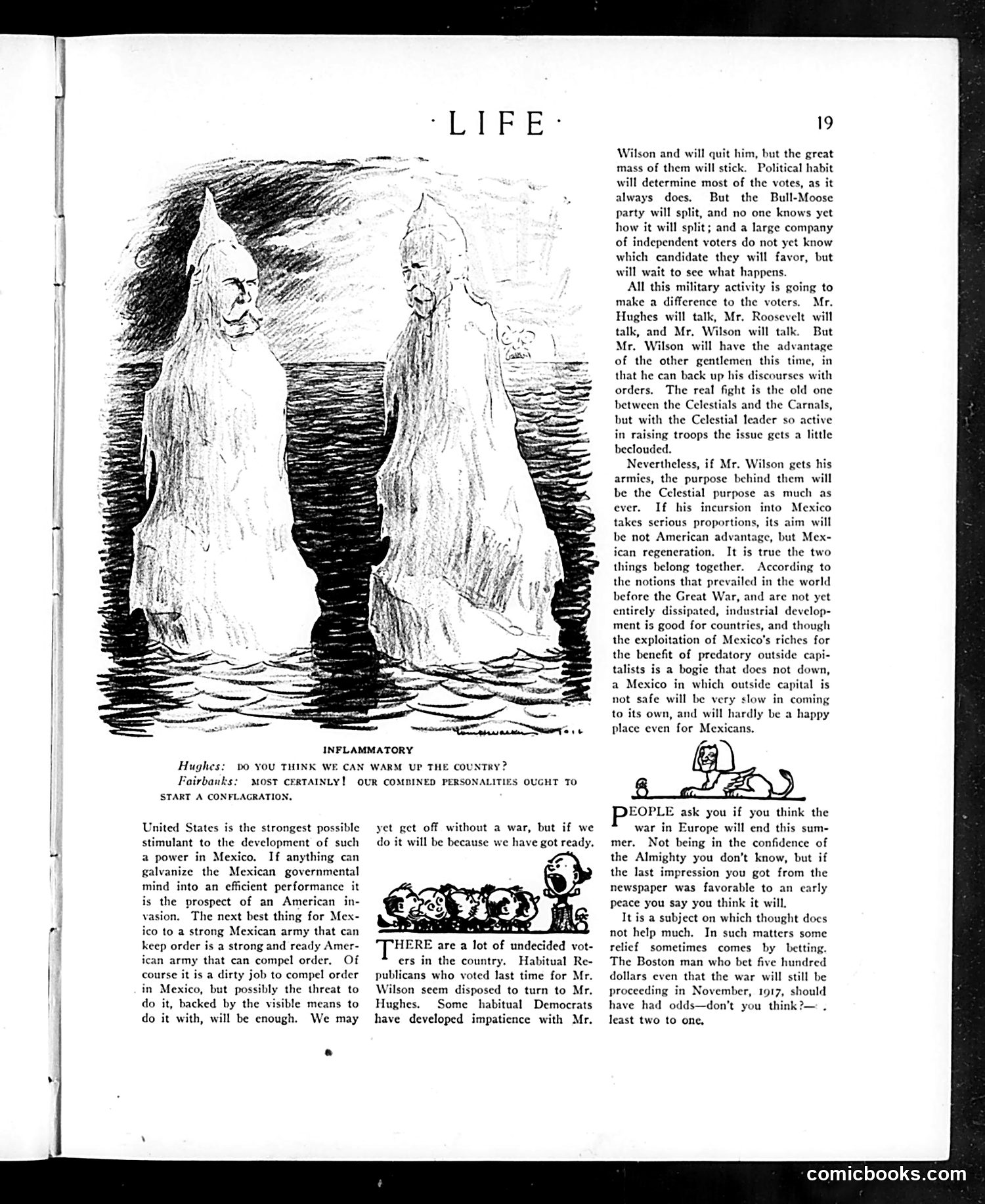
The main cartoon depicts two figures labeled Hughes and Fairbanks in a dialogue about "warming up the country" through military action. These are Charles Evans Hughes (Republican presidential candidate) and James Sherman Fairbanks (his running mate), shown as ghostly or spectral figures—likely satirizing their perceived lack of substance or presence compared to the incumbent. The satire criticizes their aggressive rhetoric toward Mexico. Hughes and Fairbanks's exchange about starting a "conflagration" mocks their bellicose campaign posturing. The accompanying text suggests Wilson has political advantage because he can "back up his discourses with orders"—he's actually mobilizing troops, whereas his opponents merely talk. The broader commentary warns that military adventurism in Mexico, while framed as "regeneration," actually serves imperialist capitalism. The cartoon satirizes how military action helps Wilson electorally while obscuring his true imperial aims behind humanitarian language.
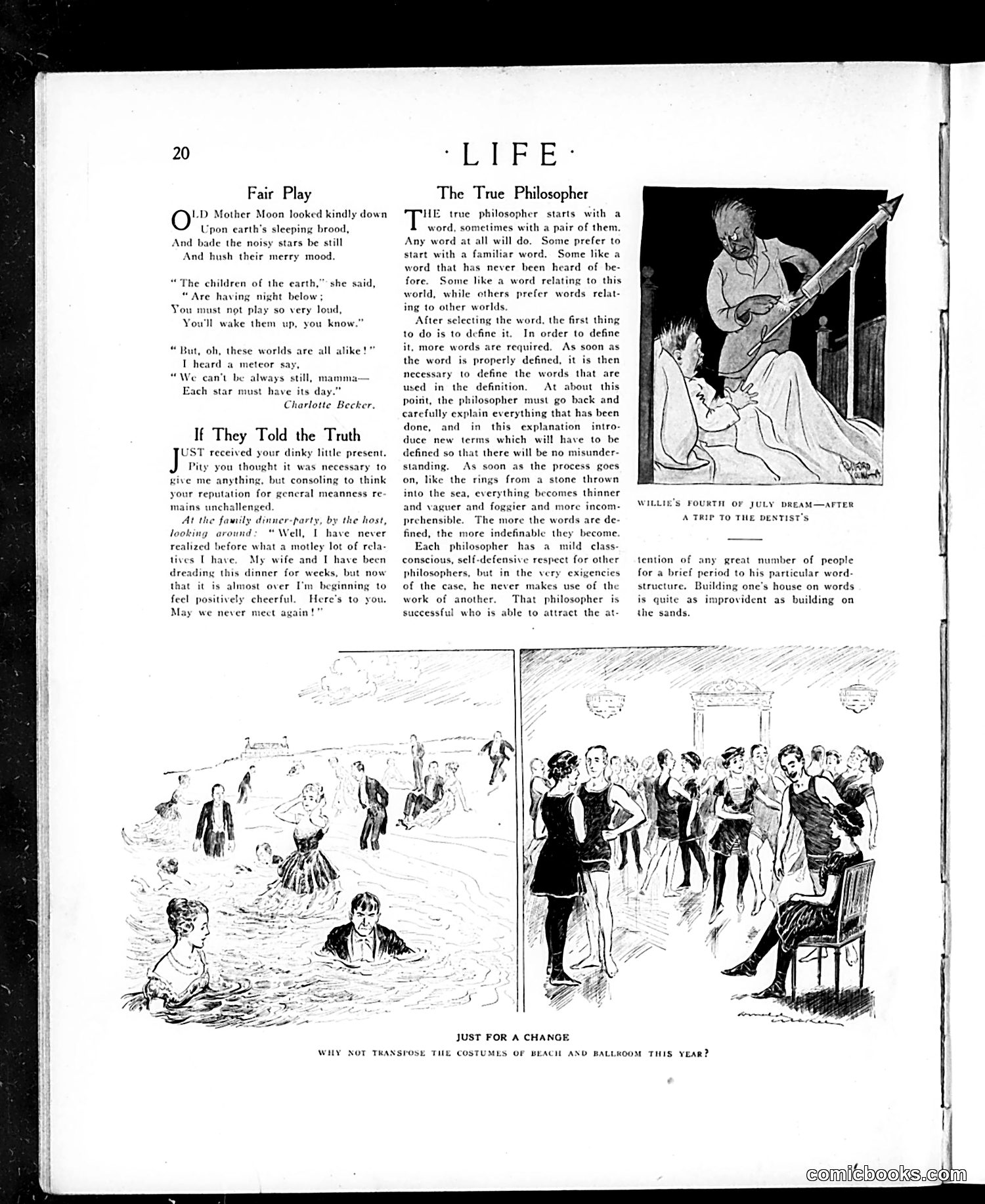
This page from *Life* magazine presents three satirical pieces mocking social conventions and human nature: **"Fair Play"** is a whimsical poem about Mother Moon scolding Earth's children to be quiet—a gentle mockery of parental platitudes. **"If They Told the Truth"** is biting social satire. It imagines what people *actually* think at formal occasions but don't say: a dinner guest admitting the present is worthless, and a host confessing he dreads family gatherings. The humor lies in exposing the gap between polite social fiction and honest sentiment—the hypocrisy of obligatory civility. **"The True Philosopher"** satirizes academic obscurantism: philosophers define words using other words requiring definition, creating an endless, self-perpetuating cycle that makes language increasingly "foggier and more incomprehensible." It mocks philosophers' mutual respect despite this fundamental futility. **"Just for a Change"** (captioning beach and ballroom illustrations) suggests swapping beach and formal attire—a lighthearted proposal to break rigid social costume conventions. Overall, the page targets social pretense, philosophical verbosity, and rigid etiquette.
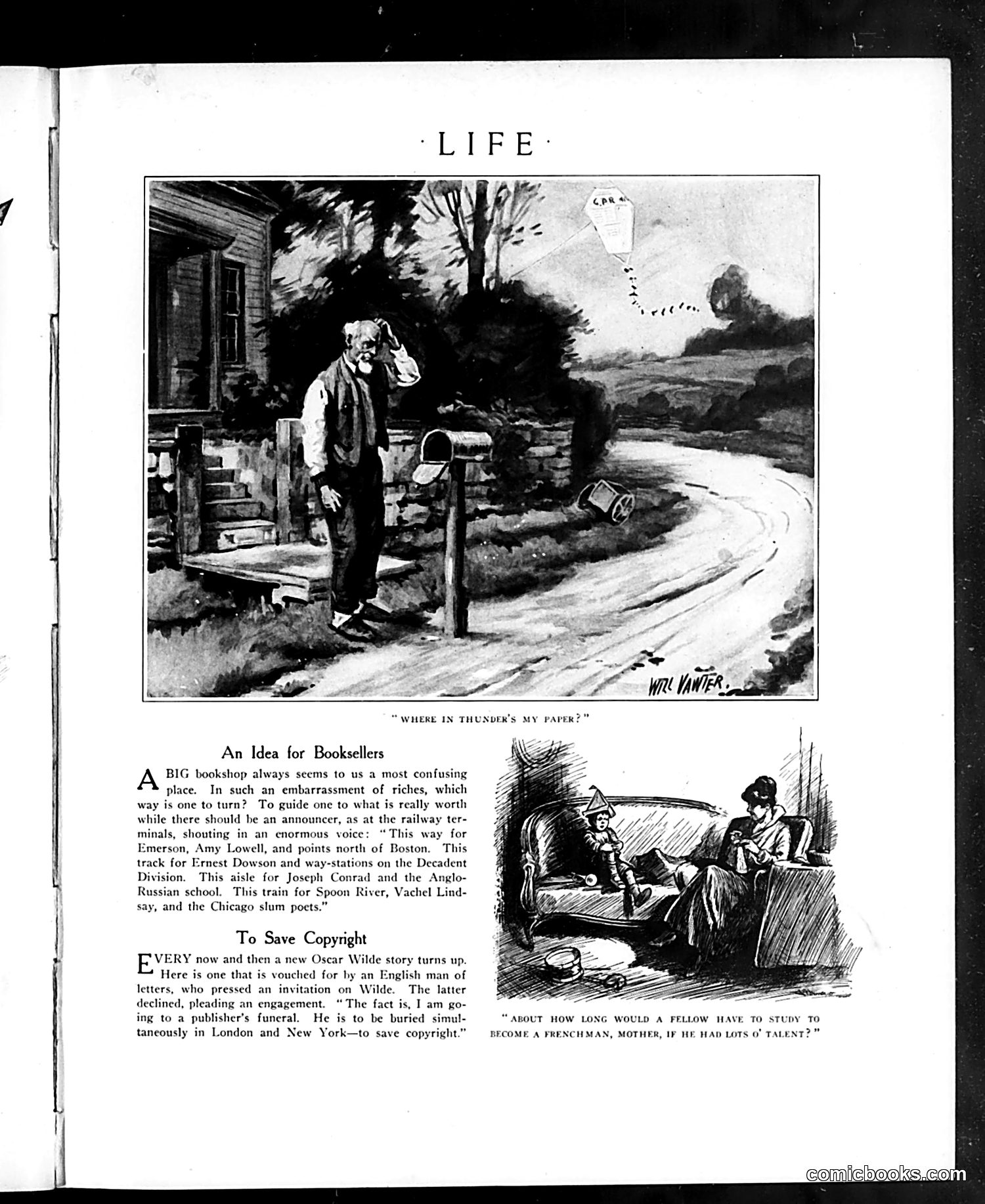
This page contains two separate satirical pieces from an early 20th-century American magazine. **"An Idea for Booksellers"** mocks the confusing nature of large bookstores by proposing they should have announcers (like railway terminals) directing customers to literary sections. It references actual authors and movements—Emerson, Amy Lowell, Ernest Dowson, Joseph Conrad, Spoon River (likely Masters' anthology), and Vachel Lindsay—organizing them by region and literary school (the "Decadent Division," "Anglo-Russian school," "Chicago slum poets"). The satire critiques both the overwhelming abundance of books and literary snobbery about which authors are "really worth while." **"To Save Copyright"** attributes an anecdote to Oscar Wilde about a publisher's funeral being held simultaneously in London and New York solely to protect copyright. This mocks both the absurdity of international copyright law and the cynicism of publishers prioritizing legal protection over funeral propriety—a darkly humorous jab at commercialism. Both pieces target literary and publishing worlds through clever wordplay and exaggeration.
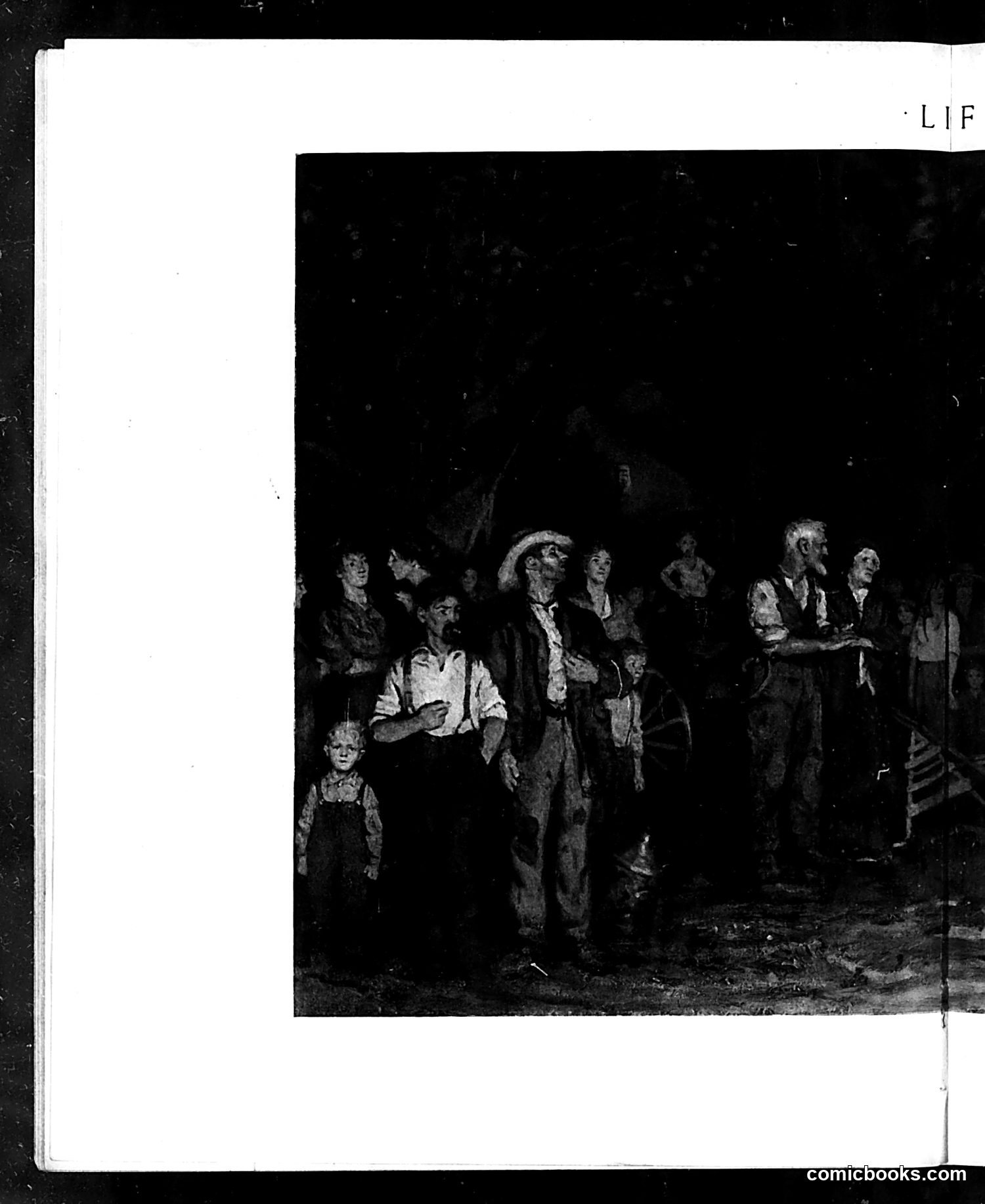
This appears to be a dramatic black-and-white illustration rather than a traditional political cartoon. The image shows a group of figures gathered in darkness, gazing upward with expressions of wonder or concern. The composition suggests a scene of collective observation or reaction to something unseen above them. Without additional visible text or captions identifying the specific figures or context, I cannot definitively explain what event or political situation this depicts. The style and subject matter suggest it may be satirizing public reaction to a significant event or phenomenon, but the specific historical reference remains unclear from the image alone. The page header reads only "LIF[e]" with no other identifying information visible.
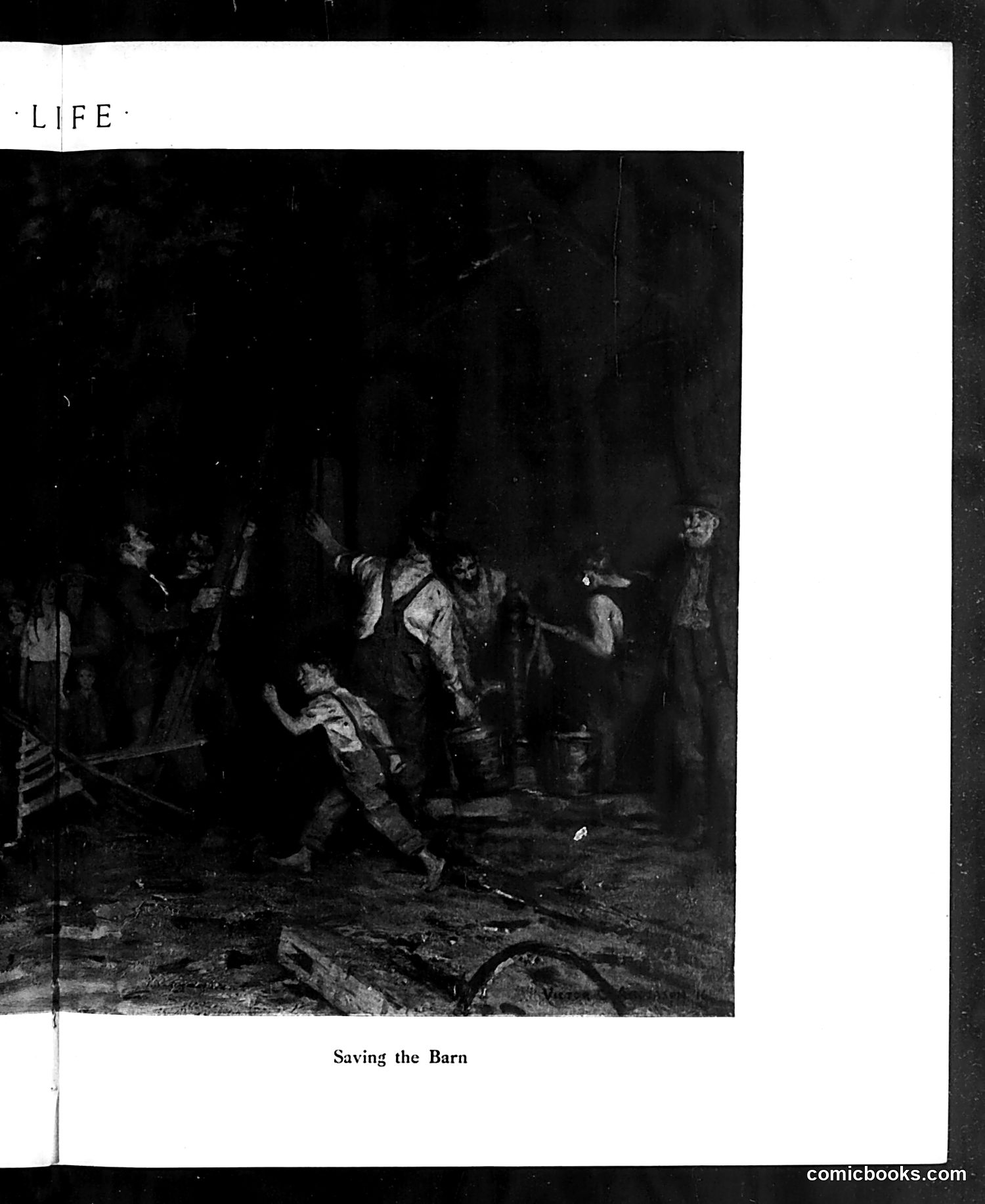
This page from *Life* magazine shows a dramatic nighttime scene titled "Saving the Barn." The black-and-white photograph depicts multiple figures actively fighting what appears to be a barn fire, with visible flames and smoke in the darkness. People are positioned around the structure with what seem to be tools or implements for firefighting. Without additional context or captions identifying specific political figures or references, the image appears to be either documentary photography of an actual fire-fighting effort, or possibly a satirical commentary on community crisis response. The title alone doesn't clarify whether this is literal reportage or symbolic commentary on a contemporary political or social issue that *Life* readers would have recognized. More context would be needed to definitively explain any satirical intent.
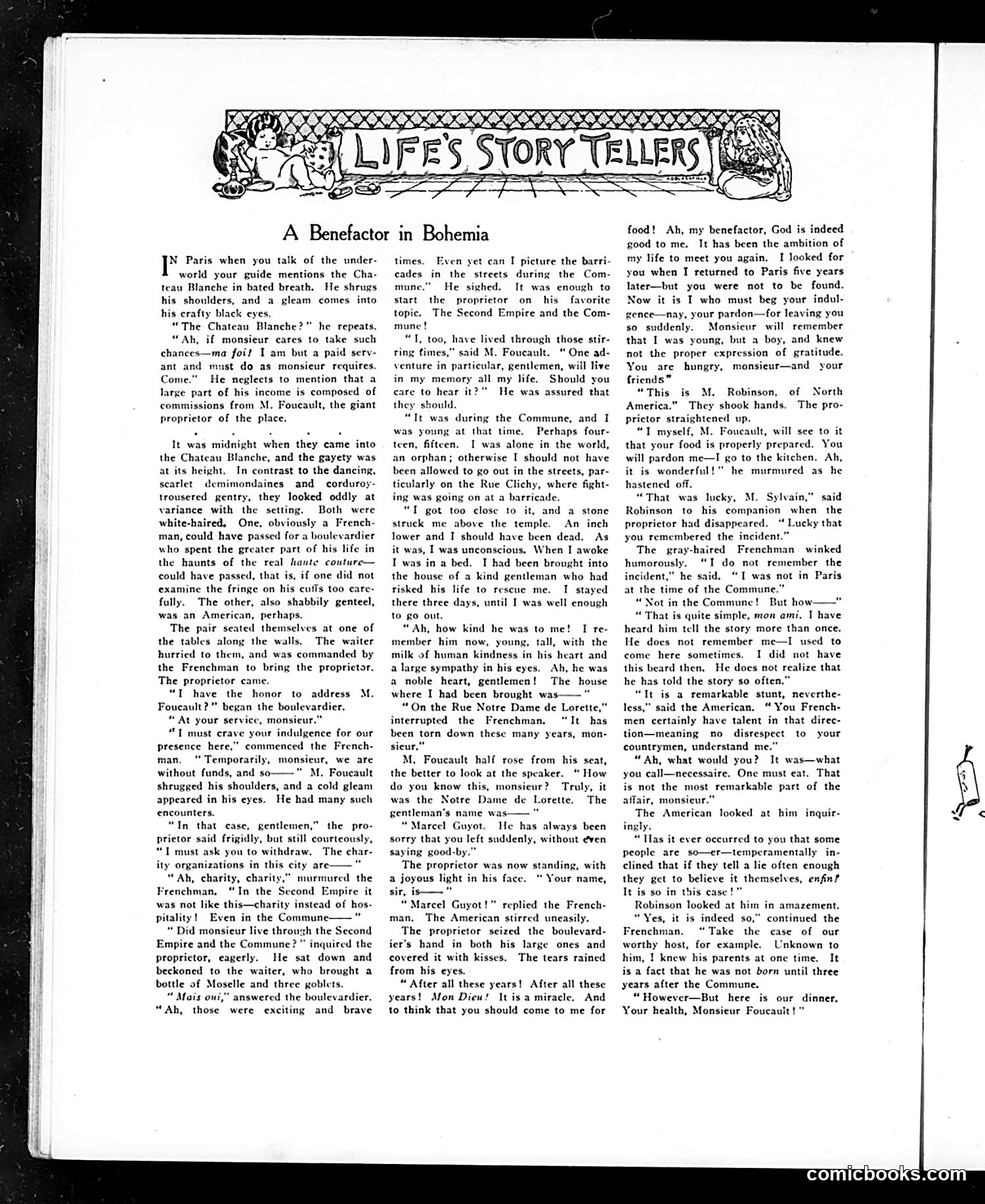
This is a literary short story rather than a political cartoon. It's a sentimental tale set in Paris's Bohemian underworld, likely from the early 1900s. The plot concerns two impoverished gentlemen—a Frenchman and an American—who cannot pay at the Chateau Blanche, a disreputable nightclub. The proprietor, M. Foucault, initially refuses service but becomes emotional when the Frenchman mentions surviving the Paris Commune (1871). Foucault then shares his own dramatic story: as a boy during the Commune, he was struck by a stone at a barricade and rescued by a kind stranger on Rue Notre Dame de Lorette. The story's point appears to be about human connection and redemption—the irony that shared historical trauma and nostalgia can transform a cold businessman into a charitable man. The narrative explores themes of memory, kindness, and how chance encounters shape lives.
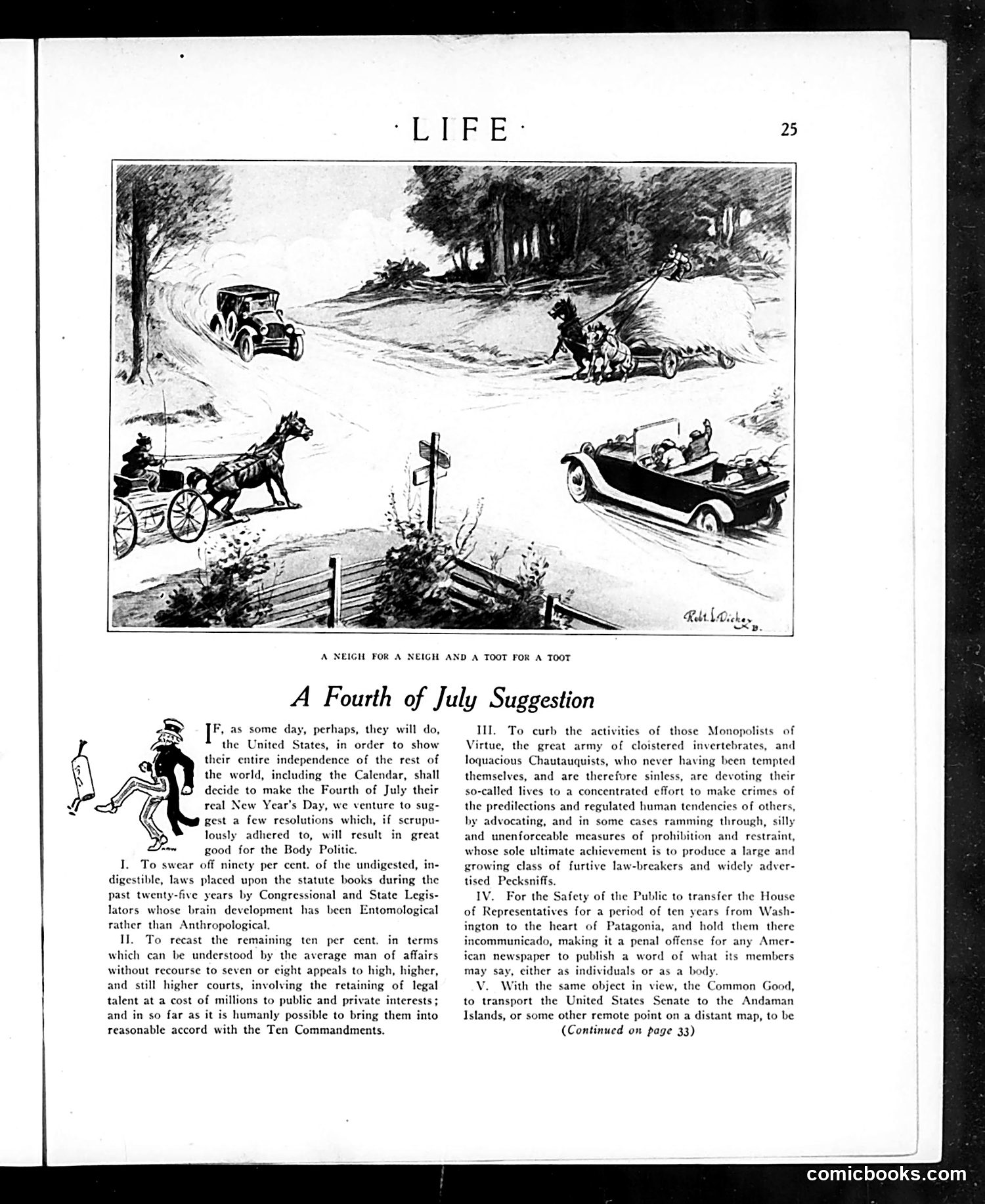
This 1920s *Life* cartoon satirizes American government dysfunction through mock "resolutions" for Fourth of July reform. The illustration shows various modes of transportation (cars, horse-drawn carts, boats), a visual pun on "neigh for a neigh and a toot for a toot"—traffic chaos representing legislative disorder. The text attacks: 1. **Bloated legislation**: 90% of laws from the past 25 years are "undigested" and incomprehensible 2. **Corrupt courts**: Legal proceedings require millions in fees and multiple appeals 3. **Moral busybodies**: "Monopolists of Virtue" and "Chautauquists" (self-righteous reformers) push unenforceable prohibition laws 4. **Government removal**: Proposals to exile the House and Senate to distant locations (Patagonia, Andaman Islands) to silence them The satire suggests American government has become so dysfunctional and filled with sanctimonious reformers that removing politicians entirely would benefit the public—a scathing critique of legislative incompetence and the Prohibition era's moral crusaders.
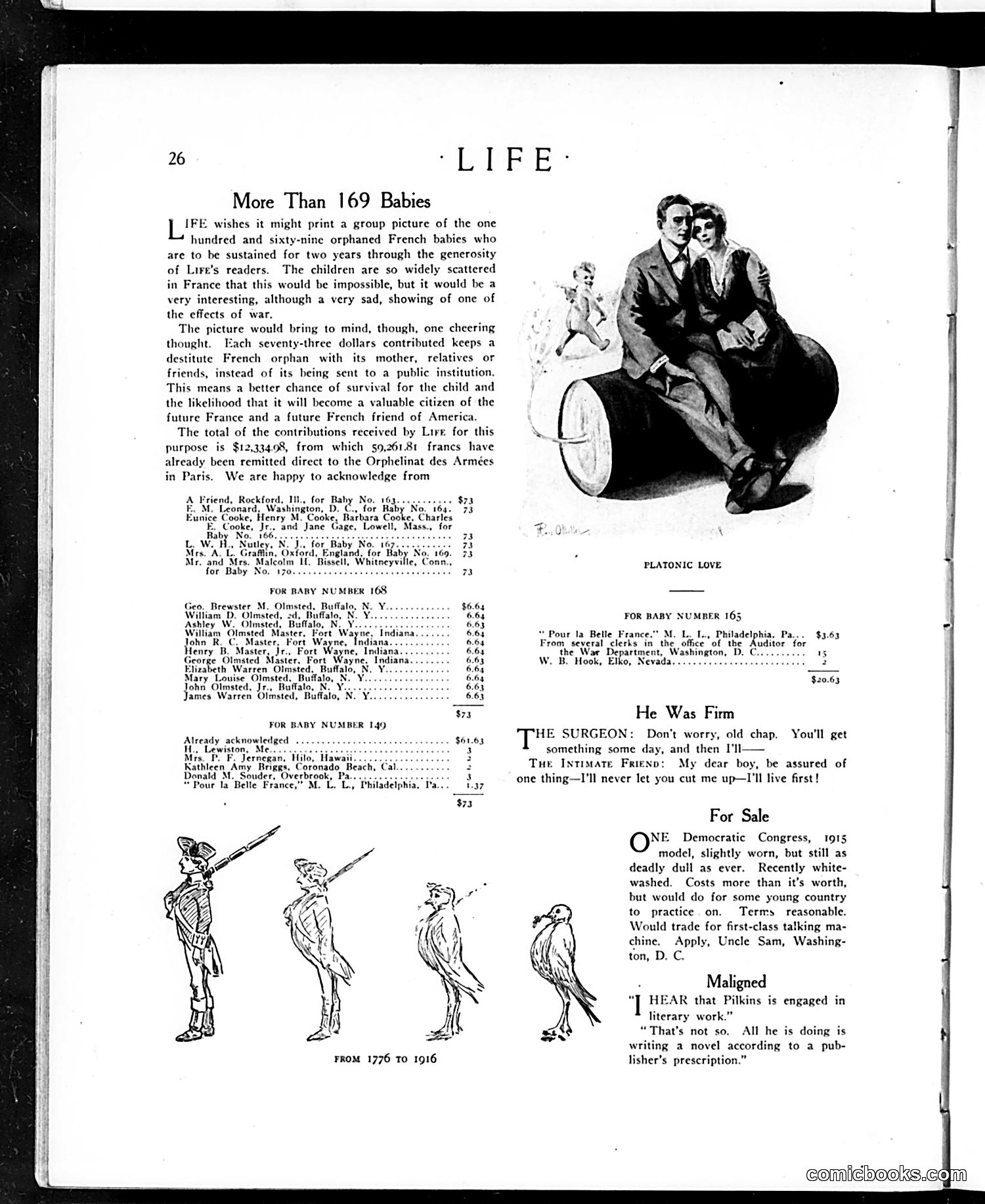
This page combines charity announcements with satirical content reflecting WWI-era American attitudes. **Main Content:** Life magazine is fundraising for French war orphans, having collected $12,334.08 to sustain 169 children for two years. Donors are acknowledged by name and location. The appeal emphasizes that $73 keeps an orphan with family rather than in institutions—framing it as both humanitarian and beneficial to future Franco-American relations. **Cartoons/Satire:** 1. **"From 1776 to 1916"** depicts the evolution of American military posture, showing a soldier's stance becoming progressively weaker—satirizing America's reluctance to enter WWI (the U.S. entered in 1917). 2. **"For Sale"** mocks the Democratic Congress of 1915 as obsolete and worthless, suggesting it should be traded for a "talking machine" (phonograph)—partisan Republican criticism of Democratic governance. 3. **"He Was Firm"** and **"Maligned"** are brief humorous anecdotes typical of Life's lighter content. The page reflects American WWI anxieties while soliciting charitable aid for French civilians.
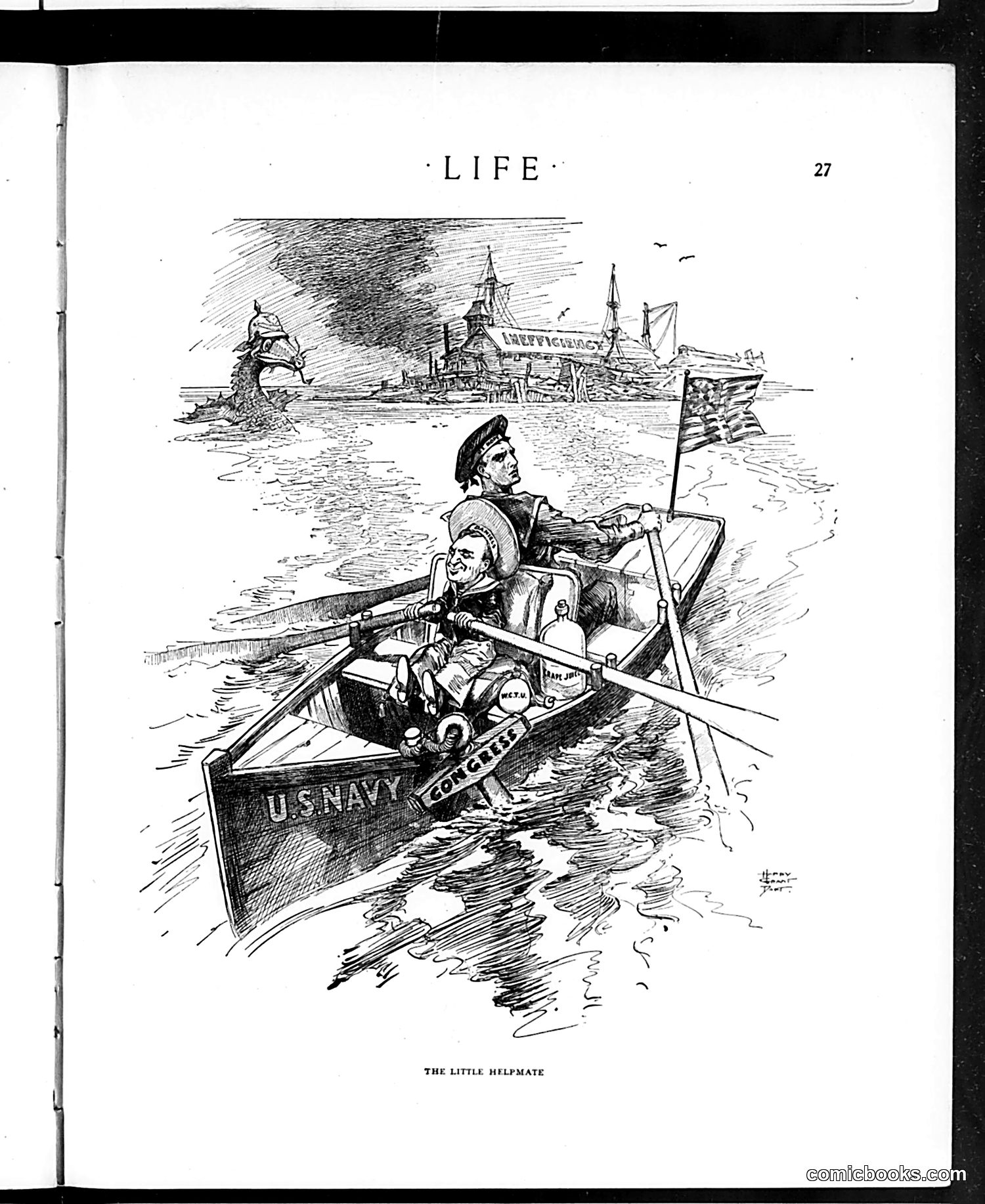
This satirical cartoon from *Life* magazine depicts a small rowboat labeled "U.S. NAVY" with two figures rowing toward an elaborate naval fleet in the background. The boat carries an American flag and appears comically undersized compared to the distant warships visible on the horizon. The title "The Little Helpmate" suggests mockery of American naval capacity or preparedness. The cartoon likely critiques either inadequate naval funding, insufficient military resources, or America's modest naval presence relative to other powers—possibly during a period when naval expansion was debated. The contrast between the tiny rowboat and the grand fleet in the distance emphasizes the disparity between ambitions and actual capabilities, or between what was promised and what was delivered.
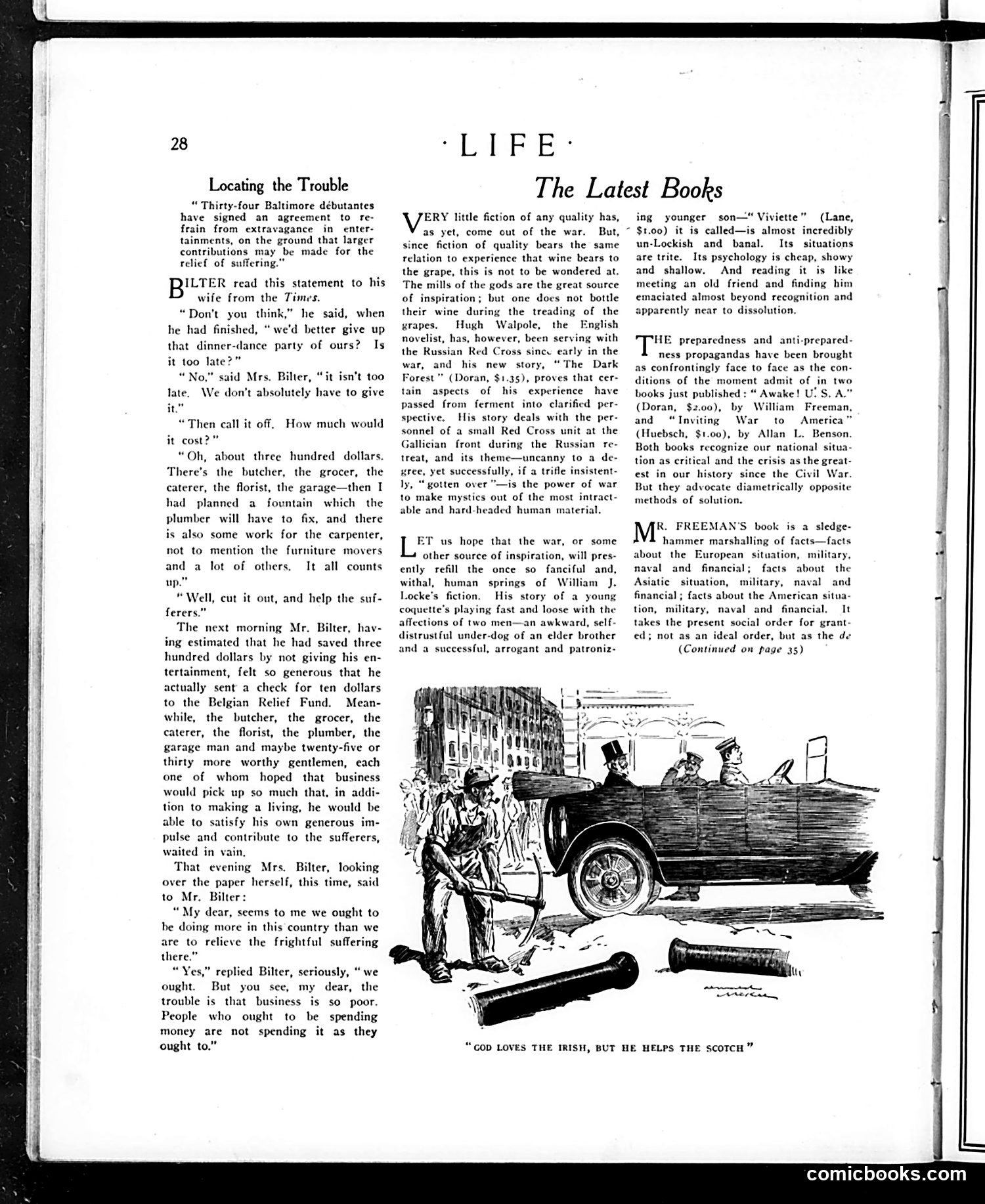
This satirical story mocks middle-class hypocrisy during wartime charity appeals. Mr. and Mrs. Bilter read that Baltimore debutantes have pledged to limit entertainment spending to aid war relief. Mrs. Bilter suggests canceling their dinner-dance party—which would cost $300 in payments to butchers, grocers, caterers, florists, plumbers, and carpenters. Mr. Bilter agrees, then feels so virtuous about "saving" the $300 that he donates merely $10 to Belgian Relief. The satire's point: by cutting the party, he didn't actually *save* money for charity—he simply prevented it from circulating through local tradespeople who desperately needed the work and hoped to contribute charitably themselves. The irony, emphasized in the final exchange, is that Bilter complains business is poor while simultaneously *causing* that poverty through his own reduced spending. His misguided "sacrifice" actually harms those he claims to help.
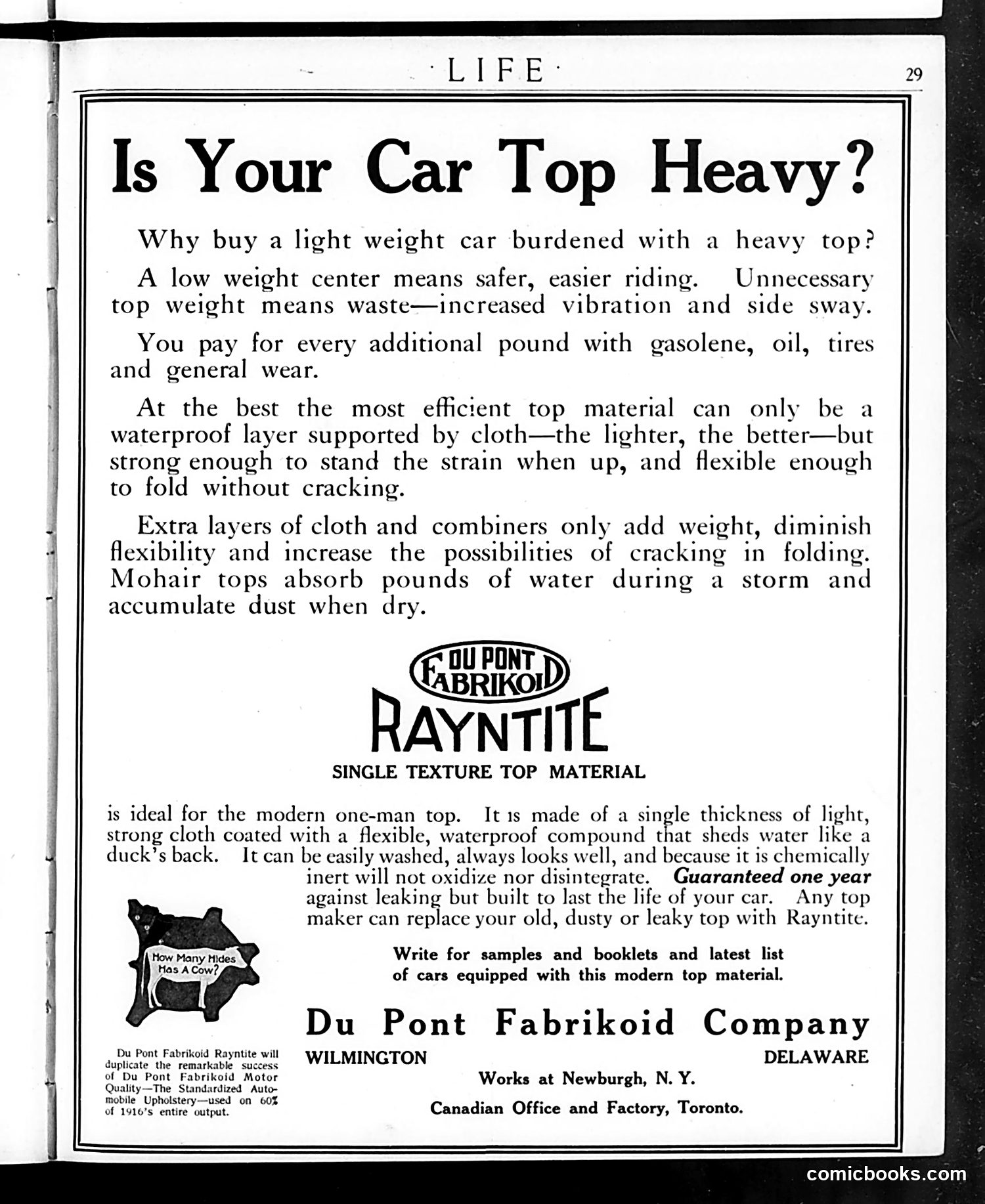
This is **not a cartoon or satire**—it's a straightforward advertisement from Life magazine (page 29). Du Pont Fabrikoid Company is promoting **Rayntite**, a synthetic car-top material. The ad argues against heavy convertible tops by claiming that unnecessary weight increases fuel consumption and causes vibration. It positions Rayntite as superior: a single-layer, lightweight cloth coated with waterproof compound that sheds water, resists cracking, and won't absorb moisture like traditional mohair tops. The small graphic showing a cow with text "How Many Hides Has A Cow?" is a playful reference to Du Pont's existing Fabrikoid motor upholstery product—suggesting their synthetic material duplicates natural leather's success. The address listing (Wilmington, Delaware; Newburgh, NY; Toronto) indicates this was a major industrial manufacturer advertising a modern automotive innovation to early 20th-century consumers concerned with car efficiency.
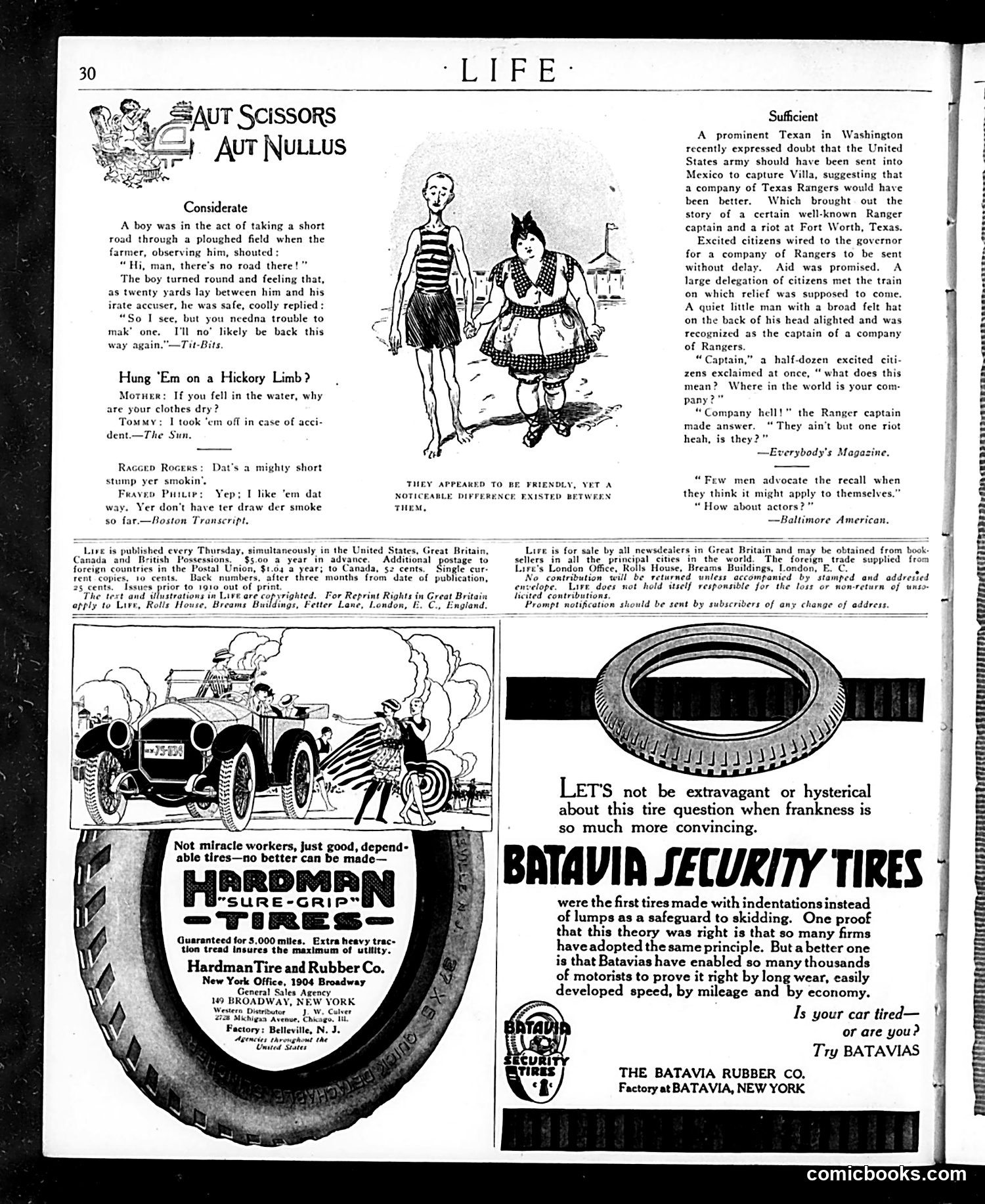
This page from *Life* magazine contains several short humorous anecdotes and advertisements typical of early 20th-century satirical publishing. The main cartoon shows two children who "appeared to be friendly, yet a noticeable difference existed between them"—likely satirizing superficial civility masking class or social differences. The "Sufficient" anecdote references the 1916 U.S. military intervention in Mexico against Pancho Villa. A Texas Ranger captain is summoned to quell a riot in Fort Worth but arrives alone, dismissing the concern: "They ain't but one riot heah, is they?" The joke satirizes frontier tough-guy bravado—suggesting one capable man can handle any situation, implicitly criticizing the need for large military operations. Lower sections contain period advertisements for Hardman and Batavia tires, emphasizing durability and safety features (indentations to prevent skidding). The page reflects early 1900s American humor: folksy anecdotes, regional dialects, and satirical commentary on contemporary politics and commercialism.
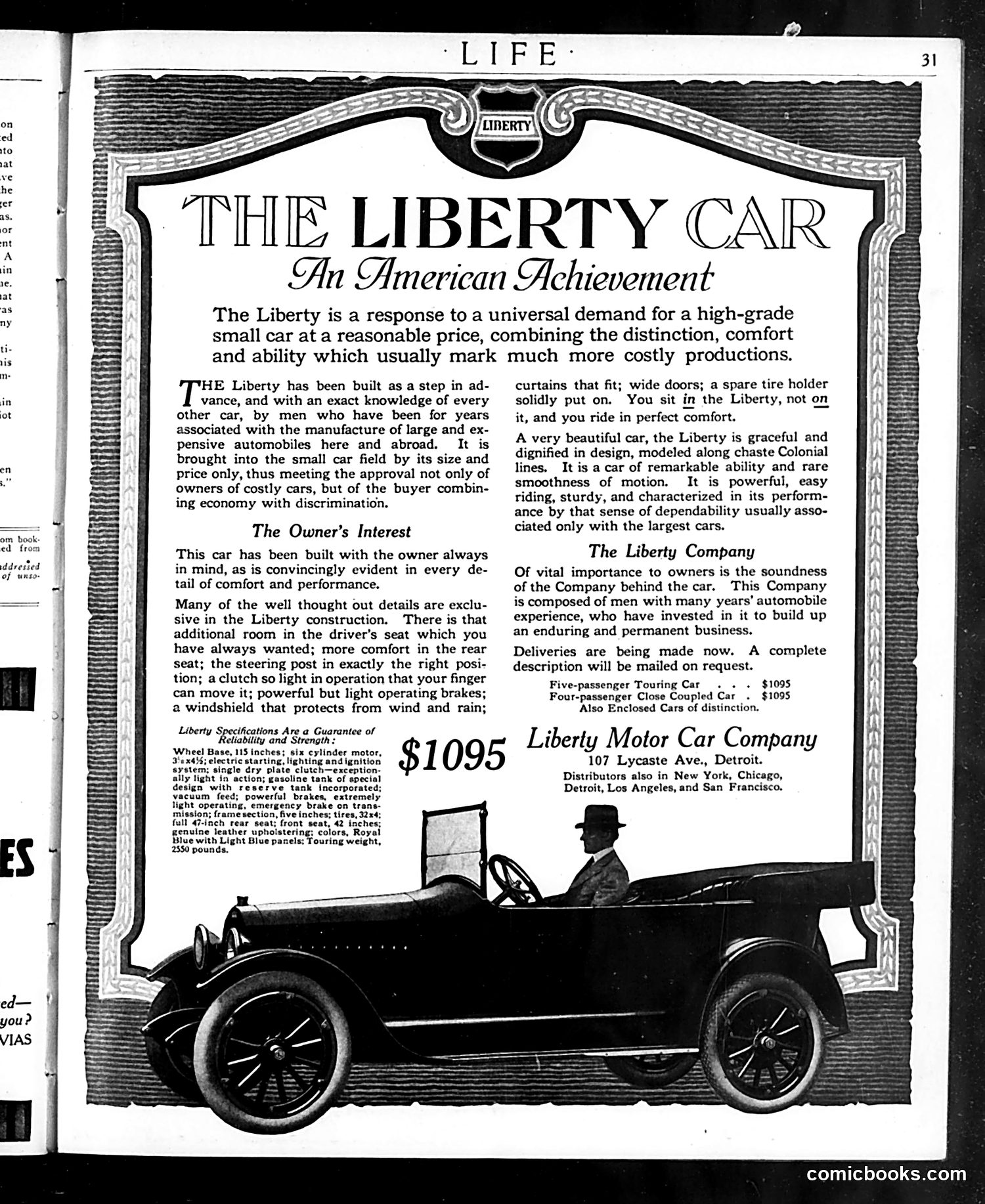
This is **not a cartoon or satire**—it's a straightforward automobile advertisement for the Liberty Motor Car, positioned as a high-quality, affordable vehicle. The page appears in *Life* magazine, which published both satirical content and paid advertising. The ad emphasizes that the Liberty is an "American Achievement" offering luxury features (Colonial design, comfortable seating, electric starter, powerful brakes) at a reasonable $1,095 price point—positioning it against both expensive luxury cars and cheap competitors. The copy appeals to buyers seeking "economy with discrimination" (taste without excess spending). The illustration shows a well-dressed man in a suit and fedora driving the open-air touring car, suggesting respectability and middle-to-upper-class appeal. The Liberty Motor Car Company, based in Detroit, frames this as a product backed by experienced automobile manufacturers. There is no satirical angle here—this is period automotive marketing emphasizing American engineering and value.
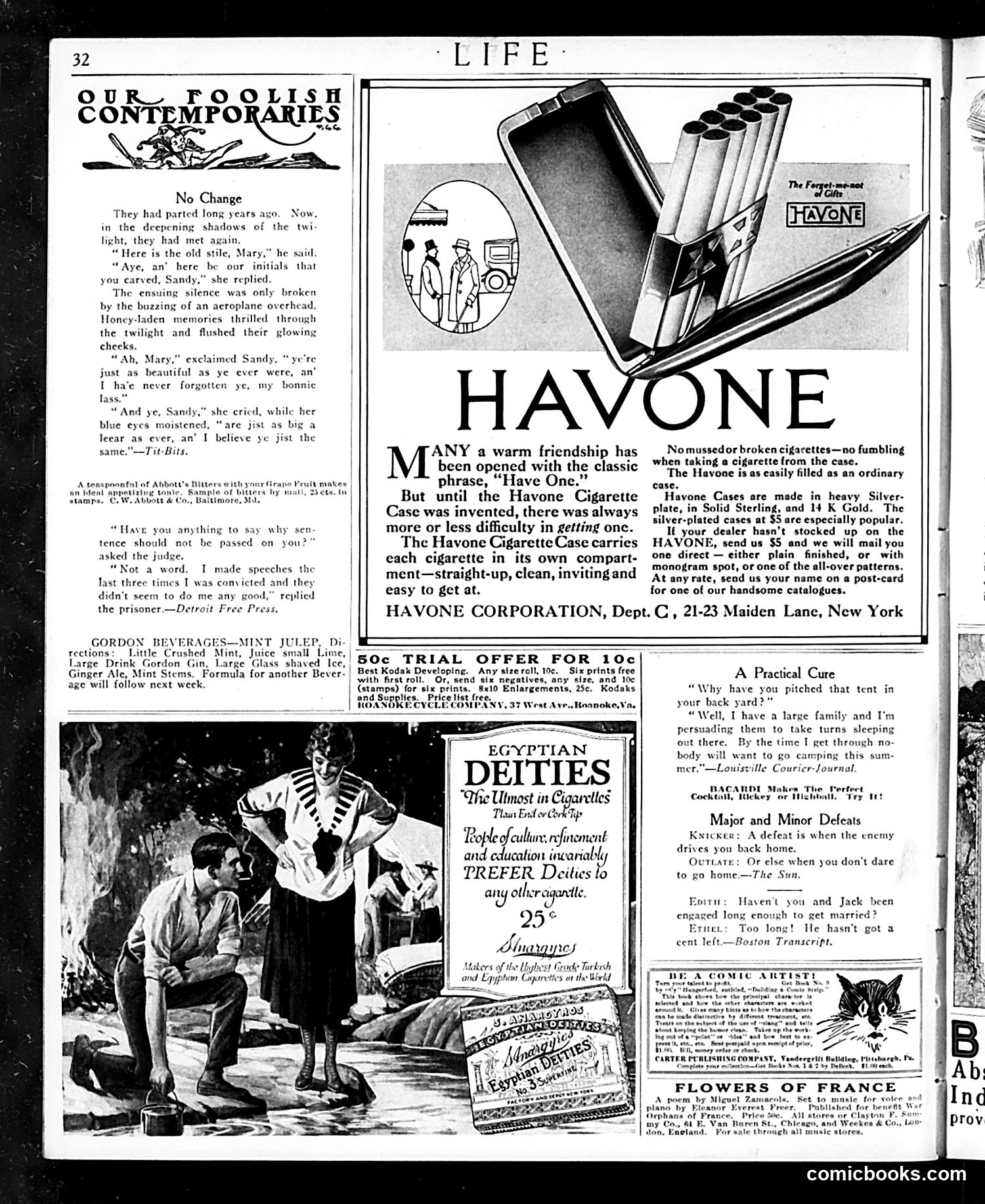
This page features *Life* magazine's satirical humor section showcasing contemporary foolishness. The main cartoon depicts a sentimental reunion between two former lovers ("Mary" and "Sandy") meeting at an old stile where they'd carved their initials years ago. The satire lies in the final detail: their romantic moment is interrupted by **an airplane overhead**—representing modern intrusion into nostalgic, timeless romance. The joke critiques how contemporary technology disrupts traditional sentimentality. Below are joke submissions mocking various social conventions: a prisoner's resignation to repeated convictions, cocktail recipes, and witty exchanges about romantic engagements and military defeats. The advertisements (Havone Cigarette Cases, Egyptian Deities cigars, Bacardi) are period-typical luxury goods marketed to the magazine's affluent readership.
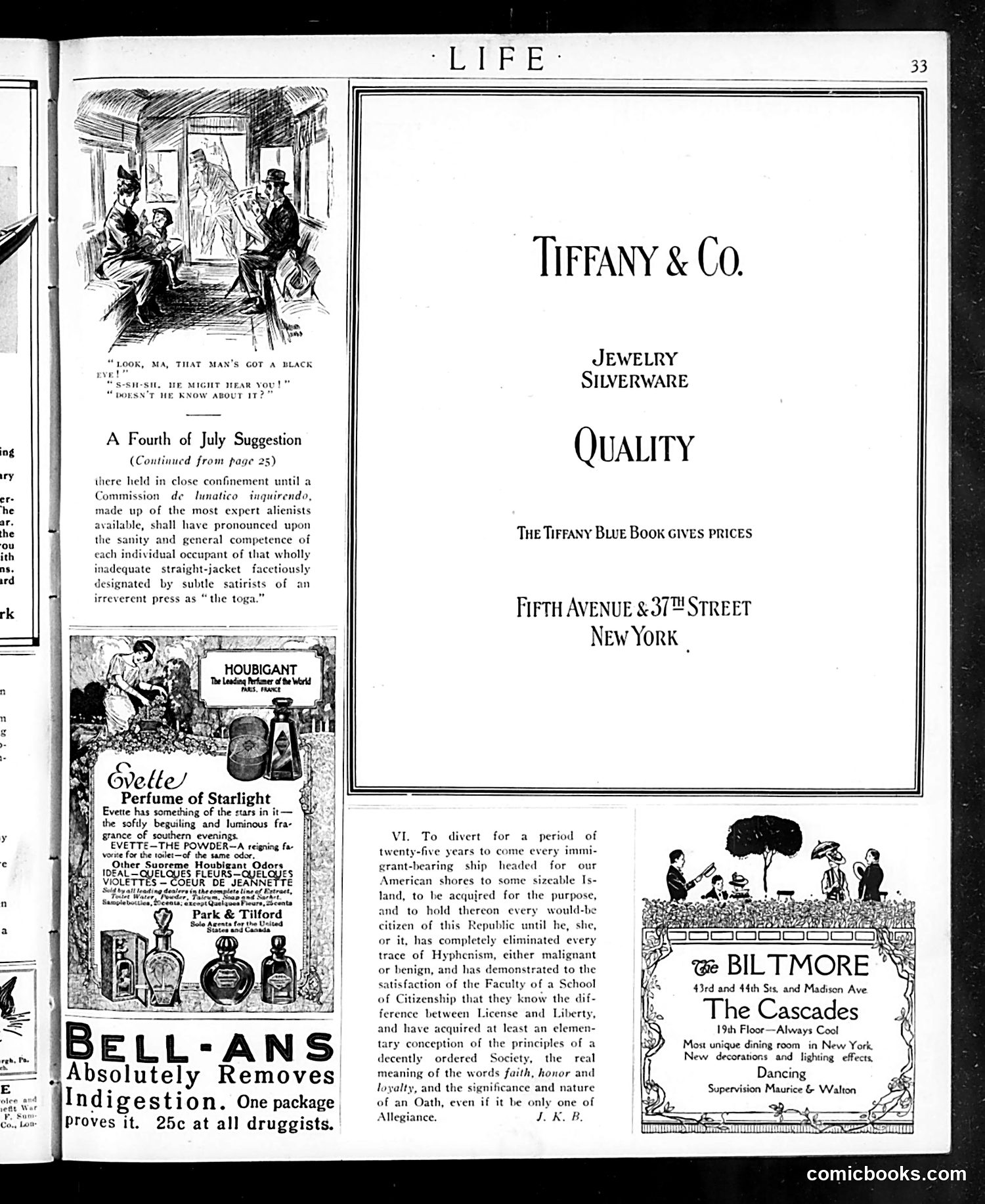
This page is primarily **advertising** interspersed with a political satire column continuation. The small cartoon at top left depicts a scene on public transportation where one man whispers to another about a third man's "black eye," asking if he knows the cause—a simple visual joke about gossip and discretion. The main text ("A Fourth of July Suggestion") is a biting satire on immigration and assimilation. The author proposes creating detention facilities where newly arrived immigrants would be held until a medical commission certifies they've eliminated "Hyphenism"—a contemporary term for dual national loyalty (e.g., "Italian-American"). The piece mocks restrictive immigration attitudes, using absurdist language ("toga" for bureaucratic red tape) to criticize those demanding immigrants renounce ethnic identity and prove loyalty to American principles like "faith, honor and loyalty." The satirical thrust targets nativist sentiment of the early 20th century, when anxiety about immigrant assimilation ran high. The author's hyperbolic "solution" exposes the prejudice underlying such demands. The remainder is period advertising for luxury goods and entertainment venues.
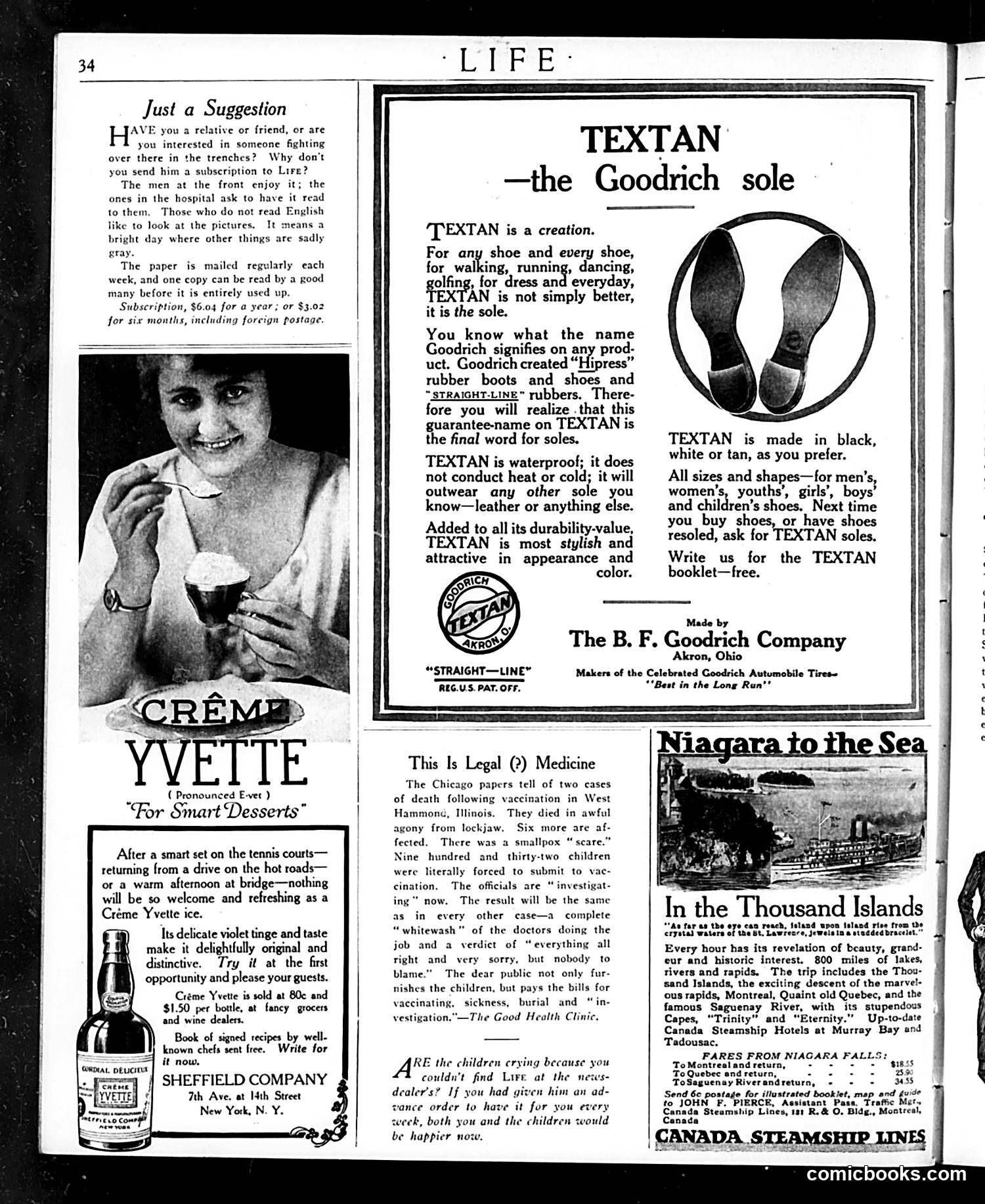
This page is primarily **advertising** for consumer products (shoe soles, dessert, travel), interspersed with brief editorial content. The notable non-advertising section is "This Is Legal (?) Medicine," a critique of forced vaccination during what appears to be a smallpox outbreak in West Hammond, Illinois. The piece attacks public health authorities for compelling vaccination, sardonically noting that children died from complications (lockjaw/tetanus) and that the subsequent official "investigation" will inevitably exonerate doctors with a "whitewash." The satire questions whether coercive vaccination constitutes legitimate medicine, and criticizes how citizens foot the bill while authorities escape accountability. The editorial tone is deeply skeptical of government medical authority—a perspective not uncommon in early 20th-century American publications skeptical of state power.
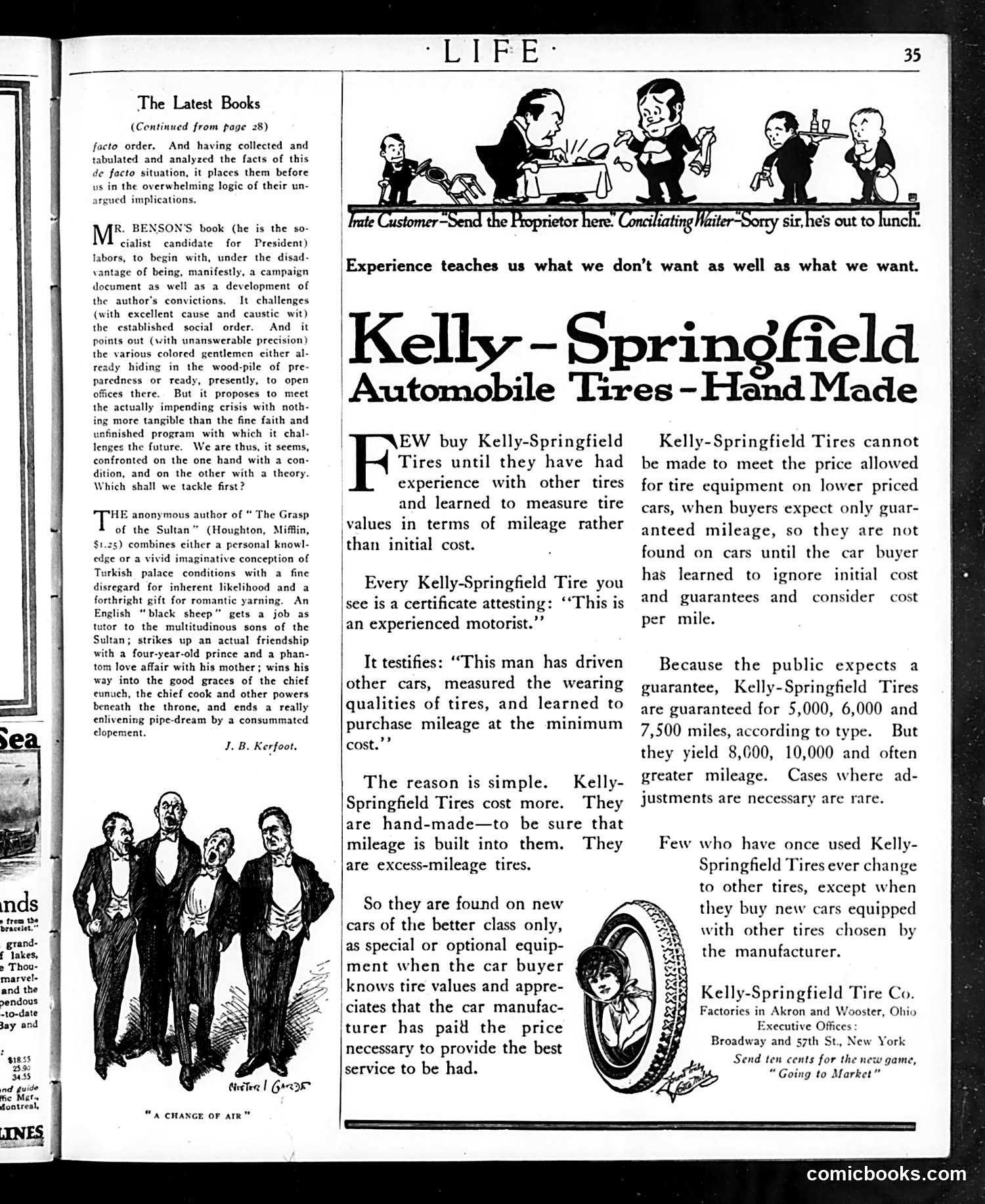
**The Cartoons:** The top cartoon depicts an irate customer demanding the proprietor fetch the manager, complaining that the waiter is out to lunch—a visual pun on the literal absence of staff. The bottom illustration, titled "A Change of Air," shows four well-dressed men in formal attire, likely depicting a social or political scene, though the specific reference is unclear from the visible text. **Book Reviews:** The page discusses recent political and literary works, including a book by "R. Benson" (identified as the socialist candidate for President) critiquing the established social order, and a novel called "The Grasp of the Sultan" featuring romantic intrigue in Turkish palace settings. **The Advertisement:** The bulk of the page is a Kelly-Springfield Tires advertisement claiming superiority through hand-manufacturing and longevity ("excess-mileage tires"), positioning them as premium products for discerning, experienced motorists willing to prioritize cost-per-mile over initial price—a class-conscious sales pitch.
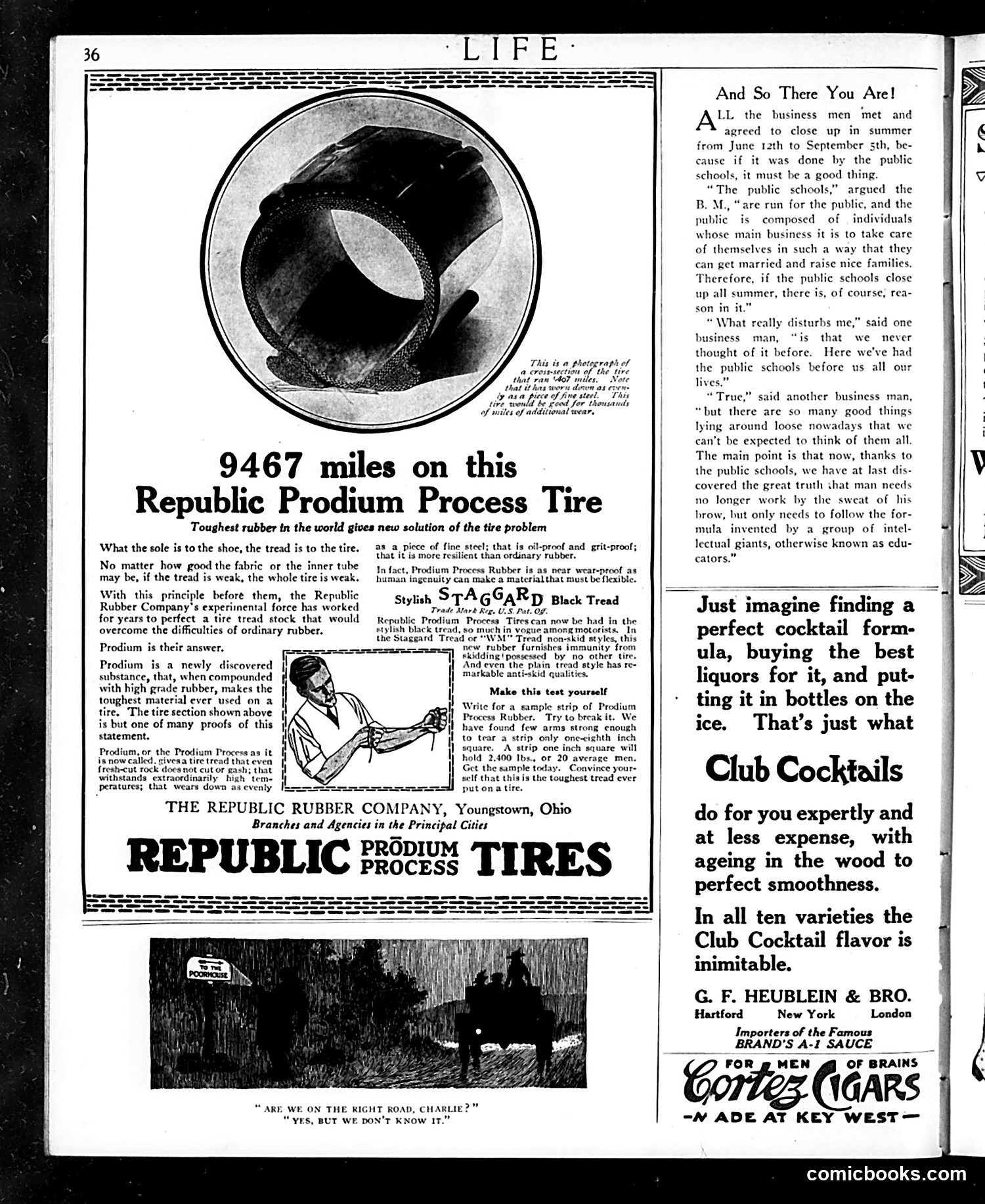
This page is primarily **advertising** for Republic Rubber tires, but includes social satire in "And So There You Are!" ## The Tire Advertisement Republic Rubber Company showcases their new "Prodium Process" tire tread, claiming superior durability (9,467 test miles). The copy emphasizes the tread's toughness, oil-resistance, and anti-skid properties. A small illustration shows a strength test where men pull on rubber strips. ## The Social Satire The brief article mocks **American business culture's herd mentality**. Business owners agreed to close their establishments during summer because public schools close—without genuinely questioning why. The satire suggests they uncritically copy institutional practices and then congratulate themselves for "discovering" obvious truths about rest and leisure, attributing this to "educators" (implied: without original thought). The humor lies in exposing their shallow reasoning and self-satisfaction. The caption cartoon ("Are We On The Right Road, Charlie?") reinforces this theme of people following others without understanding direction or purpose.
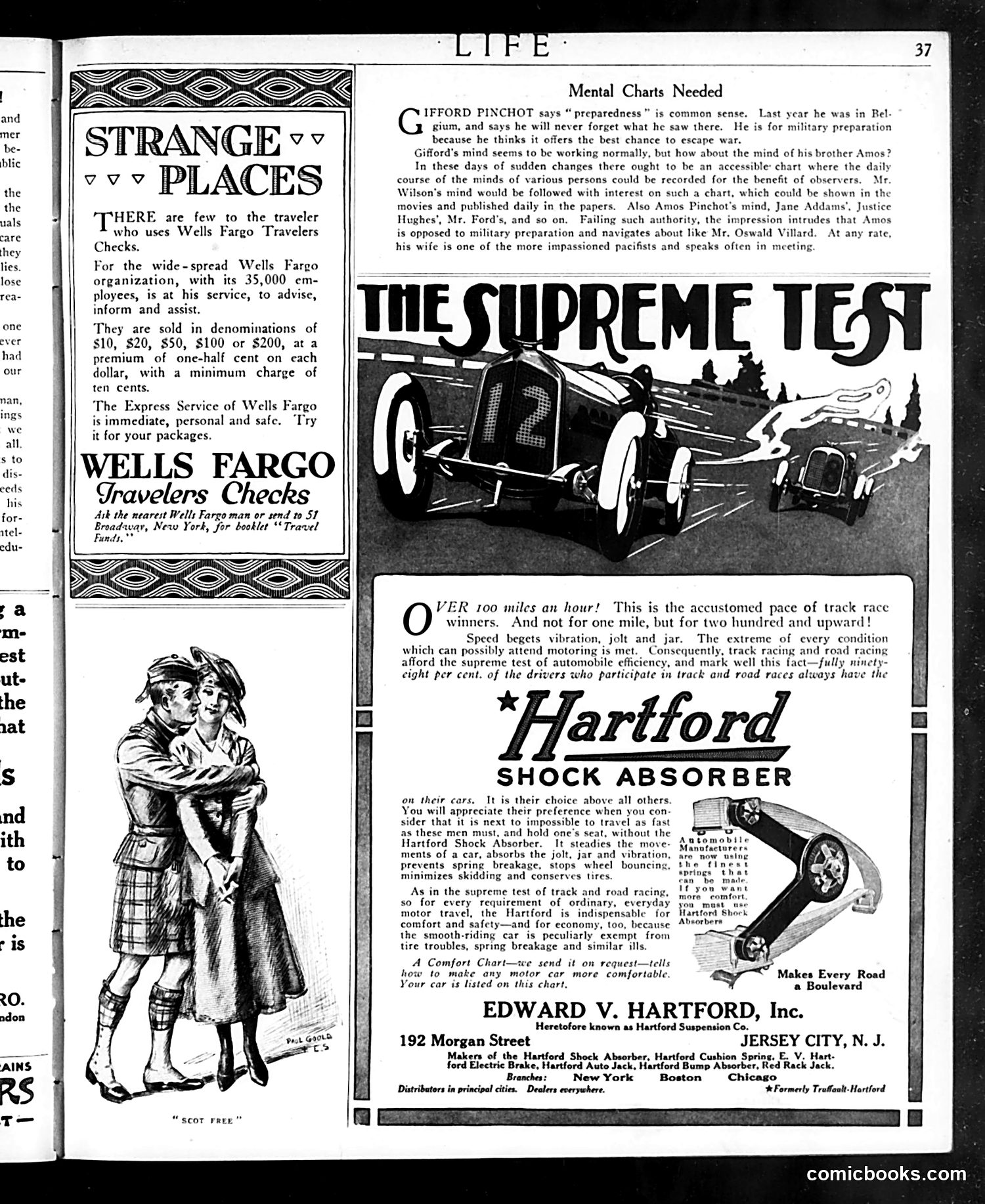
This page combines satirical editorial commentary with period advertising. The main content critiques the lack of clarity about prominent figures' positions on military preparedness during what appears to be the pre-WWI era. The "Mental Charts Needed" piece references **Gifford Pinchot** (supporting military preparation) and his brother **Amos Pinchot** (apparently opposing it), along with figures like **Woodrow Wilson**, **Justice Hughes**, **Henry Ford**, **Jane Addams**, and **Oswald Villard**. The author suggests creating daily published charts tracking these public figures' evolving positions, to be shown in movies and newspapers—satirizing the confusion about where influential Americans stood on war preparedness. The remainder consists of advertisements: Wells Fargo Travelers Checks and Hartford Shock Absorbers. The latter notably features "The Supreme Test"—racing imagery promoting shock absorbers' durability through extreme motoring conditions. These ads are straightforward commercial content with no satirical intent.
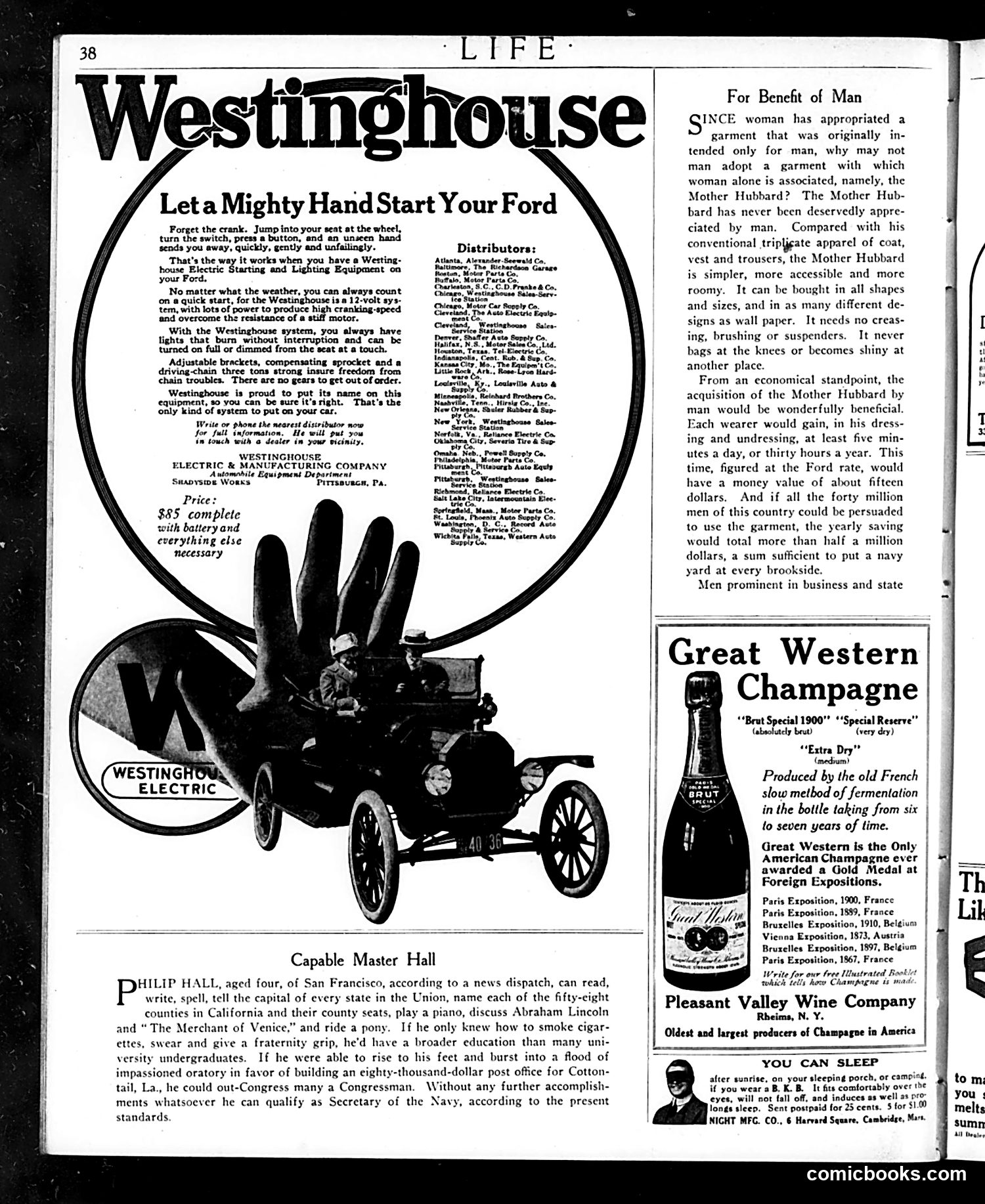
This page contains two main elements: **The Westinghouse Advertisement** (left side) promotes an electric starter system for Ford automobiles, featuring a large hand emerging from a steering wheel. The ad emphasizes convenience—"Forget the crank"—highlighting the advantage of electric starting over manual hand-cranking, which was physically demanding and dangerous. The $85 price tag and list of distributors indicate this was a significant automotive innovation of the early 1900s. **"For Benefit of Man" (right side)** is satirical commentary proposing that men adopt the "Mother Hubbard"—a loose, comfortable dress traditionally worn by women. The author argues ironically that men would save time and money if they wore this garment instead of conventional suits. The satire mocks both rigid masculine dress codes and the economic inefficiency they represent. The **champagne and product advertisements** filling remaining space are typical of Life magazine's revenue model. The page reflects early-20th-century concerns: automotive innovation, gender and clothing conventions, and economic rationality.
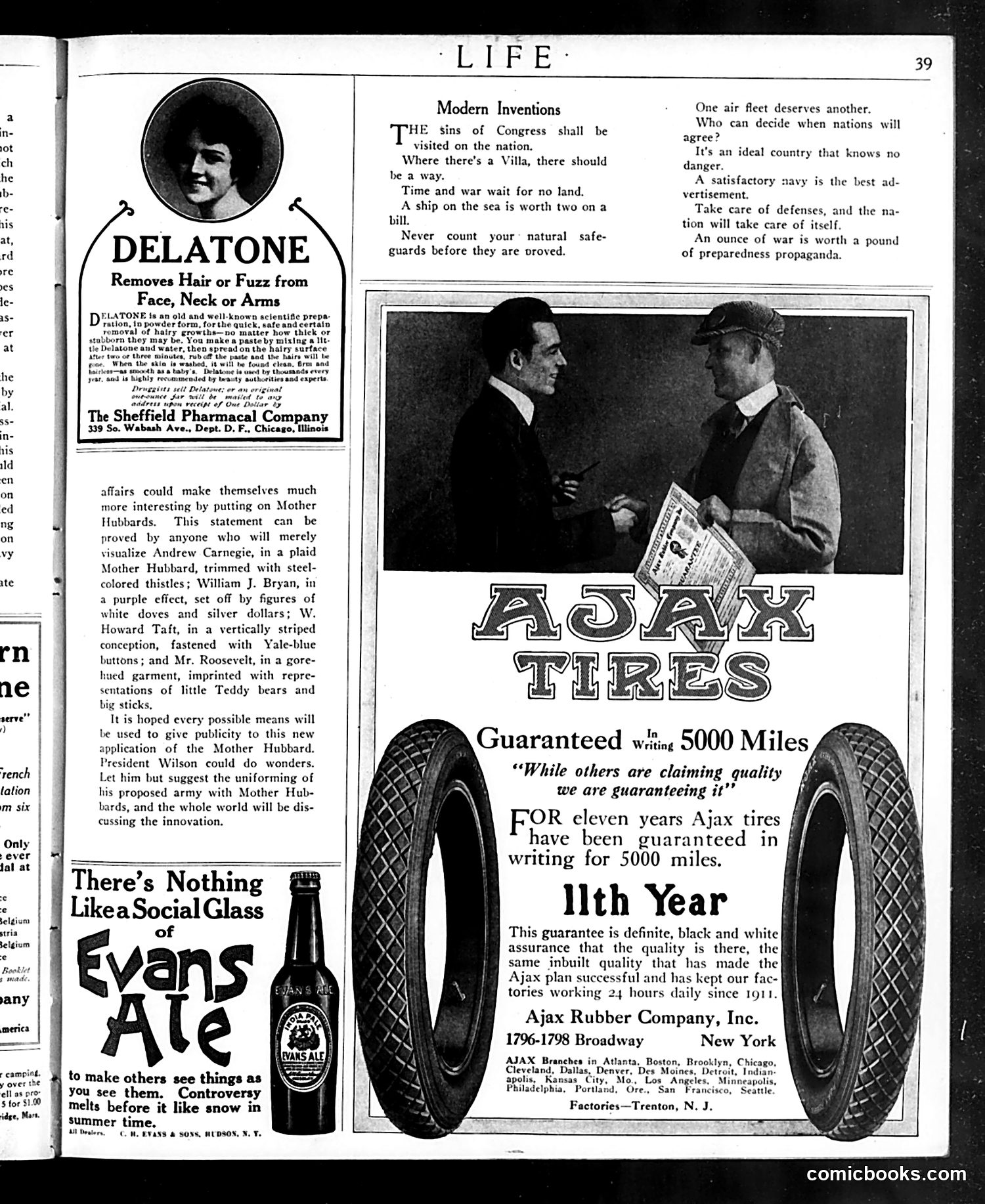
This page combines satirical commentary on early 20th-century politics with period advertisements. **"Modern Inventions" Section:** The text presents brief, sardonic observations on contemporary issues—likely referencing President Wilson's foreign policy, military preparedness debates, and naval expansion. References to "Villa" suggest Mexican border conflicts; "Mother Hubbards" (a loose garment) humorously imagine prominent political figures (Carnegie, Bryan, Taft, Roosevelt) wearing them, mocking dignified statesmen. The joke satirizes both the absurdity of fashion trends and how even serious politicians could be made ridiculous. **Advertisements:** The page features vintage product ads typical of the era: Delatone (hair removal), Evans Ale, and Ajax Tires (guaranteed 5,000 miles). These reflect consumer goods marketed during this period. The political content appears aimed at Wilson-era debates over military spending and intervention, with gentle mockery of establishment figures dressed in unflattering garments—a common Life magazine tactic for deflating pomposity.
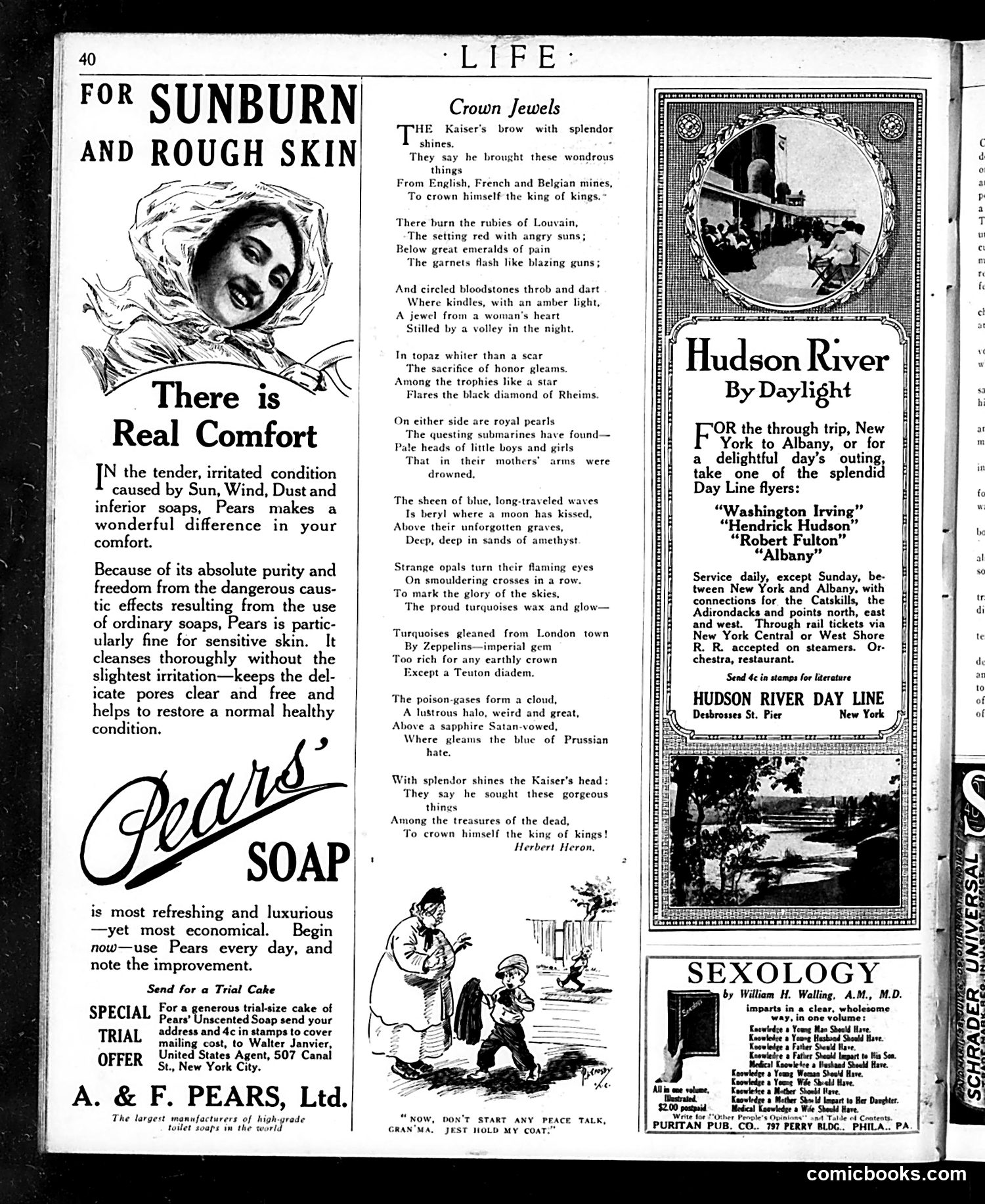
This poem by Herbert Heron is a bitter anti-German satire, likely from World War I (references to Louvain, Rheims, Belgian mines, and Zeppelins date it to that conflict). It mocks Kaiser Wilhelm II by describing his crown jewels as composed entirely of war spoils and human suffering. Each gemstone represents atrocities: rubies from Louvain (Belgian city destroyed in 1914), emeralds symbolizing "pain," garnets like "blazing guns," bloodstones, and pearls that are the "pale heads of little boys and girls" drowned at sea. Poison gases form a "sapphire." The Kaiser is portrayed as literally wearing the bodies and treasures of his victims. The final stanza reveals the satire's point: he "sought these gorgeous things / Among the treasures of the dead"—suggesting his crown represents not legitimate power but desecration and theft from the murdered. This reflects American/Allied wartime propaganda demonizing German leadership.
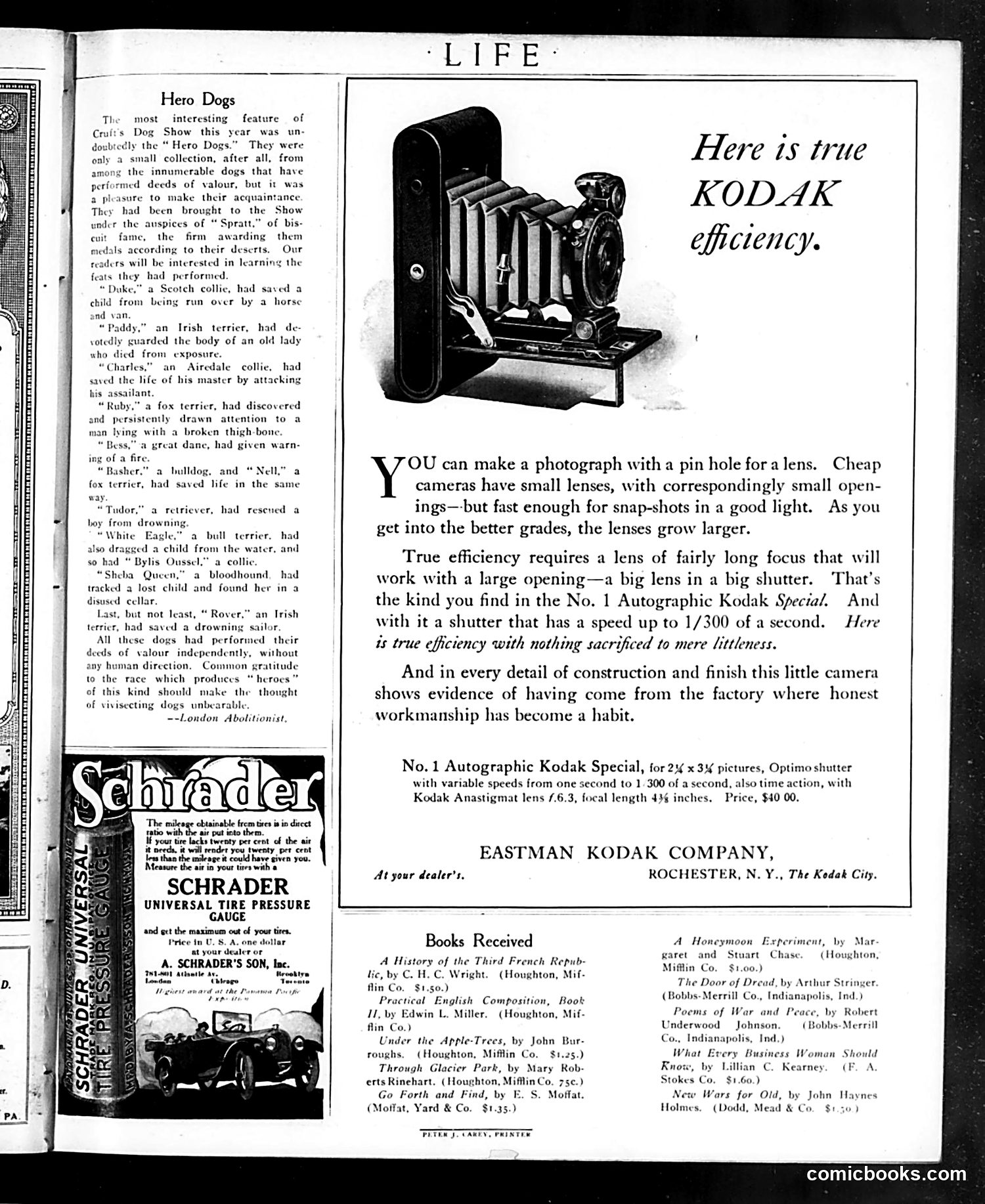
This page contains a human-interest article about dogs, not political satire. The "Hero Dogs" feature describes real dogs honored at Crufts Dog Show (a British dog competition) for acts of valor—rescuing children, detecting injuries, and saving drowning victims. The piece argues, via a quote from the London Abolitionist, that society's gratitude toward dogs performing such heroic deeds independently should make vivisection (animal testing) unthinkable. The page also includes advertising: a Schrader tire-pressure gauge ad and a substantial Kodak camera advertisement emphasizing precision engineering and efficiency. Below are book reviews for contemporary titles on French history, composition, and poetry.
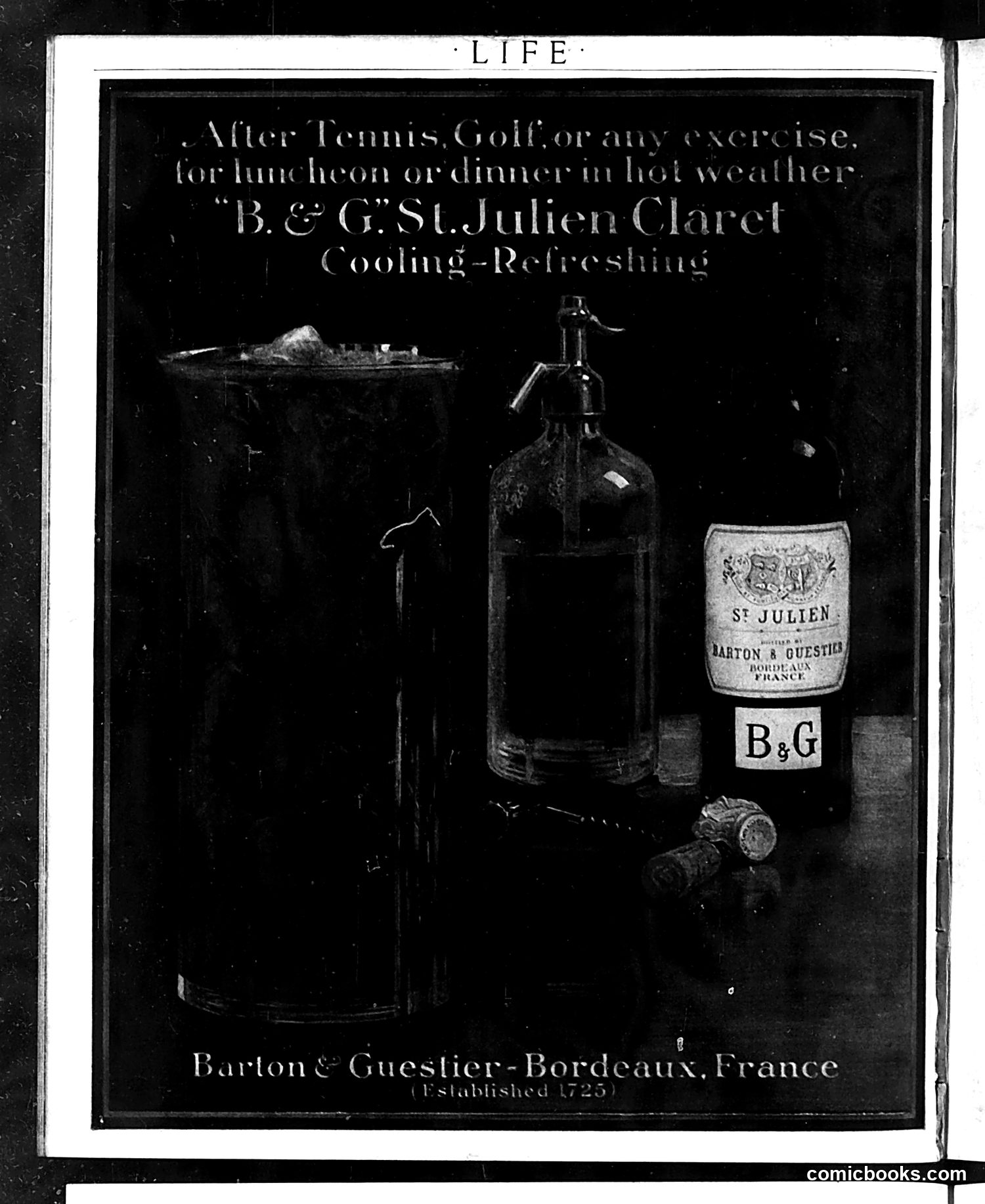
This is a **product advertisement**, not political satire. It promotes "B&G St. Julien Claret," a French wine from the Bordeaux house Barton & Guestier (established 1725). The ad targets affluent readers by suggesting the wine as an ideal refreshment after physical exertion—tennis, golf, or exercise—particularly in hot weather. The image displays the wine bottle prominently alongside period glassware and ice, emphasizing its "cooling-refreshing" properties. This represents early 20th-century luxury marketing: positioning French claret as a sophisticated beverage for the active, leisured class. The advertisement assumes readers are familiar with both the wine's prestige and the leisure activities mentioned, reflecting the magazine's affluent audience.