
Life, 1916-07-06 · page 24 of 42
Life — July 6, 1916 — page 24: what you’re looking at
What you’re looking at
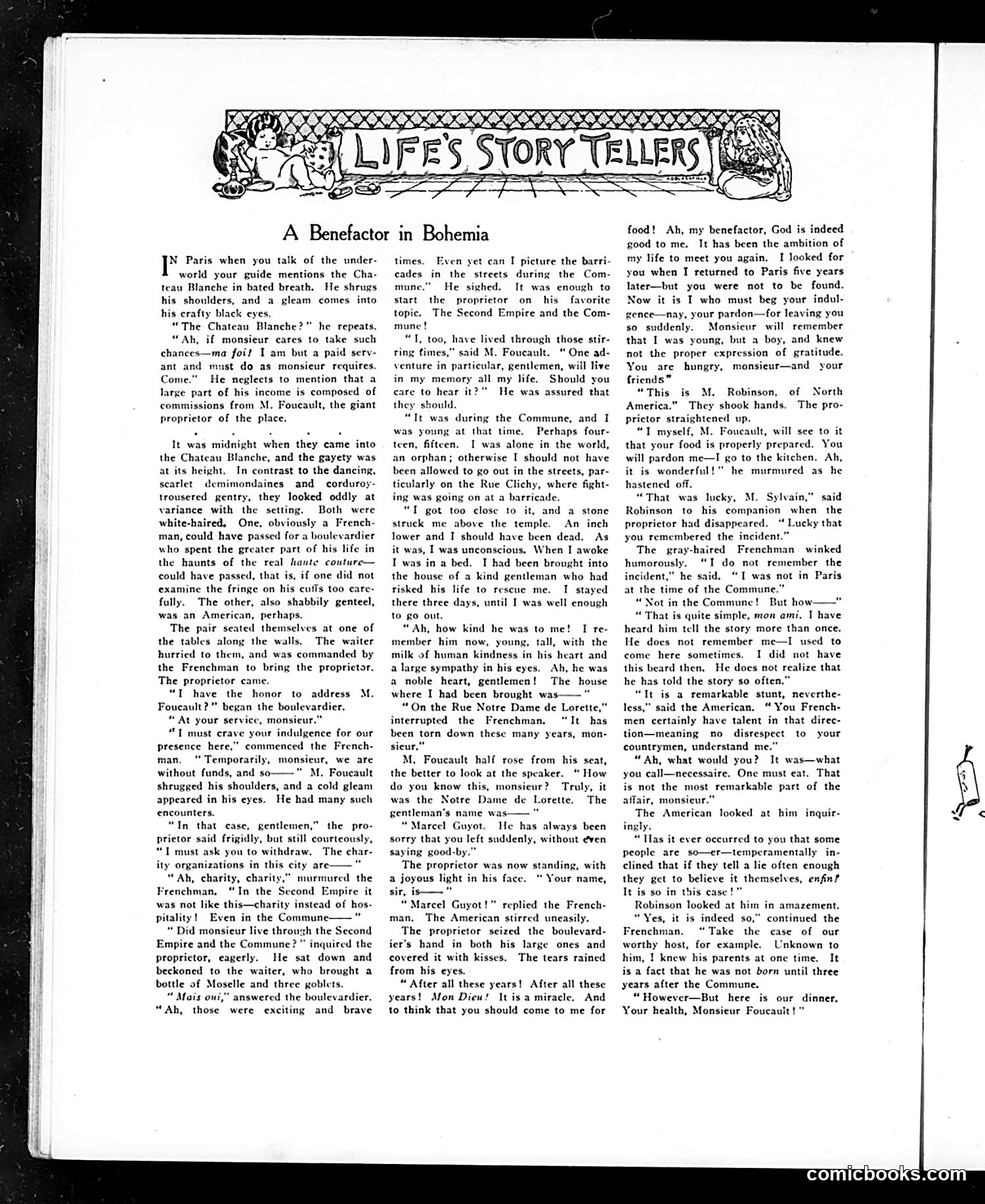
This is a literary short story rather than a political cartoon. It's a sentimental tale set in Paris's Bohemian underworld, likely from the early 1900s. The plot concerns two impoverished gentlemen—a Frenchman and an American—who cannot pay at the Chateau Blanche, a disreputable nightclub. The proprietor, M. Foucault, initially refuses service but becomes emotional when the Frenchman mentions surviving the Paris Commune (1871). Foucault then shares his own dramatic story: as a boy during the Commune, he was struck by a stone at a barricade and rescued by a kind stranger on Rue Notre Dame de Lorette. The story's point appears to be about human connection and redemption—the irony that shared historical trauma and nostalgia can transform a cold businessman into a charitable man. The narrative explores themes of memory, kindness, and how chance encounters shape lives.
📄 Transcribed text from this page (OCR, searchable)
Machine-transcribed from the original scan — historical spelling and the odd misread are preserved.
A Benefactor in Bohemia I Paris when you talk of the under- world your guide mentions the Cha- teau Blanche in bated breath, He shrugs his shoulders, and a gleam comes into his crafty black eyes. The Chateau Blanche?" he repeats. Ah, if monsieur cares to take such chances—ma foif I am but a paid ser ant and must do as monsieur require Come.” He neglects to mention that a large part of his income is composed of commissions from M. Foucault, the giant proprietor of the place. It was midnight when they came into the Chateau Blanche, and the gayety was at its height. In contrast to the dancing, scarlet demimondaines and corduroy- trousered gentry, they looked oddly at variance with the setting. Both were white-haired, One, obviously a French- man, could have passed for a boulevardier who spent the greater part of his life in the haunts of the real haute couture— could have passed, that is, if one did not examine the fringe on his cuffs too care- fully. The other, also shabbily genteel, was an American, perhaps. The pair seated themselves at one of the tables along the walls. The waiter hurried to them, and was commanded by the Frenchman to bring the proprictor. The proprietor came. I have the honor to address M. Foucault?" began the boulevardier, “At your service, monsieur. “T must crave your indulgence for our presence here,” commenced the French- man, “ Temporarily, monsieur, we are without funds, and so—-" M. Foucault shrugged his shoulders, and a cold gleam appeared in his eyes. He had many such encounters. “In that case, gentlemen,” the pro- prietor said frigidly, but still courteously, “T must ask you to withdraw. The char- ity organizations in this city are—" “Ab, charity, charity,” murmured the Frenchman, “In the Second Empire it was not like this—charity instead of hos- pitality! Even in the Commune—" ” Did monsieur live through the Second Empire and the Commune?” inquired the proprietor, eagerly. He sat down and beckoned to the waiter, who brought a bottle of Moselle and three goblets. “ Mais oui,” answered the boulevardier. “Ab, those were exciting and brave times, cades in Even yet can I picture the barri- the streets during the Com- mune.” He sighed. It was enough to start the proprietor on his favorite topic. The Second Empire and the Com- mune! “T, too, have lived through those stir- ring times,” said M. Foucault. “ One ad- venture in particular, gentlemen, wiil live in my memory all my life. Should you care to hear it?" He was assured that they should. “It was during the Commune, and I was young at that time. Perhaps four- teen, fifteen. I was alone in the world, an orphan; otherwise I should not have been allowed to go out in the streets, par- ticularly on the Rue Clichy, where fight- ing was going on at a barricade. “T got too close to it, and a stone struck me above the temple. An inch lower and I should have been dead. As it was, I was unconscious, When I awoke I was in a bed. I had been brought into the house of a kind gentleman who had risked his life to rescue me. I stayed there three days, until I was well enough to go out. “Ah, how kind he was to me! I re- member him now, young, tall, with the milk of human kindness in his heart and a large sympathy in his eyes. Ah, he was a noble heart, gentlemen! The house where I had been brought was—” “On the Rue Notre Dame de Lorette,” interrupted the Frenchman, “It has been torn down these many years, mon- sieur.” M, Foucault half rose from his seat, the better to look at the speaker. “ How do you know this, monsieur? Truly, it was the Notre Dame de Lorette. The gentleman's name was- “Marcel Guyot. He has always been sorry that you left suddenly, without even saying good-by, The proprietor was now standing, with a joyous light in his face. “ Your name, sir, is—" “Marcel Guyot!” replied the French- man, The American stirred uneasily. The proprietor seized the boulevard- ier’s hand in both his large ones and covered it with kisses. The tears rained from his eyes. After all these years! After all these years! Mon Diew! It isa miracle, And to think that you should come to me for Ah, my benefactor, God is indeed good to me. It has been the ambition of my life to meet you again, I looked for you when I returned to Paris five years later—but you were not to be found. Now it is T who must beg your indul- gence—nay, your pardon—for leaving you so suddenly, Monsieur will remember that I was young, but a boy, and knew not the proper expression of gratitude. You are hungry, monsieur—and your friends” “This is M. America.” They shook hands. prictor straightened up. “T myself, M. Foucault, will see to it that your food is properly prepared. You will pardon me—I go to the kitchen, Ab, it is wonderful!” he murmured as he hastened off. That was lucky, M. Sylvain,” said Robinson to his companion when the proprietor had disappeared,“ Lucky that you remembered the incident. The gray-haired Frenchman winked humorously. ‘I do not remember the incident,” he said. “I was not in Paris at the time of the Commune.” “Not in the Commune! But how. “That is quite simple, mon ami, I have heard him tell the story more than once. He does not remember me—I used to come here sometimes, I did not have this beard then, He docs not realize that he has told the story so often,” It is a remarkable stunt, neverthe- less,” said the American, “You French- men certainly have talent in that direc- tion—meaning no disrespect to your countrymen, understand me.” “Ah, what would you? It was—what you call—necessaire. One must eat, That is not the most remarkable part of the affair, monsieur.” The American looked at him inquir- ingly. “Tlas it ever occurred to you that some people are so—er—temperamentally in- clined that if they tell a lie often enough they get to believe it themselves, enfin? It is so in this case!” Robinson looked at hit “Yes, it is indeed so, Frenchman. “Take the case of our worthy host, for example. Unknown to him, I knew his parents at one time. It is a fact that he was not born until three years after the Commune. “However—But here is our dinner. Your health, Monsieur Foucauit !” food! Robinson, of North The pro- in amazement. continued the