
Life, 1916-07-06 · page 20 of 42
Life — July 6, 1916 — page 20: what you’re looking at
What you’re looking at
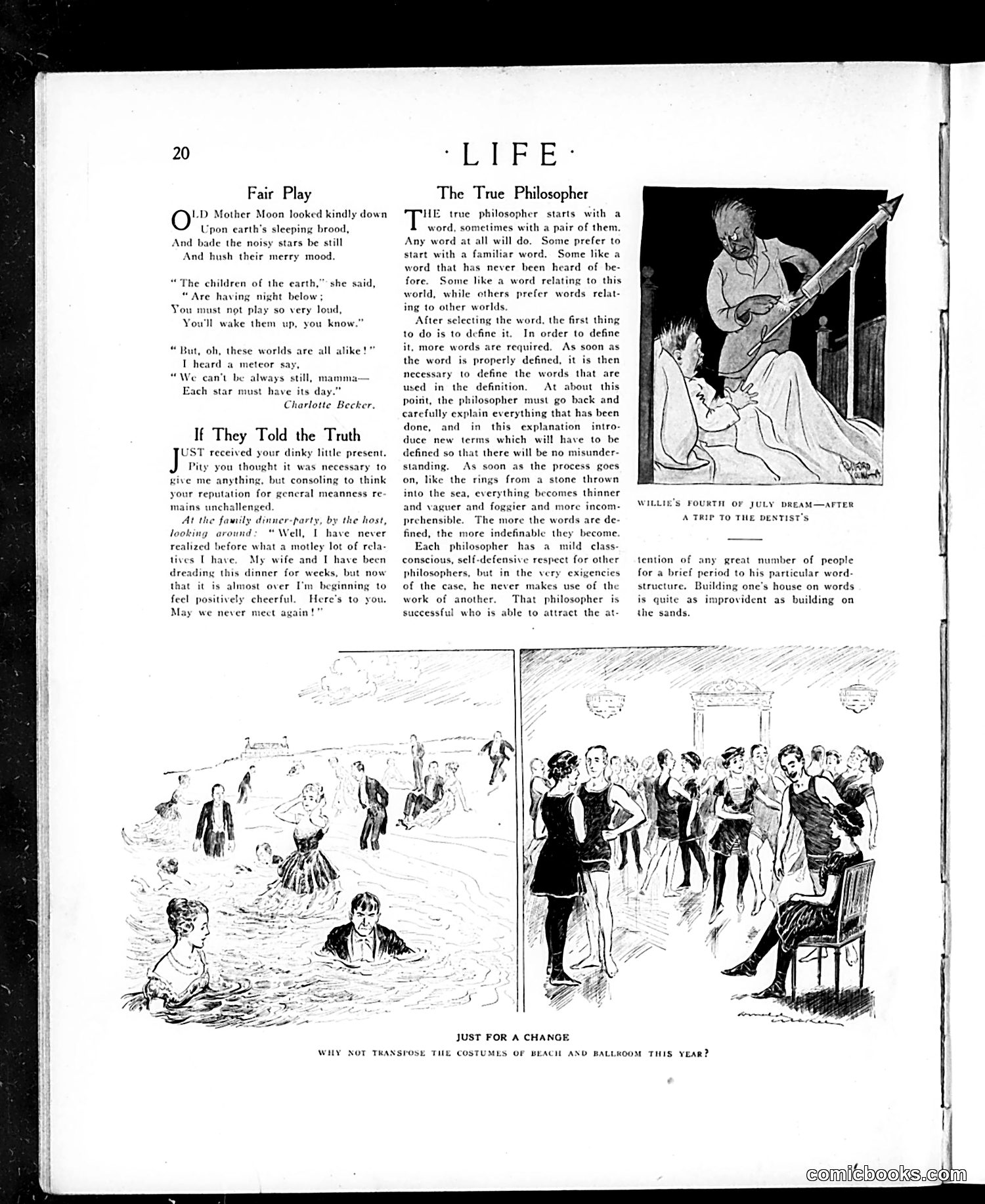
This page from *Life* magazine presents three satirical pieces mocking social conventions and human nature: **"Fair Play"** is a whimsical poem about Mother Moon scolding Earth's children to be quiet—a gentle mockery of parental platitudes. **"If They Told the Truth"** is biting social satire. It imagines what people *actually* think at formal occasions but don't say: a dinner guest admitting the present is worthless, and a host confessing he dreads family gatherings. The humor lies in exposing the gap between polite social fiction and honest sentiment—the hypocrisy of obligatory civility. **"The True Philosopher"** satirizes academic obscurantism: philosophers define words using other words requiring definition, creating an endless, self-perpetuating cycle that makes language increasingly "foggier and more incomprehensible." It mocks philosophers' mutual respect despite this fundamental futility. **"Just for a Change"** (captioning beach and ballroom illustrations) suggests swapping beach and formal attire—a lighthearted proposal to break rigid social costume conventions. Overall, the page targets social pretense, philosophical verbosity, and rigid etiquette.
📄 Transcribed text from this page (OCR, searchable)
Machine-transcribed from the original scan — historical spelling and the odd misread are preserved.
Fair Play LD Mother Moon looked kindly down Upon earth's sleeping brood, And bade the noisy stars be still And hush their merry mood. “The children of the earth,” she ht below ; You must not play so very loud, You'll wake them up, you know.” “ Are having “ But, oh, these worlds are all alike!” I heard a meteor say “We can't be always still, mamma Each star must have its d: Charlotte Becker. If They Told the Truth UST received your dinky little present. J Pity you thought give me anything, but consoling to think your repui mains unch: At the fam looking around was necessary to tion for general meanness re lenged. dinner-party, by the host, “Well, [ have never fore what a motley lot of rela- My wife and I have been dreading this dinner for weeks, but now that it is alt feel positively cheerful May we never nieet again!” realized tives [ have. ost over I'm beginning to Here's to you. “LER E * The True Philosopher HE true philosopher starts with a word, sometimes with a pair of them. Some prefer to start with a familiar word. Some like a word that has never been heard of be- fore. Some like a word relating to this world, while others prefer words relat- Any word at all will do. ing to other worlds. After selecting the word, the first thing to do is to define it. In order to define it, more words are required. As soon as the word is properly defined, it is then to define the words that are used in the definition. At about this poirit, the philosopher must go back and carefully explain everything that has been done, and in this explanation intro- duce new terms which will have to be defined so that there will be no misunder- standing. As soon as the process goes on, like the rings from a stone thrown into the sea, everything becomes thinner and vaguer and foggier and more inco prehensible. The more the words are de- fined, the more indefinable they become. Each philosopher has a conscious, self-defensive respect for other philosophers, but in the very exigencies of the case, he never makes use of the another. That philosopher is successful who is able to attract the at necessary mild class- work of win FOURTH OF JULY DREAM—AFTER A TRIP TO THE DENTIST'S tention of any great number of people for a brief period to his particular word- structure, Building one’s house on words is quite as improvident as building on the sands JUST FOR A CHANGE WHY NOT TRANSPOSE THE COSTUMES OF BEACH AND BALLROOM THIS YEAR? comiebooks.cam