
Life, 1916-07-06 · page 12 of 42
Life — July 6, 1916 — page 12: what you’re looking at
What you’re looking at
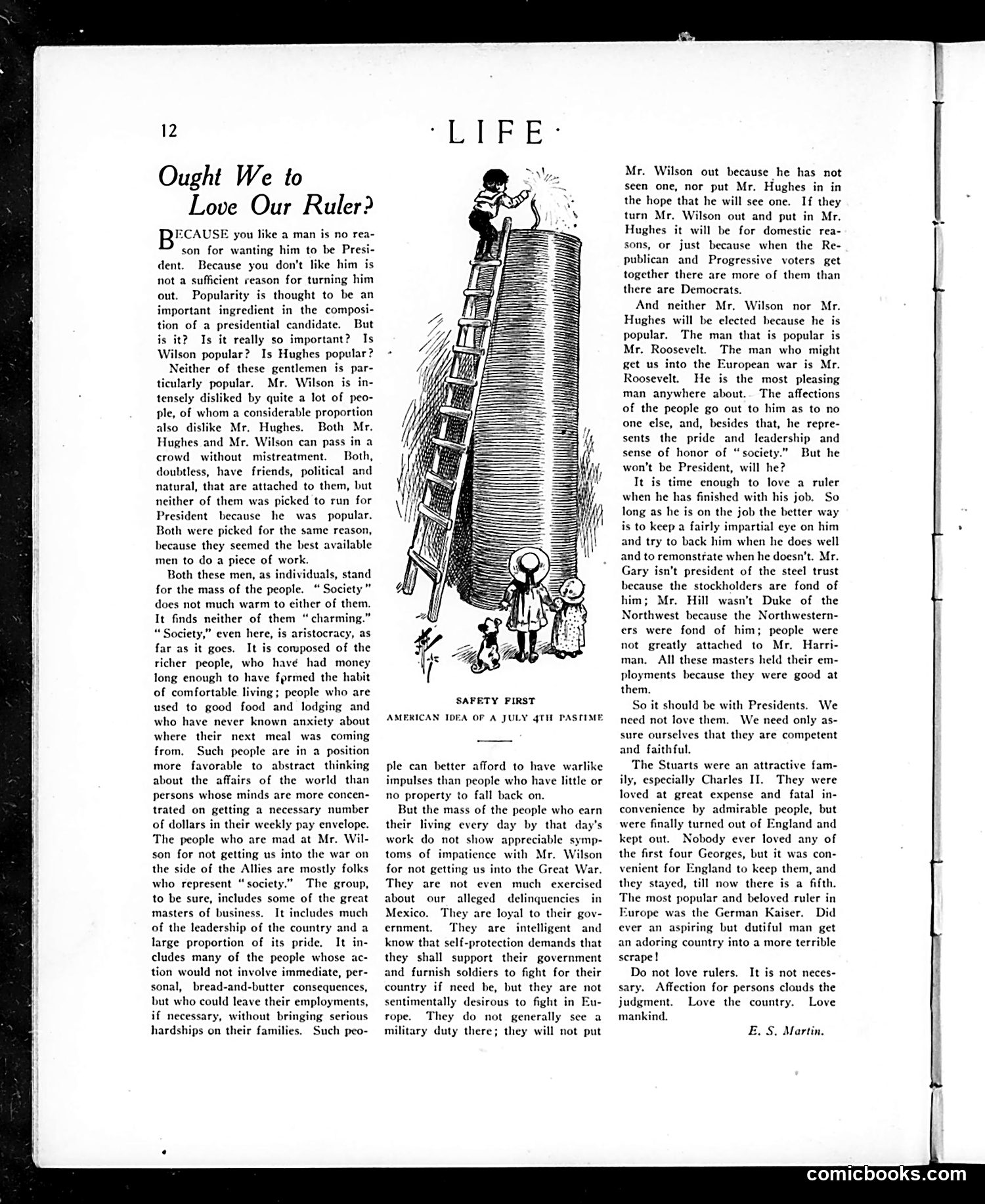
This page critiques American presidential politics, likely from the early 20th century. The cartoon "Safety First" depicts a tall, narrow structure (representing government or leadership) with a small family at its base, illustrating how ordinary citizens are dwarfed by and dependent upon their rulers. The article argues against judging leaders solely on personal popularity. It references Wilson, Hughes, and Roosevelt—suggesting this addresses the 1916 presidential election. The author contends that voters should evaluate candidates based on competence and faithfulness to duty, not affection. The piece dismisses "Society's" preference for charming personalities, arguing that solid work matters more than likability for effective governance.
📄 Transcribed text from this page (OCR, searchable)
Machine-transcribed from the original scan — historical spelling and the odd misread are preserved.
12 Ought We to Love Our Ruler? ECAUSE you like a man is no rea- son for wanting him to be Presi- dent. Because you don’t like him is not a sufficient reason for turning him out. Popularity is thought to be an important ingredient in the composi- tion of a presidential candidate. But is it? Is it really so important? Is Wilson popular? Is Hughes popular? Neither of these gentlemen is par- ticularly popular. Mr. Wilson is in- tensely disliked by quite a lot of peo- ple, of whom a considerable proportion also dislike Mr. Hughes. Both Mr. Hughes and Mr. Wilson can pass in a crowd without mistreatment. Both, doubtless, have friends, political and natural, that are attached to them, but neither of them was picked to run for President because he was popular. Both were picked for the same reason, because they seemed the best available men to do a piece of work. Both these men, as individuals, stand for the mass of the people. “ Society” does not much warm to either of them. It finds neither of them “ charming.” “ Society,” even here, is aristocracy, as far as it goes. It is composed of the richer people, who havé had money long enough to have fprmed the habit of comfortable living; people who are used to good food and lodging and who have never known anxiety about where their next meal was coming from. Such people are in a position more favorable to abstract thinking about the affairs of the world than persons whose minds are more concen- trated on getting a necessary number of dollars in their weekly pay envelope. The people who are mad at Mr. Wil- son for not getting us into the war on the side of the Allies are mostly folks who represent “society.” The group, to be sure, includes some of the great masters of business. It includes much of the leadership of the country and a large proportion of its pride. It in- cludes many of the people whose ac- tion would not involve immediate, per- sonal, bread-and-butter consequences, but who could leave their employments, if necessary, without bringing serious hardships on their families. Such peo- SAFETY FIRST AMERICAN IDEA OF A JULY 4TH PASTIME ple can better afford to have warlike impulses than people who have little or no property to fall back on. But the mass of the people who earn their living every day by that day’s work do not show appreciable symp- toms of impatience with Mr. Wilson for not getting us into the Great War. They are not even much exercised about our alleged delinquencies in Mexico. They are loyal to their gov- ernment. They are intelligent and know that self-protection demands that they shall support their government and furnish soldiers to fight for their country if need be, but they are not sentimentally desirous to fight in Eu- rope. They do not generally see a military duty there; they will not put Mr. Wilson out because he has not seen one, nor put Mr. Hughes in in the hope that he will see one. If they turn Mr. Wilson out and put in Mr. Hughes it will be for domestic rea- sons, or just because when the Re- publican and Progressive voters get together there are more of them than there are Democrats. And neither Mr, Wilson nor Mr. Hughes will be elected because he is popular. The man that is popular is Mr. Roosevelt. The man who might get us into the European war is Mr. Roosevelt. He is the most pleasing man anywhere about.. The affections of the people go out to him as to no one else, and, besides that, he repre- sents the pride and leadership and sense of honor of “society.” But he won't be President, will he? It is time enough to love a ruler when he has finished with his job. So long as he is on the job the better way is to keep a fairly impartial eye on him and try to back him when he does well and to remonstrate when he doesn’t. Mr. Gary isn’t president of the steel trust because the stockholders are fond of him; Mr. Hill wasn’t Duke of the Northwest because the Northwestern- ers were fond of him; people were not greatly attached to Mr. Harri- man. All these masters held their em- ployments because they were good at them. So it should be with Presidents. We need not love them. We need only as- sure ourselves that they are competent and faithful. The Stuarts were an attractive fam- ily, especially Charles II. They were loved at great expense and fatal in- convenience by admirable people, but were finally turned out of England and kept out. Nobody ever loved any of the first four Georges, but it was con- venient for England to keep them, and they stayed, till now there is a fifth. The most popular and beloved ruler in Europe was the German Kaiser. Did ever an aspiring but dutiful man get an adoring country into a more terrible scrape! Do not love rulers. It is not neces- sary. Affection for persons clouds the judgment. Love the country. Love mankind. E, S, Martin. comicbooks.com