
A complete issue · 41 pages · 1915
Life — December 30, 1915
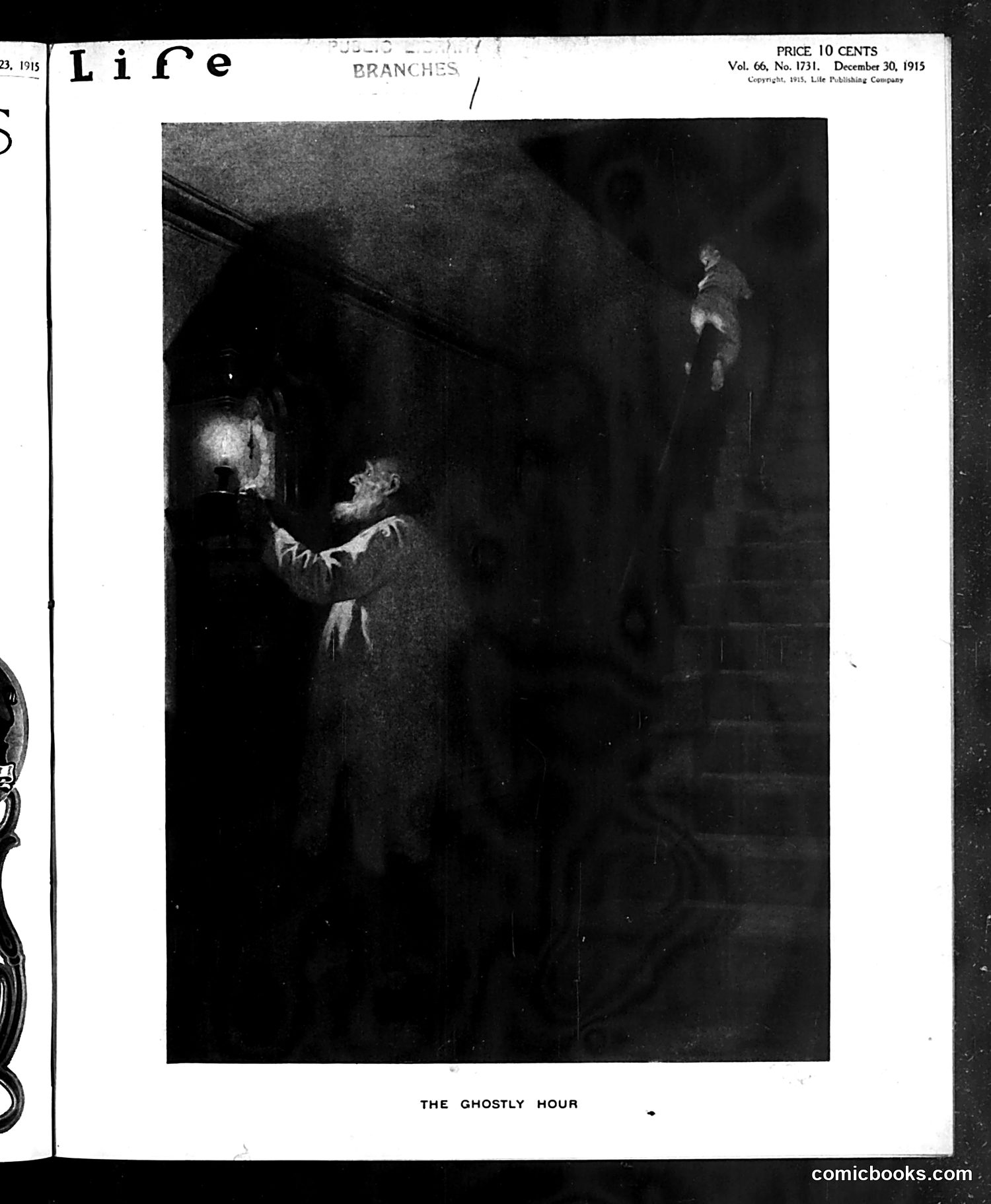
This appears to be a dramatic illustration rather than a political cartoon. The image shows a dimly lit scene with what looks like a child holding a candle or light source in a dark interior space, with another figure visible in the background. Given the title "The Ghostly Hour" and the theatrical lighting, this seems to be either: - An illustration accompanying a ghost story or supernatural tale - A scene from a stage production or film The December 30, 1915 *Life* magazine date suggests this may relate to holiday entertainment or seasonal fiction content popular during that period. Without additional text identifying the specific story or context, the precise meaning or satirical intent cannot be determined with certainty.
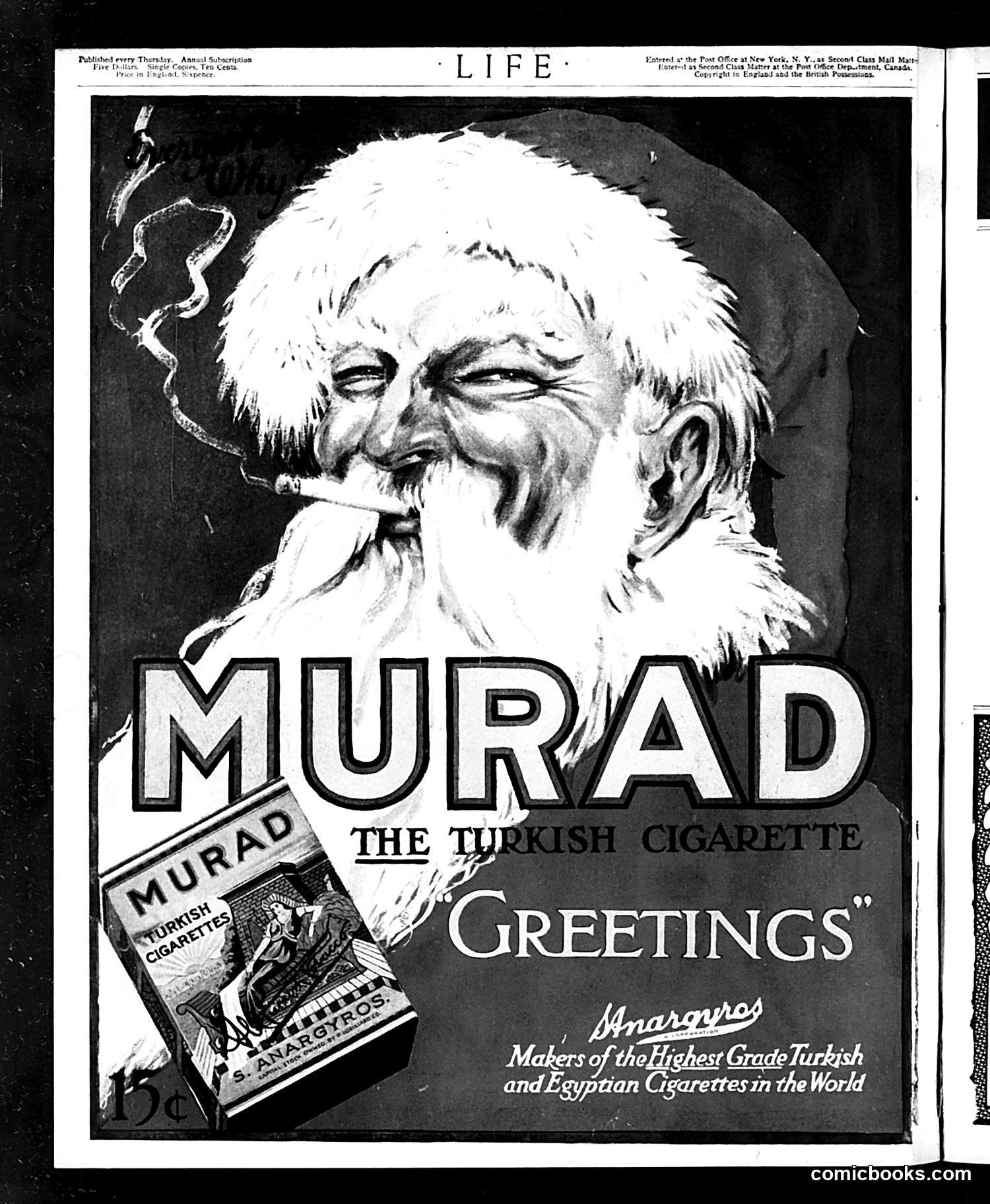
This page is primarily a **cigarette advertisement**, not political satire. It features a caricatured man with a white beard and mustache smoking a cigarette, with the text "MURAD THE TURKISH CIGARETTE" and "'GREETINGS'" below. The advertisement identifies the manufacturer as "Amargyros, Makers of the Highest Grade Turkish and Egyptian Cigarettes in the World." The bearded figure appears designed to evoke Turkish or Middle Eastern identity, playing on early 20th-century marketing that associated Turkish cigarettes with exotic appeal and quality. The "'Greetings'" suggests a personification meant to charm consumers. This reflects historical advertising practices that relied on ethnic imagery and stereotypes to sell premium products, before such approaches became socially unacceptable.
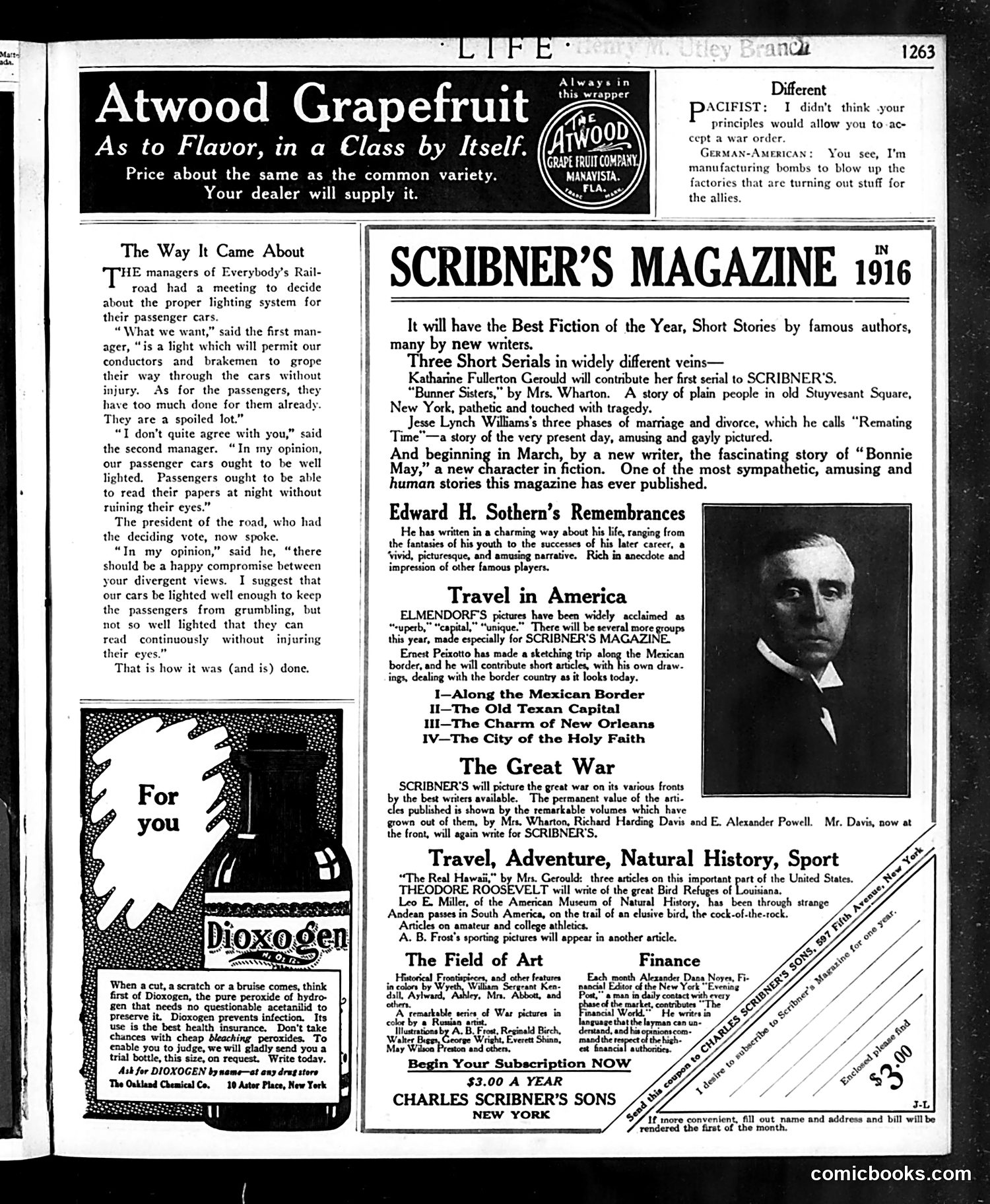
This page is primarily **advertising and editorial content** rather than political satire. The main elements include: 1. **Atwood Grapefruit ad** (top): A straightforward product advertisement. 2. **Dioxogen ad** (left): A antiseptic product marketed for cuts and bruises, with minimal satirical content. 3. **Scribner's Magazine section** (right): Announces 1916 editorial content, including fiction by established and new writers, war coverage, and travel pieces. Features a portrait of **Edward H. Southern**, likely an actor/contributor. 4. **Political content** (top right): A brief dialogue between a "Pacifist" and "German-American" discussing war orders and bomb manufacturing—this reflects WWI tensions and American debate over neutrality, but it's brief commentary rather than developed satire. The page primarily serves as **magazine promotion and product advertising** rather than satirical cartooning.
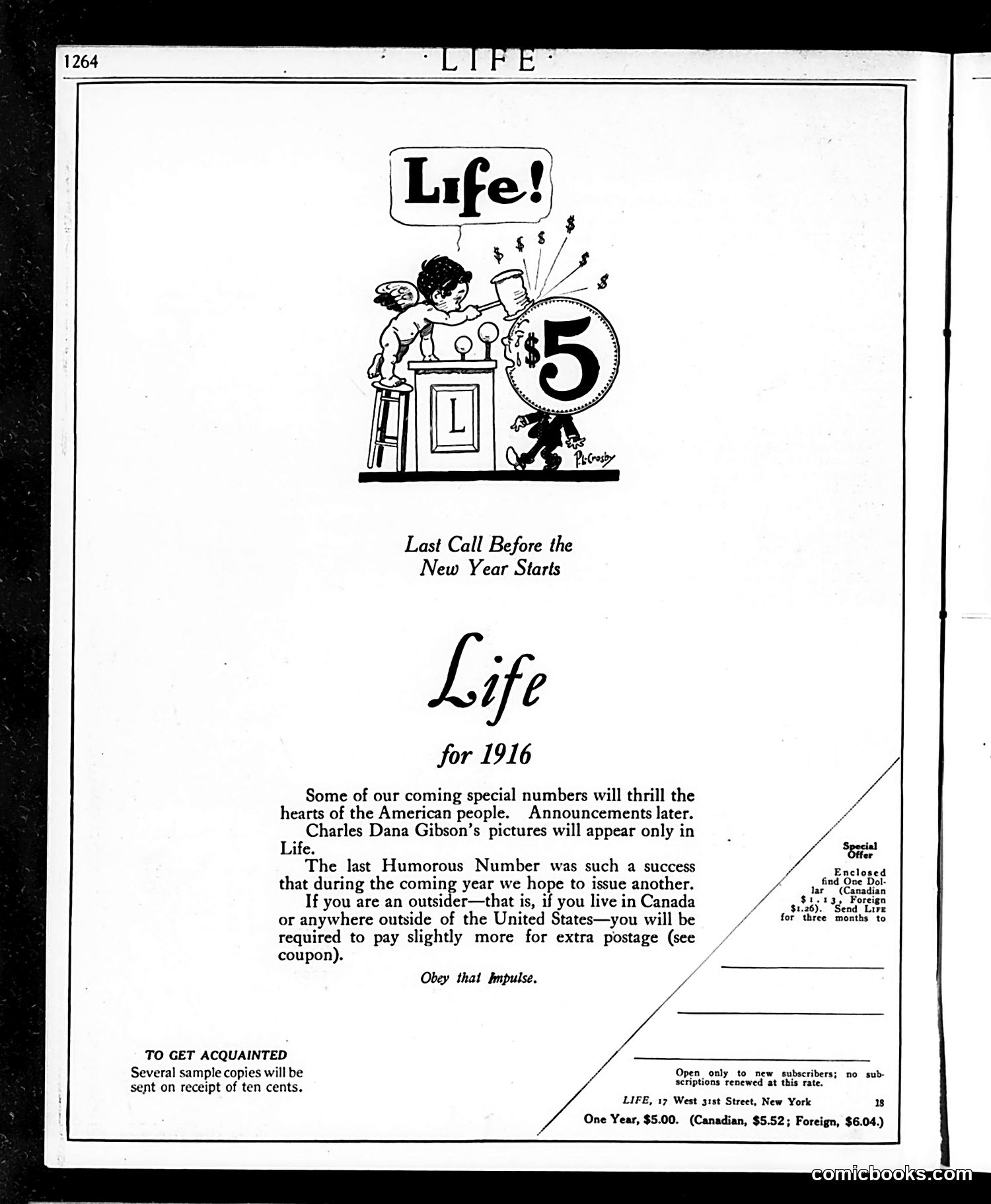
This is primarily a **subscription advertisement** for *Life* magazine's 1916 issues, rather than a political cartoon page. The illustration shows a cherub and figure operating a cash register marked "5," with dollar signs spraying out—a visual metaphor for the magazine's commercial success. The headline "Last Call Before the New Year Starts" creates urgency for subscriptions. The text promotes upcoming "special numbers" featuring Charles Dana Gibson's illustrations (Gibson was famous for his "Gibson Girl" drawings). It notes the previous "Humorous Number" sold well and promises another. The ad includes subscription rates ($5 annually in the U.S., $5.52 in Canada, $6.04 foreign) and mentions sample copies available for ten cents. This represents standard magazine promotion of the era, not satirical content.
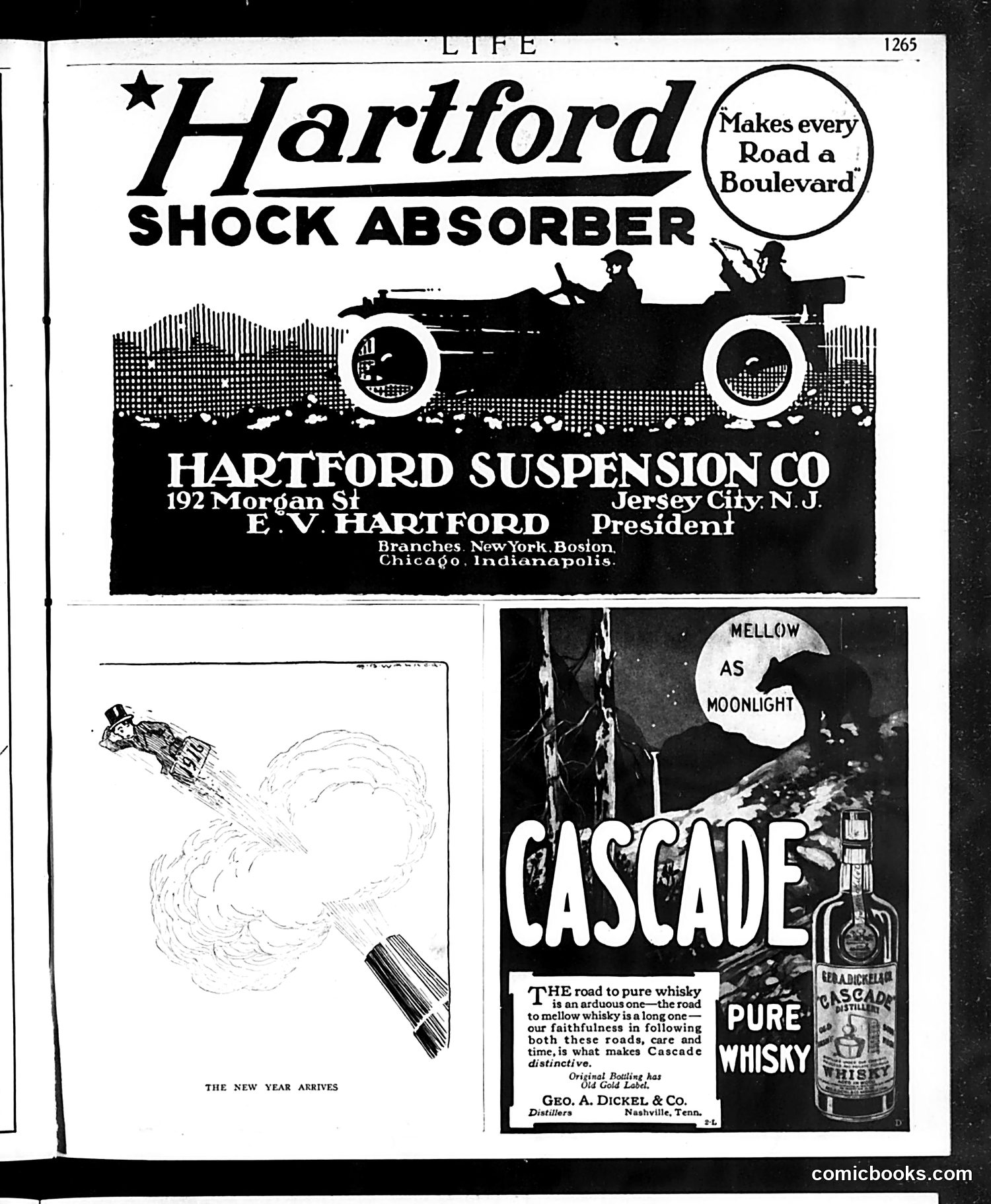
This page is primarily **advertising**, not political satire or comics. The top advertisement promotes the Hartford Shock Absorber, made by Hartford Suspension Co. (Jersey City, NJ), with the slogan "Makes every Road a Boulevard." The illustration shows a car traveling smoothly over bumpy terrain. Below that is an illustration titled "THE NEW YEAR ARRIVES," depicting a figure being propelled upward by what appears to be a spring or coil—a visual metaphor for the new year's energetic arrival. The bottom advertisement promotes Cascade Pure Whisky, made by Geo. A. Dickel & Co. (Nashville, Tenn.), describing the "road to pure whisky" as requiring care and time. All three elements use visual metaphors about roads and smooth travel, likely intentionally coordinated within this magazine page.
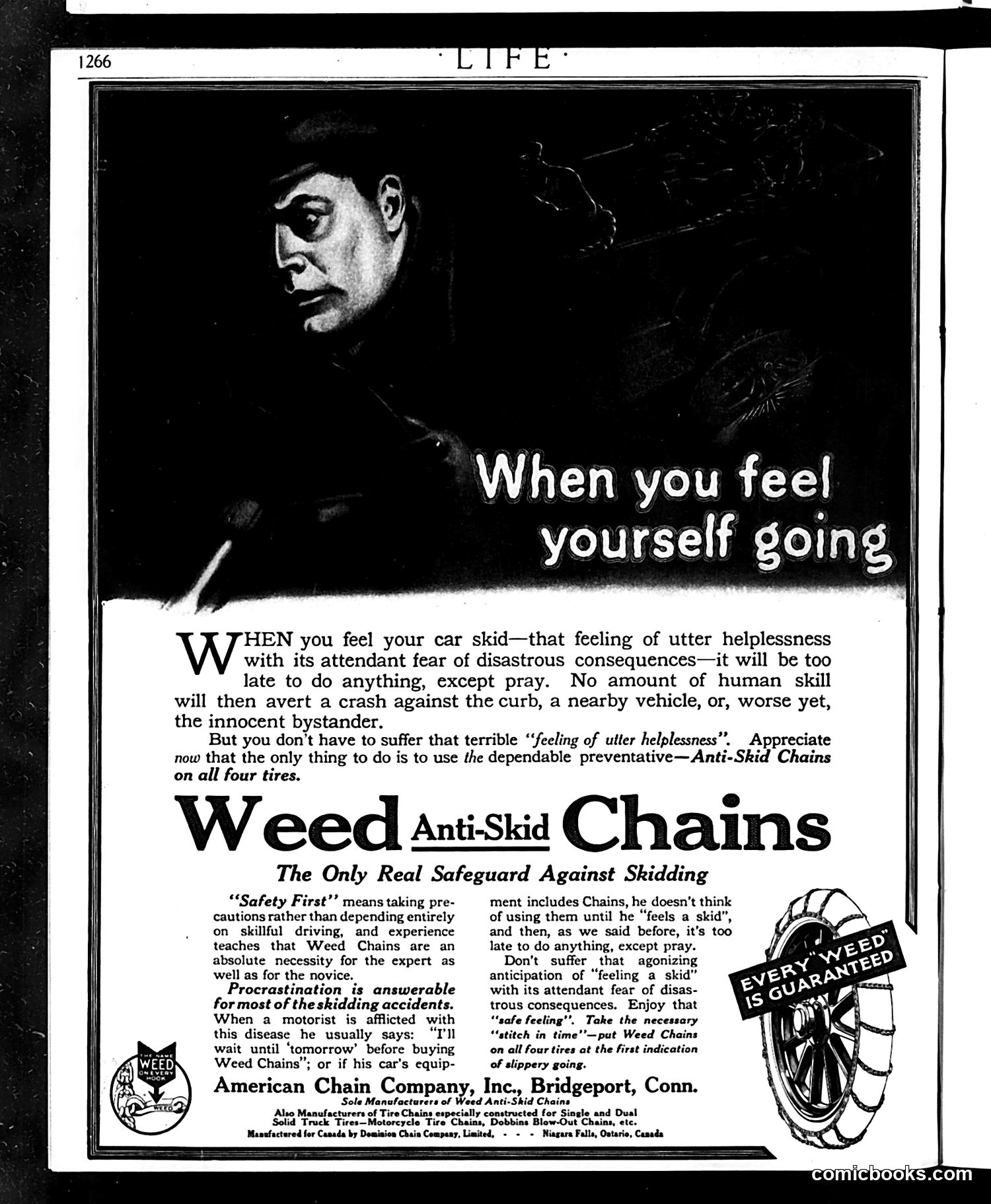
This is primarily **product advertising**, not political satire. It's a Weed Anti-Skid Chains advertisement from *Life* magazine (page 1266). The image shows a distressed driver's face in profile, illustrating the psychological anxiety of losing traction on icy roads. The ad's appeal is emotional rather than humorous—it emphasizes the "feeling of utter helplessness" when a car skids. The text argues that anti-skid chains are "the only real safeguard against skidding" and criticizes drivers who procrastinate installing them until conditions become dangerous. The ad positions chains as essential winter safety equipment. This reflects early automotive safety concerns and the practical challenges of winter driving before modern tire technology. The manufacturer is American Chain Company of Bridgeport, Connecticut.
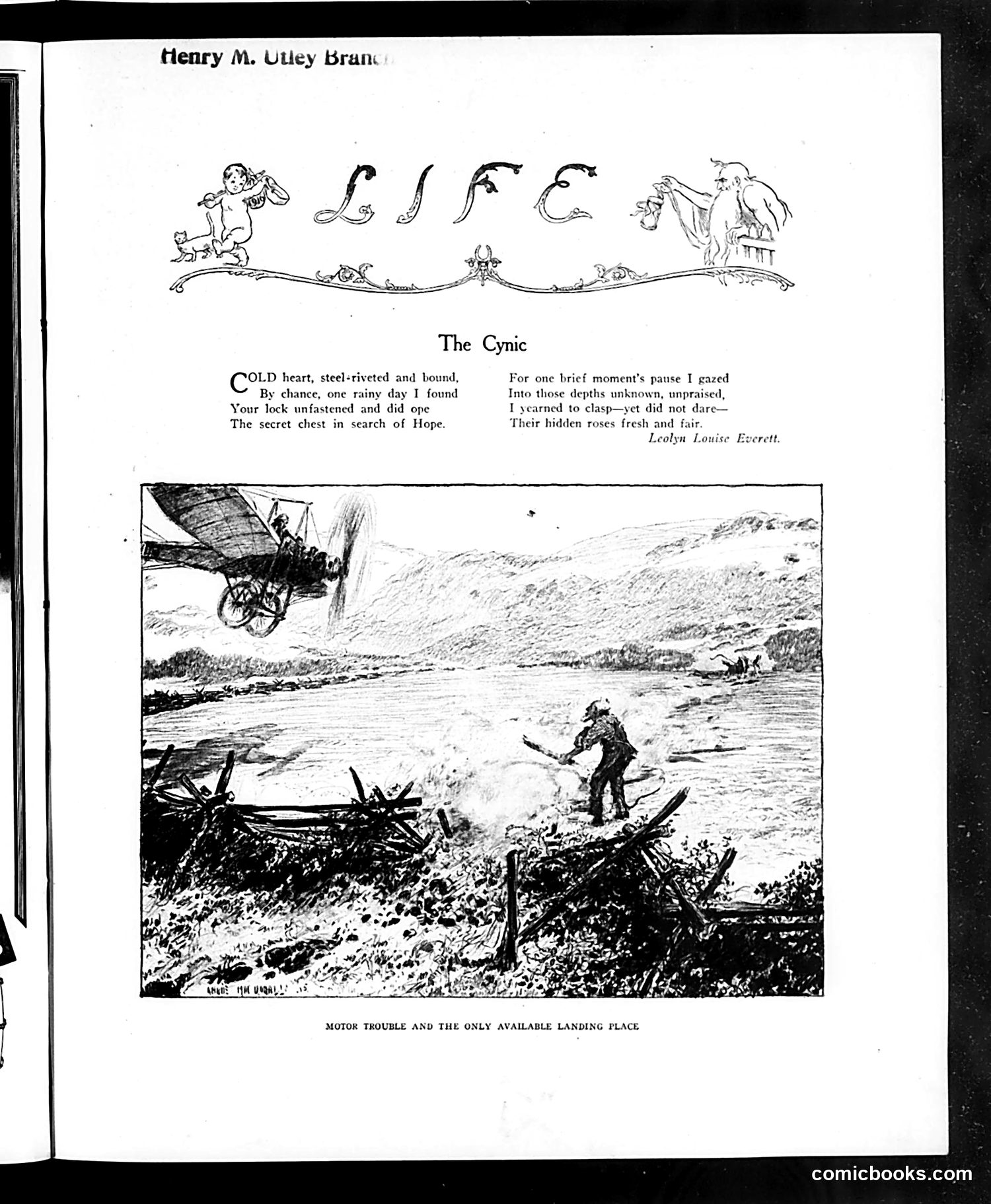
This page presents a poem titled "The Cynic" attributed to Leelyn Louise Everett, paired with an illustration showing a crashed airplane near a river with mountainous terrain. The poem's text describes encountering someone with a "cold heart, steel-riveted and bound" and searching their "secret chest in search of Hope"—only to discover beautiful hidden roses they'd refused to acknowledge. The illustration's caption reads "MOTOR TROUBLE AND THE ONLY AVAILABLE LANDING PLACE," depicting an emergency aircraft landing in wilderness, suggesting a forced confrontation with nature and reality. Together, the page appears to present a romantic or philosophical allegory: the cynic must abandon their mechanical worldview and confront raw, natural truth—the "hidden roses" representing beauty and hope they've intellectually denied.
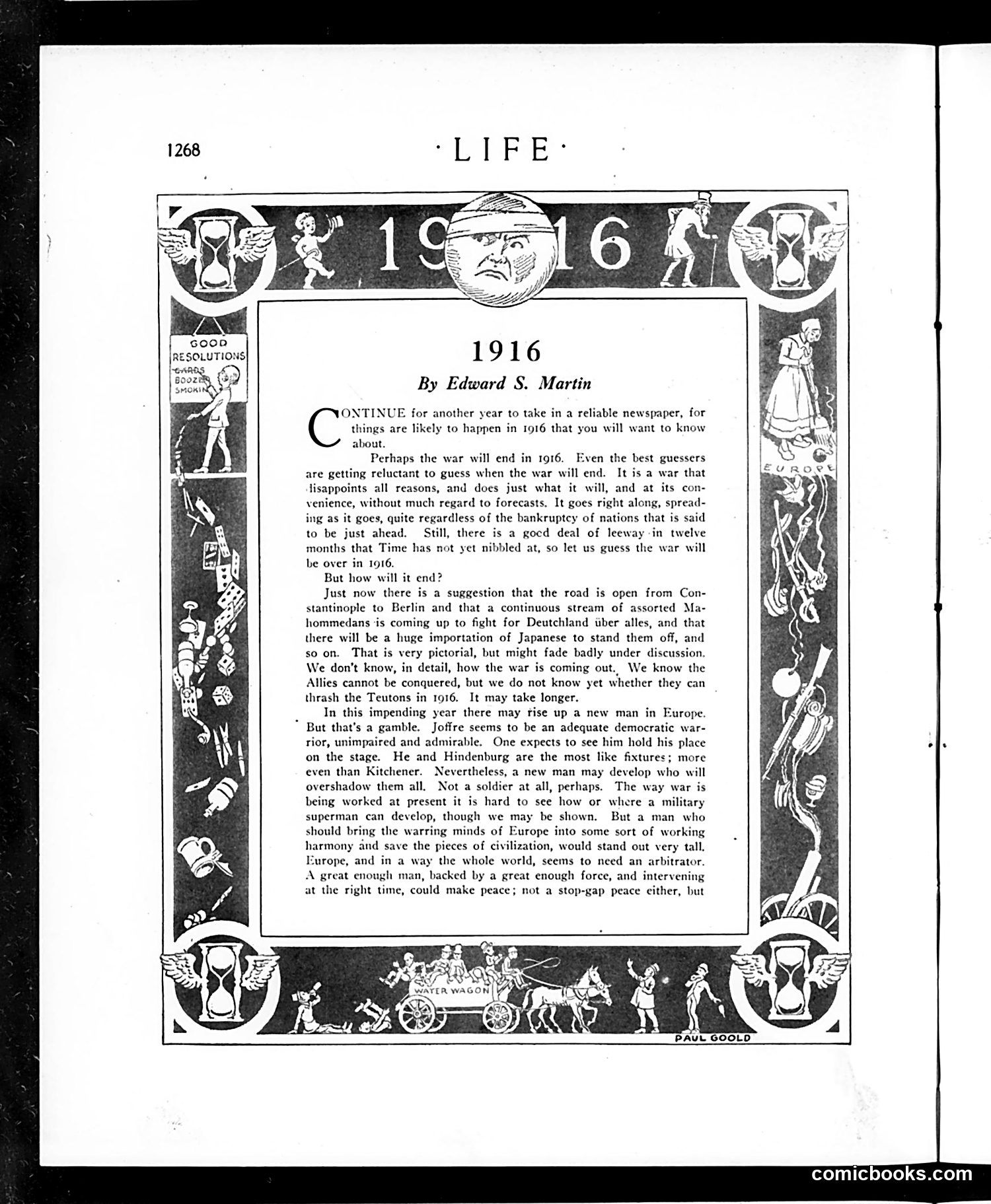
This article predicts the war (WWI) might end in 1916, though Martin expresses skepticism. He discusses potential military developments—mentioning the "road from Constantinople to Berlin," Japanese intervention, and figures like Joffre, Hindenburg, and Kitchener as current military leaders. Martin suggests a "new man" might emerge in Europe—someone capable of bringing warring nations into "working harmony" and achieving peace rather than a temporary truce. He implies current military leaders cannot accomplish this; Europe needs an "arbitrator" with sufficient power and backing. The decorative border features classical allegorical imagery (hourglasses, cherubs) suggesting themes of time and fate—reinforcing the article's speculation about war's duration and resolution.
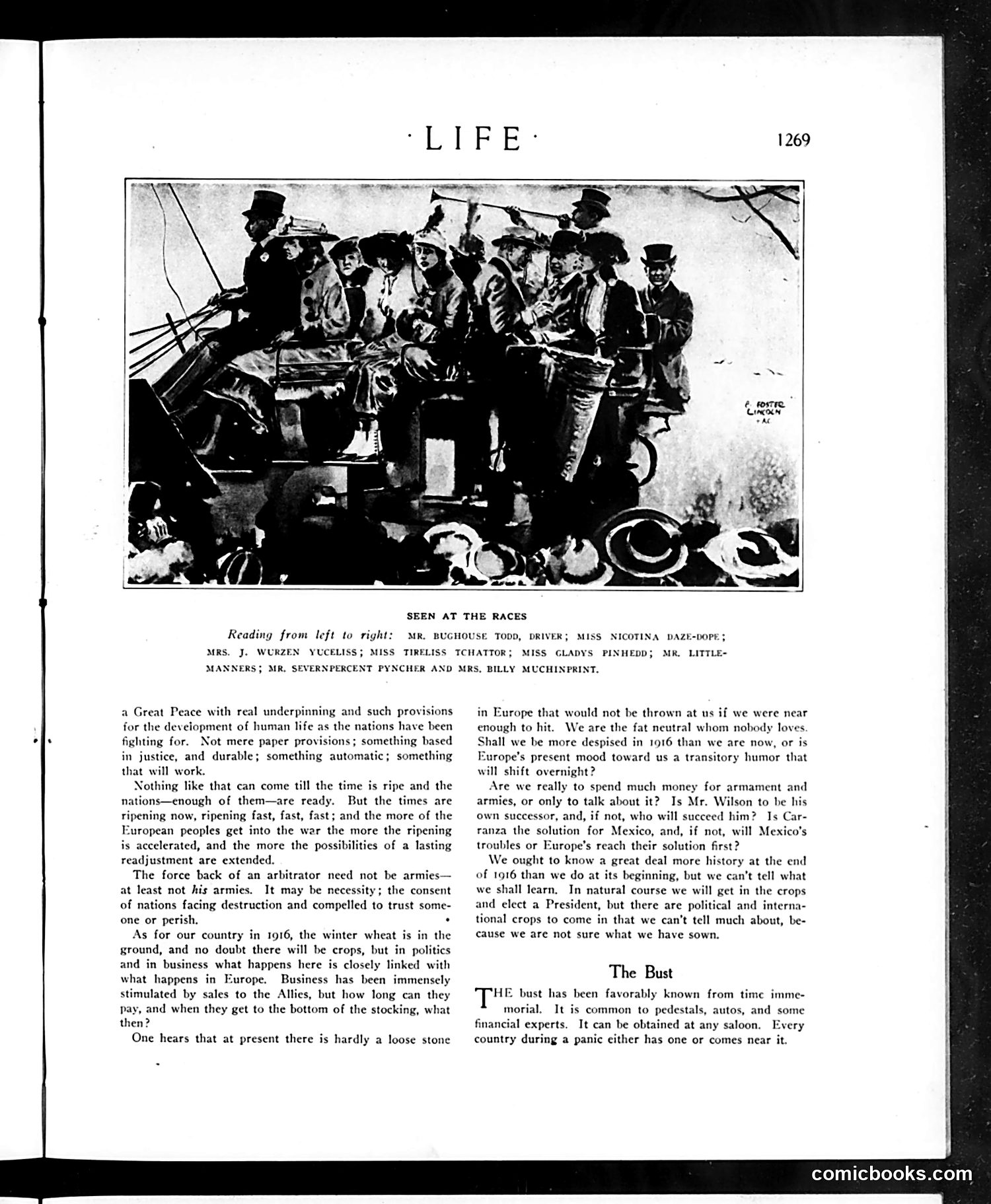
This illustration shows a group of well-dressed people gathered on what appears to be a viewing platform at a horse racing venue. The caption identifies specific individuals by name, including "Mr. Bughouse Todd, driver" and several women with unusual names like "Miss Tireless Tchattor" and "Miss Gladys Pinhead." The humor lies in the satirical naming: these absurdist character names mock the pretentious social scene at the races. Rather than depicting actual recognizable figures, Life's cartoonist created fictional but ridiculous personas to ridicule the frivolous, overdressed society crowd attending such events. The exaggerated formal dress and the silly nomenclature together suggest mockery of upper-class leisure culture during the World War I era (1916, based on page numbering).
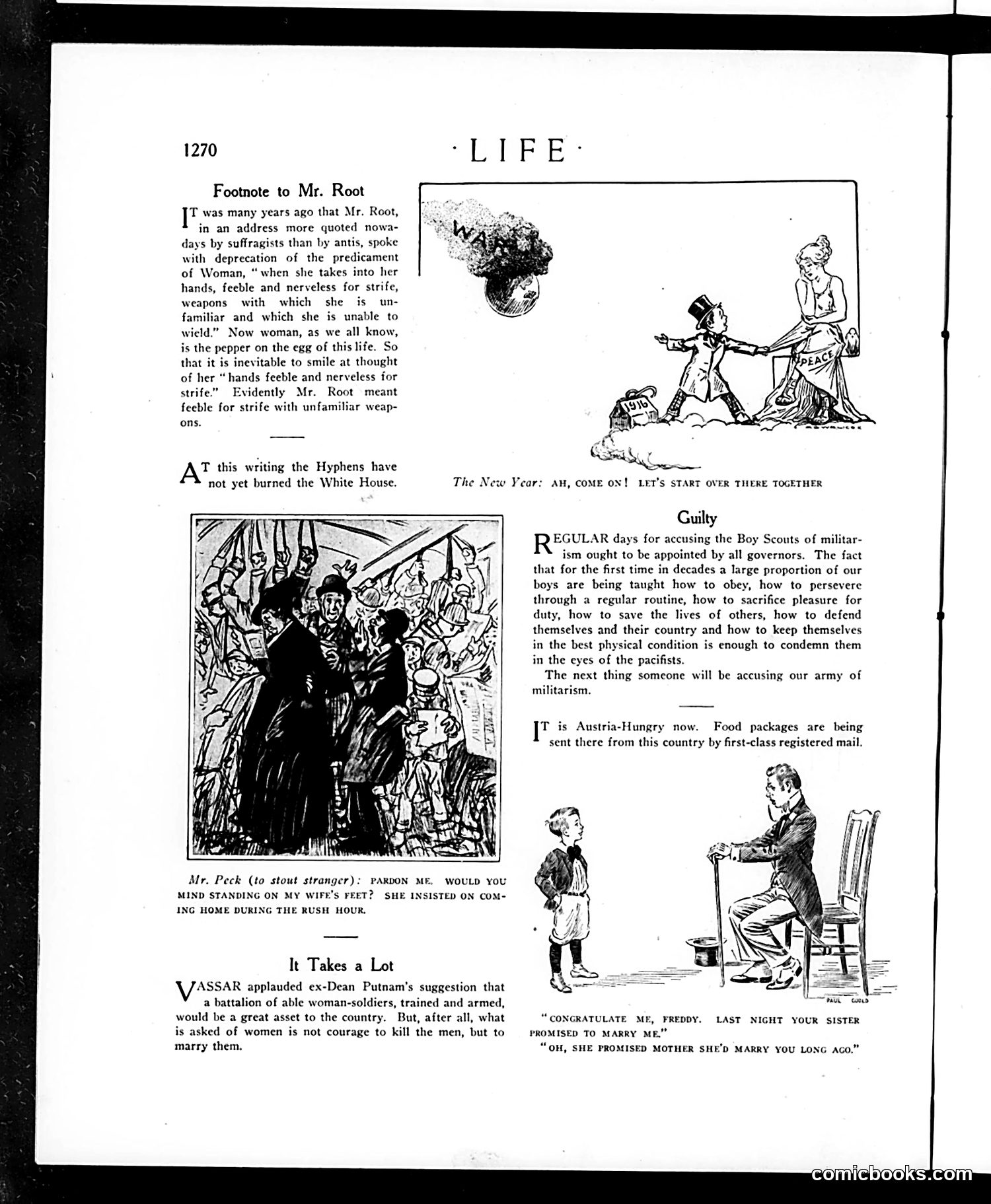
This page contains several WWI-era satirical pieces: **"Footnote to Mr. Root"** mocks suffragists' claims about women's weakness, sarcastically suggesting women lack "nerve" for combat—an anti-suffrage argument. **"The New Year"** shows a child starting fresh, referencing New Year's resolutions. **"Guilty"** defends Boy Scouts and the military against pacifist criticism, asserting their training in duty and sacrifice is justified. It notes Austria-Hungary is now at war and food packages are being sent there. **"It Takes a Lot"** discusses Vassar's suggestion for a women's military battalion, concluding women's true patriotic duty is marrying soldiers rather than fighting themselves. The overall tone is pro-military and skeptical of pacifism during wartime.
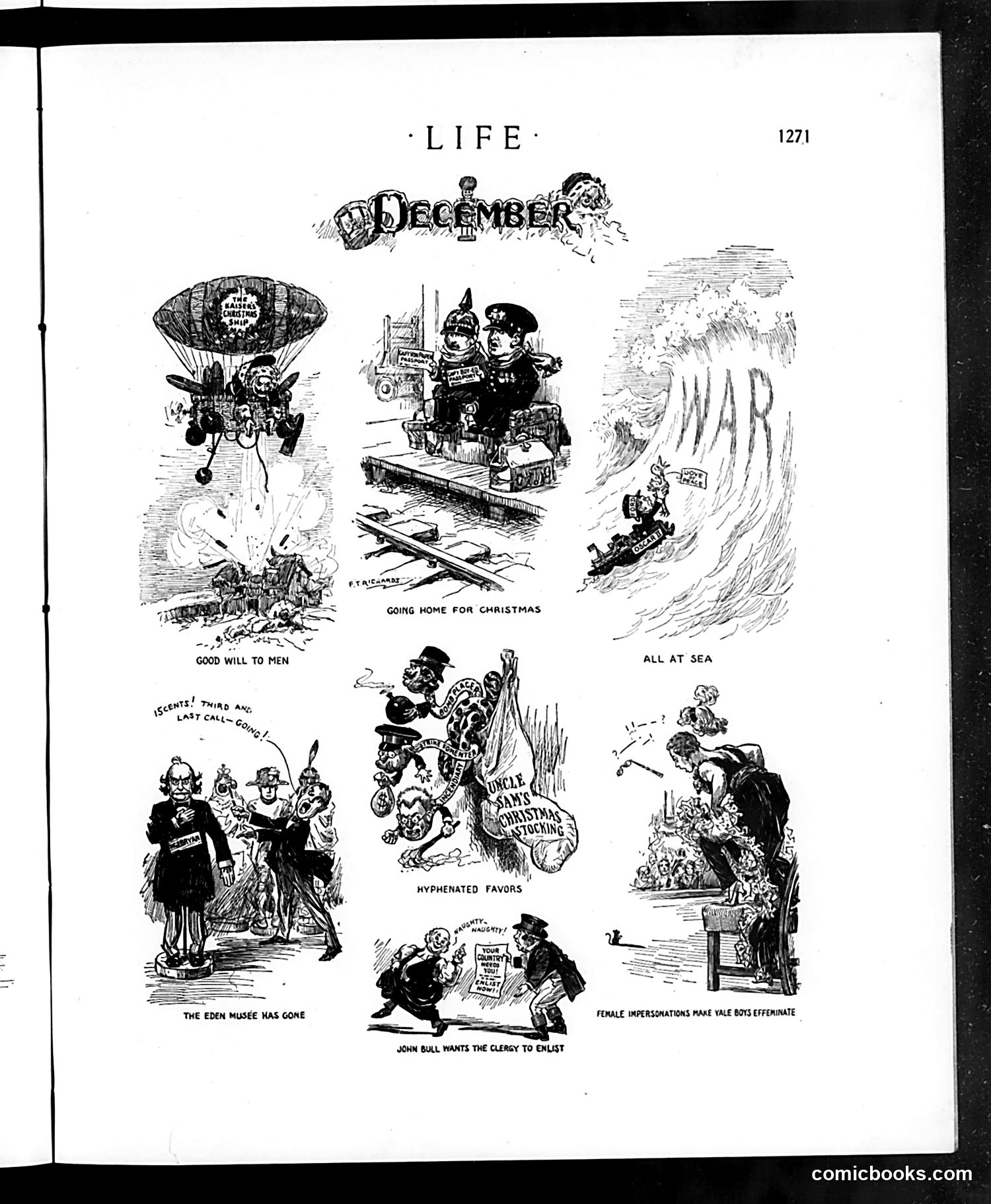
This December page from *Life* magazine contains eight political cartoons satirizing events and figures from what appears to be the early 20th century. The cartoons mock various subjects: "Good Will to Men" depicts an airship dropping bombs; "Going Home for Christmas" shows two figures with mechanical toys; "All at Sea" illustrates naval warfare; "The Eden Musee Has Gone" references a wax museum; "Hyphenated Favors" appears to criticize immigrants or dual loyalties; "John Bull Wants the Clergy to Enlist" depicts British recruitment pressures; and "Female Impersonations Make Yale Boys Effeminate" expresses contemporary anxieties about gender and masculinity. The cartoons collectively reflect wartime concerns, military recruitment, technological change, and social anxieties typical of the WWI era, using caricature and dark humor to comment on contemporary politics and culture.
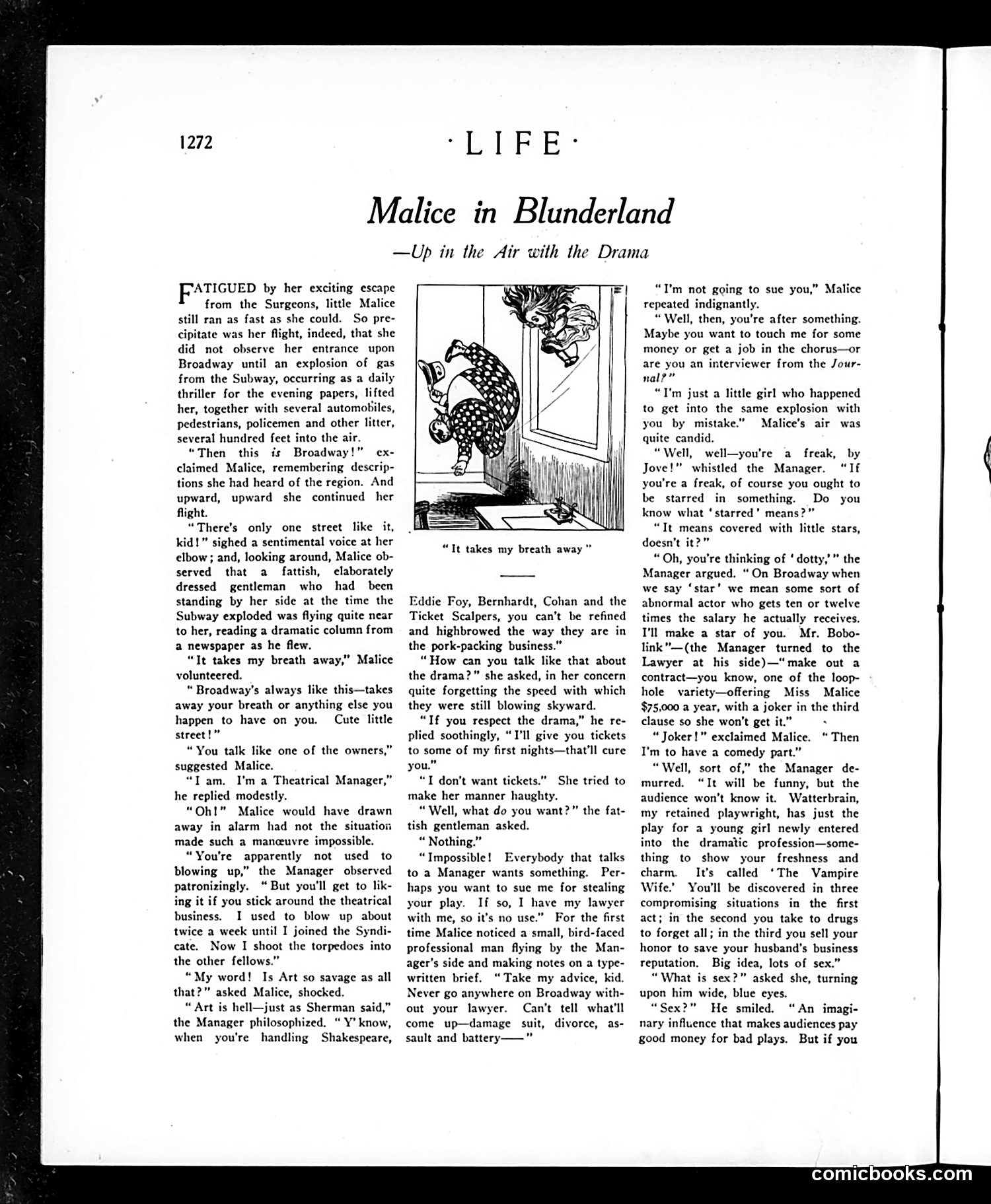
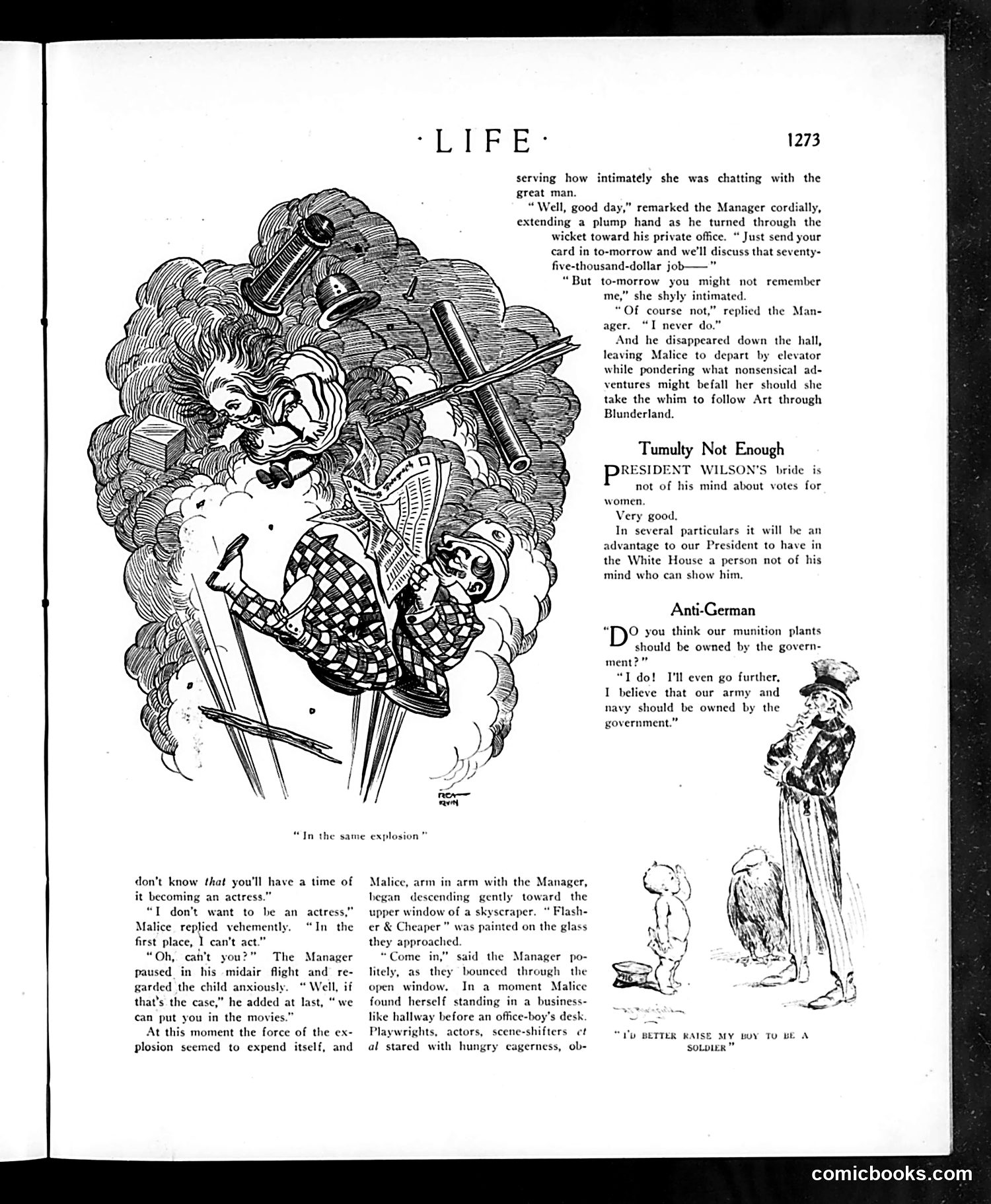
This is a satirical story about a girl named Malice who survives a Broadway subway explosion and gets swept up in theatrical chaos. The illustration shows her being literally blown upward by the blast. The satire targets **early 20th-century Broadway culture**: theatrical managers obsessed with sensationalism, ticket scalpers, and the commodification of actors. The humor lies in how everyone immediately tries to exploit Malice's misfortune—the manager wants her as a "freak" actress, lawyers circle for lawsuits, and industry people see only profit potential. The title parodies Lewis Carroll's "Alice in Wonderland," suggesting that Broadway's theatrical world is as absurd and chaotic as Carroll's fantasy realm. The satire critiques show-business ruthlessness and the devaluation of human experience for entertainment profit.
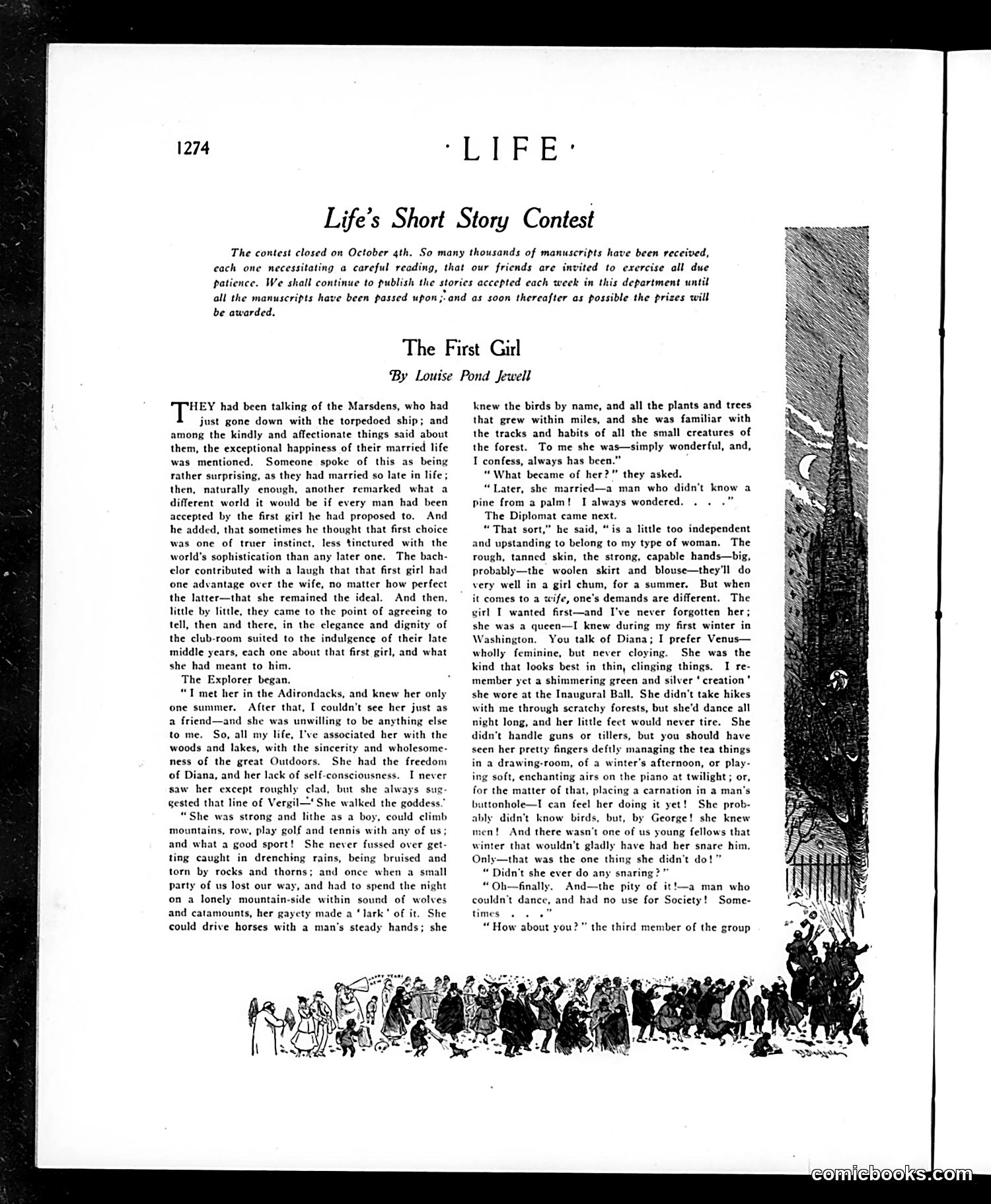
This page from *Life* magazine features "The First Girl," a short story by Louise Pond Jewell that won their Short Story Contest (closed October 4th). The page contains the story's text and accompanying illustrations. The narrative describes three men discussing an exceptional woman—"the first girl"—they knew. She's characterized as remarkably independent, athletic, and unconventional: skilled at outdoor activities, comfortable in "scratchy forests," yet also elegant and cultured. The story contrasts her with society's typical expectations of femininity, celebrating her as someone who transcends traditional gender roles while remaining refined. The bottom illustration shows a diverse crowd of people, likely representing *Life*'s readership or society broadly. This appears to be straightforward literary content rather than political satire.
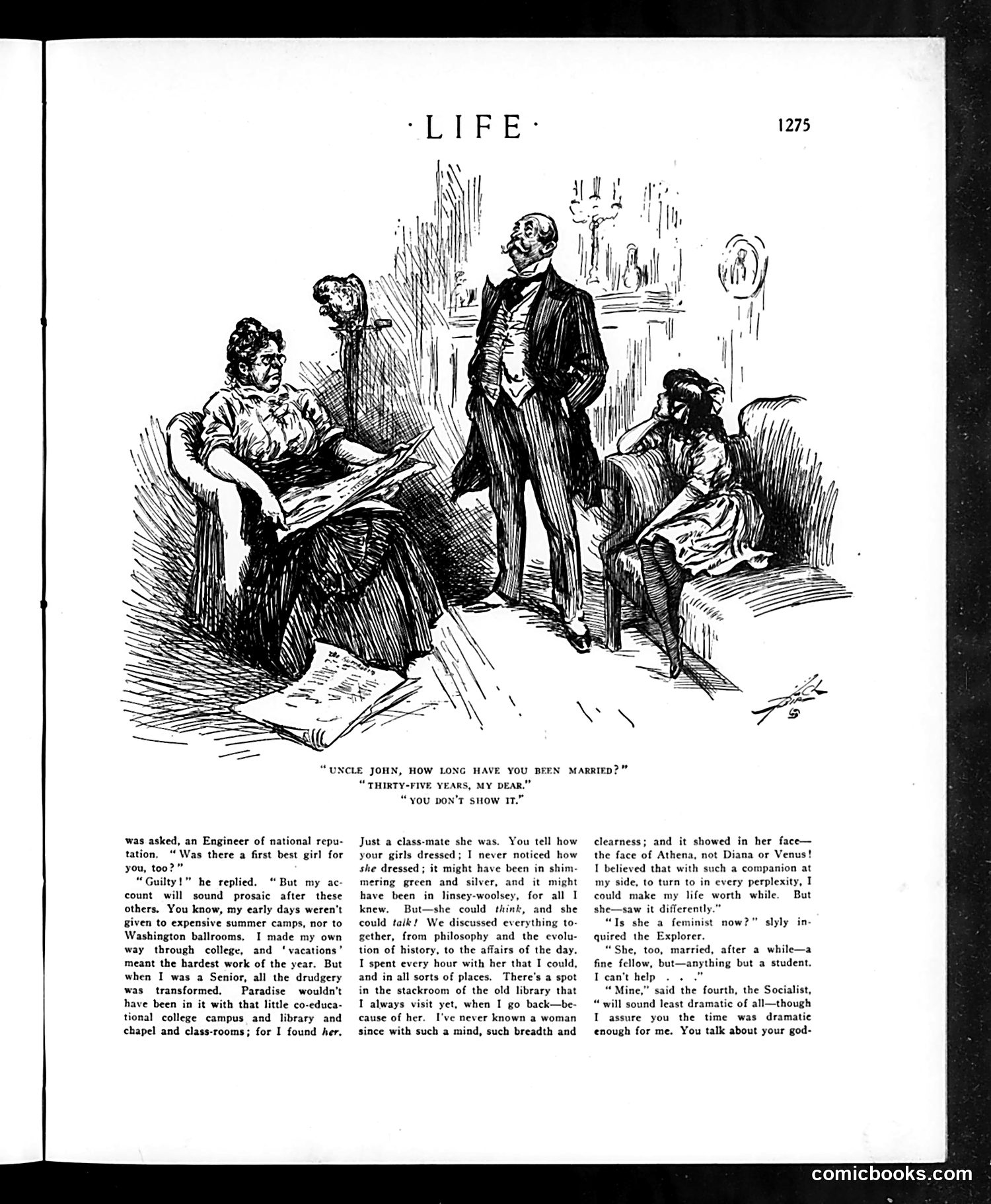
This illustration depicts a social scene where an older man (Uncle John) is being questioned about his 35-year marriage. The scene satirizes attitudes toward marriage and women's roles in what appears to be late 19th or early 20th-century America. The dialogue and surrounding text mock both the questioner's assumptions and the respondent's complacency. A key point of satire emerges in the discussion of a woman's education and independence—the narrator describes his former classmate as remarkably intelligent and well-read, yet expresses surprise she "married" at all, suggesting educated women were expected to remain unmarried. The piece critiques social hypocrisy: how society simultaneously valued women's education while assuming marriage was their inevitable fate, and how men underestimated women's intellectual capabilities.
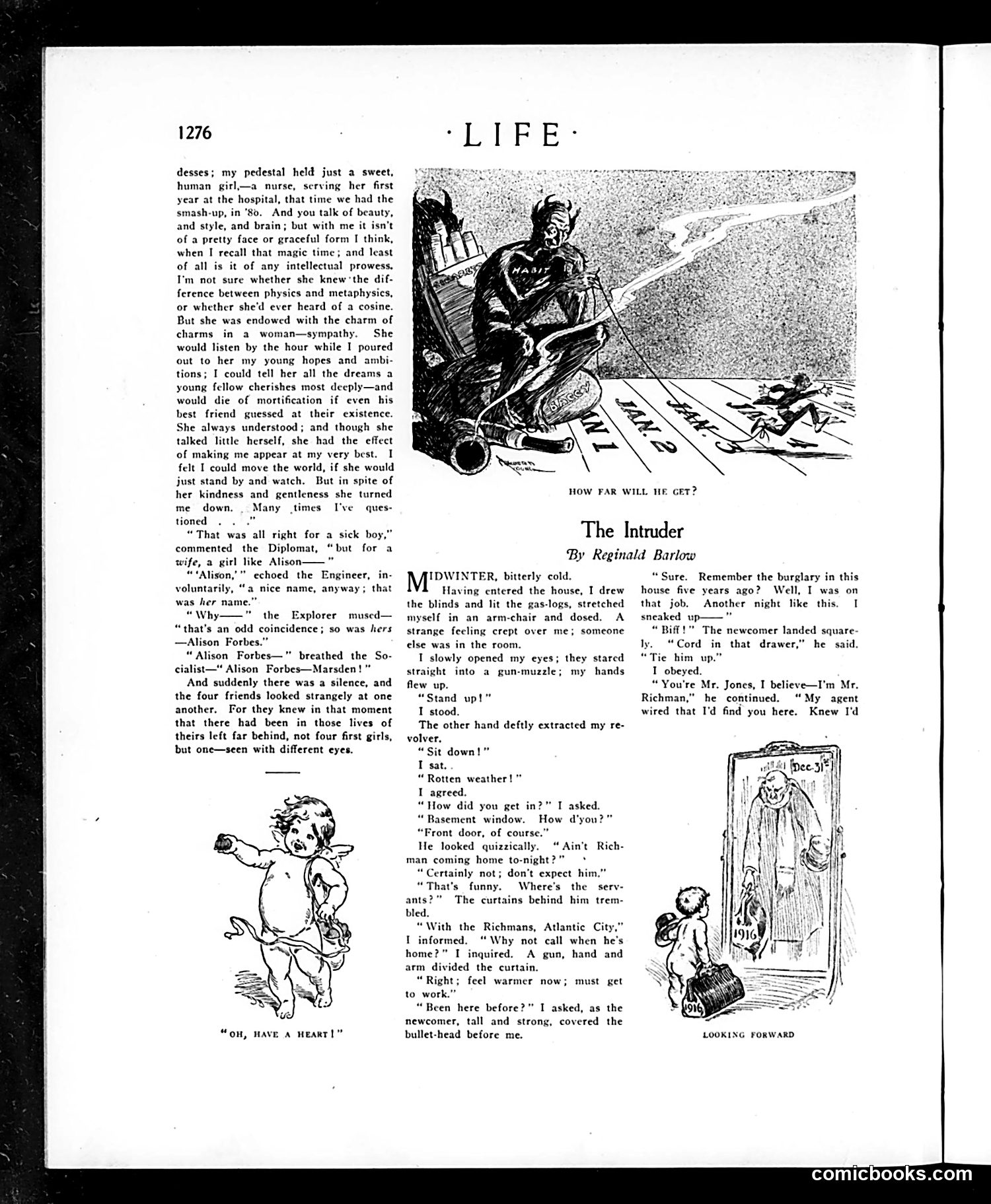
This page contains two separate fictional narratives: **"The Intruder"** (main story): A burglary tale where a homeowner is confronted by an intruder with a gun. The twist appears to be that a *second* armed figure (the actual homeowner, Mr. Richman) intervenes, subduing the burglar. The narrative plays with expectations—the reader initially believes the armed man is a criminal, only to discover he's the house's owner who anticipated the break-in. **Upper narrative (untitled)**: A sentimental story about four men who each loved a woman named "Alison Forbes" in their youth, discovering through coincidence they all cherished the same girl—"seen with different eyes." This emphasizes how the same person can mean different things to different people. The illustrations support these plots: one shows an armed figure breaking in; another depicts a child and an open doorway labeled "Looking Forward," symbolizing future uncertainty or new beginnings. Both stories explore themes of surprise revelation and hidden connections.
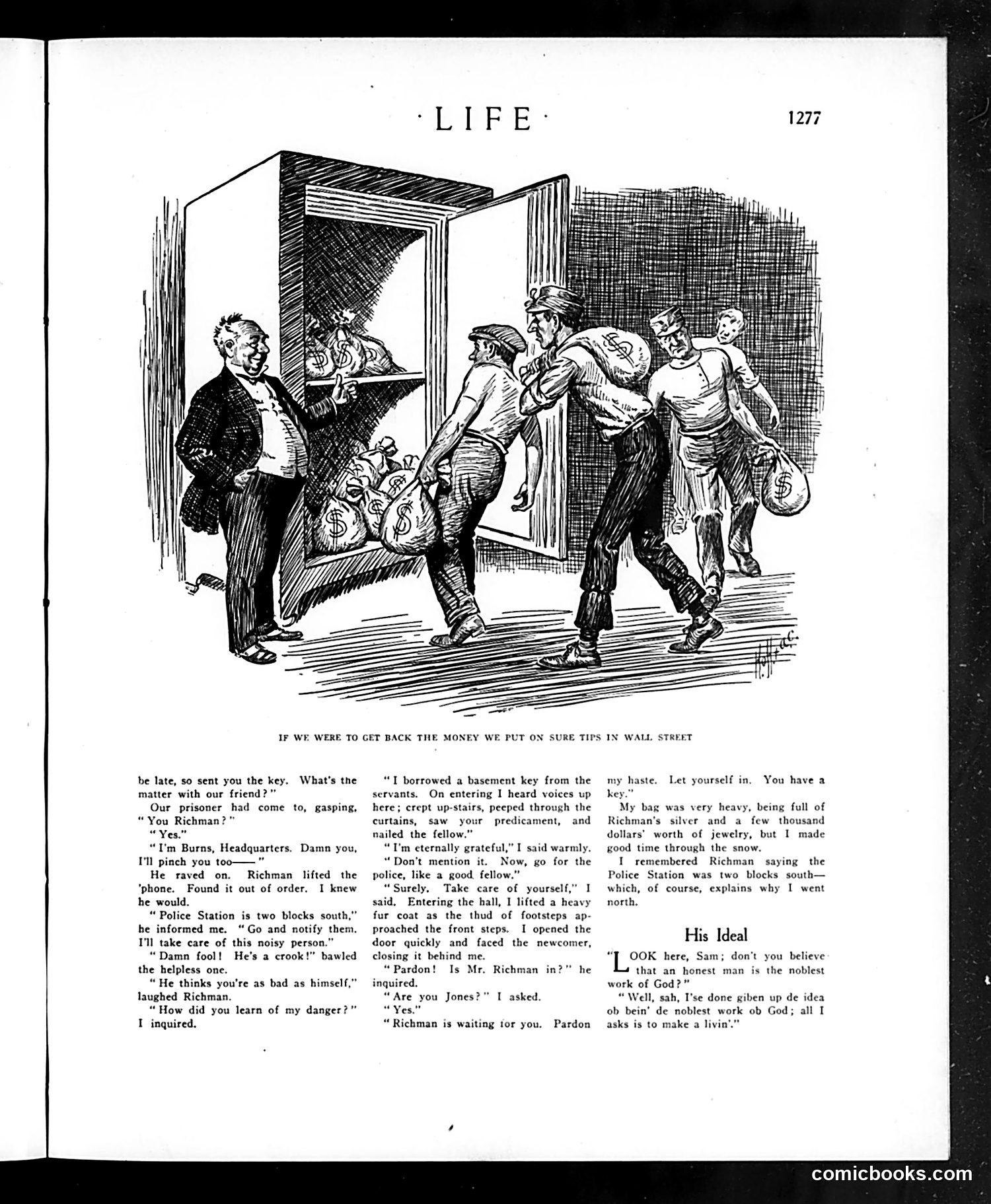
This page contains two separate pieces of satirical content: **The Top Cartoon:** Shows a well-dressed man (representing Wall Street/wealthy financiers) receiving money bags from working-class men depicted as laborers or "sure-thing" gamblers. The caption mocks the futility of average people betting on stock tips: "If we were to get back the money we put on sure tips in Wall Street" — satirizing how ordinary citizens lose their savings following Wall Street advice. **The Bottom Story:** A narrative about a burglar who steals from a wealthy man named Richman. The satire appears in the final section titled "His Ideal," where a Black character (rendered in period dialect) rejects the notion of being "the noblest work of God" as an honest man, saying he'd settle for simply making a living. This critiques the era's romantic idealization of honest labor while acknowledging economic desperation. Both pieces reflect early-1900s concerns about wealth inequality, financial exploitation, and class struggle.
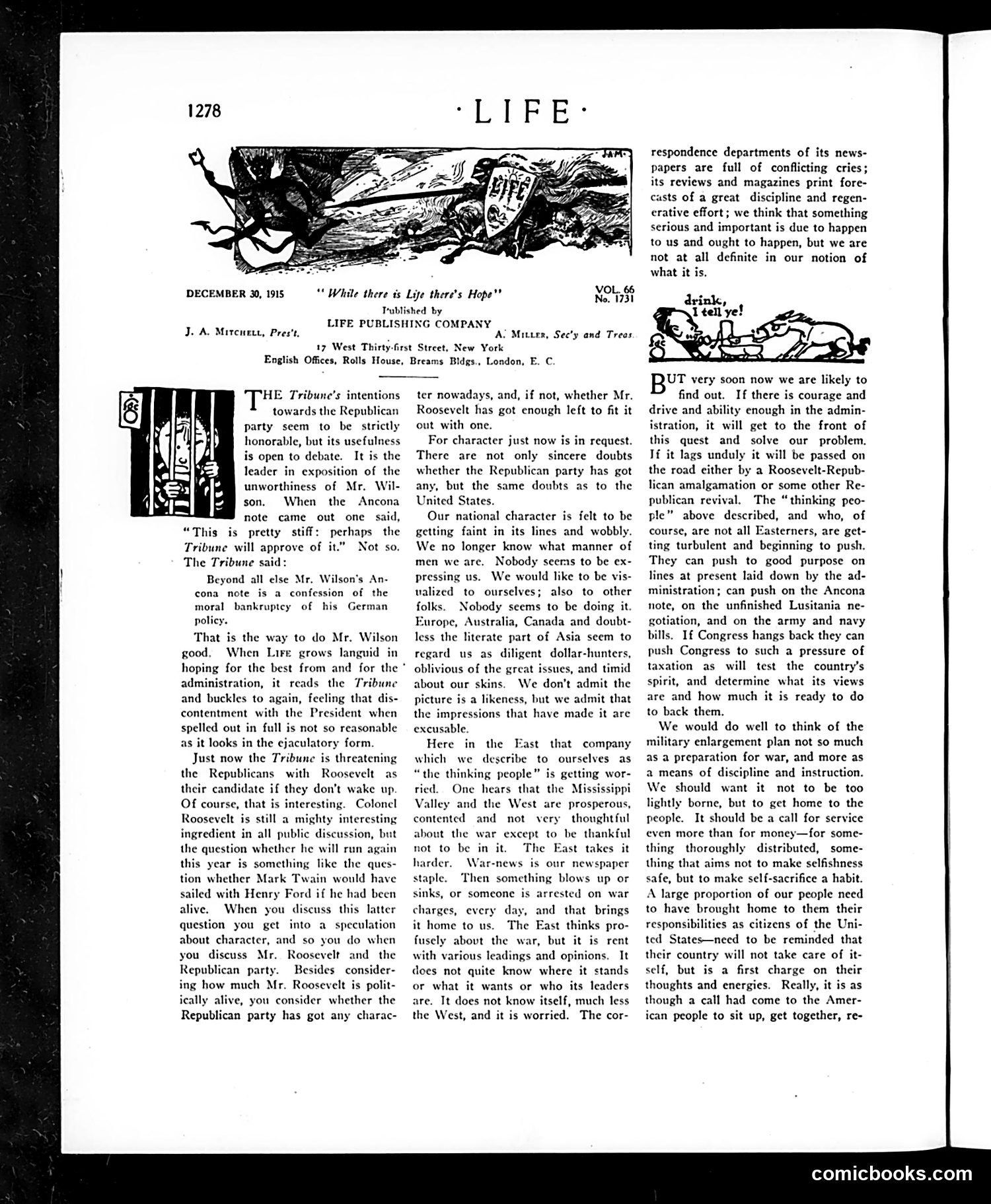
This page critiques American national character during World War I. The main cartoon (top) depicts a sinking ship labeled with classical imagery, representing America's moral and political drift. The accompanying editorial discusses the **Tribune newspaper's** criticism of President Wilson's foreign policy, particularly his response to the *Ancona* (an Italian ship sunk by Germans). Life praises the Tribune for holding Wilson accountable while questioning whether the Republican Party has "character" to field a strong alternative—possibly **Theodore Roosevelt**. The core satire: America is perceived internationally as money-obsessed and morally weak. The East Coast intelligentsia feel anxiety about the war; the prosperous Midwest remains indifferent. Life argues Americans have lost self-knowledge and national purpose. The piece suggests military preparedness and national discipline could restore American character. This reflects pre-1917 American debate over neutrality, preparedness, and whether the nation had coherent values beyond commercial interests.
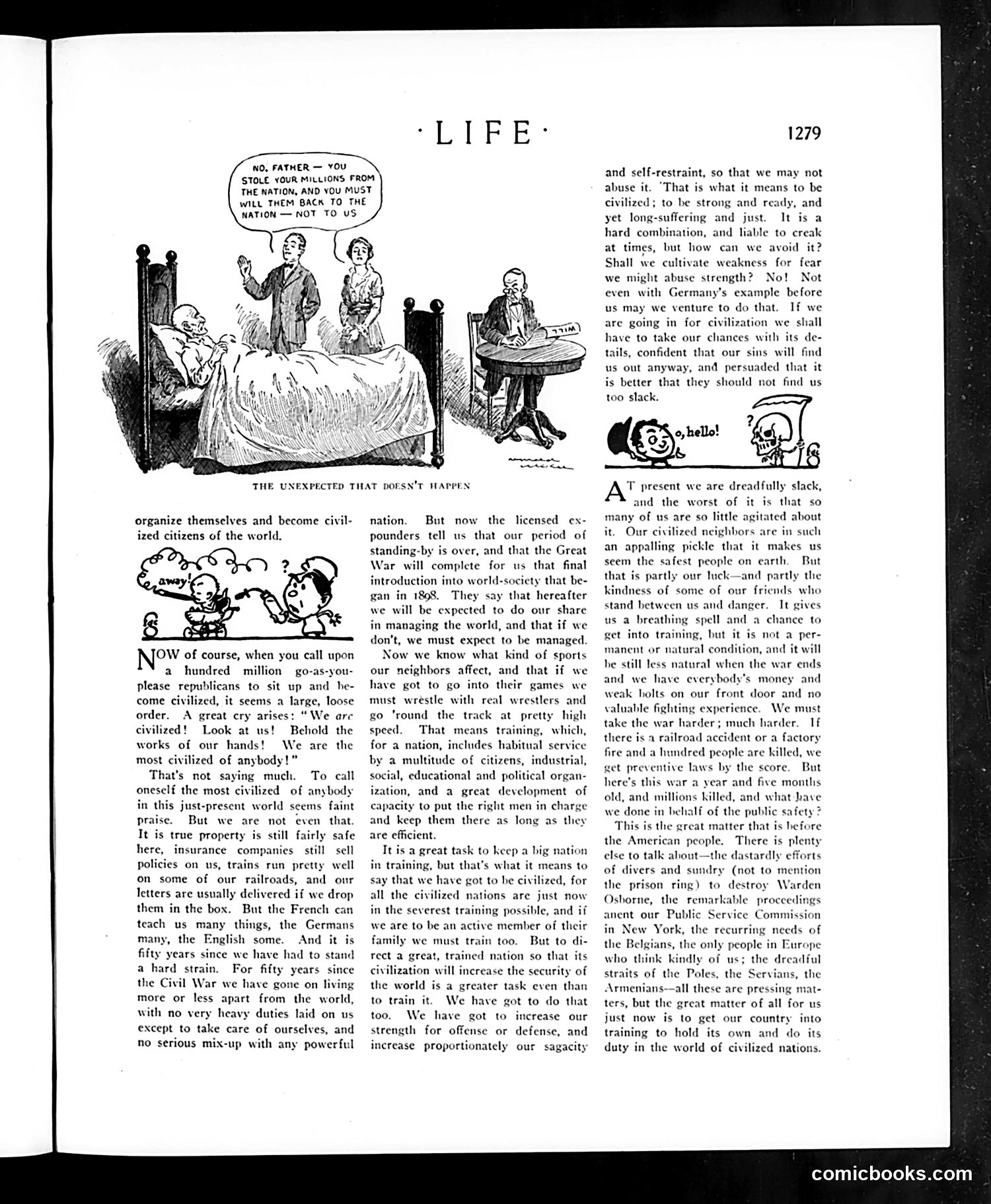
**The Main Cartoon:** A deathbed scene shows a wealthy father being confronted by his son, who declares the millions stolen from the nation must be returned to it—not inherited by the family. This satirizes Gilded Age wealth accumulation and argues for wealth redistribution or taxation of ill-gotten gains. **The Article's Context:** Written during WWI (references to "the Great War"), this piece argues America must abandon isolationism and become a disciplined, trained nation capable of participating in world affairs. The author contends that civilization requires military preparedness, industrial organization, and moral restraint—not weakness. **The Satire:** Life mocks American self-satisfaction about being "civilized" while actually being unprepared and complacent. The article criticizes the nation's fifty years of relative peace without serious duties, suggesting this has made Americans soft and undisciplined compared to European powers actively engaged in warfare. The page connects personal corruption (the cartoon) with national unreadiness (the editorial), arguing both undermine true civilization.
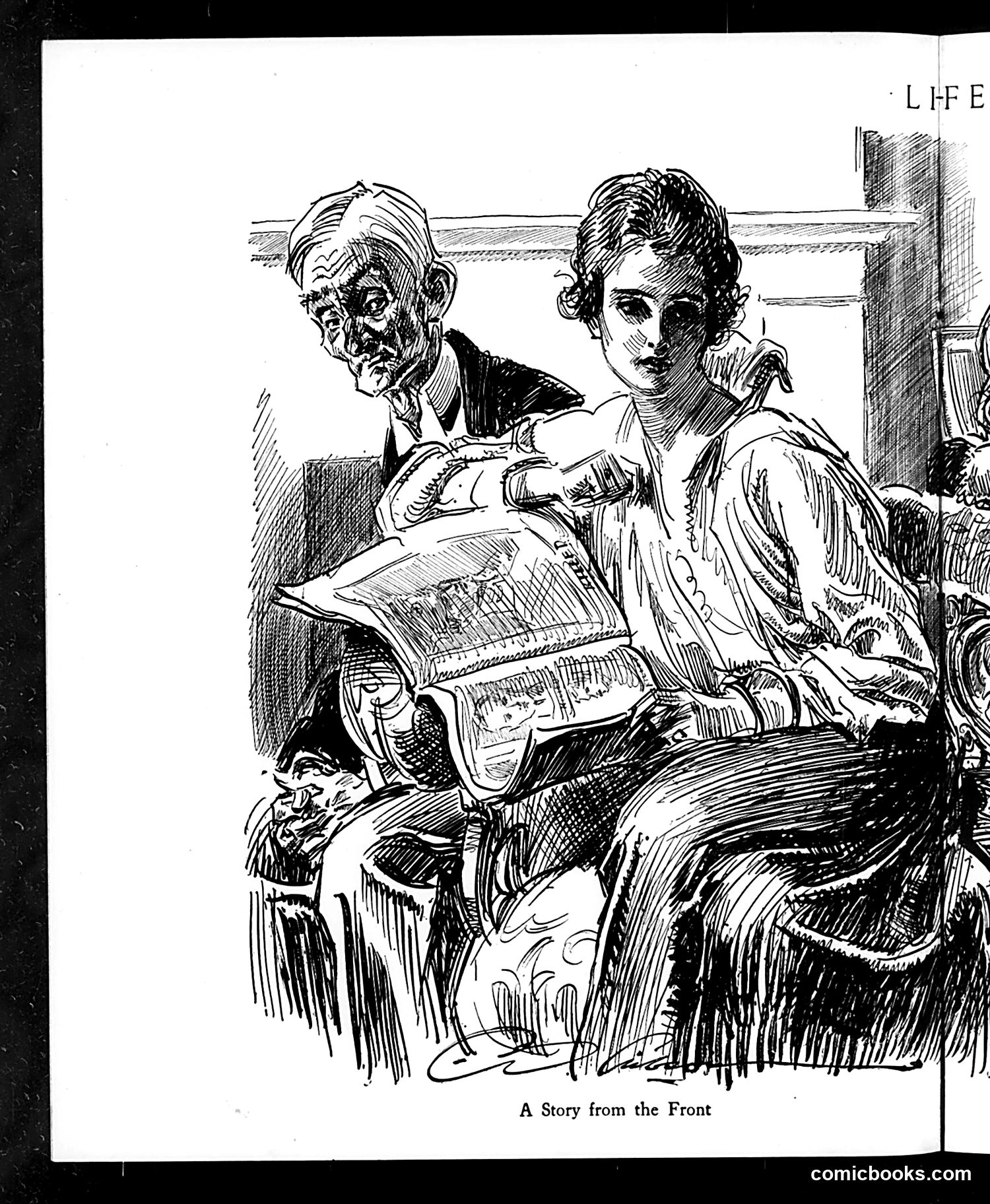
This Life magazine illustration depicts what appears to be a WWI-era scene. An older man in formal dress (possibly a military officer or official based on his bearing) leans in to listen to a young woman reading from papers on her lap. The woman's composed expression and the man's intent focus suggest she's recounting a personal narrative—likely a soldier's letter or account from the battlefield. The cartoon's title and composition suggest satire about how war stories were received and circulated on the home front. The formal indoor setting contrasts with the "front" referenced in the title, possibly mocking how civilians consumed and romanticized accounts of combat, or critiquing how such intimate narratives were mediated through domestic social interactions rather than experienced directly.
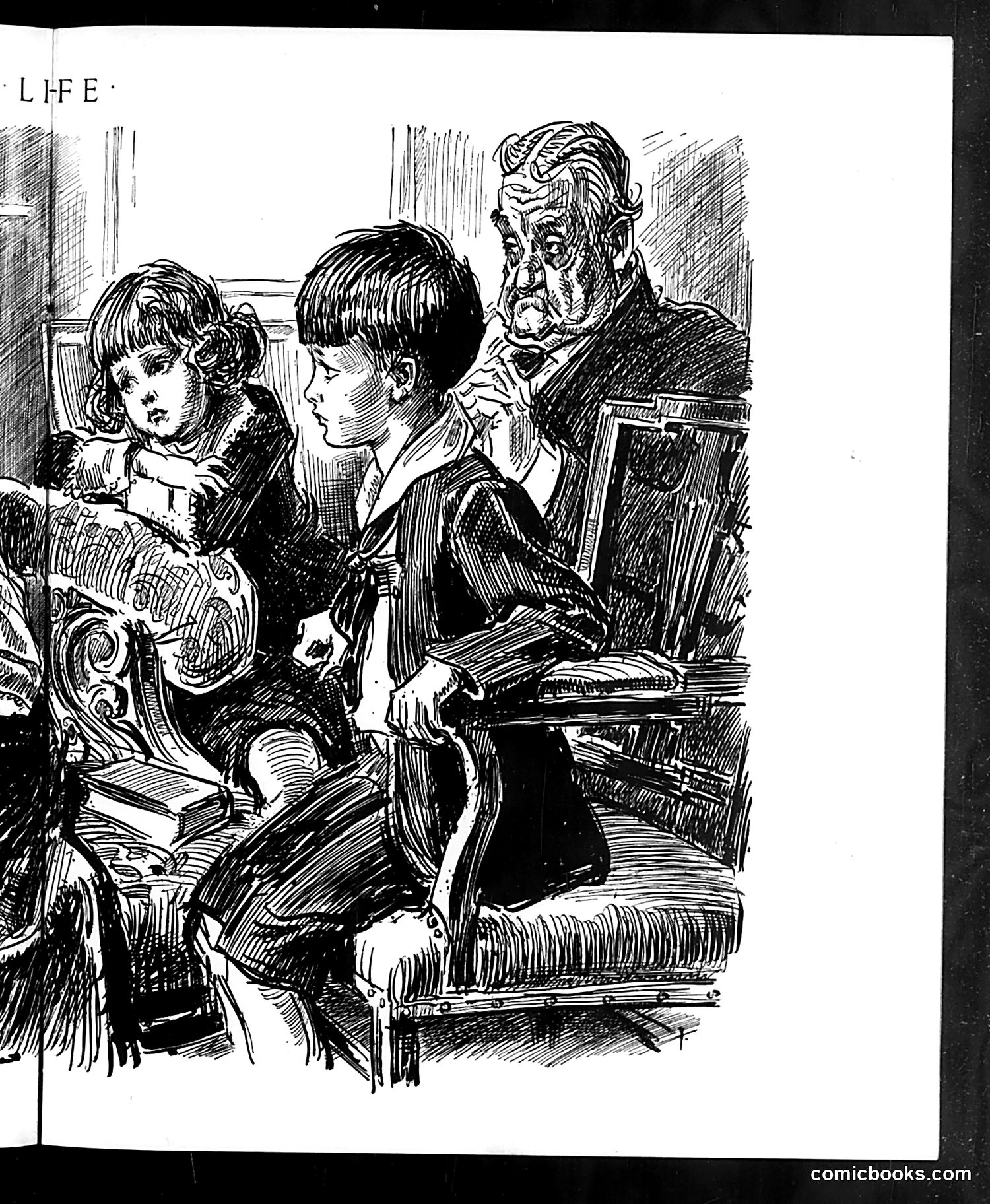
This page from *Life* magazine shows a domestic scene titled "LIFE" depicting what appears to be a family lesson or instruction moment. An older man (likely a father or tutor figure) gestures expressively while instructing two younger figures—a boy and girl—seated at a desk with books. The scene captures a teaching moment, possibly satirizing educational practices or parental instruction methods of the era. The exaggerated facial expression and animated posture of the adult suggest the cartoon may be mocking overly dramatic or pedantic teaching styles. The formal clothing and domestic interior setting indicate this represents middle or upper-class family life. Without additional OCR text visible on this page, the specific satirical target remains unclear, though it likely comments on contemporary educational or social norms regarding childhood instruction.
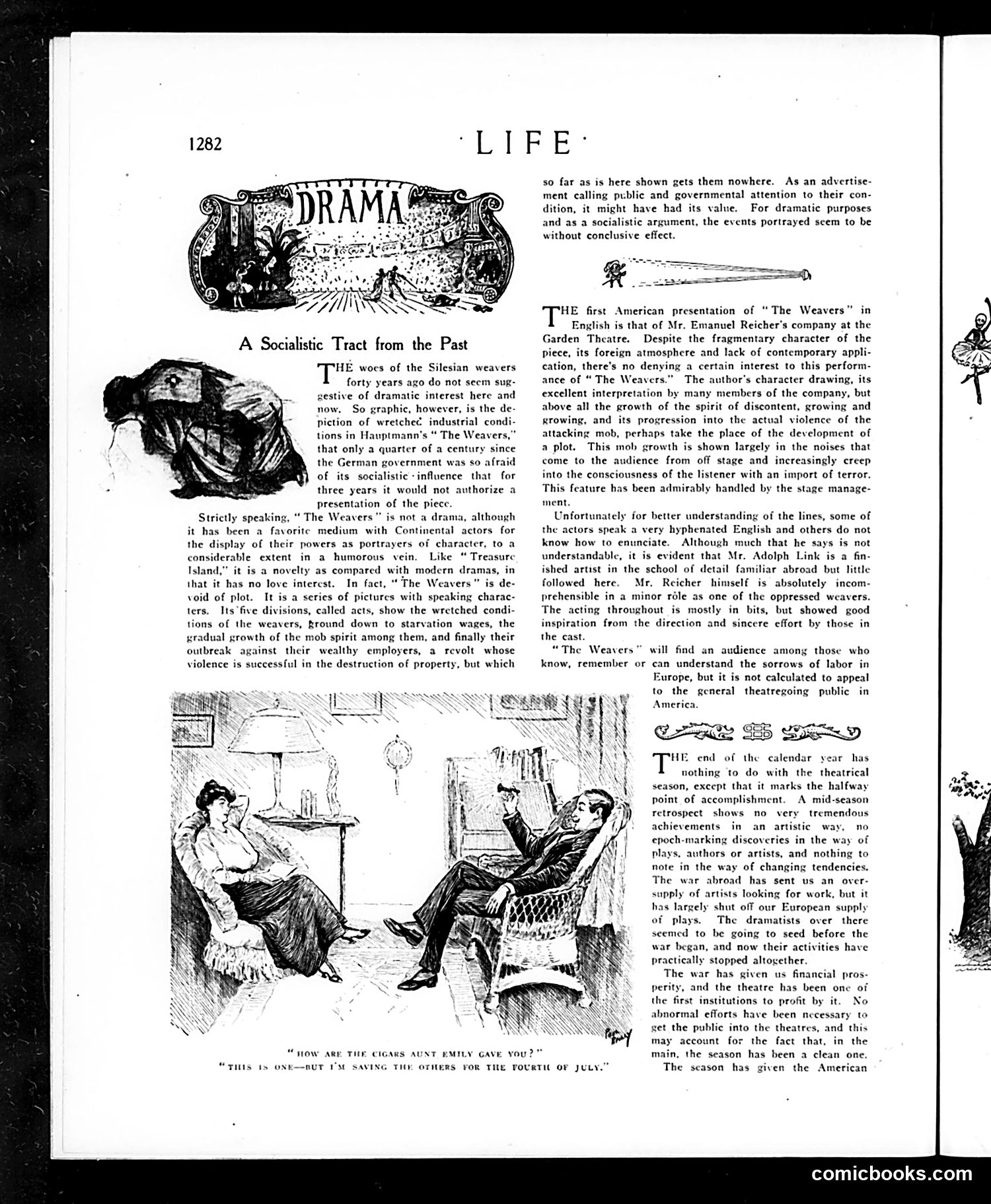
This page reviews Emanuel Reicher's American production of Gerhart Hauptmann's "The Weavers," a controversial German play about Silesian textile workers' rebellion against exploitation. **The Context:** The German government had banned the play for three years, fearing its socialist message would incite unrest. Life's critic acknowledges the work's dramatic power in depicting workers' progressive radicalization—from starvation wages to violent mob uprising—but questions its effectiveness as either drama or propaganda in America. **The Satire/Critique:** The review dismisses the play's relevance to American audiences unfamiliar with European labor struggles. The critic notes excellent staging (particularly the mounting off-stage mob sounds creating dread) and some fine acting, but criticizes unclear diction and questions whether foreign labor politics can engage the "general theatregoing public in America"—suggesting American audiences lack both knowledge of and sympathy for European working-class suffering. The cartoon caption below depicts casual domestic life, contrasting the play's serious subject matter with American indifference.
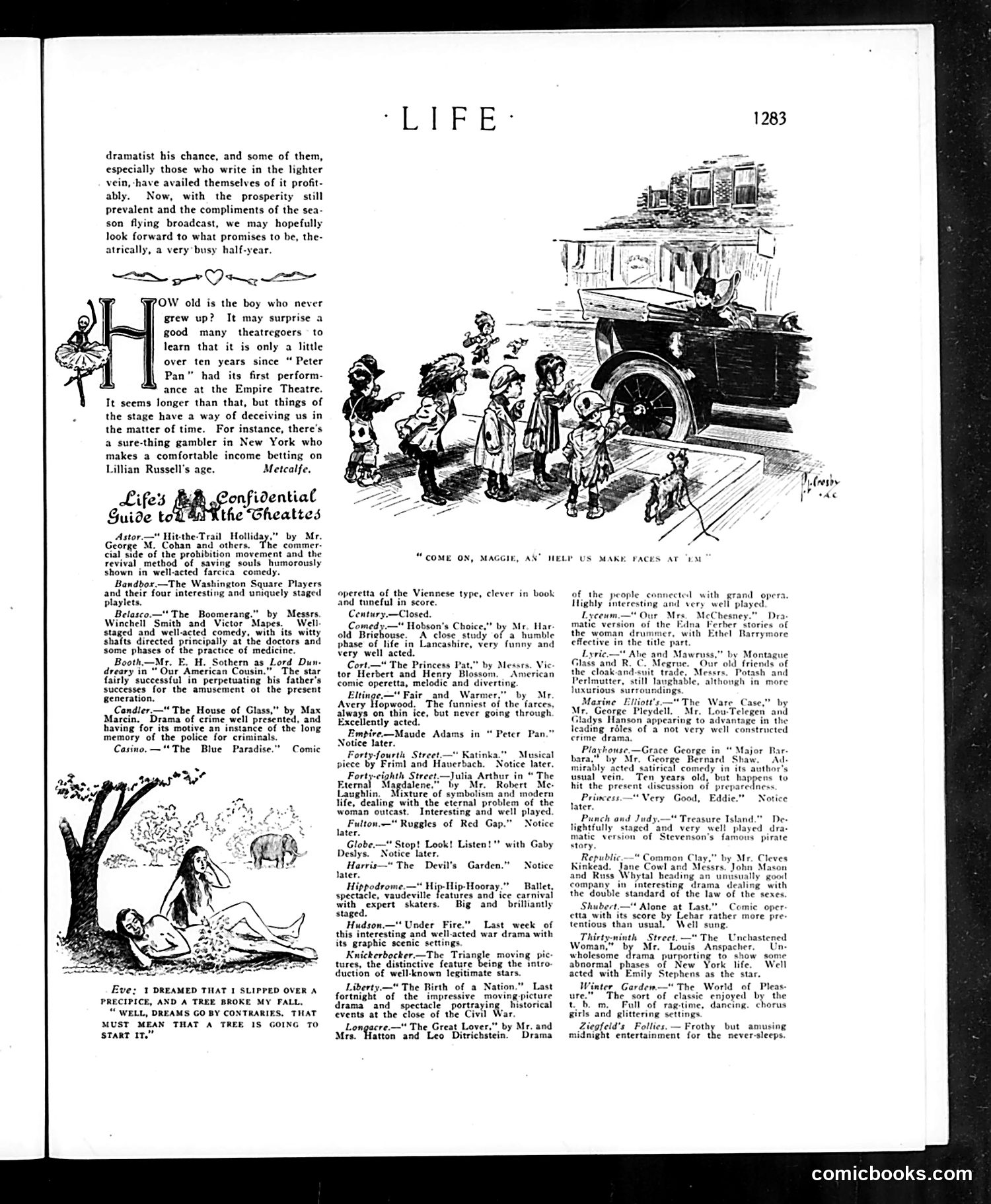
This page from Life magazine contains theater reviews and two cartoons. **Main Cartoon (top right):** Shows children gathered around a street vendor's cart labeled "COME ON, MAGGIE, AN' HELP US MAKE FACES AT 'EM," depicting working-class children mocking passersby—likely satirizing urban street life and juvenile behavior. **Bottom Cartoon:** Features a woman recounting a dream about falling off a precipice saved by a tree, concluding dreams "go by contraries" so the tree must be going to start. This is classic absurdist humor playing on superstition and dream interpretation. **Theater Section:** The bulk of the page is "Life's Confidential Guide to the Theatres," listing current Broadway productions with brief reviews. Notable entries include George M. Cohan's "Hit-the-Trail Holliday" (satirizing prohibition and revival meetings), and Maude Adams in the now-famous "Peter Pan"—which the text notes had only premiered about ten years prior, yet seems timeless. The reviews use light satire to critique theatrical productions and topical subjects.
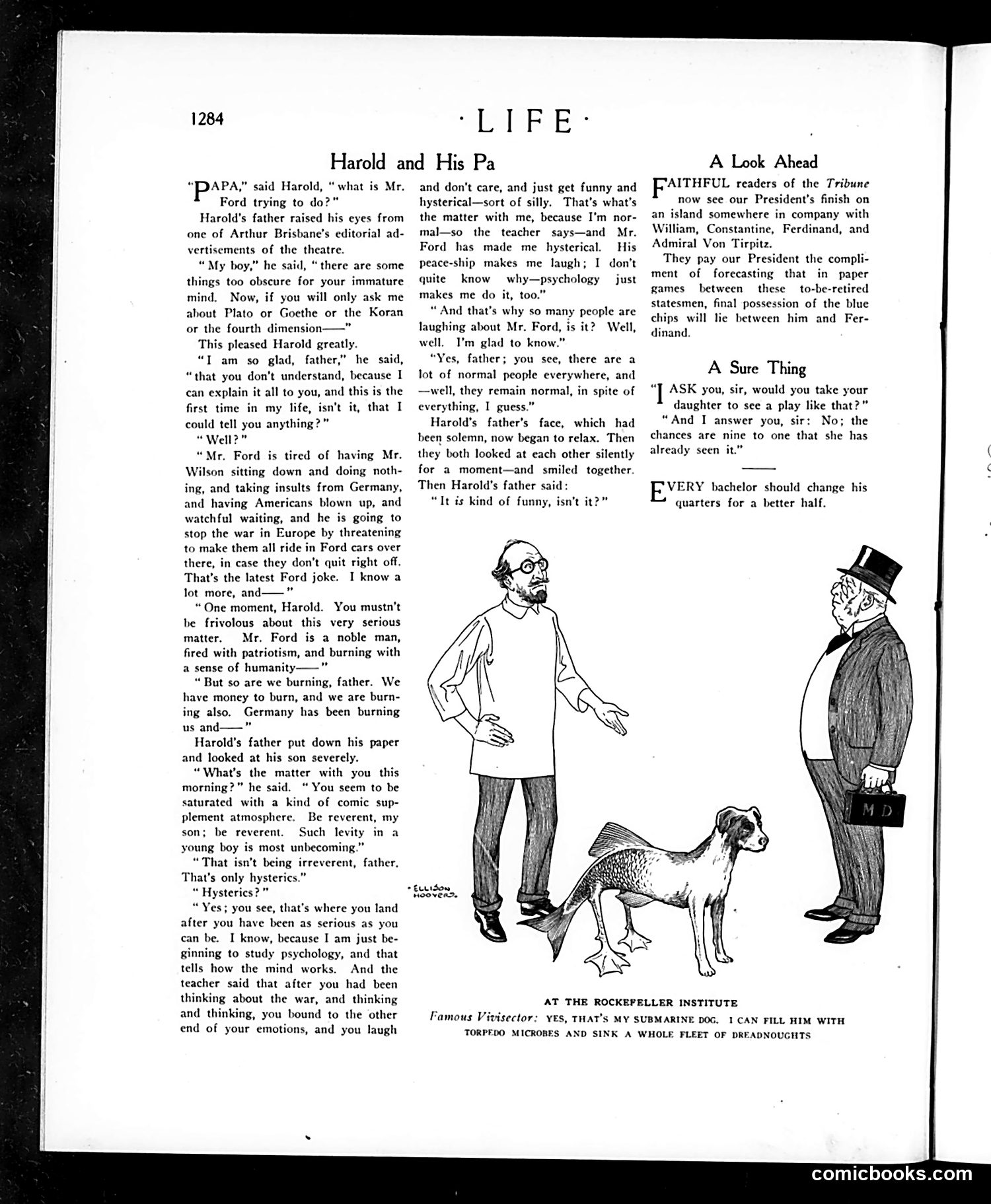
This page contains two distinct pieces satirizing World War I-era American politics and society. **"Harold and His Pa"** mocks Henry Ford's 1915 peace ship mission to stop WWI. Harold explains to his father that Ford thinks threatening to force Europeans to use Ford cars will end the war. The father initially defends Ford as a patriot, but eventually laughs at the absurdity. The satire suggests that after sustained serious thinking about war, people inevitably swing to hysteria and laughter—a psychological defense mechanism. It's a gentle mockery of both Ford's naïve interventionism and America's emotional exhaustion over the conflict. **The cartoon "At the Rockefeller Institute"** is darker satire, likely criticizing vivisection (animal experimentation) at prestigious institutions. The "vivisector" proposes filling a dog with "torpedo microbes" to sink enemy warships—an absurd image highlighting the ethical grotesqueness of using animals for weapons research or experimentation. Both pieces reflect wartime anxieties about technology, patriotism, and scientific ethics during America's pre-1917 neutrality period.
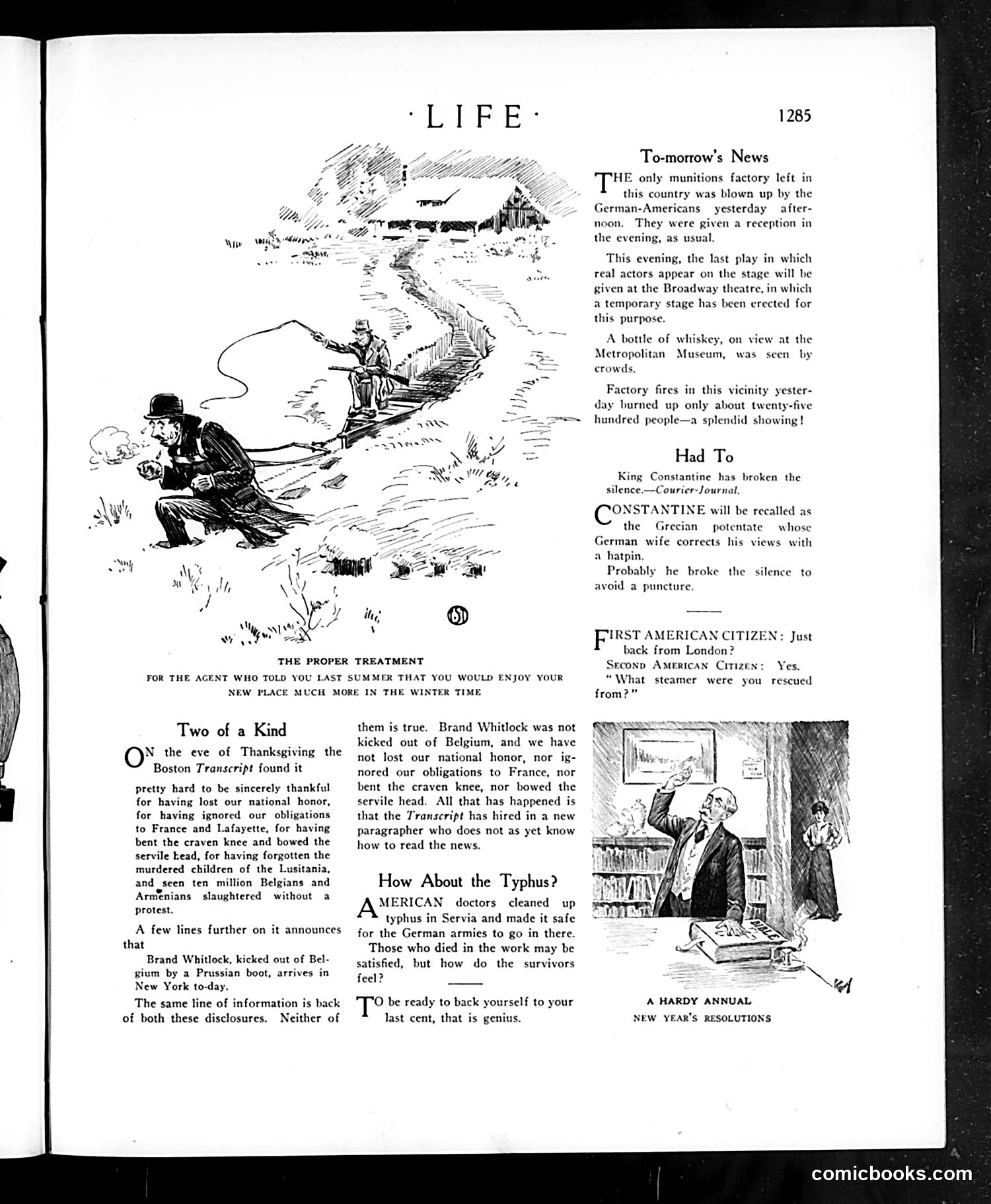
This page contains WWI-era political satire criticizing American neutrality and pro-German sentiment. **"The Proper Treatment" cartoon** shows a man fishing, captioned as advice for a real-estate agent who promised winter enjoyment—dark humor about deception. **"Two of a Kind"** attacks the *Boston Transcript* for simultaneously claiming America lost its honor by not aiding France/Belgium while reporting Brand Whitlock (U.S. diplomat to Belgium) was "kicked out" by Germans. The satire exposes the paper's contradictory, sensationalized reporting and implies editorial incompetence. **"How About the Typhus?"** mocks American doctors who worked in Serbia, suggesting their sanitization efforts merely enabled German military operations—criticism of humanitarian work serving hostile powers. **"To-morrow's News"** uses dark prophecy: German-Americans destroying munitions factories and theaters, suggesting the author fears internal sabotage and German-American disloyalty during the war. **Other quips** mock King Constantine of Greece's rumored German sympathies and pro-American/British sentiment. The overall message: America must recognize the German threat and abandon neutrality.
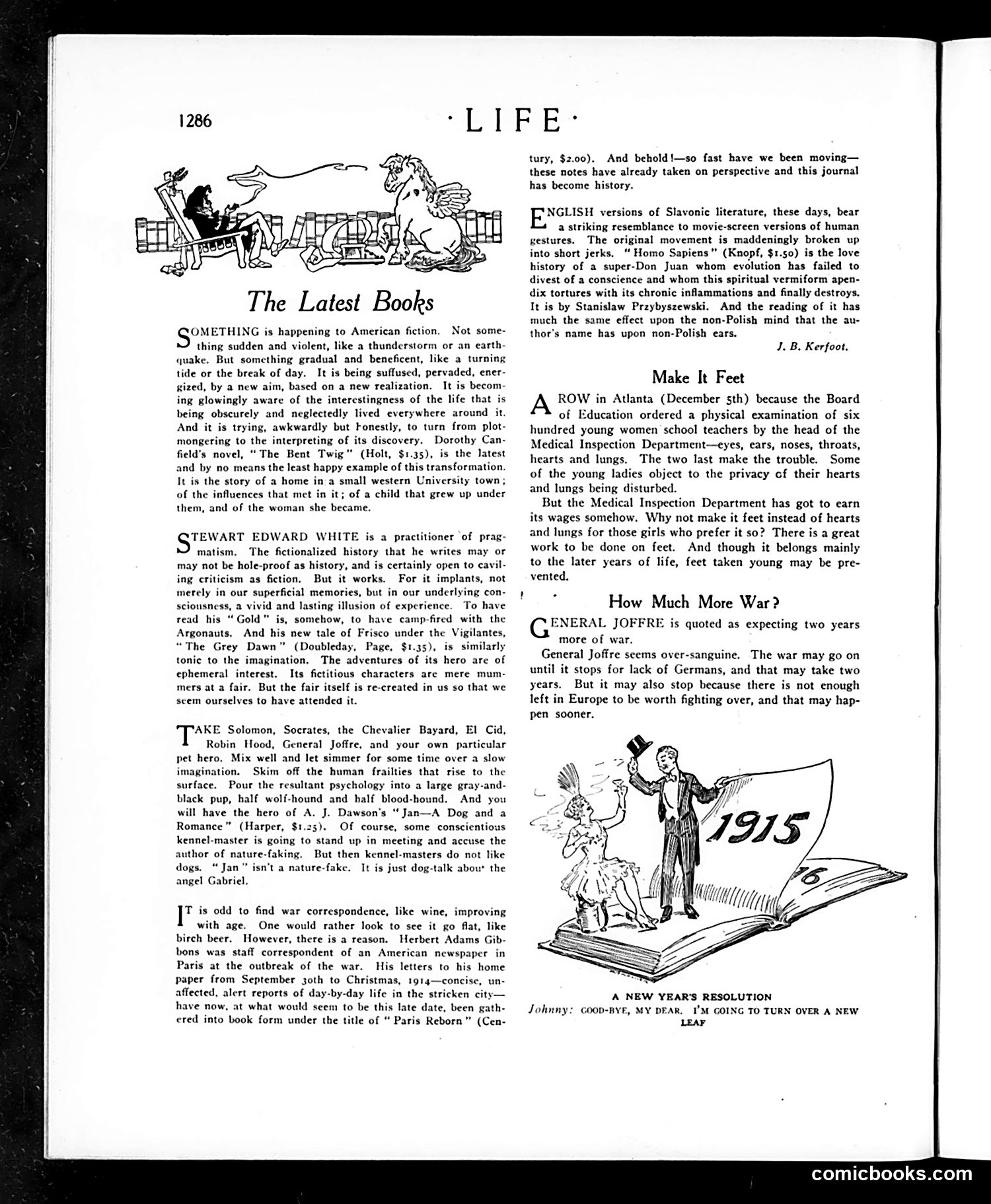
This page from Life magazine (likely early 1915, based on the "1915" reference in the cartoon) discusses contemporary American fiction and includes a satirical cartoon about New Year's resolutions. ## The Cartoon The illustration titled "A New Year's Resolution" shows a figure (labeled "Johnny") saying goodbye to 1914, depicted as turning over a new leaf. The cartoon satirizes the common tradition of making fresh starts on January 1st—a timeless, cyclical joke about people's aspirations versus their actual ability to change. ## The Text The "Latest Books" section reviews contemporary novels, praising a shift in American fiction toward realism—depicting ordinary life rather than plot-driven melodrama. It mentions works by Dorothy Canfield, Stewart Edward White, and A.J. Dawson, and discusses Herbert Adams Gibbons's wartime correspondence from Paris (1914), which the author notes has already become historical document, reflecting how rapidly World War I was reshaping events and perspective. The overall page reflects early-20th-century literary culture and wartime consciousness.
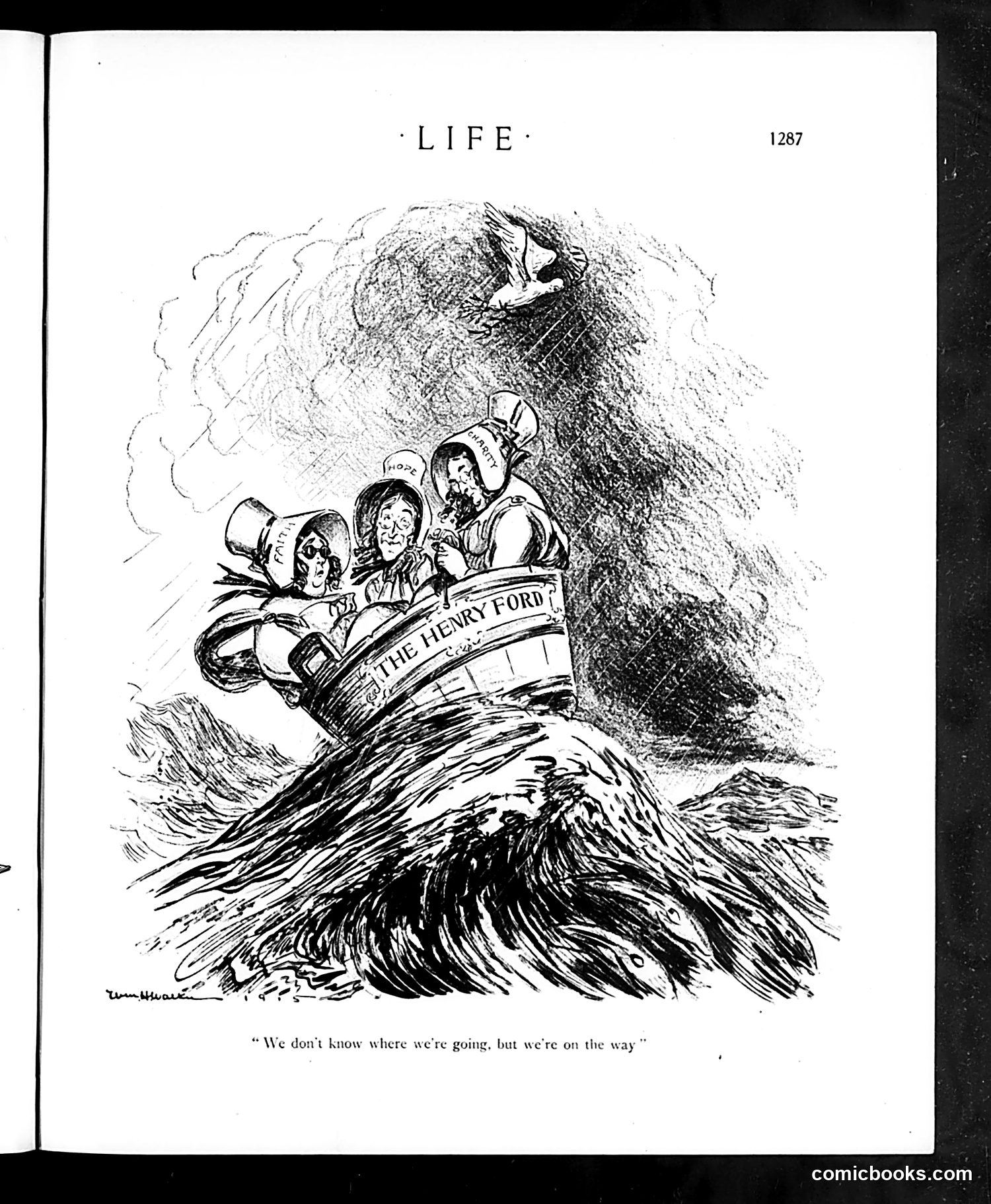
This political cartoon depicts a group of people crowded into a vehicle labeled "THE HENRY FORD," traveling up a steep, rocky mountain. The caption reads: "We don't know where we're going, but we're on the way." The satire critiques Henry Ford and his industrial movement—likely Ford's mass production philosophy or a specific business venture. The mountain represents a difficult, uncertain journey. The cartoon suggests that Ford and his followers are charging forward with enthusiasm and momentum, but without clear direction or defined goals. The precarious vehicle and treacherous terrain imply the risks of blind progress without planning. This satirizes the era's uncritical faith in industrial expansion and entrepreneurial ambition, common themes in early 20th-century American satire.
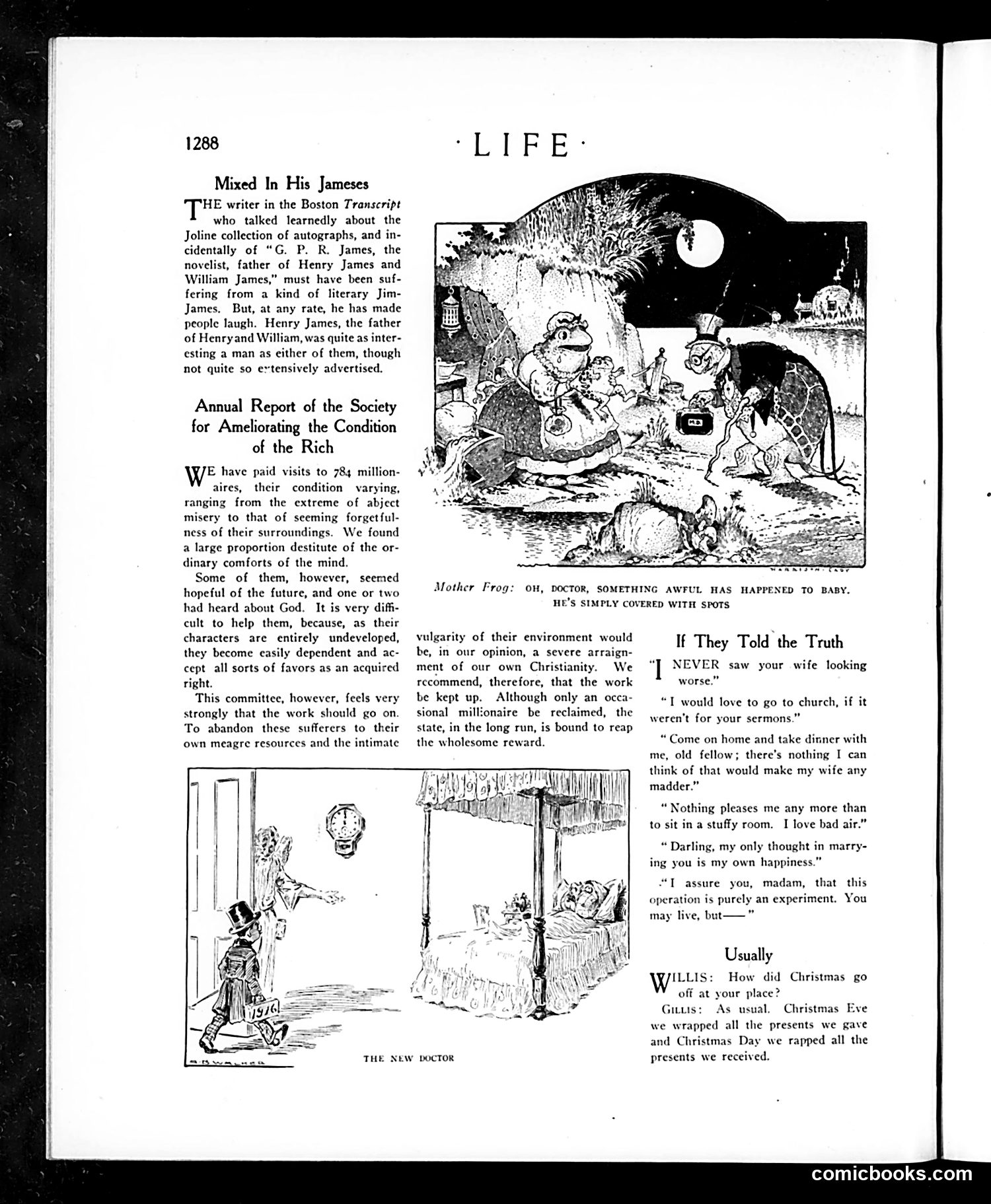
This page contains multiple satirical pieces mocking American society: **"Mixed In His Jameses"** ridicules a Boston newspaper writer who confused the genealogy of the famous James family (philosopher William James, novelist Henry James, and their father Henry James Sr.), treating this factual error as humorous literary pretension. **"Society for Ameliorating the Condition of the Rich"** is heavy irony—a mock charity report "visiting 784 millionaires" to help their supposed moral destitution. It sarcastically suggests wealthy people are underdeveloped, dependent, and vulgar, needing Christian charity. The satire critiques both the wealthy and condescending charitable attitudes. **"The New Doctor"** cartoon shows a quack physician attending a mother frog with a spotted baby, implying medical incompetence or fraud. **"If They Told the Truth"** presents cynical dialogue revealing people's actual (rather than socially acceptable) feelings about religion, marriage, and medical procedures—a humor format exposing social hypocrisy. All pieces use inversion and exaggeration to mock pretension, wealth, professional incompetence, and social dishonesty in early-20th-century America.
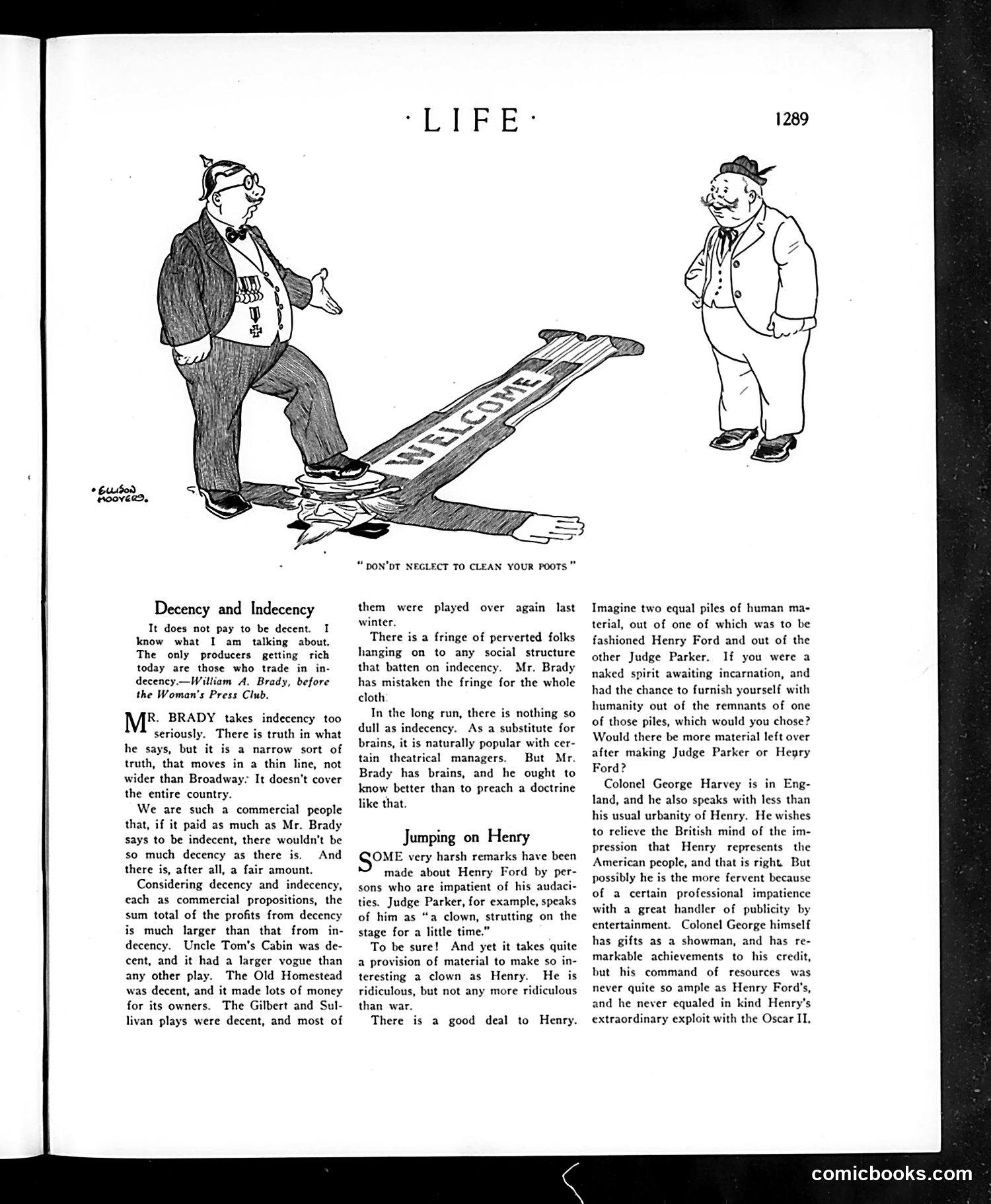
## The Cartoon The illustration satirizes hypocrisy about propriety. One well-dressed man stands on a "DECENCY" plank while gesturing dismissively; the plank has collapsed beneath another man. The caption reads "DON'T NEGLECT TO CLEAN YOUR FOOTS" — deliberately misspelling "feet" to suggest crude behavior underlying claims of respectability. ## The Articles' Context **"Decency and Indecency"** responds to theatrical producer William A. Brady's claim that indecency is profitable. Life argues Brady overstates this; decent works like *Uncle Tom's Cabin* and Gilbert & Sullivan operettas earned substantial profits. **"Jumping on Henry"** defends Henry Ford against criticism from Judge Alton B. Parker and Colonel George Harvey, who mock Ford as a ridiculous "clown." Life argues Ford's accomplishments (manufacturing innovation, the Oscar II peace ship) demonstrate real achievement beyond mere showmanship—suggesting his critics are envious rather than justified. Both pieces champion substance over pretense, matching the cartoon's message about hidden indecency beneath claims of decency.
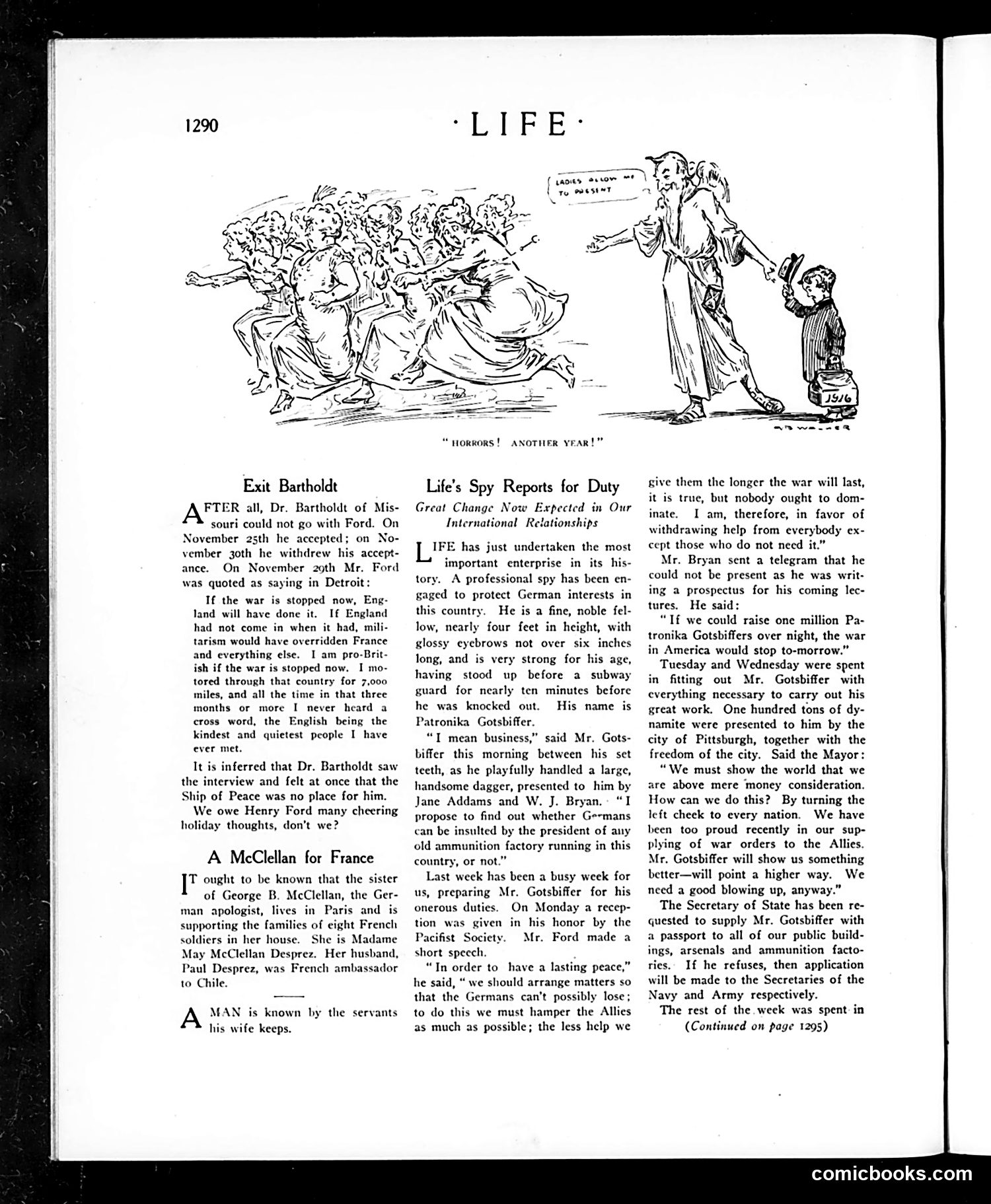
This page satirizes American pacifists and German sympathizers during World War I (before U.S. entry in 1917). **The cartoon** at top shows a crowd of women rushing away saying "Horrors! Another year!" while a woman tries to restrain two children—mocking suffragettes and pacifists demanding immediate war cessation. **"Exit Bartholdt"** ridicules Dr. Bartholdt, a congressman who initially accepted Henry Ford's peace ship invitation, then withdrew. The satire notes Ford contradicted himself by praising Britain while claiming to be pro-peace. **"A McClellan for France"** contrasts George McClellan (a German apologist) with his sister, who supports French soldiers—implying family shame. **The main article** mocks Life's fictional "spy for Germany"—a tiny man named Patronika Gotsbiffer. The satire targets pacifists (Ford, Bryan) by imagining they'd arm a German agent, supply explosives, and sabotage Allied support. It's biting satire of isolationist sentiment as effectively pro-German.
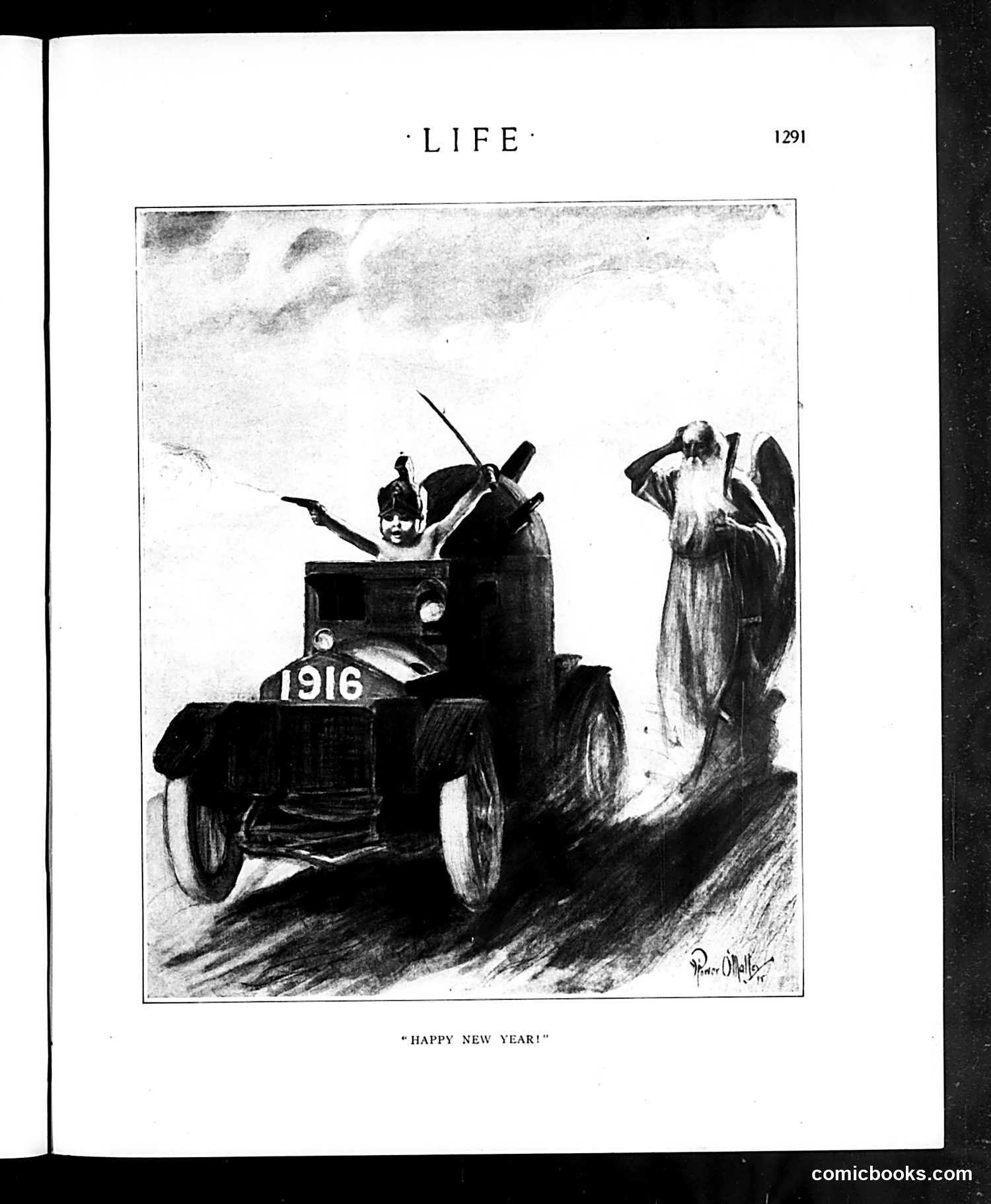
This New Year's cartoon depicts 1916 personified as a reckless driver in a speeding automobile marked "1916," wildly steering while one arm extends outward. A figure on the right—appearing to be Death or the Grim Reaper in robes—waves goodbye or watches the car pass. The satire comments on the dangers and uncertainties of the year ahead. Given the timing (1916, during World War I), the cartoon likely warns that the new year will be chaotic and potentially deadly, with Death already present. The ironic greeting "Happy New Year!" contrasts with the ominous imagery, suggesting anxiety about what 1916 would bring—possibly America's impending involvement in the war or general wartime dangers.
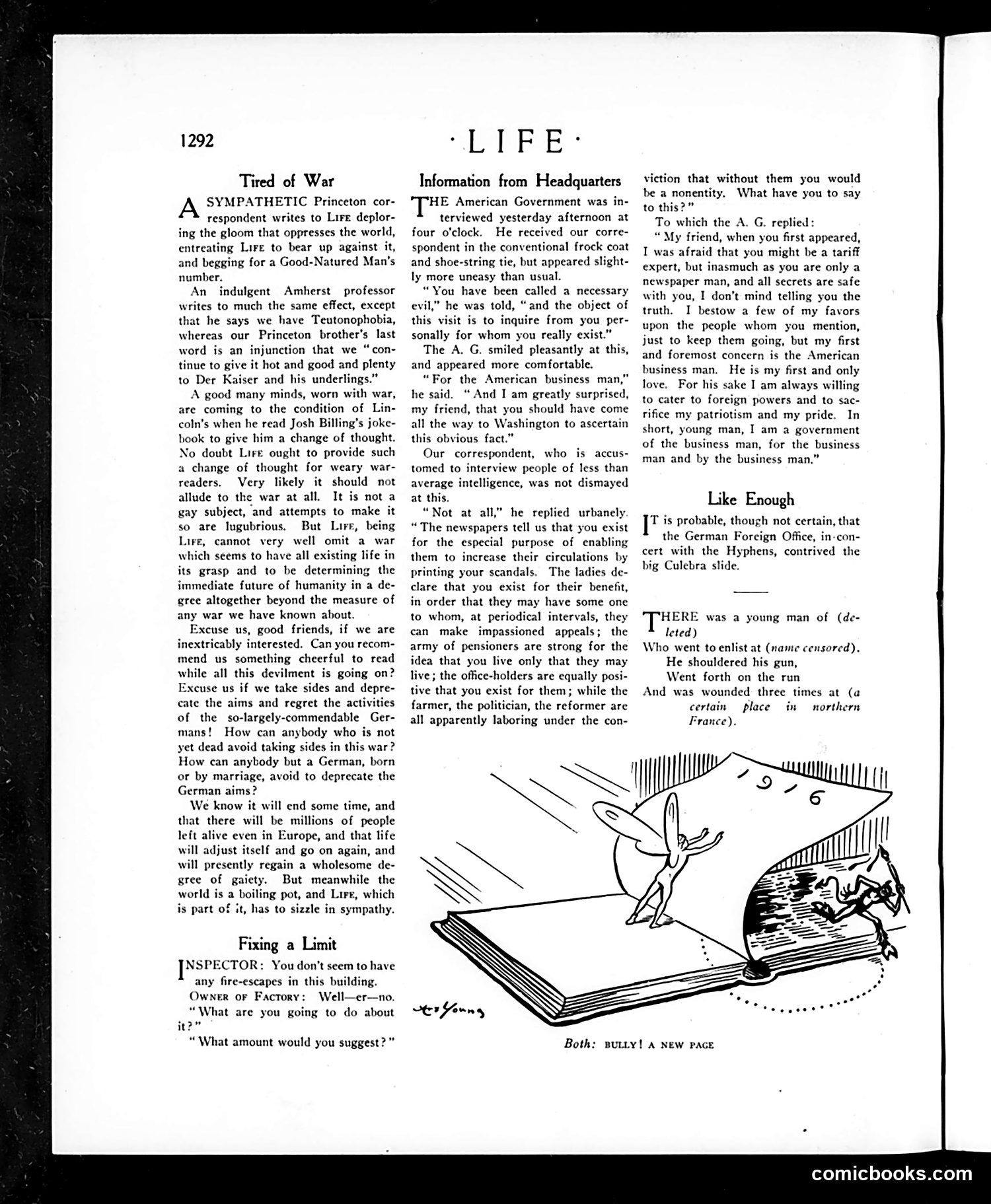
This page contains three distinct satirical pieces from an American wartime publication (appears to be WWI era, given references to "Der Kaiser"). **"Tired of War"**: An editorial defending Life's continued focus on World War I, responding to readers requesting cheerful distraction. Life argues the war is too consequential to ignore, and asks how anyone could remain neutral—particularly anyone not German-born. **"Information from Headquarters"**: Satirizes the U.S. Attorney General as serving exclusively "the American business man," while other groups (newspapers, ladies, pensioners, office-holders, farmers, politicians, reformers) each believe he exists for *their* benefit. The joke: the AG admits his true constituency is business interests. **"Fixing a Limit"**: A brief joke about factory safety—an inspector questions missing fire-escapes; the owner, asked what he'd suggest, deflects by asking "what amount" (implying a bribe), exposing regulatory corruption. The cartoon depicts a book being turned into a "new page," satirizing turning a page on unpleasant subjects.
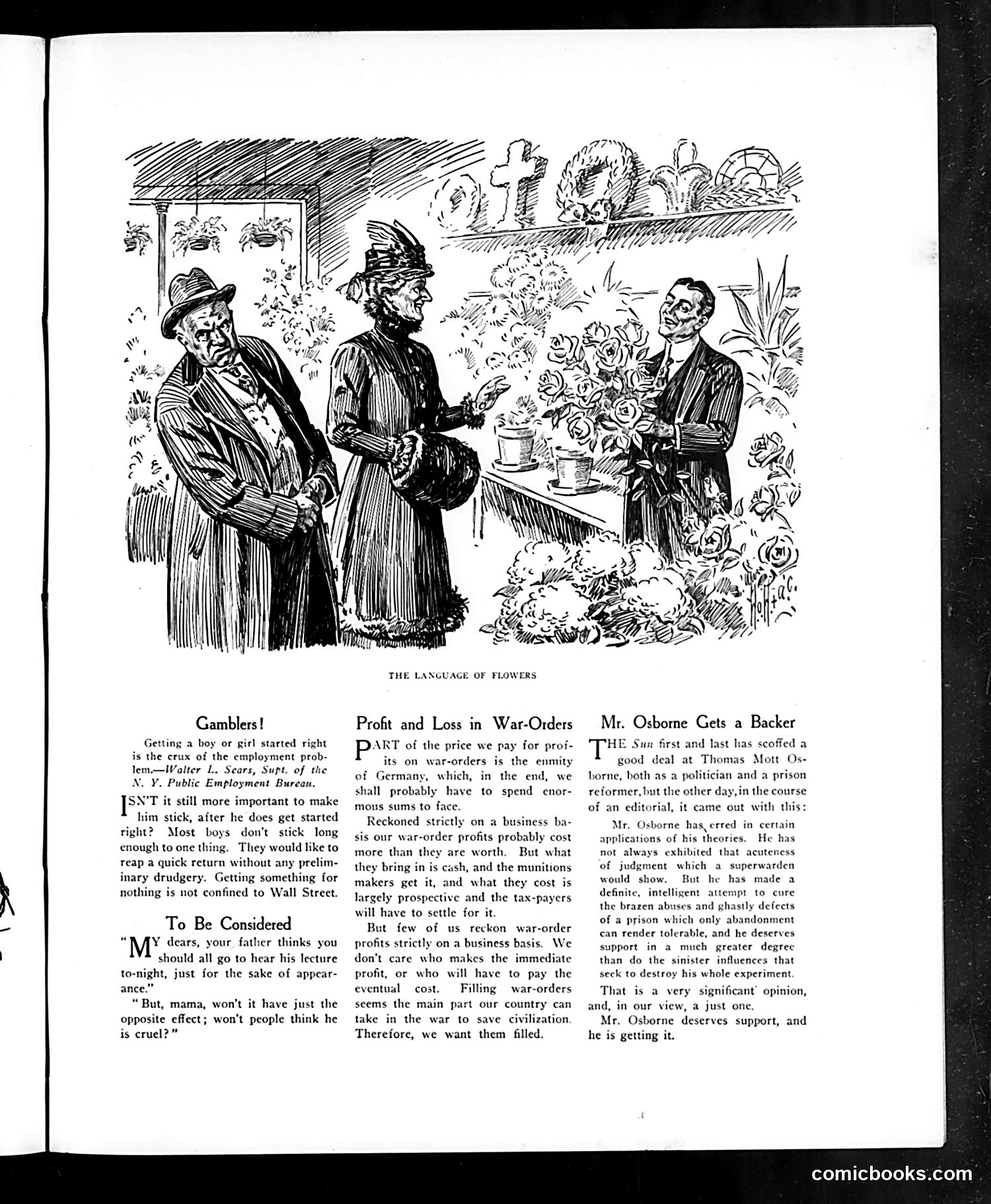
**The Cartoon**: "The Language of Flowers" shows three well-dressed men in a cemetery examining potted flowers, apparently conducting business amid gravestones and crosses—a darkly ironic juxtaposition. **Content Overview**: This page contains three distinct satirical pieces criticizing contemporary American attitudes: 1. **"Gamblers"** mocks young workers seeking quick returns without effort, comparing this mentality to Wall Street speculation. 2. **"Profit and Loss in War-Orders"** critiques munitions manufacturers profiting from WWI contracts while taxpayers will eventually bear Germany's enmity costs—highlighting how private gain shifts public burden. 3. **"Mr. Osborne Gets a Backer"** notes the *Sun* newspaper's grudging support for prison reformer Thomas Mott Osborne, suggesting even skeptics recognize his legitimate efforts despite disagreeing with specific methods. The cartoon's cemetery setting reinforces the dark commentary: business and profit-seeking persist even amid death—literally and figuratively, regarding war profiteering's human costs.
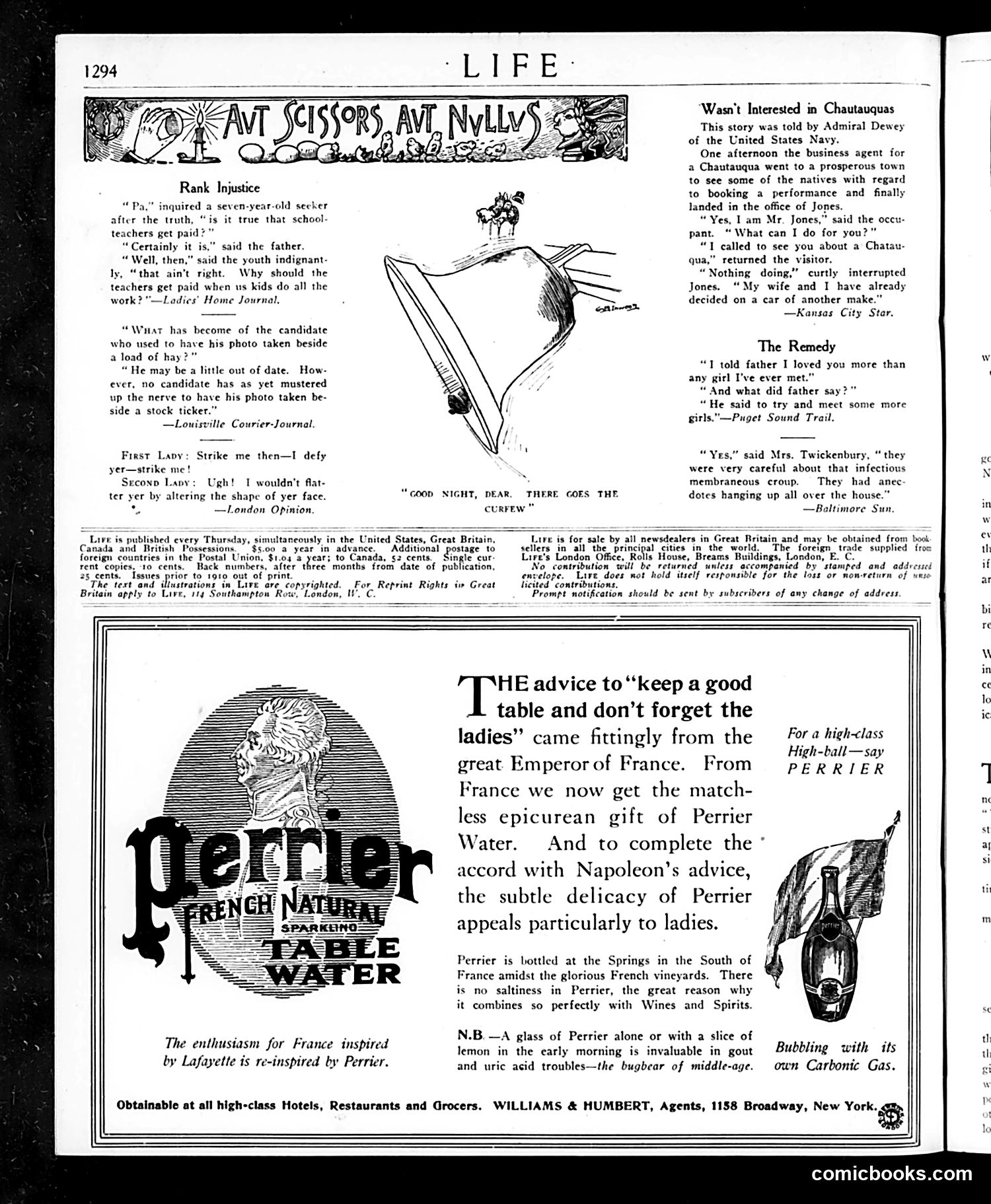
This page contains **humorous short anecdotes** rather than political cartoons. The jokes satirize everyday American life: **"Rank Injustice"**: A child questions why teachers are paid when children do the schoolwork—inverting normal logic for comic effect. **"Wasn't Interested in Chautauquas"**: Attributed to Admiral Dewey, this anecdote mocks a traveling Chautauqua performance promoter. When pitching to a prospect named Jones, Jones curtly refuses, saying he and his wife have already committed to buying a different automobile—prioritizing a car over cultural entertainment. The humor lies in the absurd non sequitur. **"The Remedy"**: A father advises his lovestruck son to date multiple girls rather than focus on one. **Minor jokes** mock fashion photography and stock market obsession. The page is **primarily an advertisement for Perrier Water**, invoking Napoleon's advice to "keep a good table and don't forget the ladies" to market sparkling water as sophisticated and appealing to women.
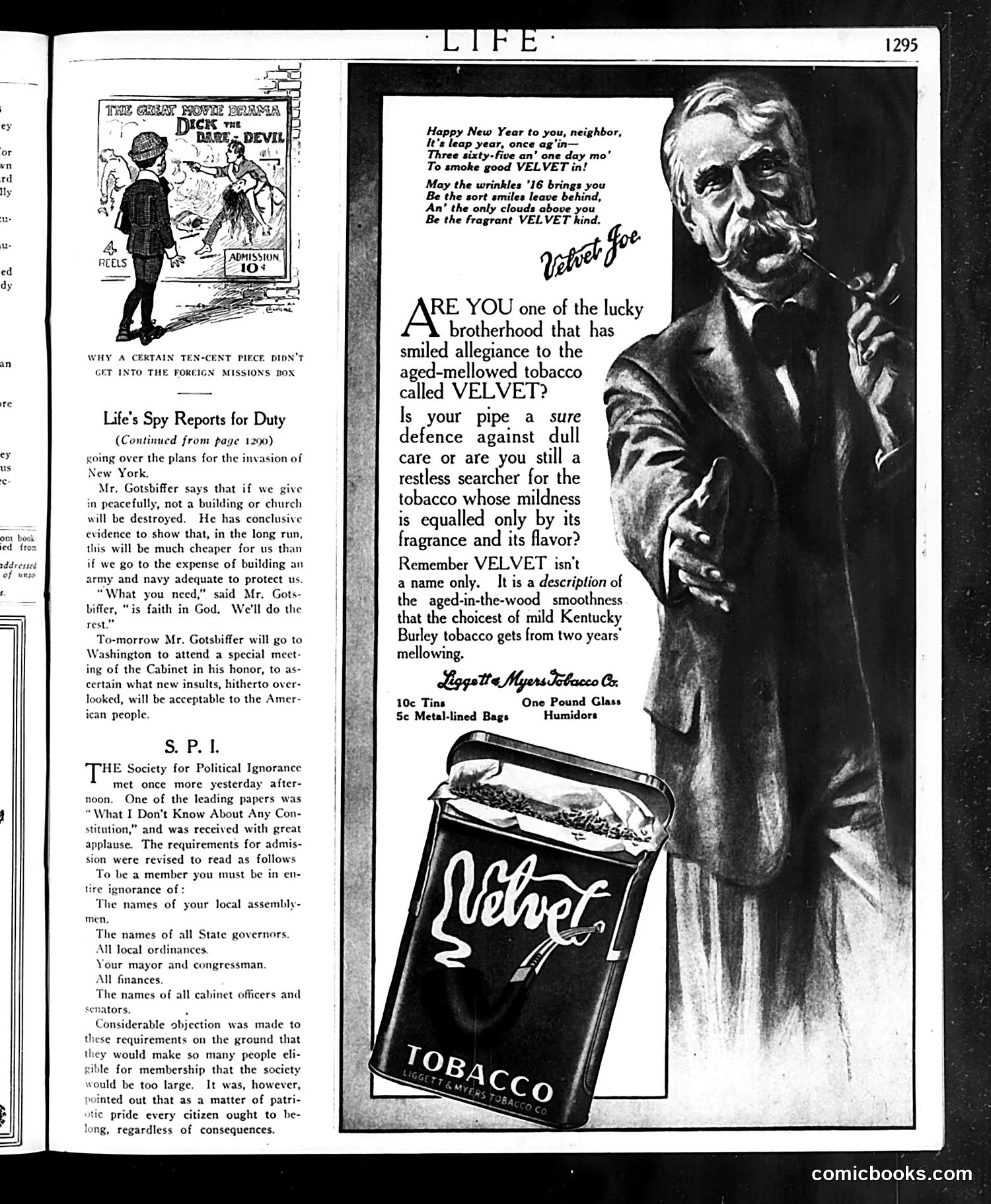
This page contains **political satire and a tobacco advertisement**. The left column satirizes American pacifism and naïveté. "Mr. Gotsbiffer" (a caricatured figure, likely representing pacifist sentiment) advocates surrendering to invasion without military defense, claiming it's cheaper. Life mocks this position as foolish appeasement. The "Society for Political Ignorance" section extends the satire—its membership requirements parody citizens' actual ignorance of government, civics, and finance. The joke: the society would be so large that patriotic pride alone might justify membership despite consequences. The small cartoon above lampoons selective charity: a man won't donate a ten-cent piece to foreign missions, perhaps because the coin itself is too valuable or because he's selfish. The **right side is a Velvet Tobacco advertisement** disguised as editorial content—common in early 20th-century magazines. It uses poetic, folksy language and a weathered man's portrait to market pipe tobacco as providing comfort and peace. The page demonstrates Life's dual function: satirical social criticism alongside paid advertising.
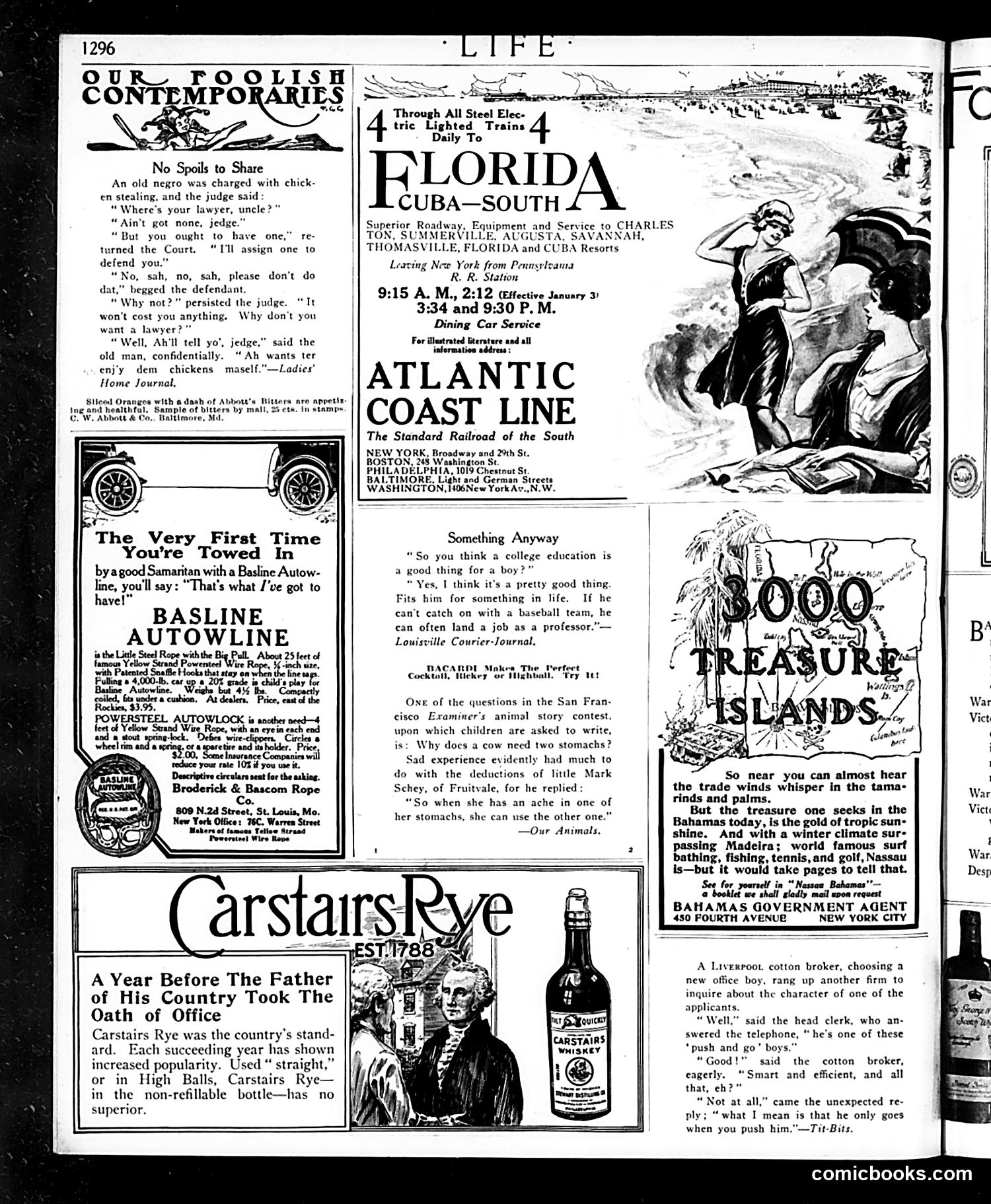
This brief comic anecdote uses a deeply offensive racial stereotype. An elderly Black man accused of stealing chickens refuses a court-appointed lawyer, explaining (in exaggerated dialect) that he wants to "enjoy dem chickens" himself—implying he's guilty and prefers his stolen goods to legal defense. The "joke" relies on the racist assumption that Black people are inherently criminal and lack intelligence. The humor comes from presenting this as the man's own admission of criminality and foolishness. The title "Our Foolish Contemporaries" frames such attitudes as typical of the era. This reflects the casual, normalized racism common in early 20th-century American popular media, even in sophisticated publications like *Life* magazine. Modern readers should recognize this as propaganda reinforcing harmful stereotypes rather than humor.
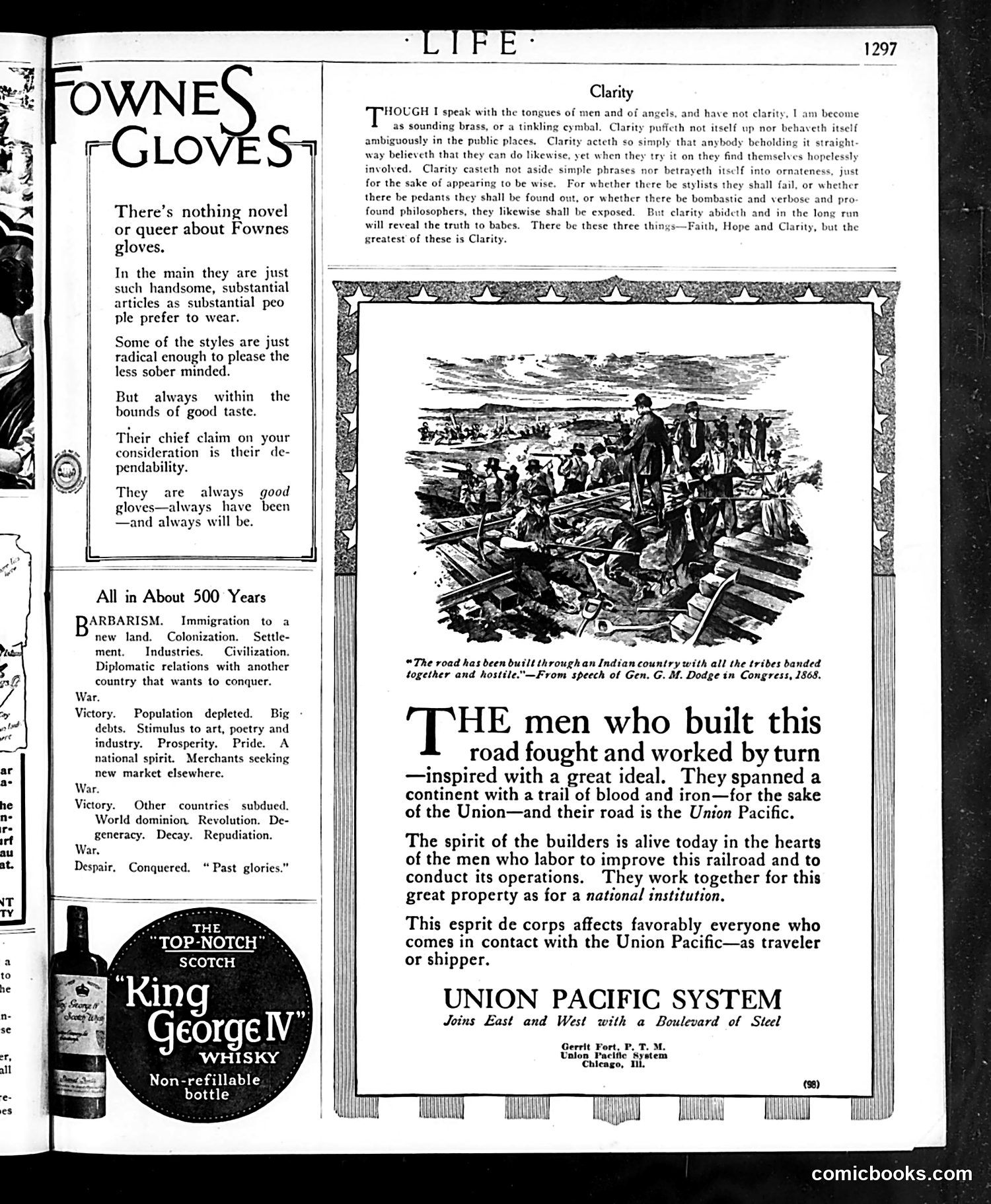
This page contains three distinct advertisements and content pieces: **Left side:** Fownes Gloves ad emphasizes reliability and good taste—a straightforward product pitch with no satirical content. **Center:** A cynical historical timeline titled "All in About 500 Years" that appears to mock imperial expansion cycles: barbarism→civilization→war→victory→prosperity, then repeating with decay and despair. This likely satirizes Western colonialism and cycles of imperial rise and fall, suggesting the pattern is inevitable and self-defeating. **Right side:** A Union Pacific Railroad advertisement uses a historical engraving depicting railroad construction through Native American territory, with a quote from Gen. G. M. Dodge (1868) acknowledging tribes were "banded together and hostile." The ad reframes this violent history as noble sacrifice "for the Union," emphasizing the railroad as a "national institution." This sanitizes colonial conquest as patriotic infrastructure. **Bottom left:** A King George IV Scotch whisky ad (non-refillable bottle). The page juxtaposes commercial messaging with subtle commentary on American expansion's human cost.
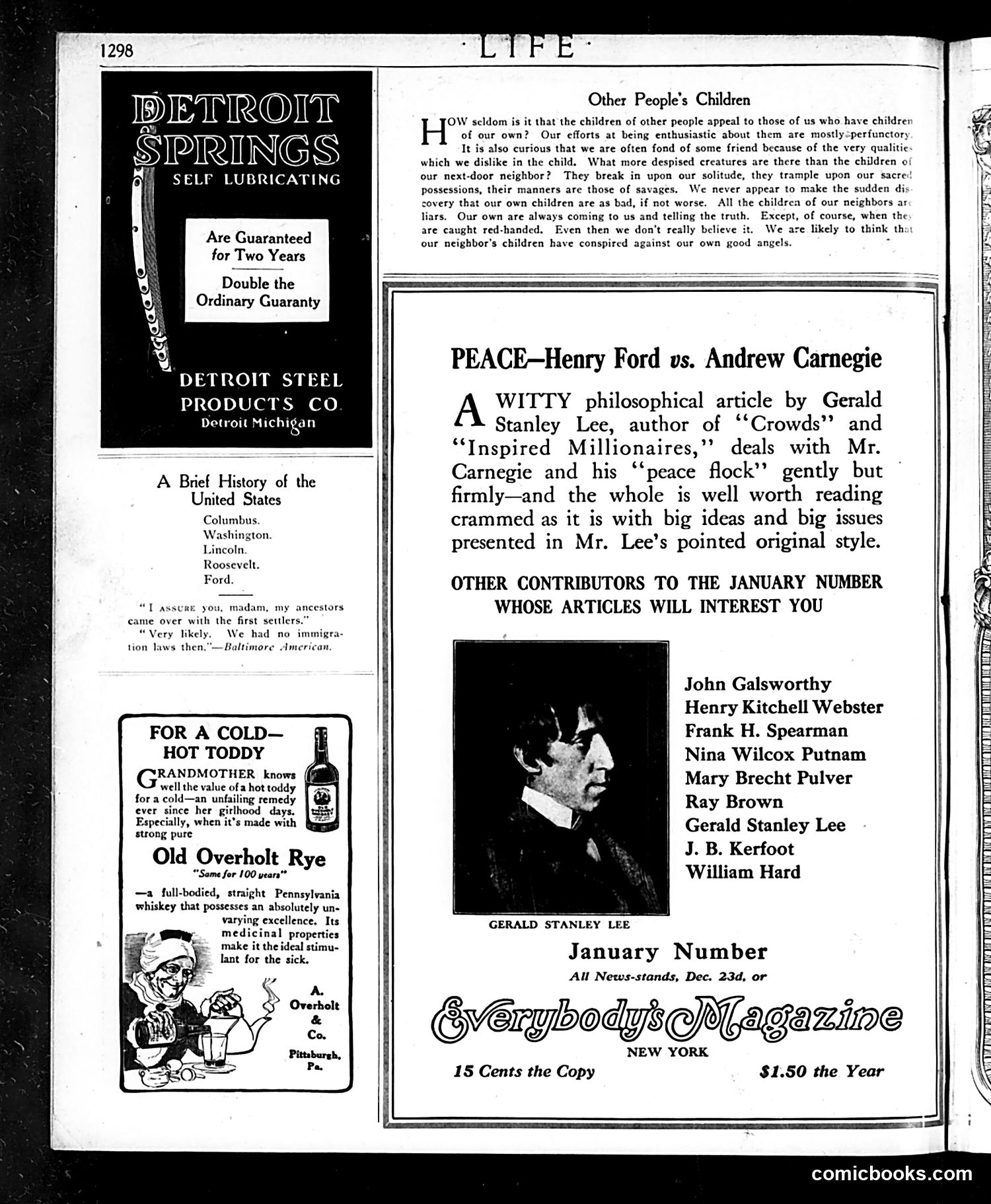
This is primarily a **magazine cover/contents page** rather than a political cartoon. The page advertises the January issue of *Everybody's Magazine* (15 cents) and lists notable contributors. The main satirical content is a short piece titled **"Other People's Children,"** which uses humor to expose parental hypocrisy: we view our neighbors' children as misbehaving liars while convinced our own are angels—even when caught misbehaving. The joke relies on the universal parental bias that readers would recognize. The page also promotes an article by **Gerald Stanley Lee comparing Henry Ford and Andrew Carnegie** on peace initiatives—likely critiquing Carnegie's philanthropic "peace" efforts against Ford's alternative vision, though specifics aren't detailed here. The left side carries vintage **advertisements** (Detroit Springs lubricant, Old Overholt Rye whiskey) and a joke about ancestry and immigration laws, typical of the era's casual social commentary. This is a **contents/promotional page**, not primarily political satire.
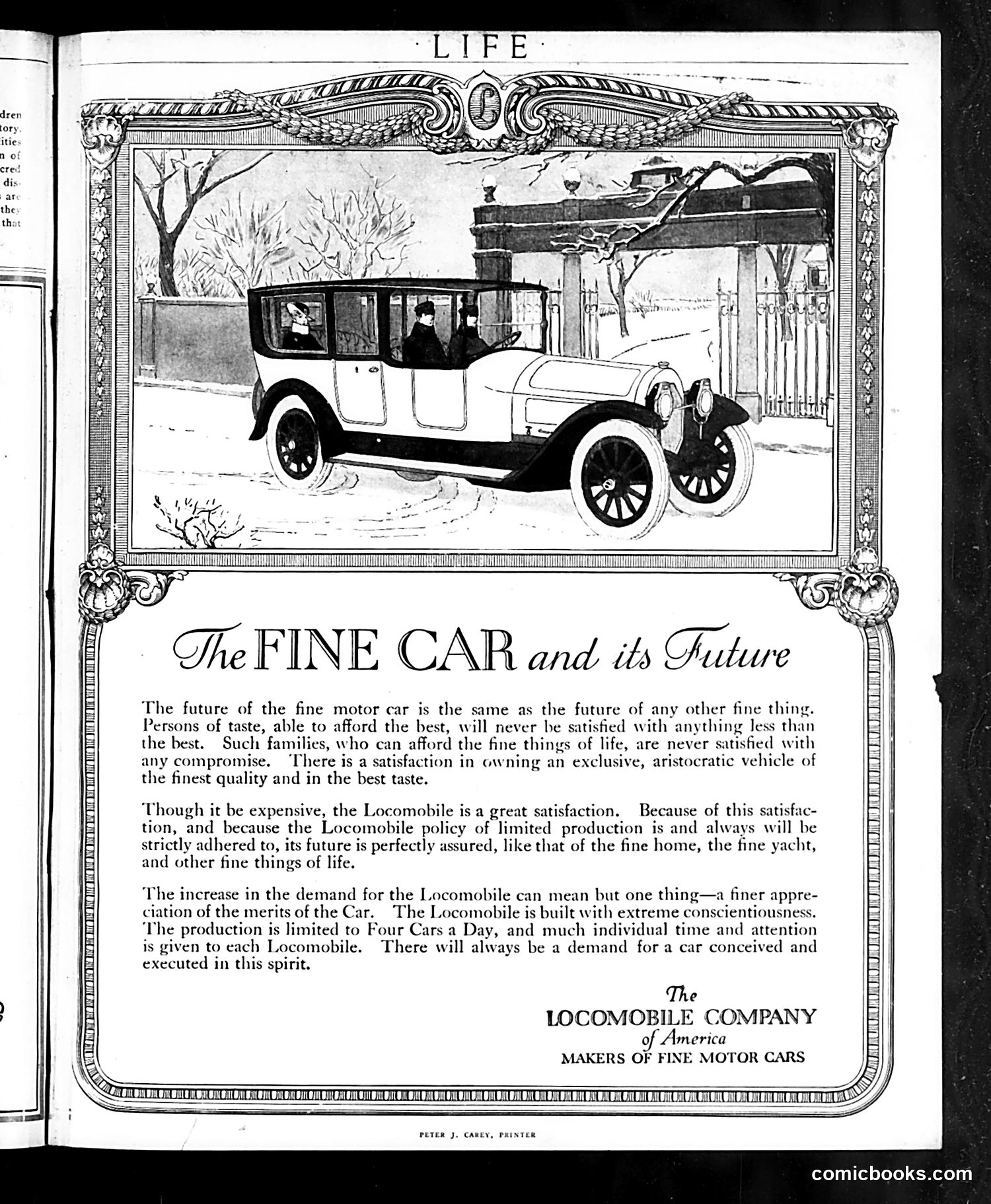
This is not a satirical cartoon but a **luxury automobile advertisement** for the Locomobile Company, published in Life magazine. The page features an illustration of an early 1900s automobile with passengers, accompanied by marketing copy that positions the Locomobile as an exclusive, high-end product for wealthy consumers of refined taste. The advertisement emphasizes: - **Exclusivity through scarcity**: Limited production of "Four Cars a Day" ensures aristocratic exclusiveness - **Class appeal**: Comparisons to "fine homes" and "fine yachts" position ownership as a status symbol - **Craftsmanship**: Individual attention to each vehicle justifies premium pricing The rhetorical strategy targets affluent readers by equating car ownership with cultural sophistication and distinguishing the Locomobile from mass-produced competitors through artificial scarcity and artisanal production methods. This reflects early automotive marketing when cars were luxury goods for the wealthy, before mass production democratized automobile ownership.
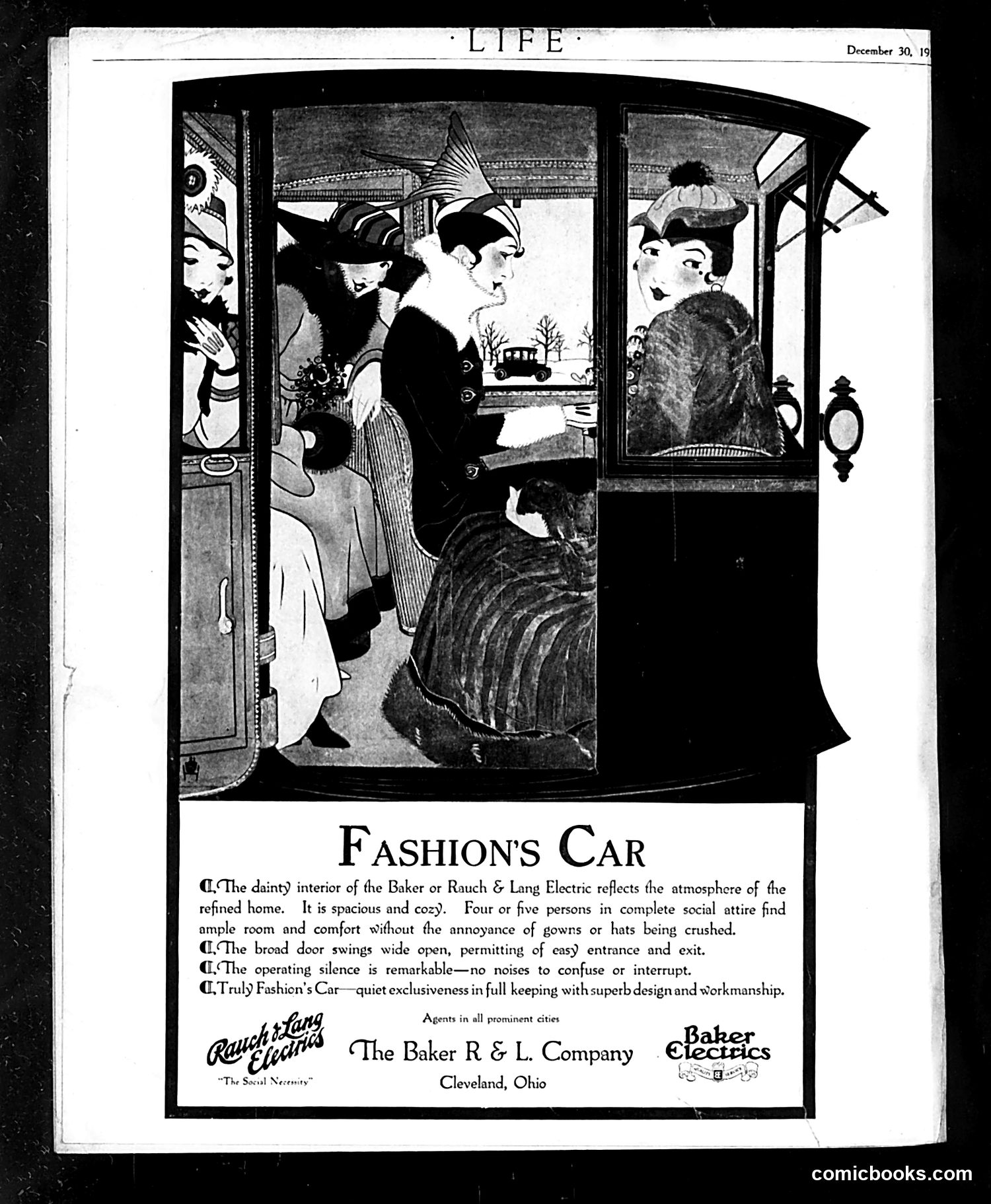
This is a full-page advertisement, not satire, promoting the Baker or Rauch & Lang Electric automobile (Cleveland, Ohio). The illustration shows fashionably dressed women entering a luxury car, emphasizing its appeal to wealthy, refined clientele. The ad's humor lies in its marketing strategy: it emphasizes that the car's spacious interior won't crush women's elaborate hats and gowns—a genuine concern for early 1900s fashion. The "quiet" electric engine (versus loud gasoline cars) is presented as refined and genteel. The tagline "Fashion's Car" positions the vehicle as a status symbol for the social elite. The ad targets women specifically, suggesting that electric cars—quieter, cleaner, and easier to operate than gas vehicles—were marketed as appropriately feminine luxury items for the fashionable classes during this era.

I can see this is a heavily darkened historical page from Life magazine, but the image is too dark and degraded for me to reliably make out specific cartoon details, text content, or identify particular figures with confidence. While I can discern there appears to be some patterned or repeated imagery in the center portion of the page, I cannot determine what specific political figures, events, or satirical points are being referenced. To provide accurate historical context as instructed, I would need a clearer, higher-contrast version of this page. I cannot responsibly invent details about the cartoons' meaning or subjects when I cannot see them clearly.