
Life, 1915-12-30 · page 19 of 41
Life — December 30, 1915 — page 19: what you’re looking at
What you’re looking at
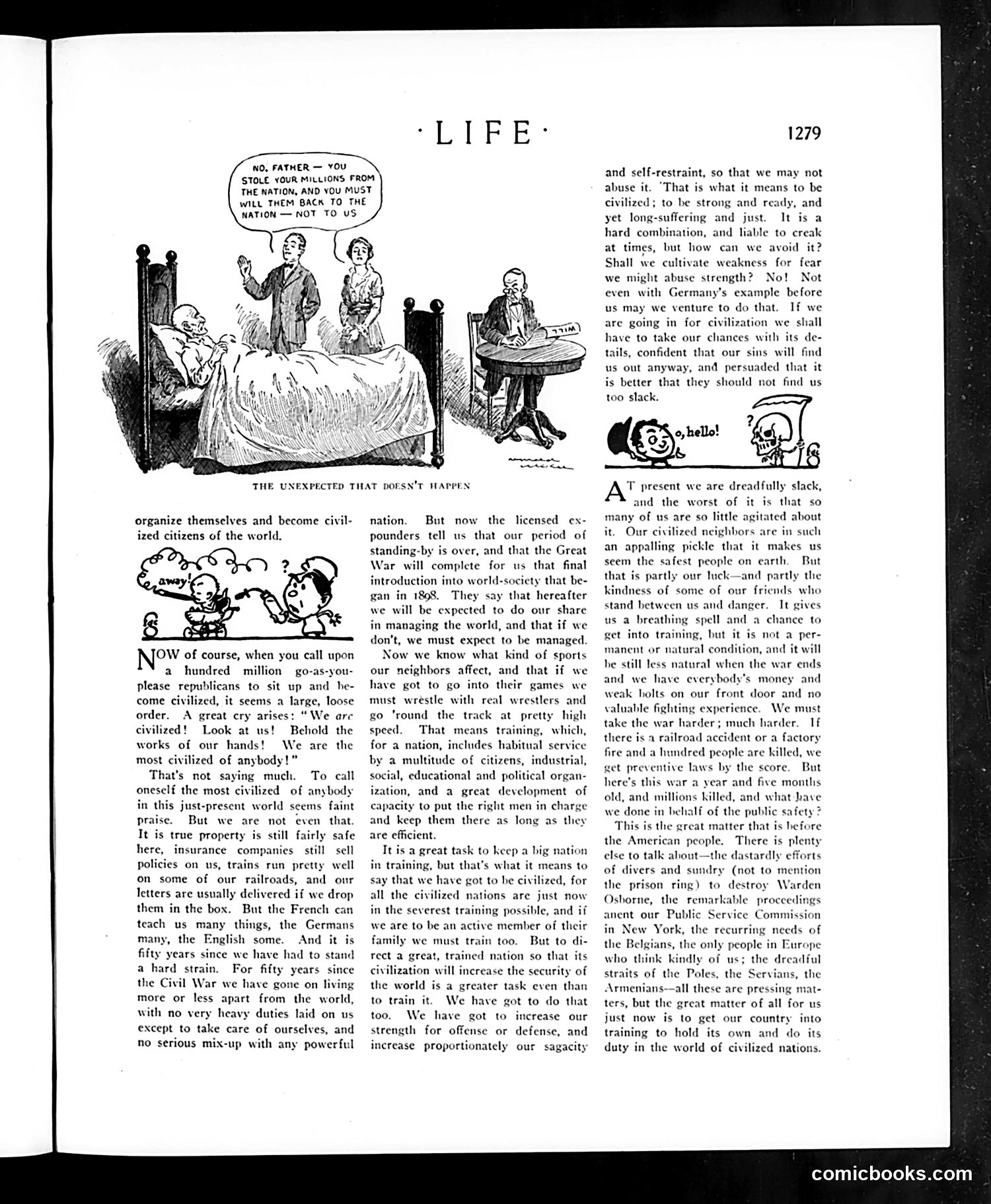
**The Main Cartoon:** A deathbed scene shows a wealthy father being confronted by his son, who declares the millions stolen from the nation must be returned to it—not inherited by the family. This satirizes Gilded Age wealth accumulation and argues for wealth redistribution or taxation of ill-gotten gains. **The Article's Context:** Written during WWI (references to "the Great War"), this piece argues America must abandon isolationism and become a disciplined, trained nation capable of participating in world affairs. The author contends that civilization requires military preparedness, industrial organization, and moral restraint—not weakness. **The Satire:** Life mocks American self-satisfaction about being "civilized" while actually being unprepared and complacent. The article criticizes the nation's fifty years of relative peace without serious duties, suggesting this has made Americans soft and undisciplined compared to European powers actively engaged in warfare. The page connects personal corruption (the cartoon) with national unreadiness (the editorial), arguing both undermine true civilization.
📄 Transcribed text from this page (OCR, searchable)
Machine-transcribed from the original scan — historical spelling and the odd misread are preserved.
NO, FATHER — YOU STOLE YOUR MILLIONS FROM THE NATION, AND YOU MUST WILL THEM BACK TO THE NATION — NOT TO US af ey 4 his PANY THE UN organize themselves and become civil- ized citizens of the world. OW of course, when you call upon a hundred million go-as-you- please republicans to sit up and he- come civilized, it seems a large, loose order. A great cry arises: “We arc civilized! Look at us! Behold the works of our hands! We are the most civilized of anybody!” That's not saying much. To call oneself the most civilized of anybody in this just-present world seems faint Praise. But we are not even that It is true property is still fairly safe here, insurance companies still sell policies on us, trains run pretty well on some of our railroads, and our letters are usually delivered if we drop them in the box. But the French can teach us many things, the Germans many, the English some. And it is fifty years since we have had to stand a hard strain. For fifty years the Civil War we have gone on living more or less apart from the world, with no very heavy duties laid on us except to take care of ourselves, and no serious mix-up with any powerful PECTED THAT DOFS HAPPEN nation. But now the licensed ex- pounders tell us that our period of standing-by is over, and that the Great War will complete for us that final introduction into world-socicty that be- gan in 1898. They say that hereafter we will be expected to do our share in managing the world, and that if we don’t, we must expect to be managed. Now we know what kind of sports our neighbors affect, and that we have got to go into their games we must wrestle with real wrestlers and go ‘round the track at pretty high speed. That means training, which, for a nation, includes habitual service by a multitude of citizens, industrial, social, educational and political organ- ization, and a great development of capacity to put the right men in charge and keep them there as long as they are efficient. It is a great task to keep a big nation in training, but that’s what it means to y that we have got to he civilized, for all the civilized nations are just now in the severest training possible, and if we are to be an active member of their family we must train too. But to di- rect a great, trained nation so that its civilization will increase the security of the world is a greater task even than to train it. We have got to do that too. We have got to increase our strength for offense or defense, and increase proportionately our sagacity 1279 and self-restraint, so that we may not abuse it. "That is what it means to be civilized; to be strong and ready, and yet long-suffering and just. It is a hard combination, and liable to creak at times, but how can we avoid it? Shall we cultivate weakness for fear we might abuse strength? No! Not even with Germany's example before us may we venture to do that. If we are going in for civilization we shall have to take our chances with its de- tails, confident that our sins will find us out anyway, and persuaded that it is better that they should not find us too slack. T present we are dreadfully slack, and the worst of it is that so many of us are so little agitated about it. Our civilized neighbors an appalling pickle that it makes us seem the safest people on earth. But that is partly our Iuck—and partly the kindness of some of our friends who stand between us and danger. It gives us a breathing spell and a chance to get into training, but it is not a per- manent or natural condition, and it will he still less natural when the war ends and we have everybody's money and weak holts on our front door and no valuable fighting experience. We must take the war harder; much harder. If there is a railroad accident or a factory fire and a hundred people are killed, we get preventive y the score. But here's this war a year and five months old, and millions killed, and what have we done in hehalf of the public safety? This is the great matter that is before the American people. There is plenty else to talk about—the dastardly efforts of divers and sundry (not to mention the prison ring) to destroy Warden Oshorne, the remarkable proceedings anent our Public Service Commission in New York, the recurring needs of the Belgians, the only people in Europe who think kindly of us; the dreadful straits of the Poles, the Servians, the Armenians-all these are pressing mat- ters, but the great matter of all for us just now is to get our country into training to hold its own and do its duty in the world of civilized nations. ire in such comicbooks.com