
Life, 1915-12-30 · page 29 of 41
Life — December 30, 1915 — page 29: what you’re looking at
What you’re looking at
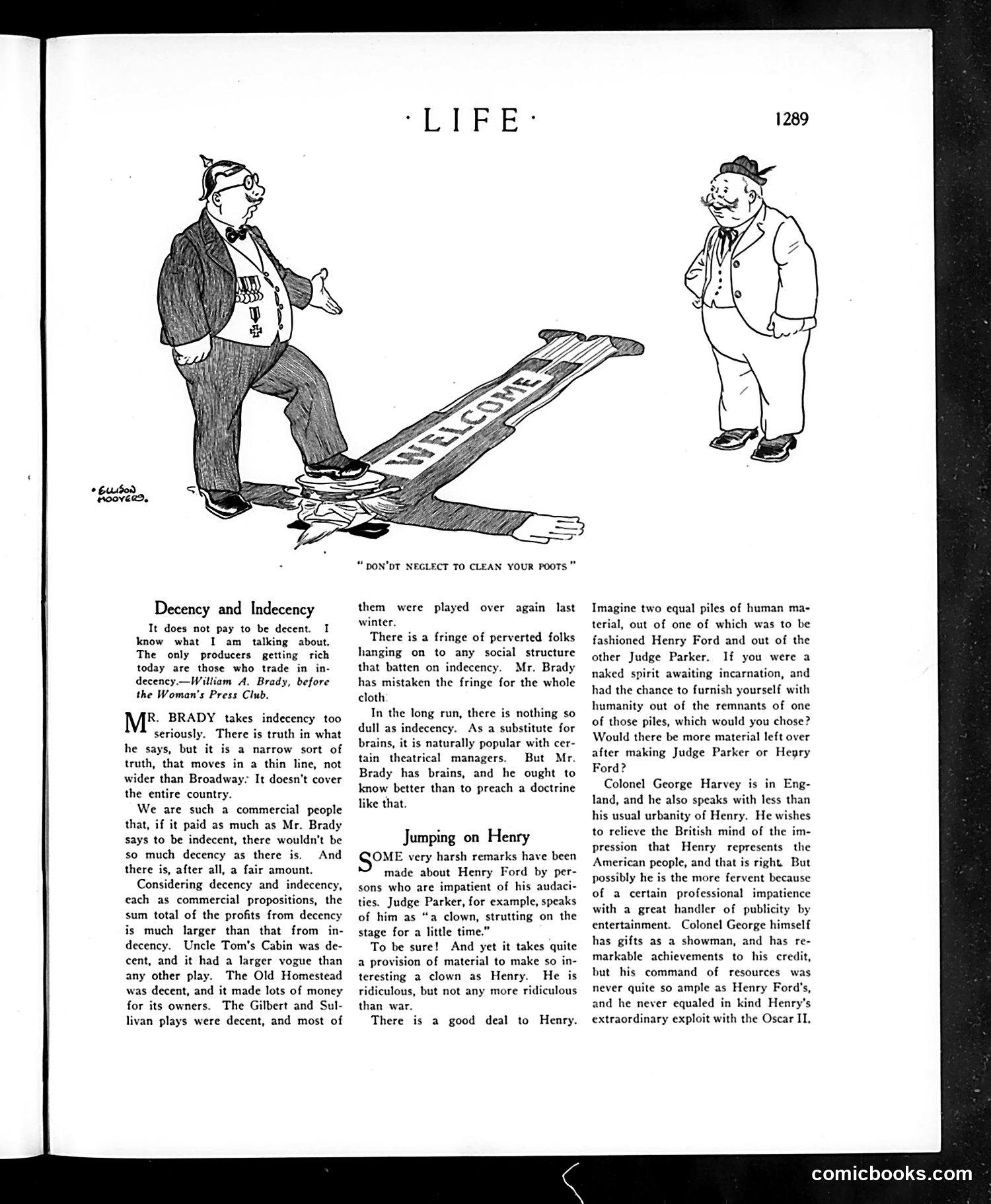
## The Cartoon The illustration satirizes hypocrisy about propriety. One well-dressed man stands on a "DECENCY" plank while gesturing dismissively; the plank has collapsed beneath another man. The caption reads "DON'T NEGLECT TO CLEAN YOUR FOOTS" — deliberately misspelling "feet" to suggest crude behavior underlying claims of respectability. ## The Articles' Context **"Decency and Indecency"** responds to theatrical producer William A. Brady's claim that indecency is profitable. Life argues Brady overstates this; decent works like *Uncle Tom's Cabin* and Gilbert & Sullivan operettas earned substantial profits. **"Jumping on Henry"** defends Henry Ford against criticism from Judge Alton B. Parker and Colonel George Harvey, who mock Ford as a ridiculous "clown." Life argues Ford's accomplishments (manufacturing innovation, the Oscar II peace ship) demonstrate real achievement beyond mere showmanship—suggesting his critics are envious rather than justified. Both pieces champion substance over pretense, matching the cartoon's message about hidden indecency beneath claims of decency.
📄 Transcribed text from this page (OCR, searchable)
Machine-transcribed from the original scan — historical spelling and the odd misread are preserved.
Decency and Indecency Tt does not pay to be decent. I know what I am talking about. The only producers getting rich today are those who trade in in- decency.—William A. Brady, before the Woman's Press Club. R. BRADY takes indecency too seriously. There is truth in what he says, but it is a narrow sort of truth, that moves in a thin line, not wider than Broadway: It doesn’t cover the entire country. We are such a commercial people that, if it paid as much as Mr. Brady says to be indecent, there wouldn't be so much decency as there is. And there is, after all, a fair amount. Considering decency and indecency, each as commercial propositions, the sum total of the profits from decency is much larger than that from in- decency. Uncle Tom's Cabin was de- cent, and it had a larger vogue than any other play. The Old Homestead was decent, and it made lots of money for its owners. The Gilbert and Sul- livan plays were decent, and most of “ DON'’DT NEGLECT TO CLEAN YOUR POOTS” them were played over again last winter. There is a fringe of perverted folks hanging on to any social structure that batten on indecency. Mr. Brady has mistaken the fringe for the whole cloth In the long run, there is nothing so dull as indecency. As a substitute for brains, it is naturally popular with cer- tain theatrical managers. But Mr. Brady has brains, and he ought to know better than to preach a doctrine like that. Jumping on Henry Some very harsh remarks have been made about Henry Ford by per- sons who are impatient of his audaci- ties. Judge Parker, for example, speaks of him as “a clown, strutting on the stage for a little time.” To be sure! And yet it takes quite a provision of material to make so in: teresting a clown as Henry. He is ridiculous, but not any more ridiculous than war. There is a good deal to Henry. Imagine two equal piles of human ma- terial, out of one of which was to be fashioned Henry Ford and out of the other Judge Parker. If you were a naked spirit awaiting incarnation, and had the chance to furnish yourself with humanity out of the remnants of one of those piles, which would you chose? Would there be more material left over after making Judge Parker or Hegry Ford? Colonel George Harvey is in Eng- land, and he also speaks with less than his usual urbanity of Henry. He wishes to relieve the British mind of the im- pression that Henry represents the American people, and that is right. But possibly he is the more fervent because of a certain professional impatience with a great handler of publicity by entertainment. Colonel George himself has gifts as a showman, and has re- markable achievements to his credit, but his command of resources was never quite so ample as Henry Ford's, and he never equaled in kind Henry's extraordinary exploit with the Oscar II, comicbooks.com