
Life, 1915-12-30 · page 22 of 41
Life — December 30, 1915 — page 22: what you’re looking at
What you’re looking at
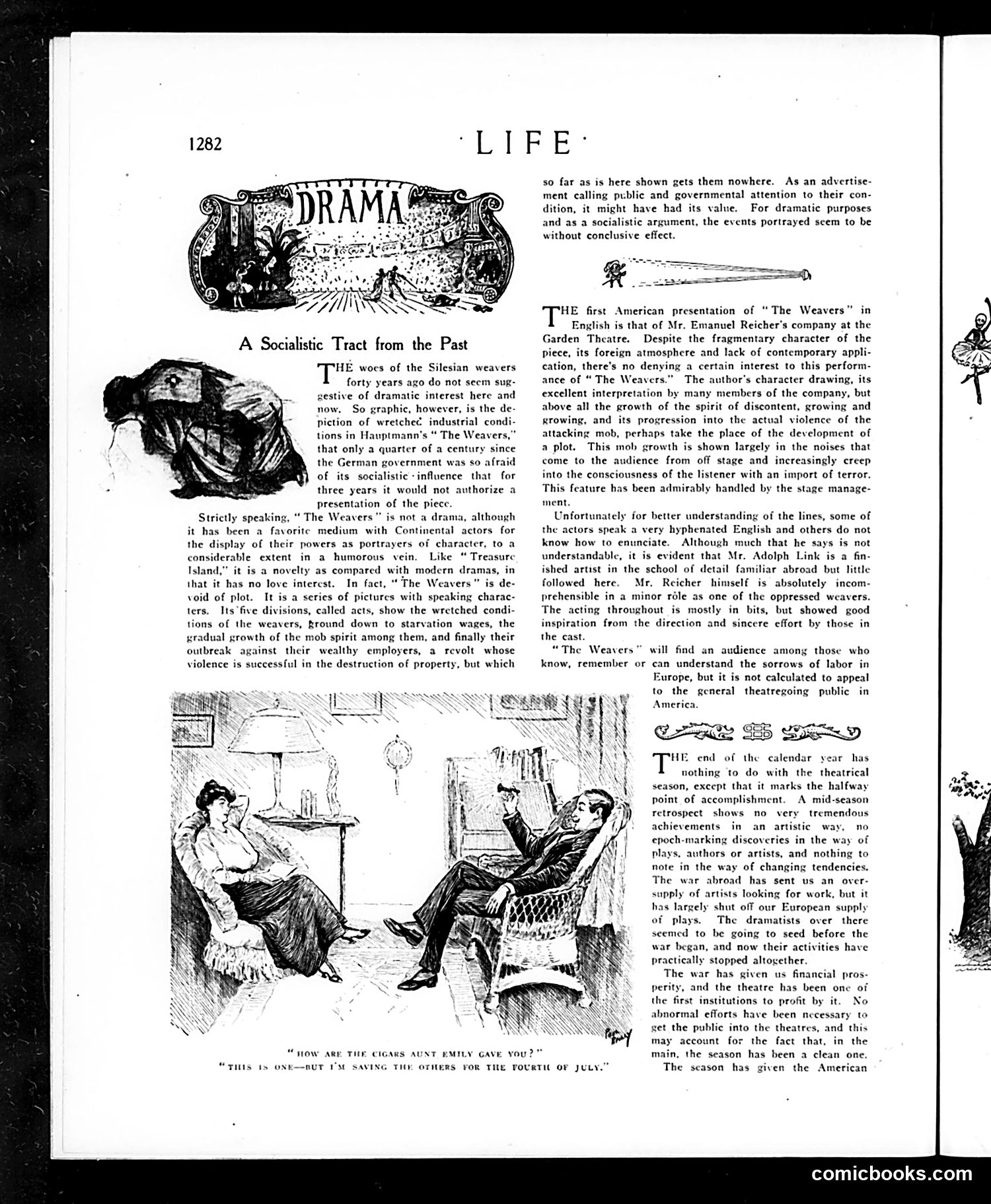
This page reviews Emanuel Reicher's American production of Gerhart Hauptmann's "The Weavers," a controversial German play about Silesian textile workers' rebellion against exploitation. **The Context:** The German government had banned the play for three years, fearing its socialist message would incite unrest. Life's critic acknowledges the work's dramatic power in depicting workers' progressive radicalization—from starvation wages to violent mob uprising—but questions its effectiveness as either drama or propaganda in America. **The Satire/Critique:** The review dismisses the play's relevance to American audiences unfamiliar with European labor struggles. The critic notes excellent staging (particularly the mounting off-stage mob sounds creating dread) and some fine acting, but criticizes unclear diction and questions whether foreign labor politics can engage the "general theatregoing public in America"—suggesting American audiences lack both knowledge of and sympathy for European working-class suffering. The cartoon caption below depicts casual domestic life, contrasting the play's serious subject matter with American indifference.
📄 Transcribed text from this page (OCR, searchable)
Machine-transcribed from the original scan — historical spelling and the odd misread are preserved.
‘LIFE’ A Socialistic Tract from the Past HE woes of the Silesian weavers forty years ago do not secm sug- gestive of dramatic interest here and now. So graphic, however, is the de- piction of wretchee industrial cond tions in Hauptmann’s “ The Weavers, that only a quarter of a century since the German government was so afraid of its socialistic -influence that for three years it would not authorize a presentation of the piece. Strictly speaking, “ The Weavers” is not a drama, although it has been a favorite medium with Continental actors for the display of their powers as portrayers of character, to a considerable extent in a humorous vein. Like “ Treasure Island,” it is a novelty as compared with modern dramas, in that it has no love interest. In fact, * The Weavers” is de- void of plot. It is a series of pictures with speaking charac- ters, Its ‘five divisions, called acts, show the wretched condi- tions of the weavers, Rround down to starvation wages, the gradual growth of the mob spirit among them, and finally their outbreak against their wealthy employers, a revolt whose violence is successful in the destruction of property, but which so far as is here shown gets them nowhere. As an advertise- ment calling public and governmental attention to their con- dition, it might have had its value. For dramatic purposes and as a socialistic argument, the events portrayed scem to be without conclusive effect. HE first American presentation of “The Weavers” in English is that of Mr. Emanuel Reicher’s company at the Garden Theatre. Despite the fragmentary character of the piece, its foreign atmosphere and lack of contemporary appli- cation, there's no denying a certain interest to this perform- ance of “The Weavers.” The author's character drawing, its excellent interpretation by many members of the company, but above all the growth of the spirit of discontent, growing and growing, and its progression into the actual violence of the attacking mob, perhaps take the place of the development of a plot. This mob growth is shown largely in the noises that come to the audience from off stage and increasingly creep into the consciousness of the listener with an import of terror. This feature has been admirably handled by the stage manage- ment. Unfortunately for better understanding of the lines, some of the actors speak a very hyphenated English and others do not know how to enunciate. Although much that he says is not understandable, it is evident that Mr. Adolph Link is a fin- ished artist in the school of detail familiar abroad but little followed here. Mr. Reicher himself is absolutely incom- prehensible in a minor rdle as one of the oppressed weavers. The acting throughout is mostly in bits, but showed good inspiration from the direction and sincere effort by those in the cast “The Weavers” will find an audience among those who know, remember or can understand the sorrows of labor in Europe, but it is not calculated to appeal to the general theatregoing public in America. CAE 5 SED HE end of the calendar year has nothing to do with the theatrical season, except that it marks the halfway point of accomplishment. A mid-season retrospect shows no very tremendous achievements in an artistic way, no epoch-marking discoveries in the way of plays, authors or artists, and nothing to note in the way of changing tendencies. The war abroad has sent vs an ove supply of artists looking for work, but it has largely shut off our European supply of plays. The dramatists over there seemed to be going to seed before the war began, and now their activities have practically stopped altogether. The war has given us financial pros- perity, and the theatre has been one of the first institutions to profit by it. No abnormal efforts have been necessary get the public into the theatres, and this may account for the fact that, in the HOW ARE THE CIGARS AUNT EMILY Gave you?” main, the season has been a clean one. “THIS Is ONE—NUT MMC SAVING THO: OTHERS FOR THE FOURTIC OF JULY.” The season has given the American comicbooks.com