
Life, 1915-12-30 · page 33 of 41
Life — December 30, 1915 — page 33: what you’re looking at
What you’re looking at
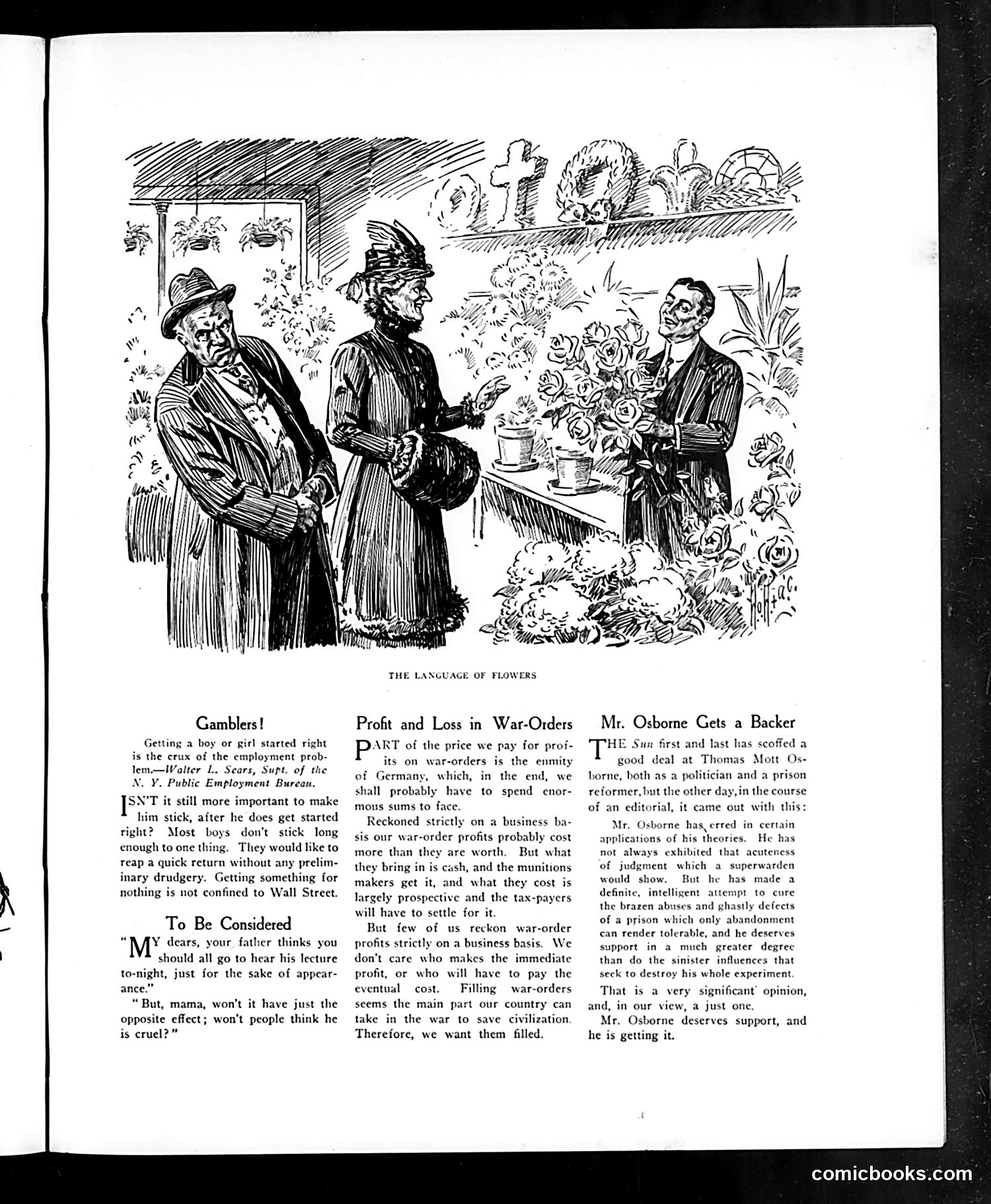
**The Cartoon**: "The Language of Flowers" shows three well-dressed men in a cemetery examining potted flowers, apparently conducting business amid gravestones and crosses—a darkly ironic juxtaposition. **Content Overview**: This page contains three distinct satirical pieces criticizing contemporary American attitudes: 1. **"Gamblers"** mocks young workers seeking quick returns without effort, comparing this mentality to Wall Street speculation. 2. **"Profit and Loss in War-Orders"** critiques munitions manufacturers profiting from WWI contracts while taxpayers will eventually bear Germany's enmity costs—highlighting how private gain shifts public burden. 3. **"Mr. Osborne Gets a Backer"** notes the *Sun* newspaper's grudging support for prison reformer Thomas Mott Osborne, suggesting even skeptics recognize his legitimate efforts despite disagreeing with specific methods. The cartoon's cemetery setting reinforces the dark commentary: business and profit-seeking persist even amid death—literally and figuratively, regarding war profiteering's human costs.
📄 Transcribed text from this page (OCR, searchable)
Machine-transcribed from the original scan — historical spelling and the odd misread are preserved.
Gamblers! Getting a boy or girl started right is the crux of the employment prob- lem—IWalter L. Sears, Supt. of the N.Y. Public Employment Bureau. | aaa it still more important to make him stick, after he does get started right? Most boys don't stick long enough to one thing. They would like to reap a quick return without any prelim- inary drudgery. Getting something for nothing is not confined to Wall Street. To Be Considered = Y dears, your father thinks you should all go to hear his lecture to-night, just for the sake of appear- ance. “But, mama, won't it have just the opposite effect; won't people think he is cruel?” THE LANGUAGE OF FLOWERS Profit and Loss in War-Orders ART of the price we pay for prof- its on war-orders is the enmity of Germany, which, in the end, we shall probably have to spend enor- mous sums to face. Reckoned strictly on a business ba- sis our war-order profits probably cost more than they are worth. But what they bring in is cash, and the munitions makers get it, and what they cost is largely prospective and the tax-payers will have to settle for it. But few of us reckon war-order profits strictly on a business basis. We don’t care who makes the immediate profit, or who will have to pay the eventual cost. Filling war-orders. seems the main part our country can take in the war to save civilization Therefore, we want them filled. Mr. Osborne Gets a Backer HE Sun first and last has scoffed a good deal at Thomas Mott Os- borne, both as a politician and a prison reformer, but the other day,in the course of an editorial, it came out with this: Mr. Osborne has, erred in certain applications of his theories. He has not always exhibited that acuteness of judgment which a superwarden would show. But he definite, intelligent attempt to cure the brazen abuses and ghastly defects of a prison which only abandonment can render tolerable, and he deserves support in a much greater degree than do the sinister influences that seek to destroy his whole experiment has made a That is a very significant’ opinion, and, in our view, a just one. Mr. Osborne deserves support, he is getting it. and comicbooks.com