
Life, 1915-12-30 · page 32 of 41
Life — December 30, 1915 — page 32: what you’re looking at
What you’re looking at
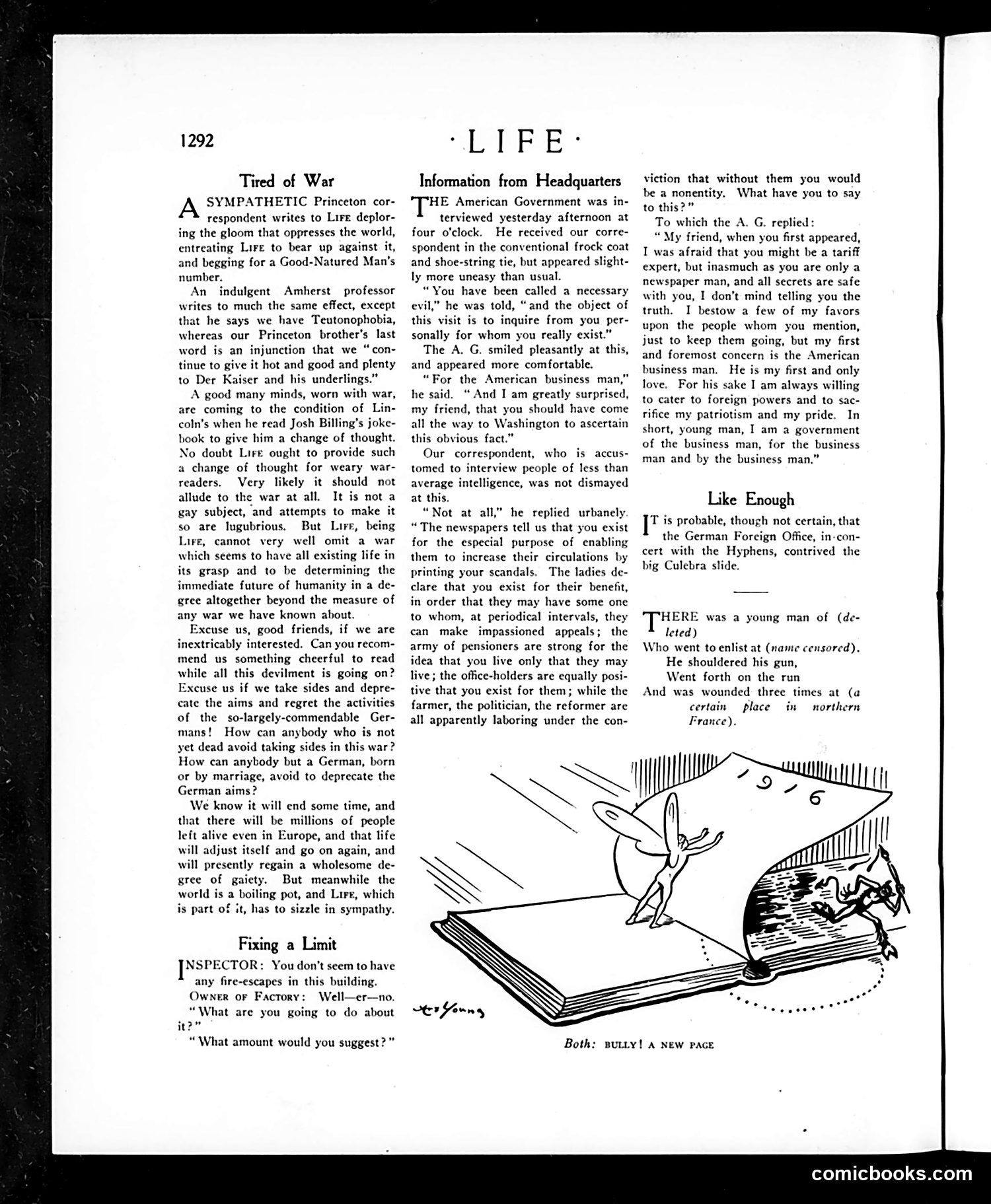
This page contains three distinct satirical pieces from an American wartime publication (appears to be WWI era, given references to "Der Kaiser"). **"Tired of War"**: An editorial defending Life's continued focus on World War I, responding to readers requesting cheerful distraction. Life argues the war is too consequential to ignore, and asks how anyone could remain neutral—particularly anyone not German-born. **"Information from Headquarters"**: Satirizes the U.S. Attorney General as serving exclusively "the American business man," while other groups (newspapers, ladies, pensioners, office-holders, farmers, politicians, reformers) each believe he exists for *their* benefit. The joke: the AG admits his true constituency is business interests. **"Fixing a Limit"**: A brief joke about factory safety—an inspector questions missing fire-escapes; the owner, asked what he'd suggest, deflects by asking "what amount" (implying a bribe), exposing regulatory corruption. The cartoon depicts a book being turned into a "new page," satirizing turning a page on unpleasant subjects.
📄 Transcribed text from this page (OCR, searchable)
Machine-transcribed from the original scan — historical spelling and the odd misread are preserved.
1292 Tired of War A SYMPATHETIC Princeton cor- respondent writes to Lire deplor- ing the gloom that oppresses the world, entreating Lire to bear up against it, and begging for a Good-Natured Man's number. An indulgent Amherst professor writes to much the same effect, except that he says we have Teutonophobia, whereas our Princeton brother's last word is an injunction that we “con- tinue to give it hot and good and plenty to Der Kaiser and his underlings.” ‘A good many minds, worn with war, are coming to the condition of Lin- coln's when he read Josh Billing’s joke- book to give him a change of thought. No doubt Lire ought to provide such a change of thought for weary war- readers. Very likely it should not allude to the war at all. It is not a gay subject, and attempts to make it so are lugubrious. But Lire, being Lire, cannot very well omit a war which seems to have all existing life in its grasp and to be determining the immediate future of humanity in a de- gree altogether beyond the measure of any war we have known about. cuse us, good friends, if we are inextricably interested. Can you recom- mend us something cheerful to read while all this devilment is going on? xeuse us if we take sides and depre- cate the aims and regret the activities of the so-largely-commendable Ger- mans! How can anybody who is not yet dead avoid taking sides in this war? How can anybody but a German, born or by marriage, avoid to deprecate the German aims? We know it will end some time, and that there will be millions of people left alive even in Europe, and that life will adjust itself and go on again, and will presently regain a wholesome de- gree of gaiety. But meanwhile the world is a boiling pot, and Lire, which is part of it, has to sizzle in sympathy. Fixing a Limit NSPECTOR: You don't seem to have any fire-escapes in this building. Owner or Factory: Well—er—no. “What are you going to do about it?” “What amount would you suggest?” i Information from Headquarters HE American Government was in- terviewed yesterday afternoon at four o'clock. He received our corre- spondent in the conventional frock coat and shoe-string tie, but appeared slight- ly more uneasy than usual. “You have been called a necessary evil,” he was told, “and the object of this it is to inquire from you per- sonally for whom you really exist.” The A. G. smiled pleasantly at this, and appeared more comfortable. “For the American business man,” he said. nd I am greatly surprised, my friend, that you should have come all the way to Washington to ascertain this obvious fact.” Our correspondent, who is accus- tomed to interview people of less than average intelligence, was not dismayed at this. “Not at all,” he replied urbanely. “The newspapers tell us that you exist for the especial purpose of enabling them to increase their circulations by printing your scandals. The ladies de- clare that you exist for their benefit, in order that they may have some one to whom, at periodical intervals, they can make impassioned appeals; the army of pensioners are strong for the idea that you live only that they may ¢; the office-holders are equally posi- tive that you exist for them; while the farmer, the politician, the reformer are all apparently laboring under the con- viction that without them you would be a nonentity. What have you to say to this?” To which the A, G. replied: “My friend, when you first appeared, I was afraid that you might be a tariff expert, but inasmuch as you are only a newspaper man, and all secrets are safe with you, I don’t mind telling you the truth. I bestow a few of my favors upon the people whom you mention, just to keep them going, but my first and foremost concern is the American business man. He is my first and only love. For his sake I am always willing to cater to foreign powers and to sac- rifice my patriotism and my pride. In short, young man, I am a government of the business man, for the business man and by the business man.” Like Enough T is probable, though not certain, that the German Foreign Office, in-con- cert with the Hyphens, contrived the big Culebra slide. 'HERE was a young man of (de- leted) Who went to enlist at (name censored). He shouldered his gun, Went forth on the run And was wounded three times at (a certain place in northern France). Both: putty! A NEW PAGE comicbooks.com