
Life, 1915-12-30 · page 18 of 41
Life — December 30, 1915 — page 18: what you’re looking at
What you’re looking at
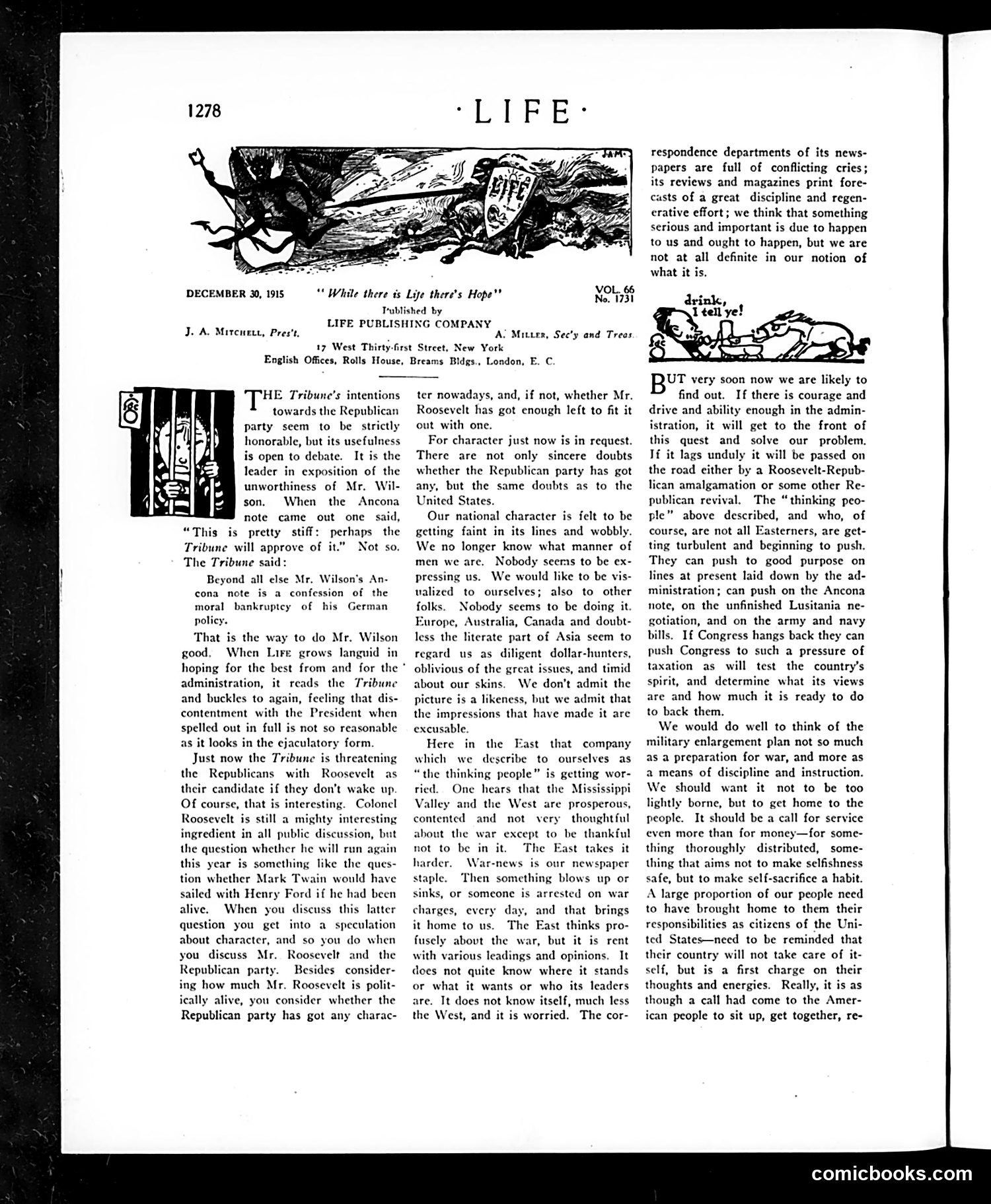
This page critiques American national character during World War I. The main cartoon (top) depicts a sinking ship labeled with classical imagery, representing America's moral and political drift. The accompanying editorial discusses the **Tribune newspaper's** criticism of President Wilson's foreign policy, particularly his response to the *Ancona* (an Italian ship sunk by Germans). Life praises the Tribune for holding Wilson accountable while questioning whether the Republican Party has "character" to field a strong alternative—possibly **Theodore Roosevelt**. The core satire: America is perceived internationally as money-obsessed and morally weak. The East Coast intelligentsia feel anxiety about the war; the prosperous Midwest remains indifferent. Life argues Americans have lost self-knowledge and national purpose. The piece suggests military preparedness and national discipline could restore American character. This reflects pre-1917 American debate over neutrality, preparedness, and whether the nation had coherent values beyond commercial interests.
📄 Transcribed text from this page (OCR, searchable)
Machine-transcribed from the original scan — historical spelling and the odd misread are preserved.
DECEMBER 30, 1915 ‘* While there ts Lise there's Hope"’ No. 1731 Tublished by LIFE PUBLISHING COMPANY J. A. Mitcuent, Pres't, Al Mittes, Sec'y and Treas. 17 West Thirty-first Street, New York English Offices, Rolls House, Breams Bldgs., London, E. C. HE Tribune's intentions towards the Republican party seem to be. strictly honorable, but its usefulness is open to debate. It is the leader in exposition of the unworthiness of Mr. Wil- son. When the Ancona note came out one said, “This is pretty stiff: perhaps the Tribune will approve of it.” Not so. The Tribune said: Beyond all else Mr. Wilson's An- cona note is a confession of moral bankruptcy of his German policy. That is the way to do Mr. Wilson good, When Lire grows languid in hoping for the best from and for the * administration, it reads the Tribune and buckles to again, feeling that dis- contentment with the President when spelled out in full is not so reasonable as it looks in the ejaculatory form. Just now the Tribune is threatening the Republicans with Roosevelt as their candidate if they don’t wake up. Of course, that is interesting. Colonel Roosevelt is still a mighty interesting ingredient in all public discussion, but the question whether he will run ag: this year is something like the ques- tion whether Mark Twain would have sailed with Henry Ford if he had been alive. When you discuss this latter question you get into a speculation about character, and so you do when you discuss Mr. Roosevelt and the Republican party. Besides consider- ing how much Mr. Roosevelt is polit- ically alive, you consider whether the Republican party has got any charac- ter nowadays, and, if not, whether Mr. Roosevelt has got enough left to fit it out with one. For character just now is in request. There are not only sincere doubts whether the Republican party has got any, but the same doubts as to the United States. Our national character is felt to be getting faint in its lines and wobbly. We no longer know what manner of men we are. Nobody seeras to be ex- pressing us. We would like to be vi to ourselves; also to other folks. Nobody seems to be doing it. Europe, Australia, Canada and doubt- the literate part of Asia seem to regard us as diligent dollar-hunters, oblivious of the great issues, and timid about our skins. We don’t admit the picture is a likeness, but we admit that the impressions that have made it are excusable, Here in the East that company which we describe to ourselves as “the thinking people” is getting wor- ried. One hears that the Mississippi ‘alley and the West are prosperous, contented and not very thoughtful ahout the war except to be thankful not to be in it. The t takes it harder. War-news is our newspaper staple. Then something blows up or sinks, or someone is arrested on war ualized charges, every day, and that brings it home to us. The East thinks pro- fusely abovt the war, but it is rent with various leadings and opinions. It does not quite know where it stands or what it wants or who its leaders are. It does not know itself, much less the West, and it is worried. The cor- respondence departments of its news- papers are full of conflicting cries; its reviews and magazines print fore- casts of a great discipline and regen- erative effort; we think that something serious and important is due to happen to us and ought to happen, but we are not at all definite in our notion of what it is. UT very soon now we are likely to find out. If there is courage and drive and ability enough in the admin- istration, it will get to the front of this quest and solve our problem. If it lags unduly it will be passed on the road either by a Roosevelt-Repub- lican amalgamation or some other Re- publican revival. The “thinking peo- ple” above described, and who, of course, are not all Easterners, are get- ting turbulent and beginning to push. They can push to good purpose on lines at present laid down by the ad- ministration; can push on the Ancona note, on the unfinished Lusitania ne- gotiation, and on the army and navy bills. If Congress hangs back they can push Congress to such a pressure of taxation as will test the country’s spirit, and determine what its views are and how much it is ready to do to back them. We would do well to think of the military enlargement plan not so much as a preparation for war, and more as a means of discipline and instruction. We should want it not to be too lightly borne, but to get home to the people. It should be a call for service even more than for money—for some- thing thoroughly distributed, some- thing that aims not to make selfishness safe, but to make self-sacrifice a habit. A large proportion of our people need to have brought home to them their responsibilities as citizens of the Uni- ted States—need to be reminded that their country will not take care of it- self, but is a first charge on their thoughts and energies. Really, it is as though a call had come to the Amer- ican people to sit up, get together, re- comicbooks.com