
Life, 1915-12-30 · page 26 of 41
Life — December 30, 1915 — page 26: what you’re looking at
What you’re looking at
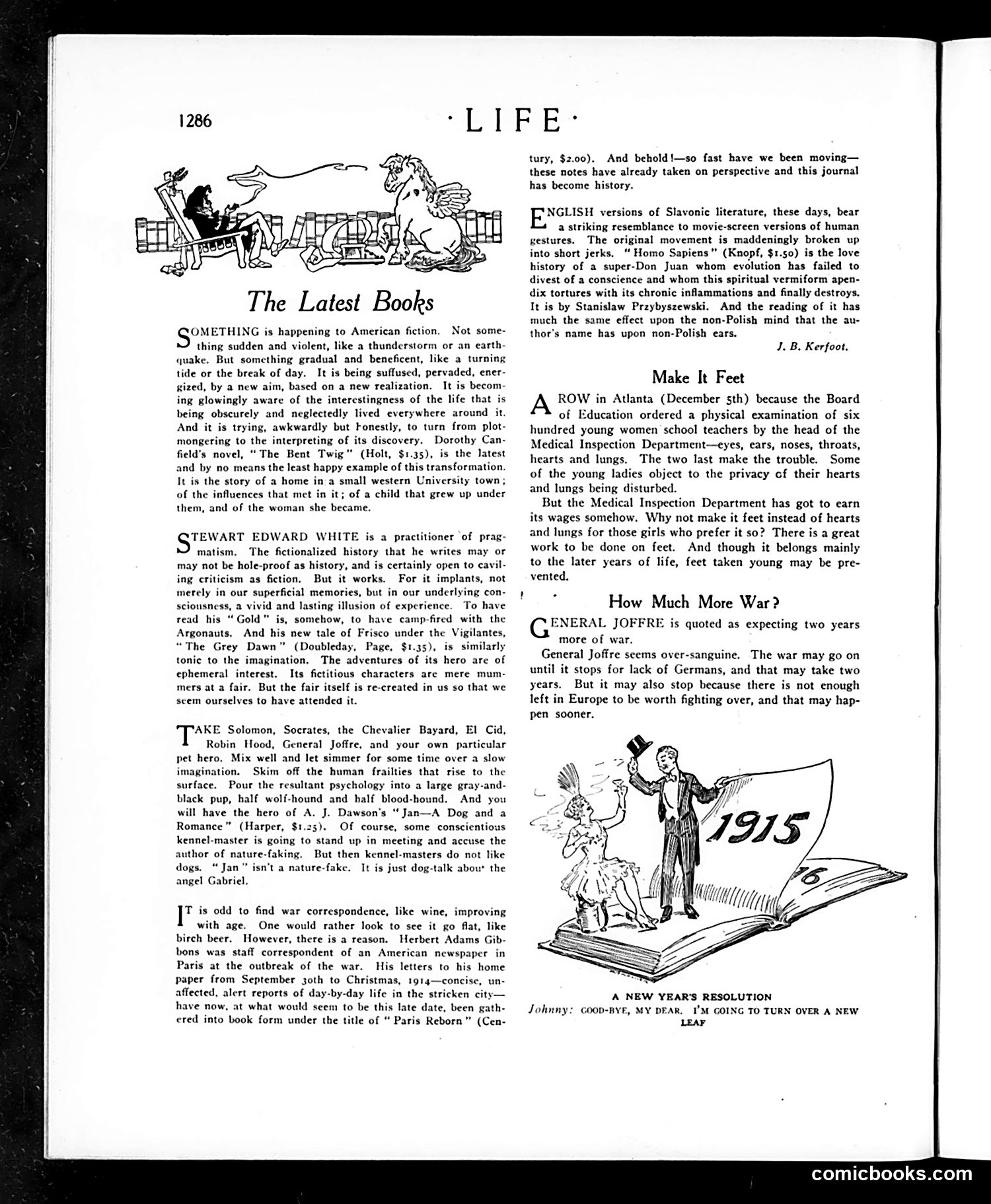
This page from Life magazine (likely early 1915, based on the "1915" reference in the cartoon) discusses contemporary American fiction and includes a satirical cartoon about New Year's resolutions. ## The Cartoon The illustration titled "A New Year's Resolution" shows a figure (labeled "Johnny") saying goodbye to 1914, depicted as turning over a new leaf. The cartoon satirizes the common tradition of making fresh starts on January 1st—a timeless, cyclical joke about people's aspirations versus their actual ability to change. ## The Text The "Latest Books" section reviews contemporary novels, praising a shift in American fiction toward realism—depicting ordinary life rather than plot-driven melodrama. It mentions works by Dorothy Canfield, Stewart Edward White, and A.J. Dawson, and discusses Herbert Adams Gibbons's wartime correspondence from Paris (1914), which the author notes has already become historical document, reflecting how rapidly World War I was reshaping events and perspective. The overall page reflects early-20th-century literary culture and wartime consciousness.
📄 Transcribed text from this page (OCR, searchable)
Machine-transcribed from the original scan — historical spelling and the odd misread are preserved.
7 BE The Latest Books OMETHING is happening to American fiction. thing sudden and violent, like a thunderstorm or an earth- quake. But something gradual and beneficent, like a turning tide or the break of day. It is being suffused, pervaded, ener- gized, by a new aim, based on a new realization. It is becom ing glowingly aware of the interestingness of the life that is being obscurely and neglectedly lived everywhere around it And it is trying, awkwardly but Fonestly, to turn from plot- mongering to the interpreting of its discovery. Dorothy Can- field’s novel, “The Bent Twig” (Holt, $1.35), is the latest and by no means the least happy example of this transformation It is the story of a home in a small western University town ; of the influences that met in it; of a child that grew up under them, and of the woman she became. Not some- TEWART matism. WARD WHITE is a practitioner “of prag- The fictionalized history that he writes may or may not be hole-proof as history, and is certainly open to cavil- ing criticism as fiction. But it works. For it implants, not merely in our superficial memories, but in our underlying con- sciousness, a id and lasting illusion of experience. To have read his “ Gold somehow, to have camp-fired with the Argonauts. And his new tale of Frisco under the Vigilantes, “The Grey Dawn” (Doubleday, Page, $1.35), is similarly tonic to the imagination, The adventures of its hero are of ephemeral interest. Its fictitious characters are mere mum- mers at a fair. But the fair itself is re-created in us so that we scem ourselves to have attended it. ‘AKE Solomon, Socrates, the Chevalier Bayard, El Ci Robin Hood, General Joffre, and your own particular pet hero, Mix well and let simmer for some time over a slow imagination. Skim off the human frailties that rise to the surface. Pour the resultant psychology into a large gray-and- black pup, half wolf-hound and half blood-hound. And you will have the hero of A. J. Dawson's “ Jan—A Dog and a Romance” (Harper, $1.25). Of course, some conscientious kennel-master is going to stand up in meeting and accuse the author of nature-faking. But then kennel-masters do not like dogs. “ Jan” isn’t a nature-fake. It is just dog-talk abou’ the angel Gabriel. T is odd to find war correspondence, like wine, improving with age. One would rather look to see it go flat, like birch beer. However, there is a reason. Herbert Adams Gib- bons was staff correspondent of an American newspaper in Paris at the outbreak of the war. His letters to his home paper from September 3oth to Christmas, 1914—concise, un- affected, alert reports of day-by-day life in the stricken city— have now, at what would seem to be this late date, been gath- ered into book form under the title of “ Paris Reborn” (Cen- Johnny: Goov-BYF, MY DEAR, tury, $2.00), And behold!—so fast have we been moving— these notes have already taken on perspective and this journal has become history. NGLISH versions of Slavonic literature, these days, bear a striking resemblance to movie-screen versions of human gestures. The original movement is maddeningly broken up into short jerks. “ Homo Sapiens” (Knopf, $1.50) is the love history of a super-Don Juan whom evolution has failed to divest of a conscience and whom this spiritual vermiform apen- dix tortures with its chronic inflammations and finally destroys. It is by Stanislaw Przybyszewski. And the reading of it has much the same effect upon the non-Polish mind that the au- thor's name has upon non-Polish ears, J. B. Kerfoot. Make It Feet ROW in Atlanta (December sth) because the Board of Education ordered a physical examination of six hundred young women school teachers by the head of the Medical Inspection Department—eyes, ears, noses, throats, hearts and lungs. The two last make the trouble. Some of the young ladies object to the privacy of their hearts and lungs being disturbed. But the Medical Inspection Department has got to earn its wages somehow. Why not make it feet instead of hearts and lungs for those girls who prefer it so? There is a great work to be done on feet. And though it belongs mainly to the later years of life, feet taken young may be pre- vented. . How Much More War ? GENERAL JOFFRE is quoted as expecting two years more of war. General Joffre seems over-sanguine. The war may go on until it stops for lack of Germans, and that may take two years, But it may also stop because there is not enough left in Europe to be worth fighting over, and that may hap- A NEW YEAR'S RESOLUTION I'M GOING TO TURN OVER A NEW LEAF comicbooks.com