
A complete issue · 52 pages · 1915
Life — October 7, 1915
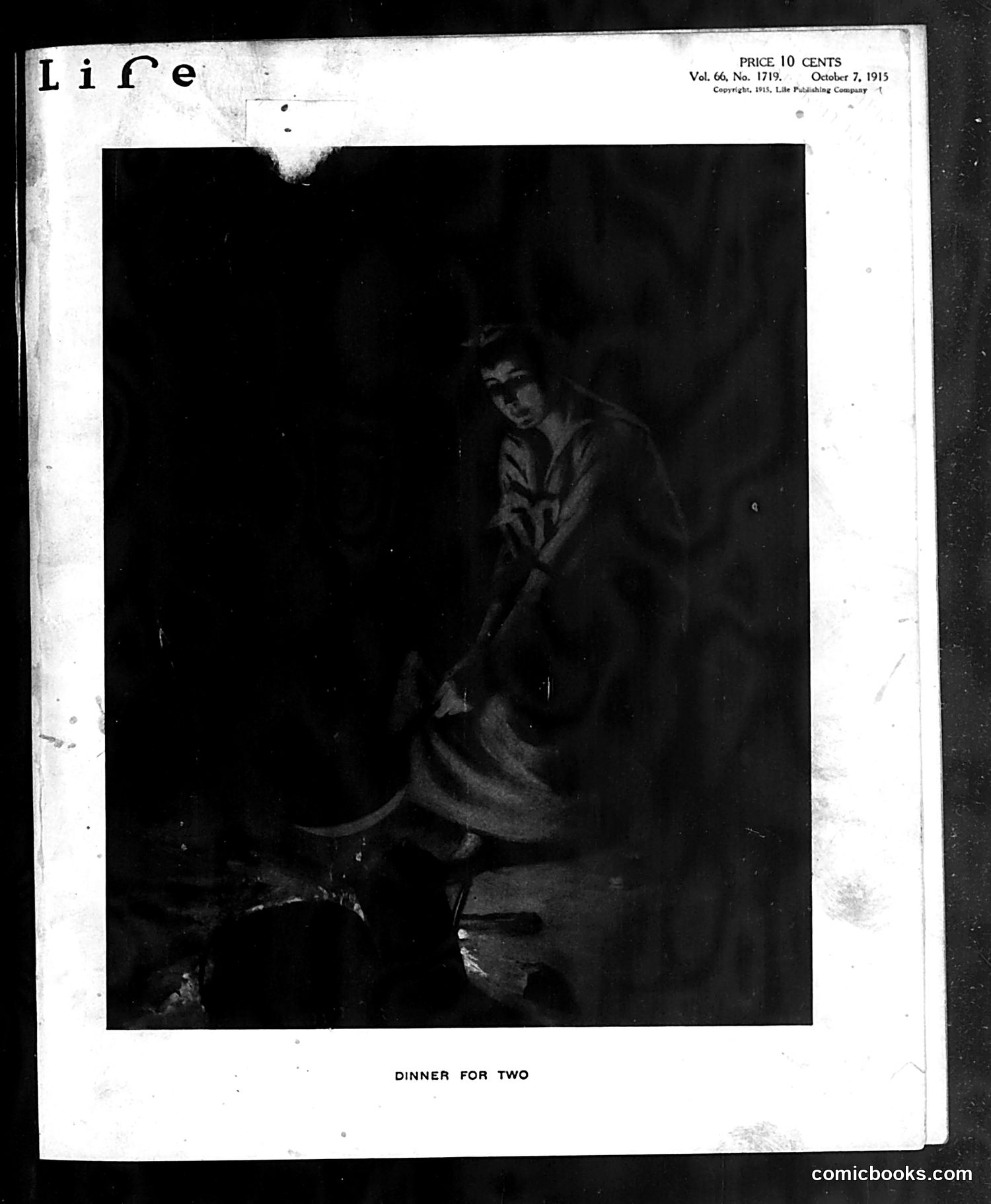
This appears to be a romantic domestic scene rather than political satire. The photograph shows a couple in an intimate dinner setting, with the woman seated and the man standing/leaning toward her in a romantic pose. The lighting is deliberately dim and atmospheric, characteristic of early 20th-century photography. The caption "Dinner for Two" suggests this is likely illustrative content meant to evoke romance or courtship—common themes in Life magazine's humor and social commentary of the era. Without additional context from surrounding articles, the specific satirical point remains unclear, though it may comment on courtship customs or romantic ideals of the 1915 period.
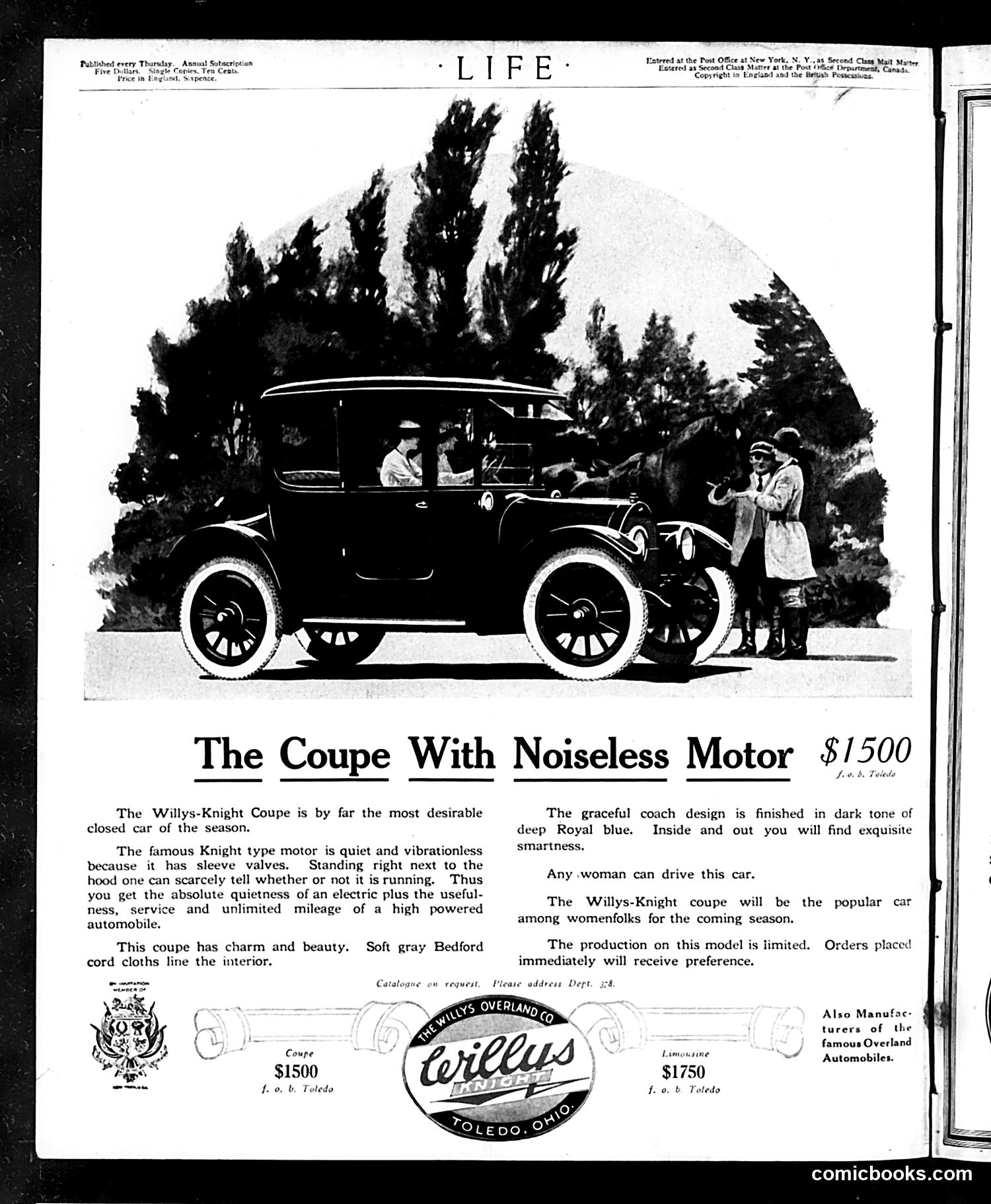
This is primarily **an automobile advertisement**, not political satire. It promotes the Willys-Knight Coupe, a closed car priced at $1500. The ad emphasizes the vehicle's appeal to women—noting "Any woman can drive this car"—reflecting early 20th-century marketing that positioned automobiles as accessible to female drivers, a relatively novel concept at the time. The illustration shows a well-dressed woman beside the parked coupe, with passengers visible inside, positioned against an elegant landscape backdrop. The "noiseless motor" feature is highlighted as a selling point. The page includes Willys-Overland company branding and notes that production is "limited," employing scarcity marketing. This appears to be standard commercial advertising rather than editorial cartoon content.
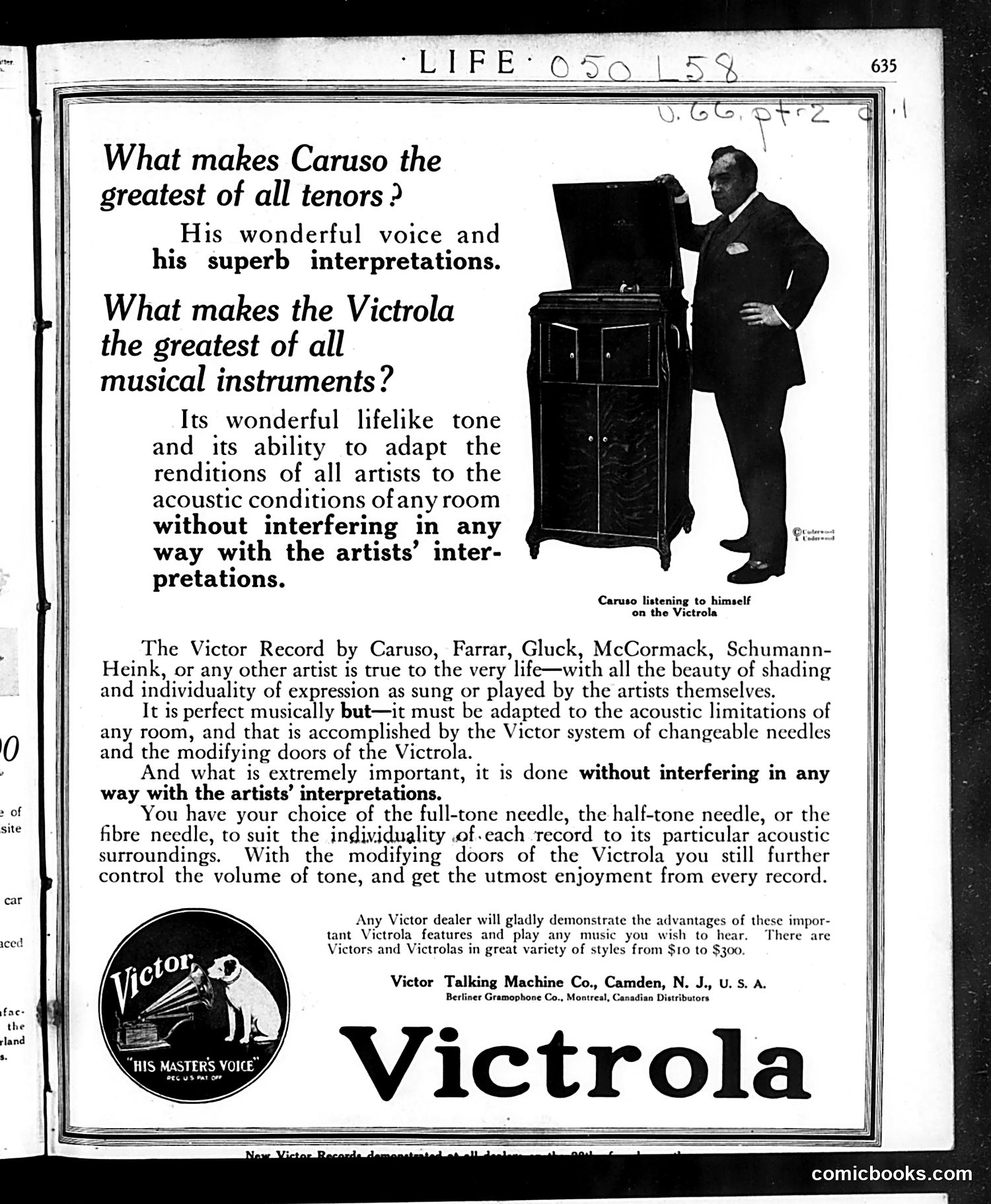
This is primarily a **Victor Talking Machine Company advertisement**, not political satire. The page features: **Content:** A promotional piece for Victrola phonographs, using tenor Enrico Caruso as the endorser. The ad claims the Victrola's superiority lies in its "wonderful lifelike tone" and ability to faithfully reproduce recordings by famous artists (Caruso, Farrar, Gluck, McCormack, Schumann-Heink) without compromising their interpretations. **The image** shows a well-dressed man (presumably Caruso) listening to a cabinet-style Victrola phonograph. **Key selling points highlighted:** Changeable needles and modifying doors allow acoustic adjustment to any room without altering artistic intent. **Historical context:** This reflects early-1900s phonograph technology marketing, when sound quality and needle selection were genuine technical concerns for consumers. This is straightforward commercial advertising, not satirical commentary.
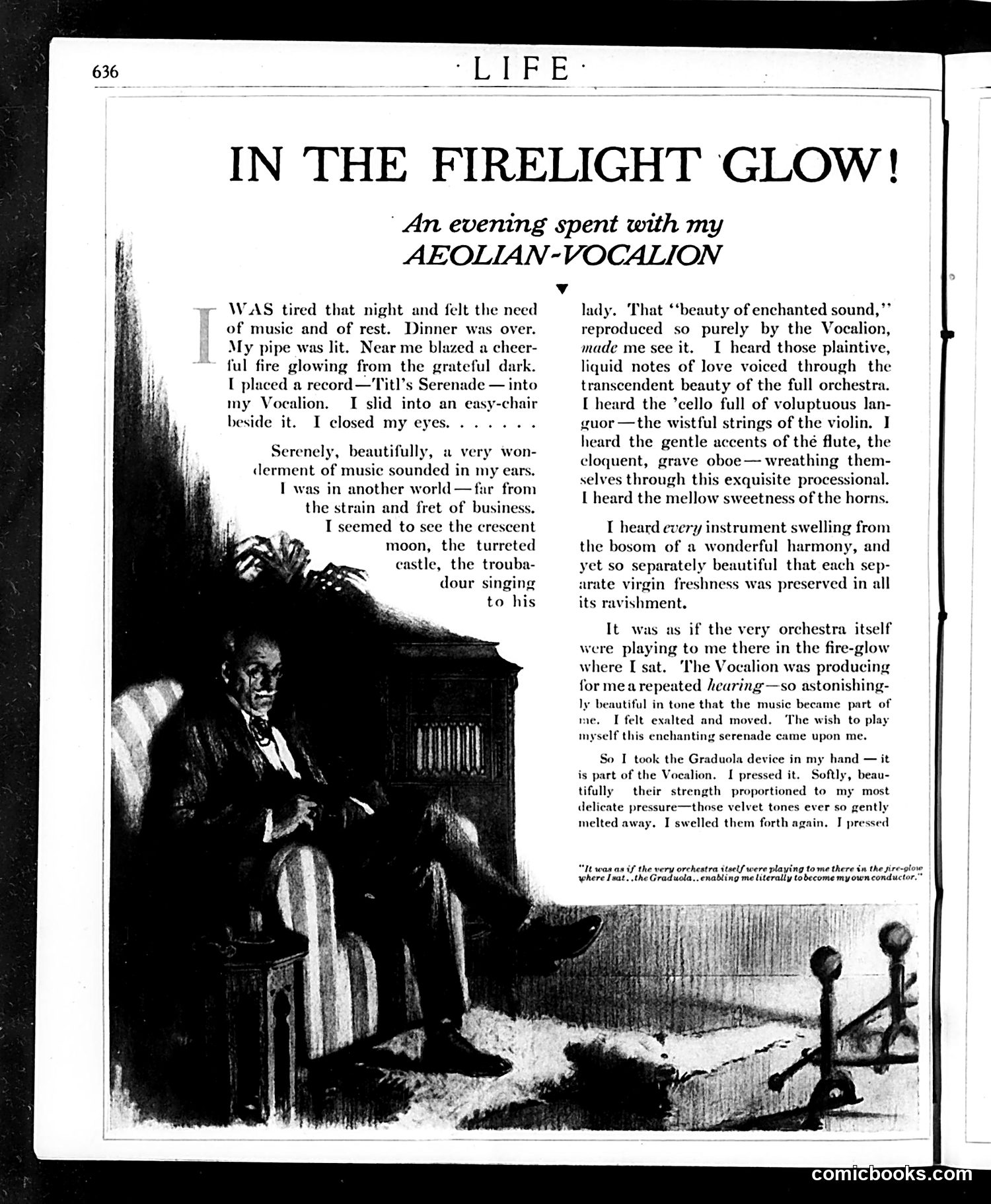
This is not a political cartoon but rather **lifestyle editorial content** from Life magazine (page 636). The article, "In the Firelight Glow!," describes an evening listening to music on a Vocalion phonograph and record player. The accompanying illustration shows a man seated by a fireplace, listening intently to the device. The text praises the Vocalion's sound quality, using flowery language about hearing orchestral instruments distinctly ("the cello full of voluptuous languor," "the oboe"). **This is essentially advertisement disguised as editorial**—promoting the Vocalion brand phonograph as a luxury item that provides concert-quality entertainment at home. It reflects early-to-mid 20th-century consumer culture and the appeal of new audio technology for leisure and self-improvement.
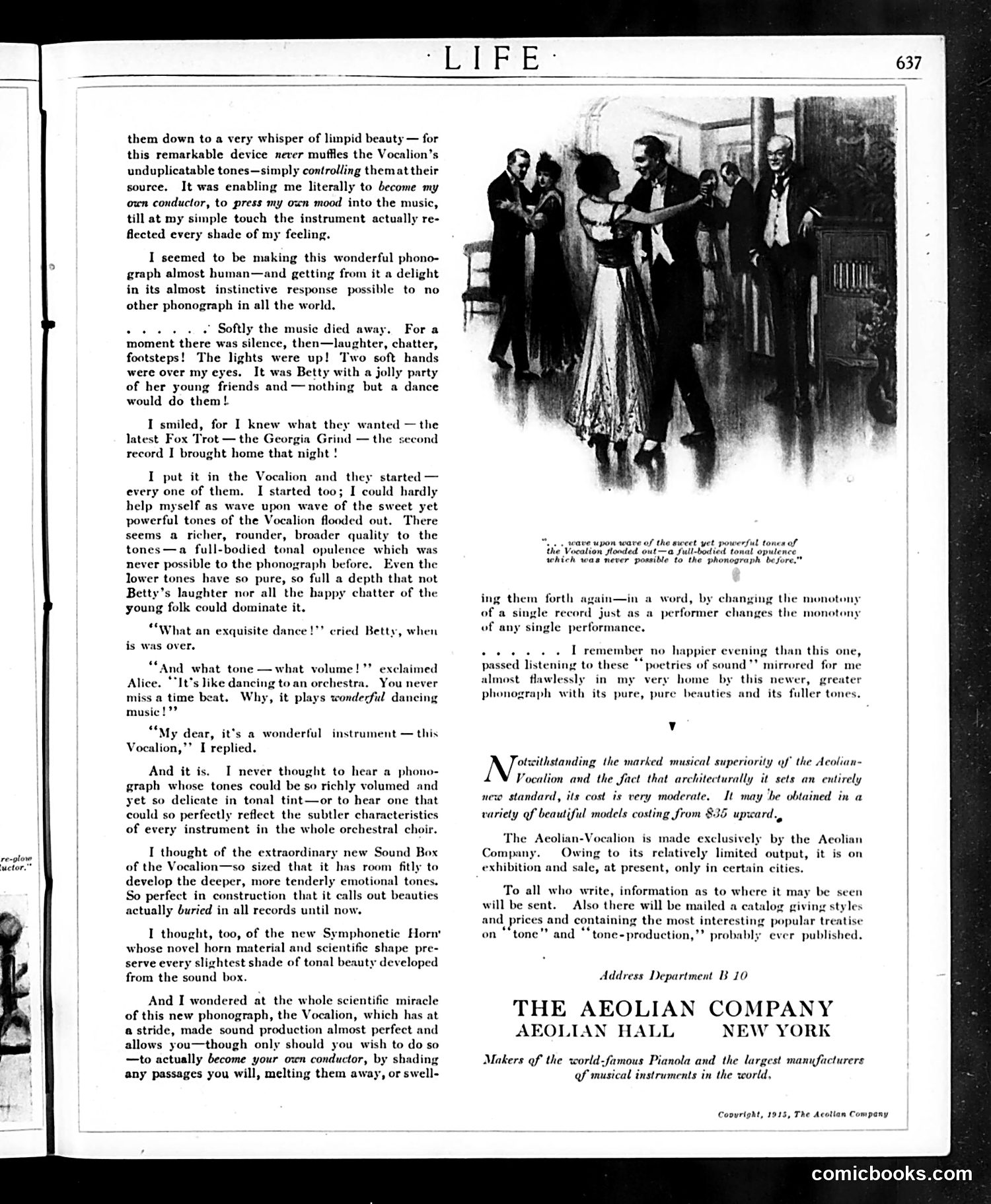
This page is primarily **advertising content**, not satire or political commentary. The text and illustration describe the **Aeolian Vocalion phonograph**, a new sound reproduction device. The image shows a social gathering where the phonograph is playing music for dancing—specifically, it mentions playing "the Georgia Grind" and a "Fox Trot." The narrative emphasizes the Vocalion's superior sound quality compared to earlier phonographs, praising its ability to reproduce orchestral music with "richer, rounder, broader quality." The speaker claims it's so realistic that listeners feel like they're hearing a live performance. This represents **early-twentieth-century consumer marketing** highlighting technological advancement in home entertainment. The social scene illustrates the phonograph's role in modern domestic leisure and social gatherings.
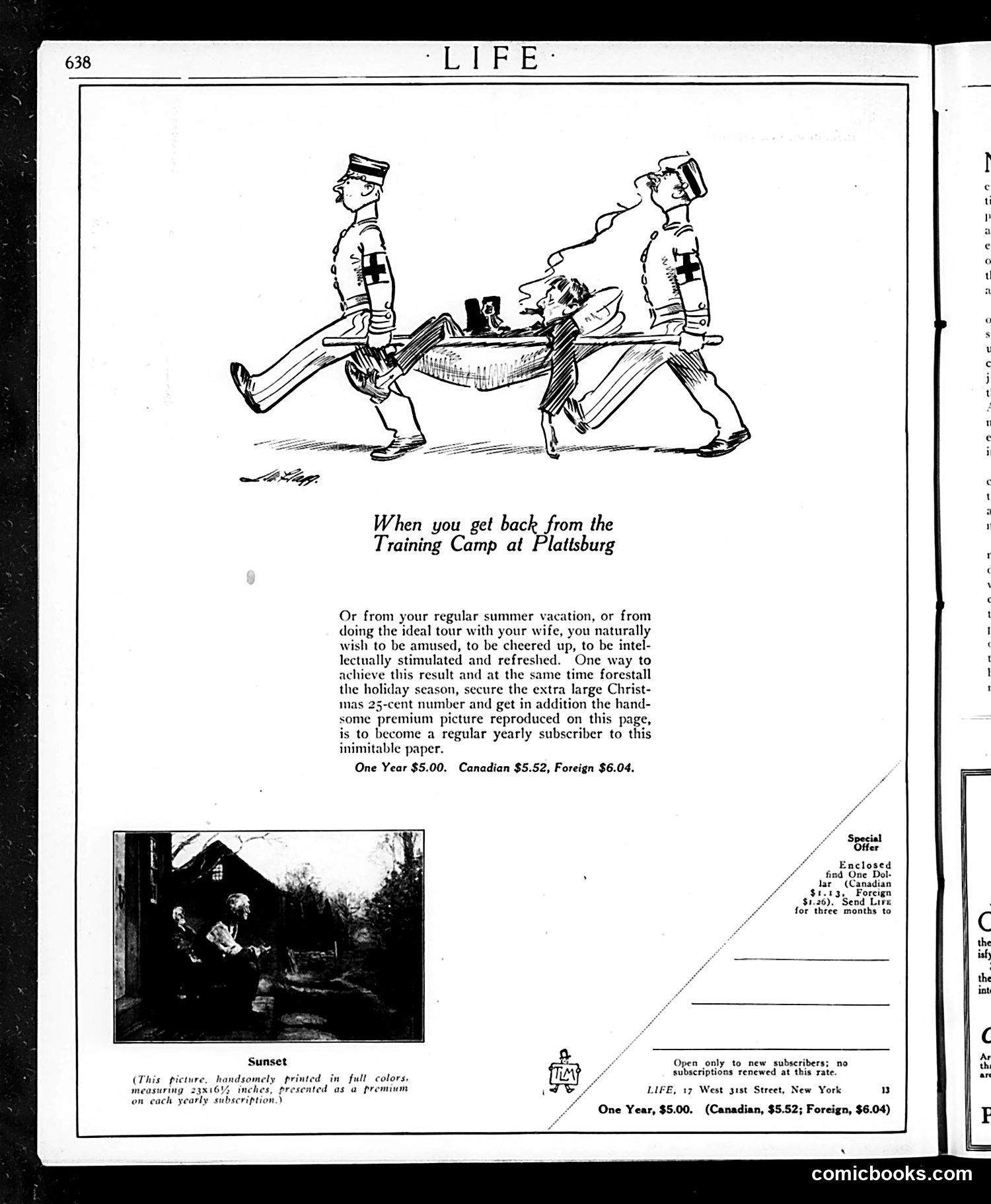
This page is primarily an **advertisement for a magazine subscription**, not political satire. The cartoon at top depicts two military medics carrying an injured soldier on a stretcher, captioned "When you get back from the Training Camp at Plattsburg." The joke appears to reference the **Plattsburg Training Camp**, a real military preparedness initiative from around World War I era. The humor suggests soldiers returning from training would be physically exhausted or injured—a lighthearted jab at the camp's rigor. The advertisement encourages subscriptions ($5 yearly) by promising readers entertainment and refreshment after vacations or military service. A photograph labeled "Sunset" appears below, offered as a premium picture for subscribers. The page is largely commercial rather than political commentary.
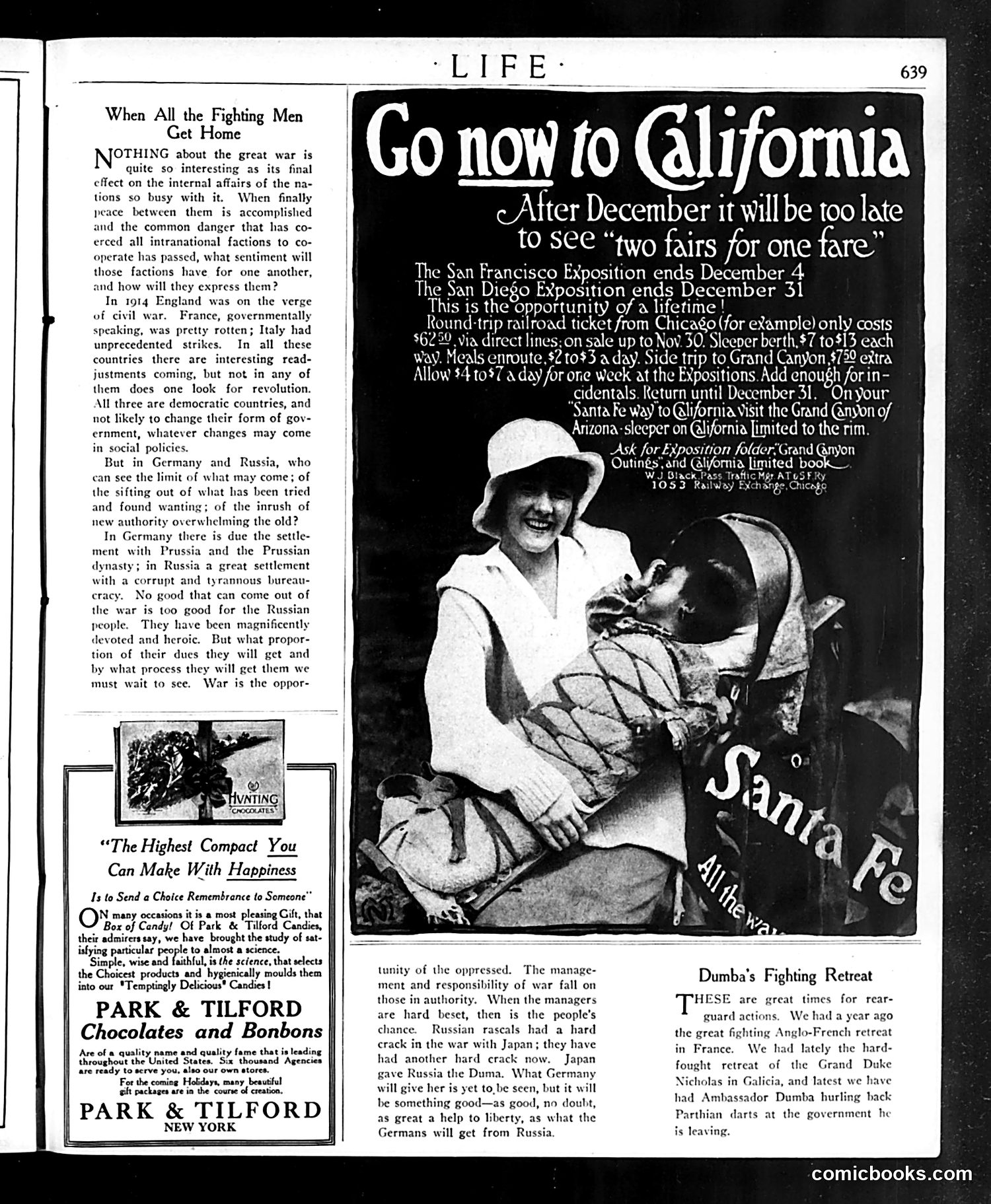
This is primarily a **Life magazine advertisement page** (page 639), not a political cartoon. The dominant content is a large Santa Fe Railway advertisement urging readers to visit California's two world expositions before they close in December 1915. The left column contains an article titled "When All the Fighting Men Get Home," discussing post-World War I geopolitical consequences for Germany and Russia—reflecting anxieties about how these nations might reorganize after the war. Below is a smaller **Park & Tilford Chocolates advertisement** with text about sending "happiness" via candy as gifts. The page reflects 1915-era concerns: WWI's end and its political implications, American tourism promotion, and gift-giving culture—not satire or caricature, but rather standard magazine content mixing editorial and commercial material.
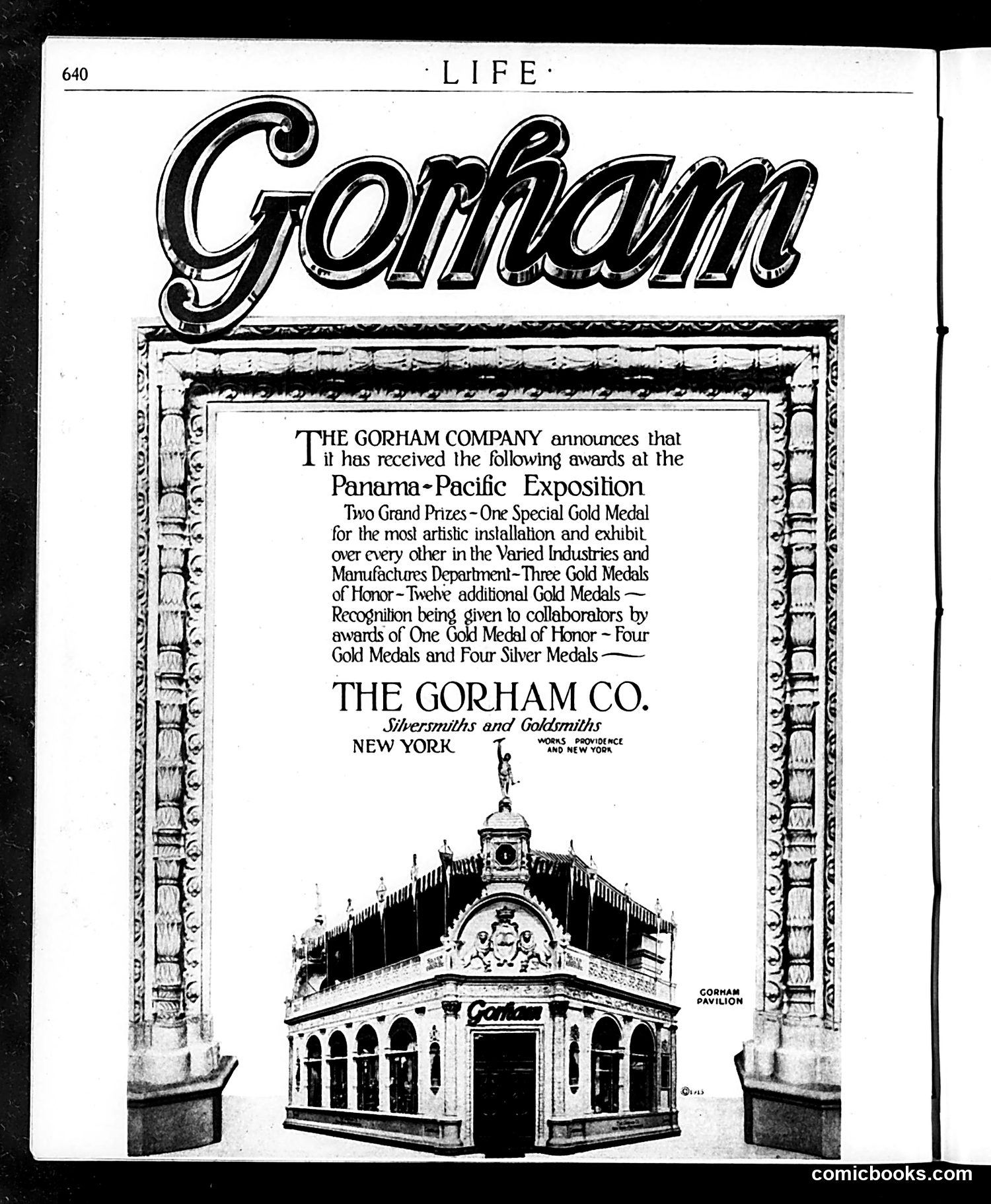
This is an **advertisement, not a cartoon or satirical content**. It announces that The Gorham Company, a New York-based silversmiths and goldsmiths manufacturer, received multiple awards at the Panama-Pacific Exposition, including: - Two Grand Prizes - One Special Gold Medal - Three additional Gold Medals of Honor - Twelve more Gold Medals - Four Gold Medals and Four Silver Medals The centerpiece shows an ornate pavilion structure labeled "Gorham Pavilion," depicting the company's exhibition booth at the exposition. This was a prestigious early-20th-century trade fair showcasing American manufacturing excellence. The advertisement celebrates Gorham's prestigious recognition and craftsmanship to potential customers.
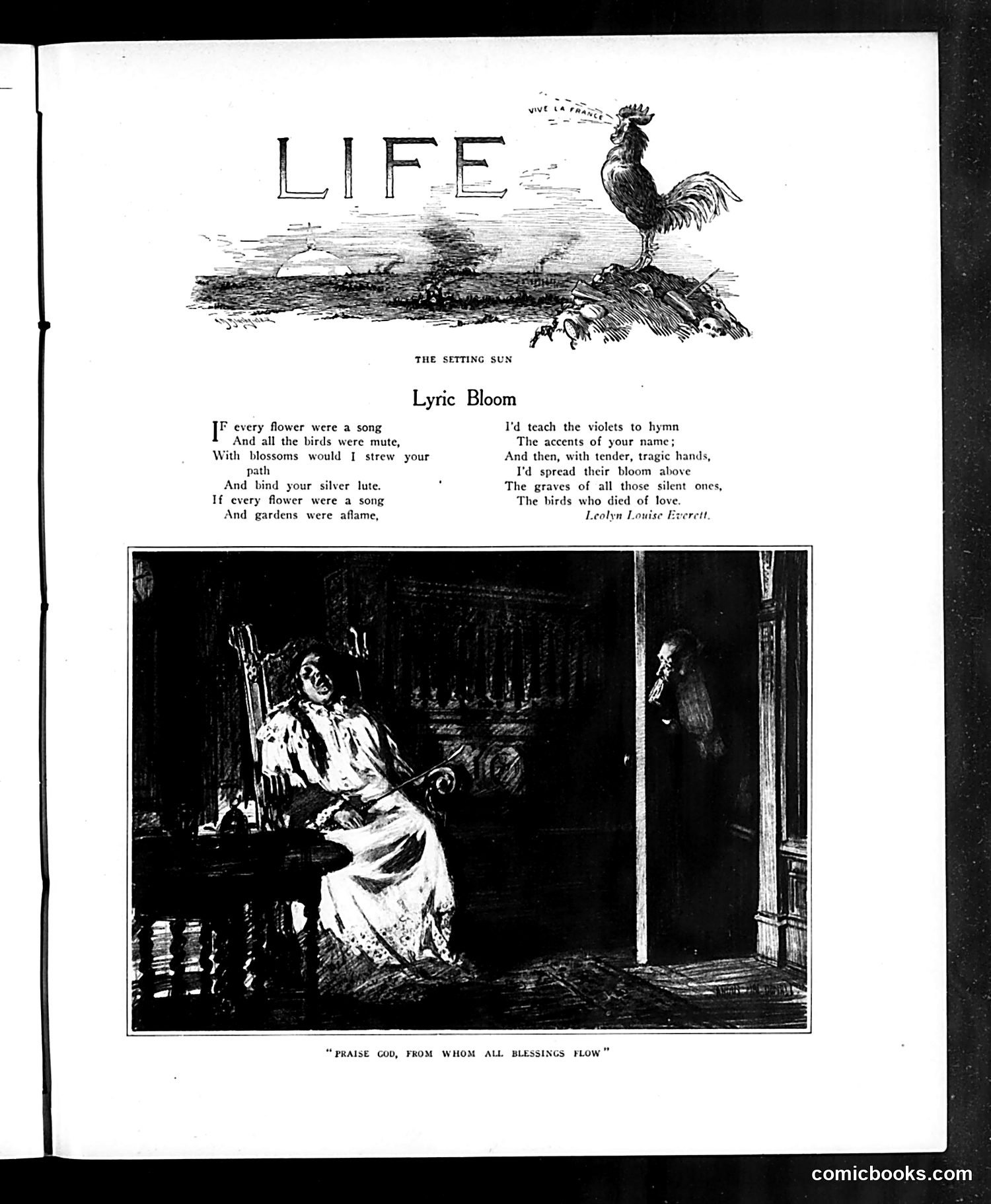
This page features a poem titled "Lyric Bloom" by Evelyn Louise Everett, accompanied by a romantic illustration below. The poem expresses idealized sentiments about nature—flowers as songs, birds as music, gardens aflame—creating a sentimental vision of romantic devotion. The illustration depicts a woman at a piano in an interior setting, with a man visible in a doorway, depicting a romantic domestic scene. The caption reads "Praise God, from whom all blessings flow"—a hymnal reference that grounds the romantic sentiment in spiritual gratitude. This appears to be a straightforward literary/artistic feature rather than political satire. It represents early 20th-century Life magazine's mix of sentimental poetry, illustration, and cultural content rather than the magazine's typical satirical commentary.
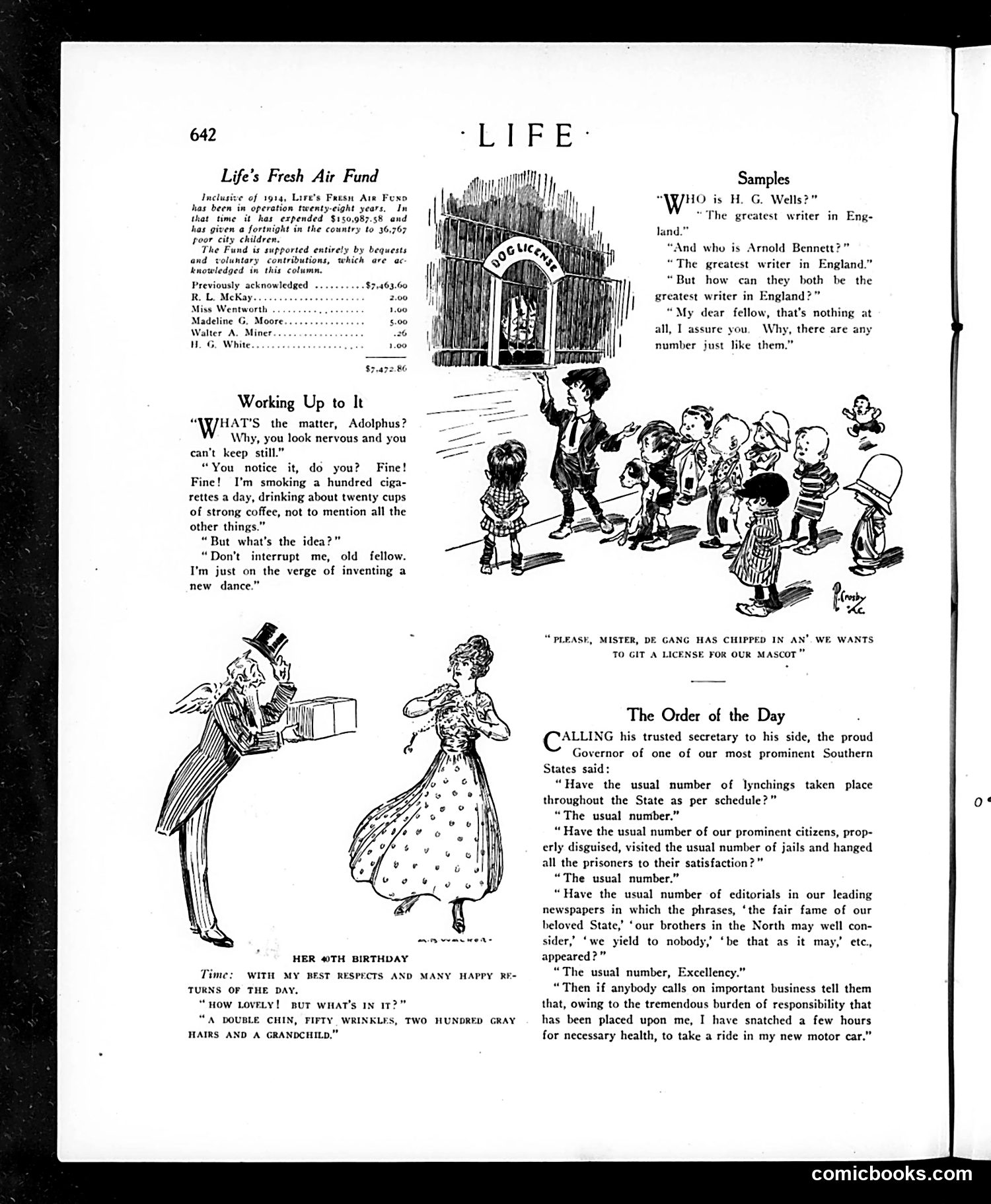
This page contains satirical commentary on several topics: **"The Order of the Day"** section mocks a Southern governor's casual acceptance of lynching as routine ("the usual number"). The satire criticizes how state officials normalize racial violence through bureaucratic language—treating murders as standard administrative matters alongside jailings and newspaper editorials. The governor's secretary records lynchings with the same indifference as other state business. The upper section includes humorous dialogue about determining "the greatest writer in England" (H.G. Wells vs. Arnold Bennett), joking that multiple writers can simultaneously hold this title. The cartoon "Working Up to It" depicts someone inventing a new dance, while illustrations show birthday wishes and celestial imagery. The page primarily focuses on satirizing political indifference to racial violence.
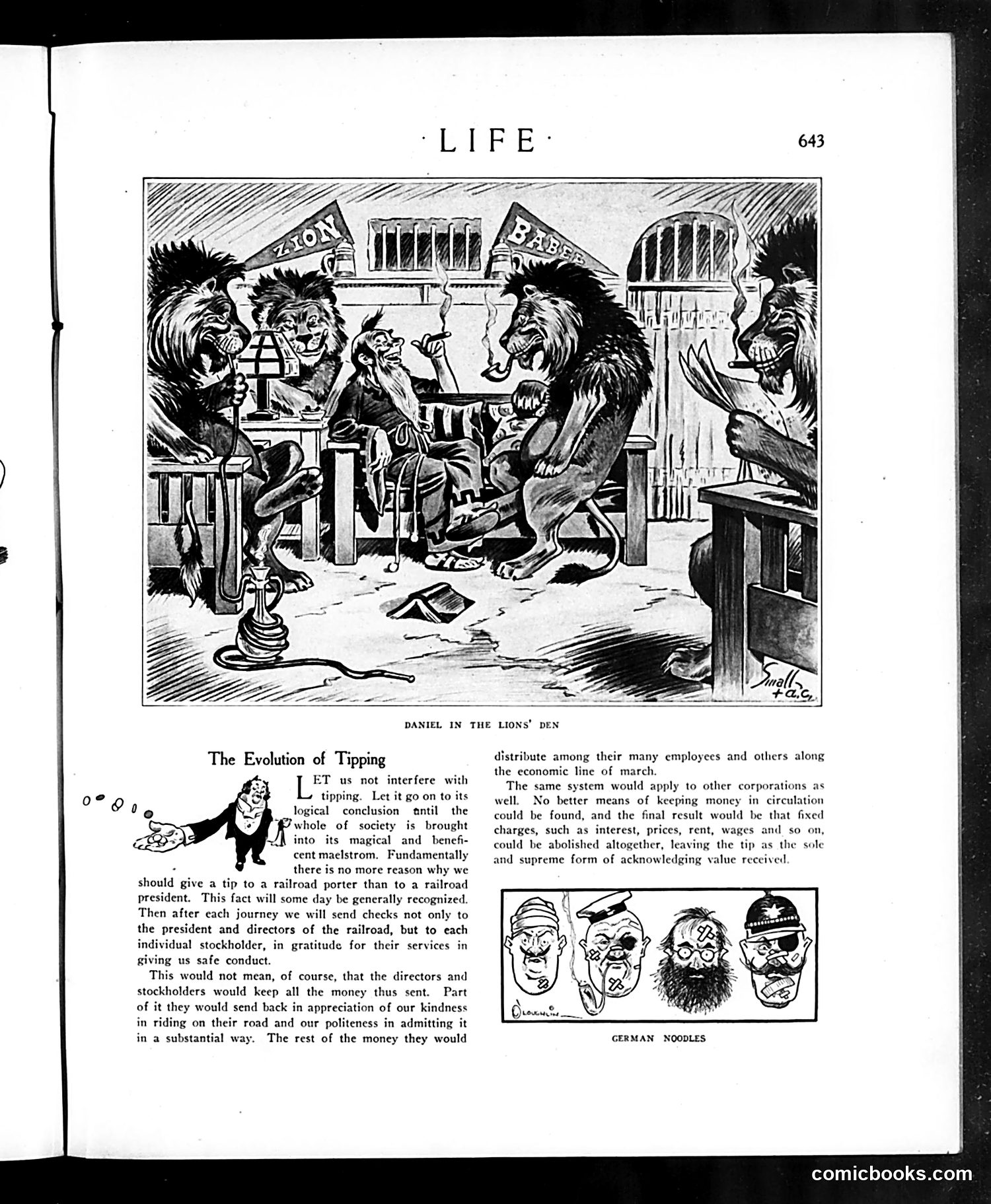
**Top Cartoon ("Daniel in the Lions' Den"):** A satirical scene depicting lions in formal business attire (wearing hats labeled "SALON" and "BARBER") operating what appears to be a barbershop or salon. The anthropomorphic lions surround a small human figure, parodying the biblical story of Daniel in the lion's den. This likely critiques predatory business practices or dangerous working conditions in early 20th-century commerce. **Article ("The Evolution of Tipping"):** The accompanying text argues that tipping should logically extend to railroad presidents and corporate directors, sarcastically following this practice to its absurd conclusion. The satire advocates abolishing tipping entirely, proposing fixed wages instead. **Bottom Panel ("German Noodles"):** Four caricatured male faces, likely ethnic stereotypes common to the era's satirical publications.
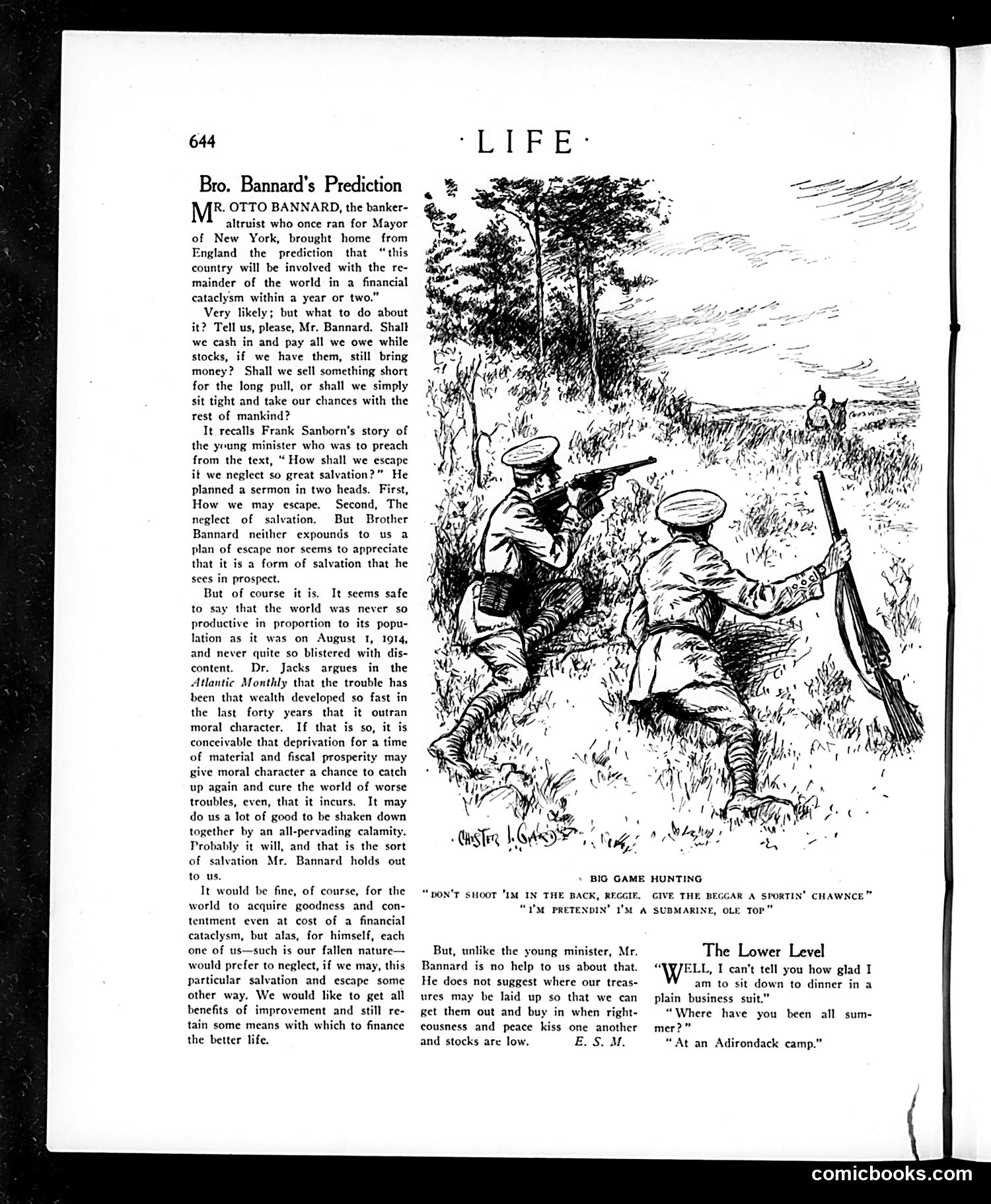
This page discusses **Bro. Bannard's Prediction** — Mr. Otto Bannard, a banker-altruist who predicted America would face financial catastrophe within a year or two. The author dismisses the prediction while reflecting on whether citizens should panic, liquidate stocks, or accept financial uncertainty. The accompanying illustration labeled **"Big Game Hunting"** shows two soldiers with rifles in tall grass. The caption reads: "Don't shoot 'im in the back, Reggie. Give the beggar a sportin' chawnce" — "I'm pretendin' I'm a submarine, ole top." This appears to mock British military attitudes, likely referencing WWI combat ethics or the submarine threat. The brief dialogue piece "The Lower Level" is unrelated social comedy.
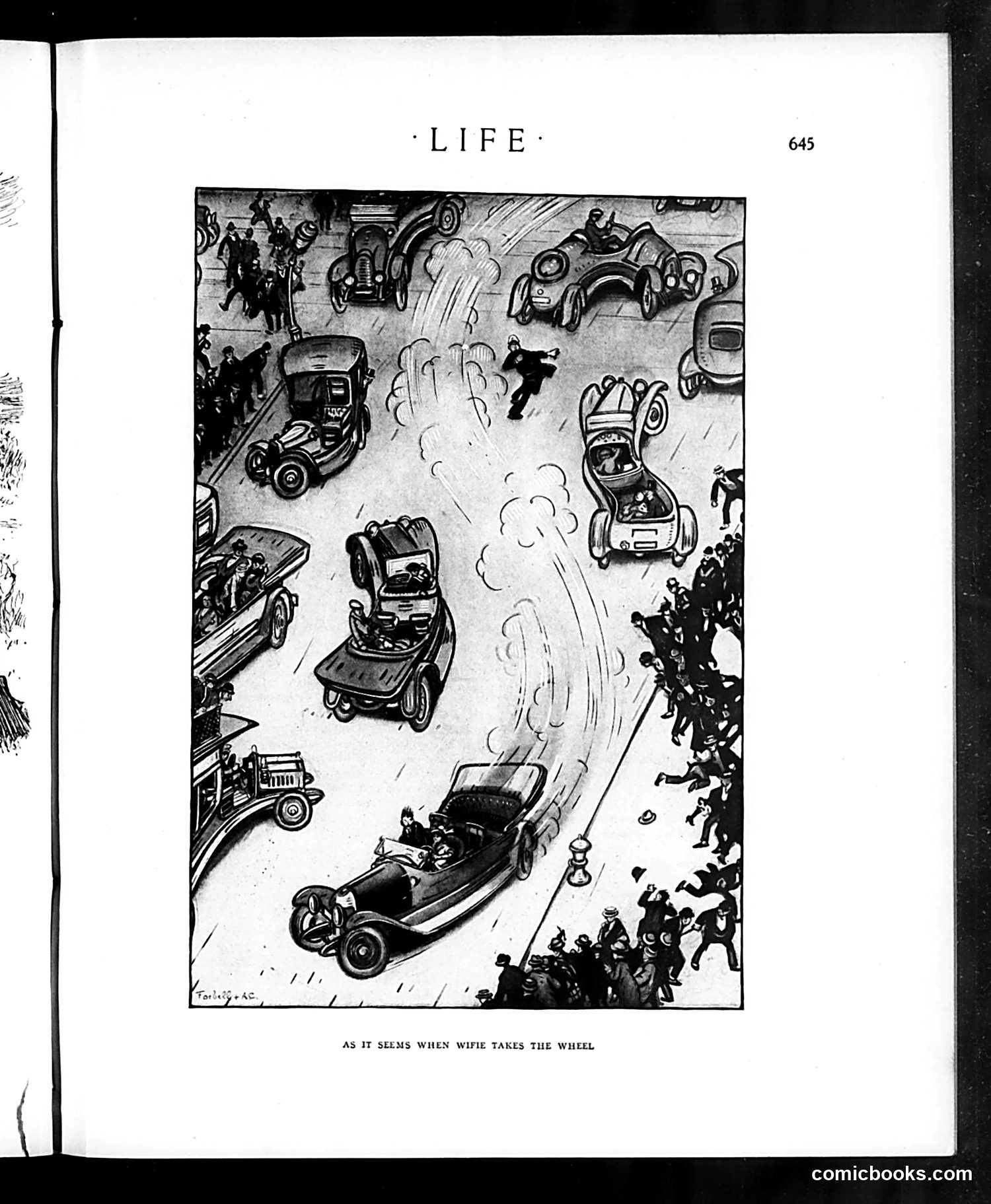
This is a satirical cartoon titled "As It Seems When Wifie Takes the Wheel," depicting a bird's-eye view of a chaotic street scene during the early automobile era. The cartoon shows multiple cars in disarray—some crashed, overturned, or careening wildly—with pedestrians scattering in panic on the sidewalks. The satire targets women drivers, a contemporary social anxiety of the early 20th century. The joke implies that when a wife assumes driving responsibility, the result is automotive mayhem and danger. This reflects period attitudes questioning women's competence behind the wheel, before women's driving became normalized. The exaggerated chaos serves as visual commentary on gender anxieties during this transitional era of transportation technology.
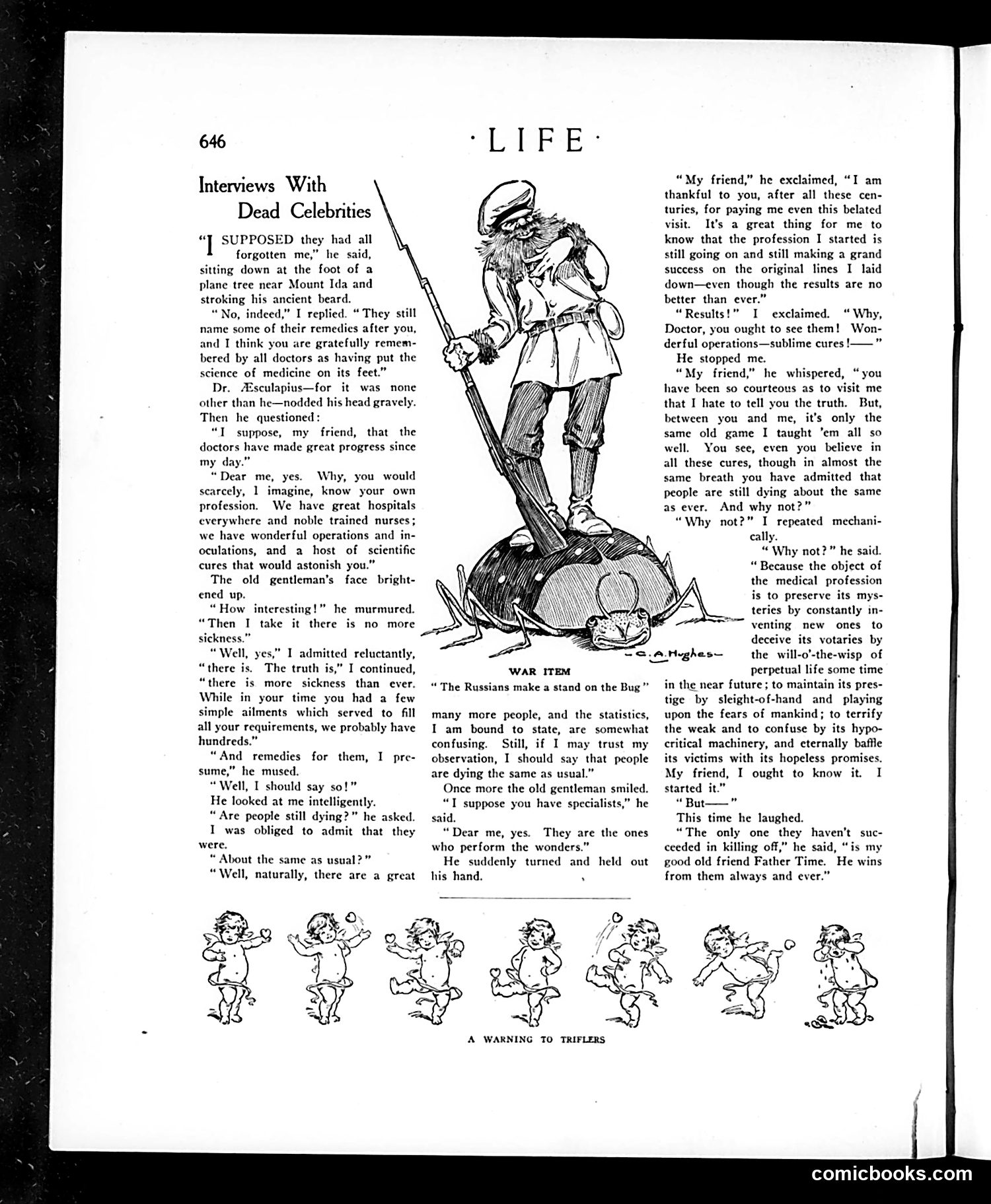
This page satirizes medical practice through a dialogue titled "Interviews With Dead Celebrities." An old gentleman (appearing to be a famous doctor or historical figure) stands atop a giant beetle, discussing medicine with a visitor. The satire critiques how doctors maintain professional mystique by constantly inventing new treatments and "cures" while people continue dying at similar rates as in previous eras. The doctor admits that despite modern hospitals, inoculations, and operations, mortality remains unchanged—yet the profession preserves its prestige through sleight-of-hand and fear-mongering. The bottom cartoon, "A Warning to Triflers," shows cherubs in a warning line, likely cautioning against medical quackery or false remedies. This reflects early 20th-century skepticism about medicine's actual efficacy versus its inflated claims.
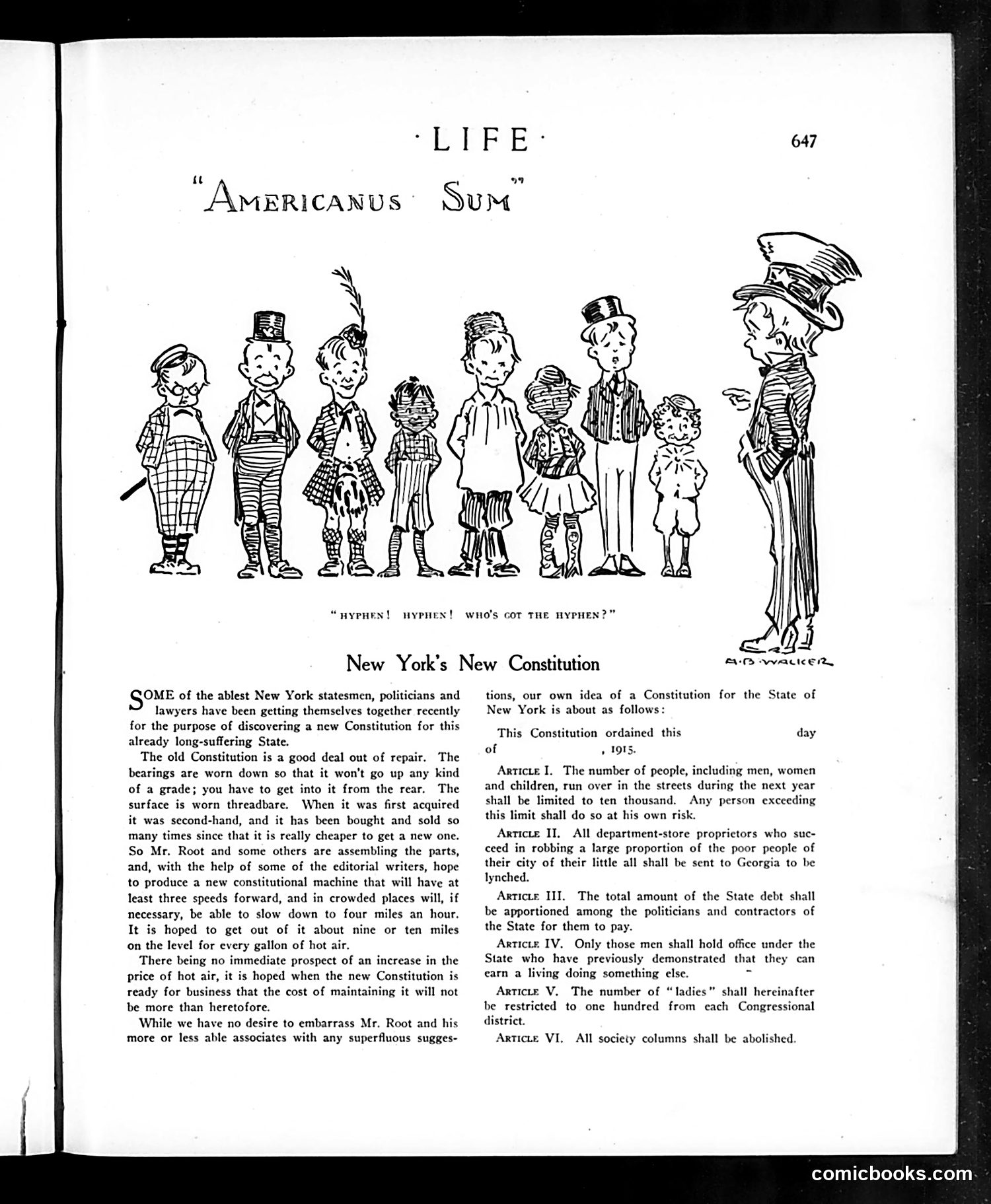
This cartoon mocks New York State's deteriorating constitutional framework around 1915. The title "Americanus Sum" (Latin: "I am American") ironically presents a ragtag line of characters representing various social problems—including what appear to be vagrants, immigrants, criminals, and other marginalized figures—as the "sum" or total of American society. The accompanying text satirizes well-meaning reformers attempting to fix New York's "old Constitution" through piecemeal repairs. The article humorously proposes absurd legislative "solutions" (limiting street populations, deporting criminals to Georgia, restricting women). The joke: America's constitutional system is so broken and cobbled-together that it produces this dysfunctional citizenry. Reform efforts are futile Band-Aids on systemic failure.
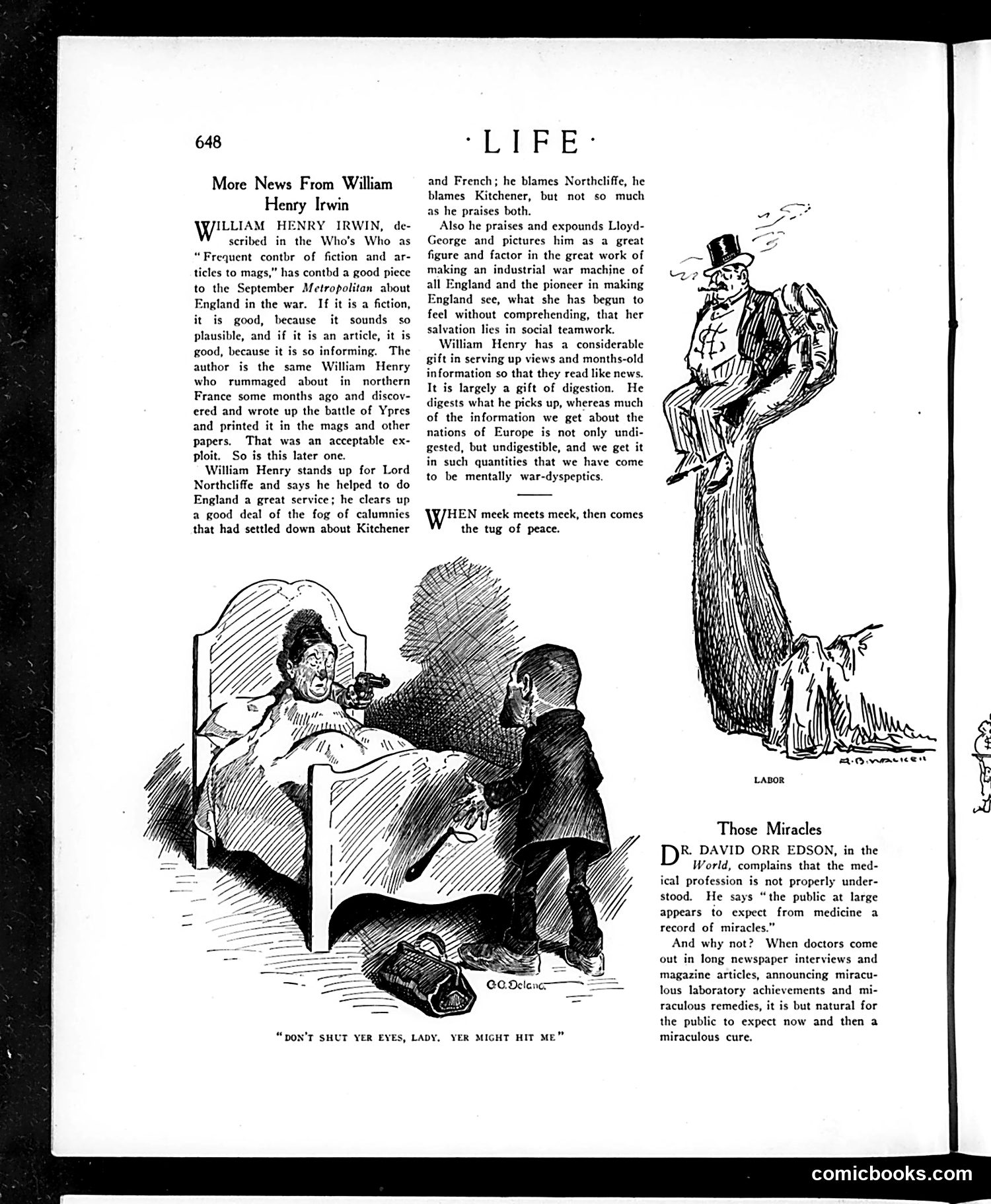
**Top Section - "More News From William Henry Irwin":** This column praises journalist William Henry Irwin's reporting on WWI England, particularly his articles about military leaders (Kitchener, French, Lloyd-George) and Lord Northcliffe. The critique is gently ironic: Irwin has a "gift" for making old information sound fresh and newsworthy through skillful "digestion"—implying he repackages existing views rather than breaking new ground. The phrase "mentally war-dyspeptics" mocks the public's indigestion from oversaturated European war coverage. **Bottom Cartoon:** A doctor examines a bedridden woman with the caption "DON'T SHUT YER EYES, LADY, YER MIGHT HIT ME." This darkly satirizes incompetent or dangerous medical practice. **"Those Miracles" Section:** Edson critiques doctors' inflated public claims about miraculous cures via newspaper and magazine interviews. Life's satire: doctors shouldn't be surprised when the public expects miracles if doctors keep *announcing* miraculous achievements. It's reasonable public expectation based on professional hype.
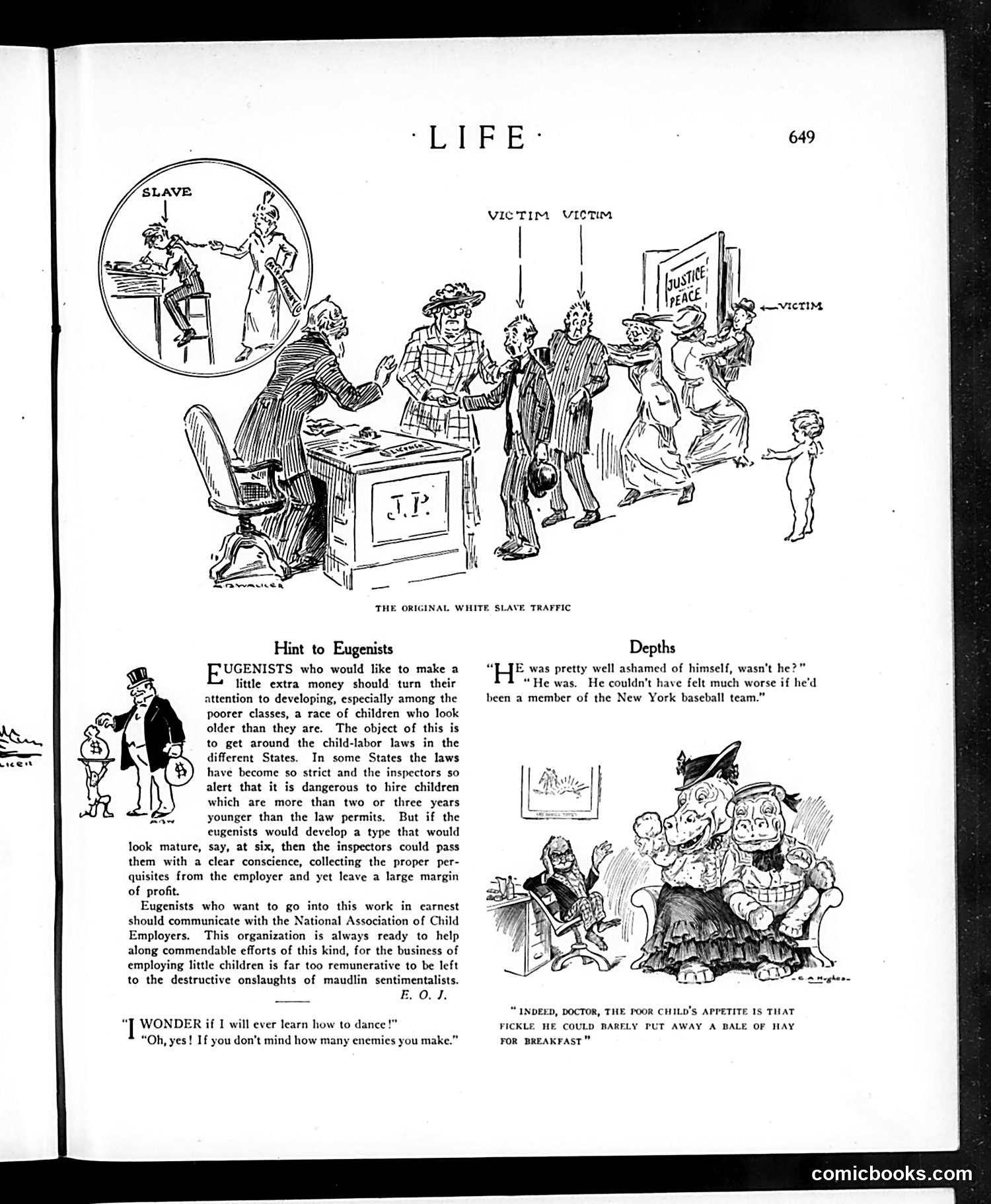
This page attacks eugenics through biting satire. The top cartoon, "The Original White Slave Traffic," depicts exploitation of poor children for labor, with labels showing victims of a corrupt system involving "J.P." (likely J.P. Morgan or financial elites), inspectors, and profiteers. The "Hint to Eugenists" section uses heavy irony to mock eugenicists' claims about "improving" the human race. It sarcastically proposes breeding children who *look* older to circumvent child-labor laws—revealing how eugenics rhetoric masked economic exploitation of the poor. The text ridicules both eugenics advocates and the fictional "National Association of Child Employers." Lower cartoons mock the wealthy: one jokes about making "enemies" while dancing (social climbing), another presents a doctor's dark humor about a poor child's starvation (mocking indifference to child poverty by suggesting a child could eat hay). The page satirizes how pseudoscientific eugenics was weaponized to justify labor exploitation and class inequality, while exposing the hypocrisy of elites claiming racial/biological "improvement."
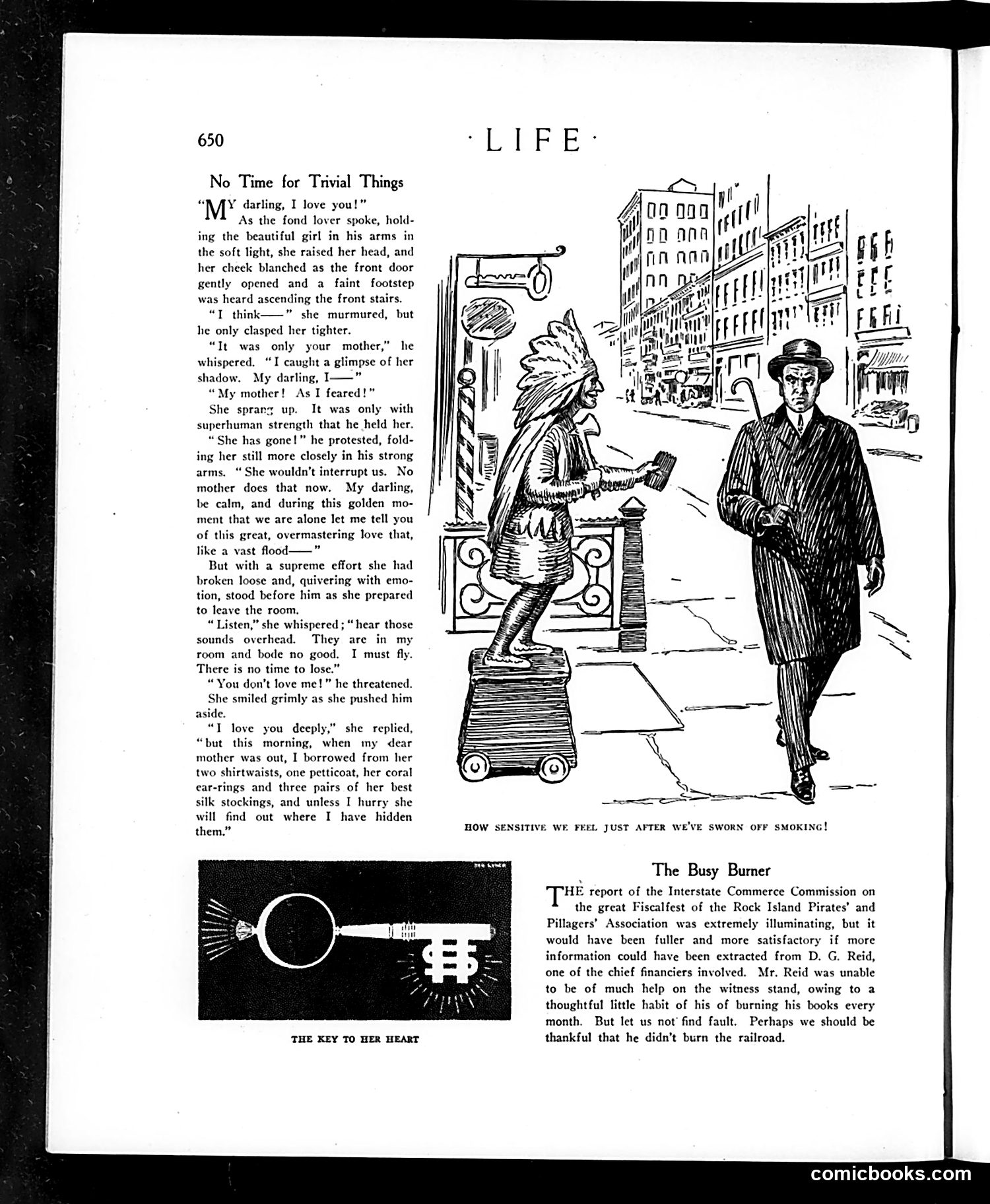
**"No Time for Trivial Things"** is a comedic short story satirizing early 1900s courtship and female propriety. A young woman prioritizes retrieving borrowed clothing (shirtwaists, petticoat, stockings) from her mother's room over a romantic moment with her lover. The joke mocks how strict maternal supervision and rigid social conventions around propriety constrain romantic life—the woman's fear of her mother discovering the theft outweighs her declared love. **"The Busy Burner"** satirizes D.G. Reid, an actual railroad financier involved in the "Fiscalfest" (apparent satire of financial mismanagement). Reid habitually burned his books monthly, conveniently preventing testimony during Interstate Commerce Commission investigations. The cartoon mocks his destruction of financial records as evidence-tampering while sardonically suggesting readers should be "thankful" he didn't burn the railroad itself—dark humor about corporate corruption and inadequate regulatory oversight.
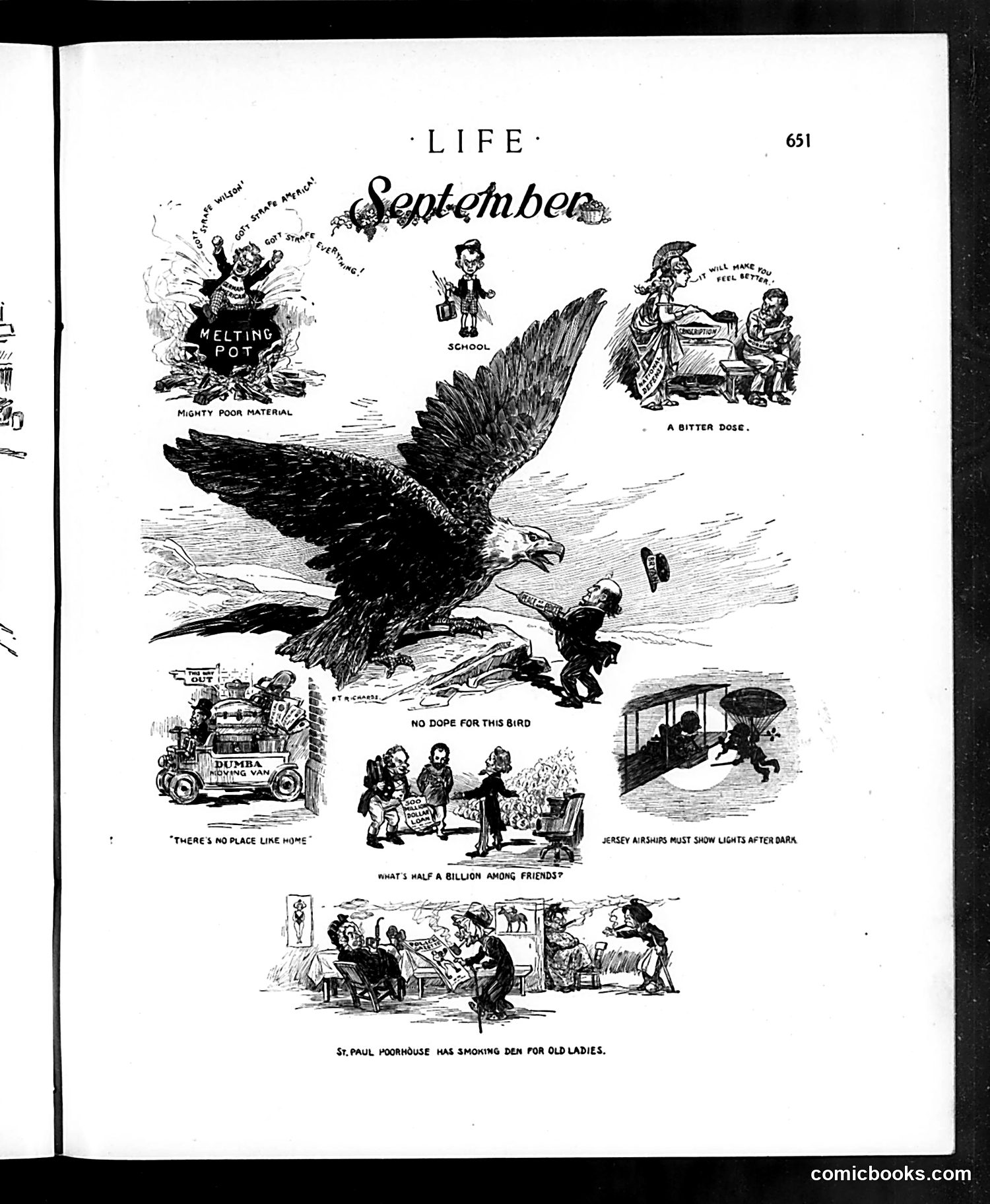
This is a political cartoon page satirizing various September 1920s issues. The central image shows a large eagle ("No Dope for This Bird") attacking a man, likely representing law enforcement or government resistance to something. Surrounding vignettes mock contemporary concerns: - "Melting Pot" critiques immigration - "School" shows educational issues - "A Bitter Dose" depicts medicine/health - "There's No Place Like Home" references the Dumba driving car - "Jersey Airships Must Show Lights After Dark" addresses aviation safety - "What's Half a Billion Among Friends?" satirizes government spending - The bottom caption about St. Paul's poorhouse smoking den for elderly women mocks social welfare policy The page uses caricature and exaggeration to critique government policies, social conditions, and public debates of the era. The specific historical context for some references remains unclear without additional documentation.
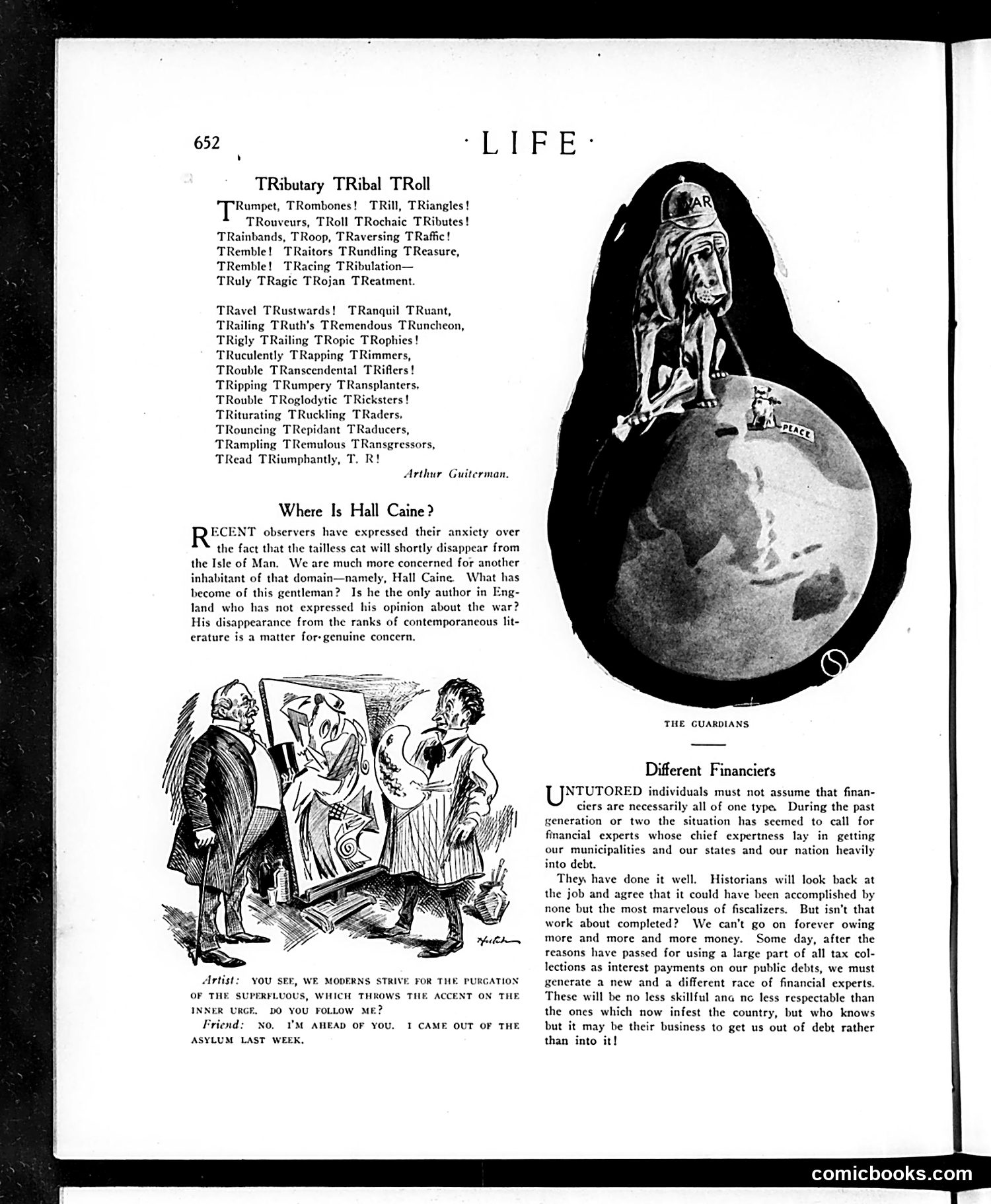
**Top Section - "TRibutary TRibal TRoll"** by Arthur Guiterman is a playful alliterative poem mocking wartime rhetoric and propaganda. The cascading "TR" sounds parody grandiose patriotic language about war, sacrifice, and national duty—treating solemn themes with absurdist wordplay. **"Where Is Hall Caine?"** questions the silence of Hall Caine, a prominent British author of the era, regarding his public position on World War I. The piece expresses concern that this notable literary figure has failed to publicly declare his stance on the war, contrasting his absence with other contemporary writers' outspokenness. **Bottom cartoon** shows an artist discussing his avant-garde aesthetic philosophy while a friend reveals he's escaped an asylum. The joke satirizes pretentious modernist art theory—its obscure jargon and self-importance—by suggesting only an asylum patient would take such nonsense seriously. **"Different Financiers"** critiques war profiteering and debt accumulation, arguing that financial experts excelled at *creating* national debt during wartime but may lack skills to *reduce* it afterward.
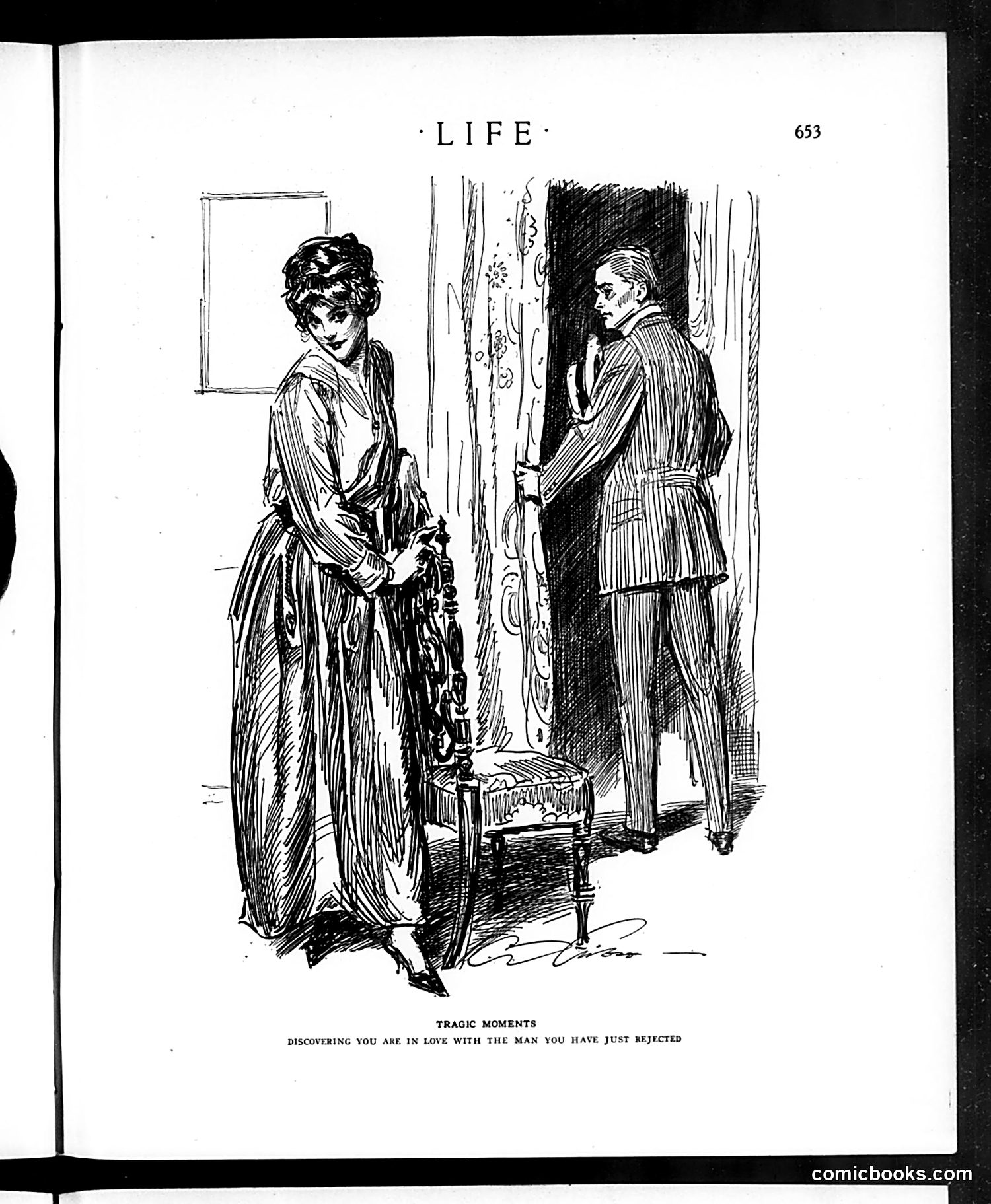
This is a satirical illustration titled "Tragic Moments: Discovering You Are in Love with the Man You Have Just Rejected." It depicts a domestic scene showing a woman in an elegant robe confronting a man in a suit near a doorway, with period furnishings visible. The humor is situational rather than politically pointed: it illustrates a common romantic predicament of the era—the ironic timing of realizing one's true feelings after rejecting a suitor. This reflects early 20th-century social conventions around courtship and marriage proposals, where women faced pressure to make decisive romantic choices. The sketch-style illustration was typical of Life's satirical commentary on middle and upper-class social life and romantic entanglements.
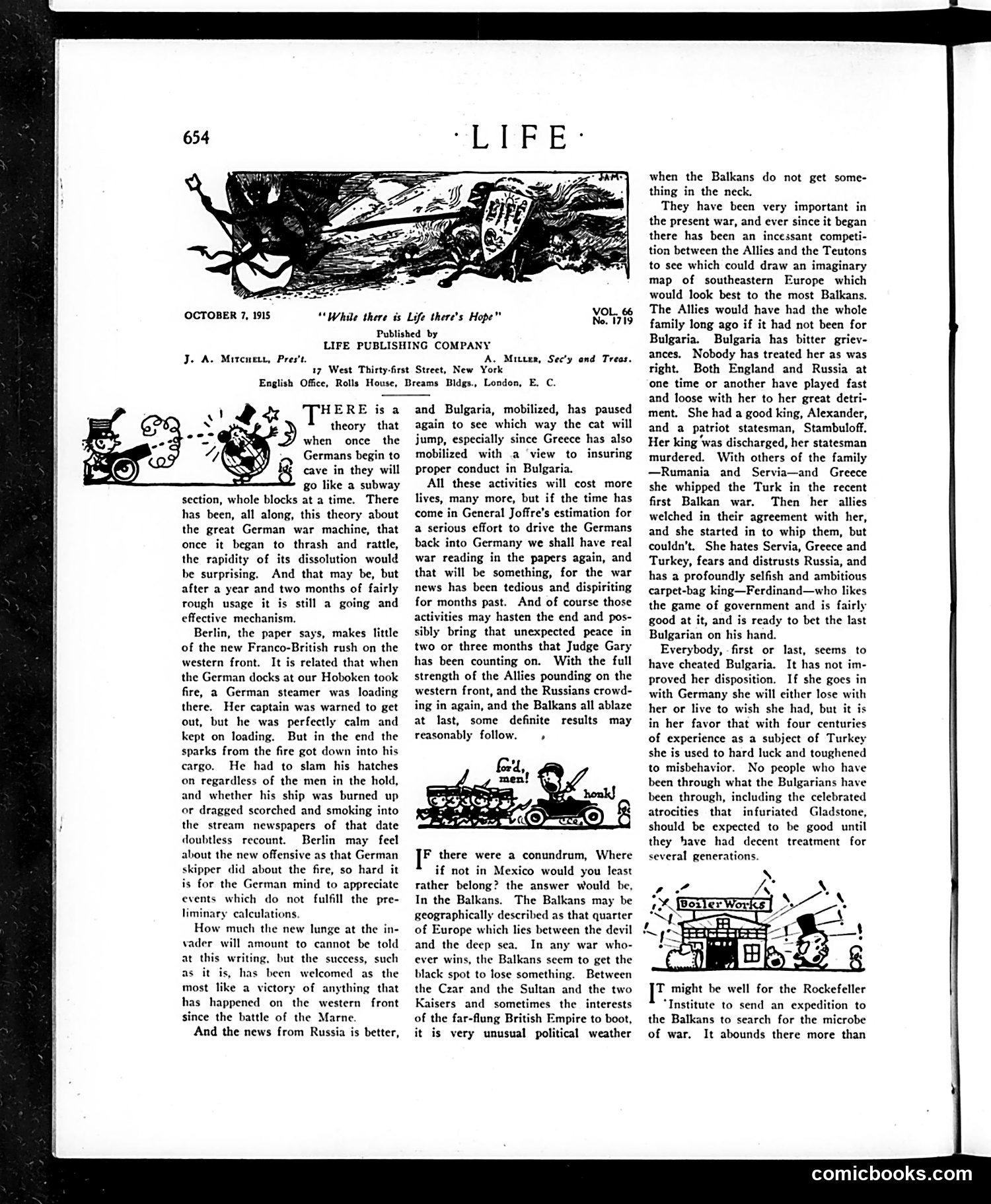
This page contains satirical commentary on World War I's progress, specifically addressing three theaters: the Western Front, Eastern Front, and the Balkans. **The main cartoons/illustrations** (visible but small) appear to depict military/industrial imagery related to the war effort. **Key political references:** - The German war machine is discussed as theoretically fragile but proving surprisingly durable after 15+ months of combat - General Joffre (French commander) is cited regarding new Allied offensive efforts - Bulgaria's mobilization and Greece's response are noted as diplomatically significant - Russia's military situation is improving **The satire's point:** The Balkans are characterized as perpetually suffering "something in the neck" — caught between competing imperial powers (Czar, Sultan, Kaisers, British Empire). Bulgaria specifically is blamed for preventing Allied control of the region, having legitimate grievances from prior mistreatment by Britain and Russia. The overall tone suggests frustration with slow progress and diplomatic complexity, while acknowledging the war's brutal cost.
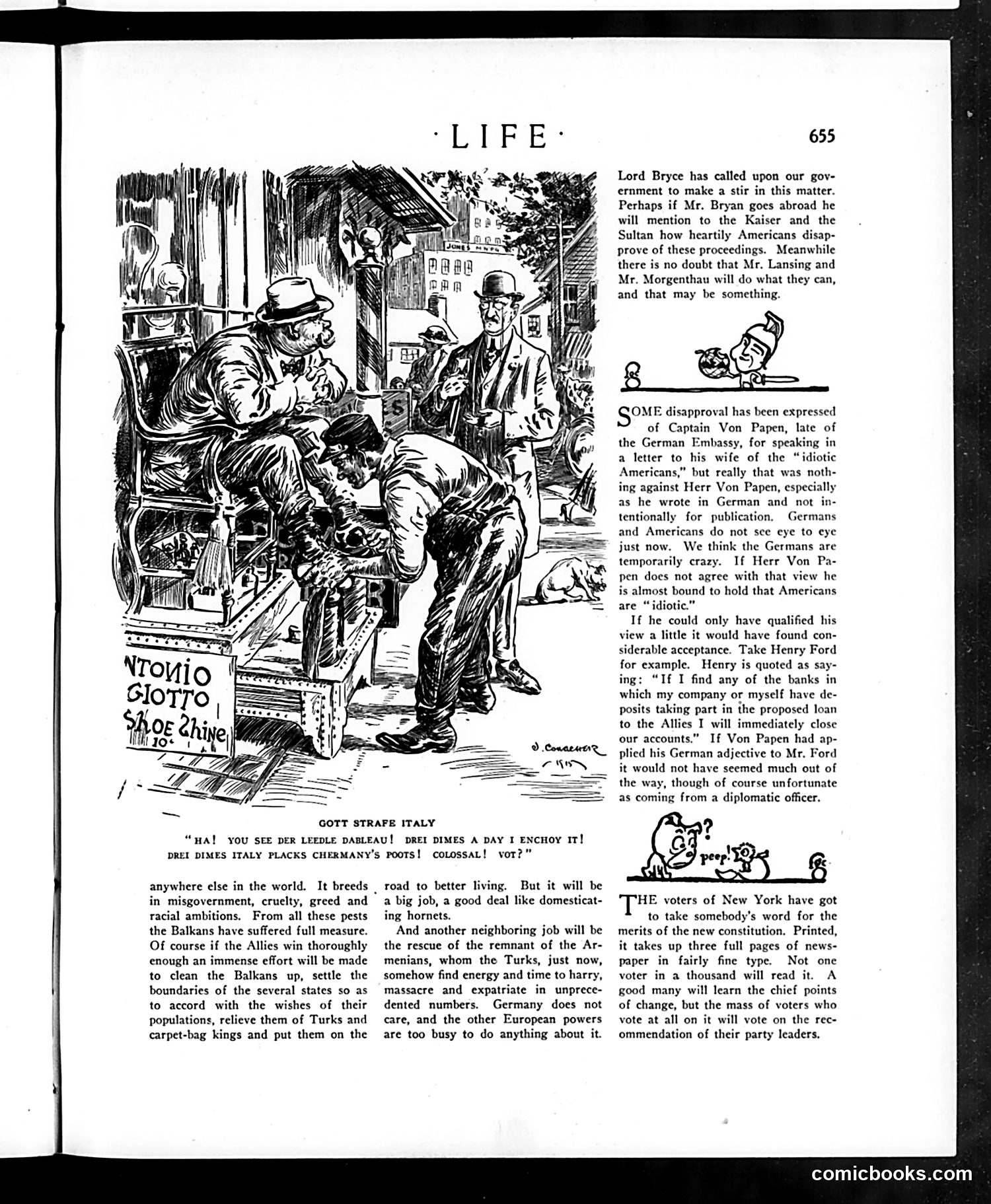
The main cartoon satirizes German-Italian tensions during World War I. It depicts a German soldier showing an Italian figure a crude visual joke—Italy's boots (implying Italian soldiers' feet) stamping on Germany's face. The German speaks in exaggerated dialect, calling it a "colossal" scene worth "drei dimes a day." The satire mocks both German arrogance and the uncomfortable Allied partnership: Germany apparently views Italy (its supposed ally) as comically treading on German interests, yet finds this amusing. The cartoon ridicules German attitudes toward their allies and suggests friction within the Central Powers. The surrounding text discusses broader diplomatic issues—Von Papen's insulting letter calling Americans "idiotic," Armenian massacres, and Balkan reconstruction—all framed as examples of how nations misunderstand each other during wartime. The piece argues that while Von Papen's criticism was tactless, Americans and Germans genuinely viewed each other as irrational during this period.
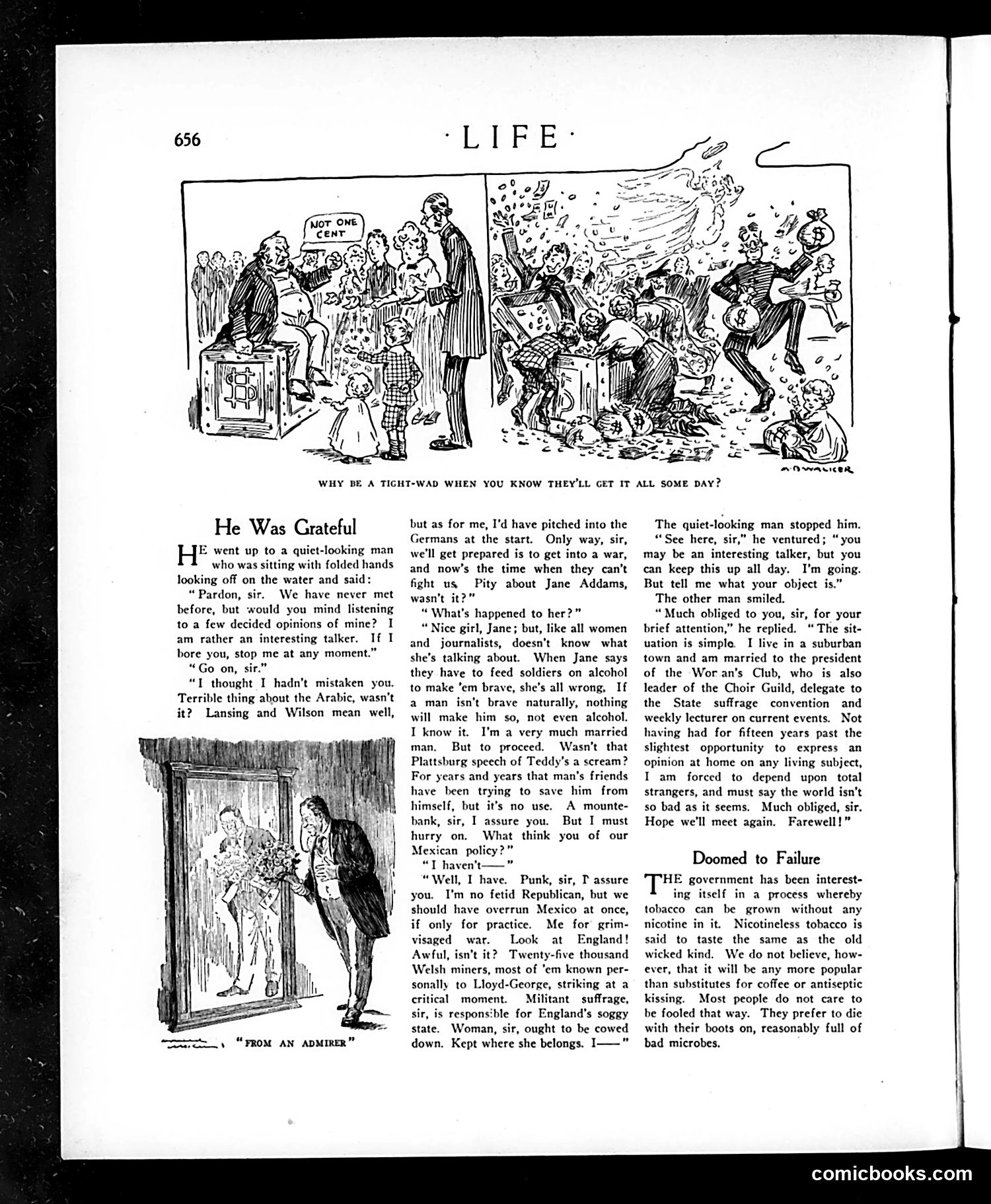
**Top Cartoon:** "Why Be a Tight-Wad When You Know They'll Get It All Some Day?" depicts a charity collection box, satirizing wartime profiteering and the expectation that wealth will eventually be seized through taxation or redistribution during the conflict. **"He Was Grateful" Story:** A man traps a stranger to vent opinions on current events—the Arabic sinking, Jane Addams's pacifism, Theodore Roosevelt's Plattsburg preparedness speech, militant suffragism, and Mexican policy. The twist: he's a suburban husband whose wife dominates their household through her leadership roles (Women's Club president, choir director, suffrage delegate). Unable to speak at home, he buttonholes strangers for intellectual outlets. **"Doomed to Failure":** The government attempts developing nicotine-free tobacco. The satire dismisses this as futile—people prefer the *real thing*, including its dangers, rather than sanitized substitutes. It's a commentary on Prohibition-era attempts at "safer" alternatives and human nature's resistance to reform. The page reflects pre-WWI American anxieties about war preparedness, women's political activism, and government overreach.
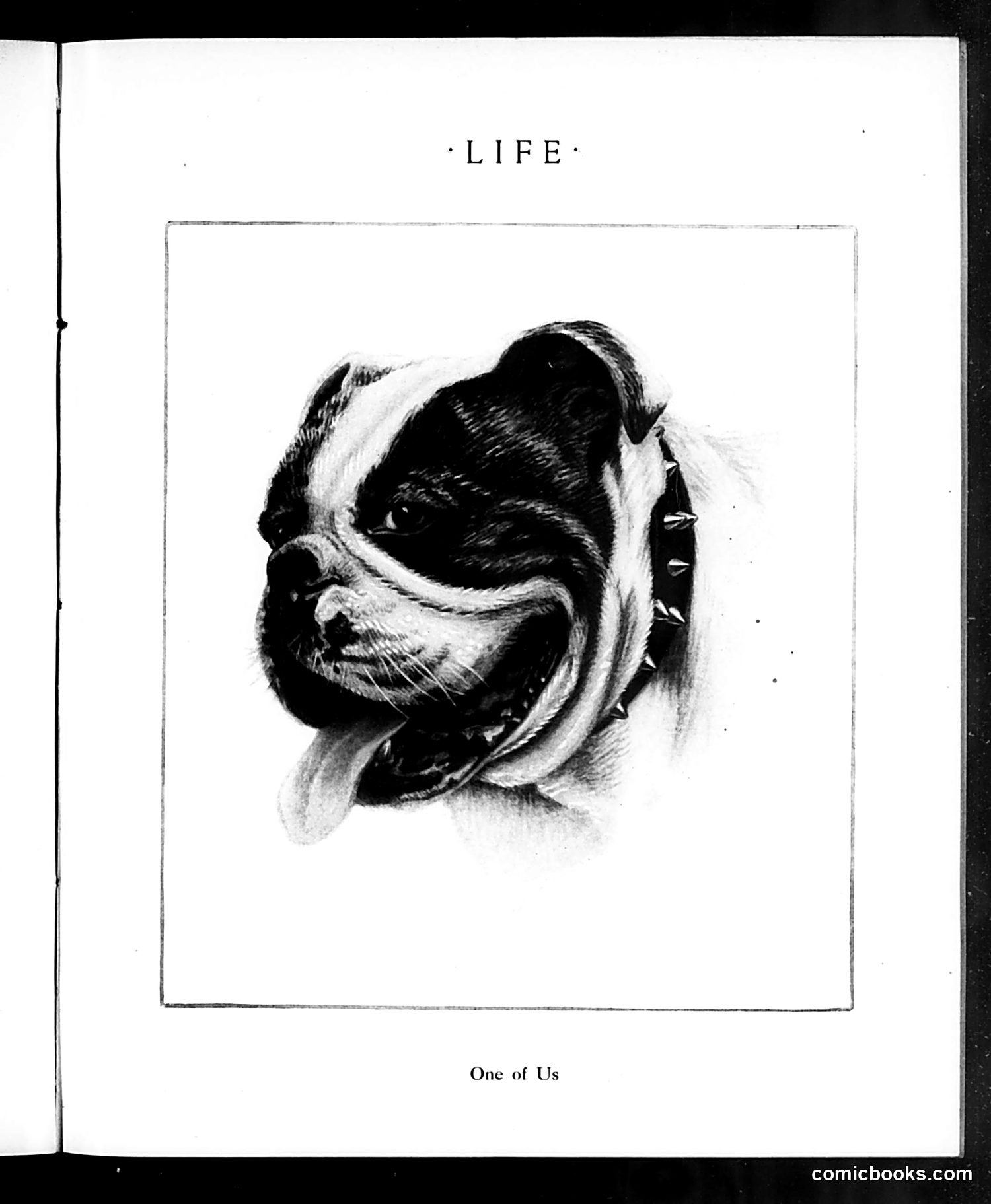
This page from Life magazine features a black and white illustration of a bulldog's head, wrapped in what appears to be a bonnet or head covering with decorative studs or rivets along one edge. The title "One of Us" suggests satirical commentary on belonging or membership. The bulldog—a breed historically associated with British identity and stubbornness—appears dressed or constrained in an unusual manner. Without additional context about the specific publication date, the exact satirical target remains unclear. The image likely comments on either conformity, national identity, or perhaps mockery of a particular group or movement that claimed inclusive membership. The phrase "One of Us" itself ironically questions authentic belonging.
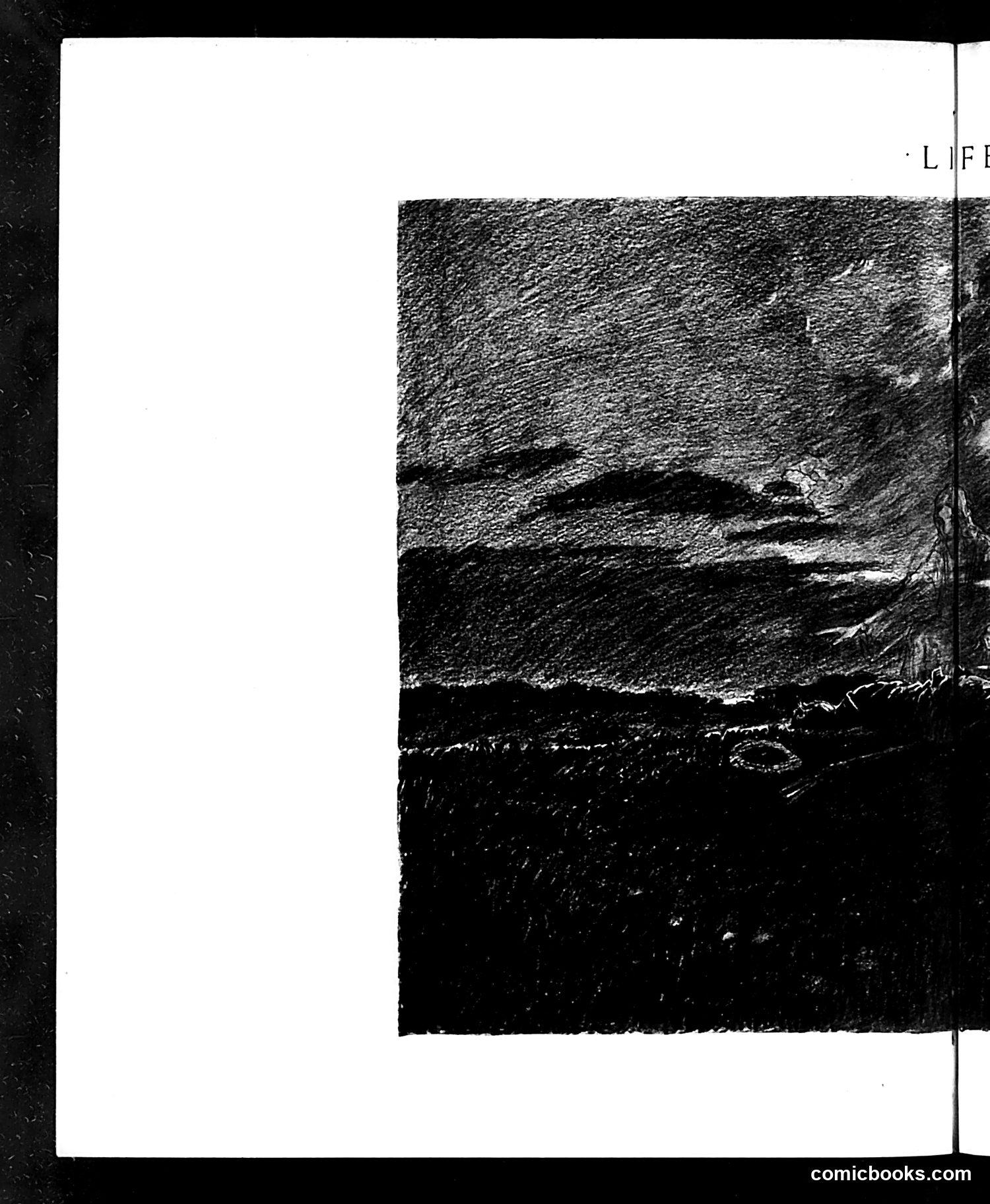
I can see this is a page from Life magazine with "LIFE" visible in the top right corner and "comicbooks.com" at the bottom. However, the image quality is quite poor—the central content appears to be a black and white photograph or illustration showing what looks like geological strata or rock layers, but the details are too degraded for me to discern specific figures, captions, or satirical intent with confidence. Without legible text or clear visual details, I cannot reliably identify what cartoon or content this represents, what political or social commentary it makes, or what historical context it references. To provide accurate analysis as requested, I would need a clearer image where text and illustrations are readable.
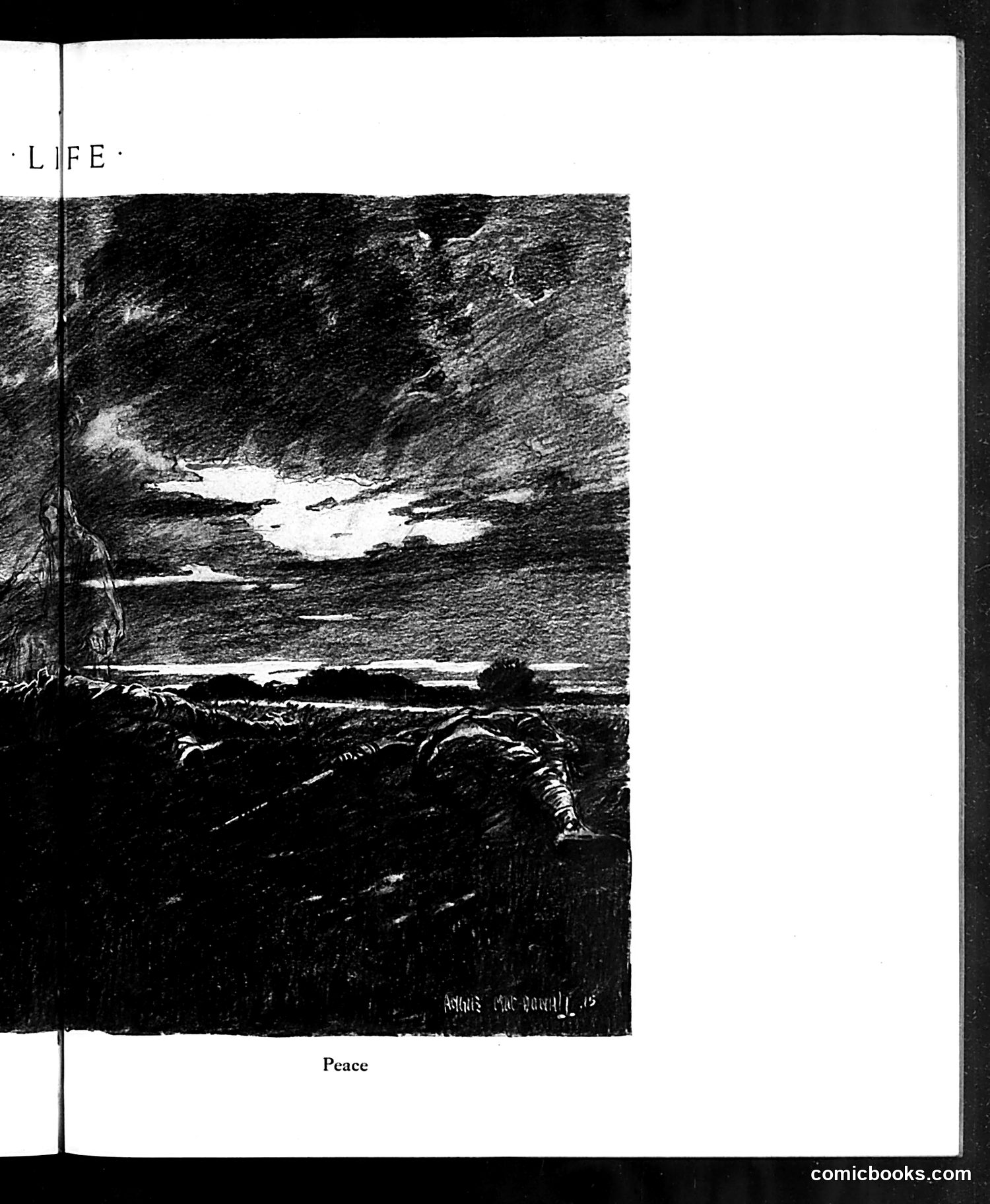
This page presents a landscape illustration titled "Peace" showing a serene natural scene: a waterway or stream surrounded by rocky, forested terrain with vegetation in the foreground. The image appears deliberately peaceful and idyllic. However, without clearer OCR text or additional context clues on the page, the specific satirical point is unclear. Given Life magazine's tradition of political satire, this "Peace" illustration might ironically comment on contemporary conflicts or world affairs—possibly contrasting an idealized vision of peace with harsh reality. The stark black-and-white engraving style emphasizes nature's tranquility. The page header reads "LIFE" but the garbled OCR text prevents identifying the specific historical moment, date, or political target this cartoon references.
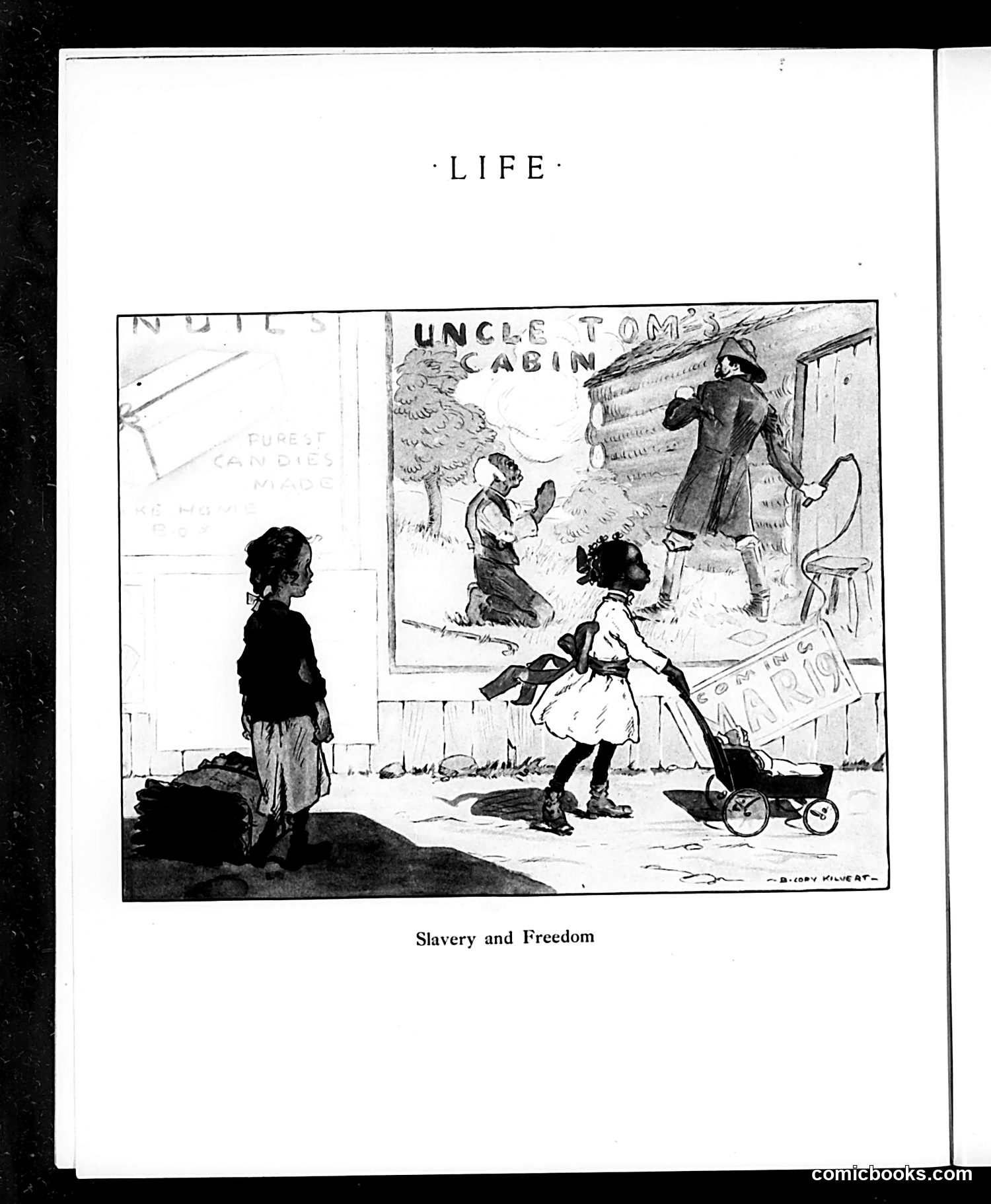
This satirical cartoon contrasts two scenes. On the left, a young Black child stands alone in poverty and darkness. On the right, a poster advertises "Uncle Tom's Cabin," while well-dressed white figures (including what appears to be a vendor or promoter) gesture toward the theatrical advertisement. A white child plays with toys nearby. The satire critiques the commodification and sentimentalization of slavery narratives. While Harriet Beecher Stowe's anti-slavery novel was culturally celebrated, the cartoon suggests the actual conditions of Black people remained desperate and unchanged. The juxtaposition implies that white society consumed slavery as entertainment and moral theater without substantively addressing real suffering or inequality—a sharp commentary on the gap between abolitionist sentiment and genuine social progress.
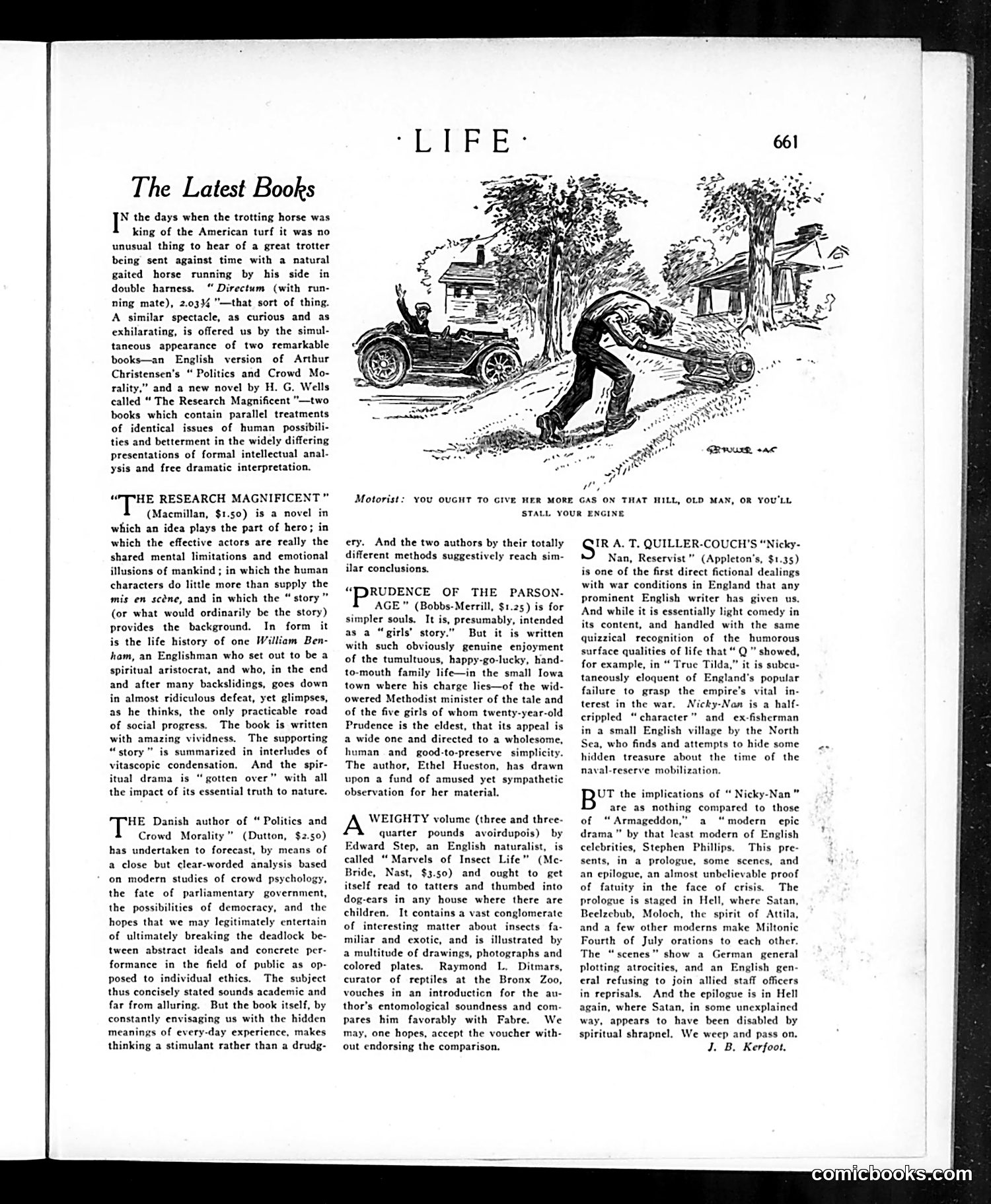
This is a book review section from Life magazine discussing four contemporary publications. The prominent cartoon depicts a motorist on a hill giving driving advice to an older man: "You ought to give her more gas on that hill, old man, or you'll stall your engine." The joke uses automotive/mechanical language as a metaphor—likely satirizing intellectual discourse of the era. The reviews themselves compare two parallel works examining human society and progress: H.G. Wells's novel "The Research Magnificent" and Arthur Christensen's analytical work "Politics and Crowd Morality." Life presents these as competing approaches to identical themes, comparing them humorously to horses racing in tandem harness. The reviews also cover lighter fare like "Prudence of the Parsonage" (small-town family life) and a naturalist's encyclopedia about insects. The page reflects Life's function as both satirical commentary and serious cultural criticism for educated American readers.
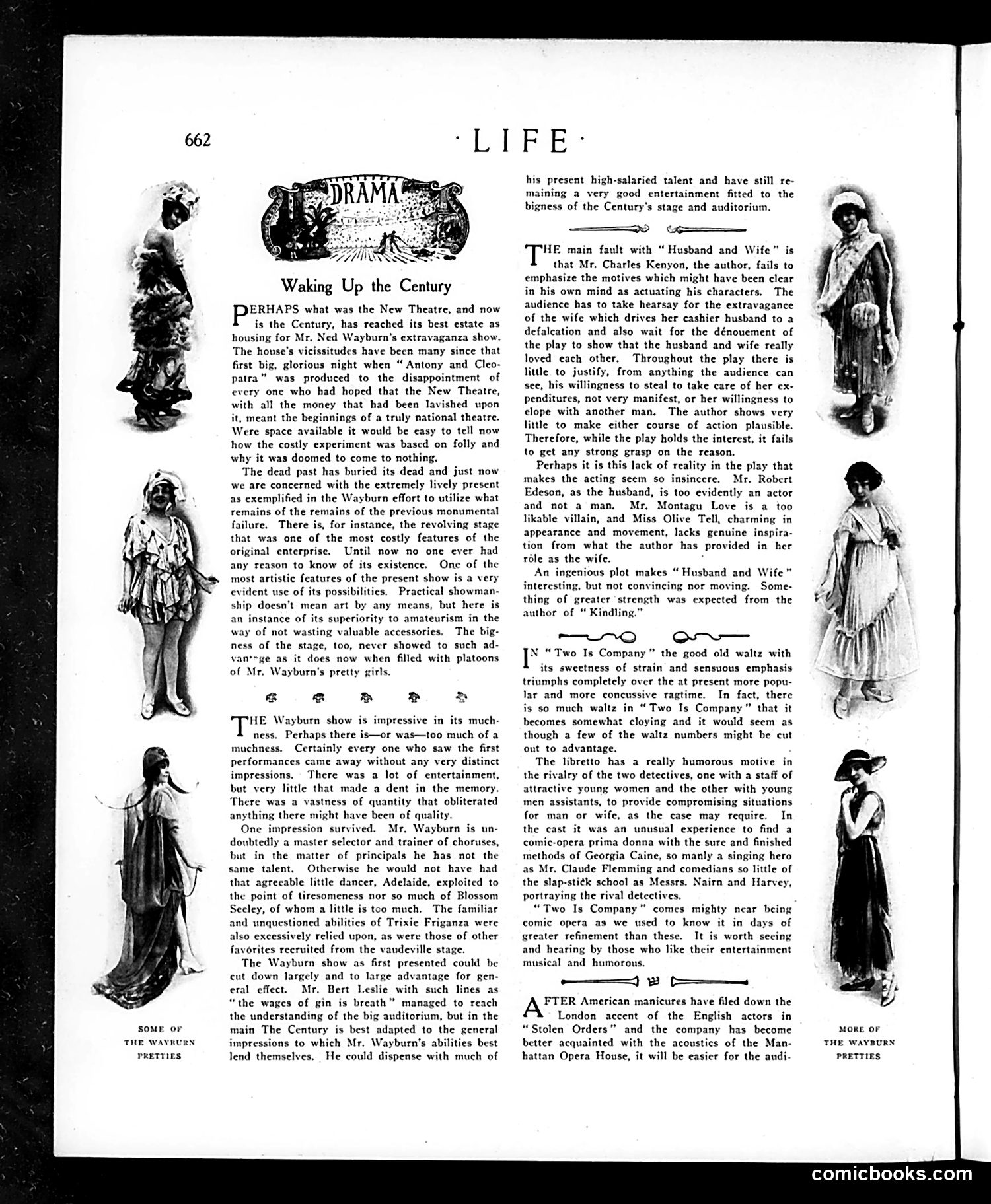
This page contains three theater reviews from Life magazine's drama section, illustrated with photographs of performers in costume. **"Waking Up the Century"** reviews Ned Wayburn's extravaganza at the Century Theatre (formerly the struggling "New Theatre"). The critic praises Wayburn's skill organizing chorus girls and using the theater's previously-hidden revolving stage effectively. However, the review criticizes the show's excessive scale—too many acts and performers create quantity over quality, leaving no lasting impression. The critic suggests cutting high-salaried performers like Adelaide, Blossom Seeley, and Trixie Friganza. **"Two Is Company"** receives brief praise for its waltzes charming audiences. **"Husband and Wife"** by Charles Kenyon is criticized for failing to justify characters' motivations. The critic complains audiences don't understand why the wife's extravagance drives her husband to embezzlement or why she'd leave him. The sidebar images show "Wayburn Pretties"—chorus performers in costume, reflecting the era's emphasis on female dancers as theatrical attractions.
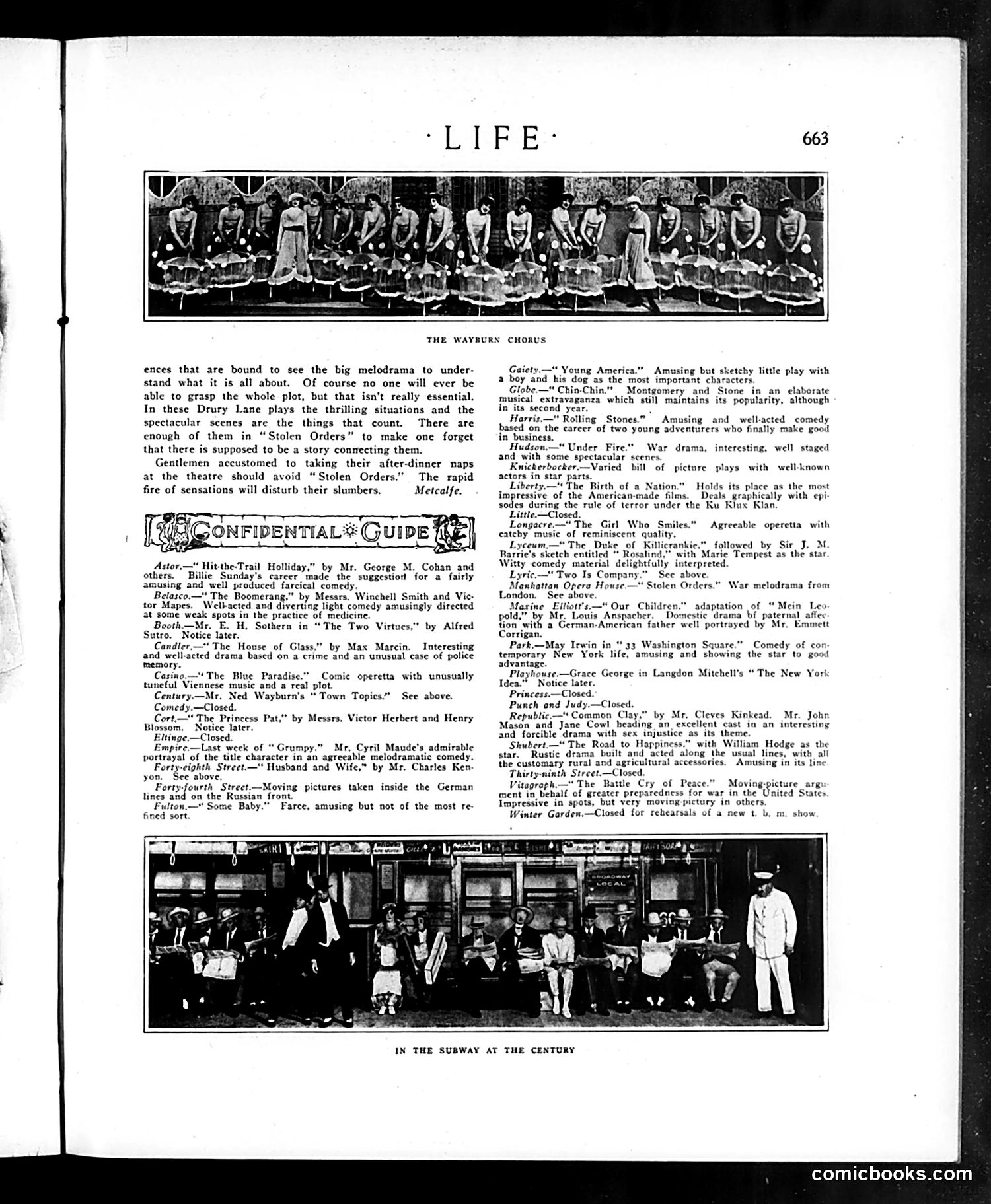
This page presents theater reviews from early 20th-century Broadway, accompanied by two photographs. The top image shows "The Wayburn Chorus"—a line of chorus girls in theatrical costume, representing Ned Wayburn's "Town Topics" production at the Century Theatre. The reviews discuss various theatrical productions with brief critical assessments. Notable entries include D.W. Griffith's "The Birth of a Nation," described as "the most impressive of the Americans-made films," dealing with "the rule of terror under the Ku Klux Klan"—presented here without apparent critical judgment of the film's racist content. The bottom photograph, captioned "In the Subway at the Century," shows a crowded subway scene, likely illustrating urban life or theater-going culture. The page reflects early 1910s Broadway culture and entertainment criticism, with no apparent political satire—it functions primarily as an entertainment guide with accompanying theatrical photography.
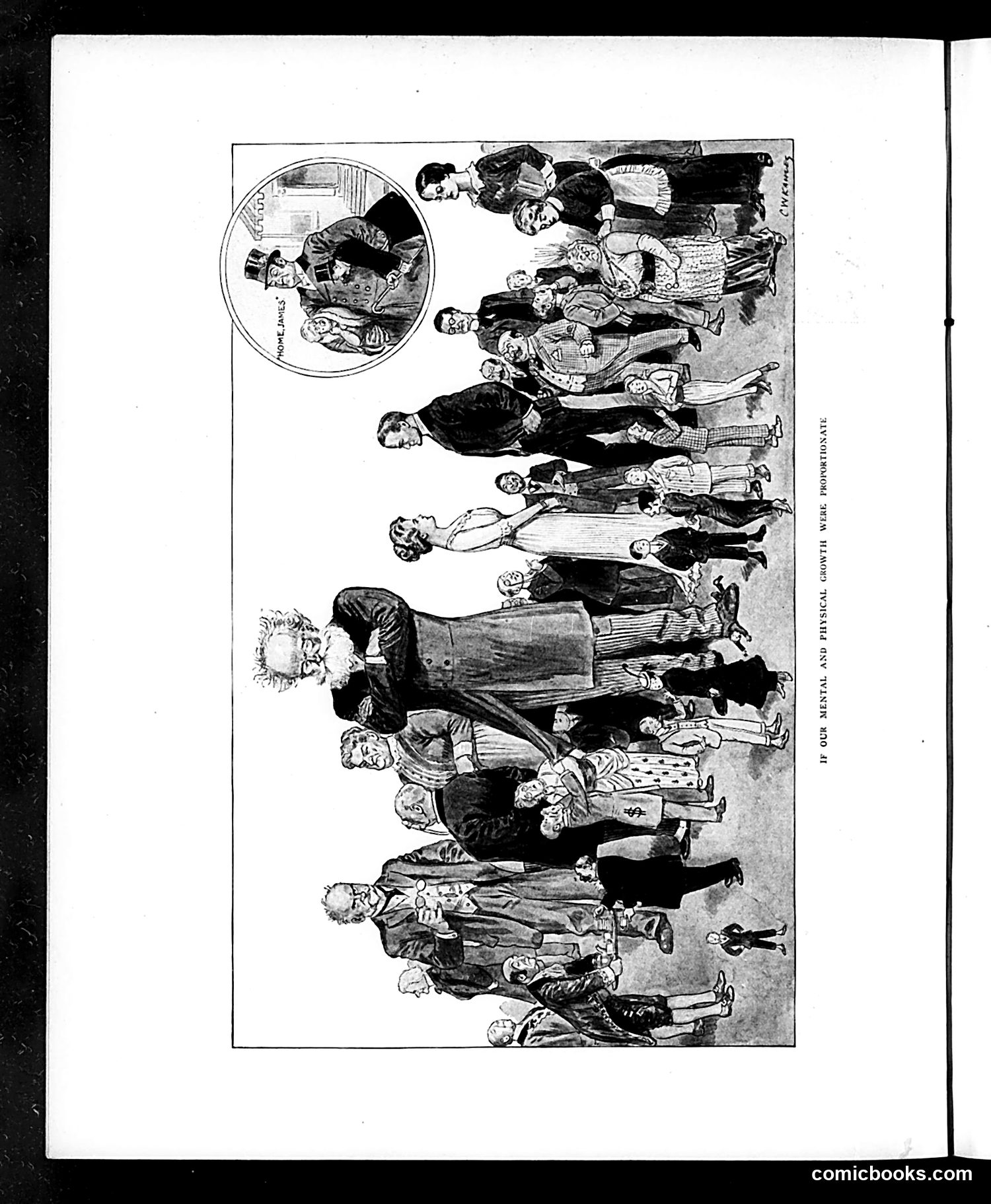
This cartoon uses satirical visual comparison to critique the physical development of American society. The image shows figures arranged vertically, with a circular inset at top-left depicting someone hunched over reading or studying. The caption suggests that mental and physical growth should be proportionate—implying they are not. The satire appears to contrast intellectual development with physical fitness or health. The exaggerated postures and proportions of the figures suggest that Americans' mental pursuits (possibly excessive reading, studying, or sedentary intellectual work) have outpaced their physical development, resulting in poor posture, weakness, or general physical decline. This reflects early 20th-century concerns about degeneracy and the health costs of modern, desk-bound lifestyles.
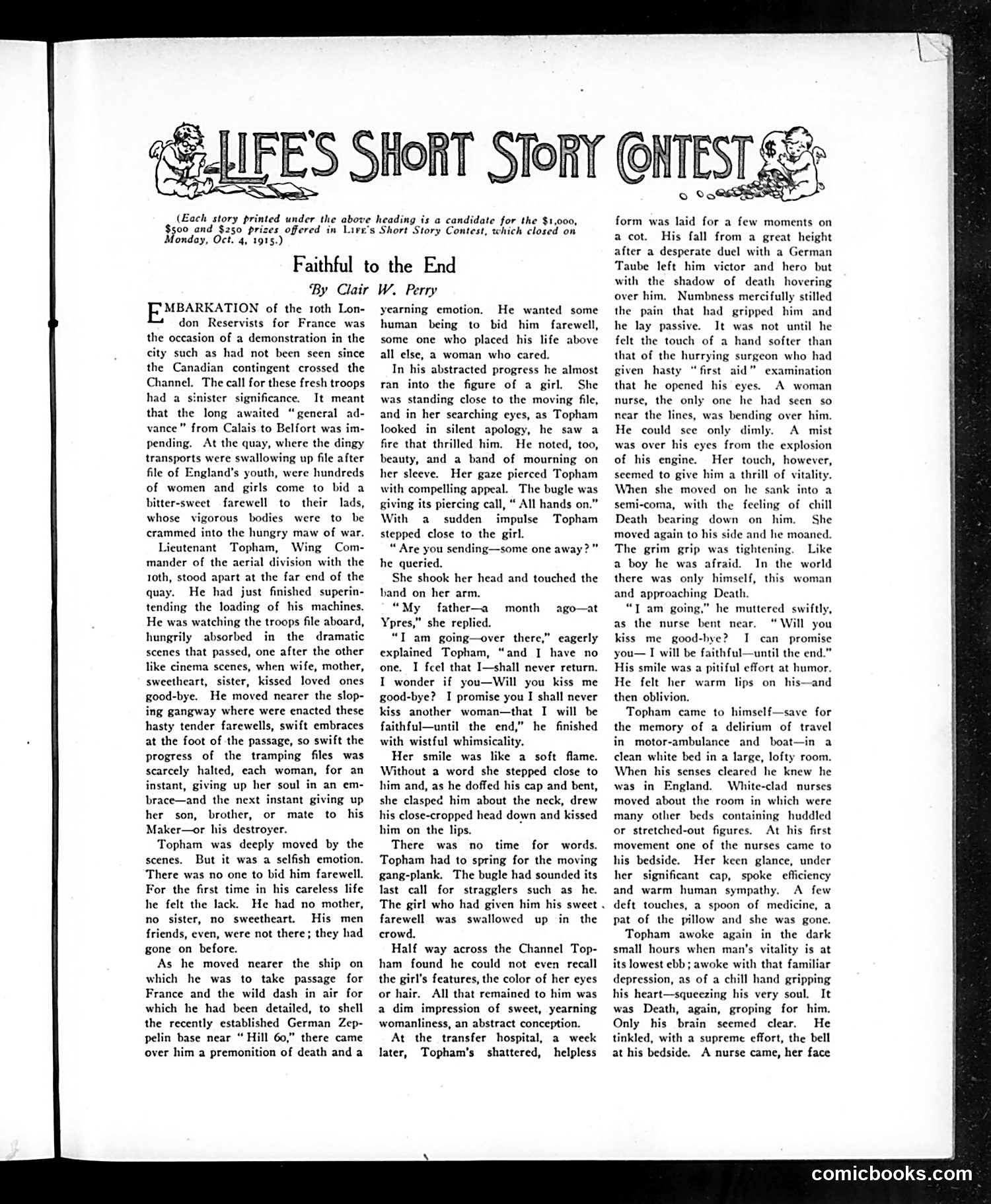
This page presents a romantic wartime short story, not political satire. The narrative concerns Lieutenant Topham, a British aerial commander departing for France during World War I (specifically to attack German Zeppelin bases near "Hill 60"). Emotionally isolated—lacking family or sweetheart to bid him farewell—Topham impulsively asks a young woman at the docks to kiss him goodbye, promising he'll remain faithful "until the end." She agrees, they kiss, and he departs. The story reflects WWI's emotional tenor: soldiers' mortality anxiety, the poignancy of hasty farewells, and romantic idealization amid mechanized warfare. This was published October 4, 1915, when Britain had been at war for over a year. The piece is a *Life* magazine fiction contest entry, not satirical commentary—it's sentimental melodrama typical of wartime popular literature.
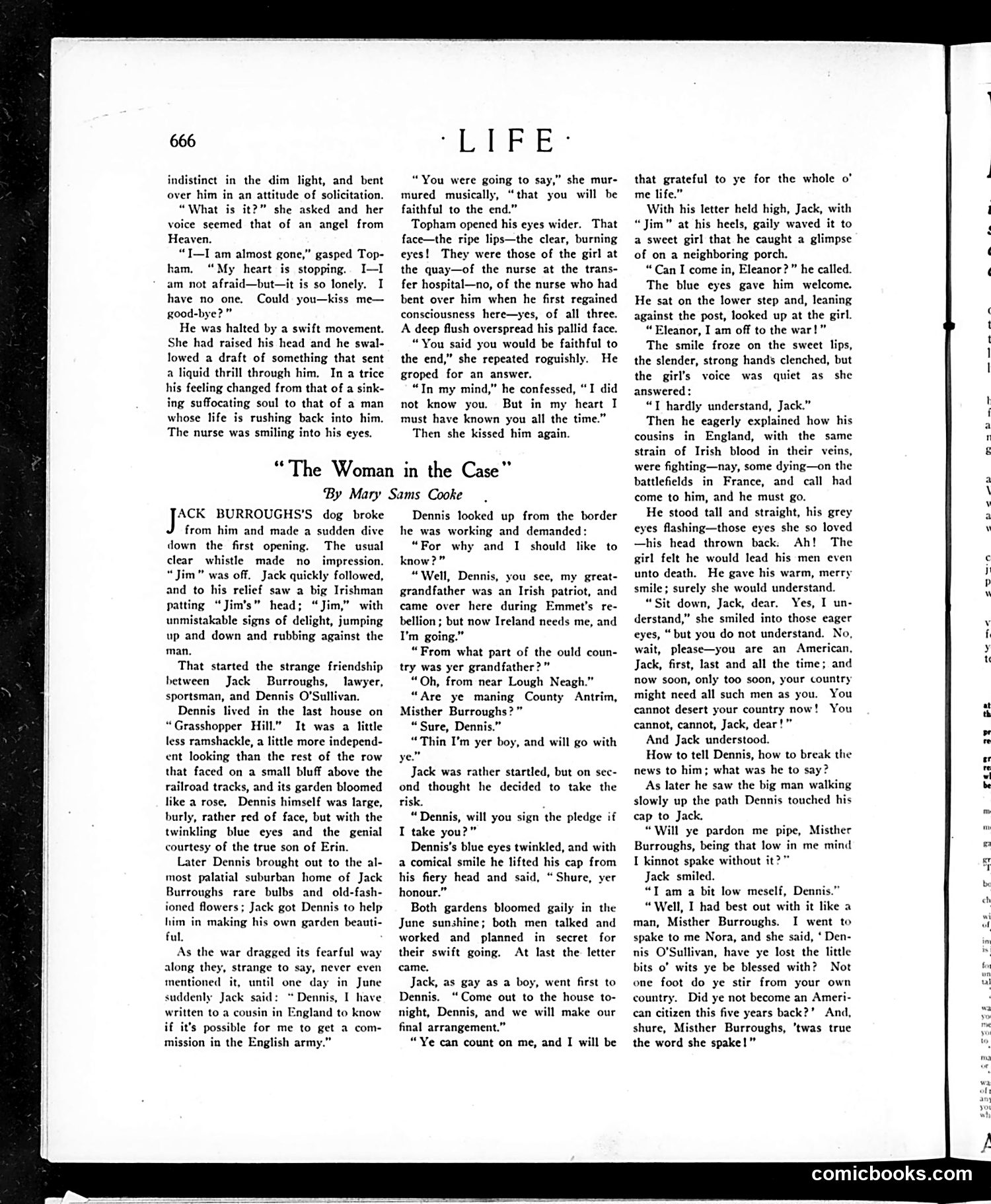
This page contains two distinct pieces of fiction rather than political cartoons. **Top section** appears to be the conclusion of a serialized story involving a character named Topham and a mysterious nurse who has appeared to him in multiple guises—at a quay, a transfer hospital, and his current location. The narrative suggests romantic/supernatural elements as she nurses him back from near-death. **Main story**: "The Woman in the Case" by Mary Sams Cooke depicts an upper-class American lawyer (Jack Burroughs) and his working-class Irish gardener neighbor (Dennis O'Sullivan) during World War I. Jack reveals he's obtained a commission in the English army due to Irish ancestry. Dennis enthusiastically volunteers to join him. The story explores themes of patriotism, class friendship, and Irish-American identity during wartime. The dialogue captures period attitudes toward military service and Irish participation in the Great War. Both pieces are sentimental fiction typical of *Life*'s literary content during this era—not satirical commentary.
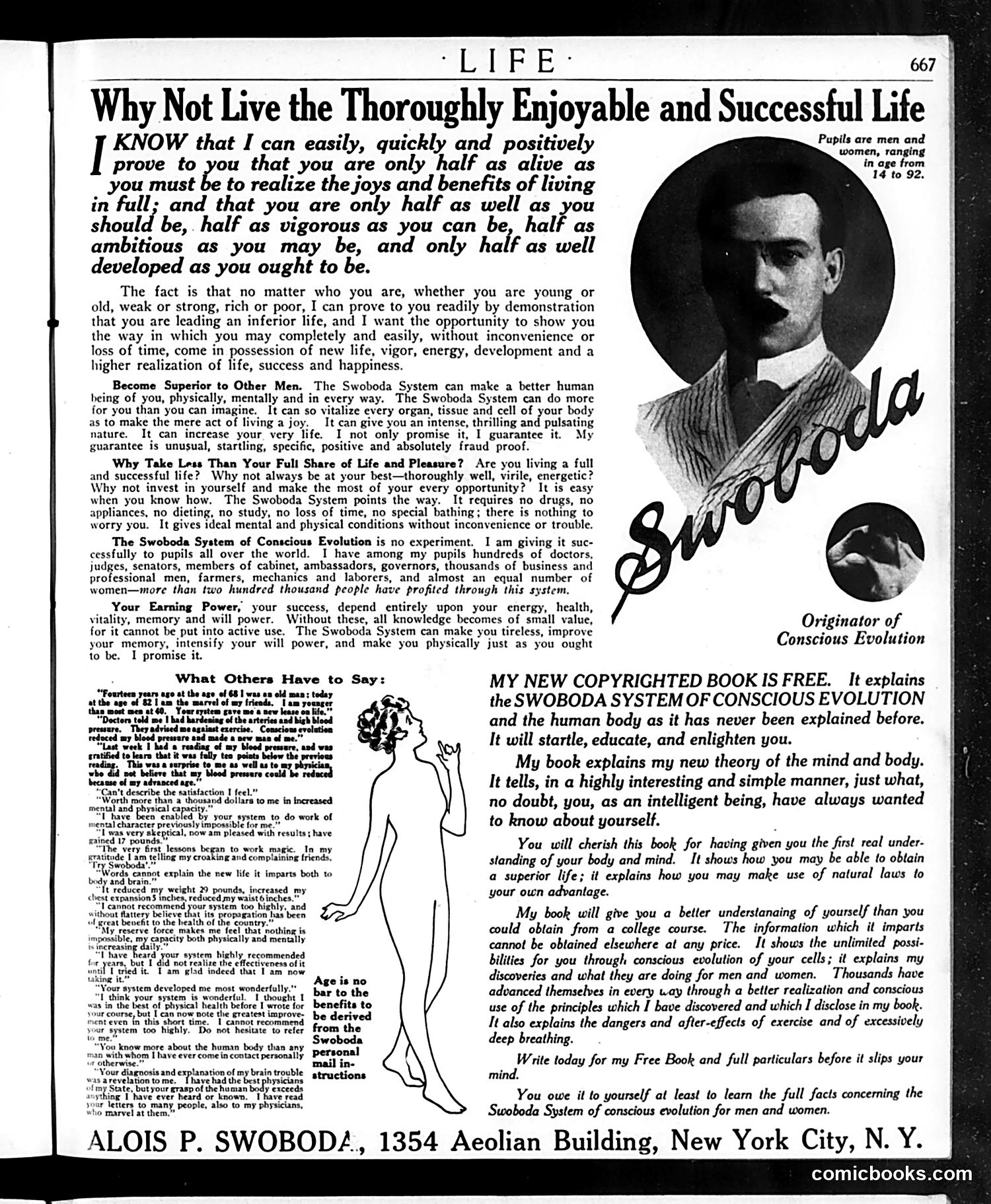
This is a **full-page advertisement** for the "Swoboda System of Conscious Evolution," a pseudoscientific self-improvement scheme from the early 20th century. **The Figure:** Alois P. Swoboda, identified at bottom as the "Originator of Conscious Evolution," promotes his system through testimonials and grandiose claims. **The Pitch:** Swoboda claims his method can make people "half as alive" into fully vital beings—without drugs, dieting, or special equipment. He promises increased energy, vigor, success, and physical vitality through undefined "conscious evolution." **Historical Context:** This represents early 1900s pseudoscientific marketing that exploited widespread anxiety about modernity, vigor, and self-improvement. The long list of supposed clients (doctors, judges, senators) is a credibility tactic common to dubious wellness schemes. **The Satire:** *Life* magazine published this as satire—the absurd, unmeasurable claims and vague promises are presented straight-faced, making the advertisement itself the joke for readers who recognized snake-oil when they saw it.
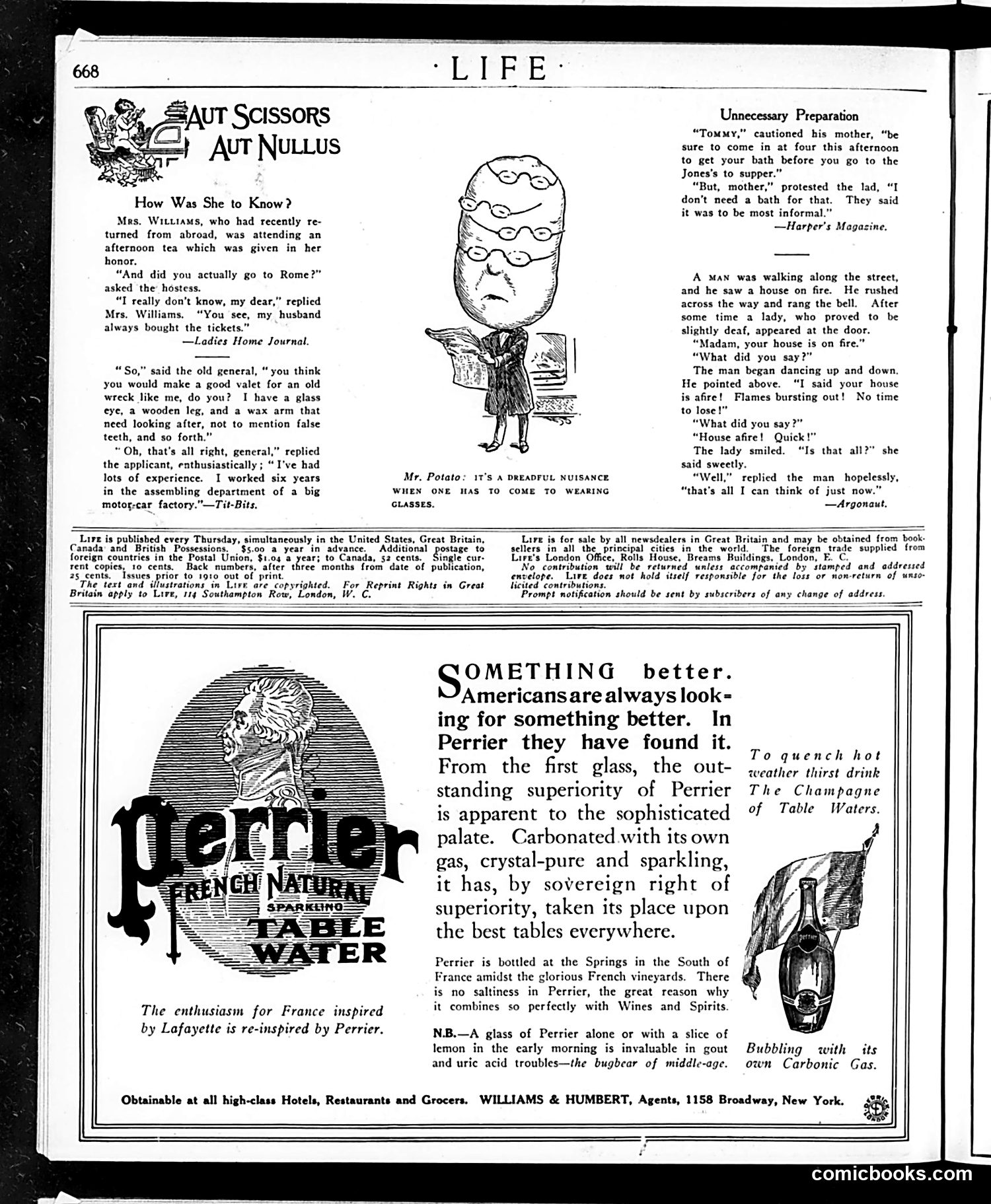
This page contains four separate humorous anecdotes satirizing social pretension and miscommunication in early 20th-century America: 1. **"How Was She to Know?"** mocks wealthy tourists who claim travel experiences they didn't actually experience themselves—Mrs. Williams attended a Rome-themed tea but admits her husband bought the tickets, implying she never went to Rome. 2. **"Mr. Potato"** jokes about a job applicant's misplaced confidence: he worked assembling motorcar parts and thinks this qualifies him as a valet for a disabled general, missing the absurdity entirely. 3. **The deaf lady anecdote** satirizes communication breakdown: a man frantically warns of fire, but the woman mistakes his urgency for politeness and remains unmoved. 4. The cartoon titled **"Unnecessary Preparation"** mocks over-preparation for informal social events—a boy protests needing a bath for a casual supper. The page primarily advertises **Perrier sparkling water**, positioning it as a superior French product for sophisticated American consumers. The overall theme reflects period anxieties about social propriety, class performance, and modern consumer culture.
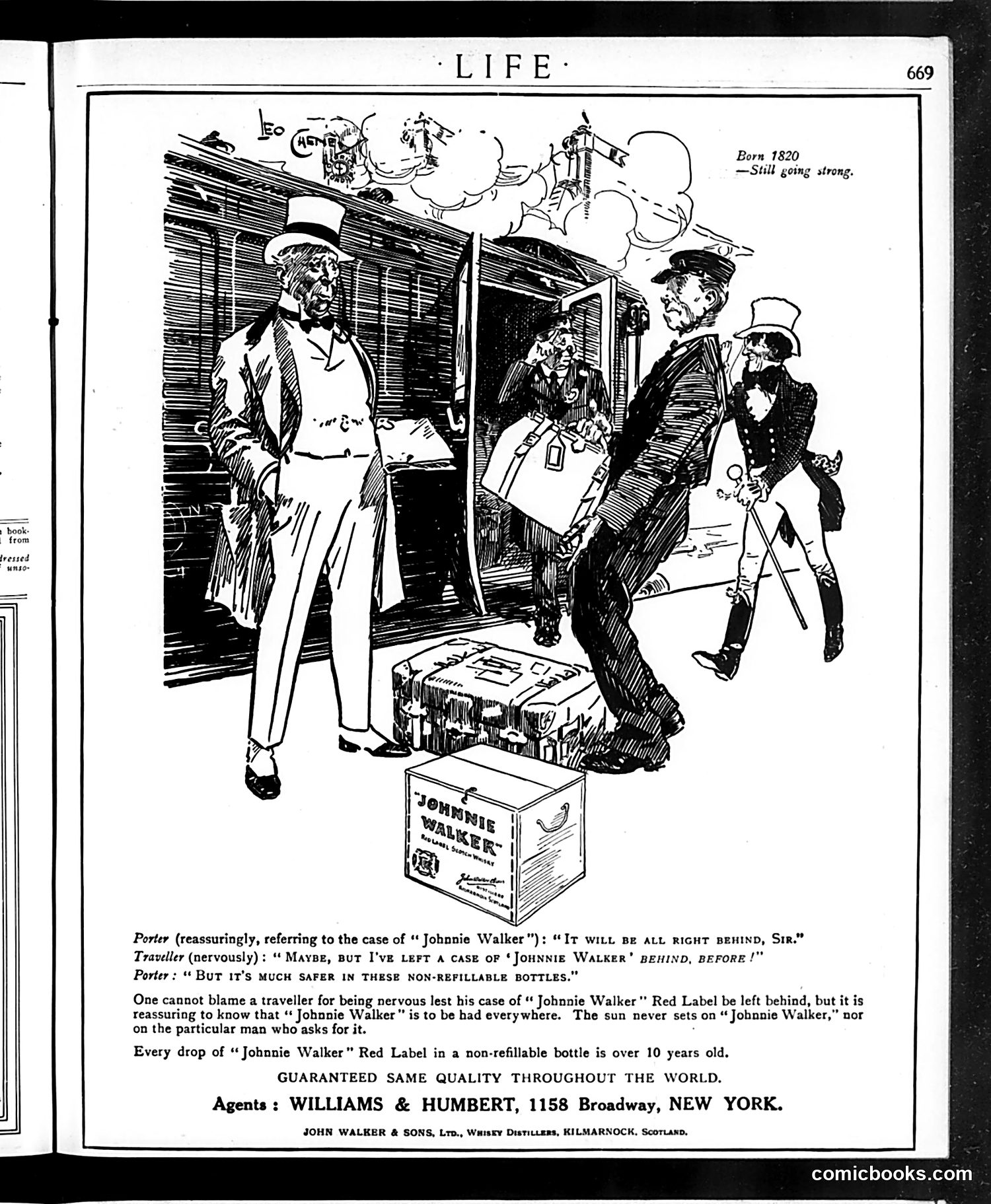
This is a **Johnnie Walker whisky advertisement** disguised as humorous editorial content in Life magazine. The cartoon depicts a porter and traveler at what appears to be a train station. The traveler nervously mentions he's previously left a case of Johnnie Walker whisky behind; the porter reassures him it's now safe in "non-refillable bottles." **The satire/advertising point:** The joke plays on travelers' anxiety about luggage being misplaced—particularly valuable alcohol. The ad cleverly turns this into a selling point: Johnnie Walker is so globally available and reliable ("the sun never sets on Johnnie Walker") that even if you *do* leave it behind, you can get more anywhere. The non-refillable bottles also emphasize product authenticity and quality control. The "Born 1820—Still going strong" tagline references the brand's age and longevity, suggesting durability and trustworthiness. This blurs advertising and editorial content in ways modern readers would immediately recognize as advertising, but early-20th-century Life magazine frequently published such hybrid content.
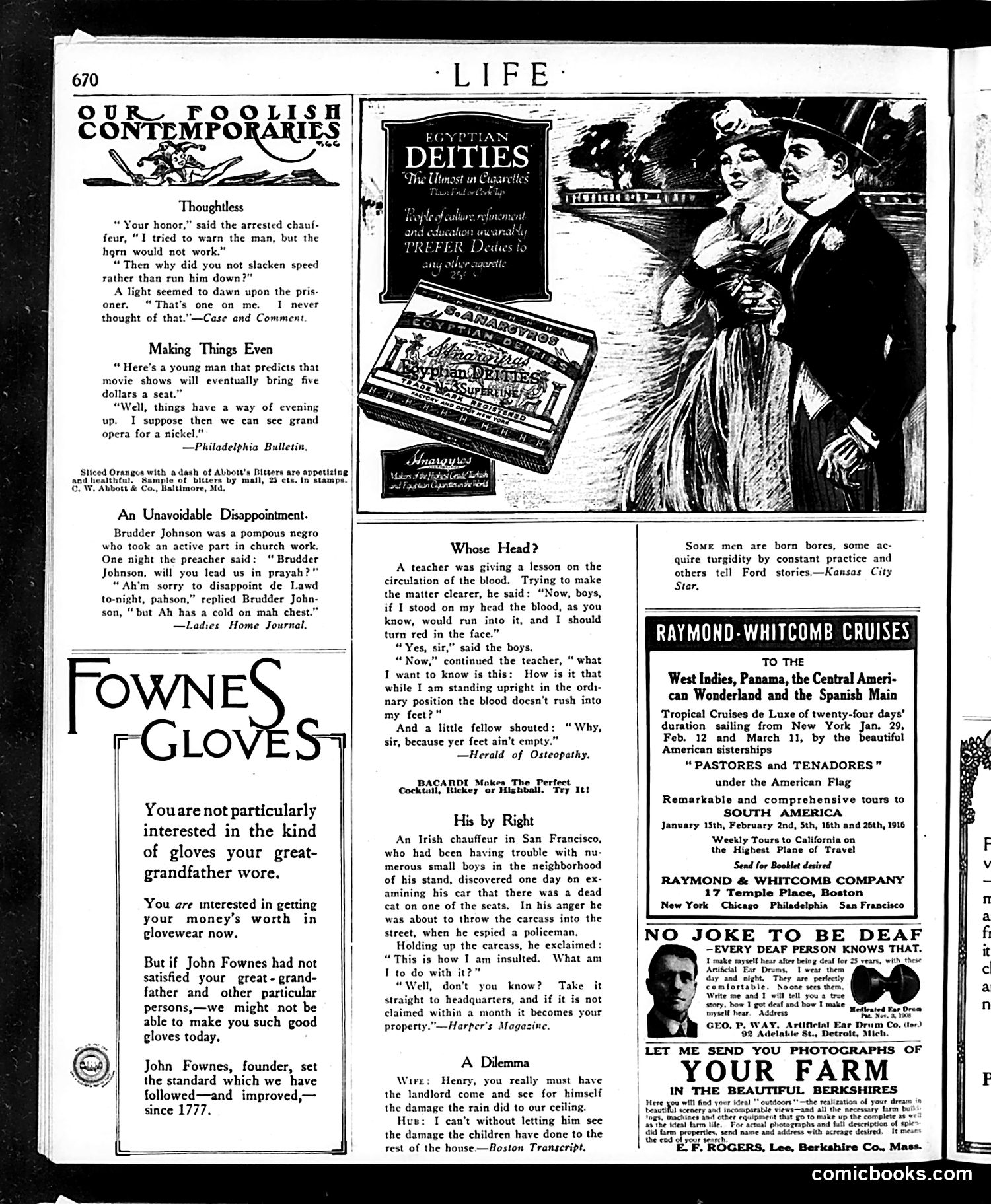
This page from *Life* magazine contains several short humorous anecdotes satirizing social attitudes of the era: **"Thoughtless"** mocks a chauffeur's poor judgment in a traffic accident—he blamed his horn rather than considering basic safety. **"Making Things Even"** jokes about inflation: if movie tickets will cost five dollars, opera should cost a nickel by comparison. **"An Unavoidable Disappointment"** uses racist dialect humor (common in early 20th-century publications) to ridicule a Black church member's excuse. **"Whose Head?"** presents a teacher's anatomy lesson where a child makes a crude joke about why blood doesn't rush to feet—implying they're empty-headed. **"His by Right"** depicts an Irish chauffeur's indignation at finding a dead cat in his car, suggesting immigrant working-class sensitivity to disrespect. The page mostly advertises luxury cruise lines, artificial ear devices, and Fownes Gloves, reflecting *Life's* affluent readership. The humor reflects period prejudices now considered offensive.
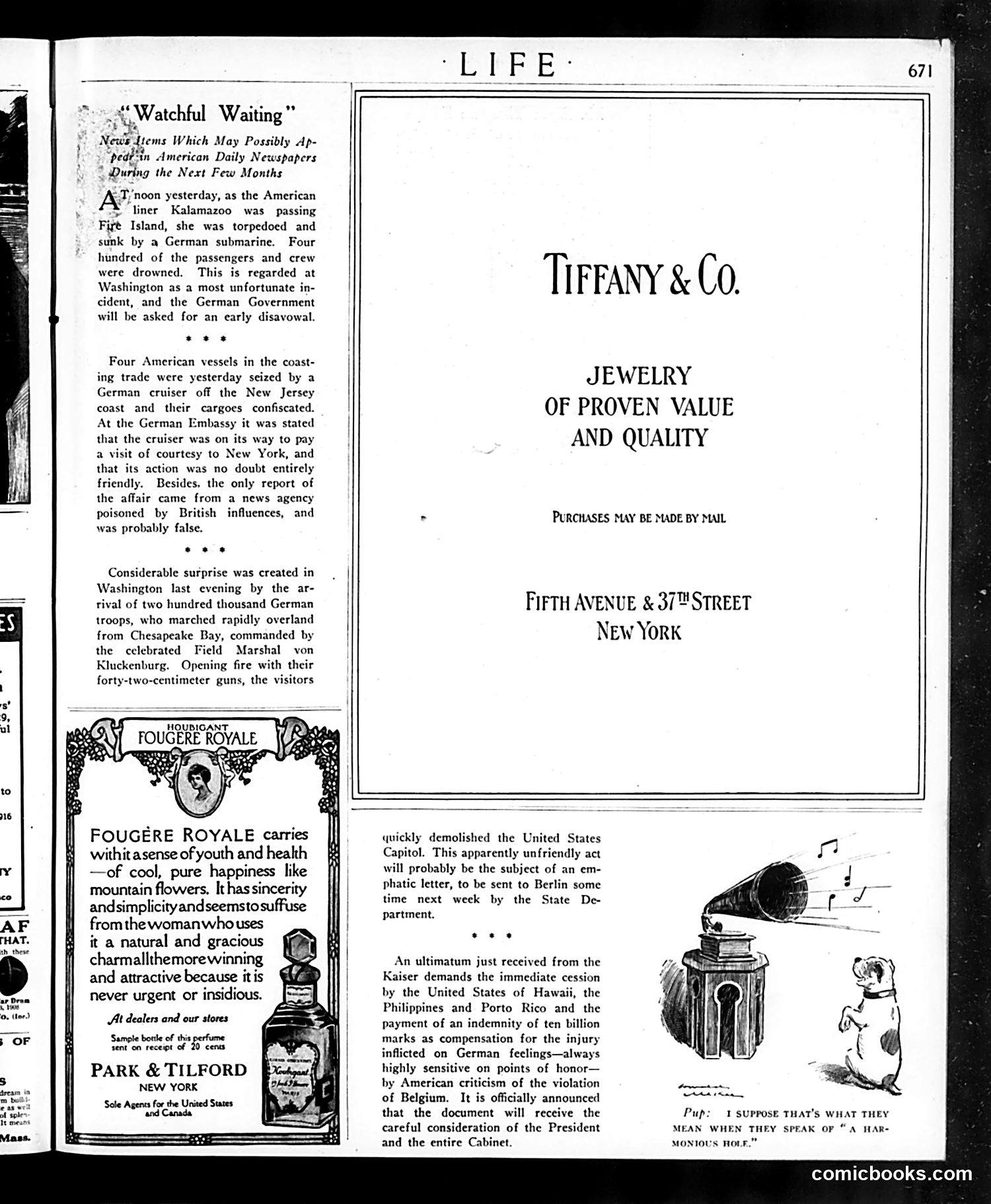
This page satirizes President Woodrow Wilson's policy of "watchful waiting" toward German aggression during World War I (before U.S. entry in 1917). The left column presents increasingly absurd hypothetical newspaper headlines mocking American passivity: a torpedoed ship dismissed as an "unfortunate incident," seized vessels explained away as "friendly" visits, and a German army marching from Chesapeake Bay to destroy the Capitol—all met with polite diplomatic letters rather than action. The bottom cartoon shows a dog and phonograph, captioned as commentary on "harmonious" relations—likely mocking U.S.-German diplomatic pretenses as hollow noise. The satire's point: Life ridicules Wilson's cautious diplomacy as farcical and inadequate, suggesting that real German hostility deserves stronger response than formal complaints. The exaggeration emphasizes the gap between German aggression and American restraint.
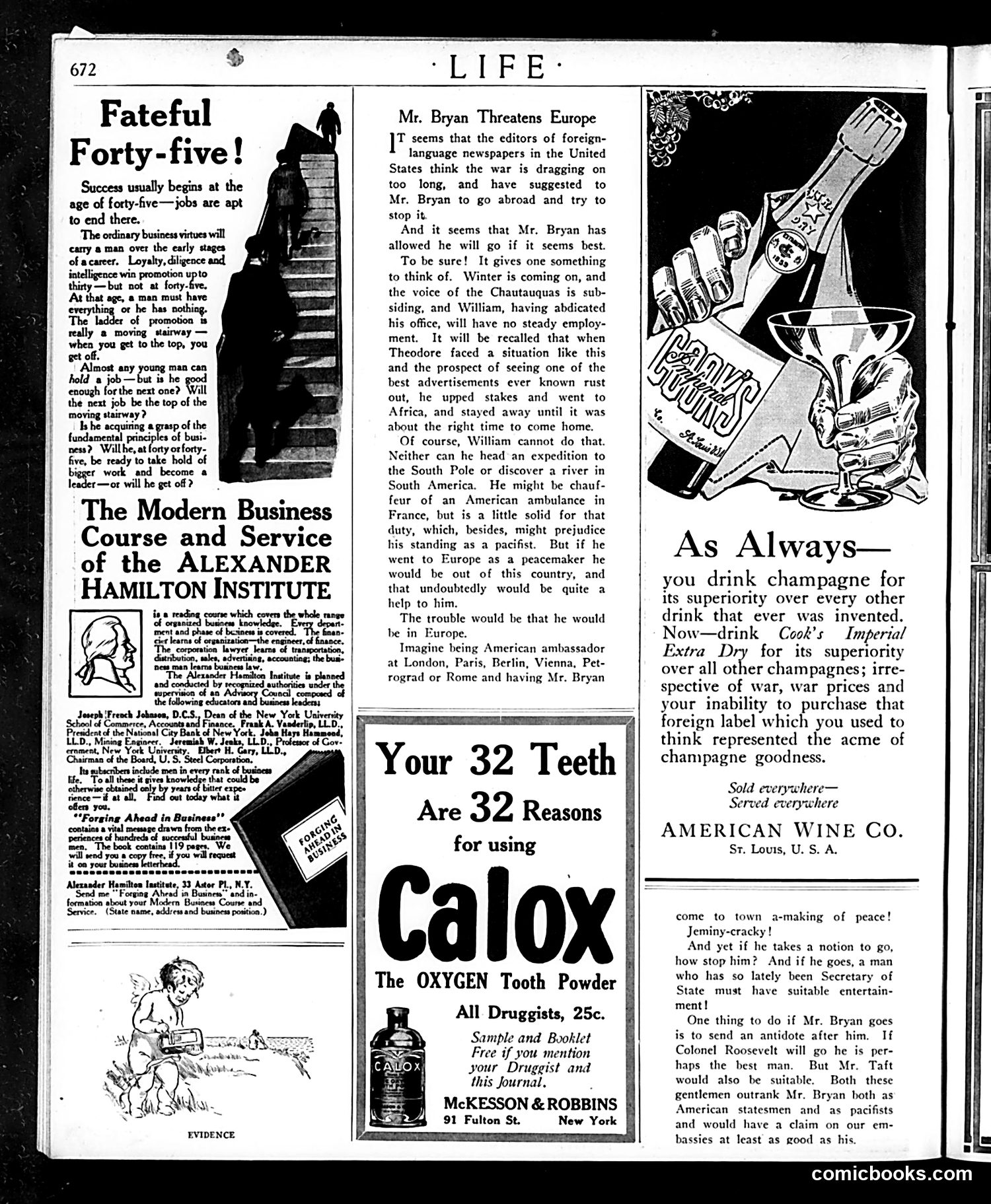
The main article satirizes William Jennings Bryan, the three-time presidential candidate and former Secretary of State under Wilson. Foreign-language newspaper editors have suggested Bryan go to Europe to help end World War I, and Bryan has agreed. Life's satire mocks this proposal as absurd. The piece notes Bryan—now jobless after leaving office—is like Theodore Roosevelt, who went to Africa when facing unemployment. But Bryan can't lead polar expeditions or discover rivers. The joke: if Bryan became a "peacemaker" ambassador in London, Paris, Berlin, Vienna, or Petrograd, at least he'd be *out of the country*, which would "be quite a help to him." The concluding sarcasm suggests sending an "antidote after him," and notes that Colonels Roosevelt or President Taft would be more suitable ambassadors—a jab at Bryan's diplomatic credentials and pacifism during wartime. The page also contains unrelated advertisements for a business course, Calox tooth powder, and Cook's champagne.
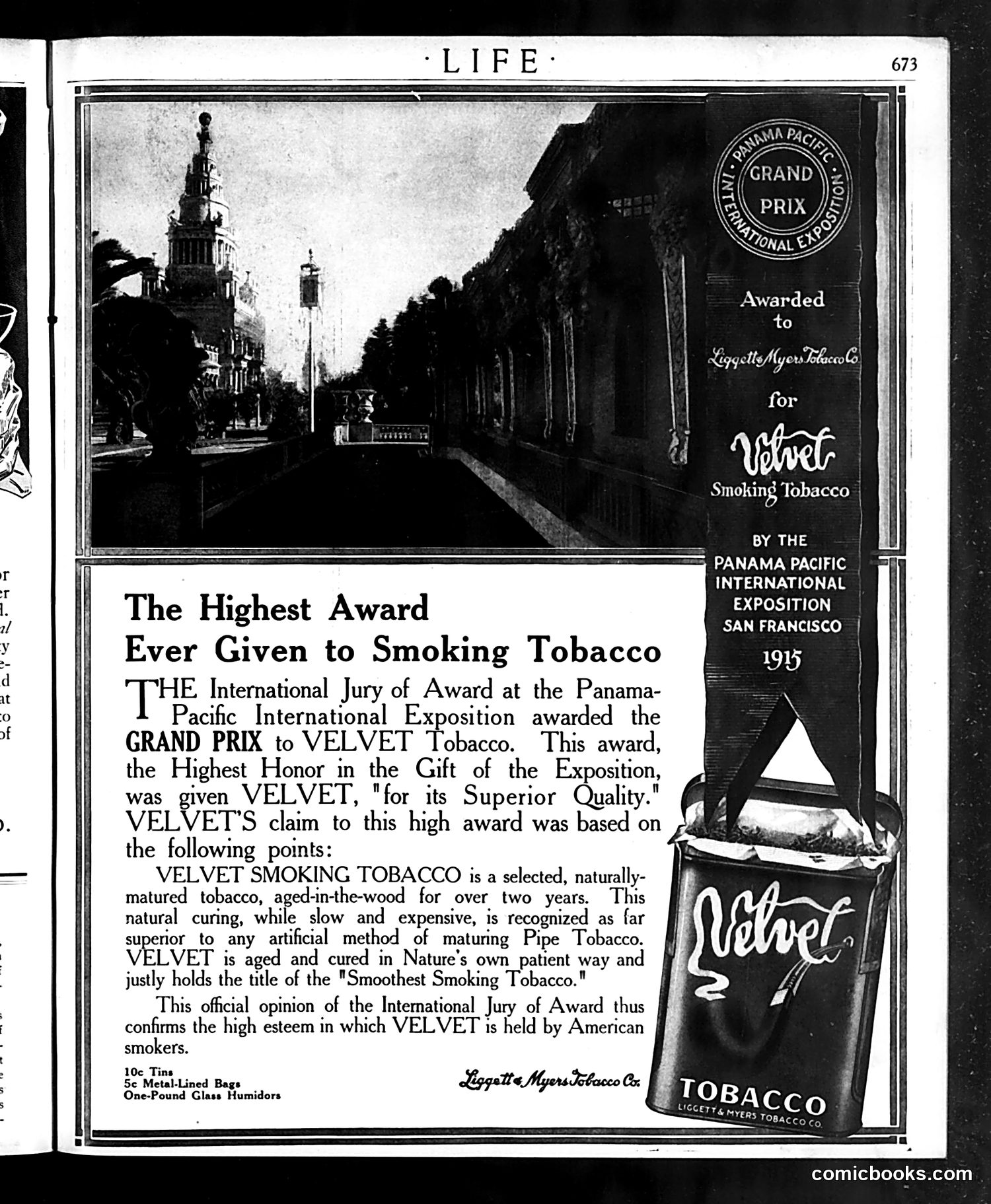
This is **not a cartoon or satire**—it's a straightforward advertisement, not satirical content. The page promotes Velvet Tobacco by Liggett & Myers, claiming it won the Grand Prix (highest award) at the 1915 Panama-Pacific International Exposition in San Francisco "for Superior Quality." The ad emphasizes the product's natural aging process (two years in wood), positioning it as superior to artificially matured competing tobaccos. It includes an image of the product packaging and a scenic photograph (likely from the Exposition) to establish prestige. For modern readers: This represents early 20th-century tobacco marketing before health warnings were required. The association with a major international exposition was a credibility strategy—winning prestigious awards was used to differentiate brands in a competitive market, much as "award-winning" marketing persists today, though tobacco advertising itself is now heavily restricted.
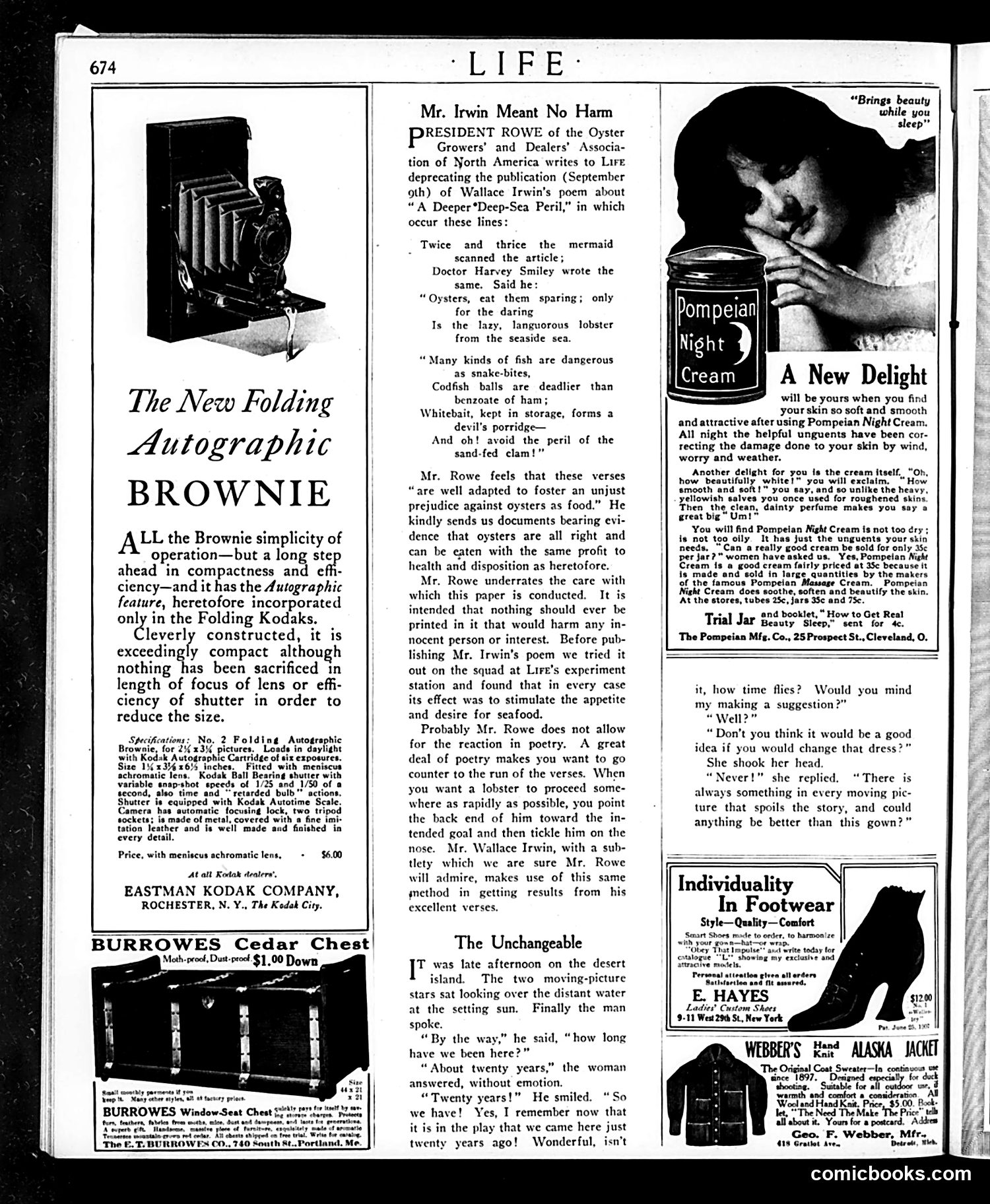
This page contains **satirical commentary** rather than a political cartoon. The main content addresses **President Rowe of the Oyster Growers' Association**, who objected to a Wallace Irwin poem published in Life that humorously warned against eating various seafood, including oysters. The satire works by **mock-seriously defending the poem**: Life claims it actually *stimulated* appetites when tested on their "experiment station" staff, and praises Irwin's "subtlety" in using reverse psychology—comparing his method to tickling a lobster's nose to make it move forward. The joke is that Life is **playfully dismissing legitimate industry complaints** through absurdist reasoning and pseudo-scientific claims. The broader satire suggests that poetry's ironic effects shouldn't be taken literally as harmful propaganda. The remainder of the page contains period **product advertisements** (cameras, furniture, beauty cream) typical of Life magazine's revenue model.
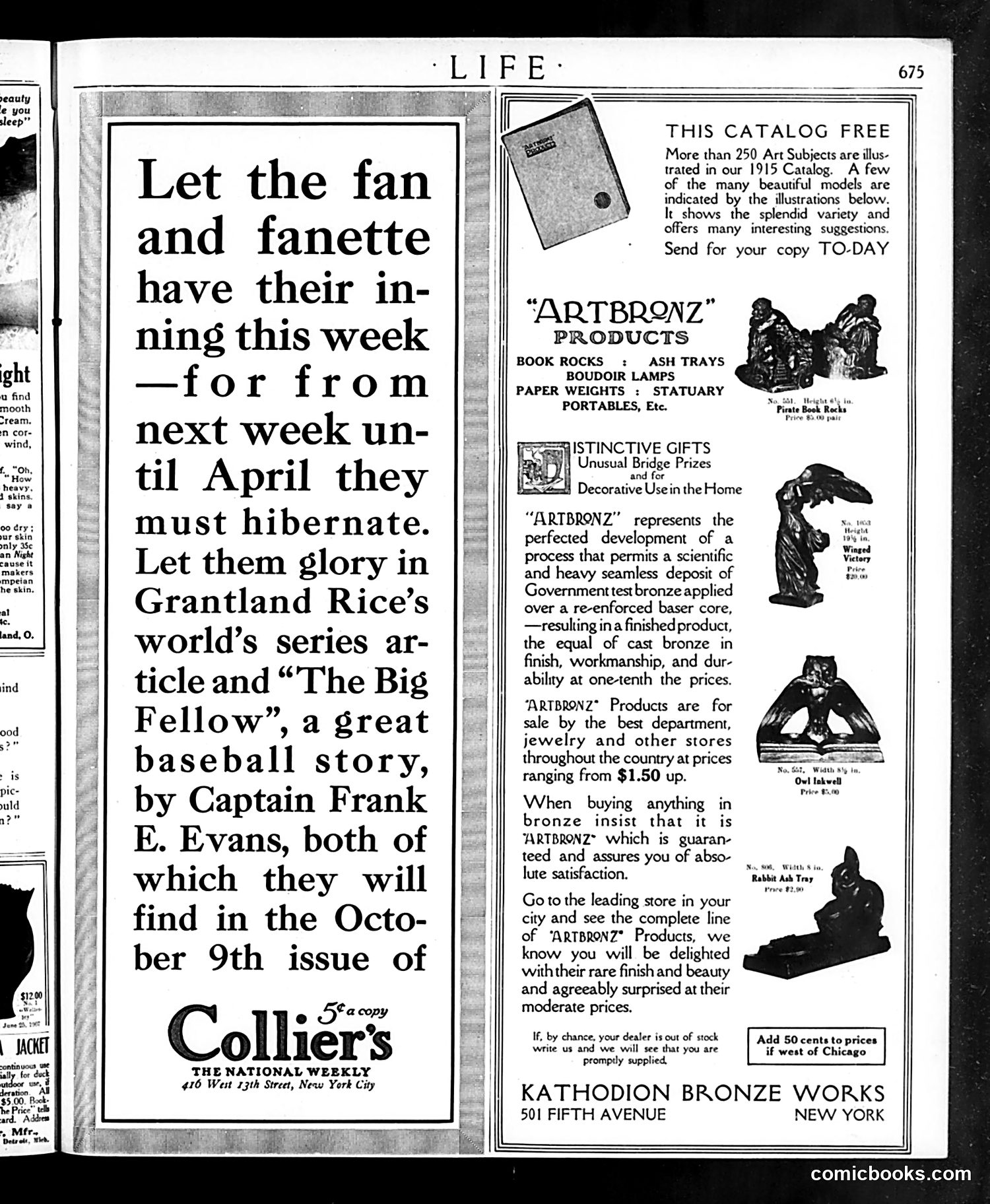
This page is primarily **advertising with a small editorial announcement**, not a political cartoon. The left side contains a **Collier's magazine advertisement** promoting two baseball stories: Grantland Rice's World Series coverage and "The Big Fellow" by Captain Frank E. Evans. The ad uses seasonal humor—suggesting fans should enjoy baseball reading "this week" before fans and "fanettes" (female fans) must "hibernate" until April, playing on the baseball season's end. The right side advertises **"Artbronz" products** (decorative bronze items like lamps, bookends, and ashtrays) and a **Kathodion Bronze Works catalog**. The copy emphasizes that Artbronz offers cast-bronze quality at one-tenth the cost through a special process. **No political satire or caricature is present.** This is a straightforward commercial page from Life magazine's advertising section, typical of early-1900s periodical layouts mixing editorial promotion with product advertising.
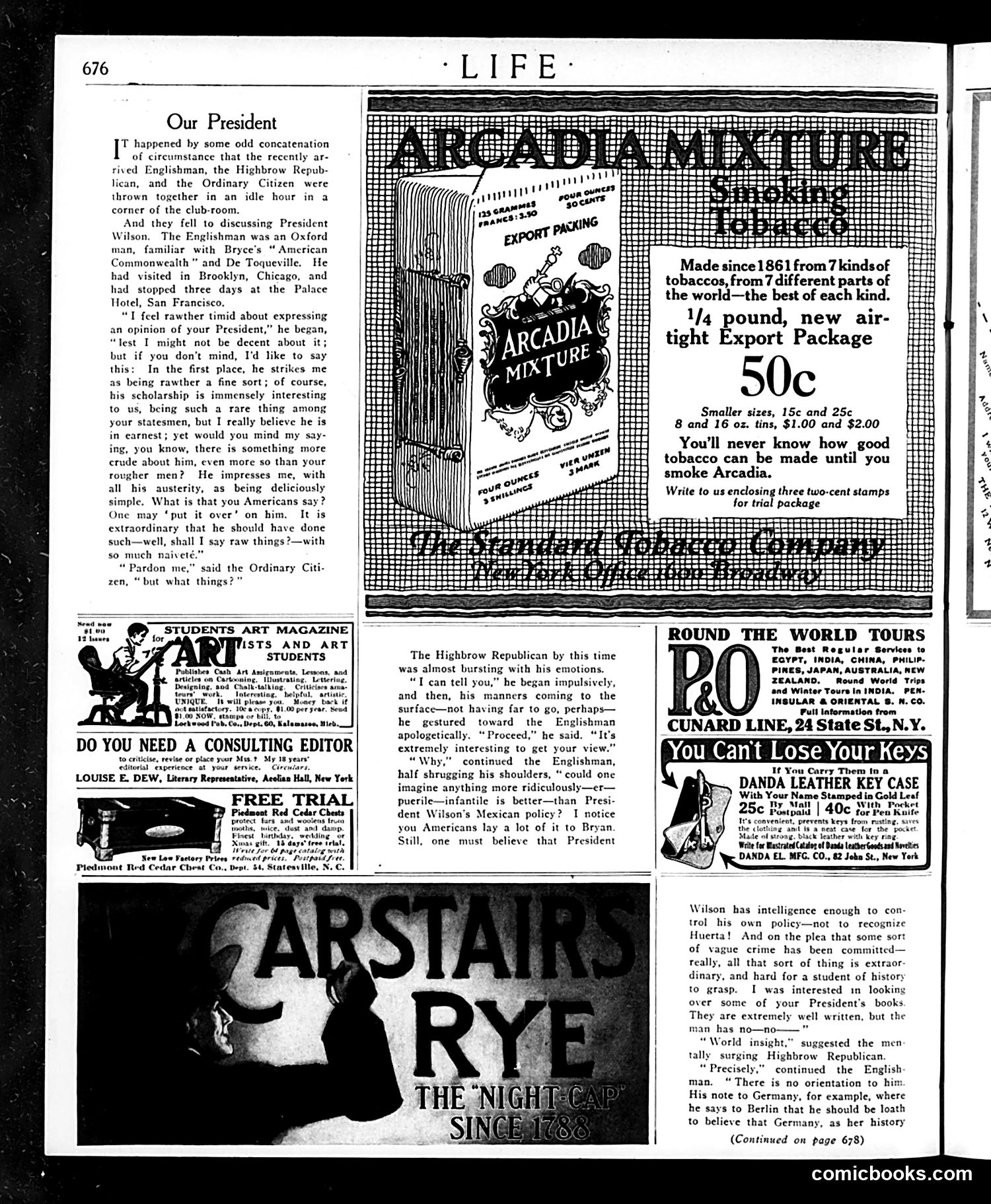
This article presents three characters—an educated Englishman, a "Highbrow Republican," and an "Ordinary Citizen"—discussing President Woodrow Wilson. The Englishman offers backhanded praise: Wilson is scholarly and sincere, but "crude" and "simple"—easily deceived ("put it over" on him). The main critique concerns Wilson's Mexican policy, which the Englishman finds absurdly "puerile" and "infantile." He questions Wilson's refusal to recognize the Huerta government based on vague moral objections, viewing this as lacking "world insight" or historical understanding. The satire mocks Wilson's idealistic foreign policy as naïve and amateurish compared to European realpolitik. The characters suggest Wilson, despite intelligence, lacks practical wisdom and operates from abstract principle rather than strategic reality—a common complaint about his early presidency before U.S. entry into World War I.
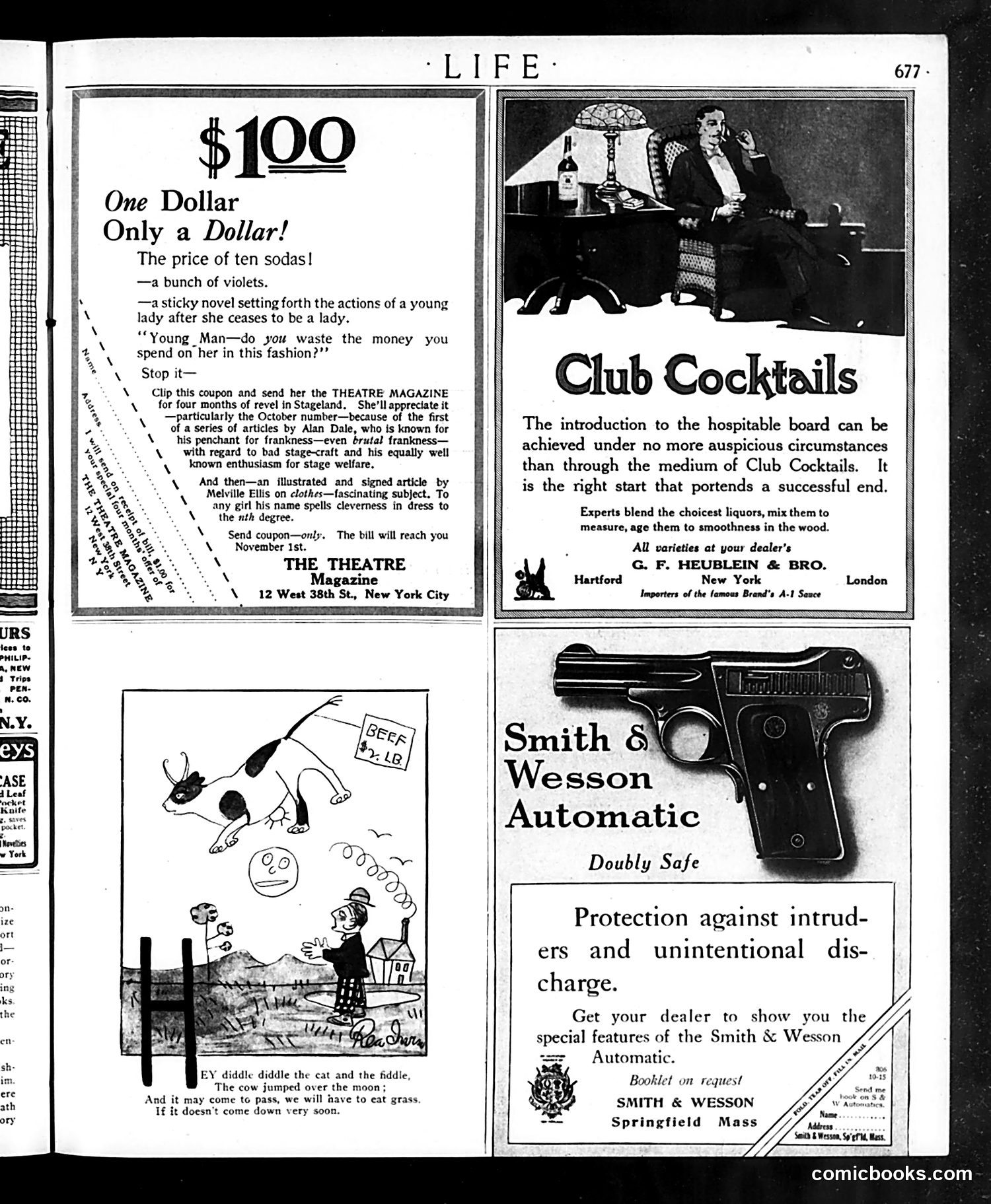
This page consists primarily of **advertisements**, not editorial content or satire. The top-left ad promotes *Theatre Magazine* ($1 for four months), satirically questioning whether a young man wastes money on his date by buying her flowers or novels—suggesting he should buy her a subscription instead. It's standard period advertising copy with mild humor. The cartoon (center-left) illustrates the nursery rhyme "Hey Diddle Diddle," but adds a topical twist: the final lines reference food scarcity ("we will have to eat grass"), likely alluding to **wartime rationing or agricultural concerns** of the era (though the specific date isn't visible here). The remaining ads—for Club Cocktails and Smith & Wesson automatic pistols—are straightforward product promotions emphasizing quality and safety, with no apparent satire or political commentary. The juxtaposition of cocktails and firearms is notable to modern readers but typical of period magazine layouts.
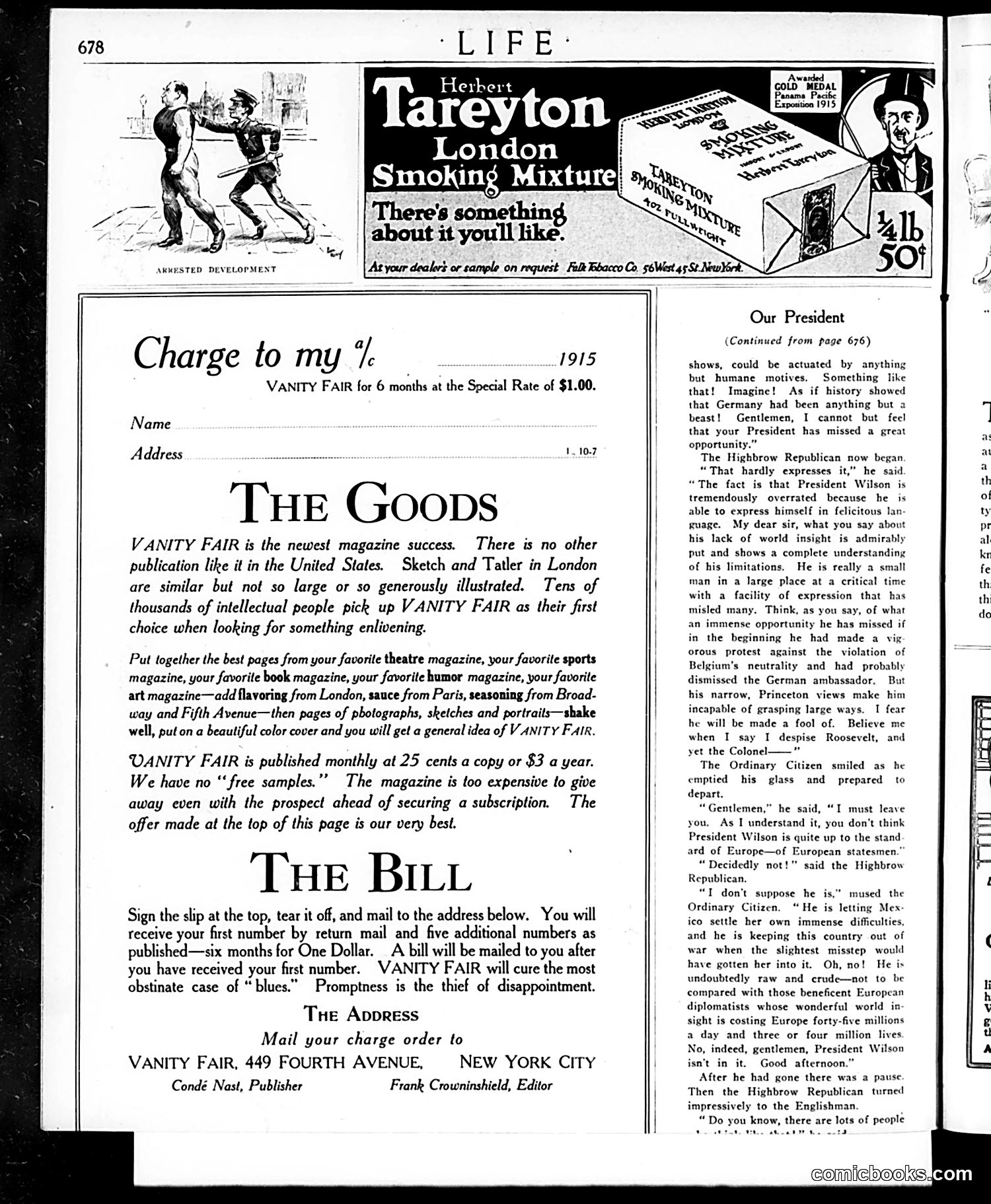
This page is primarily an **advertisement for Vanity Fair magazine** (1915), not political satire. However, the right column contains the conclusion of an article titled "Our President" that critiques intellectual attitudes toward President Woodrow Wilson. The piece satirizes two types of critics: a "Highbrow Republican" who disparages Wilson as intellectually limited despite his eloquent speech, and an unnamed "Ordinary Citizen" who points out the irony—Wilson is actually keeping America out of World War I and managing Mexico diplomatically, while European statesmen are squandering millions of lives in trench warfare. The satire's target is **pretentious intellectuals** who mistake rhetorical sophistication for actual wisdom, while dismissing pragmatic leadership. Wilson's restraint and non-interventionism are implicitly praised through the Ordinary Citizen's gentle rebuttal. The cartoon "Arrested Development" (top left) appears unrelated to this content.
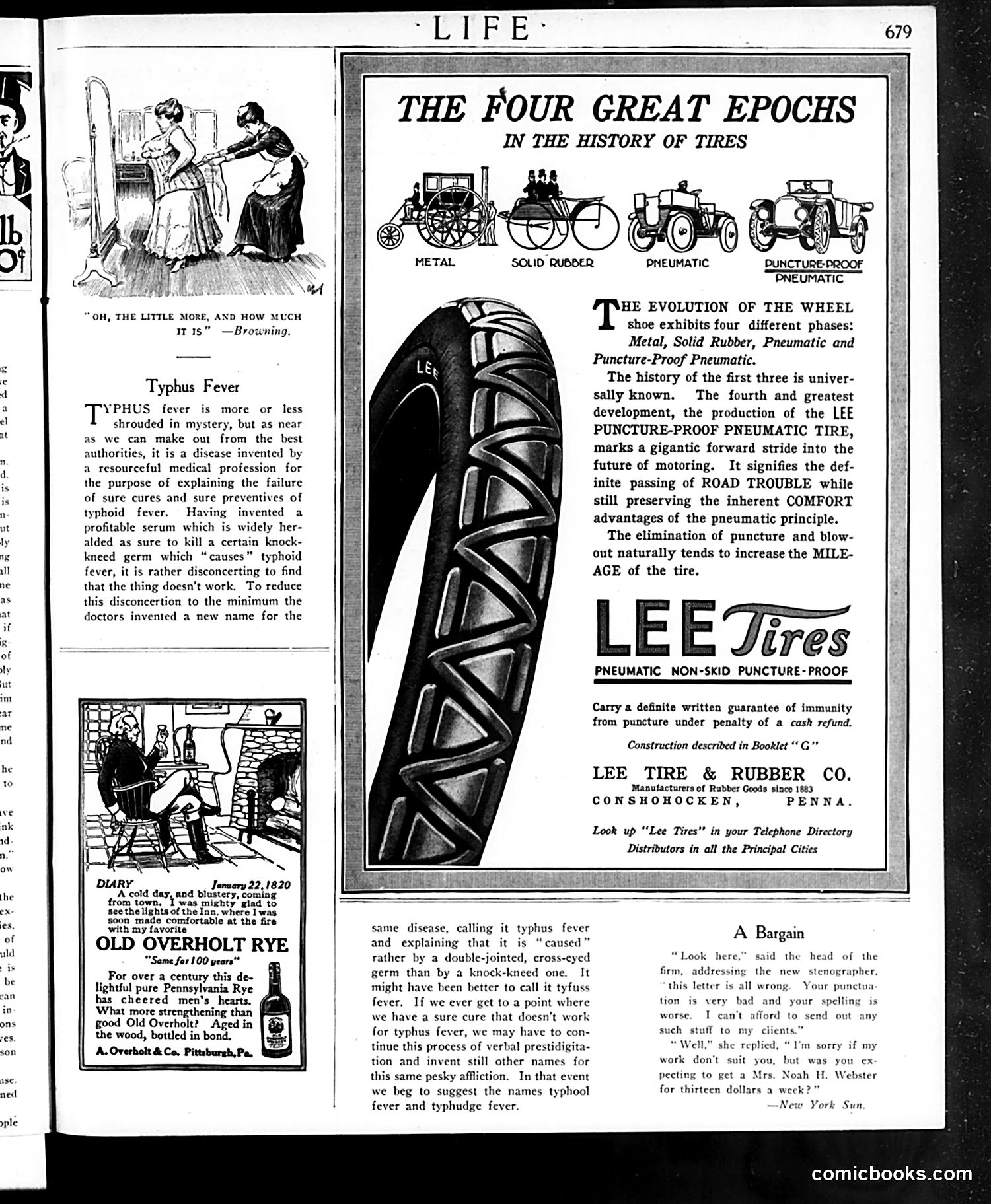
This page contains three distinct items: **"Typhus Fever" satirical article (left):** Life magazine mocks the medical profession for inventing a new disease name to cover their failures. When their "sure cure" serum for typhoid fever didn't work, doctors allegedly renamed the illness "typhus fever" and blamed it on a different germ to avoid admitting the treatment failed. The satire suggests doctors use verbal sleight-of-hand and invented terminology to maintain professional authority and profit, even when their medicine doesn't actually work. **Lee Tires advertisement (center/right):** A straightforward commercial claiming Lee's "puncture-proof pneumatic tire" represents the fourth great epoch in tire technology—eliminating the common problem of road punctures while maintaining comfort. **"A Bargain" joke (bottom right):** A stenographer defends her poor spelling and punctuation by noting she's only paid thirteen dollars weekly—implying you get what you pay for.
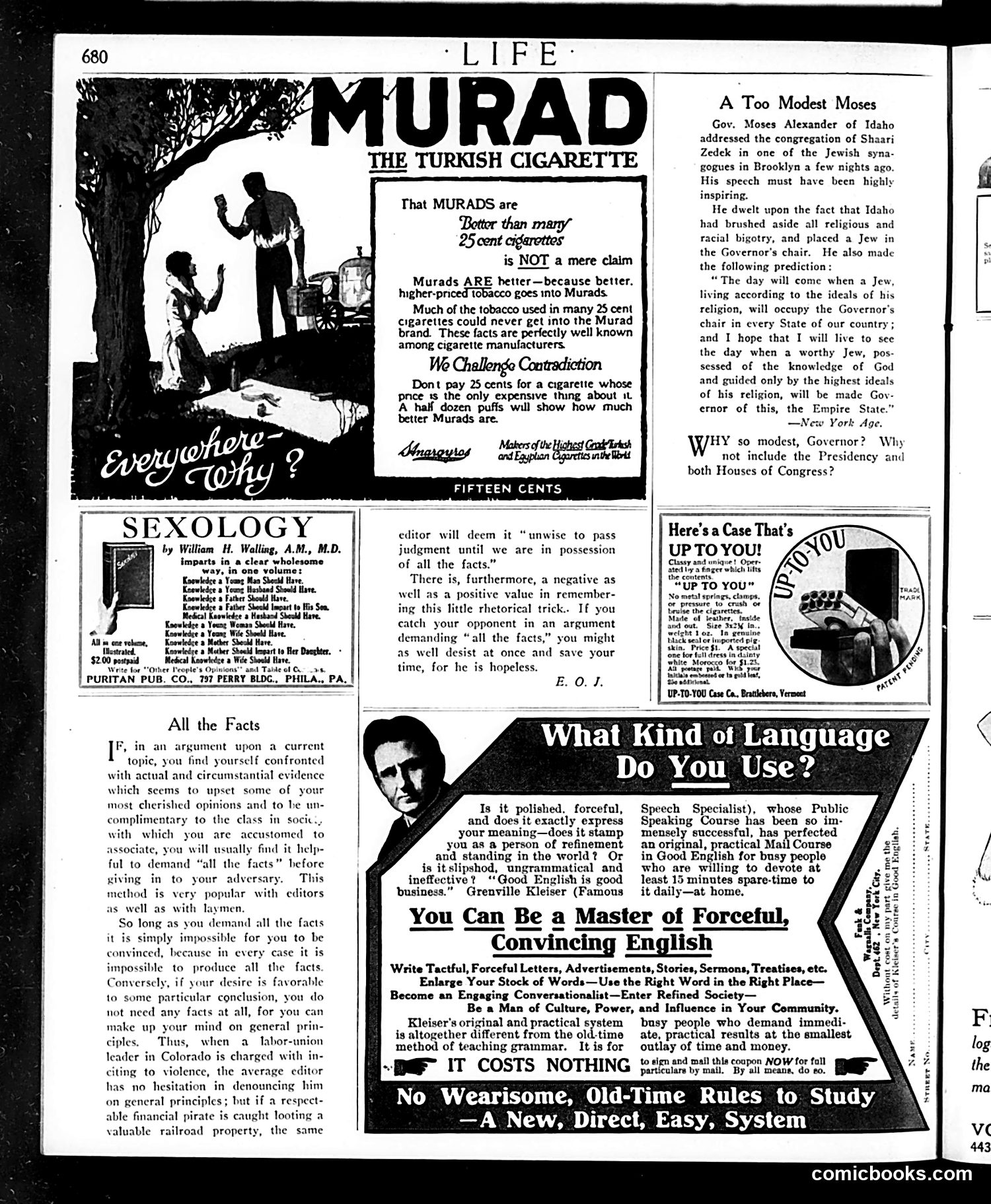
This page mixes satirical commentary with period advertising. The main satirical piece, "A Too Modest Moses," mocks Gov. Moses Alexander of Idaho's modest prediction that a Jewish governor would eventually lead every state. The joke: the writer sarcastically suggests Alexander should have predicted a Jewish President and Congress, exposing the absurdity of his cautious optimism about Jewish political inclusion during an era of significant antisemitism. The "All the Facts" editorial column critiques rhetorical bad faith—how people demanding "all the facts" use this demand to avoid losing arguments, and how editors selectively apply this standard (rigorously for labor leaders, leniently for wealthy corporate criminals). It's cynical commentary on editorial bias and intellectual dishonesty in public discourse. The remaining content is period advertising: Murad cigarettes, Sexology book, language courses, and a suitcase brand—typical early 20th-century magazine filler.
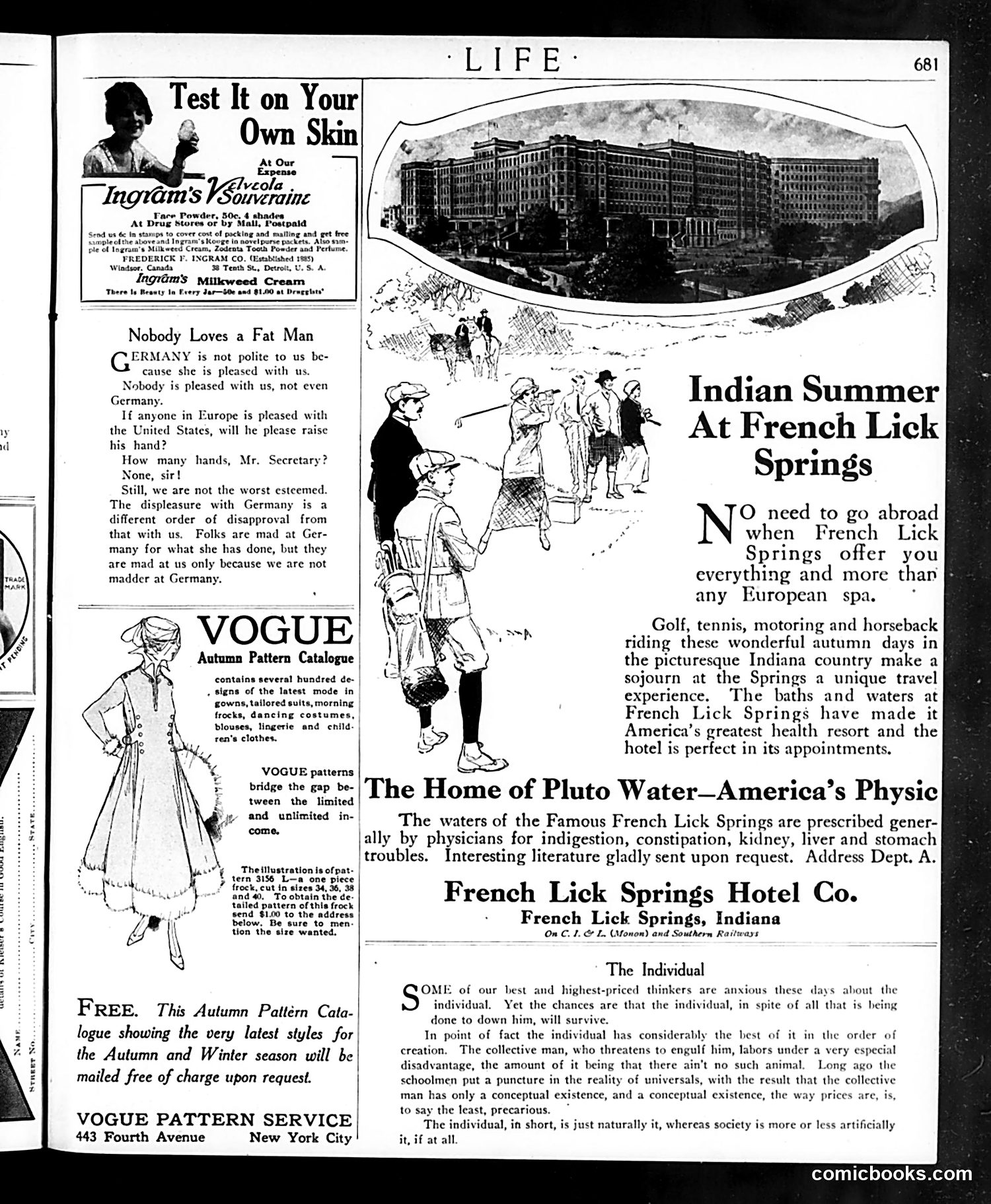
This page mixes satirical commentary with advertising. The main satire is "Nobody Loves a Fat Man," a brief political piece criticizing American-German relations post-WWI. It uses darkly humorous logic: Germany dislikes the U.S., yet Europe dislikes America even more—not for what America *has* done, but for what it *hasn't* done (being insufficiently hostile to Germany). The joke reflects post-war frustration that American diplomacy satisfied no one. The bulk of the page is advertising: Ingram's skincare, Vogue pattern catalogs, and a lengthy pitch for French Lick Springs, Indiana—a spa resort marketed as superior to European spas, with medicinal mineral waters. A final essay on "The Individual" defends individualism against collectivism, typical of 1920s American libertarian-leaning thought. The page reflects 1920s concerns: post-war diplomatic tensions, beauty/fashion consumption, and ideological debates about individualism versus collective society.
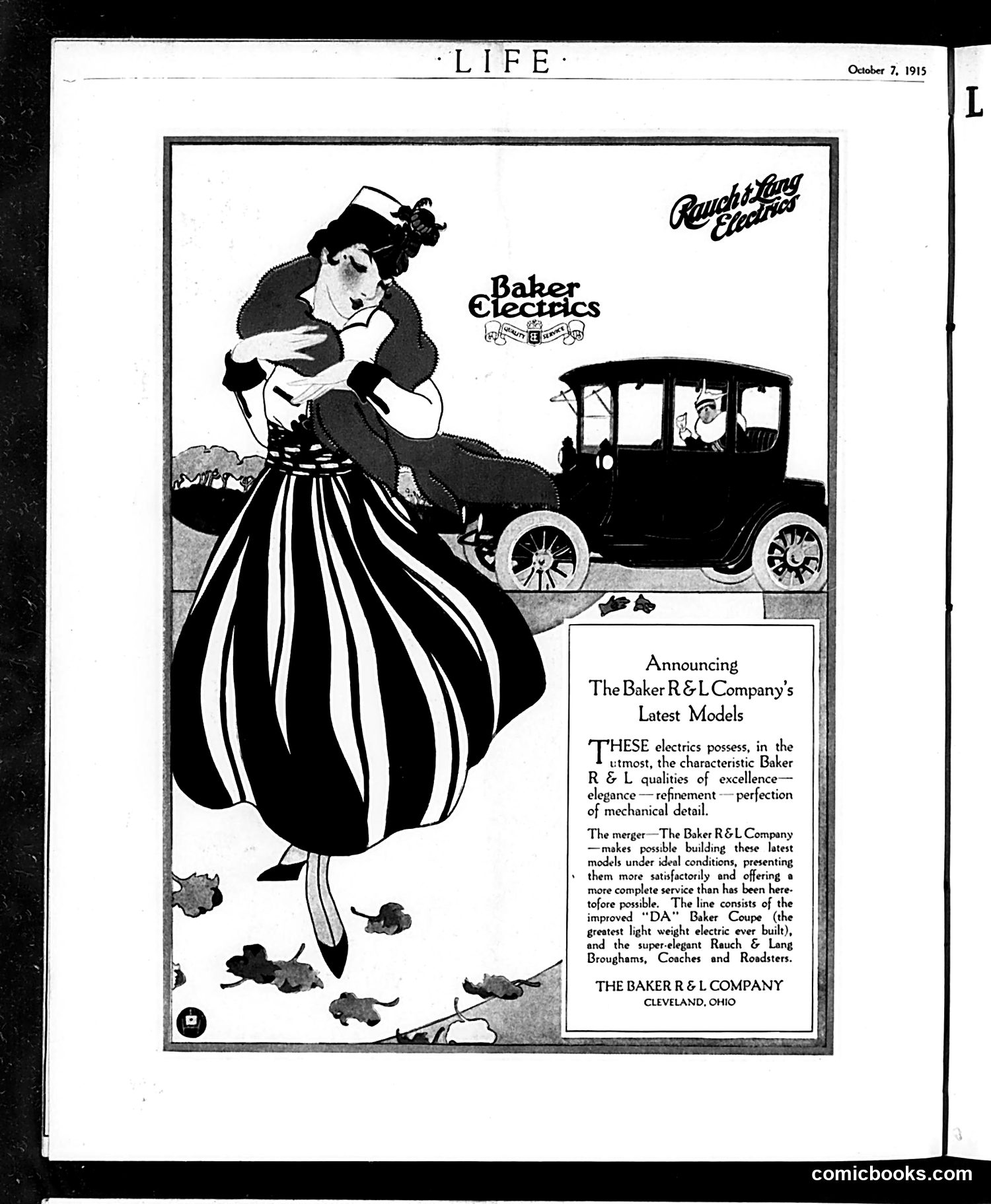
This is primarily a **commercial advertisement**, not political satire. It announces the merger of Baker Electric and Rauch & Lang electric automobile companies. The image depicts a fashionably dressed woman in an elegant gown admiring a Baker electric automobile—a luxury vehicle. The "joke" is genteel rather than satirical: the woman's refined appearance mirrors the cars' promised elegance and "perfection of mechanical detail." **Historical context**: Electric cars were premium products for wealthy consumers in 1915, marketed as sophisticated and reliable. The advertisement emphasizes that the merger enables superior manufacturing and service. The stylized illustration matches Life magazine's typical aesthetic of the era—elegant, art deco-influenced imagery aimed at affluent readers. No political content or recognizable caricatures appear here; this is straightforward period advertising.