
Life, 1915-10-07 · page 12 of 52
Life — October 7, 1915 — page 12: what you’re looking at
What you’re looking at
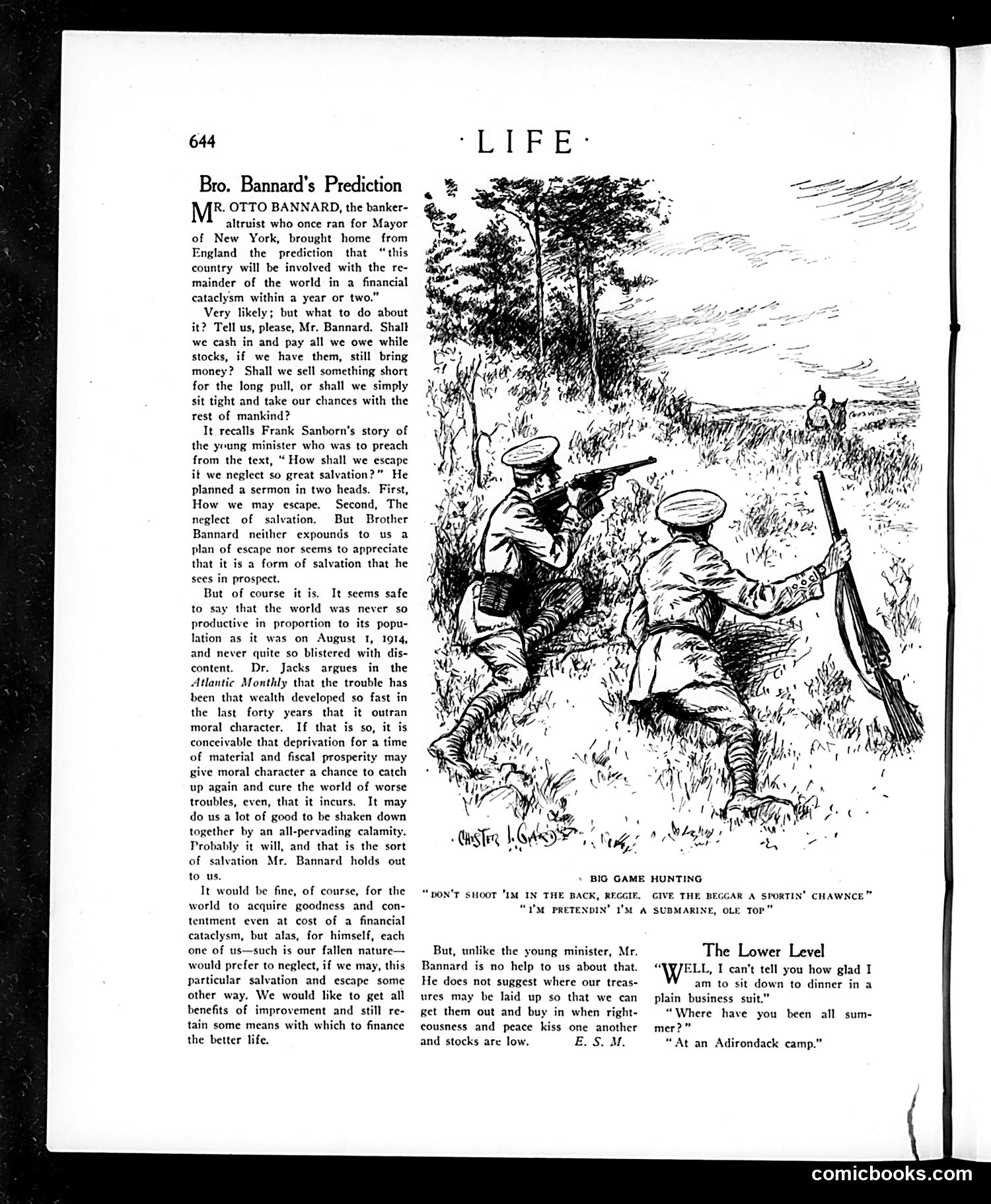
This page discusses **Bro. Bannard's Prediction** — Mr. Otto Bannard, a banker-altruist who predicted America would face financial catastrophe within a year or two. The author dismisses the prediction while reflecting on whether citizens should panic, liquidate stocks, or accept financial uncertainty. The accompanying illustration labeled **"Big Game Hunting"** shows two soldiers with rifles in tall grass. The caption reads: "Don't shoot 'im in the back, Reggie. Give the beggar a sportin' chawnce" — "I'm pretendin' I'm a submarine, ole top." This appears to mock British military attitudes, likely referencing WWI combat ethics or the submarine threat. The brief dialogue piece "The Lower Level" is unrelated social comedy.
📄 Transcribed text from this page (OCR, searchable)
Machine-transcribed from the original scan — historical spelling and the odd misread are preserved.
644 Bro. Bannard’s Prediction R, OTTO BANNARD, the banker- altruist who once ran for Mayor of New York, brought home from England the prediction that “this country will be involved with the re- mainder of the world in a financial cataclysm within a year or two.” Very likely; but what to do about it? Tell us, please, Mr. Bannard. Shalt we cash in and pay all we owe while stocks, if we have them, still bring money? Shall we sell something short for the long pull, or shall we simply sit tight and take our chances with the rest of mankind? It recalls Frank Sanborn’s story of the yeung minister who was to preach from the text, “ How shall we escape it we neglect so great salvation?” He planned a sermon in two heads. First, How we may escape. Second, The neglect of salvation. But Brother Bannard neither expounds to us a plan of escape nor seems to appreciate that it is a form of salvation that he sees in prospect. But of course it is. It seems safe to say that the world was never so productive in proportion to its popu- lation as it was on August 1, 1914, and never quite so blistered with dis- content. Dr. Jacks argues in the Atlantic Monthly that the trouble has been that wealth developed so fast in the last forty years that it outran moral character. If that is so, it is conceivable that deprivation for a time of material and fiscal prosperity may give moral character a chance to catch up again and cure the world of worse troubles, even, that it incurs. It may do us a lot of good to be shaken down together by an all-pervading calamity. Probably it will, and that is the sort of salvation Mr. Bannard holds out to us. It would be fine, of course, for the world to acquire goodness and con- tentment even at cost of a financial cataclysm, but alas, for himself, each one of us—such is our fallen nature— would prefer to neglect, if we may, this particular salvation and escape some other way. We would like to get all benefits of improvement and still re- tain some means with which to finance the better life. » BIG GAME HUNTING “DON'T SHOOT ‘IM IN THE BACK, REGGIE, GIVE THE BEGGAR A SPORTIN’ CHAWNCE” “I'M PRETENDIN’ I'M A SUBMARINE, OLE TOP” But, unlike the young minister, Mr. Bannard is no help to us about that. He does not suggest where our treas- ures may be laid up so that we can get them out and buy in when right- cousness and peace kiss one another and stocks are low, B.S. M. The Lower Level “NYJELL, I can’t tell you how glad I am to sit down to dinner in a plain business suit.” “Where have you been all sum- mer?” “At an Adirondack camp.” comicbooks.com